clutch Hyundai H350 2016 User Guide
[x] Cancel search | Manufacturer: HYUNDAI, Model Year: 2016, Model line: H350, Model: Hyundai H350 2016Pages: 473, PDF Size: 26.4 MB
Page 288 of 473
5-17
Driving your vehicle
5
Good driving practices
Never take the vehicle out of gearand coast down a hill. This is
extremely hazardous. Always leave
the vehicle in gear.
Don't "ride" the brakes. This can cause them to overheat and mal-
function. Instead, when you are
driving down a long hill, slow down
and shift to a lower gear. When you
do this, engine braking will help
slow down the vehicle.
Slow down before shifting to a lower gear. This will help avoid
over-revving the engine, which can
cause damage.
Slow down when you encounter cross winds. This gives you much
better control of your vehicle.
Be sure the vehicle is completely stopped before you attempt to shift
into reverse. The transmission can
be damaged if you do not. To shift
into reverse, depress the clutch,
move the shift lever to neutral, wait
three seconds, then shift to the
reverse position. Exercise extreme caution when
driving on a slippery surface. Be
especially careful when braking,
accelerating or shifting gears. On a
slippery surface, an abrupt change
in vehicle speed can cause the
drive wheels to lose traction and
the vehicle to go out of control.
Always buckle-up! In a colli-
sion, an unbelted occupant is
significantly more likely to be
seriously injured or killed
than a properly belted occu-pant.
Avoid high speeds when cor- nering or turning.
Do not make quick steering
wheel movements, such as
sharp lane changes or fast,sharp turns.
The risk of rollover is greatly
increased if you lose control
of your vehicle at highwayspeeds.
(Continued)
WARNING
(Continued)
Loss of control often occurs if
two or more wheels drop off
the roadway and the driver
oversteers to reenter the road-
way.
In the event your vehicle
leaves the roadway, do not
steer sharply. Instead, slow
down before pulling back into
the travel lanes.
Never exceed posted speed limits.
Page 301 of 473

5-30
Driving your vehicle
1. Cruise indicator
2. Cruise set indicator
The cruise control system allows you
to program the vehicle to maintain aconstant speed without pressing the
accelerator pedal. This system is designed to function
above approximately 40 km/h (25mph).
CCRR UU IISS EE CC OO NNTTRR OO LL SS YY SSTT EEMM (( IIFF EE QQ UUIIPP PPEEDD ))
OEU054004
If the cruise control is left on,
(CRUISE indicator light in the
instrument cluster illuminat-
ed), the cruise control can be
switched on accidentally.
Keep the cruise control sys-
tem off (CRUISE indicatorlight OFF) when the cruise
control is not in use, to avoid
inadvertently setting a speed.
Use the cruise control system
only when traveling on open
highways in good weather.
Do not use the cruise control
when it may not be safe to
keep the vehicle at a constant
speed, for instance, driving in
heavy or varying traffic, or on
slippery (rainy, icy or snow-
covered) or winding roads or
over 6% up-hill or down-hill
roads.
(Continued)
(Continued)
Pay particular attention to the
driving conditions whenever
using the cruise control sys-tem.
Be careful when driving
downhill using the cruise con-
trol system, which may
increase the vehicle speed.
WARNING
During cruise-speed driving of
a manual transmission vehicle,do not shift into neutral without
depressing the clutch pedal,
since the engine will be over-
revved. If this happens, depress
the clutch pedal or release the
cruise control ON-OFF switch.
CAUTION
Page 304 of 473
5-33
Driving your vehicle
5
To cancel cruise control, do oneof the following:
Press the brake pedal.
Press the clutch pedal with a man- ual transmission.
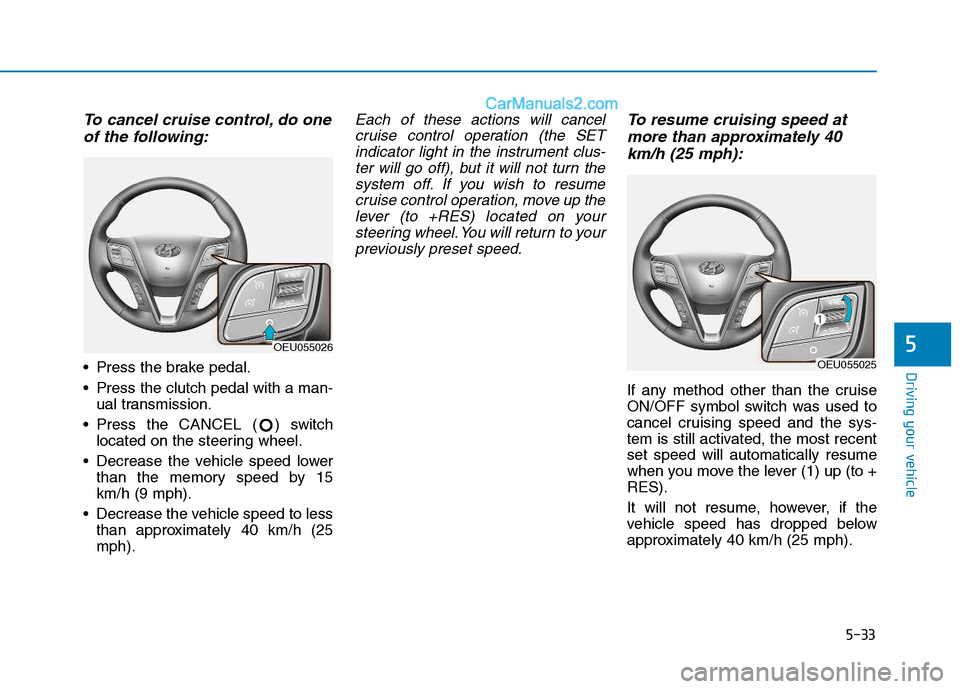
Press the CANCEL ( ) switch located on the steering wheel.
Decrease the vehicle speed lower than the memory speed by 15 km/h (9 mph).
Decrease the vehicle speed to less than approximately 40 km/h (25mph).
Each of these actions will cancel
cruise control operation (the SETindicator light in the instrument clus- ter will go off), but it will not turn thesystem off. If you wish to resumecruise control operation, move up the lever (to +RES) located on yoursteering wheel. You will return to yourpreviously preset speed.To resume cruising speed at
more than approximately 40
km/h (25 mph):
If any method other than the cruise
ON/OFF symbol switch was used to
cancel cruising speed and the sys-
tem is still activated, the most recentset speed will automatically resume
when you move the lever (1) up (to +RES).
It will not resume, however, if the
vehicle speed has dropped below
approximately 40 km/h (25 mph).
OEU055026
OEU055025
Page 312 of 473

5-41
Driving your vehicle
5
When the Active ECO is activated,it does not turn off even though the
engine is restarted again. To turn
off the system, press the active
ECO button again.
If Active ECO is turned off, it will return to the ECO mode.
When Active ECO is activated:
Vehicle speed may drop.
When driving up a hill, you mayfeel the engine torque change.
Limitation of Active ECO oper- ation :
If the following conditions occur while
Active ECO is operating, the system
operation is limited even thoughthere is no change in the ECO indi-
cator.
When the coolant temperature islow:The system will be limited until
engine performance becomes nor-mal.
When driving up a hill: The system will be limited to gain
power when driving uphill because
the engine torque is restricted. This is the switch of the PTO (Power
Take Off) which takes off the power
from the transmission.To activate the P.T.O. system
1.Stop the vehicle. Then, apply the
parking brake.
2.Depress the clutch pedal to dis- connect the power. Wait for 2 to 3
seconds. Press ON the P.T.O.
switch. Then, slowly take your footoff the clutch pedal.
3.Make sure that the P.T.O indicator illuminates on the cluster.
To deactivate the P.T.O. sys- tem
1.Depress the clutch pedal. PressOFF the P.T.O. switch. Then, slowly
take your foot off the clutch pedal.
2.Make sure that the P.T.O indicator goes OFF on the cluster.
PPTTOO SS WW IITT CCHH (( IIFF EE QQ UUIIPP PPEEDD ))
OEU044062
Page 313 of 473
5-42
Driving your vehicleE
ECCOO NNOO MM IICC AA LL OO PPEERR AA TTIIOO NN
Your vehicle's fuel economy depends
mainly on your style of driving, where
you drive and when you drive.
Each of these factors affects how
many kilometers (miles) you can get
from a liter (gallon) of fuel. To operate
your vehicle as economically as pos-
sible, use the following driving sug-
gestions to help save money in bothfuel and repairs:
Drive smoothly. Accelerate at a
moderate rate. Don't make "jack-
rabbit" starts or full-throttle shifts
and maintain a steady cruising
speed. Don't race between stop-
lights. Try to adjust your speed to
the traffic so you don't have to
change speeds unnecessarily.
Avoid heavy traffic whenever pos-
sible. Always maintain a safe dis-
tance from other vehicles so you
can avoid unnecessary braking.
This also reduces brake wear.
Drive at a moderate speed. The faster you drive, the more fuel your
vehicle uses. Driving at a moderate
speed, especially on the highway,
is one of the most effective ways toreduce fuel consumption. Don't "ride" the brake or clutch
pedal. This can increase fuel con-
sumption and also increase wear
on these components. In addition,
driving with your foot resting on the
brake pedal may cause the brakes
to overheat, which reduces their
effectiveness and may lead to
more serious consequences.
Take care of your tires. Keep them inflated to the recommended pres-
sure. Incorrect inflation, either too
much or too little, results in unnec-
essary tire wear. Check the tirepressures at least once a month.
Be sure that the wheels are aligned correctly. Improper align-ment can result from hitting curbs
or driving too fast over irregular
surfaces. Poor alignment causes
faster tire wear and may also result
in other problems as well as
greater fuel consumption.
When the power is still con-
nected, activating the P.T.O.
system may incur deadly dam-
age to the gear.
The P.T.O. system should be
activated within the permissi-
ble toque.
- Activation of the P.T.O., goingbeyond the permissible maxi-
mum toque, may incur deadly
damage to the P.T.O. gear andtransmission.
Before activating the P.T.O.
system, depress the clutch
pedal, when the P.T.O switch is
pressed OFF. (For the manualtransmission.)
- The P.T.O. gear may be dam-aged and become uncontrol-
lable.
WARNING
Page 337 of 473
6-2
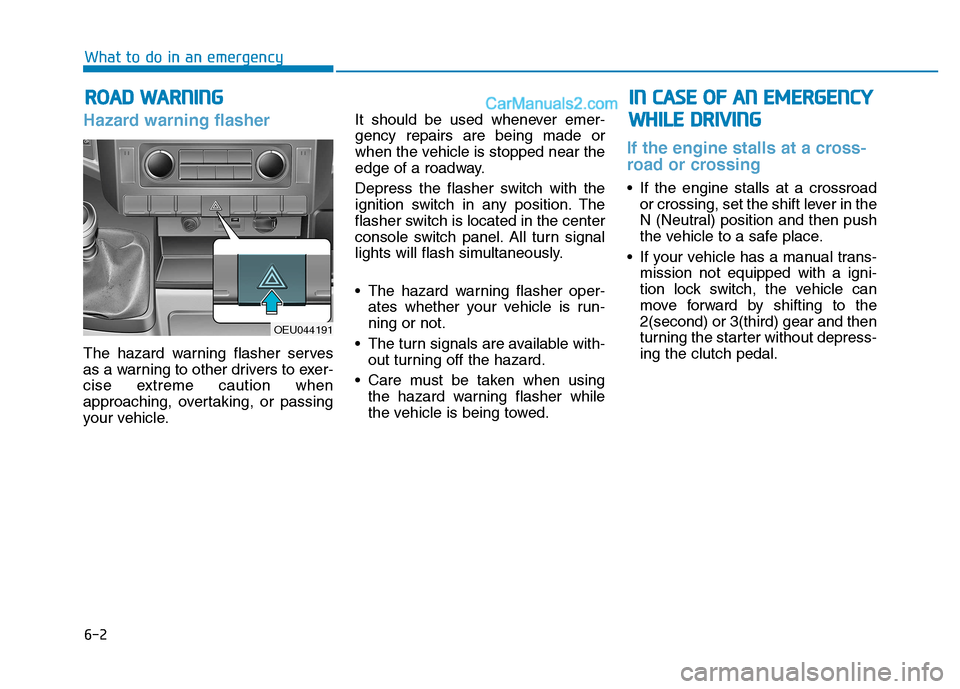
Hazard warning flasher
The hazard warning flasher serves
as a warning to other drivers to exer-
cise extreme caution when
approaching, overtaking, or passing
your vehicle.It should be used whenever emer-gency repairs are being made or
when the vehicle is stopped near the
edge of a roadway.
Depress the flasher switch with the
ignition switch in any position. The
flasher switch is located in the center
console switch panel. All turn signal
lights will flash simultaneously.
• The hazard warning flasher oper-
ates whether your vehicle is run- ning or not.
The turn signals are available with- out turning off the hazard.
Care must be taken when using the hazard warning flasher while
the vehicle is being towed.
If the engine stalls at a cross-
road or crossing
If the engine stalls at a crossroador crossing, set the shift lever in the
N (Neutral) position and then push
the vehicle to a safe place.
If your vehicle has a manual trans- mission not equipped with a igni-
tion lock switch, the vehicle can
move forward by shifting to the2(second) or 3(third) gear and then
turning the starter without depress-ing the clutch pedal.
RROO AADD WW AARRNN IINN GG
What to do in an emergency
I
INN CC AA SSEE OO FF AA NN EE MM EERR GG EENN CCYY
W
W HHIILL EE DD RRIIVV IINN GG
OEU044191
Page 364 of 473
7
Maintenance
7
Maintenance
Engine compartment .............................................7-3
Maintenance services ...........................................7-5Owner's responsibility ......................................................7-5
Owner maintenance precautions ..................................7-5
Engine compartment precautions (Diesel engine) ....7-7
Owner maintenance ...............................................7-8 Owner maintenance schedule ........................................7-8
Scheduled maintenance services ......................7-10 Normal maintenance schedule (for Europe) ............7-11
Normal maintenance schedule (except Europe) .....7-14
Maintenance under severe usage conditions ..........7-17
Explanation of scheduled maintenance items ..7-19
Engine oil ..............................................................7-22 Checking the engine oil level ....................................7-22
Changing the engine oil and filter ..............................7-23
Engine coolant......................................................7-24 Checking the coolant level ...........................................7-24
Changing the coolant .....................................................7-26
Brake/Clutch fluid ..............................................7-27 Checking the brake/clutch fluid level ........................7-27
Power steering fluid ............................................7-28 Checking the power steering fluid level ...................2-28
Checking the power steering hose.............................2-29
Washer fluid .........................................................7-29 Checking the washer fluid level ...............................7-29 Parking brake .......................................................7-30
Checking the parking brake .........................................7-30
Fuel filter (For diesel).........................................7-30 Draining water from fuel filter ....................................7-30
Fuel filter cartridge replacement ................................7-30
Manual transmission and rearaxle oil ..............7-31 Check and adding oil ......................................................7-31
Change the gear oil ........................................................7-31
Air cleaner ............................................................7-31 Filter replacement ...........................................................7-31
Climate control air filter .....................................7-33 Filter inspection ...............................................................7-33
Filter replacement ...........................................................7-33
Wiper blades .........................................................7-34 Blade inspection ..............................................................7-34
Blade replacement ..........................................................7-35
Battery...................................................................7-37 For best battery service................................................7-37
Battery capacity label ...................................................7-40
Battery recharging .......................................................7-40
Reset items .......................................................................7-41
Tires and wheels ..................................................7-42 Tire care ............................................................................7-42
Recommended cold tire inflation pressures.............7-42
Checking tire inflation pressure ..................................7-43
7
Page 366 of 473
7-3
7
Maintenance
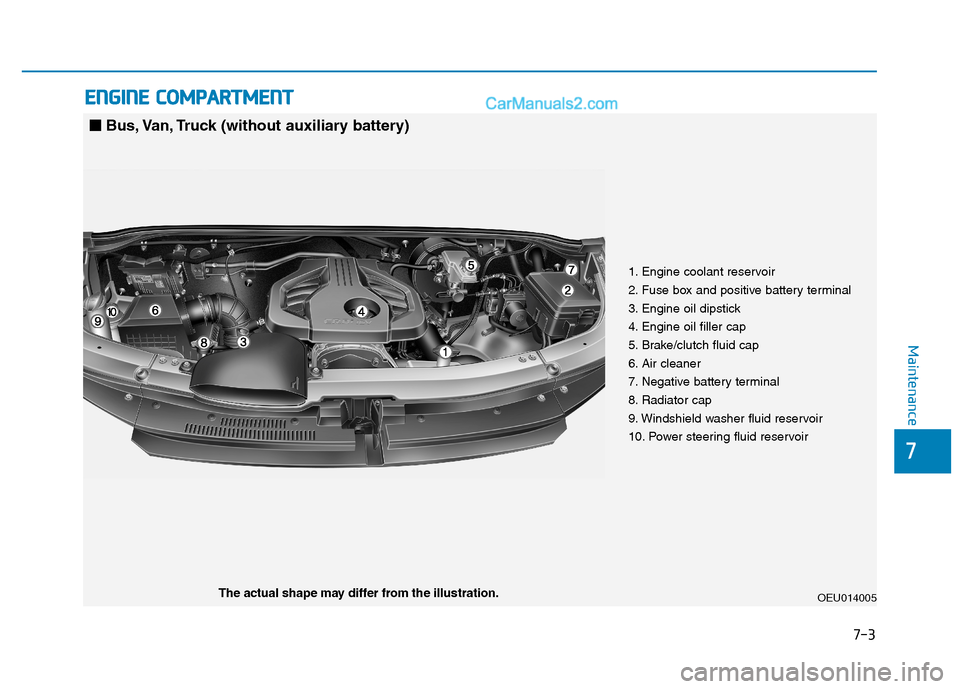
EENN GGIINN EE CC OO MM PPAA RRTTMM EENN TT
1. Engine coolant reservoir
2. Fuse box and positive battery terminal
3. Engine oil dipstick
4. Engine oil filler cap
5. Brake/clutch fluid cap
6. Air cleaner
7. Negative battery terminal
8. Radiator cap
9. Windshield washer fluid reservoir
10. Power steering fluid reservoir
OEU014005
The actual shape may differ from the illustration.
■■
Bus, Van, Truck (without auxiliary battery)
Page 367 of 473
7-4
Maintenance
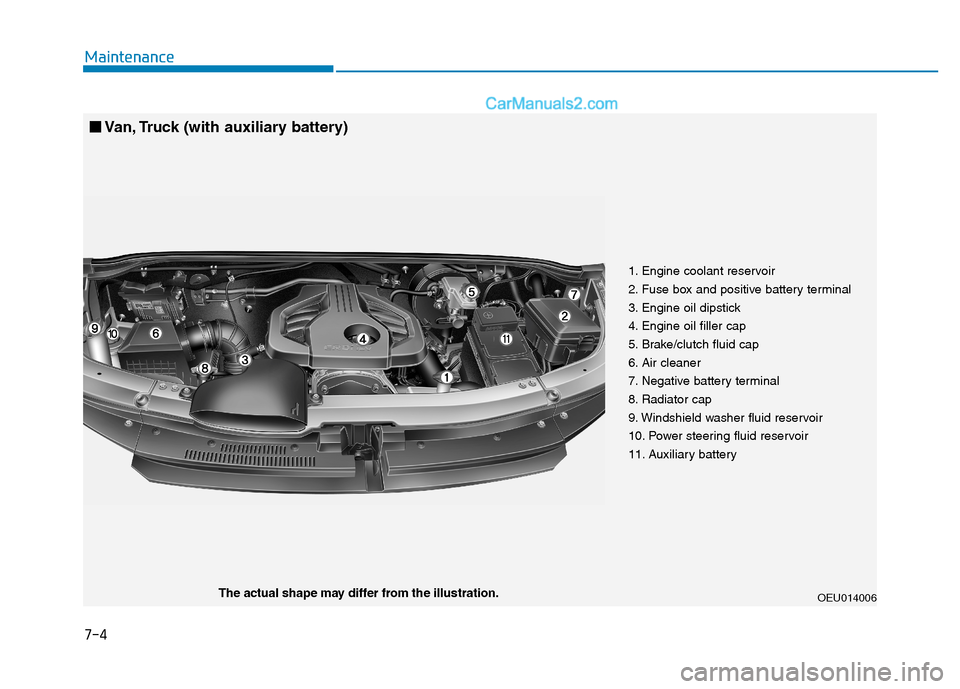
OEU014006
The actual shape may differ from the illustration.
■
■
Van, Truck (with auxiliary battery)
1. Engine coolant reservoir
2. Fuse box and positive battery terminal
3. Engine oil dipstick
4. Engine oil filler cap
5. Brake/clutch fluid cap
6. Air cleaner
7. Negative battery terminal
8. Radiator cap
9. Windshield washer fluid reservoir
10. Power steering fluid reservoir
11. Auxiliary battery
Page 371 of 473
7-8
Maintenance
The following lists are vehicle checks and inspections that should be per-
formed at the frequencies indicated
to help ensure safe, dependable
operation of your vehicle. If you have
any question, we recommend that
you consult an authorized HYUNDAI
dealer.
These Owner Maintenance Checks
are generally not covered by war-
ranties and you may be charged for
labor, parts and lubricants used.Owner maintenance schedule
When you stop for fuel:
Check the engine oil level.
Check coolant level in coolantreservoir.
Check the windshield washer fluid level.
Look for low or under-inflated tires.
While operating your vehicle:
Note any changes in the sound of the exhaust or any smell of
exhaust fumes in the vehicle.
Check for vibrations in the steering wheel. Notice any increased steer-
ing effort or looseness in the steer-
ing wheel, or change in its straight-ahead position.
Notice if your vehicle constantly turns slightly or “pulls” to one side
when traveling on smooth, levelroad.
When stopping, listen and check for unusual sounds, pulling to one
side, increased brake pedal travel
or “hard-to-push” brake pedal.
If any slipping or changes in the operation of your transmission
occurs, check the transmission
fluid level.
Check manual transmission opera- tion, including clutch operation.
Check parking brake.
Check for fluid leaks under your vehicle (water dripping from the air
conditioning system during or after
use is normal).
OOWW NNEERR MM AAIINN TTEENN AANN CCEE
Be careful when checking your
engine coolant level when the
engine is hot. Scalding hot
coolant and steam may blow
out under pressure. This could
cause burns or other serious
injury.
WARNING