radiator Hyundai H350 2016 User Guide
[x] Cancel search | Manufacturer: HYUNDAI, Model Year: 2016, Model line: H350, Model: Hyundai H350 2016Pages: 473, PDF Size: 26.4 MB
Page 385 of 473
7-22
Maintenance
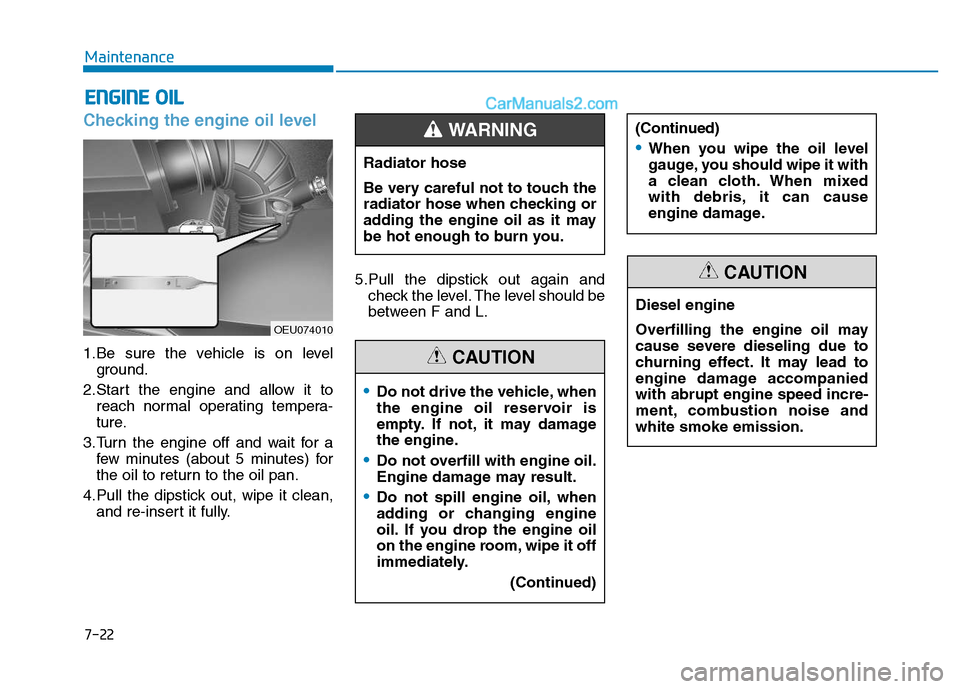
Checking the engine oil level
1.Be sure the vehicle is on levelground.
2.Start the engine and allow it to reach normal operating tempera-
ture.
3.Turn the engine off and wait for a few minutes (about 5 minutes) for
the oil to return to the oil pan.
4.Pull the dipstick out, wipe it clean, and re-insert it fully. 5.Pull the dipstick out again and
check the level. The level should be
between F and L.
EENN GGIINN EE OO IILL
OEU074010 Radiator hose
Be very careful not to touch the
radiator hose when checking or
adding the engine oil as it may
be hot enough to burn you.
WARNING
Do not drive the vehicle, when
the engine oil reservoir is
empty. If not, it may damage
the engine.
Do not overfill with engine oil.
Engine damage may result.
Do not spill engine oil, when
adding or changing engine
oil. If you drop the engine oil
on the engine room, wipe it off
immediately.
(Continued)
(Continued)
When you wipe the oil level
gauge, you should wipe it with
a clean cloth. When mixed
with debris, it can cause
engine damage.
CAUTION
Diesel engine
Overfilling the engine oil may
cause severe dieseling due to
churning effect. It may lead to
engine damage accompaniedwith abrupt engine speed incre-
ment, combustion noise andwhite smoke emission.
CAUTION
Page 387 of 473
7-24
Maintenance
The high-pressure cooling system
has a reservoir filled with year-round
antifreeze coolant. The reservoir is
filled at the factory. Check the
antifreeze protection and coolant
level at least once a year, at thebeginning of the winter season, and
before traveling to a colder climate.Checking the coolant level
EENN GGIINN EE CC OO OOLLAA NN TT
Do not drive with no engine
coolant. It may cause waterpump failure and engine
seizure, etc.
When the engine overheats
from low engine coolant, sud-
denly adding engine coolant
may cause cracks in the
engine. To prevent damage,
add engine coolant slowly insmall quantities.
CAUTION
Removing radiator
cap
Never attempt to remove the radiator cap while the engine
is operating or hot. Doing somight lead to cooling system
and engine damage and could
result in serious personal
injury from escaping hotcoolant or steam.
Turn the engine off and wait
until it cools down. Use
extreme care when removing
the radiator cap. Wrap a thick
towel around it, and turn it
counterclockwise slowly to
the first stop. Step back while
the pressure is released fromthe cooling system.
(Continued)
WARNING (Continued)When you are sure all the pressure has been released,
press down on the cap, using
a thick towel, and continue
turning counterclockwise to
remove it.
Even if the engine is not oper-
ating, do not remove the radi-ator cap or the drain plugwhile the engine and radiator
are hot. Hot coolant and
steam may still blow out
under pressure, causing seri-
ous injury.
Page 389 of 473
7-26
Maintenance
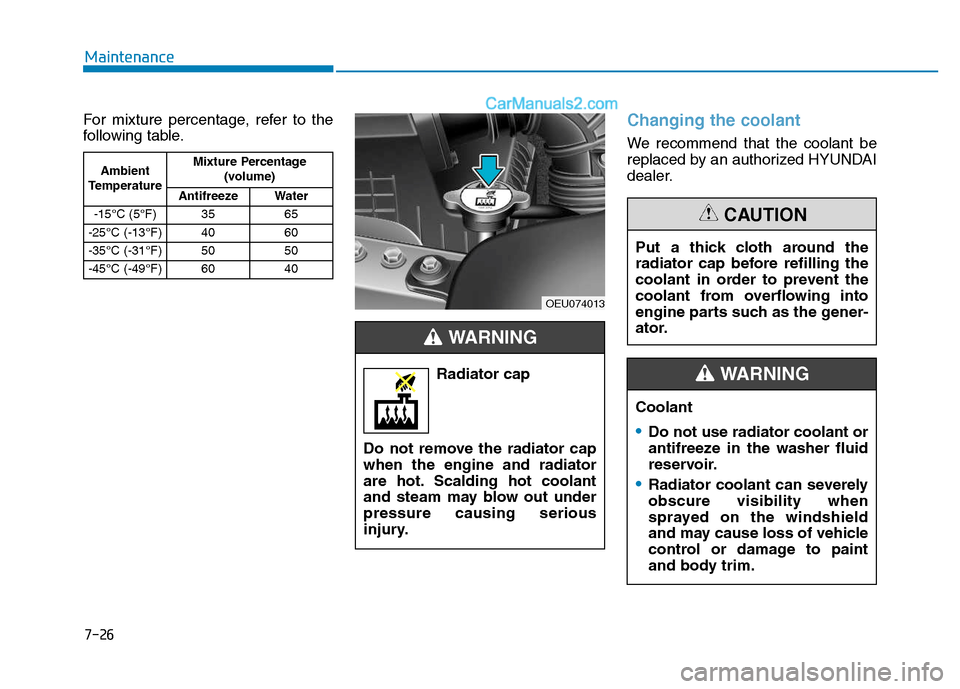
For mixture percentage, refer to the
following table.Changing the coolant
We recommend that the coolant be
replaced by an authorized HYUNDAI
dealer.
Ambient
Temperature Mixture Percentage
(volume)
Antifreeze Water
-15°C (5°F) 35 65
-25°C (-13°F) 40 60
-35°C (-31°F) 50 50
-45°C (-49°F) 60 40
OEU074013
Radiator cap
Do not remove the radiator cap when the engine and radiator
are hot. Scalding hot coolant
and steam may blow out underpressure causing serious
injury.
WARNING
Put a thick cloth around the
radiator cap before refilling the
coolant in order to prevent the
coolant from overflowing into
engine parts such as the gener-
ator.
CAUTION
Coolant
Do not use radiator coolant or
antifreeze in the washer fluid
reservoir.
Radiator coolant can severely obscure visibility when
sprayed on the windshield
and may cause loss of vehicle
control or damage to paint
and body trim.
WARNING
Page 392 of 473
7-29
7
MaintenanceUse only the specified power steer-ing fluid. (Refer to "Recommendedlubricants or capacities" in section 9.)
Checking the power steering hose
Check the connections for oil leaks,
damage and twists in the power
steering hose before driving.
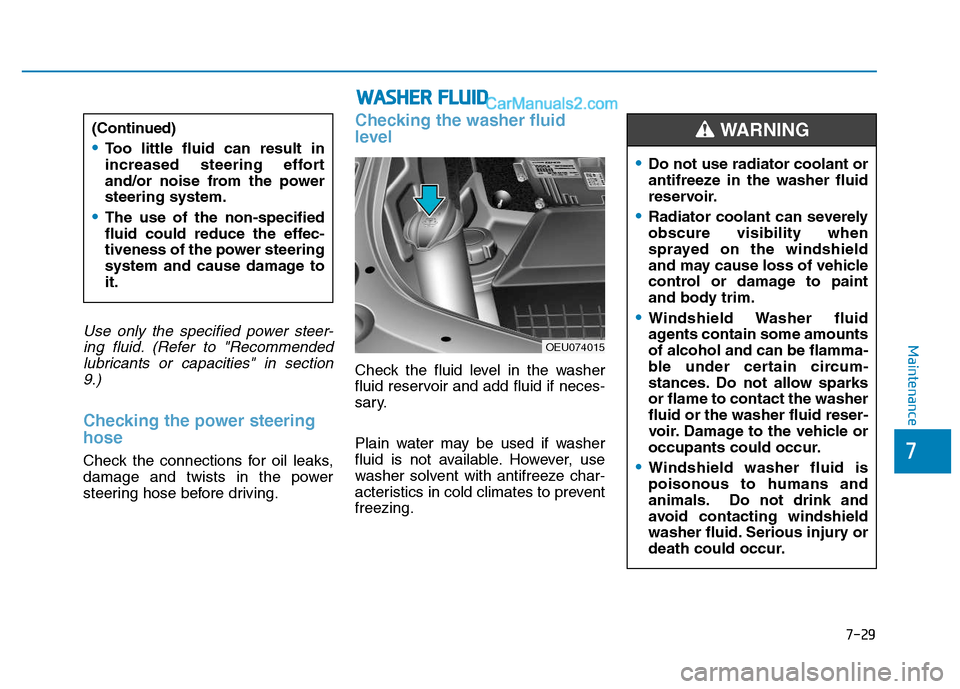
Checking the washer fluid
level
Check the fluid level in the washer
fluid reservoir and add fluid if neces-
sary.
Plain water may be used if washer
fluid is not available. However, use
washer solvent with antifreeze char-
acteristics in cold climates to preventfreezing.
(Continued)
Too little fluid can result in
increased steering effort
and/or noise from the powersteering system.
The use of the non-specified
fluid could reduce the effec-
tiveness of the power steering
system and cause damage toit.
WW
AASSHH EERR FF LLUU IIDD
OEU074015
Do not use radiator coolant or
antifreeze in the washer fluid
reservoir.
Radiator coolant can severely obscure visibility when
sprayed on the windshield
and may cause loss of vehicle
control or damage to paint
and body trim.
Windshield Washer fluid
agents contain some amountsof alcohol and can be flamma-
ble under certain circum-
stances. Do not allow sparksor flame to contact the washerfluid or the washer fluid reser-
voir. Damage to the vehicle or
occupants could occur.
Windshield washer fluid is poisonous to humans and
animals. Do not drink and
avoid contacting windshield
washer fluid. Serious injury or
death could occur.
WARNING
Page 460 of 473
8-7
8
Specifications & Consumer information
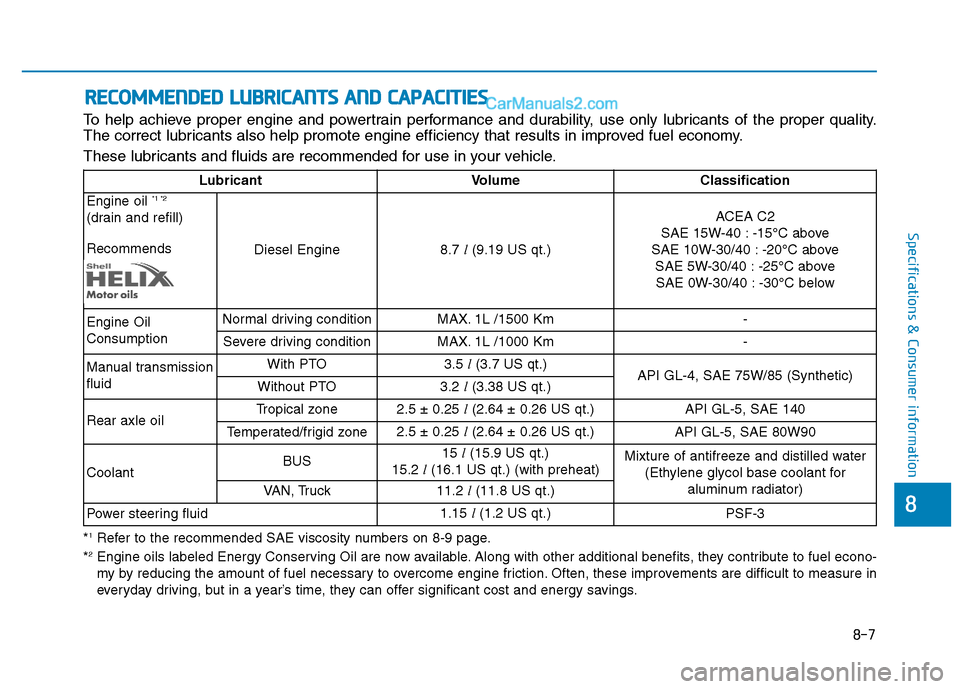
RREECCOO MM MMEENN DDEEDD LL UU BBRRIICC AA NN TTSS AA NN DD CC AA PPAA CCIITT IIEE SS
To help achieve proper engine and powertrain performance and durability, use only lubricants of the proper quality.
The correct lubricants also help promote engine efficiency that results in improved fuel economy.
These lubricants and fluids are recommended for use in your vehicle.
LubricantVolume Classification
Engine oil *1 *2
(drain and refill) Recommends
Diesel Engine8.7 l(9.19 US qt.)
ACEA C2
SAE 15W-40 : -15°C above
SAE 10W-30/40 : -20°C above SAE 5W-30/40 : -25°C aboveSAE 0W-30/40 : -30°C below
Engine Oil ConsumptionNormal driving conditionMAX. 1L /1500 Km-
Severe driving conditionMAX. 1L /1000 Km-
Manual transmission fluidWith PTO3.5 l(3.7 US qt.)API GL-4, SAE 75W/85 (Synthetic)Without PTO3.2 l(3.38 US qt.)
Rear axle oilTropical zone2.5 ± 0.25 l(2.64 ± 0.26 US qt.)API GL-5, SAE 140
Temperated/frigid zone2.5 ± 0.25 l(2.64 ± 0.26 US qt.)API GL-5, SAE 80W90
Coolant BUS15 l(15.9 US qt.)
15.2 l(16.1 US qt.) (with preheat)Mixture of antifreeze and distilled water
(Ethylene glycol base coolant for aluminum radiator)
VAN, Truck11.2 l(11.8 US qt.)
Power steering fluid1.15 l(1.2 US qt.)PSF-3
*1
Refer to the recommended SAE viscosity numbers on 8-9 page.
* 2
Engine oils labeled Energy Conserving Oil are now available. Along with other additional benefits, they contribute to fuel econo -
my by reducing the amount of fuel necessary to overcome engine friction. Often, these improvements are difficult to measure in
everyday driving, but in a year’s time, they can offer significant cost and energy savings.