seats Hyundai H350 2016 User Guide
[x] Cancel search | Manufacturer: HYUNDAI, Model Year: 2016, Model line: H350, Model: Hyundai H350 2016Pages: 473, PDF Size: 26.4 MB
Page 54 of 473
2-34
Safety system of your vehicle
Why did not my air bag go off in a collision? (Inflation andnon-inflation conditions of the
air bag)
There are many types of acci-
dents in which the air bag
would not inflate to provide
additional protection.
These include rear impacts,
second or third collisions in
multiple impact accidents, as
well as low speed impacts.
(Continued)
A child restraint system must
never be installed in a front
seat. The infant or child may
be severely injured or killed
by a deploying air bag in anaccident.
Children at the age of 12 and
under must always be proper-
ly restrained in a rear seat.
Never allow children to ride in
a front passenger's seat.
When a child at the age of 13
and over sits in a front seat,
he or she must be properlyfastened and the seat shouldbe located in the rearmostposition.
❇
❇ The age requirements
about the child detrainment
differ in each country.
For the maximum protection
in all types of crashes, all
occupants including the driv-
er should always wear their
seat belts, regardless of the
air bag installment in theirseats.
(Continued)
(Continued)This is to minimizethe risk of severe injury or
death in the event of a crash. Do not sit or lean unnecessar-
ily close to the air bag, when
the vehicle is in motion.
Sitting improperly or out of
position may result in serious
or fatal injury in a crash. Alloccupants should sit in anupright position with the seat-
back in an upright position,centered on the seat cushion
with their seat belt on, legs
comfortably extended and
their feet rested on the floor
until the vehicle is parked and
the ignition switch is turned
OFF.
The SRS air bag rapidly
inflates to provide Protection
to occupants in a crash. Whenan occupant is out of positionwithout fastening a seat belt,
the air bag may forcefully
strike the occupant, causing
serious or fatal injury.
Page 60 of 473
2-40
Safety system of your vehicle
Additional safety precautions
Never let passengers ride in the
trunk or on top of a foldeddown
seatback. All occupants should sit
upright, fully back in their seats
with their seat belts fastened and
their feet rested on the floor.
Passengers should not move
out of their seats or change their
seat positions, when the vehicleis in motion. A passenger, who
does not fasten a seat belt during a
crash or emergency stop, may be
thrown against the vehicle interior,
against other occupants, or out of
the vehicle.
Each seat belt is designed torestrain one occupant. When
more than one person uses the
same seat belt, they may be seri-ously injured or killed in a collision.
Do not use any accessories onseat belts. Devices, which the
manufacturers claim to improve
occupants’ comfort, may reduce
the protection provided by the seat
belt and increase the risk of seri-
ous injury in a crash.
(Continued)When the air bags inflate, we recommend that the system
be replaced by an authorized
HYUNDAI dealer.
Do not modify or disconnect SRS wirings or other SRS
components. Such attempts
may result in injury, because
an air bag may accidentally
inflate or deactivate the SRSsystem.
Observe any safety precau-
tions to discard the air bagsystem or to scrape the vehi-
cle. An authorized HYUNDAI
dealer knows these precau-
tions and can give you the
necessary information.
Failure to follow these precau-
tions and procedures may
increase the risk of personal
injury.
(Continued)
(Continued)
When your vehicle is flooded or when the floor mats are
soaked with water, do not
attempt to start the engine. We
recommend that you contact
an authorized HYUNDAI deal-
er.
Page 61 of 473
2-41
Safety system of your vehicle
2
Passengers should not place
hard or sharp objects between
themselves and the air bags.
Carrying hard or sharp objects on
your laps or in your mouth may
result in injury, when an air bag
inflates.
Keep occupants away from the
air bag covers. All occupants
should sit upright, fully back in their
seats with their seat belts fastened
and their feet rested on the floor.When occupants are too close to
the air bag, they may be injured byan inflating air bag.
Do not attach or place objects
on or near the air bag covers.
Any object attached to or placed
on the front air bag covers may
interfere with the proper operation
of the air bags.
Do not modify the front seats.
Modification of the front seats may
interfere with the sensing operation
of the supplemental restraint sys-tem.
Do not place items under the
front seats. Placing items under
the front seats may interfere with
the sensing operation of the sup-
plemental restraint system and
wiring harnesses.
Never hold an infant or child on
your laps. The infant or child may
be seriously injured or killed in the
event of a crash. All infants and
children should be properly
restrained in appropriate child
safety seats or seat belts in a rearseat.
Sitting improperly or out of
position may cause occu-
pants to be shifted too close
to a deploying air bag, strikethe interior structure or be
thrown out of the vehicle,
resulting in serious injury ordeath.
Always sit upright with the
seatback in an upright posi-
tion, centered on the seat
cushion with your seat belt
on, legs comfortably extended
and feet rested on the floor.
WARNING
Page 449 of 473
7-86
Maintenance
Cleaning the upholstery andinterior trim
Vinyl
Remove dust and loose dirt from
vinyl with a whisk broom or vacuum
cleaner. Clean vinyl surfaces with a
vinyl cleaner.
Fabric
Remove dust and loose dirt from fab-
ric with a whisk broom or vacuum
cleaner. Clean with a mild soap solu-
tion recommended for upholstery or
carpets. Remove fresh spots imme-
diately with a fabric spot cleaner. If
fresh spots do not receive immediate
attention, the fabric can be stained
and its color can be affected. Also, its
fire-resistant properties can be
reduced if the material is not proper-ly maintained.
Cleaning the lap/shoulder beltwebbing
Clean the belt webbing with any mild
soap solution recommended for
cleaning upholstery or carpet. Follow
the instructions provided with the
soap. Do not bleach or re-dye the
webbing because this may weakenit.
Cleaning the interior windowglass
If the interior glass surfaces of the
vehicle become fogged (that is, cov-
ered with an oily, greasy or waxy
film), they should be cleaned with
glass cleaner. Follow the directions
on the glass cleaner container.
Using anything but recom-
mended cleaners and proce-
dures may affect the fabric’sappearance and fire-resistant
properties.
CAUTION
When cleaning leather products
(steering wheel, seats etc.), use
neutral detergents or low alco-
hol content solutions. If you usehigh alcohol content solutions
or acid/alkaline detergents, the
color of the leather may fade or
the surface may get stripped
off.
CAUTION
Do not scrape or scratch the
inside of the rear window. This
may result in damage to the rear
window defroster grid.
CAUTION
Page 472 of 473
I-7
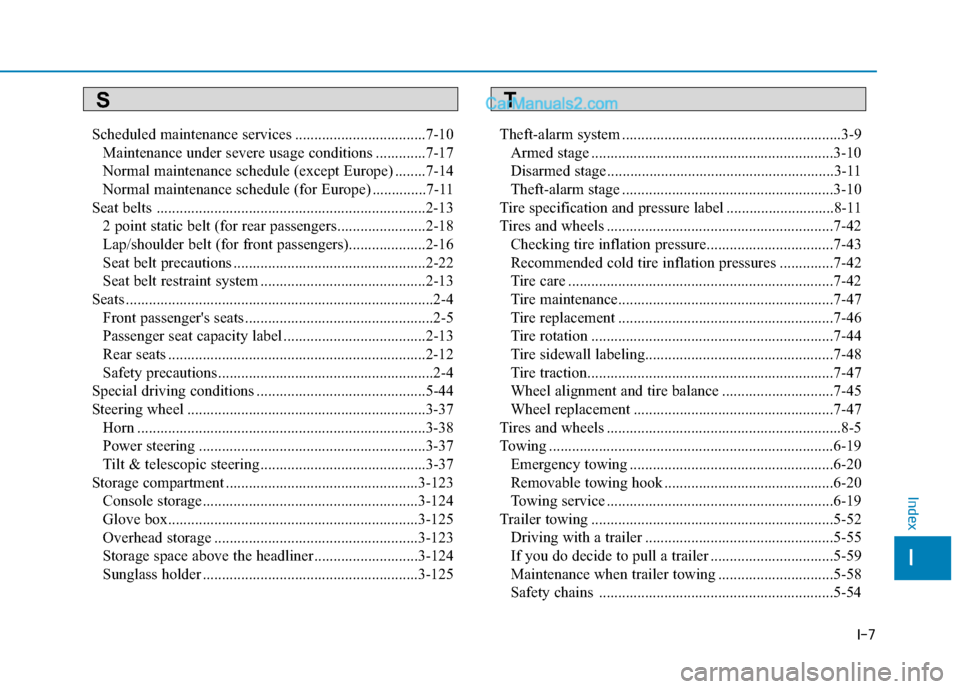
Scheduled maintenance services ..................................7-10
Maintenance under severe usage conditions .............7-17
Normal maintenance schedule (except Europe) ........7-14
Normal maintenance schedule (for Europe) ..............7-11
Seat belts ......................................................................2-13 2 point static belt (for rear passengers.......................2-18
Lap/shoulder belt (for front passengers)....................2-16
Seat belt precautions ..................................................2-22
Seat belt restraint system ...........................................2-13
Seats ................................................................................2-4
Front passenger's seats .................................................2-5
Passenger seat capacity label .....................................2-13
Rear seats ...................................................................2-12
Safety precautions........................................................2-4
Special driving conditions ............................................5-44
Steering wheel ..............................................................3-37 Horn ...........................................................................3-38
Power steering ...........................................................3-37
Tilt & telescopic steering ...........................................3-37
Storage compartment ..................................................3-123
Console storage........................................................3-124
Glove box.................................................................3-125
Overhead storage .....................................................3-123
Storage space above the headliner...........................3-124
Sunglass holder ........................................................3-125 Theft-alarm system .........................................................3-9
Armed stage ...............................................................3-10
Disarmed stage ...........................................................3-11
Theft-alarm stage .......................................................3-10
Tire specification and pressure label ............................8-11
Tires and wheels ...........................................................7-42 Checking tire inflation pressure.................................7-43
Recommended cold tire inflation pressures ..............7-42
Tire care .....................................................................7-42
Tire maintenance........................................................7-47
Tire replacement ........................................................7-46
Tire rotation ...............................................................7-44
Tire sidewall labeling.................................................7-48
Tire traction................................................................7-47
Wheel alignment and tire balance .............................7-45
Wheel replacement ....................................................7-47
Tires and wheels .............................................................8-5
Towing ..........................................................................6-19 Emergency towing .....................................................6-20
Removable towing hook ............................................6-20
Towing service ...........................................................6-19
Trailer towing ...............................................................5-52
Driving with a trailer .................................................5-55
If you do decide to pull a trailer ................................5-59
Maintenance when trailer towing ..............................5-58
Safety chains .............................................................5-54
I
Index
TS