torque Hyundai H350 2016 User Guide
[x] Cancel search | Manufacturer: HYUNDAI, Model Year: 2016, Model line: H350, Model: Hyundai H350 2016Pages: 473, PDF Size: 26.4 MB
Page 349 of 473
6-14
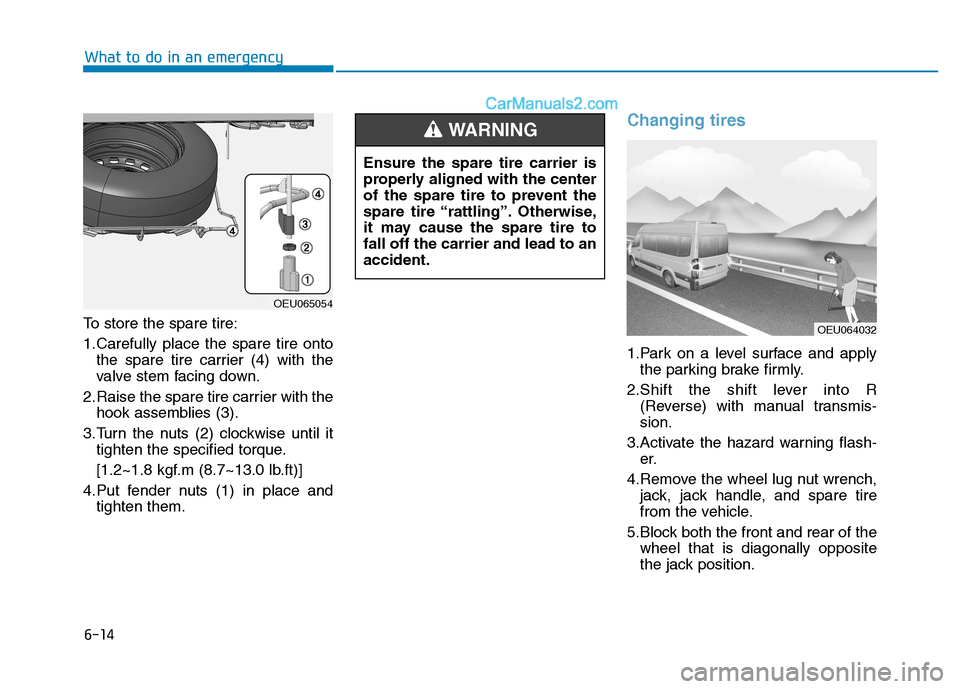
To store the spare tire:
1.Carefully place the spare tire onto
the spare tire carrier (4) with the
valve stem facing down.
2.Raise the spare tire carrier with the hook assemblies (3).
3.Turn the nuts (2) clockwise until it tighten the specified torque.
[1.2~1.8 kgf.m (8.7~13.0 lb.ft)]
4.Put fender nuts (1) in place and tighten them.
Changing tires
1.Park on a level surface and applythe parking brake firmly.
2.Shift the shift lever into R (Reverse) with manual transmis- sion.
3.Activate the hazard warning flash- er.
4.Remove the wheel lug nut wrench, jack, jack handle, and spare tire
from the vehicle.
5.Block both the front and rear of the wheel that is diagonally opposite
the jack position.
What to do in an emergency
OEU065054
OEU064032
Ensure the spare tire carrier is
properly aligned with the center
of the spare tire to prevent the
spare tire “rattling”. Otherwise,
it may cause the spare tire tofall off the carrier and lead to anaccident.
WARNING
Page 354 of 473
6-19
What to do in an emergency
6
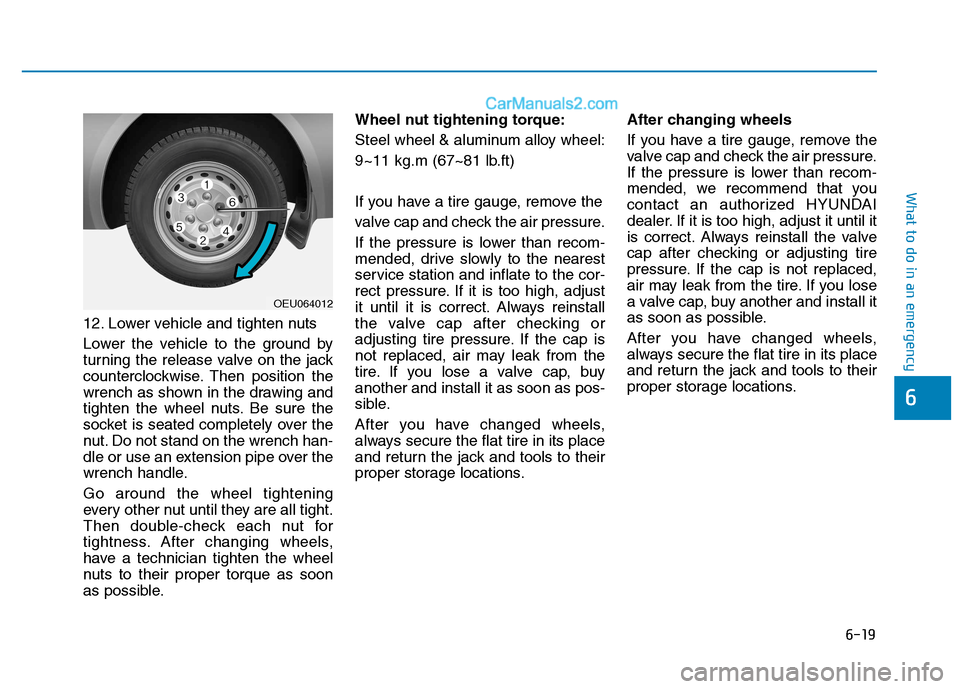
12. Lower vehicle and tighten nuts
Lower the vehicle to the ground by
turning the release valve on the jack
counterclockwise. Then position the
wrench as shown in the drawing and
tighten the wheel nuts. Be sure the
socket is seated completely over the
nut. Do not stand on the wrench han-
dle or use an extension pipe over the
wrench handle. Go around the wheel tightening
every other nut until they are all tight.
Then double-check each nut for
tightness. After changing wheels,
have a technician tighten the wheel
nuts to their proper torque as soon
as possible.Wheel nut tightening torque:
Steel wheel & aluminum alloy wheel:
9~11 kg.m (67~81 lb.ft)
If you have a tire gauge, remove the
valve cap and check the air pressure.
If the pressure is lower than recom-
mended, drive slowly to the nearest
service station and inflate to the cor-
rect pressure. If it is too high, adjust
it until it is correct. Always reinstall
the valve cap after checking or
adjusting tire pressure. If the cap is
not replaced, air may leak from the
tire. If you lose a valve cap, buyanother and install it as soon as pos-
sible.
After you have changed wheels,
always secure the flat tire in its place
and return the jack and tools to their
proper storage locations.
After changing wheels
If you have a tire gauge, remove the
valve cap and check the air pressure.
If the pressure is lower than recom-
mended, we recommend that you
contact an authorized HYUNDAI
dealer. If it is too high, adjust it until it
is correct. Always reinstall the valve
cap after checking or adjusting tire
pressure. If the cap is not replaced,
air may leak from the tire. If you lose
a valve cap, buy another and install it
as soon as possible.
After you have changed wheels,
always secure the flat tire in its place
and return the jack and tools to their
proper storage locations.
OEU064012
Page 384 of 473
7-21
7
Maintenance
Coolant
The coolant should be changed at
the intervals specified in the mainte-
nance schedule.
Manual transmission fluid (if equipped)
Inspect the manual transmission fluid according to the maintenance
schedule.
Brake hoses and lines
Visually check for proper installation,
chafing, cracks, deterioration and
any leakage. Replace any deteriorat-
ed or damaged parts immediately.
Brake fluid
Check brake fluid level in the brake
fluid reservoir. The level should be
between “MIN” and “MAX” marks on
the side of the reservoir. Use only
hydraulic brake fluid conforming to
DOT 4 specification.
Parking brake
Inspect the parking brake system
including the parking brake lever and
cables.
Brake discs, pads, calipers
and rotors
Check the pads for excessive wear,
discs for run out and wear, and
calipers for fluid leakage.
For more information on checking
the pads or lining wear limit, refer to
the HYUNDAI web site. (http://brakeman
ual.hmc.co.kr)
Suspension mounting bolts
Check the suspension connections
for looseness or damage. Retighten
to the specified torque.
Steering gear box, linkage &
boots/lower arm ball joint
With the vehicle stopped and engine
off, check for excessive free-play in
the steering wheel.
Check the linkage for bends or dam-
age. Check the dust boots and ball
joints for deterioration, cracks, or
damage. Replace any damaged
parts.
Power steering pump, belt and hoses
Check the power steering pump and
hoses for leakage and damage.
Replace any damaged or leaking
parts immediately. Inspect the power
steering belt (or drive belt) for evi-
dence of cuts, cracks, excessive
wear, oiliness and proper tension.
Replace or adjust it if necessary.
Air conditioning refrigerant (if equipped)
Check the air conditioning lines and
connections for leakage and dam-
age.
Page 403 of 473
7-40
Maintenance
Battery capacity label
❈The actual battery label in the vehicle
may differ from the illustration.
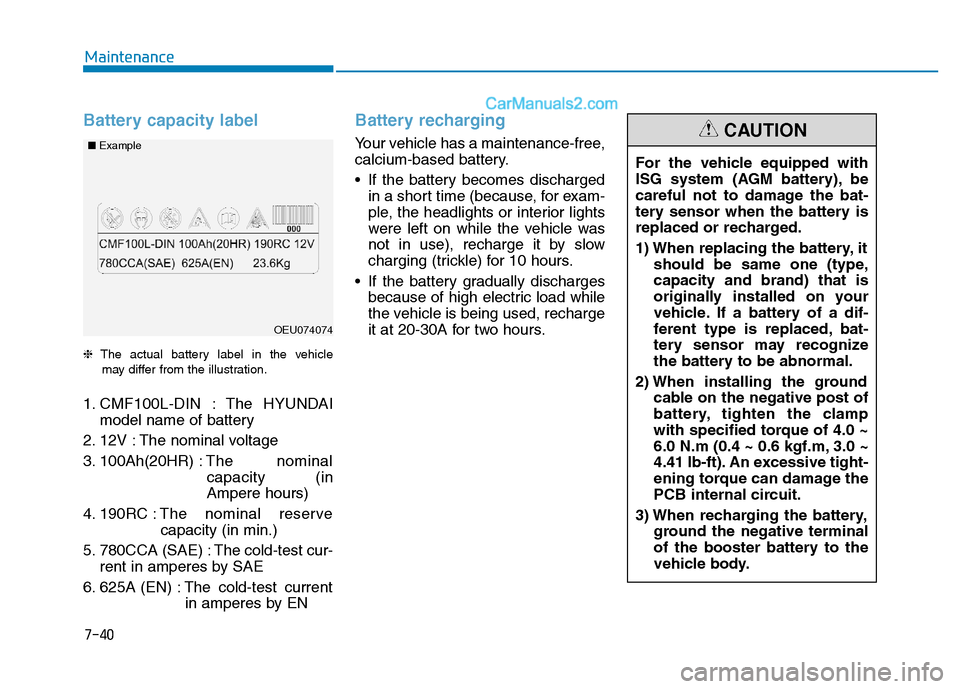
1. CMF100L-DIN : The HYUNDAI model name of battery
2. 12V : The nominal voltage
3. 100Ah(20HR) : The nominal
capacity (in Ampere hours)
4. 190RC : The nominal reserve
capacity (in min.)
5. 780CCA (SAE) : The cold-test cur- rent in amperes by SAE
6. 625A (EN) : The cold-test current in amperes by EN
Battery recharging
Your vehicle has a maintenance-free,
calcium-based battery.
If the battery becomes dischargedin a short time (because, for exam-
ple, the headlights or interior lights
were left on while the vehicle was
not in use), recharge it by slow
charging (trickle) for 10 hours.
If the battery gradually discharges because of high electric load while
the vehicle is being used, recharge
it at 20-30A for two hours. For the vehicle equipped with
ISG system (AGM battery), be
careful not to damage the bat-
tery sensor when the battery is
replaced or recharged.
1) When replacing the battery, it
should be same one (type, capacity and brand) that is
originally installed on your
vehicle. If a battery of a dif-
ferent type is replaced, bat-
tery sensor may recognize
the battery to be abnormal.
2) When installing the ground cable on the negative post of
battery, tighten the clamp
with specified torque of 4.0 ~
6.0 N.m (0.4 ~ 0.6 kgf.m, 3.0 ~
4.41 lb-ft). An excessive tight-
ening torque can damage the
PCB internal circuit.
3) When recharging the battery, ground the negative terminal
of the booster battery to the
vehicle body.CAUTION
OEU074074
■
Example
Page 458 of 473
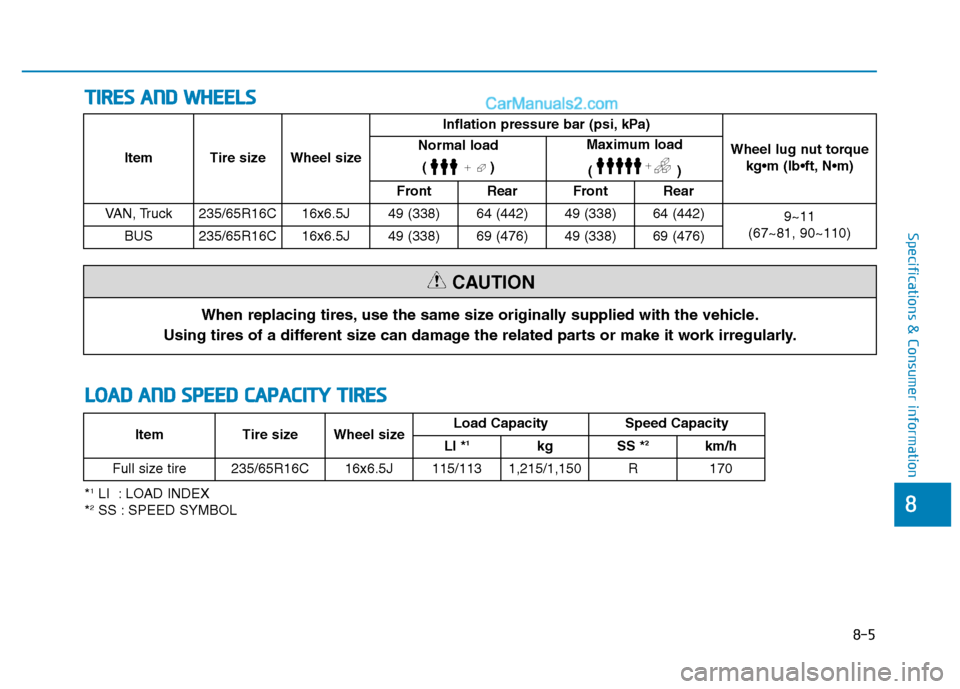
8-5
8
Specifications & Consumer information
TTIIRR EESS AA NN DD WW HHEEEELLSS
When replacing tires, use the same size originally supplied with the vehicle.
Using tires of a different size can damage the related parts or make it work irregularly.
CAUTION
LL OO AADD AA NN DD SS PP EEEEDD CC AA PPAA CCIITT YY TT IIRR EESS
Item Tire size Wheel size Inflation pressure bar (psi, kPa)
Wheel lug nut torquekg•m (lb N
Normal load
()Maximum load
()
Front Rear Front Rear
VAN, Truck 235/65R16C 16x6.5J 49 (338) 64 (442) 49 (338) 64 (442) 9~11
(67~81, 90~110)
BUS 235/65R16C 16x6.5J 49 (338) 69 (476) 49 (338) 69 (476)
* 1
LI : LOAD INDEX
* 2
SS : SPEED SYMBOL Item Tire size Wheel size
Load Capacity Speed Capacity
LI * 1
kg SS * 2
km/h
Full size tire 235/65R16C 16x6.5J 115/113 1,215/1,150 R 170