engine coolant Hyundai H350 2016 Owner's Guide
[x] Cancel search | Manufacturer: HYUNDAI, Model Year: 2016, Model line: H350, Model: Hyundai H350 2016Pages: 473, PDF Size: 26.4 MB
Page 378 of 473
7-15
7
Maintenance
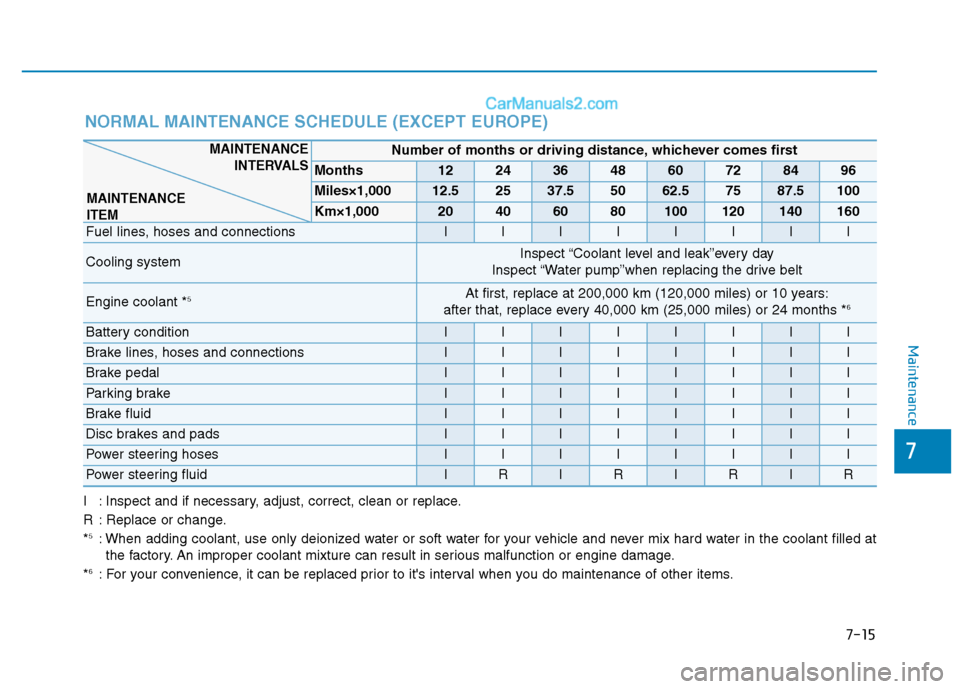
NORMAL MAINTENANCE SCHEDULE (EXCEPT EUROPE)
Number of months or driving distance, whichever comes first
Months1224364860728496
Miles×1,00012.52537.55062.57587.5100
Km×1,00020406080100120140160
Fuel lines, hoses and connectionsIIIIIIII
Cooling systemInspect “Coolant level and leak”every day
Inspect “Water pump”when replacing the drive belt
Engine coolant * 5At first, replace at 200,000 km (120,000 miles) or 10 years:
after that, replace every 40,000 km (25,000 miles) or 24 months * 6
Battery conditionIIIIIIII
Brake lines, hoses and connectionsIIIIIIII
Brake pedalIIIIIIII
Parking brakeIIIIIIII
Brake fluidIIIIIIII
Disc brakes and padsIIIIIIII
Power steering hosesIIIIIIII
Power steering fluidIRIRIRIR
MAINTENANCE
INTERVALS
I : Inspect and if necessary, adjust, correct, clean or replace.
R : Replace or change.*5
: When adding coolant, use only deionized water or soft water for your vehicle and never mix hard water in the coolant filled at
the factory. An improper coolant mixture can result in serious malfunction or engine damage.
* 6
: For your convenience, it can be replaced prior to it's interval when you do maintenance of other items.
MAINTENANCE ITEM
Page 384 of 473
7-21
7
Maintenance
Coolant
The coolant should be changed at
the intervals specified in the mainte-
nance schedule.
Manual transmission fluid (if equipped)
Inspect the manual transmission fluid according to the maintenance
schedule.
Brake hoses and lines
Visually check for proper installation,
chafing, cracks, deterioration and
any leakage. Replace any deteriorat-
ed or damaged parts immediately.
Brake fluid
Check brake fluid level in the brake
fluid reservoir. The level should be
between “MIN” and “MAX” marks on
the side of the reservoir. Use only
hydraulic brake fluid conforming to
DOT 4 specification.
Parking brake
Inspect the parking brake system
including the parking brake lever and
cables.
Brake discs, pads, calipers
and rotors
Check the pads for excessive wear,
discs for run out and wear, and
calipers for fluid leakage.
For more information on checking
the pads or lining wear limit, refer to
the HYUNDAI web site. (http://brakeman
ual.hmc.co.kr)
Suspension mounting bolts
Check the suspension connections
for looseness or damage. Retighten
to the specified torque.
Steering gear box, linkage &
boots/lower arm ball joint
With the vehicle stopped and engine
off, check for excessive free-play in
the steering wheel.
Check the linkage for bends or dam-
age. Check the dust boots and ball
joints for deterioration, cracks, or
damage. Replace any damaged
parts.
Power steering pump, belt and hoses
Check the power steering pump and
hoses for leakage and damage.
Replace any damaged or leaking
parts immediately. Inspect the power
steering belt (or drive belt) for evi-
dence of cuts, cracks, excessive
wear, oiliness and proper tension.
Replace or adjust it if necessary.
Air conditioning refrigerant (if equipped)
Check the air conditioning lines and
connections for leakage and dam-
age.
Page 387 of 473
7-24
Maintenance
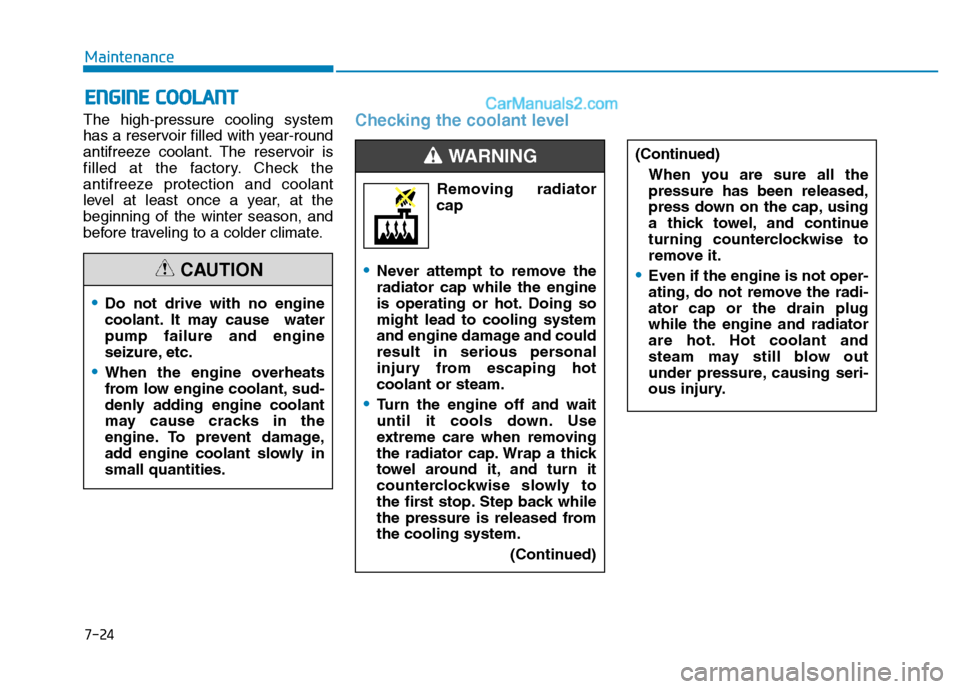
The high-pressure cooling system
has a reservoir filled with year-round
antifreeze coolant. The reservoir is
filled at the factory. Check the
antifreeze protection and coolant
level at least once a year, at thebeginning of the winter season, and
before traveling to a colder climate.Checking the coolant level
EENN GGIINN EE CC OO OOLLAA NN TT
Do not drive with no engine
coolant. It may cause waterpump failure and engine
seizure, etc.
When the engine overheats
from low engine coolant, sud-
denly adding engine coolant
may cause cracks in the
engine. To prevent damage,
add engine coolant slowly insmall quantities.
CAUTION
Removing radiator
cap
Never attempt to remove the radiator cap while the engine
is operating or hot. Doing somight lead to cooling system
and engine damage and could
result in serious personal
injury from escaping hotcoolant or steam.
Turn the engine off and wait
until it cools down. Use
extreme care when removing
the radiator cap. Wrap a thick
towel around it, and turn it
counterclockwise slowly to
the first stop. Step back while
the pressure is released fromthe cooling system.
(Continued)
WARNING (Continued)When you are sure all the pressure has been released,
press down on the cap, using
a thick towel, and continue
turning counterclockwise to
remove it.
Even if the engine is not oper-
ating, do not remove the radi-ator cap or the drain plugwhile the engine and radiator
are hot. Hot coolant and
steam may still blow out
under pressure, causing seri-
ous injury.
Page 388 of 473
7-25
7
Maintenance
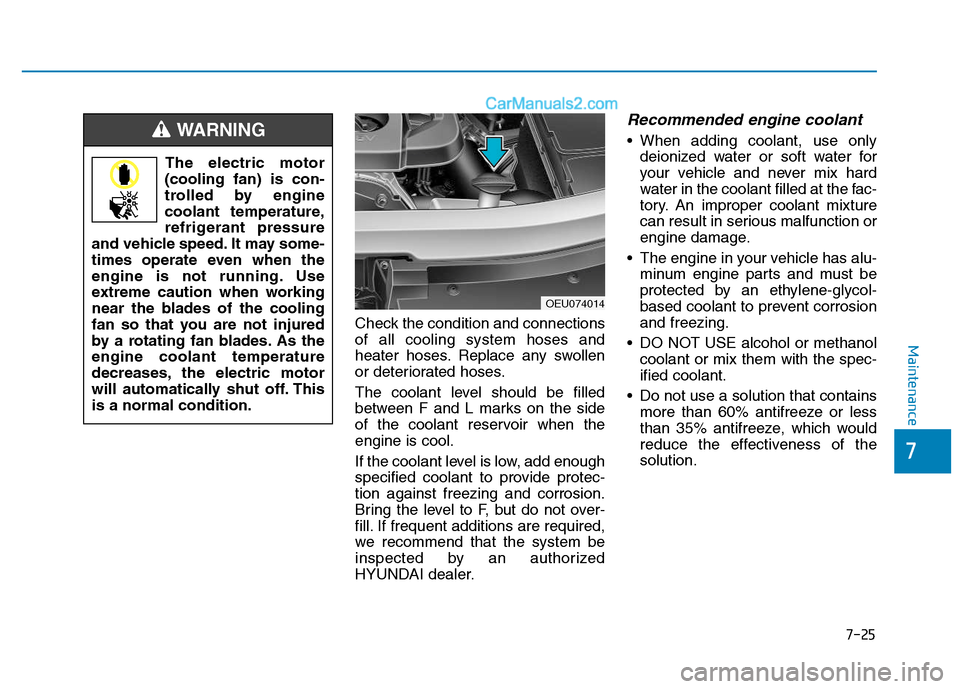
Check the condition and connections of all cooling system hoses and
heater hoses. Replace any swollen
or deteriorated hoses.
The coolant level should be filled
between F and L marks on the side
of the coolant reservoir when theengine is cool.
If the coolant level is low, add enough
specified coolant to provide protec-tion against freezing and corrosion.
Bring the level to F, but do not over-
fill. If frequent additions are required,
we recommend that the system be
inspected by an authorized
HYUNDAI dealer.
Recommended engine coolant
When adding coolant, use onlydeionized water or soft water for
your vehicle and never mix hard
water in the coolant filled at the fac-
tory. An improper coolant mixture
can result in serious malfunction or
engine damage.
The engine in your vehicle has alu- minum engine parts and must be
protected by an ethylene-glycol-
based coolant to prevent corrosionand freezing.
DO NOT USE alcohol or methanol coolant or mix them with the spec-ified coolant.
Do not use a solution that contains more than 60% antifreeze or less
than 35% antifreeze, which would
reduce the effectiveness of thesolution.
The electric motor
(cooling fan) is con-
trolled by engine
coolant temperature,
refrigerant pressure
and vehicle speed. It may some-
times operate even when the
engine is not running. Use
extreme caution when working
near the blades of the cooling
fan so that you are not injured
by a rotating fan blades. As theengine coolant temperature
decreases, the electric motor
will automatically shut off. Thisis a normal condition.WARNING
OEU074014
Page 389 of 473
7-26
Maintenance
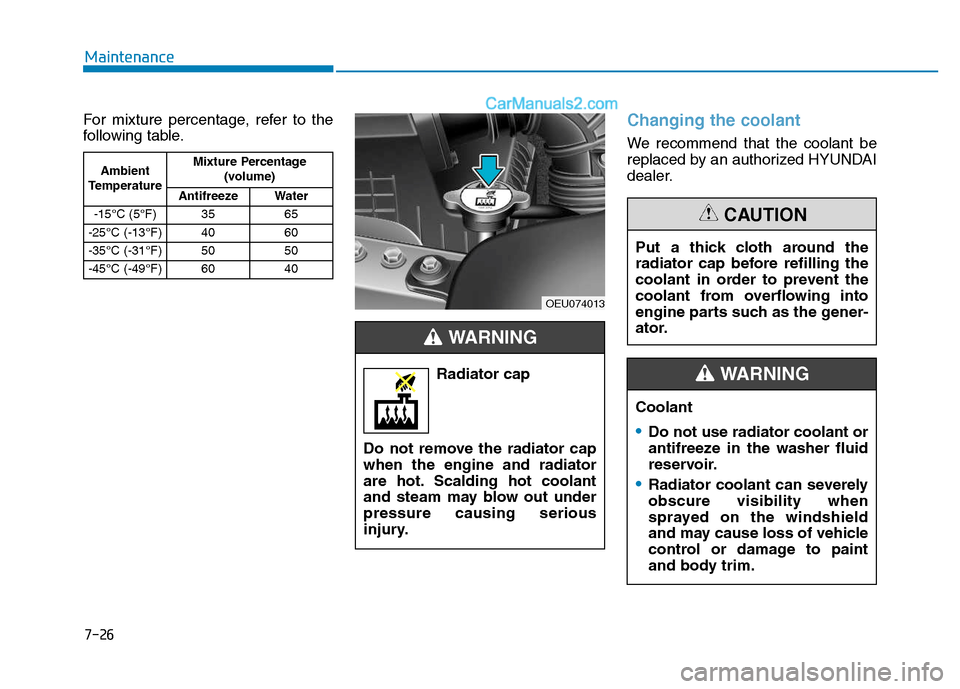
For mixture percentage, refer to the
following table.Changing the coolant
We recommend that the coolant be
replaced by an authorized HYUNDAI
dealer.
Ambient
Temperature Mixture Percentage
(volume)
Antifreeze Water
-15°C (5°F) 35 65
-25°C (-13°F) 40 60
-35°C (-31°F) 50 50
-45°C (-49°F) 60 40
OEU074013
Radiator cap
Do not remove the radiator cap when the engine and radiator
are hot. Scalding hot coolant
and steam may blow out underpressure causing serious
injury.
WARNING
Put a thick cloth around the
radiator cap before refilling the
coolant in order to prevent the
coolant from overflowing into
engine parts such as the gener-
ator.
CAUTION
Coolant
Do not use radiator coolant or
antifreeze in the washer fluid
reservoir.
Radiator coolant can severely obscure visibility when
sprayed on the windshield
and may cause loss of vehicle
control or damage to paint
and body trim.
WARNING
Page 450 of 473
7-87
7
Maintenance
The emission control system of your
vehicle is covered by a written limited
warranty. Please see the warranty
information contained in the Service
Passport in your vehicle.
Your vehicle is equipped with an emission control system to meet all
emission regulations. There are three emission control
systems which are as follows.
(1) Crankcase emission control sys-tem
(2) Evaporative emission control sys- tem
(3) Exhaust emission control systemIn order to assure the proper function
of the emission control systems, it is
recommended that you have your
vehicle inspected and maintained by
an authorized HYUNDAI dealer orother repair shops that use qualifiedtechnicians in accordance with the
maintenance schedule in this manu-al.1. Crankcase emission control system
The positive crankcase ventilation
system is employed to prevent air
pollution caused by blow-by gases
being emitted from the crankcase.This system supplies fresh filtered air
to the crankcase through the air
intake hose. Inside the crankcase,
the fresh air mixes with blow-by
gases, which then pass through the
PCV valve into the induction system.
2. Evaporative emission con-trol System
The Evaporative Emission Control
System is designed to prevent fuel
vapors from escaping into the atmos-
phere.
Canister
Fuel vapors generated inside the fueltank are absorbed and stored in the
onboard canister. When the engine is
running, the fuel vapors absorbed in
the canister are drawn into the surgetank through the purge control sole-
noid valve.
Purge Control Solenoid Valve
(PCSV)
The purge control solenoid valve is
controlled by the Engine Control
Module (ECM); when the engine
coolant temperature is low during
idling, the PCSV closes so that evap-
orated fuel is not taken into the
engine. After the engine warms-up
during ordinary driving, the PCSV
opens to introduce evaporated fuel to
the engine.
EE MM IISS SSIIOO NN CC OO NNTTRR OO LL SS YY SSTT EEMM
Page 460 of 473
8-7
8
Specifications & Consumer information
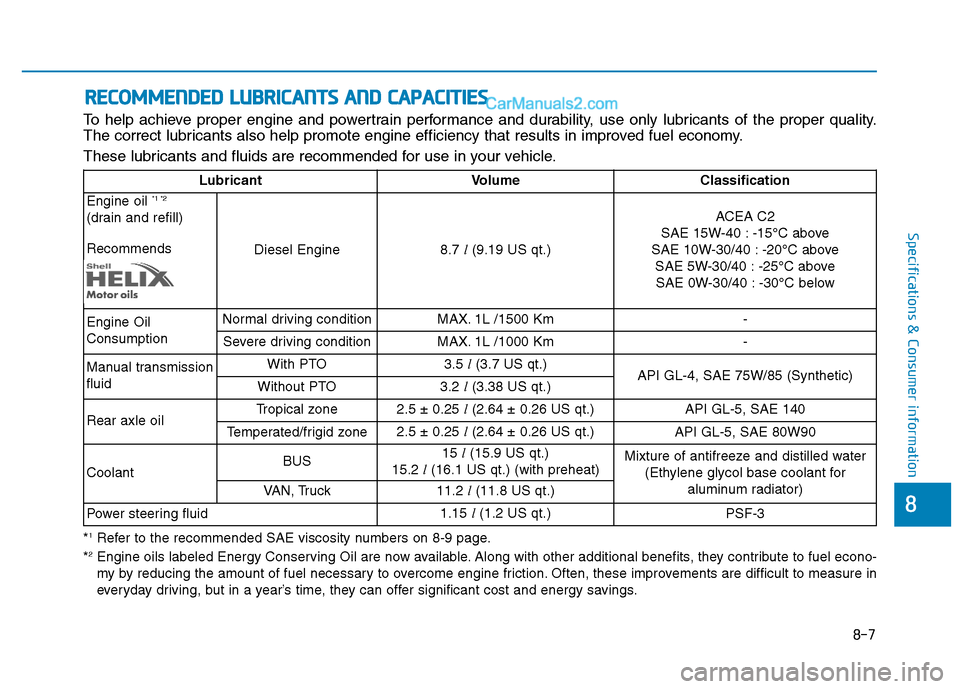
RREECCOO MM MMEENN DDEEDD LL UU BBRRIICC AA NN TTSS AA NN DD CC AA PPAA CCIITT IIEE SS
To help achieve proper engine and powertrain performance and durability, use only lubricants of the proper quality.
The correct lubricants also help promote engine efficiency that results in improved fuel economy.
These lubricants and fluids are recommended for use in your vehicle.
LubricantVolume Classification
Engine oil *1 *2
(drain and refill) Recommends
Diesel Engine8.7 l(9.19 US qt.)
ACEA C2
SAE 15W-40 : -15°C above
SAE 10W-30/40 : -20°C above SAE 5W-30/40 : -25°C aboveSAE 0W-30/40 : -30°C below
Engine Oil ConsumptionNormal driving conditionMAX. 1L /1500 Km-
Severe driving conditionMAX. 1L /1000 Km-
Manual transmission fluidWith PTO3.5 l(3.7 US qt.)API GL-4, SAE 75W/85 (Synthetic)Without PTO3.2 l(3.38 US qt.)
Rear axle oilTropical zone2.5 ± 0.25 l(2.64 ± 0.26 US qt.)API GL-5, SAE 140
Temperated/frigid zone2.5 ± 0.25 l(2.64 ± 0.26 US qt.)API GL-5, SAE 80W90
Coolant BUS15 l(15.9 US qt.)
15.2 l(16.1 US qt.) (with preheat)Mixture of antifreeze and distilled water
(Ethylene glycol base coolant for aluminum radiator)
VAN, Truck11.2 l(11.8 US qt.)
Power steering fluid1.15 l(1.2 US qt.)PSF-3
*1
Refer to the recommended SAE viscosity numbers on 8-9 page.
* 2
Engine oils labeled Energy Conserving Oil are now available. Along with other additional benefits, they contribute to fuel econo -
my by reducing the amount of fuel necessary to overcome engine friction. Often, these improvements are difficult to measure in
everyday driving, but in a year’s time, they can offer significant cost and energy savings.
Page 468 of 473
I-3
Rear heating and air conditioning............................3-116
System operation......................................................3-117
Cruise control system ...................................................5-30
Declaration of conformity ............................................8-12
Defroster .....................................................................3-109
Digital tachograph ........................................................3-80
Dimensions .....................................................................8-2
Door lock ......................................................................3-11 Deadlocks...................................................................3-14
Operating door locks from inside the vehicle ...........3-12
Operating door locks from outside the vehicle .........3-11
Speed sensing door lock system ................................3-14
Economical operation ...................................................5-42 Electrical step.............................................................3-17
Electrical step warning alarm ....................................3-19
Operation and obstacle detection...............................3-19
Regular cleaning ........................................................3-21
Emergency commodity .................................................6-27 Fire extinguisher ........................................................6-27
First aid kit .................................................................6-27
Tire pressure gauge ....................................................6-28
Triangle reflector .......................................................6-28
Emergency exit .............................................................6-26 Emergency starting .........................................................6-4
Emission control system ...............................................7-87
Crankcase emission control system ...........................7-87
Evaporative emission control system ........................7-87
Exhaust emission control system...............................7-88
Engine compartment .............................................1-10, 7-3
Engine coolant ..............................................................7-24 Changing the coolant .................................................7-26
Checking the coolant level ........................................7-24
Engine number ..............................................................8-11
Engine oil......................................................................7-22 Changing the engine oil and filter .............................7-23
Checking the engine oil level ....................................7-22
Engine .............................................................................8-3
Explanation of scheduled maintenance items ..............7-19
Exterior overview (I) .....................................................1-2
Exterior overview (II) .....................................................1-3
Exterior overview (III) ...................................................1-4
Exterior overview (IV) ...................................................1-5
Exterior overview (V).....................................................1-6
Exterior overview (VI) ...................................................1-7
Fuel filler lid .................................................................3-32
Fuel filter (For diesel)...................................................7-30 Draining water from fuel filter ..................................7-30
Fuel filter cartridge replacement................................7-30
I
Index
D
E
F