engine coolant HYUNDAI I10 2007 User Guide
[x] Cancel search | Manufacturer: HYUNDAI, Model Year: 2007, Model line: I10, Model: HYUNDAI I10 2007Pages: 354, PDF Size: 37.04 MB
Page 234 of 354
Driving your vehicle
42
5
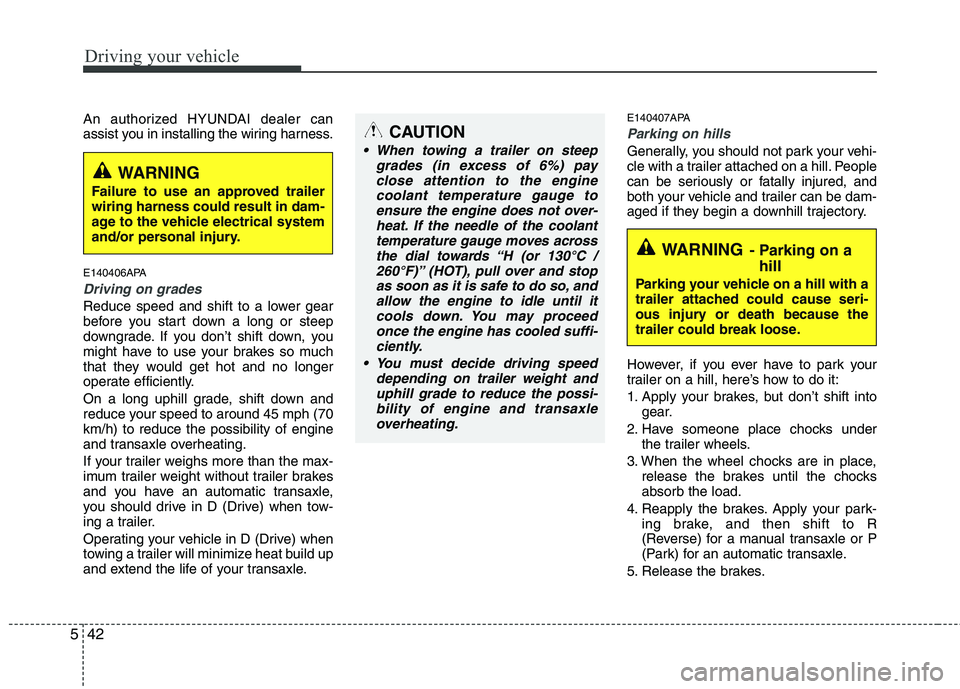
An authorized HYUNDAI dealer can
assist you in installing the wiring harness.
E140406APA
Driving on grades
Reduce speed and shift to a lower gear
before you start down a long or steep
downgrade. If you don’t shift down, you
might have to use your brakes so much
that they would get hot and no longer
operate efficiently.
On a long uphill grade, shift down and
reduce your speed to around 45 mph (70km/h) to reduce the possibility of engine
and transaxle overheating.
If your trailer weighs more than the max-
imum trailer weight without trailer brakes
and you have an automatic transaxle,
you should drive in D (Drive) when tow-
ing a trailer.
Operating your vehicle in D (Drive) when
towing a trailer will minimize heat build up
and extend the life of your transaxle. E140407APA
Parking on hills
Generally, you should not park your vehi-
cle with a trailer attached on a hill. People
can be seriously or fatally injured, and
both your vehicle and trailer can be dam-
aged if they begin a downhill trajectory.
However, if you ever have to park your
trailer on a hill, here’s how to do it:
1. Apply your brakes, but don’t shift into
gear.
2. Have someone place chocks under the trailer wheels.
3. When the wheel chocks are in place, release the brakes until the chocks absorb the load.
4. Reapply the brakes. Apply your park- ing brake, and then shift to R
(Reverse) for a manual transaxle or P
(Park) for an automatic transaxle.
5. Release the brakes.
WARNING
Failure to use an approved trailer wiring harness could result in dam-
age to the vehicle electrical system
and/or personal injury.
CAUTION
When towing a trailer on steep grades (in excess of 6%) pay
close attention to the enginecoolant temperature gauge toensure the engine does not over- heat. If the needle of the coolant
temperature gauge moves acrossthe dial towards “H (or 130°C /260°F)” (HOT), pull over and stop
as soon as it is safe to do so, andallow the engine to idle until it cools down. You may proceedonce the engine has cooled suffi-
ciently.
You must decide driving speed depending on trailer weight anduphill grade to reduce the possi-bility of engine and transaxle
overheating.
WARNING - Parking on a
hill
Parking your vehicle on a hill with a
trailer attached could cause seri-
ous injury or death because the
trailer could break loose.
Page 235 of 354
543
Driving your vehicle
When you are ready to leave after park-
ing on a hill
1. With the manual transaxle in Neutralor automatic transaxle in P (Park),
apply your brakes and hold the brake
pedal down while you:
and
2. Slowly remove your foot from the brake pedal.
3. Drive slowly until the trailer is clear of the chocks.
4. Stop and have someone pick up and store the chocks. E140500APA
Maintenance when trailer towing
Your vehicle will need service more often
when you regularly pull a trailer.
Important items to pay particular atten-tion to include engine oil, automatic
transaxle fluid, axle lubricant and cooling
system fluid. Brake condition is another
important item to frequently check. Each
item is covered in this manual, and the
Index will help you find them quickly. If
you’re trailering, it’s a good idea to review
these sections before you start your trip.
Don’t forget to also maintain your trailer
and hitch. Follow the maintenance
schedule that accompanied your trailer
and check it periodically. Preferably, con-
duct the check at the start of each day’s
driving. Most importantly, all hitch nutsand bolts should be tight.
WARNING
- Parking brake
It can be dangerous to get out of
your vehicle if the parking brake is
not firmly set.
If you have left the engine running,
the vehicle can move suddenly. You
or others could be seriously or
fatally injured.CAUTION
Due to higher load during trailer usage, overheating might occur
in hot days or during uphill driv- ing. If the coolant gauge indicatesover-heating, switch off the A/Cand stop the vehicle in a safe area
to cool down the engine.
When towing check the transaxle fluid more frequently.
If your vehicle is not equipped with air conditioner, you should
install a condenser fan to improveengine performance when towinga trailer.
Page 244 of 354
What to do in an emergency
6
6
IF THE ENGINE OVERHEATS
F050000APA
If your temperature gauge indicates over-
heating, you experience a loss of power,
or hear loud pinging or knocking, the
engine is probably too hot. If this hap-
pens, you should:
1. Pull off the road and stop as soon as it is safe to do so.
2. Place the gear selector lever in P (auto- matic transaxle) or Neutral (manual
transaxle) and set the parking brake. If
the air conditioning is on, turn it off.
3. If engine coolant is running out under the car or steam is coming out from
the hood, stop the engine. Do not openthe hood until the coolant has stopped
running or the steaming has stopped.
If there is no visible loss of engine
coolant and no steam, leave the
engine running and check to be sure
the engine cooling fan is operating. If
the fan is not running, turn the engine
off. 4. Check to see if the water pump drive
belt is missing. If it is not missing,
check to see that it is tight. If the drive
belt seems to be satisfactory, check for
coolant leaking from the radiator,
hoses or under the car. (If the air con-
ditioning had been in use, it is normal
for cold water to be draining from it
when you stop).
5. If the water pump drive belt is broken or engine coolant is leaking out, stop the engine immediately and call the
nearest authorized HYUNDAI dealer
for assistance. 6. If you cannot find the cause of the
overheating, wait until the engine tem-
perature has returned to normal. Then,if coolant has been lost, carefully add
coolant to the reservoir to bring the
fluid level in the reservoir up to the
halfway mark.
7. Proceed with caution, keeping alert for further signs of overheating. If over-heating happens again, call an author-
ized HYUNDAI dealer for assistance.
WARNING
While the engine is running, keep
hair, hands and clothing away from
moving parts such as the fan and
drive belts to prevent injury.
WARNING
Do not remove the radiator cap
when the engine is hot. This can
allow coolant to be blown out of the
opening and cause serious burns.
CAUTION
Serious loss of coolant indicates there is a leak in the cooling systemand this should be checked as soonas possible by an authorized HYUNDAI dealer.
Page 263 of 354
7
Engine compartment ............................................ 7-2
Maintenance services ............................................ 7-5
Owner maintenance .............................................. 7-7
Scheduled maintenance service ........................... 7-9
Explanation of scheduled maintenance items .. 7-22
Engine oil ............................................................. 7-25
Engine coolant ..................................................... 7-27
Brakes/clutch fluid ............................................. 7-29
Automatic transaxle fluid .................................. 7-30
Washer fluid ........................................................ 7-32
Parking brake .................................................... 7-32
Air cleaner ........................................................... 7-33
Climate control air filter .................................... 7-35
Wiper blades ....................................................... 7-36
Battery ................................................................. 7-39
Tires and wheels ................................................. 7-41
Fuses ..................................................................... 7-51
Light bulbs .......................................................... 7-63
Appearance care ................................................. 7-71
Emission control system ..................................... 7-78
Maintenance
Page 264 of 354
Maintenance
2
7
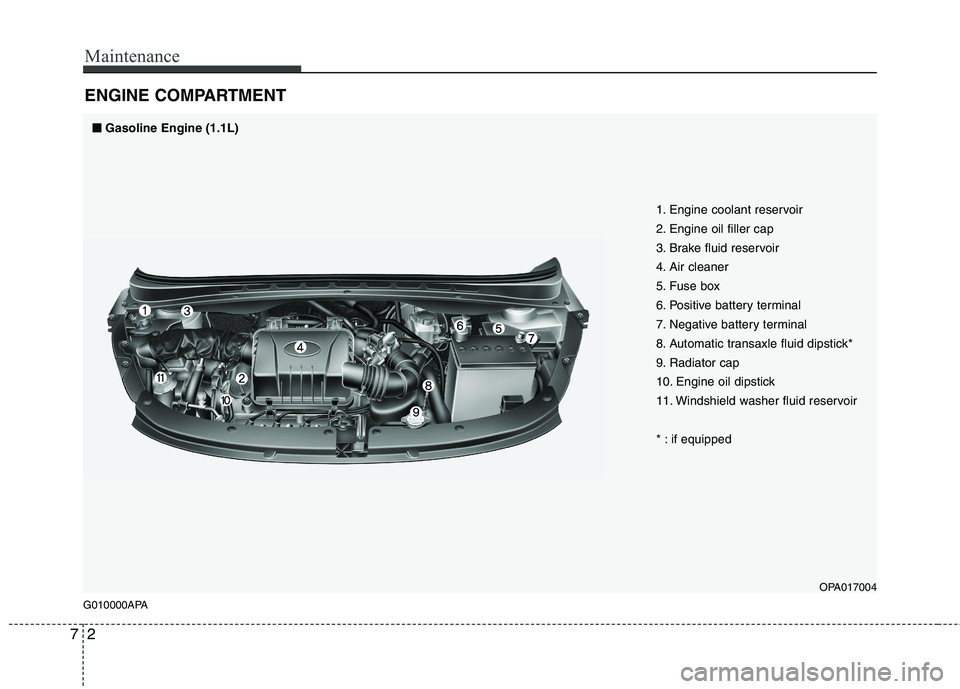
ENGINE COMPARTMENT
G010000APA
OPA017004
1. Engine coolant reservoir
2. Engine oil filler cap
3. Brake fluid reservoir
4. Air cleaner
5. Fuse box
6. Positive battery terminal
7. Negative battery terminal
8. Automatic transaxle fluid dipstick*
9. Radiator cap
10. Engine oil dipstick
11. Windshield washer fluid reservoir
* : if equipped
■
■
Gasoline Engine (1.1L)
Page 265 of 354
73
Maintenance
OPA079102
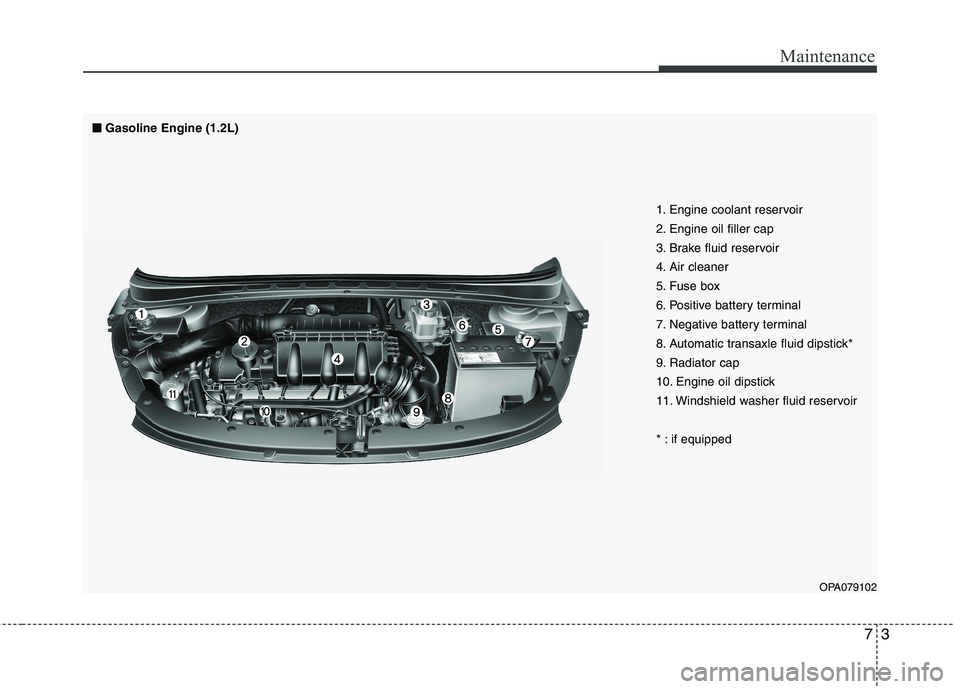
1. Engine coolant reservoir
2. Engine oil filler cap
3. Brake fluid reservoir
4. Air cleaner
5. Fuse box
6. Positive battery terminal
7. Negative battery terminal
8. Automatic transaxle fluid dipstick*
9. Radiator cap
10. Engine oil dipstick
11. Windshield washer fluid reservoir
* : if equipped
■
■
Gasoline Engine (1.2L)
Page 266 of 354
Maintenance
4
7
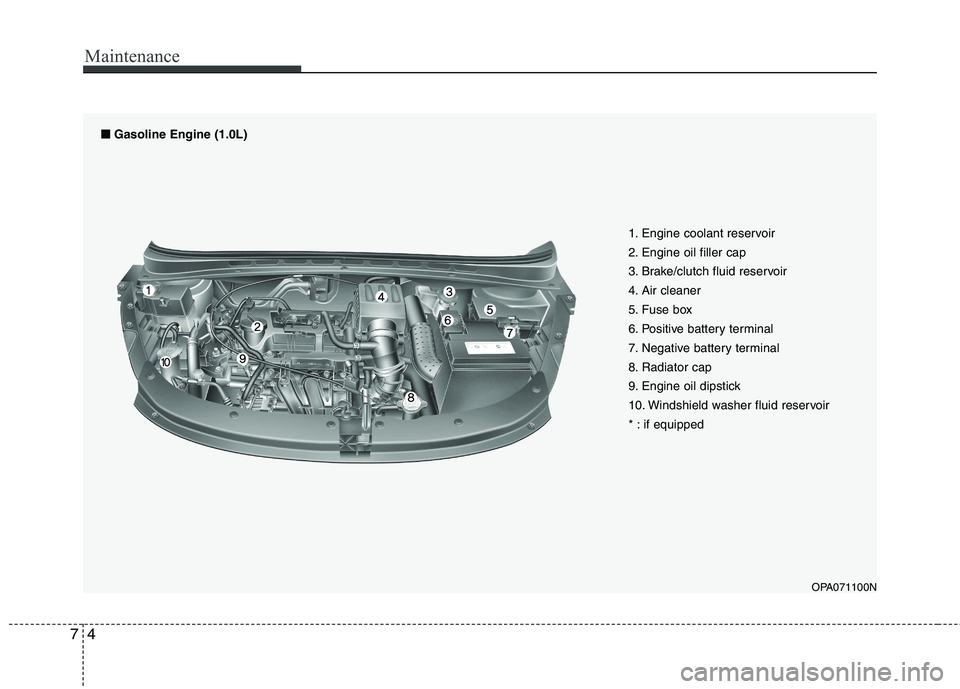
1. Engine coolant reservoir
2. Engine oil filler cap
3. Brake/clutch fluid reservoir
4. Air cleaner
5. Fuse box
6. Positive battery terminal
7. Negative battery terminal
8. Radiator cap
9. Engine oil dipstick
10. Windshield washer fluid reservoir
* : if equipped
■
■
Gasoline Engine (1.0L)
OPA071100N
Page 269 of 354
77
Maintenance
OWNER MAINTENANCE
G030000AEN
The following lists are vehicle checks and
inspections that should be performed by
the owner or an authorized HYUNDAIdealer at the frequencies indicated to
help ensure safe, dependable operation
of your vehicle.
Any adverse conditions should be
brought to the attention of your dealer as
soon as possible.
These Owner Maintenance Checks are
generally not covered by warranties and
you may be charged for labor, parts and
lubricants used. Owner maintenance schedule
G030101AUN
When you stop for fuel:
Check the engine oil level.
Check coolant level in coolant reser-
voir.
Check the windshield washer fluid level.
Look for low or under-inflated tires. G030102AUN
While operating your vehicle:
Note any changes in the sound of the
exhaust or any smell of exhaust fumes
in the vehicle.
Check for vibrations in the steering wheel. Notice any increased steering
effort or looseness in the steering
wheel, or change in its straight-aheadposition.
Notice if your vehicle constantly turns slightly or “pulls” to one side when trav-
eling on smooth, level road.
When stopping, listen and check for unusual sounds, pulling to one side,
increased brake pedal travel or “hard-
to-push” brake pedal.
If any slipping or changes in the oper- ation of your transaxle occurs, check
the transaxle fluid level.
Check automatic transaxle P (Park) function.
Check parking brake.
Check for fluid leaks under your vehicle (water dripping from the air condition-
ing system during or after use is nor-mal).
WARNING
Be careful when checking your
engine coolant level when the
engine is hot. Scalding hot coolant
and steam may blow out under
pressure. This could cause burns
or other serious injury.
Page 270 of 354
Maintenance
8
7
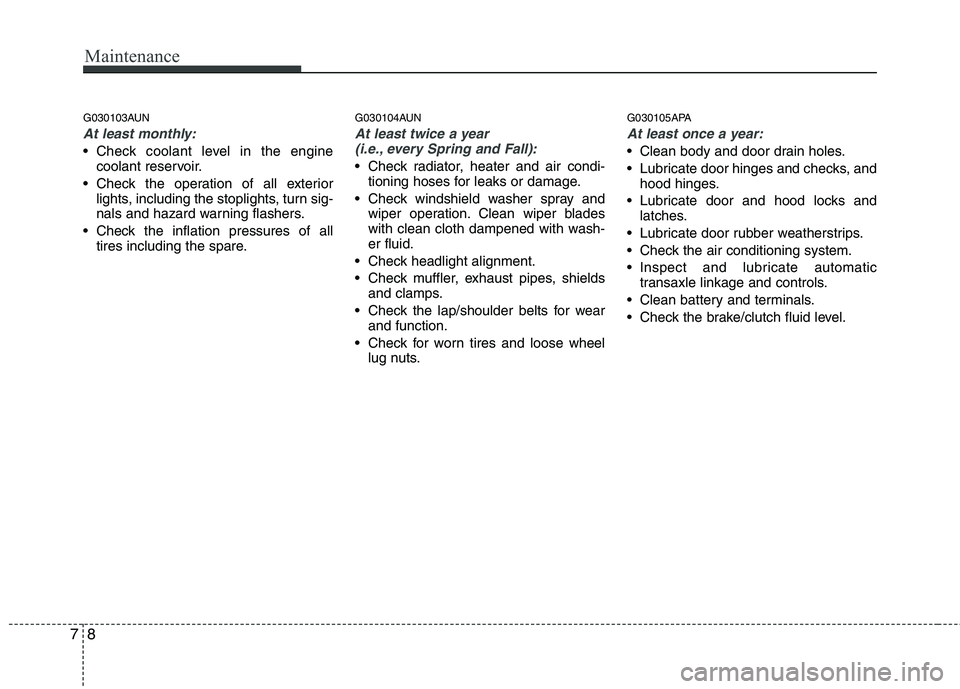
G030103AUN
At least monthly:
Check coolant level in the engine
coolant reservoir.
Check the operation of all exterior lights, including the stoplights, turn sig-
nals and hazard warning flashers.
Check the inflation pressures of all tires including the spare. G030104AUN
At least twice a year
(i.e., every Spring and Fall):
Check radiator, heater and air condi- tioning hoses for leaks or damage.
Check windshield washer spray and wiper operation. Clean wiper blades
with clean cloth dampened with wash-er fluid.
Check headlight alignment.
Check muffler, exhaust pipes, shields and clamps.
Check the lap/shoulder belts for wear and function.
Check for worn tires and loose wheel lug nuts. G030105APA
At least once a year:
Clean body and door drain holes.
Lubricate door hinges and checks, and
hood hinges.
Lubricate door and hood locks and latches.
Lubricate door rubber weatherstrips.
Check the air conditioning system.
Inspect and lubricate automatic transaxle linkage and controls.
Clean battery and terminals.
Check the brake/clutch fluid level.
Page 273 of 354
711
Maintenance
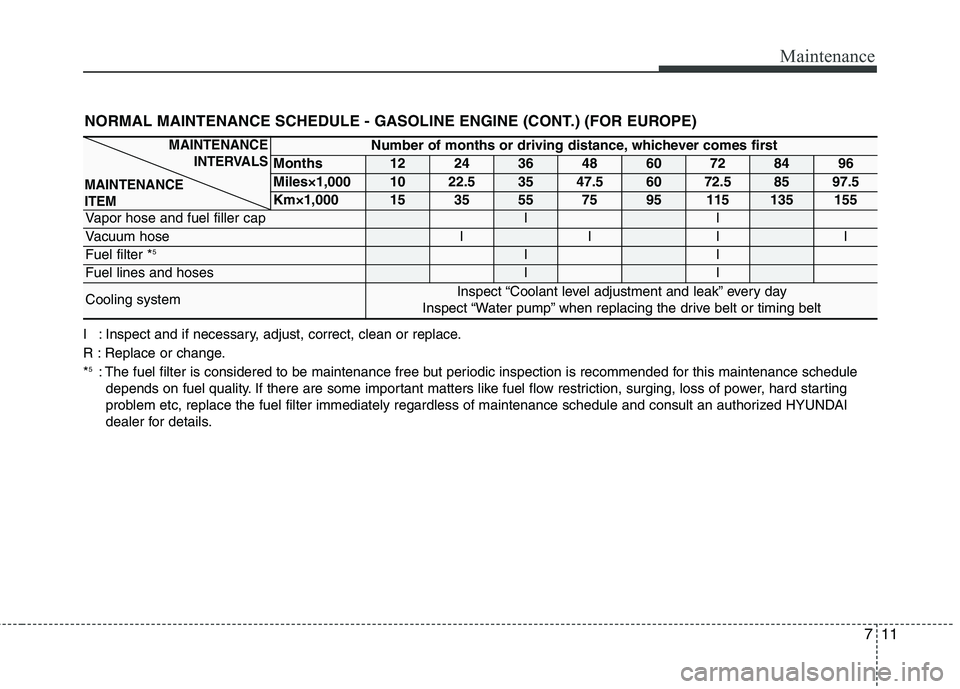
I : Inspect and if necessary, adjust, correct, clean or replace.
R : Replace or change.*5
: The fuel filter is considered to be maintenance free but periodic inspection is recommended for this maintenance schedule
depends on fuel quality. If there are some important matters like fuel flow restriction, surging, loss of power, hard starting
problem etc, replace the fuel filter immediately regardless of maintenance schedule and consult an authorized HYUNDAI
dealer for details.
NORMAL MAINTENANCE SCHEDULE - GASOLINE ENGINE (CONT.) (FOR EUROPE)
Number of months or driving distance, whichever comes first
Months1224364860728496
Miles×1,0001022.53547.56072.58597.5
Km×1,0001535557595115135155
Vapor hose and fuel filler capII
Vacuum hoseIIII
Fuel filter *
5II
Fuel lines and hosesII
Cooling systemInspect “Coolant level adjustment and leak” every day
Inspect “Water pump” when replacing the drive belt or timing belt
MAINTENANCE INTERVALS
MAINTENANCE ITEM