check oil HYUNDAI I10 2008 User Guide
[x] Cancel search | Manufacturer: HYUNDAI, Model Year: 2008, Model line: I10, Model: HYUNDAI I10 2008Pages: 354, PDF Size: 37.04 MB
Page 278 of 354

Maintenance
16
7
I : Inspect and if necessary, adjust, correct, clean or replace.
R : Replace or change.* 1
: Adjust alternator and power steering (and water pump drive belt) and air conditioner drive belt (if equipped). Inspect and if n ec-
essary correct or replace.
* 2
: Check the engine oil level and leak every 500 km (350 miles) or before starting a long trip.
* 3
: For your convenience, it can be replaced prior to it's interval when you do maintenance of other items.
** : Driving in summer season temperature over 40°C (104°F - SAUDI, UAE, OMAN, KUWAIT, BAHRAIN, QATAR, IRAN,YEMEN ETC) or driving over 170 km/h (106 mile/h) must conform the severe driving condition.
MAINTENANCE INTERVALS
MAINTENANCE ITEM
Replace every 40,000 km (25,000 miles) * 3
G040100APA
NORMAL MAINTENANCE SCHEDULE - GASOLINE ENGINE (EXCEPT EUROPE)
Replace every 10,000 km (6,000 miles) or 12 months **
Replace every 50,000 km (3,000 miles) or 6 months
Replace every 135,000 km (85,000 miles) or 108 months
Number of months or driving distance, whichever comes first
Months 12 24 36 48 60 72 84 96
Miles×1,000 10 20 30 40 50 60 70 80
Km×1,000 15 30 45 60 75 90 105 120
Drive belts * 1
IIII
Engine oil and For Middle East
For China
engine oil filter * 2
Except Middle East,China R R R R R R R R
Engine timing belt (1.1L)
Air cleaner filter For China, India, Middle East R R R R R R R R
Except China, India, Middle East I I R I I R I I
Spark plugs
Page 284 of 354
Maintenance
22
7
EXPLANATION OF SCHEDULED MAINTENANCE ITEMS
G050100APA Engine oil and filter
The engine oil and filter (including drain
plug gasket) should be changed at the
intervals specified in the maintenance
schedule. If the car is being driven in
severe conditions, more frequent oil andfilter changes are required.
G050200AUN Drive belts
Inspect all drive belts for evidence of
cuts, cracks, excessive wear or oil satu-
ration and replace if necessary. Drive
belts should be checked periodically forproper tension and adjusted as neces-
sary. G050500AUN Timing belt (if equipped)
Inspect all parts related to the timing belt
for damage and deformation. Replace
any damaged parts immediately. G050300AEN
Fuel filter (cartridge) A clogged filter can limit the speed at
which the vehicle may be driven, damage
the emission system and cause multiple
issues such as hard starting. If an exces-
sive amount of foreign matter accumu-
lates in the fuel tank, the filter may
require replacement more frequently.
After installing a new filter, run the engine
for several minutes, and check for leaks
at the connections. Fuel filters should be
installed by an authorized HYUNDAI
dealer.G050400AEN
Fuel lines, fuel hoses and con- nections
Check the fuel lines, fuel hoses and con-
nections for leakage and damage. Have
an authorized HYUNDAI dealer replace
any damaged or leaking parts immedi-
ately.
Page 287 of 354
725
Maintenance
ENGINE OIL
G060100AEN
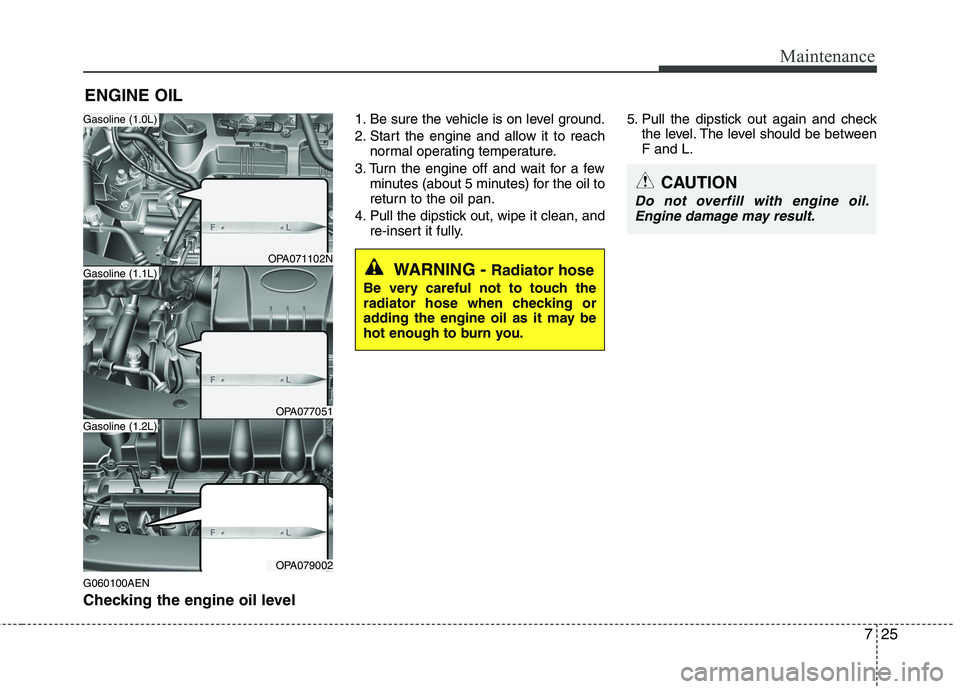
Checking the engine oil level 1. Be sure the vehicle is on level ground.
2. Start the engine and allow it to reach
normal operating temperature.
3. Turn the engine off and wait for a few minutes (about 5 minutes) for the oil to
return to the oil pan.
4. Pull the dipstick out, wipe it clean, and re-insert it fully. 5. Pull the dipstick out again and check
the level. The level should be betweenF and L.
WARNING - Radiator hose
Be very careful not to touch the
radiator hose when checking or
adding the engine oil as it may be
hot enough to burn you.
CAUTION
Do not overfill with engine oil. Engine damage may result.
OPA071102N
OPA077051
OPA079002
Gasoline (1.1L)
Gasoline (1.0L)
Gasoline (1.2L)
Page 291 of 354
729
Maintenance
BRAKE/CLUTCH FLUID
G080100APA
Checking the brake/clutch fluid
level
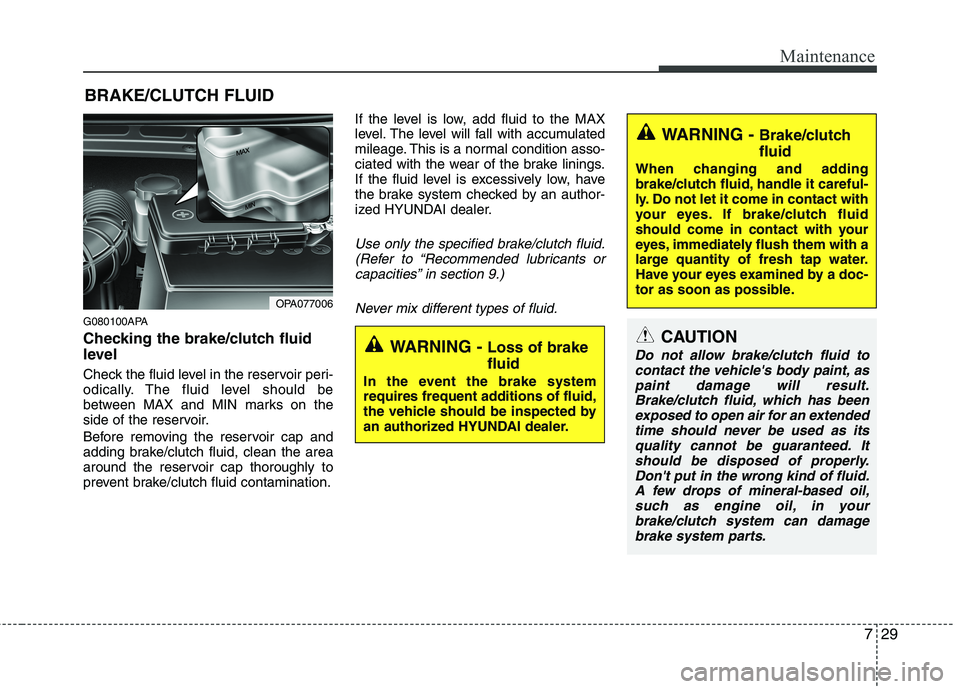
Check the fluid level in the reservoir peri-
odically. The fluid level should be
between MAX and MIN marks on the
side of the reservoir.
Before removing the reservoir cap and
adding brake/clutch fluid, clean the area
around the reservoir cap thoroughly to
prevent brake/clutch fluid contamination. If the level is low, add fluid to the MAX
level. The level will fall with accumulated
mileage. This is a normal condition asso-
ciated with the wear of the brake linings.
If the fluid level is excessively low, have
the brake system checked by an author-
ized HYUNDAI dealer.
Use only the specified brake/clutch fluid.
(Refer to “Recommended lubricants orcapacities” in section 9.)
Never mix different types of fluid.
OPA077006
WARNING - Loss of brake fluid
In the event the brake system
requires frequent additions of fluid,
the vehicle should be inspected by
an authorized HYUNDAI dealer.
WARNING - Brake/clutch fluid
When changing and adding
brake/clutch fluid, handle it careful-
ly. Do not let it come in contact with
your eyes. If brake/clutch fluid
should come in contact with your
eyes, immediately flush them with a
large quantity of fresh tap water.
Have your eyes examined by a doc-
tor as soon as possible.
CAUTION
Do not allow brake/clutch fluid to contact the vehicle's body paint, aspaint damage will result. Brake/clutch fluid, which has been exposed to open air for an extendedtime should never be used as its
quality cannot be guaranteed. Itshould be disposed of properly. Don't put in the wrong kind of fluid.A few drops of mineral-based oil,
such as engine oil, in your brake/clutch system can damagebrake system parts.
Page 302 of 354
Maintenance
40
7
G190200AUN
Battery recharging
Your vehicle has a maintenance-free,
calcium-based battery.
If the battery becomes discharged in a
short time (because, for example, the
headlights or interior lights were left on
while the vehicle was not in use),
recharge it by slow charging (trickle)
for 10 hours.
If the battery gradually discharges because of high electric load while the
vehicle is being used, recharge it at 20-
30A for two hours. G190300APA Reset items
Items should be reset after the battery
has been discharged or the battery hasbeen disconnected.
Sunroof (See section 4)
Digital clock (See section 4)
Audio (See section 4)
(Continued)
The electrical ignition system
works with high voltage. Never
touch these components with theengine running or the ignition
switched on.
Failure to follow the above warn-
ings can result in serious bodily
injury or death.(Continued)
Before performing maintenance or recharging the battery, turn off all accessories and stop the
engine.
The negative battery cable must be removed first and installed
last when the battery is discon-nected.WARNING - Recharging
battery
When recharging the battery,
observe the following precautions:
The battery must be removed from the vehicle and placed in an area with good ventilation.
Do not allow cigarettes, sparks, or flame near the battery.
Watch the battery during charg- ing, and stop or reduce the charg-
ing rate if the battery cells begin
gassing (boiling) violently or if
the temperature of the electrolyte
of any cell exceeds 49°C (120°F).
Wear eye protection when check- ing the battery during charging.
Disconnect the battery charger in the following order.
1. Turn off the battery charger main switch.
2. Unhook the negative clamp from the negative battery terminal.
3. Unhook the positive clamp from the positive battery terminal.
(Continued)
Page 338 of 354
Maintenance
76
7
Keep paint and trim in good condition
Scratches or chips in the finish should be
covered with "touch-up" paint as soon as
possible to reduce the possibility of cor-
rosion. If bare metal is showing through,the attention of a qualified body and paintshop is recommended.
Bird droppings : Bird droppings are high-
ly corrosive and may damage painted
surfaces in just a few hours. Always
remove bird droppings as soon as possi-
ble. Don't neglect the interior Moisture can collect under the floor mats
and carpeting to cause corrosion. Check
under the mats periodically to be sure
the carpeting is dry. Use particular care if
you carry fertilizers, cleaning materials or
chemicals in the car.
These should be carried only in proper
containers and any spills or leaks should
be cleaned up, flushed with clean water
and thoroughly dried. Interior care
G230201AUN
Interior general precautions
Prevent caustic solutions such as per- fume and cosmetic oil from contacting
the dashboard because they may cause
damage or discoloration. If they do con-tact the dashboard, wipe them off imme-
diately. See the instructions that follow for
the proper way to clean vinyl.
G230202AUN
Cleaning the upholstery and interior
trim
Vinyl
Remove dust and loose dirt from vinyl
with a whisk broom or vacuum cleaner.
Clean vinyl surfaces with a vinyl cleaner.
Fabric
Remove dust and loose dirt from fabric
with a whisk broom or vacuum cleaner.Clean with a mild soap solution recom-
mended for upholstery or carpets.
Remove fresh spots immediately with a
fabric spot cleaner. If fresh spots do not
receive immediate attention, the fabriccan be stained and its color can be
affected. Also, its fire-resistant properties
can be reduced if the material is not
properly maintained.
CAUTION
Never allow water or other liquidsto come in contact with
electrical/electronic componentsinside the vehicle as this may dam-age them.
CAUTION
Using anything but recommendedcleaners and procedures may affect
the fabric’s appearance and fire- resistant properties.
Page 350 of 354
95
Specifications
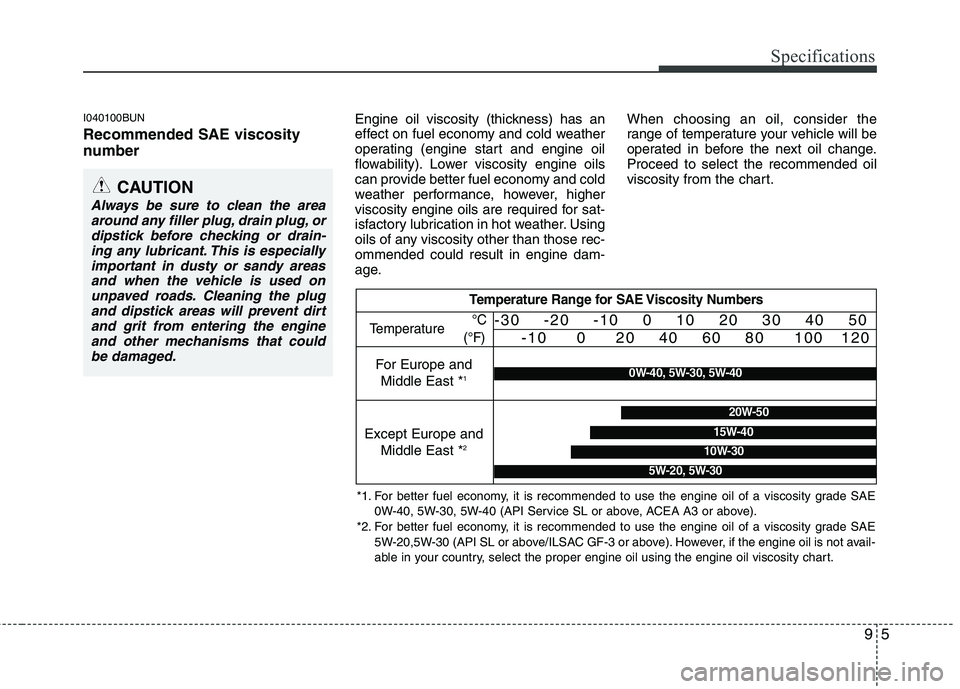
I040100BUN Recommended SAE viscosity
number Engine oil viscosity (thickness) has an
effect on fuel economy and cold weather
operating (engine start and engine oil
flowability). Lower viscosity engine oils
can provide better fuel economy and cold
weather performance, however, higher
viscosity engine oils are required for sat-
isfactory lubrication in hot weather. Using
oils of any viscosity other than those rec-ommended could result in engine dam-
age.When choosing an oil, consider the
range of temperature your vehicle will be
operated in before the next oil change.Proceed to select the recommended oil
viscosity from the chart.
CAUTION
Always be sure to clean the area
around any filler plug, drain plug, or
dipstick before checking or drain-ing any lubricant. This is especiallyimportant in dusty or sandy areas
and when the vehicle is used on unpaved roads. Cleaning the plugand dipstick areas will prevent dirt and grit from entering the engine and other mechanisms that could
be damaged.
Temperature Range for SAE Viscosity Numbers
Temperature
For Europe and
Middle East * 1
°C
(°F)-30 -20 -10 0 10 20 30 40 50 -10 0 20 40 60 80 100 120
*1. For better fuel economy, it is recommended to use the engine oil of a viscosity grade SAE0W-40, 5W-30, 5W-40 (API Service SL or above, ACEA A3 or above).
*2. For better fuel economy, it is recommended to use the engine oil of a viscosity grade SAE 5W-20,5W-30 (API SL or above/ILSAC GF-3 or above). However, if the engine oil is not avail-
able in your country, select the proper engine oil using the engine oil viscosity chart.
0W-40, 5W-30, 5W-40
Except Europe and
Middle East * 2
20W-50
10W-30
15W-40
5W-20, 5W-30