Front seat HYUNDAI I10 2010 Service Manual
[x] Cancel search | Manufacturer: HYUNDAI, Model Year: 2010, Model line: I10, Model: HYUNDAI I10 2010Pages: 354, PDF Size: 37.04 MB
Page 74 of 354
355
Safety features of your vehicle
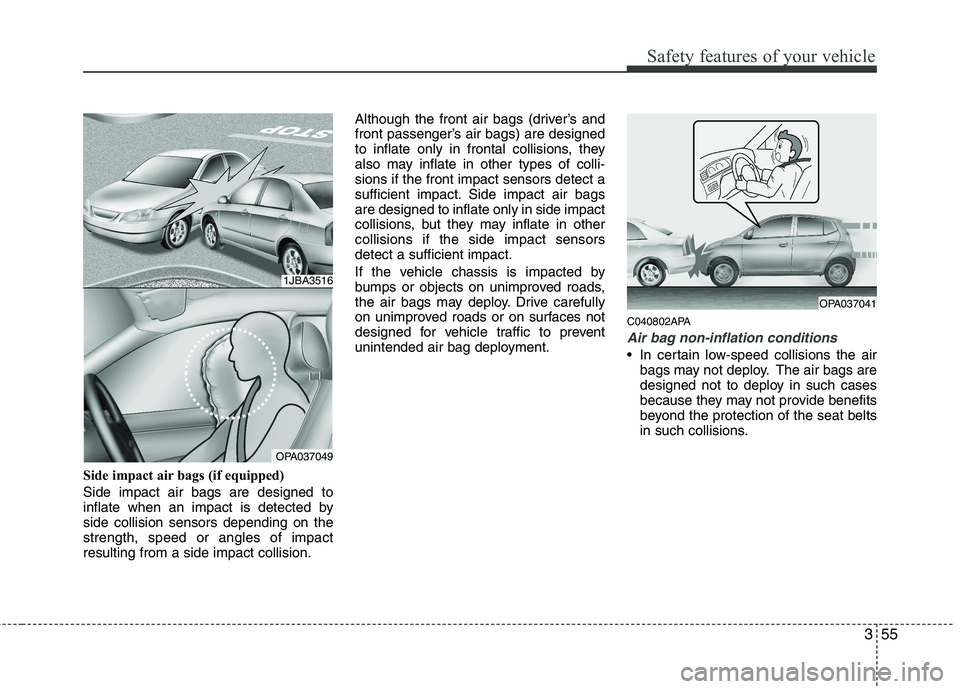
Side impact air bags (if equipped) Side impact air bags are designed to
inflate when an impact is detected byside collision sensors depending on thestrength, speed or angles of impactresulting from a side impact collision.Although the front air bags (driver’s and
front passenger’s air bags) are designed
to inflate only in frontal collisions, they
also may inflate in other types of colli-sions if the front impact sensors detect a
sufficient impact. Side impact air bagsare designed to inflate only in side impact
collisions, but they may inflate in othercollisions if the side impact sensorsdetect a sufficient impact.
If the vehicle chassis is impacted by
bumps or objects on unimproved roads,
the air bags may deploy. Drive carefully
on unimproved roads or on surfaces not
designed for vehicle traffic to prevent
unintended air bag deployment.
C040802APA
Air bag non-inflation conditions
In certain low-speed collisions the air
bags may not deploy. The air bags are
designed not to deploy in such cases
because they may not provide benefits
beyond the protection of the seat belts
in such collisions.
OPA037041
1JBA3516
OPA037049
Page 78 of 354
359
Safety features of your vehicle
C041300AUN
Additional safety precautionsNever let passengers ride in the
cargo area or on top of a folded-
down back seat. All occupants should
sit upright, fully back in their seats with
their seat belts on and their feet on the
floor.
Passengers should not move out of
or change seats while the vehicle is
moving. A passenger who is not wear-
ing a seat belt during a crash or emer-
gency stop can be thrown against the
inside of the vehicle, against other
occupants, or out of the vehicle.
Each seat belt is designed torestrain one occupant. If more than
one person uses the same seat belt,
they could be seriously injured or killedin a collision.
Do not use any accessories on seatbelts. Devices claiming to improve
occupant comfort or reposition the seat
belt can reduce the protection provided
by the seat belt and increase the
chance of serious injury in a crash.
Passengers should not place hardor sharp objects between them-
selves and the air bags. Carrying
hard or sharp objects on your lap or in
your mouth can result in injuries if an
air bag inflates.
Keep occupants away from the air
bag covers. All occupants should sit
upright, fully back in their seats with
their seat belts on and their feet on the
floor. If occupants are too close to the
air bag covers, they could be injured if
the air bags inflate.
Do not attach or place objects on or
near the air bag covers. Any object
attached to or placed on the front or
side air bag covers could interfere with
the proper operation of the air bags.
Do not modify the front seats.Modification of the front seats could
interfere with the operation of the sup-
plemental restraint system sensing
components or side air bags.
Do not place items under the frontseats. Placing items under the front
seats could interfere with the operation
of the supplemental restraint system
sensing components and wiring har-
nesses.
Never hold an infant or child on yourlap. The infant or child could be seri-
ously injured or killed in the event of a
crash. All infants and children should
be properly restrained in appropriate
child safety seats or seat belts in therear seat. C041400AUN
Adding equipment to or modifying
your air bag-equipped vehicle
If you modify your vehicle by changing
your vehicle's frame, bumper system,
front end or side sheet metal or ride
height, this may affect the operation of
your vehicle's air bag system.
WARNING
Sitting improperly or out of posi- tion can cause occupants to be
shifted too close to a deploying
air bag, strike the interior struc-
ture or be thrown from the vehicle
resulting in serious injury ordeath.
Always sit upright with the seat- back in an upright position, cen-tered on the seat cushion with
your seat belt on, legs comfort-
ably extended and your feet on
the floor.
Page 98 of 354
419
Features of your vehicle
D100100APA Opening the fuel filler lid
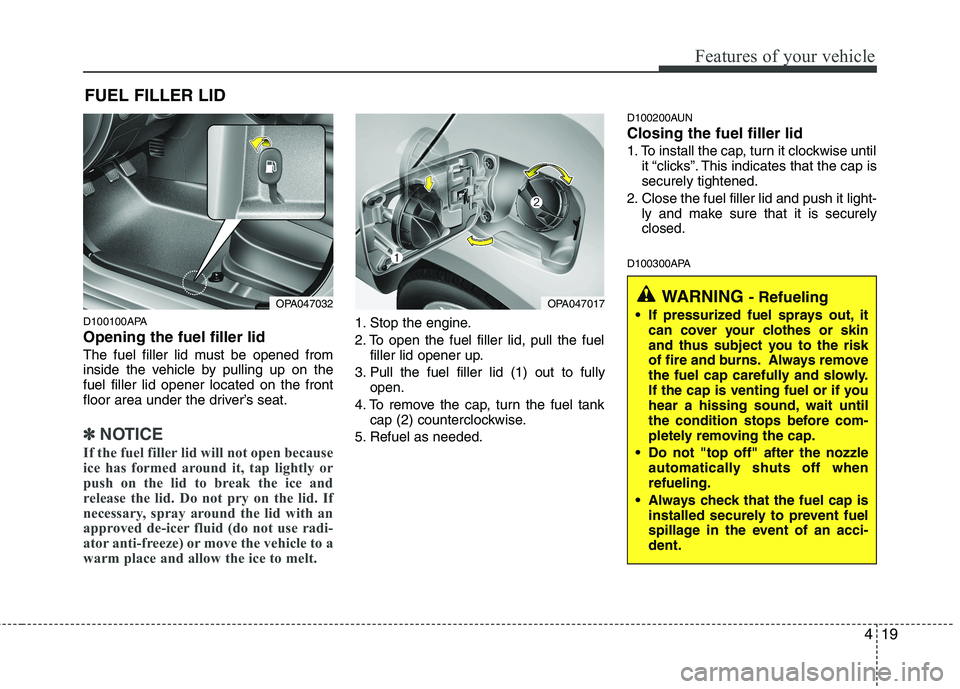
The fuel filler lid must be opened from
inside the vehicle by pulling up on thefuel filler lid opener located on the front
floor area under the driver’s seat.
✽✽NOTICE
If the fuel filler lid will not open because
ice has formed around it, tap lightly or
push on the lid to break the ice and
release the lid. Do not pry on the lid. If
necessary, spray around the lid with an
approved de-icer fluid (do not use radi-
ator anti-freeze) or move the vehicle to a
warm place and allow the ice to melt.
1. Stop the engine.
2. To open the fuel filler lid, pull the fuel filler lid opener up.
3. Pull the fuel filler lid (1) out to fully open.
4. To remove the cap, turn the fuel tank cap (2) counterclockwise.
5. Refuel as needed. D100200AUN Closing the fuel filler lid
1. To install the cap, turn it clockwise until
it “clicks”. This indicates that the cap is securely tightened.
2. Close the fuel filler lid and push it light- ly and make sure that it is securelyclosed.
D100300APA
FUEL FILLER LID
OPA047032OPA047017WARNING
- Refueling
If pressurized fuel sprays out, it can cover your clothes or skin
and thus subject you to the risk
of fire and burns. Always remove
the fuel cap carefully and slowly.
If the cap is venting fuel or if you
hear a hissing sound, wait until
the condition stops before com-
pletely removing the cap.
Do not "top off" after the nozzle automatically shuts off whenrefueling.
Always check that the fuel cap is installed securely to prevent fuel
spillage in the event of an acci-dent.
Page 137 of 354
Features of your vehicle
58
4
OPA047078/OPA047079
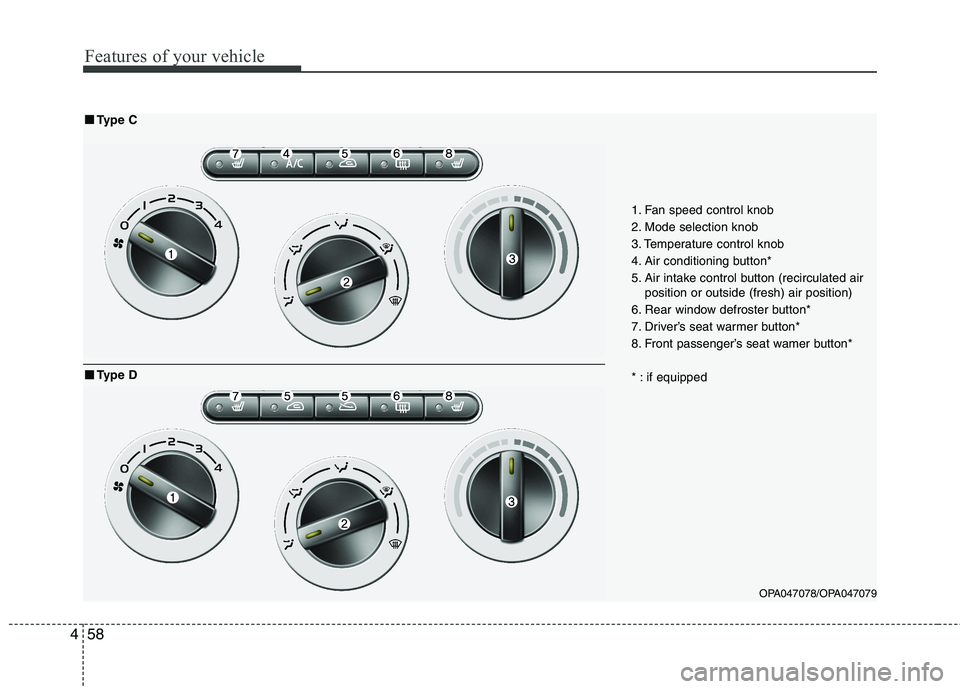
1. Fan speed control knob
2. Mode selection knob
3. Temperature control knob
4. Air conditioning button*
5. Air intake control button (recirculated air
position or outside (fresh) air position)
6. Rear window defroster button*
7. Driver’s seat warmer button*
8. Front passenger’s seat wamer button*
* : if equipped
■■ Type C
■
■ Type D
Page 205 of 354
513
Driving your vehicle
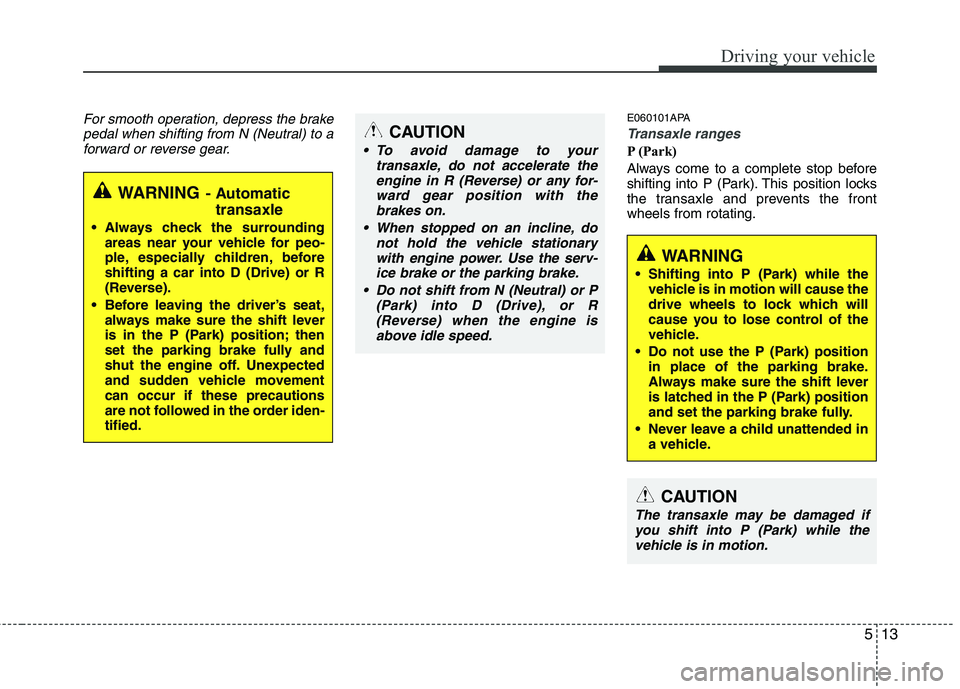
For smooth operation, depress the brakepedal when shifting from N (Neutral) to aforward or reverse gear.E060101APA
Transaxle ranges
P (Park)
Always come to a complete stop before
shifting into P (Park). This position locks
the transaxle and prevents the frontwheels from rotating.
WARNING - Automatic
transaxle
Always check the surrounding areas near your vehicle for peo-
ple, especially children, beforeshifting a car into D (Drive) or R
(Reverse).
Before leaving the driver’s seat, always make sure the shift lever
is in the P (Park) position; then
set the parking brake fully and
shut the engine off. Unexpected
and sudden vehicle movementcan occur if these precautions
are not followed in the order iden-tified.
CAUTION
To avoid damage to your
transaxle, do not accelerate the
engine in R (Reverse) or any for-ward gear position with thebrakes on.
When stopped on an incline, do not hold the vehicle stationarywith engine power. Use the serv-ice brake or the parking brake.
Do not shift from N (Neutral) or P (Park) into D (Drive), or R
(Reverse) when the engine isabove idle speed.
WARNING
Shifting into P (Park) while the vehicle is in motion will cause the
drive wheels to lock which will
cause you to lose control of the
vehicle.
Do not use the P (Park) position in place of the parking brake.
Always make sure the shift lever
is latched in the P (Park) position
and set the parking brake fully.
Never leave a child unattended in a vehicle.
CAUTION
The transaxle may be damaged if
you shift into P (Park) while thevehicle is in motion.
Page 318 of 354
Maintenance
56
7
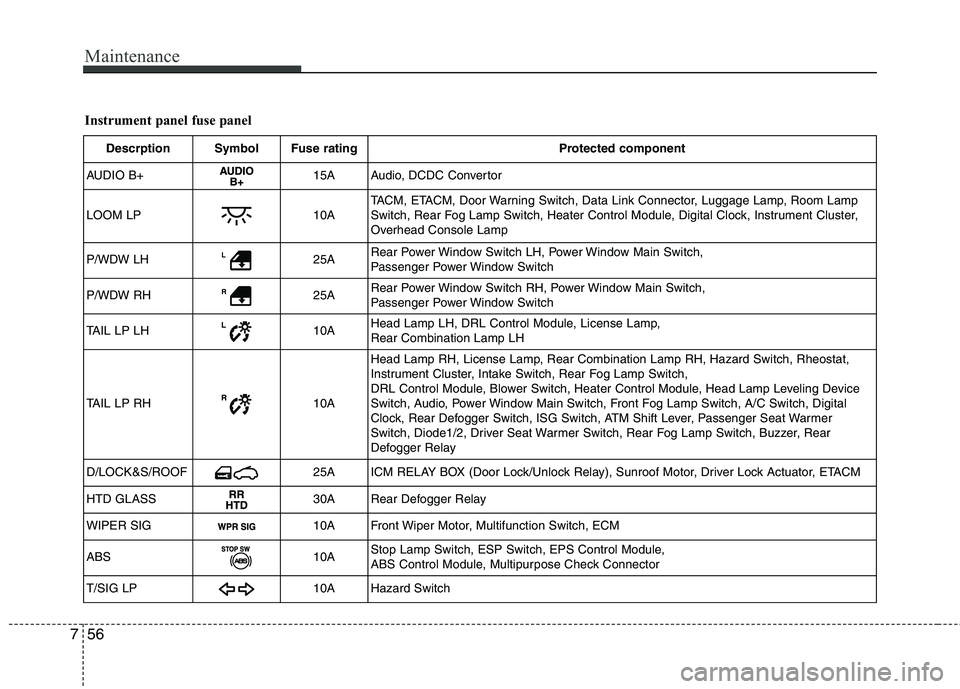
Instrument panel fuse panel
Descrption Symbol Fuse rating Protected component
AUDIO B+
15A Audio, DCDC Convertor
LOOM LP
10A TACM, ETACM, Door Warning Switch, Data Link Connector, Luggage Lamp, Room Lamp
Switch, Rear Fog Lamp Switch, Heater Control Module, Digital Clock, Instrument Cluster,
Overhead Console Lamp
P/WDW LH
25A Rear Power Window Switch LH, Power Window Main Switch,
Passenger Power Window Switch
P/WDW RH
25A Rear Power Window Switch RH, Power Window Main Switch,
Passenger Power Window Switch
TAIL LP LH
10A Head Lamp LH, DRL Control Module, License Lamp, Rear Combination Lamp LH
TAIL LP RH
10A Head Lamp RH, License Lamp, Rear Combination Lamp RH, Hazard Switch, Rheostat,
Instrument Cluster, Intake Switch, Rear Fog Lamp Switch,
DRL Control Module, Blower Switch, Heater Control Module, Head Lamp Leveling Device
Switch, Audio, Power Window Main Switch, Front Fog Lamp Switch, A/C Switch, Digital
Clock, Rear Defogger Switch, ISG Switch, ATM Shift Lever, Passenger Seat Warmer
Switch, Diode1/2, Driver Seat Warmer Switch, Rear Fog Lamp Switch, Buzzer, Rear
Defogger Relay
D/LOCK&S/ROOF
25A ICM RELAY BOX (Door Lock/Unlock Relay), Sunroof Motor, Driver Lock Actuator, ETACM
HTD GLASS
30A Rear Defogger Relay
WIPER SIG
10A Front Wiper Motor, Multifunction Switch, ECM
ABS
10A Stop Lamp Switch, ESP Switch, EPS Control Module,
ABS Control Module, Multipurpose Check Connector
T/SIG LP
10A Hazard Switch
Page 319 of 354
757
Maintenance
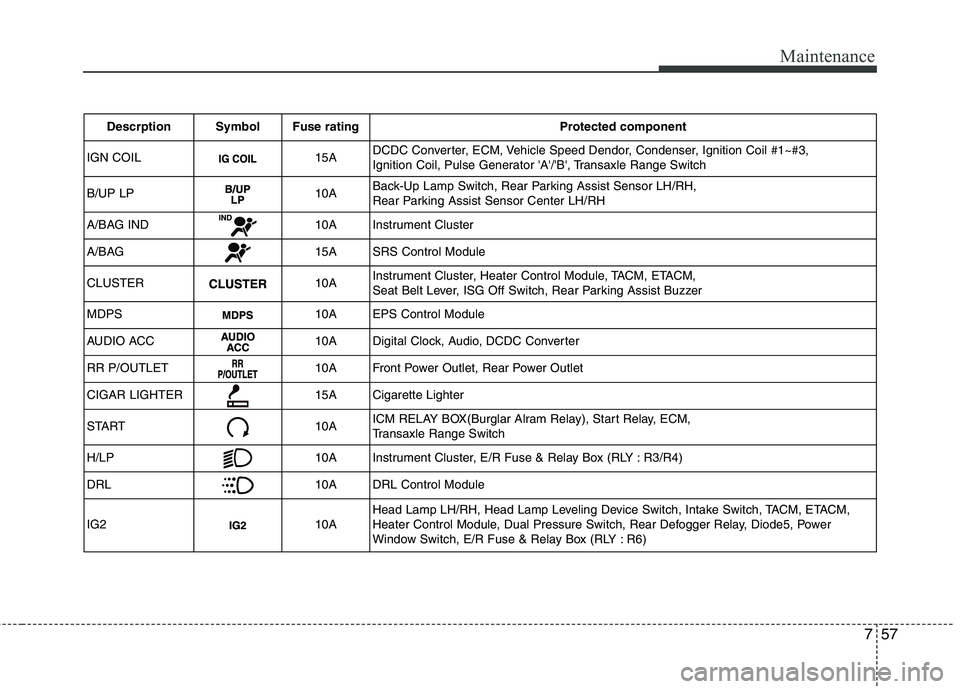
Descrption Symbol Fuse ratingProtected component
IGN COIL
15A DCDC Converter, ECM, Vehicle Speed Dendor, Condenser, Ignition Coil #1~#3,
Ignition Coil, Pulse Generator 'A'/'B', Transaxle Range Switch
B/UP LP
10A Back-Up Lamp Switch, Rear Parking Assist Sensor LH/RH,
Rear Parking Assist Sensor Center LH/RH
A/BAG IND
10A Instrument Cluster
A/BAG
15A SRS Control Module
CLUSTER
10A Instrument Cluster, Heater Control Module, TACM, ETACM,
Seat Belt Lever, ISG Off Switch, Rear Parking Assist Buzzer
MDPS
10A EPS Control Module
AUDIO ACC
10A Digital Clock, Audio, DCDC Converter
RR P/OUTLET
10A Front Power Outlet, Rear Power Outlet
CIGAR LIGHTER
15A Cigarette Lighter
START
10A ICM RELAY BOX(Burglar Alram Relay), Start Relay, ECM,
Transaxle Range Switch
H/LP
10A Instrument Cluster, E/R Fuse & Relay Box (RLY : R3/R4)
DRL
10A DRL Control Module
IG2
10A Head Lamp LH/RH, Head Lamp Leveling Device Switch, Intake Switch, TACM, ETACM,
Heater Control Module, Dual Pressure Switch, Rear Defogger Relay, Diode5, Power
Window Switch, E/R Fuse & Relay Box (RLY : R6)
Page 320 of 354
Maintenance
58
7
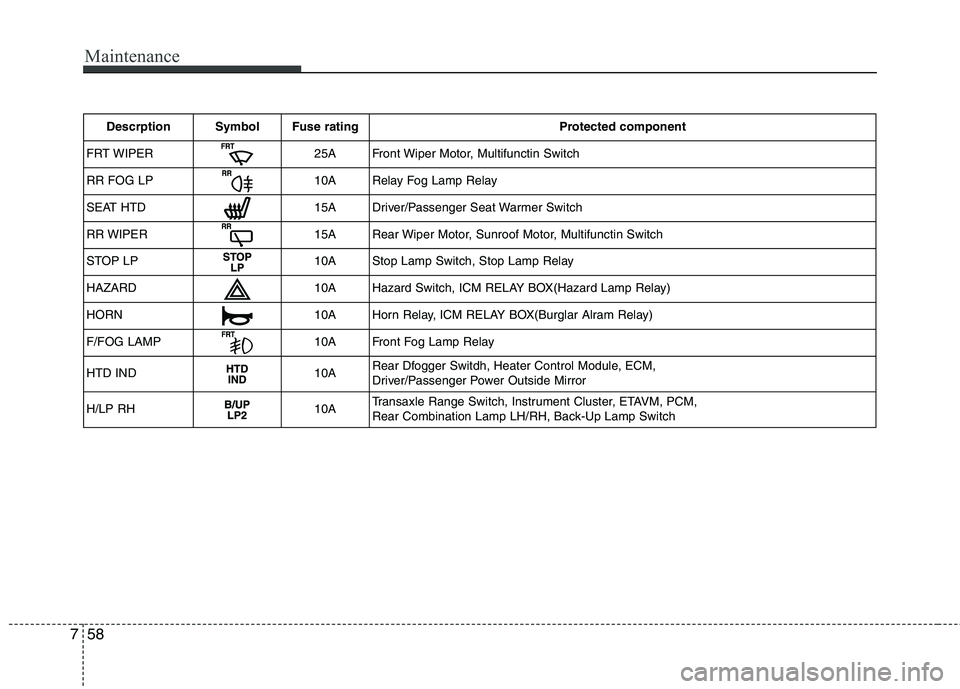
Descrption Symbol Fuse rating Protected component
FRT WIPER
25A Front Wiper Motor, Multifunctin Switch
RR FOG LP
10A Relay Fog Lamp Relay
SEAT HTD
15A Driver/Passenger Seat Warmer Switch
RR WIPER
15A Rear Wiper Motor, Sunroof Motor, Multifunctin Switch
STOP LP
10A Stop Lamp Switch, Stop Lamp Relay
HAZARD
10A Hazard Switch, ICM RELAY BOX(Hazard Lamp Relay)
HORN
10A Horn Relay, ICM RELAY BOX(Burglar Alram Relay)
F/FOG LAMP
10A Front Fog Lamp Relay
HTD IND
10A Rear Dfogger Switdh, Heater Control Module, ECM,
Driver/Passenger Power Outside Mirror
H/LP RH
10A Transaxle Range Switch, Instrument Cluster, ETAVM, PCM,
Rear Combination Lamp LH/RH, Back-Up Lamp Switch
Page 344 of 354
Consumer information
2
8
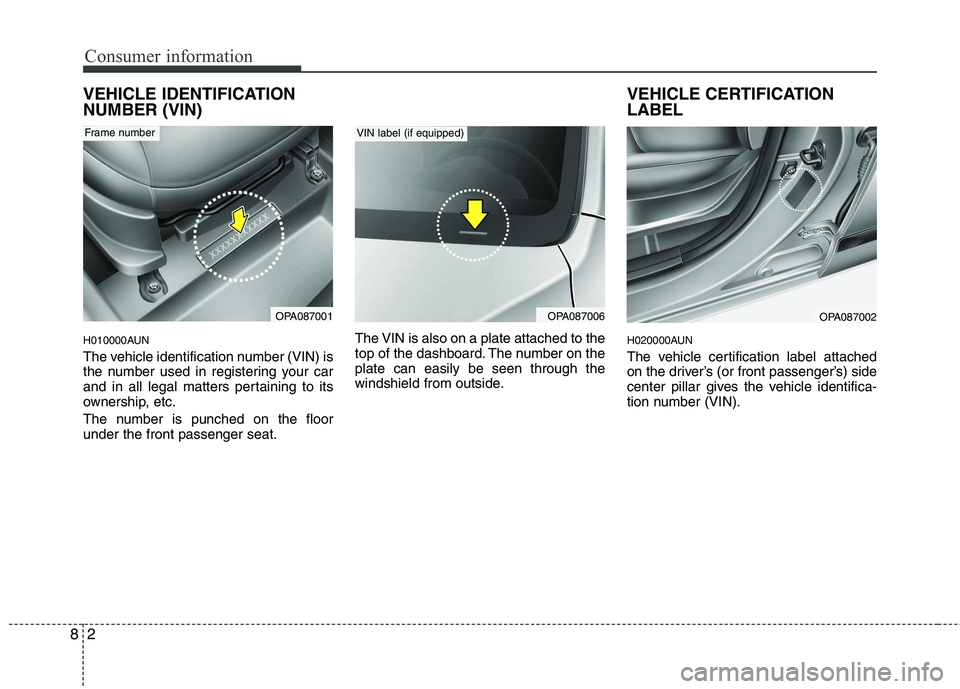
VEHICLE IDENTIFICATION NUMBER (VIN)
H010000AUN
The vehicle identification number (VIN) is
the number used in registering your car
and in all legal matters pertaining to its
ownership, etc.
The number is punched on the floor under the front passenger seat. The VIN is also on a plate attached to the
top of the dashboard. The number on theplate can easily be seen through the
windshield from outside.VEHICLE CERTIFICATION LABEL
H020000AUN
The vehicle certification label attached
on the driver’s (or front passenger’s) side
center pillar gives the vehicle identifica-
tion number (VIN).
OPA087001
Frame number
OPA087006
VIN label (if equipped)
OPA087002