ignition HYUNDAI I10 2012 Repair Manual
[x] Cancel search | Manufacturer: HYUNDAI, Model Year: 2012, Model line: I10, Model: HYUNDAI I10 2012Pages: 354, PDF Size: 37.04 MB
Page 255 of 354
617
What to do in an emergency
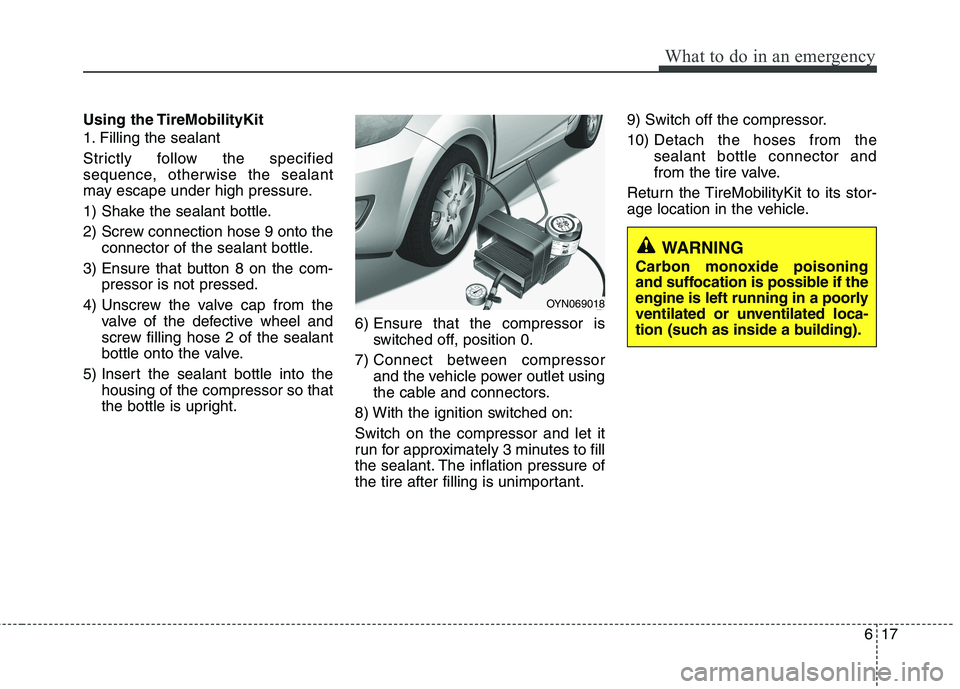
Using the TireMobilityKit
1. Filling the sealant
Strictly follow the specified
sequence, otherwise the sealant
may escape under high pressure.
1) Shake the sealant bottle.
2) Screw connection hose 9 onto theconnector of the sealant bottle.
3) Ensure that button 8 on the com- pressor is not pressed.
4) Unscrew the valve cap from the valve of the defective wheel and
screw filling hose 2 of the sealant
bottle onto the valve.
5) Insert the sealant bottle into the housing of the compressor so that
the bottle is upright. 6) Ensure that the compressor is
switched off, position 0.
7) Connect between compressor and the vehicle power outlet using
the cable and connectors.
8) With the ignition switched on: Switch on the compressor and let it
run for approximately 3 minutes to fill
the sealant. The inflation pressure of
the tire after filling is unimportant. 9) Switch off the compressor. 10)
Detach the hoses from the sealant bottle connector and
from the tire valve.
Return the TireMobilityKit to its stor-
age location in the vehicle.
WARNING
Carbon monoxide poisoning
and suffocation is possible if the
engine is left running in a poorly
ventilated or unventilated loca-
tion (such as inside a building).
OYN069018
Page 256 of 354
What to do in an emergency
18
6
Distributing the sealant
Immediately drive approximately 3
km (2 miles) to evenly distribute the
sealant in the tire. Producing the tire inflation pres- sure
1) After driving approximately 3 km
(2 miles), stop at a suitable loca- tion.
2) Connect connection hose 9 of the compressor directly to the tire
valve.
3) Connect between compressor and the vehicle power outlet using
the cable and connectors.
4) Adjust the tire inflation pressure to 230 kPa (33 psi). With the ignition
switched on, proceed as follows.
- To increase the inflation pres- sure: Switch on the compressor,
position I. To check the current
inflation pressure setting, briefly
switch off the compressor. - To reduce the inflation pres-
sure: Press the button 8 on the
compressor.
WARNING
Do not let the compressor run for
more than 10 minutes, otherwise
the device will overheat and may
be damaged.
WARNING
The tire inflation pressure must
be at least 230 kPa (33 psi). If it is
not, do not continue driving. Call
for road side service or towing.
CAUTION
Do not exceed a speed of 60 km/h (35 mph). If possible, donot fall below a speed of 20 km/h (12 mph).
While driving, if you experienceany unusual vibration, ride dis-turbance or noise, reduce yourspeed and drive with caution until you can safely pull off ofthe side of the road.
Call for road side service or tow-ing.
CAUTION
If the inflation pressure is notmaintained, drive the vehicle asecond time, refer to Distributing the sealant. Then repeat steps 1to 4.
Use of the TireMobilityKit maybe ineffectual for tire damagelarger than approximately 4 mm (0.16 in).
Please contact the nearestHYUNDAI A/S center, or a work-shop that works according toHYUNDAI repair procedures with correspondingly trainedpersonnel if the tire cannot bemade roadworthy with the TireMobilityKit.
Page 259 of 354
621
What to do in an emergency
When towing your vehicle in an emer- gency without wheel dollies :
1. Set the ignition switch in the ACC posi-tion.
2. Place the transaxle shift lever in N (Neutral).
3. Release the parking brake.
F080200APA
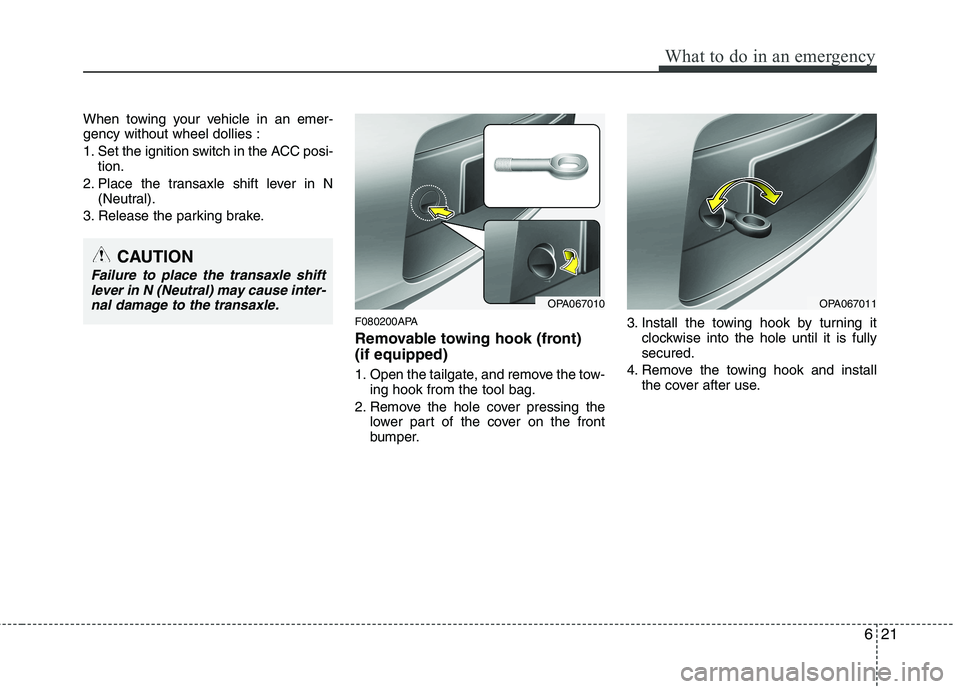
Removable towing hook (front) (if equipped)
1. Open the tailgate, and remove the tow-ing hook from the tool bag.
2. Remove the hole cover pressing the lower part of the cover on the front
bumper. 3. Install the towing hook by turning it
clockwise into the hole until it is fullysecured.
4. Remove the towing hook and install the cover after use.
CAUTION
Failure to place the transaxle shift
lever in N (Neutral) may cause inter-nal damage to the transaxle.
OPA067010OPA067011
Page 261 of 354
623
What to do in an emergency
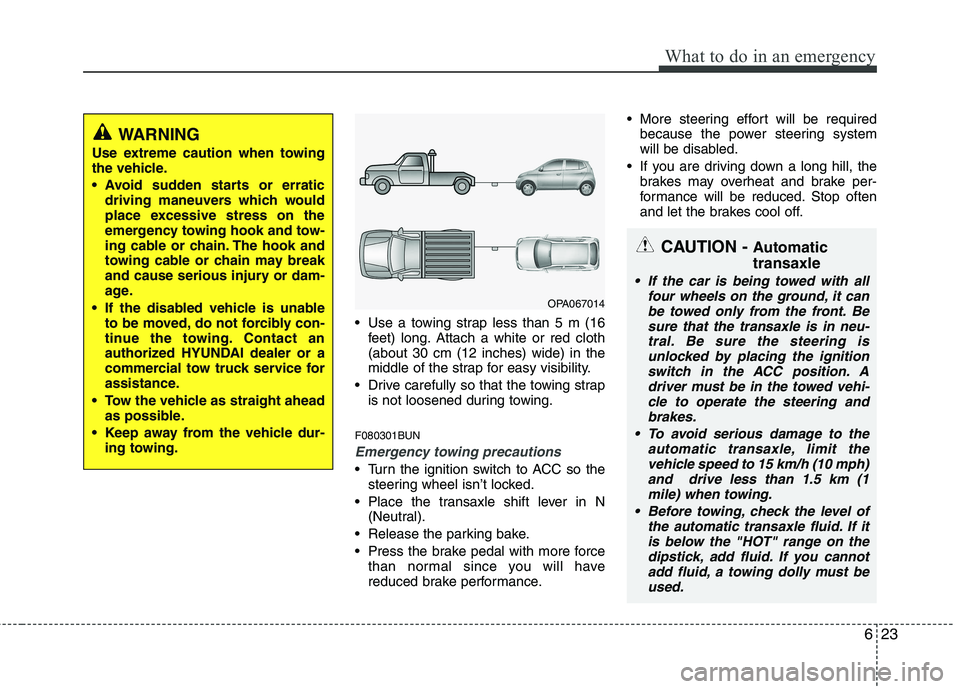
Use a towing strap less than 5 m (16feet) long. Attach a white or red cloth (about 30 cm (12 inches) wide) in the
middle of the strap for easy visibility.
Drive carefully so that the towing strap is not loosened during towing.
F080301BUN
Emergency towing precautions
Turn the ignition switch to ACC so the steering wheel isn’t locked.
Place the transaxle shift lever in N (Neutral).
Release the parking bake.
Press the brake pedal with more force than normal since you will have
reduced brake performance. More steering effort will be required
because the power steering system
will be disabled.
If you are driving down a long hill, the brakes may overheat and brake per-
formance will be reduced. Stop often
and let the brakes cool off.
WARNING
Use extreme caution when towing
the vehicle.
driving maneuvers which would
place excessive stress on the
emergency towing hook and tow-
ing cable or chain. The hook and
towing cable or chain may break
and cause serious injury or dam-
age.
If the disabled vehicle is unable to be moved, do not forcibly con-
tinue the towing. Contact an
authorized HYUNDAI dealer or a
commercial tow truck service for
assistance.
Tow the vehicle as straight ahead as possible.
Keep away from the vehicle dur- ing towing.
OPA067014
CAUTION - Automatic transaxle
If the car is being towed with all
four wheels on the ground, it can
be towed only from the front. Be sure that the transaxle is in neu-tral. Be sure the steering is unlocked by placing the ignition
switch in the ACC position. A driver must be in the towed vehi-cle to operate the steering and brakes.
To avoid serious damage to the automatic transaxle, limit thevehicle speed to 15 km/h (10 mph)and drive less than 1.5 km (1 mile) when towing.
Before towing, check the level of the automatic transaxle fluid. If itis below the "HOT" range on the dipstick, add fluid. If you cannot
add fluid, a towing dolly must be used.
Page 302 of 354
Maintenance
40
7
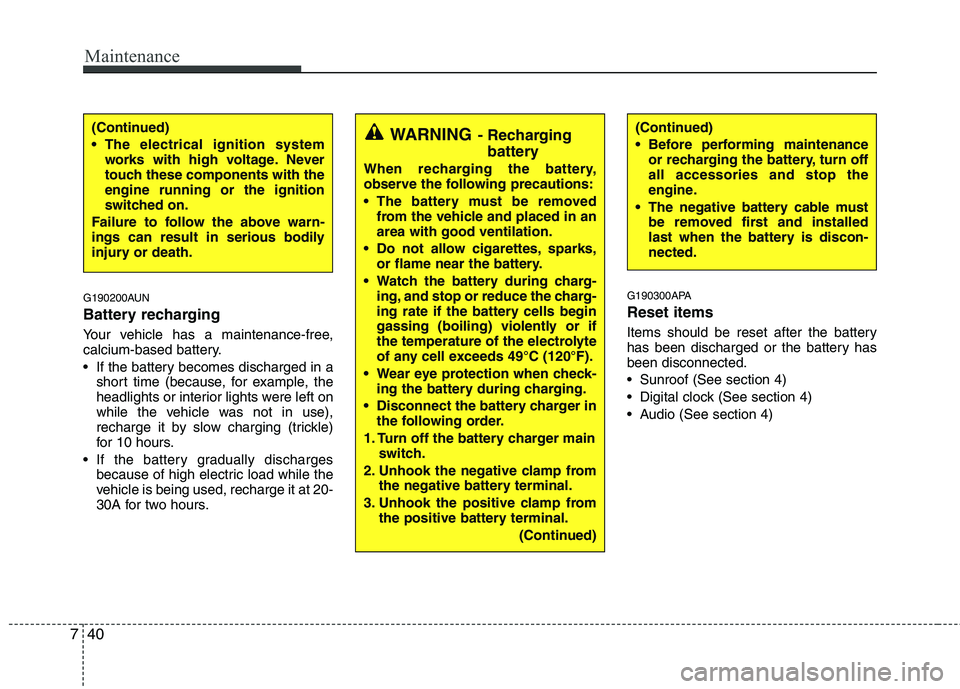
G190200AUN
Battery recharging
Your vehicle has a maintenance-free,
calcium-based battery.
If the battery becomes discharged in a
short time (because, for example, the
headlights or interior lights were left on
while the vehicle was not in use),
recharge it by slow charging (trickle)
for 10 hours.
If the battery gradually discharges because of high electric load while the
vehicle is being used, recharge it at 20-
30A for two hours. G190300APA Reset items
Items should be reset after the battery
has been discharged or the battery hasbeen disconnected.
Sunroof (See section 4)
Digital clock (See section 4)
Audio (See section 4)
(Continued)
The electrical ignition system
works with high voltage. Never
touch these components with theengine running or the ignition
switched on.
Failure to follow the above warn-
ings can result in serious bodily
injury or death.(Continued)
Before performing maintenance or recharging the battery, turn off all accessories and stop the
engine.
The negative battery cable must be removed first and installed
last when the battery is discon-nected.WARNING - Recharging
battery
When recharging the battery,
observe the following precautions:
The battery must be removed from the vehicle and placed in an area with good ventilation.
Do not allow cigarettes, sparks, or flame near the battery.
Watch the battery during charg- ing, and stop or reduce the charg-
ing rate if the battery cells begin
gassing (boiling) violently or if
the temperature of the electrolyte
of any cell exceeds 49°C (120°F).
Wear eye protection when check- ing the battery during charging.
Disconnect the battery charger in the following order.
1. Turn off the battery charger main switch.
2. Unhook the negative clamp from the negative battery terminal.
3. Unhook the positive clamp from the positive battery terminal.
(Continued)
Page 314 of 354
Maintenance
52
7
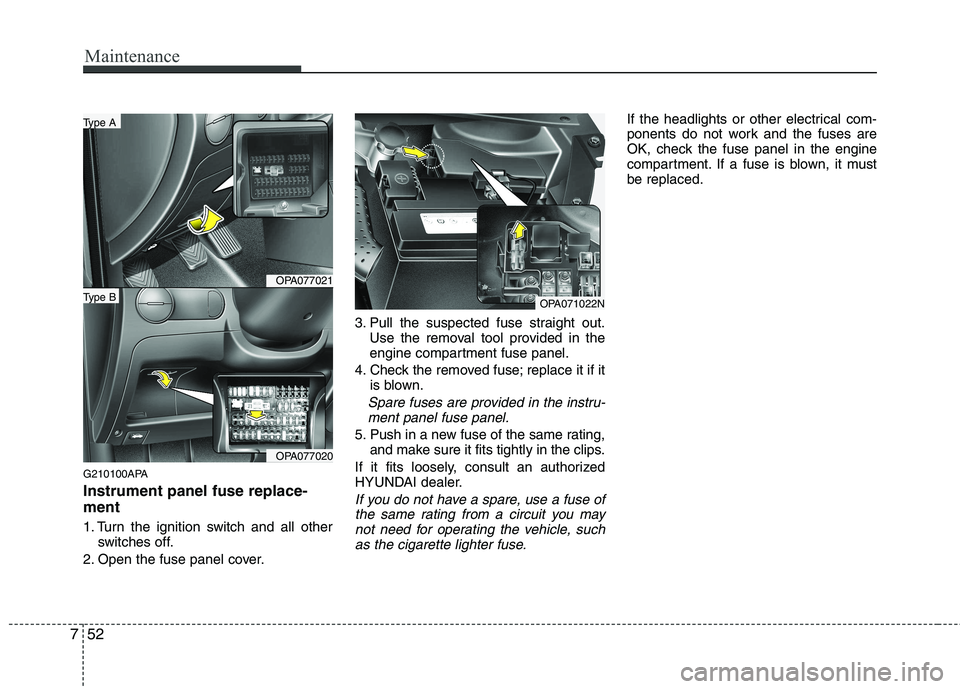
G210100APA Instrument panel fuse replace- ment
1. Turn the ignition switch and all other
switches off.
2. Open the fuse panel cover. 3. Pull the suspected fuse straight out.
Use the removal tool provided in the
engine compartment fuse panel.
4. Check the removed fuse; replace it if it is blown.
Spare fuses are provided in the instru-
ment panel fuse panel.
5. Push in a new fuse of the same rating, and make sure it fits tightly in the clips.
If it fits loosely, consult an authorized
HYUNDAI dealer.
If you do not have a spare, use a fuse of the same rating from a circuit you maynot need for operating the vehicle, suchas the cigarette lighter fuse.
If the headlights or other electrical com-
ponents do not work and the fuses are
OK, check the fuse panel in the engine
compartment. If a fuse is blown, it mustbe replaced.
OPA071022N
OPA077021
OPA077020
Type A
Type B
Page 315 of 354
753
Maintenance
G210101AUN
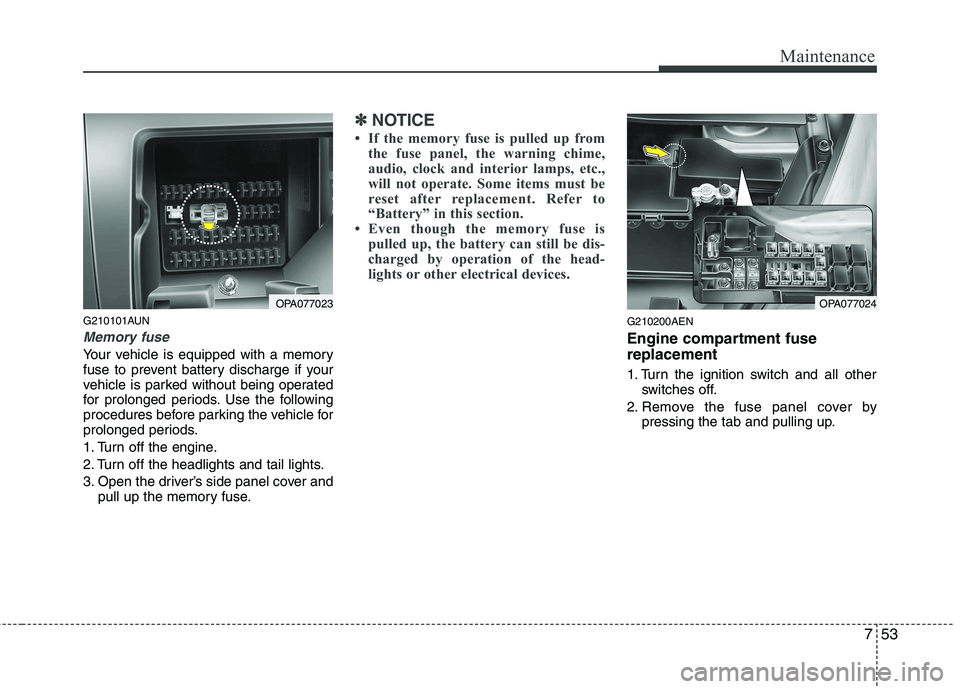
Memory fuse
Your vehicle is equipped with a memory
fuse to prevent battery discharge if your
vehicle is parked without being operated
for prolonged periods. Use the following
procedures before parking the vehicle for
prolonged periods.
1. Turn off the engine.
2. Turn off the headlights and tail lights.
3. Open the driver’s side panel cover andpull up the memory fuse.
✽✽ NOTICE
If the memory fuse is pulled up from the fuse panel, the warning chime,
audio, clock and interior lamps, etc.,
will not operate. Some items must be
reset after replacement. Refer to
“Battery” in this section.
Even though the memory fuse is
pulled up, the battery can still be dis-
charged by operation of the head-
lights or other electrical devices.
G210200AEN
Engine compartment fuse replacement
1. Turn the ignition switch and all other switches off.
2. Remove the fuse panel cover by pressing the tab and pulling up.
OPA077023OPA077024
Page 319 of 354

757
Maintenance
Descrption Symbol Fuse ratingProtected component
IGN COIL
15A DCDC Converter, ECM, Vehicle Speed Dendor, Condenser, Ignition Coil #1~#3,
Ignition Coil, Pulse Generator 'A'/'B', Transaxle Range Switch
B/UP LP
10A Back-Up Lamp Switch, Rear Parking Assist Sensor LH/RH,
Rear Parking Assist Sensor Center LH/RH
A/BAG IND
10A Instrument Cluster
A/BAG
15A SRS Control Module
CLUSTER
10A Instrument Cluster, Heater Control Module, TACM, ETACM,
Seat Belt Lever, ISG Off Switch, Rear Parking Assist Buzzer
MDPS
10A EPS Control Module
AUDIO ACC
10A Digital Clock, Audio, DCDC Converter
RR P/OUTLET
10A Front Power Outlet, Rear Power Outlet
CIGAR LIGHTER
15A Cigarette Lighter
START
10A ICM RELAY BOX(Burglar Alram Relay), Start Relay, ECM,
Transaxle Range Switch
H/LP
10A Instrument Cluster, E/R Fuse & Relay Box (RLY : R3/R4)
DRL
10A DRL Control Module
IG2
10A Head Lamp LH/RH, Head Lamp Leveling Device Switch, Intake Switch, TACM, ETACM,
Heater Control Module, Dual Pressure Switch, Rear Defogger Relay, Diode5, Power
Window Switch, E/R Fuse & Relay Box (RLY : R6)
Page 321 of 354
759
Maintenance
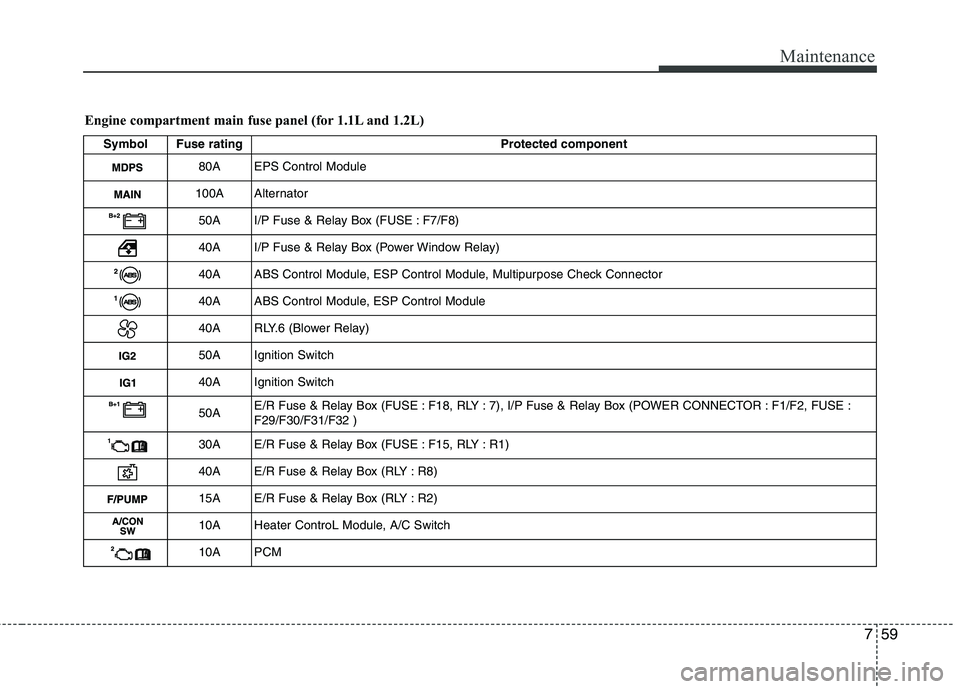
Engine compartment main fuse panel (for 1.1L and 1.2L)Symbol Fuse rating Protected component
80A EPS Control Module
100A Alternator
50A I/P Fuse & Relay Box (FUSE : F7/F8)
40A I/P Fuse & Relay Box (Power Window Relay)
40A ABS Control Module, ESP Control Module, Multipurpose Check Connector
40A ABS Control Module, ESP Control Module
40A RLY.6 (Blower Relay)
50A Ignition Switch
40A Ignition Switch
50AE/R Fuse & Relay Box (FUSE : F18, RLY : 7), I/P Fuse & Relay Box (POWER CONNECTOR : F1/F2, FUSE : F29/F30/F31/F32 )
30A E/R Fuse & Relay Box (FUSE : F15, RLY : R1)
40A E/R Fuse & Relay Box (RLY : R8)
15A E/R Fuse & Relay Box (RLY : R2)
10A Heater ControL Module, A/C Switch
10A PCM
Page 323 of 354
761
Maintenance
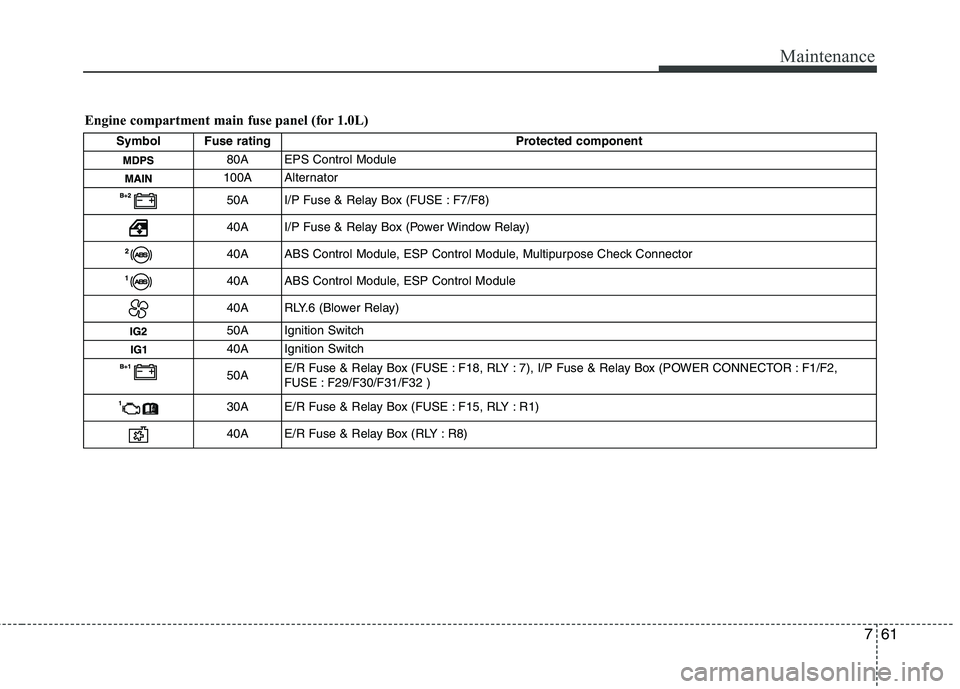
Engine compartment main fuse panel (for 1.0L)Symbol Fuse rating Protected component
80A EPS Control Module
100A Alternator
50A I/P Fuse & Relay Box (FUSE : F7/F8)
40A I/P Fuse & Relay Box (Power Window Relay)
40A ABS Control Module, ESP Control Module, Multipurpose Check Connector
40A ABS Control Module, ESP Control Module
40A RLY.6 (Blower Relay)
50A Ignition Switch
40A Ignition Switch
50AE/R Fuse & Relay Box (FUSE : F18, RLY : 7), I/P Fuse & Relay Box (POWER CONNECTOR : F1/F2,
FUSE : F29/F30/F31/F32 )
30A E/R Fuse & Relay Box (FUSE : F15, RLY : R1)
40A E/R Fuse & Relay Box (RLY : R8)