service HYUNDAI I20 2020 Owner's Manual
[x] Cancel search | Manufacturer: HYUNDAI, Model Year: 2020, Model line: I20, Model: HYUNDAI I20 2020Pages: 444, PDF Size: 8.93 MB
Page 199 of 444
![HYUNDAI I20 2020 Owners Manual 6-71
06
System maintenance
Climate control air filter
OIK047401LOIK047401L
[A] : Outside air, [B] : Recirculated air
[C] : Climate control air filter, [D] : Blower
[E] : Evaporator core, [F] : Heat](/img/35/56132/w960_56132-198.png "HYUNDAI I20 2020 Owners Manual 6-71
06
System maintenance
Climate control air filter
OIK047401LOIK047401L
[A] : Outside air, [B] : Recirculated air
[C] : Climate control air filter, [D] : Blower
[E] : Evaporator core, [F] : Heat")
6-71
06
System maintenance
Climate control air filter
OIK047401LOIK047401L
[A] : Outside air, [B] : Recirculated air
[C] : Climate control air filter, [D] : Blower
[E] : Evaporator core, [F] : Heater core
This filter is installed behind the glove
box. It filters the dust or other pollutants
that enter the vehicle through the
heating and air conditioning system.
We recommend that the climate control
air filter be replaced by an authorized
HYUNDAI dealer according to the
maintenance schedule. If the vehicle is
being driven in severe conditions such
as dusty or rough roads, more frequent
climate control filter inspections and
changes are required.
If the air flow rate suddenly decreases,
we recommend the system be checked
at an authorized HYUNDAI dealer.
i Information
• Replace the filter according to the
Maintenance Schedule.
• If the car is being driven in severe
conditions such as dusty, rough roads,
more frequent climate control air filter
inspections and changes are required.
• When the air flow rate suddenly
decreases, we recommend that the
system be checked by an authorized
HYUNDAI dealer.
Checking the amount of air
conditioner refrigerant and
compressor lubricant
When the amount of refrigerant is low,
the performance of the air conditioning
is reduced. Overfilling also has a bad
influence on the air conditioning system.
Therefore, if abnormal operation is
found, we recommend that the system
be inspected by an authorized HYUNDAI
dealer.
NOTICE
It is important that the correct type and
amount of oil and refrigerant is used.
Otherwise, damage to the compressor
and abnormal system operation may
occur. To prevent damage, the air
conditioning system in your vehicle
should only be serviced by trained and
certified technicians.
WARNING
Vehicles equipped with R-134a
Since the refrigerant is
operated at very high
pressure, the air
conditioning system should
only be serviced by trained
and certified technicians.
All refrigerants should be reclaimed
with proper equipment.
Venting refrigerants directly to the
atmosphere is harmful to individuals
and environment. Failure to heed these
warnings can lead to serious injuries.
Page 216 of 444
6-88
Convenient features
NOTICE
• Before entering a place with a low
height clearance, be sure that the
antenna is removed.
• Be sure to remove the antenna before
washing the vehicle in an automatic
car wash or it may be damaged.
• When reinstalling your antenna, it is
important that it is fully tightened
and adjusted to the upright position
to ensure proper reception. But it
could be removed when parking the
vehicle.
NOTICE
Installation of aftermarket antenna may
result in water leakage, wind noise,
rattling & improper radio operation.
We recommend to use the antenna
available with an authorized Hyundai
dealer.
i Information
Some models do not have audio (plastic
blanking cover) system, and will not
supply radio main cable. Thus if you want
to insert Aftermarket audio or OEM
audio to listen radio broadcasting service,
we recommend to use the feeder cable
available with an authorized HYUNDAI
dealer.
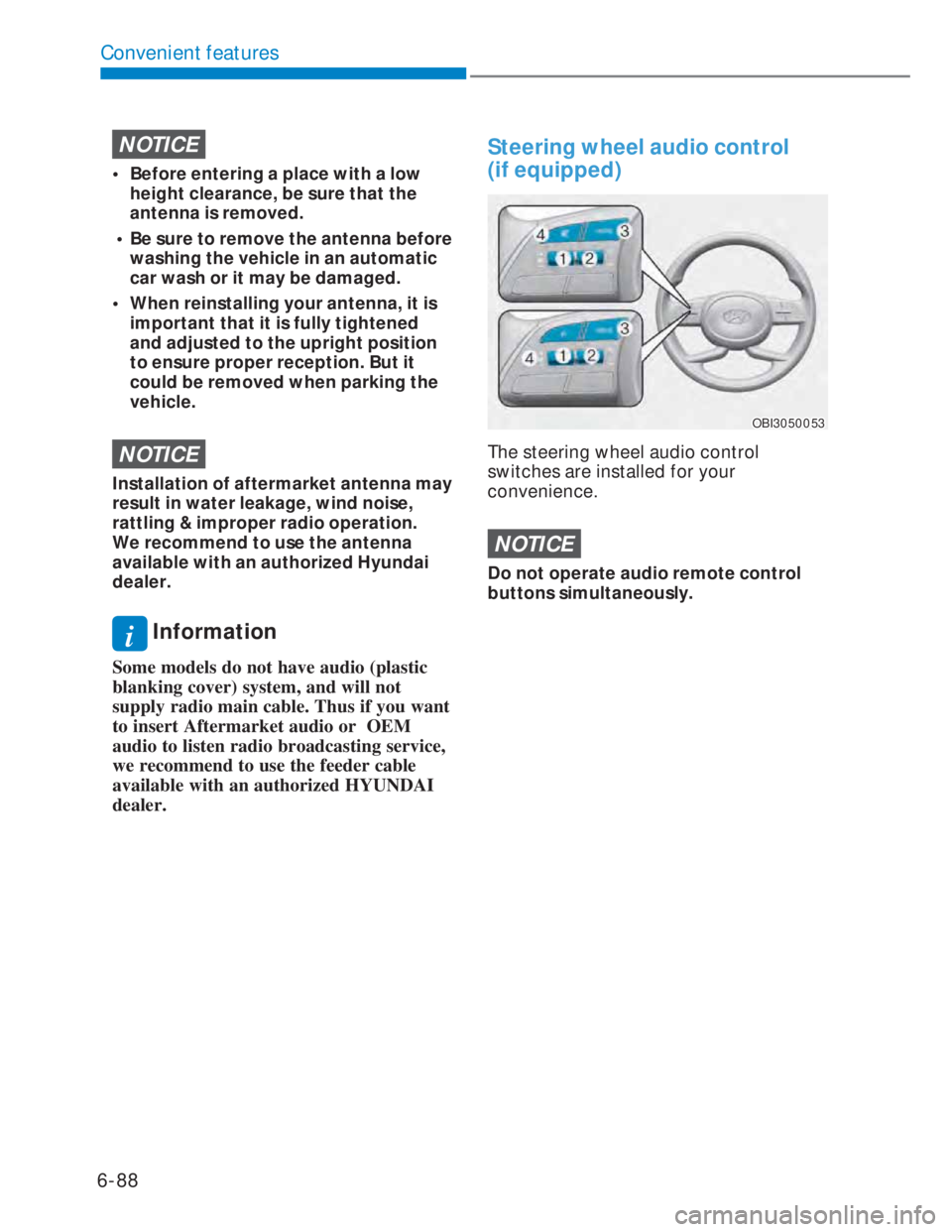
Steering wheel audio control
(if equipped)
OBI3050053OBI3050053
The steering wheel audio control
switches are installed for your
convenience.
NOTICE
Do not operate audio remote control
buttons simultaneously.
Page 226 of 444

6-98
Convenient features
i Information
- About handling the system
• Do not apply excessive force to the
system. Excessive pressure on the
screen may damage the LCD panel or
the touch panel.
• When cleaning the screen or button
panel, make sure to stop the engine
and use a soft, dry cloth. Wiping the
screen or buttons with a rough cloth or
using solvents (alcohol, benzene, paint
thinner, etc.) may scratch or chemically
damage the surface.
• If you attach a liquid-type air freshener
to the fan louvre, the surface of the
louvre may become deformed due to
the flowing air.
• If you want to change the position of
the installed device, please inquire
with your place of purchase or service
maintenance centre. Technical expertise
is required to install or disassemble the
device.
NOTICE
• If you experience any problems with
the system, contact your place of
purchase or dealer.
• Placing the audio system within an
electromagnetic environment may
result in noise interference.
Turning the system on or off
To turn on the system, start the engine.
• If you do not want to use the system
while driving, you can turn off the
system by pressing the [POWER]
button on the control panel. To use
the system again, press the [POWER]
button again.
After you have turned off the engine, the
system will automatically turn off after a
while or as soon as you open the driver’s
door.
• Depending on the vehicle model or
specifications, the system may turn
off as soon as you turn off the engine.
• When you turn back on the system,
the previous mode and settings will
remain intact.
WARNING
• Some functions may be disabled for
safety reasons while the vehicle is
moving. They work only when the
vehicle stops. Park your vehicle in
a safe location before using any of
them.
• Stop using the system if it
malfunctions, such as no audio
output or display. If you continue
using the system when it is
malfunctioning, it may lead to a fire,
electric shock, or system failure.
i Information
You can turn on the system when the key
ignition switch is placed in the “ACC”
or “ON” position. Using the system for
an extended period without the engine
running drains the battery. If you plan on
using the system for a long time, start the
engine.
Page 240 of 444
6-112
Convenient features
NOTICE
• You cannot access the Phone screen
if there is no connected mobile
phone. To use the Bluetooth phone
function, connect a mobile phone to
the system.
• The Bluetooth Handsfree function
may not work when you are
passing out of the cellular service
coverage area, such as when you
are in a tunnel, underground, or in a
mountainous area.
• Call quality may be degraded in the
following environments:
-The reception of the mobile phone
is poor.
-The inside of the vehicle is noisy.
-The mobile phone is placed
near metallic objects, such as a
beverage can.
• Depending on the connected mobile
phone, the volume and sound quality
of the Bluetooth Handsfree may vary.
Making a call
If your mobile phone is connected to the
system, you can make a call by selecting
a name from your call history or contacts
list.
1. On the control panel, press the
[PHONE] button.
• Alternatively, press the Call/
Answer button on the steering
wheel.
2. Select a phone number.
• To select a phone number from your
favourites list, select Favourites.
• To select a phone number from your
call history, select Call history.
• To select a phone number from your
contacts list that downloaded from
the connected mobile phone, select
Contacts.
3. To end the call, press the [2 SHFL]
button on the control panel.
• Alternatively, press the Call end
button on the steering wheel.
Registering the favourites list
You can more easily use Bluetooth to talk
on the phone hands-free by registering
phone numbers as your favourites.
1. On the Phone screen, turn the [TUNE]
knob on the control panel to select
Favourites and press the knob.
2. Select [MENU/CLOCK] X Add new
favourites.
3. Press the [1 RPT] button, and select
the desired phone number.
Page 300 of 444

7-53
07
Winter precautions
Use high quality ethylene glycol
coolant
Your vehicle is delivered with high
quality ethylene glycol coolant in the
cooling system. It is the only type of
coolant that should be used because it
helps prevent corrosion in the cooling
system, lubricates the water pump and
prevents freezing. Be sure to replace or
replenish your coolant in accordance
with the maintenance schedule in
chapter 8. Before winter, have your
coolant tested to assure that its freezing
point is sufficient for the temperatures
anticipated during the winter.
Check battery and cables
Winter puts additional burdens on the
battery system. Visually inspect the
battery and cables as described in
chapter 8. The level of charge in your
battery can be checked by an authorized
HYUNDAI dealer or a service station.
Change to “winter weight” oil if
necessary
In some climates it is recommended that
a lower viscosity “winter weight” oil be
used during cold weather. See chapter
2 for recommendations. If you aren’t
sure what weight oil you should use, we
recommend that you consult with an
authorized HYUNDAI dealer.
Check spark plugs and ignition
system
Inspect your spark plugs as described
in chapter 8 and replace them if
necessary. Also check all ignition wiring
and components to be sure they are not
cracked, worn or damaged in any way.
To keep locks from freezing
To keep the locks from freezing, squirt
an approved de-icer fluid or glycerine
into the key opening. If a lock is covered
with ice, squirt it with an approved
de-icing fluid to remove the ice. If the
lock is frozen internally, you may be able
to thaw it out by using a heated key.
Handle the heated key with care to avoid
injury.
Use approved window washer anti-
freeze in system
To keep the water in the window washer
system from freezing, add an approved
window washer anti-freeze solution in
accordance with instructions on the
container. Window washer anti-freeze is
available from an authorized HYUNDAI
dealer and most auto parts outlets. Do
not use engine coolant or other types
of anti-freeze as these may damage the
paint finish.
Page 315 of 444
Hazard warning flasher................................................................................... 9-2
In case of an emergency while driving
.......................................................... 9-2
If the engine stalls while driving .............................................................................. 9-2
If the engine stalls at a crossroad or crossing ......................................................... 9-2
If you have a flat tire while driving
.......................................................................... 9-3
If the engine will not start .............................................................................. 9-3
If the engine doesn’t turn over or turns over slowly ............................................... 9-3
If the engine turns over normally but doesn’t start ................................................ 9-3
Jump starting .................................................................................................. 9-4
If the engine overheats
................................................................................... 9-7
Tire pressure monitoring system (TPMS)
......................................................9-9
Check tire pressure ................................................................................................... 9-9
Tire pressure monitoring system .............................................................................9-10
Low tire pressure telltale..........................................................................................9-11
Low tire pressure position telltale and tire pressure telltale
..................................9-11
TPMS (Tire Pressure Monitoring System) malfunction indicator
.......................... 9-12
Changing a tire with TPMS ...................................................................................... 9-12
If you have a flat tire ......................................................................................9-14
Jack and tools........................................................................................................... 9-14
Removing and storing the spare tire....................................................................... 9-14
Changing tires
.......................................................................................................... 9-15
Jack label .................................................................................................................. 9-19
EC Declaration of conformity for Jack................................................................... 9-20
Towing ............................................................................................................ 9-21
Towing service .......................................................................................................... 9-21
Removable towing hook ......................................................................................... 9-22
Emergency towing .................................................................................................. 9-23
Emergency commodity ................................................................................ 9-25
First aid kit ............................................................................................................... 9-25
Triangle reflector ..................................................................................................... 9-25
9. Emergency situations
9
Page 318 of 444
9-4
Emergency situations
Jump starting can be dangerous if done
incorrectly. Follow the jump starting
procedure in this section to avoid serious
injury or damage to your vehicle. If in
doubt about how to properly jump start
your vehicle, we strongly recommend
that you have a service technician or
towing service do it for you.
WARNING
To prevent SERIOUS INJURY or DEATH
to you or bystanders, always follow
these precautions when working near
or handling the battery:
Always read and follow
instructions carefully when
handling a battery.
Wear eye protection designed
to protect the eyes from acid
splashes.
Keep all flames, sparks, or
smoking materials away from
the battery.
Hydrogen is always present in
battery cells, is highly
combustible, and may explode
if ignited.
Keep batteries out of reach of
children.
Batteries contain sulfuric acid
which is highly corrosive. Do
not allow acid to contact your
eyes, skin or clothing.If acid gets into your eyes, flush your
eyes with clean water for at least 15
minutes and get immediate medical
attention. If acid gets on your skin,
thoroughly wash the area. If you
feel pain or a burning sensation, get
medical attention immediately.
• When lifting a plastic-cased battery,
excessive pressure on the case may
cause battery acid to leak. Lift with a
battery carrier or with your hands on
opposite corners.
• Do not attempt to jump start your
vehicle if your battery is frozen.
• NEVER attempt to recharge the
battery when the vehicle’s battery
cables are connected to the battery.
• The electrical ignition system works
with high voltage. NEVER touch these
components with the engine running
or when the ignition switch is in the
ON position.
• Do not allow the (+) and (-) jumper
cables to touch. It may cause sparks.
• The battery may rupture or explode
when you jump start with a low or
frozen battery.
• Never attempt jump start if you
observe cracks, leaks or other
damage on Battery.
JUMP STARTING
Page 325 of 444
9-11
09
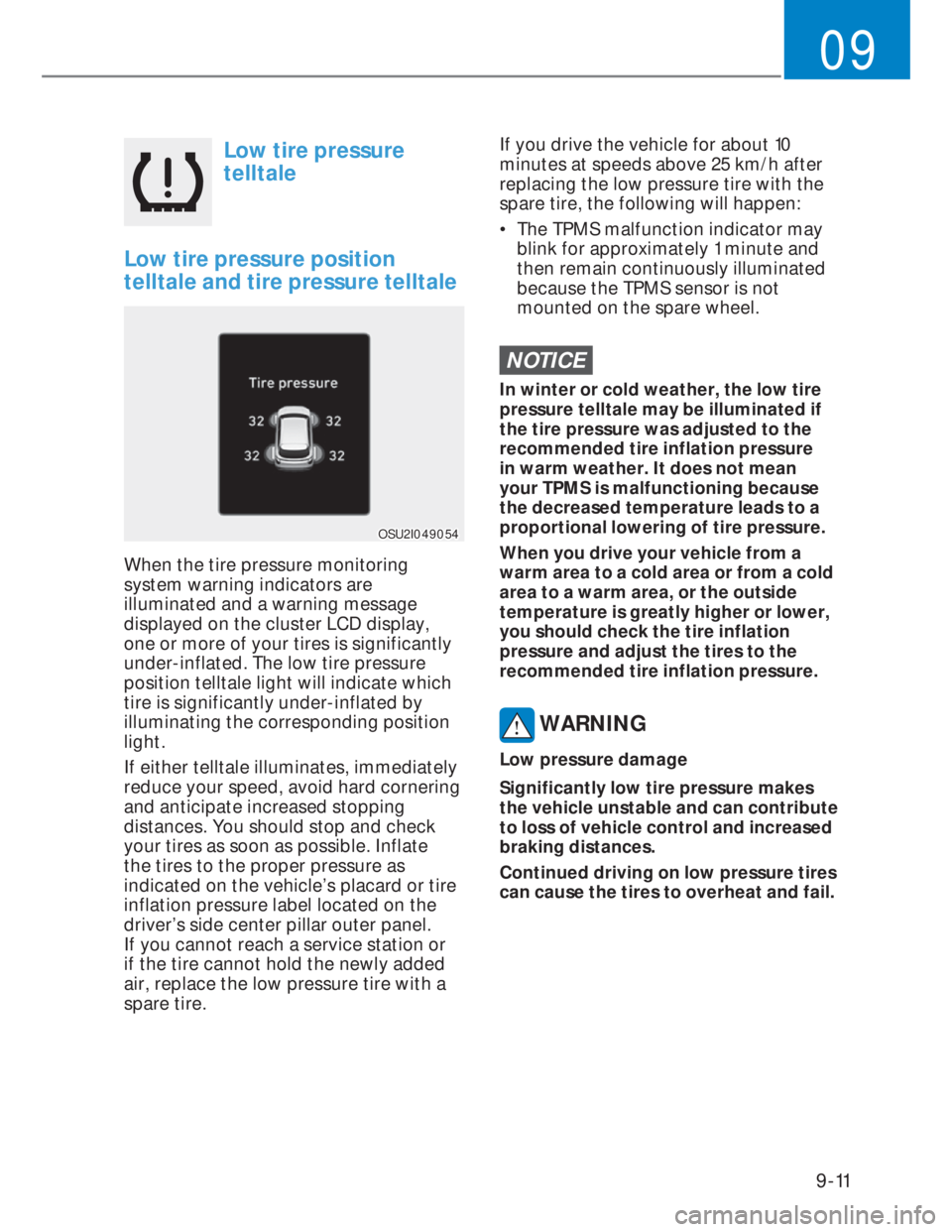
Low tire pressure
telltale
Low tire pressure position
telltale and tire pressure telltale
OSU2I049054OSU2I049054
When the tire pressure monitoring
system warning indicators are
illuminated and a warning message
displayed on the cluster LCD display,
one or more of your tires is significantly
under-inflated. The low tire pressure
position telltale light will indicate which
tire is significantly under-inflated by
illuminating the corresponding position
light.
If either telltale illuminates, immediately
reduce your speed, avoid hard cornering
and anticipate increased stopping
distances. You should stop and check
your tires as soon as possible. Inflate
the tires to the proper pressure as
indicated on the vehicle’s placard or tire
inflation pressure label located on the
driver’s side center pillar outer panel.
If you cannot reach a service station or
if the tire cannot hold the newly added
air, replace the low pressure tire with a
spare tire.
If you drive the vehicle for about 10
minutes at speeds above 25 km/h after
replacing the low pressure tire with the
spare tire, the following will happen:
• The TPMS malfunction indicator may
blink for approximately 1 minute and
then remain continuously illuminated
because the TPMS sensor is not
mounted on the spare wheel.
NOTICE
In winter or cold weather, the low tire
pressure telltale may be illuminated if
the tire pressure was adjusted to the
recommended tire inflation pressure
in warm weather. It does not mean
your TPMS is malfunctioning because
the decreased temperature leads to a
proportional lowering of tire pressure.
When you drive your vehicle from a
warm area to a cold area or from a cold
area to a warm area, or the outside
temperature is greatly higher or lower,
you should check the tire inflation
pressure and adjust the tires to the
recommended tire inflation pressure.
WARNING
Low pressure damage
Significantly low tire pressure makes
the vehicle unstable and can contribute
to loss of vehicle control and increased
braking distances.
Continued driving on low pressure tires
can cause the tires to overheat and fail.
Page 326 of 444
9-12
Emergency situations
TPMS (Tire Pressure
Monitoring System)
malfunction indicator
The TPMS malfunction indicator
will illuminate after it blinks for
approximately one minute when there
is a problem with the Tire Pressure
Monitoring System. If the system is able
to correctly detect an under inflation
warning at the same time as system
failure then it will illuminate the TPMS
malfunction indicator.
We recommend that the system be
checked by an authorized HYUNDAI
dealer.
NOTICE
If there is a malfunction with the TPMS,
the low tire pressure position telltale
will not be displayed even though the
vehicle has an under-inflated tire.
CAUTION
• The TPMS malfunction indicator
may be illuminated if the vehicle is
moving around electric power supply
cables or radios transmitter such as
at police stations, government and
public offices, broadcasting stations,
military installations, airports, or
transmitting towers, etc. This can
interfere with normal operation of
the Tire Pressure Monitoring System
(TPMS).
• The TPMS malfunction indicator may
illuminate if snow chains or some
separately purchased devices such
as notebook computers, mobile
charger, remote starter, navigation
etc. are used in the vehicle. This can
interfere with normal operation of
the Tire Pressure Monitoring System
(TPMS).
Changing a tire with TPMS
If you have a flat tire, the Low Tire
Pressure will come on. We recommend
that the flat tire be checked by an
authorized HYUNDAI dealer.
NOTICE
We recommend that you use a
puncture-repairing agent approved by
HYUNDAI.
The sealant on the tire pressure sensor
and wheel shall be eleminated when
you replace the tire with a new one.
Each wheel is equipped with a tire
pressure sensor mounted inside
the tire behind the valve stem. You
must use TPMS specific wheels. It is
recommended that you have your tires
serviced by an authorized HYUNDAI
dealer.
Even if you replace the low pressure tire
with the spare tire, the Low Tire Pressure
Telltale will blink or remain on until the
low pressure tire is repaired and placed
on the vehicle.
After you replace the low pressure tire
with the spare tire, the Low Tire Pressure
Telltale may blink or illuminate after a
few minutes because the TPMS sensor
mounted on the spare wheel is not
initiated.
Once the low pressure tire is re-inflated
to the recommended pressure and
installed on the vehicle or the new TPMS
sensor mounted on the wheel, the TPMS
malfunction indicator and the low tire
pressure and position telltales will turn
off within a few minutes of driving.
If the indicator does not turn off after a
few minutes of driving, we recommend
that the system be checked by an
authorized HYUNDAI dealer.
Page 327 of 444
9-13
09
NOTICE
If original mounted tire is replaced
with the spare tire, the TPMS sensor
on the replaced spare wheel should be
initiated and we recommend that the
TPMS sensor on the original mounted
wheel be deactivated by a HYUNDAI
dealer. If the TPMS sensor on the
original mounted wheel located in the
spare tire carrier still activates, the
tire pressure monitoring system may
not operate properly. We recommend
that the system be serviced by an
authorized HYUNDAI dealer.
You may not be able to identify a low
tire by simply looking at it. Always use
a good quality tire pressure gauge to
measure the tire’s inflation pressure.
Please note that a tire that is hot (from
being driven) will have a higher pressure
measurement than a tire that is cold.
A cold tire means the vehicle is in parked
position for at least 3 hours or driven
less than 1.6 km (1 mile) in that period.
Allow the tire to cool before measuring
the inflation pressure. Always be sure
the tire is cold before inflating to the
recommended pressure.
NOTICE
We recommend that you use the tire
sealant approved by HYUNDAI if your
vehicle is equipped with a Tire Pressure
Monitoring System. The liquid sealant
can damage the tire pressure sensors.
WARNING
TPMS
• The TPMS cannot alert you to severe
and sudden tire damage caused by
external factors such as nails or road
debris.
• If you feel any vehicle instability,
immediately take your foot off
the accelerator, apply the brakes
gradually and with light force, and
slowly move to a safe position off the
road.
WARNING
Protecting TPMS
Tampering with, modifying, or disabling
the Tire Pressure Monitoring System
(TPMS) components may interfere with
the system’s ability to warn the driver
of low tire pressure conditions and/
or TPMS malfunctions. Tamper-ing
with, modifying, or disabling the Tire
Pressure Monitoring System (TPMS)
components may void the war-ranty for
that portion of the vehicle.