belt HYUNDAI I20 2020 Workshop Manual
[x] Cancel search | Manufacturer: HYUNDAI, Model Year: 2020, Model line: I20, Model: HYUNDAI I20 2020Pages: 444, PDF Size: 8.93 MB
Page 351 of 444

10-12
Maintenance
MAINTENANCE
INTERVALS
MAINTENANCE ITEMNumber of months or driving distance, whichever comes first
Kmsx1,000
1.51020304050607080
Months
2 1224364860728496
Years
- 12345678
ENGINE BAY
Engine oil & filter *
1 *2 *3
I RRRRRRRR
Drive beltAt first, Inspect 90,000km or 72 months after that,
Inspect every 30,000km or 24 month
Air cleaner filter 1.0 T-GDI C C R C R C R C C
S
martstream G1.2
CCCRCCRCC
Battery condition & specific gravity IIIIIIIII
Spark Plugs *
10
1.0 T-GDI Replace at every 70,000 kmsSmartstream G1.2
Replace at every 150,000 kms
Valve clearance *
4
Inspect at every 90,000 kms or 108 months
Vaccum Hose - - - I - - I - I
Idler / damper pulley/Adj. Bolt Inspect when replacing the drive belt or timing belt/chain
Brake/Clutch fluid Replace @ every 40,000 kms or 3 years
Engine Coolant (topup & specify gravity) *
5
Inspect at every service;
Replace first at 100,000 Km or 60 months ; then at every 30,000 Km or 24 months
Manual transaxle fluid *
6
------ I --
Dual Clutch transaxle fluid (if equipped)*
6
------ I --
MT system actuator fluid (if equipped) *
6
-R-R R-R
Intelligent Var. transaxle fluid (if equipped)*
6
-- -- I ---
I : Inspect and if necessary adjust,top-up, clean or replaceC : Clean and Replace if necessary R : Replace
NORMAL MAINTENANCE SCHEDULE - PETROL ENGINE (CONT.)
Page 353 of 444
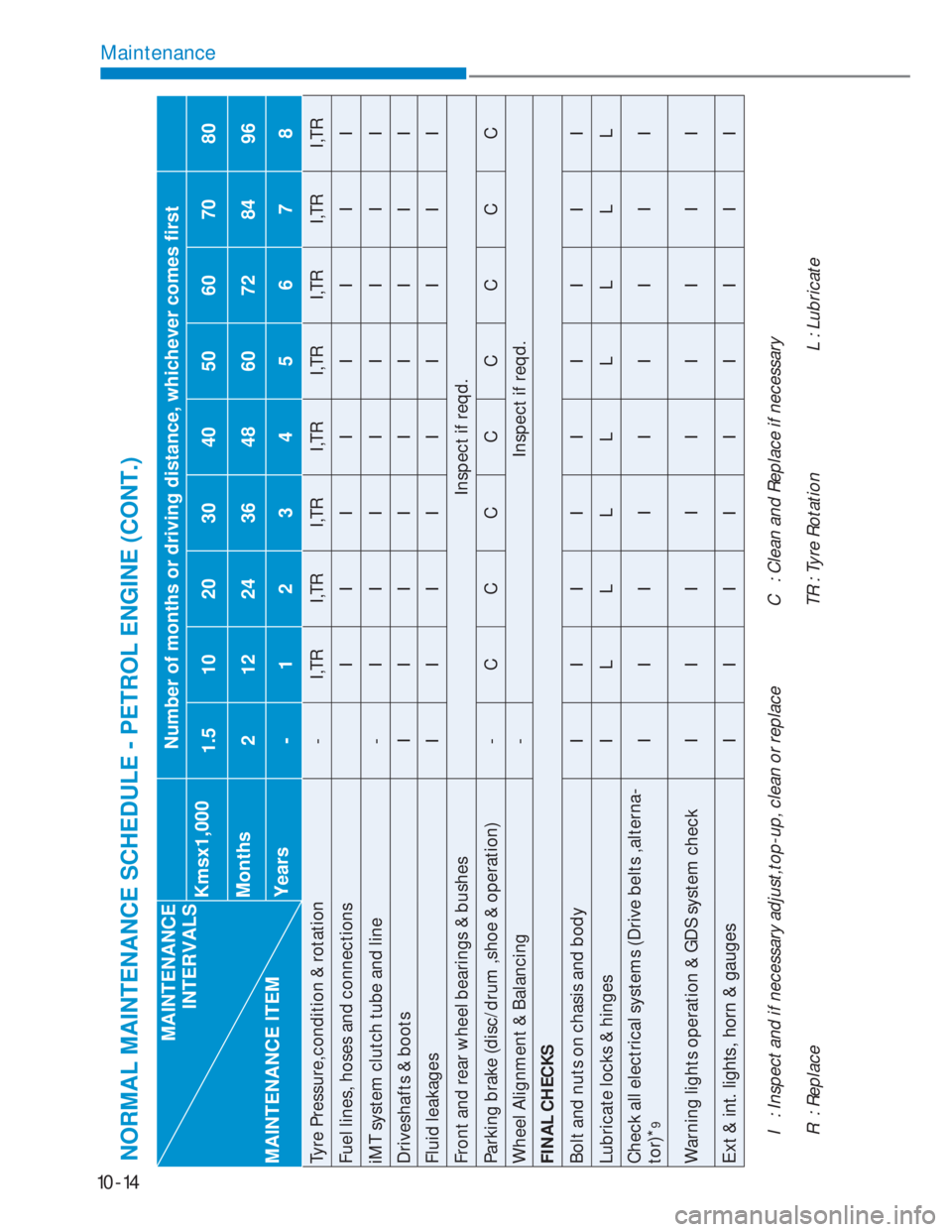
10-14
Maintenance
MAINTENANCE
INTERVALS
MAINTENANCE ITEMNumber of months or driving distance, whichever comes first
Kmsx1,000
1.51020304050607080
Months
2 1224364860728496
Years
- 12345678
Tyre Pressure,condition & rotation - I,TR I,TR I,TR I,TR I,TR I,TR I,TR I,TR
Fuel lines, hoses and connections IIIIIIII
iMT system clutch tube and line - I IIIIIII
Driveshafts & bootsIIIIIIIII
Fluid leakages IIIIIIIII
Front and rear wheel bearings & bushes Inspect if reqd.
Parking brake (disc/drum ,shoe & operation) - CCCCCCCC
Wheel Alignment & Balancing - Inspect if reqd.
FINAL CHECKS
Bolt and nuts on chasis and body I I IIIIIII
Lubricate locks & hinges ILLLLLLLL
Check all electrical systems (Drive belts ,alterna-
tor)*
9
IIIIIIIII
Warning lights operation & GDS system check I IIIIIIII
Ext & int. lights, horn & gaugesIIIIIIIII
NORMAL MAINTENANCE SCHEDULE - PETROL ENGINE (CONT.)
I : Inspect and if necessary adjust,top-up, clean or replace
R : ReplaceC : Clean and Replace if necessary
TR : Tyre Rotation L : Lubricate
Page 354 of 444
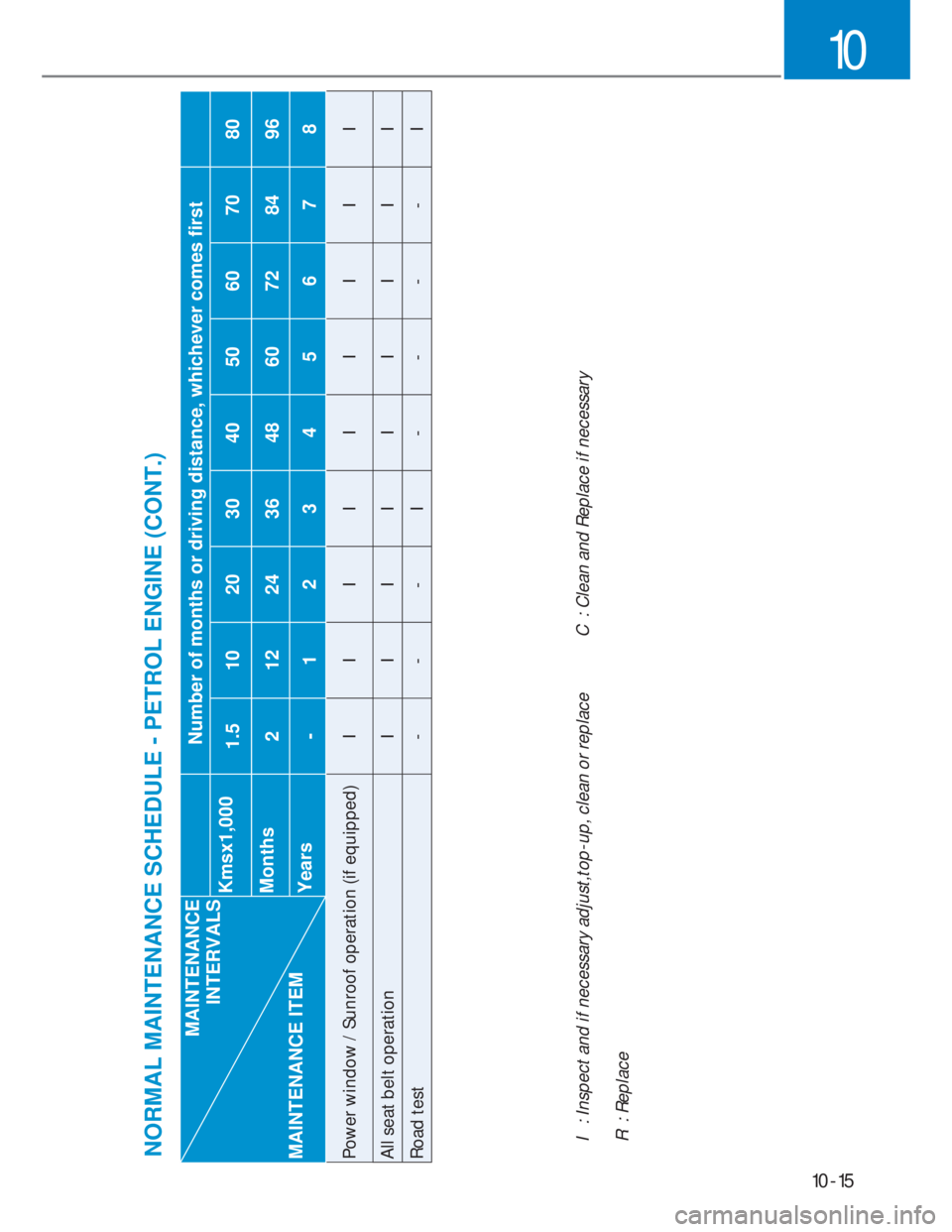
10-15
10
MAINTENANCE
INTERVALS
MAINTENANCE ITEMNumber of months or driving distance, whichever comes first
Kmsx1,000
1.51020304050607080
Months
2 1224364860728496
Years
- 12345678
Power window / Sunroof operation (if equipped) I I IIIIIII
All seat belt operationIIIIIIIII
Road test - - - I - - - - INORMAL MAINTENANCE SCHEDULE - PETROL ENGINE (CONT.)I : Inspect and if necessary adjust,top-up, clean or replace
R : ReplaceC : Clean and Replace if necessary
Page 357 of 444
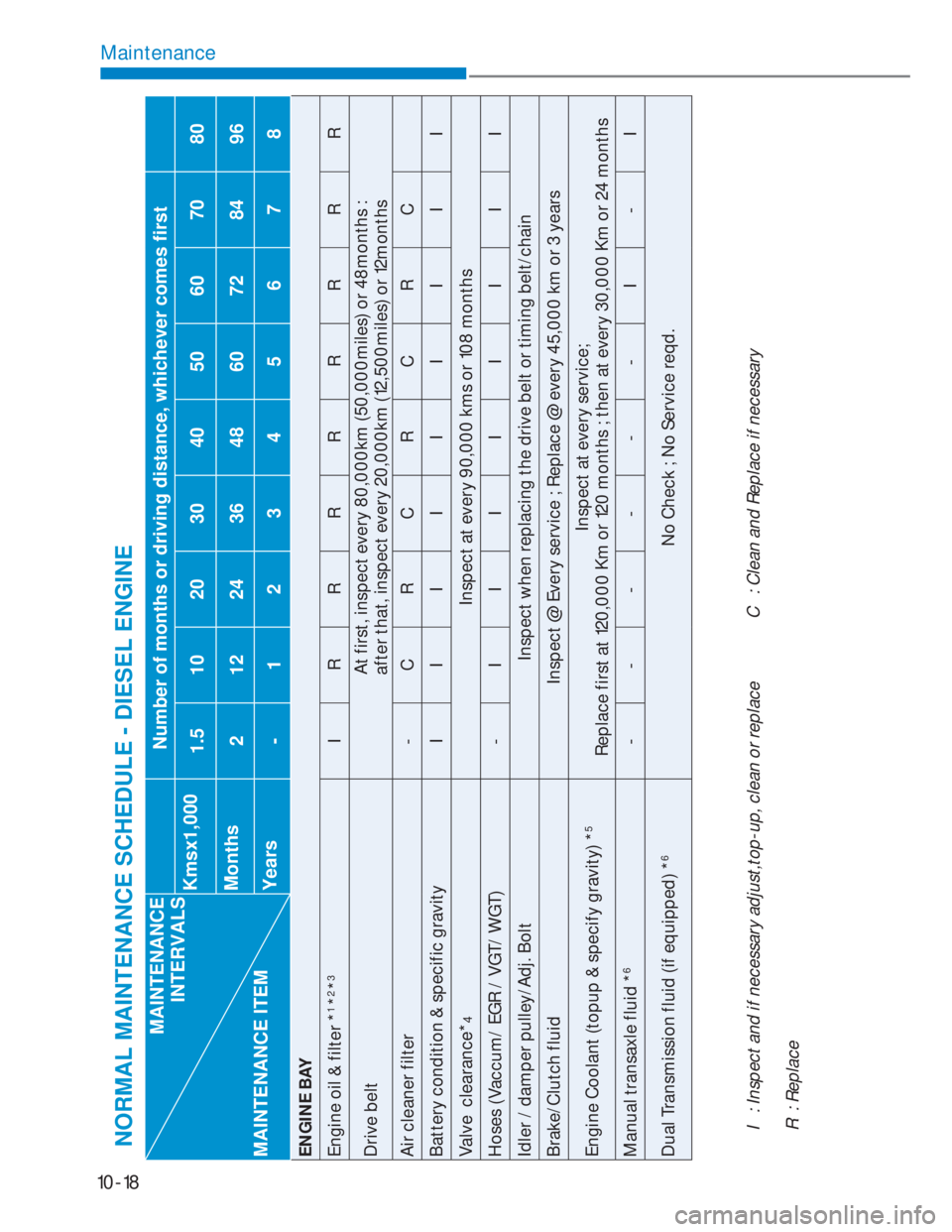
10-18
Maintenance
MAINTENANCE
INTERVALS
MAINTENANCE ITEMNumber of months or driving distance, whichever comes first
Kmsx1,000
1.51020304050607080
Months
2 1224364860728496
Years
- 12345678
ENGINE BAY
Engine oil & filter *
1 *2 *3
I RRRRRRRR
Drive beltAt first, inspect every 80,000km (50,000miles) or 48months :
after that, inspect every 20,000km (12,500miles) or 12months
Air cleaner filter - C R C R C R C
Battery condition & specific gravityIIIIIIIII
Valve clearance*
4
Inspect at every 90,000 kms or 108 months
Hoses (Vaccum/ EGR / VGT/ WGT) -IIIIIIII
Idler / damper pulley/Adj. Bolt Inspect when replacing the drive belt or timing belt/chain
Brake/Clutch fluid Inspect @ Every service ; Replace @ every 45,000 km or 3 years
Engine Coolant (topup & specify gravity) *
5
Inspect at every service;
Replace first at 120,000 Km or 120 months ; then at every 30,000 Km or 24 months
Manual transaxle fluid *
6
------ I - I
Dual Transmission fluid (if equipped) *
6
No Check ; No Service reqd.
NORMAL MAINTENANCE SCHEDULE - DIESEL ENGINE
C : Clean and Replace if necessary I : Inspect and if necessary adjust,top-up, clean or replace
R : Replace
Page 359 of 444
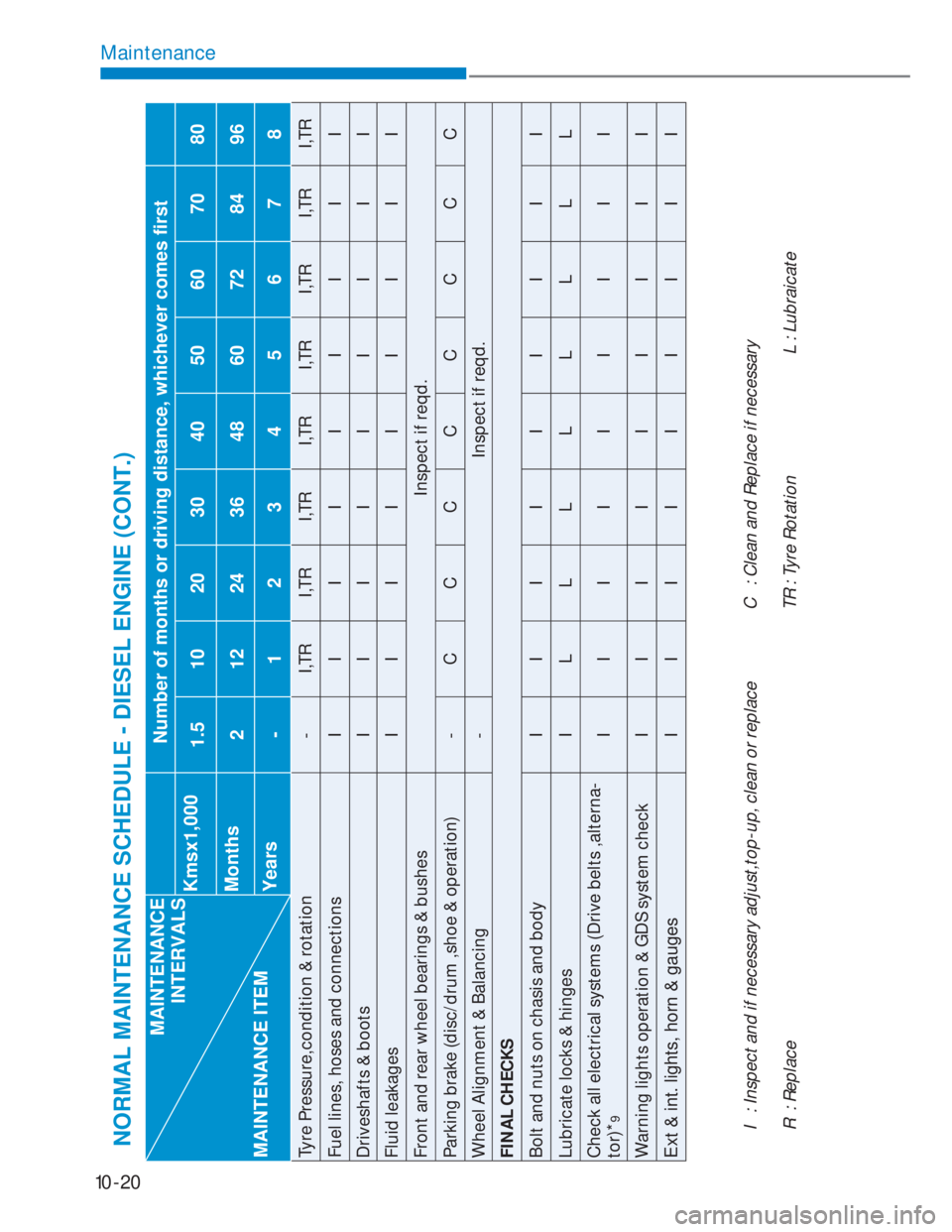
10-20
Maintenance
NORMAL MAINTENANCE SCHEDULE - DIESEL ENGINE (CONT.)
MAINTENANCE
INTERVALS
MAINTENANCE ITEMNumber of months or driving distance, whichever comes first
Kmsx1,000
1.51020304050607080
Months
2 1224364860728496
Years
- 12345678
Tyre Pressure,condition & rotation - I,TR I,TR I,TR I,TR I,TR I,TR I,TR I,TR
Fuel lines, hoses and connectionsIIIIIIIII
Driveshafts & bootsIIIIIIIII
Fluid leakages I IIIIIIII
Front and rear wheel bearings & bushes Inspect if reqd.
Parking brake (disc/drum ,shoe & operation) - C CCCCCCC
Wheel Alignment & Balancing - Inspect if reqd.
FINAL CHECKS
Bolt and nuts on chasis and body I I IIIIIII
Lubricate locks & hinges ILLLLLLLL
Check all electrical systems (Drive belts ,alterna-
tor)*
9
IIIIIIIII
Warning lights operation & GDS system check I IIIIIIII
Ext & int. lights, horn & gaugesIIIIIIIII
C : Clean and Replace if necessary
TR : Tyre Rotation L : Lubraicate I : Inspect and if necessary adjust,top-up, clean or replace
R : Replace
Page 360 of 444
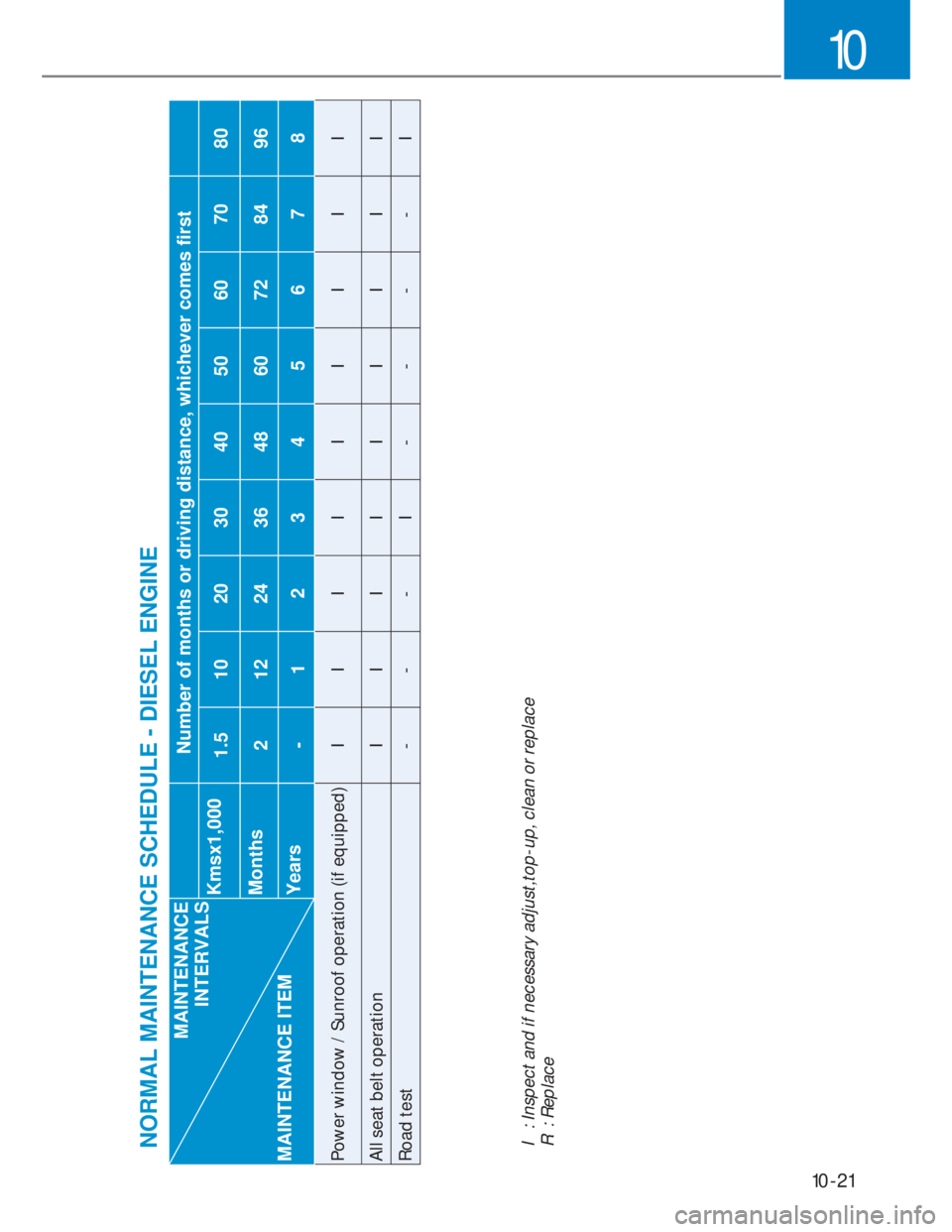
10-21
10
MAINTENANCE
INTERVALS
MAINTENANCE ITEMNumber of months or driving distance, whichever comes first
Kmsx1,000
1.51020304050607080
Months
2 1224364860728496
Years
- 12345678
Power window / Sunroof operation (if equipped) I I IIIIIII
All seat belt operation IIIIIIIII
Road test - - - I---- INORMAL MAINTENANCE SCHEDULE - DIESEL ENGINEI : Inspect and if necessary adjust,top-up, clean or replace
R : Replace
Page 363 of 444
10-24
Maintenance
Engine oil and filter
The engine oil and filter should be
changed at the intervals specified in
the maintenance schedule. If the car
is being driven in severe conditions,
more frequent oil and filter changes are
required.
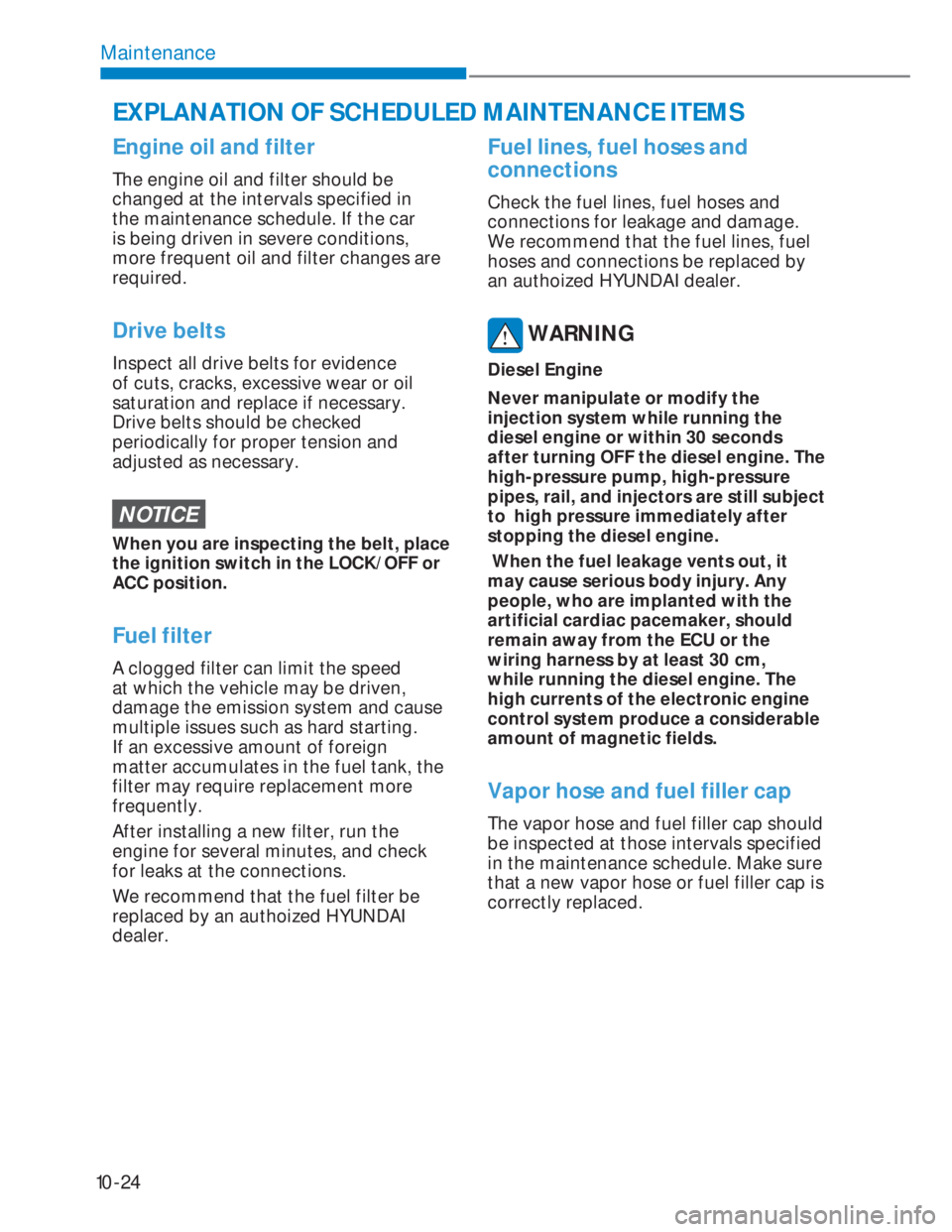
Drive belts
Inspect all drive belts for evidence
of cuts, cracks, excessive wear or oil
saturation and replace if necessary.
Drive belts should be checked
periodically for proper tension and
adjusted as necessary.
NOTICE
When you are inspecting the belt, place
the ignition switch in the LOCK/OFF or
ACC position.
Fuel filter
A clogged filter can limit the speed
at which the vehicle may be driven,
damage the emission system and cause
multiple issues such as hard starting.
If an excessive amount of foreign
matter accumulates in the fuel tank, the
filter may require replacement more
frequently.
After installing a new filter, run the
engine for several minutes, and check
for leaks at the connections.
We recommend that the fuel filter be
replaced by an authoized HYUNDAI
dealer.
Fuel lines, fuel hoses and
connections
Check the fuel lines, fuel hoses and
connections for leakage and damage.
We recommend that the fuel lines, fuel
hoses and connections be replaced by
an authoized HYUNDAI dealer.
WARNING
Diesel Engine
Never manipulate or modify the
injection system while running the
diesel engine or within 30 seconds
after turning OFF the diesel engine. The
high-pressure pump, high-pressure
pipes, rail, and injectors are still subject
to high pressure immediately after
stopping the diesel engine.
When the fuel leakage vents out, it
may cause serious body injury. Any
people, who are implanted with the
artificial cardiac pacemaker, should
remain away from the ECU or the
wiring harness by at least 30 cm,
while running the diesel engine. The
high currents of the electronic engine
control system produce a considerable
amount of magnetic fields.
Vapor hose and fuel filler cap
The vapor hose and fuel filler cap should
be inspected at those intervals specified
in the maintenance schedule. Make sure
that a new vapor hose or fuel filler cap is
correctly replaced.
EXPLANATION OF SCHEDULED MAINTENANCE ITEMS
Page 399 of 444
10-60
Maintenance
4. Tire ply composition and material
The number of layers or plies of
rubber-coated fabric in the tire. Tire
manufacturers also must indicate the
materials in the tire, which include steel,
nylon, polyester, and others. The letter
“R” means radial ply construction; the
letter “D” means diagonal or bias ply
construction; and the letter “B” means
belted-bias ply construction.
5. Maximum permissible inflation
pressure
This number is the greatest amount
of air pressure that should be put in
the tire. Do not exceed the maximum
permissible inflation pressure. Refer to
the Tire and Loading Information label
for recommended inflation pressure.
6. Maximum load rating
This number indicates the maximum
load in kilograms and pounds that can
be carried by the tire. When replacing
the tires on the vehicle, always use a
tire that has the same load rating as the
factory installed tire.
7. Uniform tire quality grading
Quality grades can be found where
applicable on the tire sidewall between
tread shoulder and maximum chapter
width.
For example:
TREAD wear 200
TRACTION AA
TEMPERATURE A
Tread wear
The tread wear grade is a comparative
rating based on the wear rate of the tire
when tested under controlled conditions
on a specified government test course.
For example, a tire graded 150 would
wear one-and-a-half times (1½) as well
on the government course as a tire
graded 100.
The relative performance of tires
depends upon the actual conditions
of their use, however, and may depart
significantly from the norm due to
variations in driving habits, service
practices and differences in road
characteristics and climate.
These grades are molded on the side-
walls of passenger vehicle tires. The
tires available as standard or optional
equipment on your vehicle may vary
with respect to grade.
Page 435 of 444
10-96
Maintenance
Leather (if equipped)
• Feature of Seat Leather
- Leather is made from the outer skin
of an animal, which goes through a
special process to be available for
use. Since it is a natural object, each
part differs in thickness or density.
Wrinkles may appear as a natural
result of stretching and shrinking
depending on the temperature and
humidity.
- The seat is made of stretchable
fabric to improve comfort.
- The parts contacting the body are
curved and the side supporting
area is high which provides driving
comfort and stability.
- Wrinkles may appear naturally
from usage. It is not a fault of the
products.
CAUTION
• Wrinkles or abrasions which appear
naturally from usage are not covered
by warranty.
• Belts with metallic accessories,
zippers or keys inside the back
pocket may damage the seat fabric.
• Make sure not to wet the seat. It may
change the nature of natural leather.
• Jeans or clothes which could bleach
may contaminate the surface of the
seat covering fabric.• Caring for the leather seats
- Vacuum the seat periodically to
remove dust and sand on the seat. It
will prevent abrasion or damage of
the leather and maintain its quality.
- Wipe the natural leather seat cover
often with dry or soft cloth.
- Use of proper leather protective may
prevent abrasion of the cover and
helps maintain the color. Be sure to
read the instructions and consult a
specialist when using leather coating
or protective agent.
- Light colored (beige, cream beige)
leather is easily contaminated and
the stain is noticeable. Clean the
seats frequently.
- Avoid wiping with wet cloth. It may
cause the surface to crack.
Page 436 of 444
10-97
10
• Cleaning the leather seats
- Remove all contaminations instantly.
Refer to instructions below for
removal of each contaminant.
- Cosmetic products (sunscreen,
foundation, etc.)
Apply cleansing cream on a cloth
and wipe the contaminate spot. Wipe
off the cream with a wet cloth and
remove water with a dry cloth.
- Beverages (coffee, soft drink, etc.)
Apply a small amount of neutral
detergent and wipe until
contaminations do not smear.
- Oil
Remove oil instantly with absorbable
cloth and wipe with stain remover
used only for natural leather.
- Chewing gum
Harden the gum with ice and remove
gradually. Cleaning the lap/shoulder belt
webbing
Clean the belt webbing with any
mild soap solution recommended for
cleaning upholstery or carpet. Follow
the instructions provided with the soap.
Do not bleach or re-dye the webbing
because this may weaken it.
Cleaning the interior window glass
If the interior glass surfaces of the
vehicle become fogged (that is, covered
with an oily, greasy or waxy film), they
should be cleaned with glass cleaner.
Follow the directions on the glass
cleaner container.
NOTICE
Do not scrape or scratch the inside of
the rear window. This may result in
damage to the rear window defroster
grid.