key HYUNDAI I20 2020 Workshop Manual
[x] Cancel search | Manufacturer: HYUNDAI, Model Year: 2020, Model line: I20, Model: HYUNDAI I20 2020Pages: 444, PDF Size: 8.93 MB
Page 261 of 444

7-14
Driving your vehicle
Starting and stopping the engine for
turbocharger intercooler
1. Do not race or accelerate the engine
immediately after starting the engine.
If the engine is cold, idle for several
seconds before sufficient lubrication is
ensured in the turbo charger unit.
2. After high speed or extended driving
that requires heavy engine load, idle
the engine about one minute before
turning the engine off. This idle time
will allow the turbocharger to cool
prior to shutting the engine off.
NOTICE
Do not turn off the engine immediately
after it has been subjected to a heavy
load. Doing so may cause severe
damage to the engine or turbo charger
unit.
NOTICE
To prevent damage to the vehicle:
• If traffic and road conditions permit,
you may put the shift lever in the N
(Neutral) position while the vehicle
is still moving and press the Engine
Start/Stop button in an attempt to
restart the engine.
• Do not push or tow your vehicle to
start the engine.
NOTICE
To prevent damage to the vehicle:
When the stop lamp fuse is blown, you
can’t start the engine normally. Replace
the fuse with a new one. If you are not
able to replace the fuse, you can start
the engine by pressing and holding
the Engine Start/Stop button for 10
seconds with the Engine Start/Stop
button in the ACC position.
Do not press the Engine Start/Stop
button for more than 10 seconds except
when the stop lamp fuse is blown.
For your safety always depress the
brake and/or clutch pedal before
starting the engine.
OBI3060002OBI3060002
i Information
If the smart key battery is weak or the
smart key does not work correctly, you
can start the engine by pressing the
Engine Start/Stop button with the smart
key in the direction of the picture above.
Page 276 of 444

7-29
07
Parking
Always come to a complete stop and
continue to depress the brake pedal.
Move the shift lever into the P (Park)
position, apply the parking brake, and
place the ignition switch in the LOCK/
OFF position. Take the Key with you
when exiting the vehicle.
WARNING
When you stay in the vehicle with
the engine running, be careful not to
depress the accelerator pedal for a long
period of time. The engine or exhaust
system may overheat and start a fire.
The exhaust gas and the exhaust
system are very hot. Keep away from
the exhaust system components.
Do not stop or park over flammable
materials, such as dry grass, paper or
leaves. They may ignite and cause a
fire.
Good driving practices
• Never move the shift lever from P
(Park) or N (Neutral) to any other
position with the accelerator pedal
depressed.
• Never move the shift lever into P
(Park) when the vehicle is in motion.
Be sure the vehicle is completely
stopped before you attempt to shift
into R (Reverse) or D (Drive).
• Do not move the shift lever to N
(Neutral) when driving. Doing so may
result in an accident because of a loss
of engine braking and the transmission
could be damaged.
• Driving uphill or downhill, always shift
to D (Drive) when driving forward or to
R (Reverse) when driving backwards,
and check the gear position indicated
on the cluster before driving. If you
drive in the opposite direction of the
selected gear, the engine will turn
off and a serious accident might be
occurred due to the degraded brake
performance.
• Do not drive with your foot resting
on the brake pedal. Even light, but
consistent pedal pressure can result
in the brakes overheating, brake wear
and possibly even brake failure.
• Depressing both accelerator and brake
pedals at the same time can trigger
logic for engine power reduction to
assure vehicle deceleration. Vehicle
acceleration will resume after the
brake pedal is released.
• When driving in Manual shift mode,
slow down before shifting to a lower
gear. Otherwise, the lower gear may
not be engaged if the engine rpms are
outside of the allowable range.
• Always apply the parking brake when
leaving the vehicle. Do not depend on
placing the transmission in P (Park) to
keep the vehicle from moving.
Page 282 of 444

7-35
07
Shift-lock release
If the shift lever cannot be moved from
the P (Park) position into R (Reverse)
position with the brake pedal depressed,
continue depressing the brake, and then
do the following:
OBI3060005OBI3060005
1. Place the ignition switch in the LOCK/
OFF position.
2. Apply the parking brake.
3. Push the shift-lock release button.
4. Move the shift lever while pushing the
shift-lock release button.
5. Stop pushing the shift-lock release
button.
6. Depress the brake pedal, and then
restart the engine.
If you need to use the shift-lock release,
we recommend that the system be
inspected by an authorized HYUNDAI
dealer immediately.
Parking
Always come to a complete stop and
continue to depress the brake pedal.
Move the shift lever into the P (Park)
position, apply the parking brake, and
place the ignition switch in the LOCK/
OFF position. Take the Key with you
when exiting the vehicle.
WARNING
When you stay in the vehicle with
the engine running, be careful not to
depress the accelerator pedal for a long
period of time. The engine or exhaust
system may overheat and start a fire.
The exhaust gas and the exhaust
system are very hot. Keep away from
the exhaust system components.
Do not stop or park over flammable
materials, such as dry grass, paper or
leaves. They may ignite and cause a
fire.
Page 300 of 444

7-53
07
Winter precautions
Use high quality ethylene glycol
coolant
Your vehicle is delivered with high
quality ethylene glycol coolant in the
cooling system. It is the only type of
coolant that should be used because it
helps prevent corrosion in the cooling
system, lubricates the water pump and
prevents freezing. Be sure to replace or
replenish your coolant in accordance
with the maintenance schedule in
chapter 8. Before winter, have your
coolant tested to assure that its freezing
point is sufficient for the temperatures
anticipated during the winter.
Check battery and cables
Winter puts additional burdens on the
battery system. Visually inspect the
battery and cables as described in
chapter 8. The level of charge in your
battery can be checked by an authorized
HYUNDAI dealer or a service station.
Change to “winter weight” oil if
necessary
In some climates it is recommended that
a lower viscosity “winter weight” oil be
used during cold weather. See chapter
2 for recommendations. If you aren’t
sure what weight oil you should use, we
recommend that you consult with an
authorized HYUNDAI dealer.
Check spark plugs and ignition
system
Inspect your spark plugs as described
in chapter 8 and replace them if
necessary. Also check all ignition wiring
and components to be sure they are not
cracked, worn or damaged in any way.
To keep locks from freezing
To keep the locks from freezing, squirt
an approved de-icer fluid or glycerine
into the key opening. If a lock is covered
with ice, squirt it with an approved
de-icing fluid to remove the ice. If the
lock is frozen internally, you may be able
to thaw it out by using a heated key.
Handle the heated key with care to avoid
injury.
Use approved window washer anti-
freeze in system
To keep the water in the window washer
system from freezing, add an approved
window washer anti-freeze solution in
accordance with instructions on the
container. Window washer anti-freeze is
available from an authorized HYUNDAI
dealer and most auto parts outlets. Do
not use engine coolant or other types
of anti-freeze as these may damage the
paint finish.
Page 410 of 444
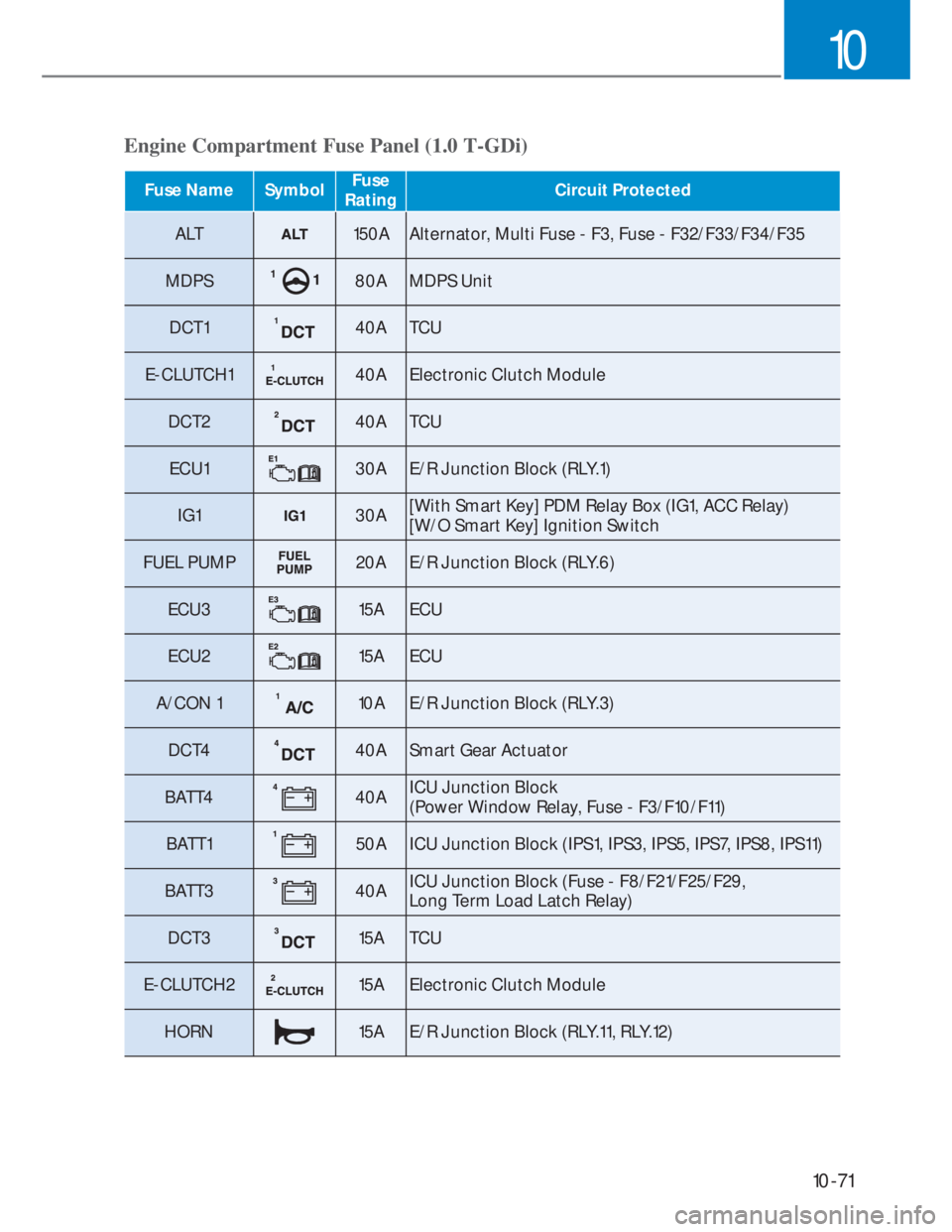
10-71
10
Engine Compartment Fuse Panel (1.0 T-GDi)
Fuse Name SymbolFuse
RatingCircuit Protected
ALT150A Alternator, Multi Fuse - F3, Fuse - F32/F33/F34/F35
MDPS
80A MDPS Unit
DCT1
40A TCU
E-CLUTCH1
40A Electronic Clutch Module
DCT2
40A TCU
ECU1
30A E/R Junction Block (RLY.1)
IG1
30A[With Smart Key] PDM Relay Box (IG1, ACC Relay)
[W/O Smart Key] Ignition Switch
FUEL PUMP
20A E/R Junction Block (RLY.6)
ECU3
15A ECU
ECU2
15A ECU
A/CON 1
10A E/R Junction Block (RLY.3)
DCT4
40A Smart Gear Actuator
BATT4
40AICU Junction Block
(Power Window Relay, Fuse - F3/F10/F11)
BATT1
50A ICU Junction Block (IPS1, IPS3, IPS5, IPS7, IPS8, IPS11)
BATT3
40AICU Junction Block (Fuse - F8/F21/F25/F29,
Long Term Load Latch Relay)
DCT3
15A TCU
E-CLUTCH2
15A Electronic Clutch Module
HORN
15A E/R Junction Block (RLY.11, RLY.12)
Page 411 of 444
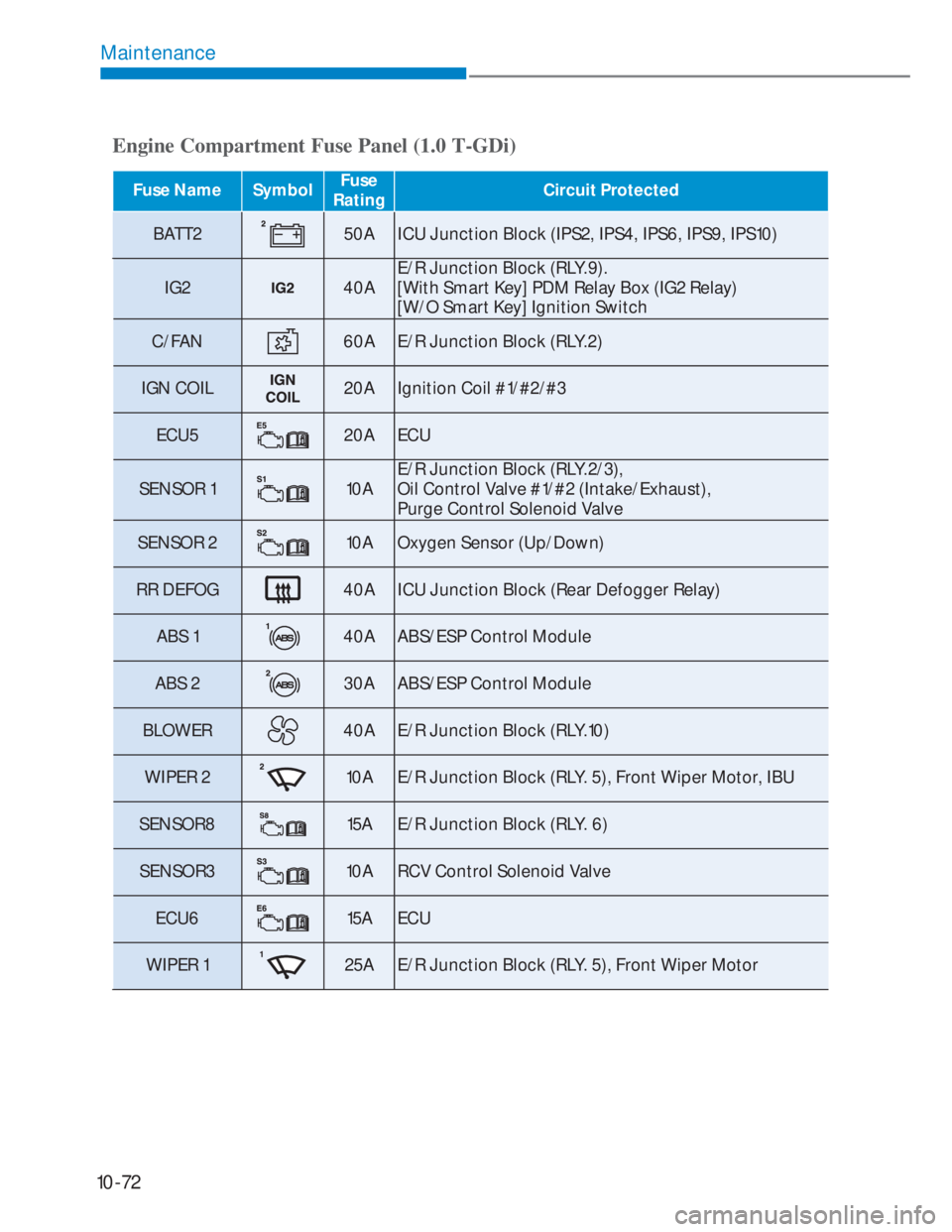
10-72
Maintenance
Engine Compartment Fuse Panel (1.0 T-GDi)
Fuse Name SymbolFuse
RatingCircuit Protected
BATT250A ICU Junction Block (IPS2, IPS4, IPS6, IPS9, IPS10)
IG2
40AE/R Junction Block (RLY.9).
[With Smart Key] PDM Relay Box (IG2 Relay)
[W/O Smart Key] Ignition Switch
C/FAN
60A E/R Junction Block (RLY.2)
IGN COIL
20A Ignition Coil #1/#2/#3
ECU5
20A ECU
SENSOR 1
10AE/R Junction Block (RLY.2/3),
Oil Control Valve #1/#2 (Intake/Exhaust),
Purge Control Solenoid Valve
SENSOR 2
10A Oxygen Sensor (Up/Down)
RR DEFOG
40A ICU Junction Block (Rear Defogger Relay)
ABS 1
40A ABS/ESP Control Module
ABS 2
30A ABS/ESP Control Module
BLOWER
40A E/R Junction Block (RLY.10)
WIPER 2
10A E/R Junction Block (RLY. 5), Front Wiper Motor, IBU
SENSOR8
15A E/R Junction Block (RLY. 6)
SENSOR3
10A RCV Control Solenoid Valve
ECU6
15A ECU
WIPER 1
25A E/R Junction Block (RLY. 5), Front Wiper Motor
Page 412 of 444
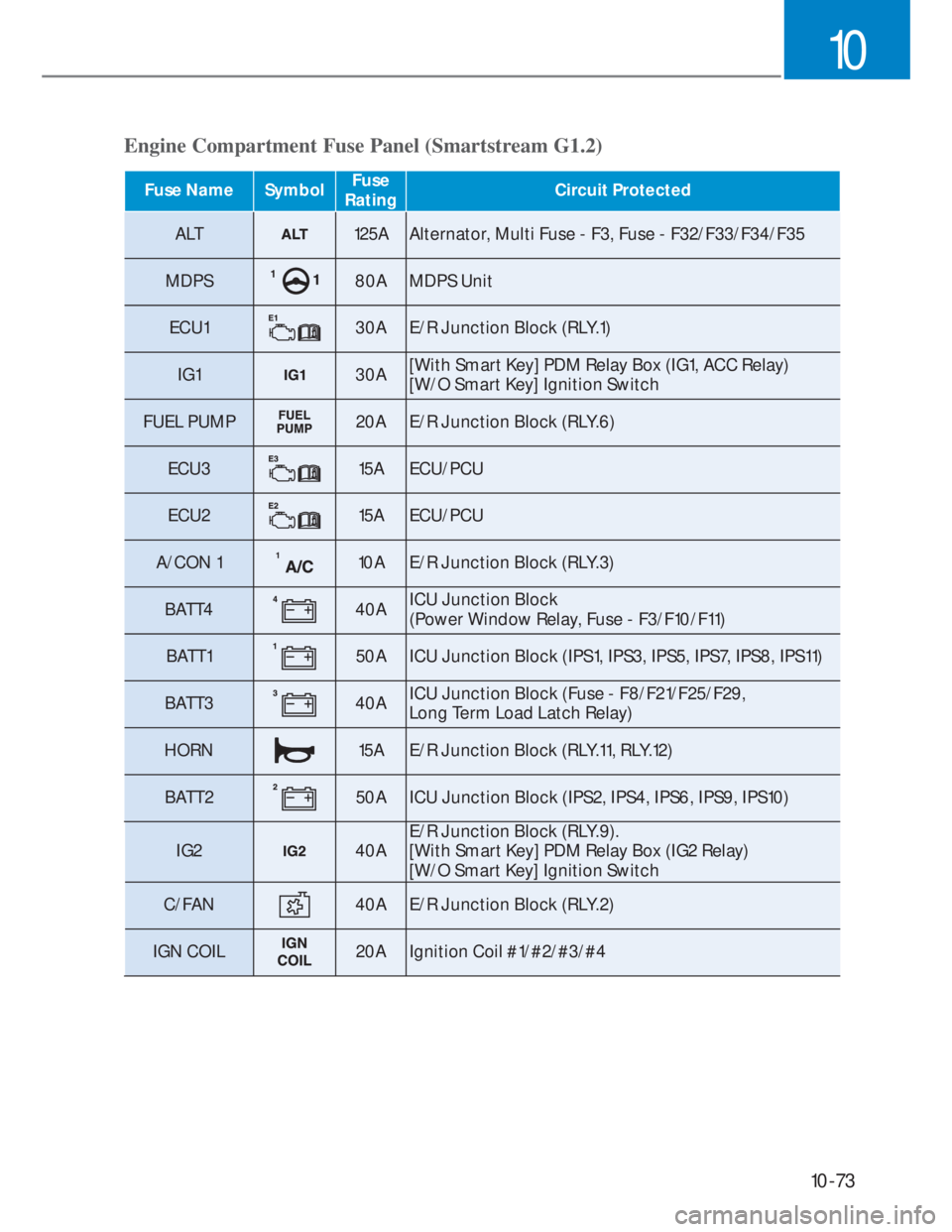
10-73
10
Engine Compartment Fuse Panel (Smartstream G1.2)
Fuse Name SymbolFuse
RatingCircuit Protected
ALT125A Alternator, Multi Fuse - F3, Fuse - F32/F33/F34/F35
MDPS
80A MDPS Unit
ECU1
30A E/R Junction Block (RLY.1)
IG1
30A[With Smart Key] PDM Relay Box (IG1, ACC Relay)
[W/O Smart Key] Ignition Switch
FUEL PUMP
20A E/R Junction Block (RLY.6)
ECU3
15A ECU/PCU
ECU2
15A ECU/PCU
A/CON 1
10A E/R Junction Block (RLY.3)
BATT4
40AICU Junction Block
(Power Window Relay, Fuse - F3/F10/F11)
BATT1
50A ICU Junction Block (IPS1, IPS3, IPS5, IPS7, IPS8, IPS11)
BATT3
40AICU Junction Block (Fuse - F8/F21/F25/F29,
Long Term Load Latch Relay)
HORN
15A E/R Junction Block (RLY.11, RLY.12)
BATT2
50A ICU Junction Block (IPS2, IPS4, IPS6, IPS9, IPS10)
IG2
40AE/R Junction Block (RLY.9).
[With Smart Key] PDM Relay Box (IG2 Relay)
[W/O Smart Key] Ignition Switch
C/FAN
40A E/R Junction Block (RLY.2)
IGN COIL
20A Ignition Coil #1/#2/#3/#4
Page 414 of 444
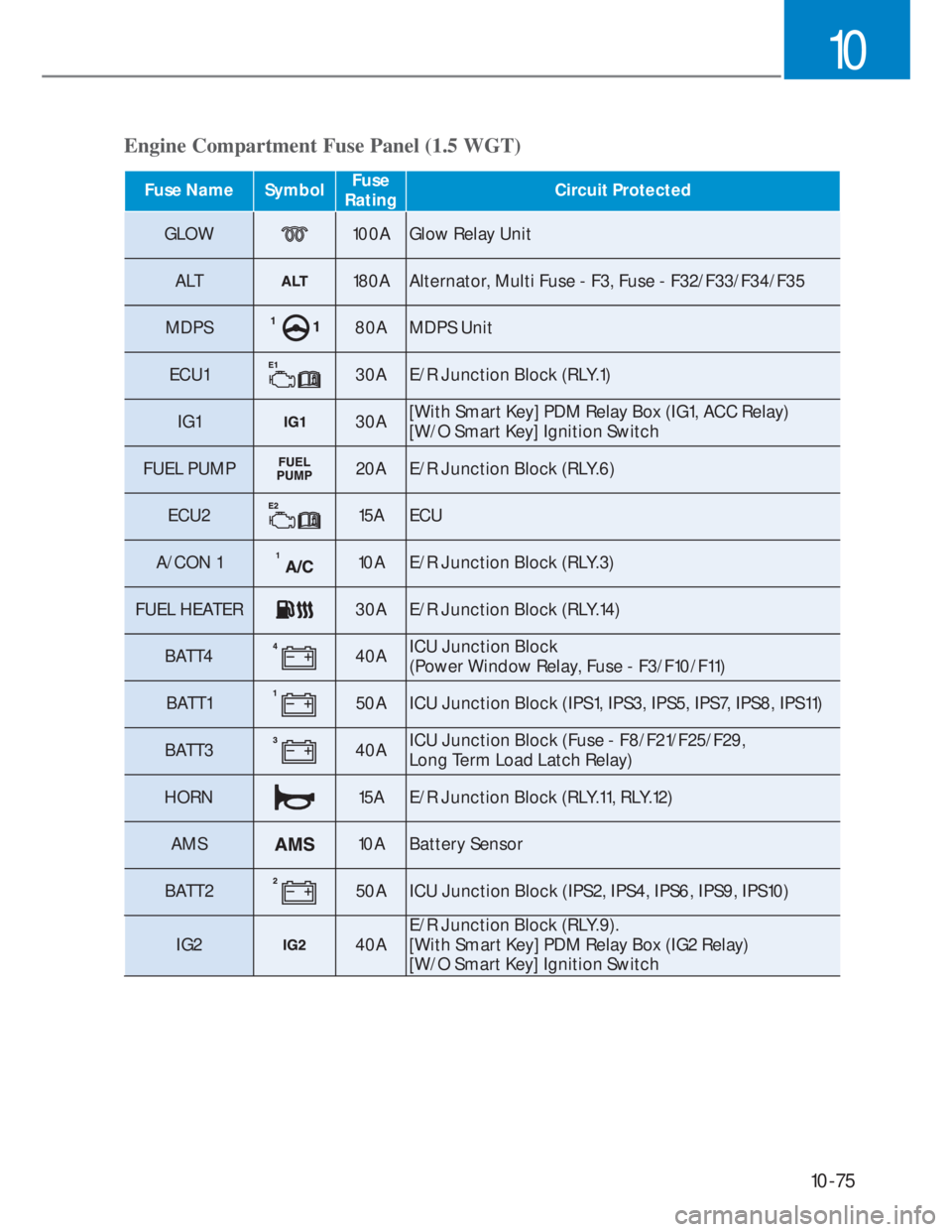
10-75
10
Engine Compartment Fuse Panel (1.5 WGT)
Fuse Name SymbolFuse
RatingCircuit Protected
GLOW100A Glow Relay Unit
ALT
180A Alternator, Multi Fuse - F3, Fuse - F32/F33/F34/F35
MDPS
80A MDPS Unit
ECU1
30A E/R Junction Block (RLY.1)
IG1
30A[With Smart Key] PDM Relay Box (IG1, ACC Relay)
[W/O Smart Key] Ignition Switch
FUEL PUMP
20A E/R Junction Block (RLY.6)
ECU2
15A ECU
A/CON 1
10A E/R Junction Block (RLY.3)
FUEL HEATER
30A E/R Junction Block (RLY.14)
BATT4
40AICU Junction Block
(Power Window Relay, Fuse - F3/F10/F11)
BATT1
50A ICU Junction Block (IPS1, IPS3, IPS5, IPS7, IPS8, IPS11)
BATT3
40AICU Junction Block (Fuse - F8/F21/F25/F29,
Long Term Load Latch Relay)
HORN
15A E/R Junction Block (RLY.11, RLY.12)
AMS
10A Battery Sensor
BATT2
50A ICU Junction Block (IPS2, IPS4, IPS6, IPS9, IPS10)
IG2
40AE/R Junction Block (RLY.9).
[With Smart Key] PDM Relay Box (IG2 Relay)
[W/O Smart Key] Ignition Switch
Page 416 of 444
10-77
10
We recommend that you consult an
authorized HYUNDAI dealer to replace
most vehicle light bulbs. It is difficult
to replace vehicle light bulbs because
other parts of the vehicle must be
removed before you can get to the bulb.
This is especially true for removing the
headlight assembly to get to the bulb(s).
Removing/installing the headlight
assembly can result in damage to the
vehicle.
WARNING
Prior to replacing a light, depress the
foot brake, move the shift lever into the
N (Neutral, for Automatic transmission
vehicle) or neutral (for manual
transmission vehicle), apply the parking
brake, place the ignition switch in the
LOCK/OFF position, and take the key
with you when leaving the vehicle to
avoid sudden movement of the vehicle
and to prevent possible electric shock.
Be aware the bulbs may be hot and may
burn your fingers.
NOTICE
Be sure to replace the burned-out bulb
with one of the same wattage rating.
Otherwise, it may cause damage to the
fuse or electric wiring system.
i Information
The headlight and tail lamp lenses could
appear frosty if the vehicle is washed after
driving or the vehicle is driven at night
in wet weather. This condition is caused
by temperature difference between the
lamp inside and outside and, it does not
indicate a problem with your vehicle.
When moisture condenses in the lamp,
it will be removed after driving with the
headlight on. The removable level may
differ depending on lamp size, lamp
position and environmental condition.
However, if moisture is not removed, we
recommend that your vehicle is inspected
by an authorized HYUNDAI dealer.
LIGHT BULBS
Page 435 of 444
10-96
Maintenance
Leather (if equipped)
• Feature of Seat Leather
- Leather is made from the outer skin
of an animal, which goes through a
special process to be available for
use. Since it is a natural object, each
part differs in thickness or density.
Wrinkles may appear as a natural
result of stretching and shrinking
depending on the temperature and
humidity.
- The seat is made of stretchable
fabric to improve comfort.
- The parts contacting the body are
curved and the side supporting
area is high which provides driving
comfort and stability.
- Wrinkles may appear naturally
from usage. It is not a fault of the
products.
CAUTION
• Wrinkles or abrasions which appear
naturally from usage are not covered
by warranty.
• Belts with metallic accessories,
zippers or keys inside the back
pocket may damage the seat fabric.
• Make sure not to wet the seat. It may
change the nature of natural leather.
• Jeans or clothes which could bleach
may contaminate the surface of the
seat covering fabric.• Caring for the leather seats
- Vacuum the seat periodically to
remove dust and sand on the seat. It
will prevent abrasion or damage of
the leather and maintain its quality.
- Wipe the natural leather seat cover
often with dry or soft cloth.
- Use of proper leather protective may
prevent abrasion of the cover and
helps maintain the color. Be sure to
read the instructions and consult a
specialist when using leather coating
or protective agent.
- Light colored (beige, cream beige)
leather is easily contaminated and
the stain is noticeable. Clean the
seats frequently.
- Avoid wiping with wet cloth. It may
cause the surface to crack.