fuel filter HYUNDAI I30 2012 User Guide
[x] Cancel search | Manufacturer: HYUNDAI, Model Year: 2012, Model line: I30, Model: HYUNDAI I30 2012Pages: 635, PDF Size: 40.66 MB
Page 378 of 635
761
Maintenance
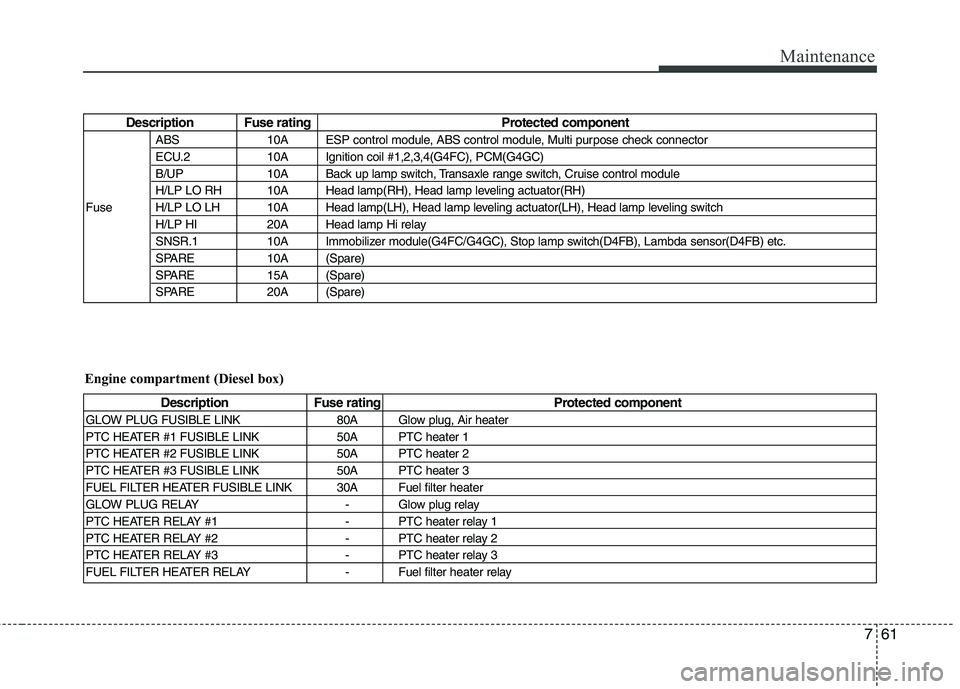
Description Fuse rating Protected componentABS 10A ESP control module, ABS control module, Multi purpose check connector
ECU.2 10A Ignition coil #1,2,3,4(G4FC), PCM(G4GC)
B/UP 10A Back up lamp switch, Transaxle range switch, Cruise control module
H/LP LO RH 10A Head lamp(RH), Head lamp leveling actuator(RH)
Fuse H/LP LO LH 10A Head lamp(LH), Head lamp leveling actuator(LH), Head lamp leveling switch H/LP HI 20A Head lamp Hi relay
SNSR.1 10A Immobilizer module(G4FC/G4GC), Stop lamp switch(D4FB), Lambda sensor(D4FB) etc.
SPARE 10A (Spare)
SPARE 15A (Spare)
SPARE 20A (Spare)
Description Fuse rating Protected component
GLOW PLUG FUSIBLE LINK 80A Glow plug, Air heater
PTC HEATER #1 FUSIBLE LINK 50A PTC heater 1
PTC HEATER #2 FUSIBLE LINK 50A PTC heater 2
PTC HEATER #3 FUSIBLE LINK 50A PTC heater 3
FUEL FILTER HEATER FUSIBLE LINK 30A Fuel filter heater
GLOW PLUG RELAY - Glow plug relay
PTC HEATER RELAY #1 - PTC heater relay 1
PTC HEATER RELAY #2 - PTC heater relay 2
PTC HEATER RELAY #3 - PTC heater relay 3
FUEL FILTER HEATER RELAY - Fuel filter heater relay
Engine compartment (Diesel box)
Page 391 of 635
Maintenance
74
7
EMISSION CONTROL SYSTEM
G270000AFD
The emission control system of your
vehicle is covered by a written limited
warranty. Please see the warranty infor-
mation contained in the Service Passport
in your vehicle.
Your vehicle is equipped with an emis- sion control system to meet all emission
regulations. There are three emission control sys-
tems which are as follows.
(1) Crankcase emission control system
(2) Evaporative emission control system(3) Exhaust emission control system In order to assure the proper function of
the emission control systems, it is rec-
ommended that you have your car
inspected and maintained by an author-
ized HYUNDAI dealer in accordance with
the maintenance schedule in this manu-al. Caution for the Inspection and
Maintenance Test (With Electronic
Stability Program (ESP) system)
To prevent the vehicle from misfir-
ing during dynamometer testing,
turn the Electronic Stability
Program (ESP) system off by press-
ing the ESP switch.
After dynamometer testing is com- pleted, turn the ESP system back on
by pressing the ESP switch again.
G270100AUN
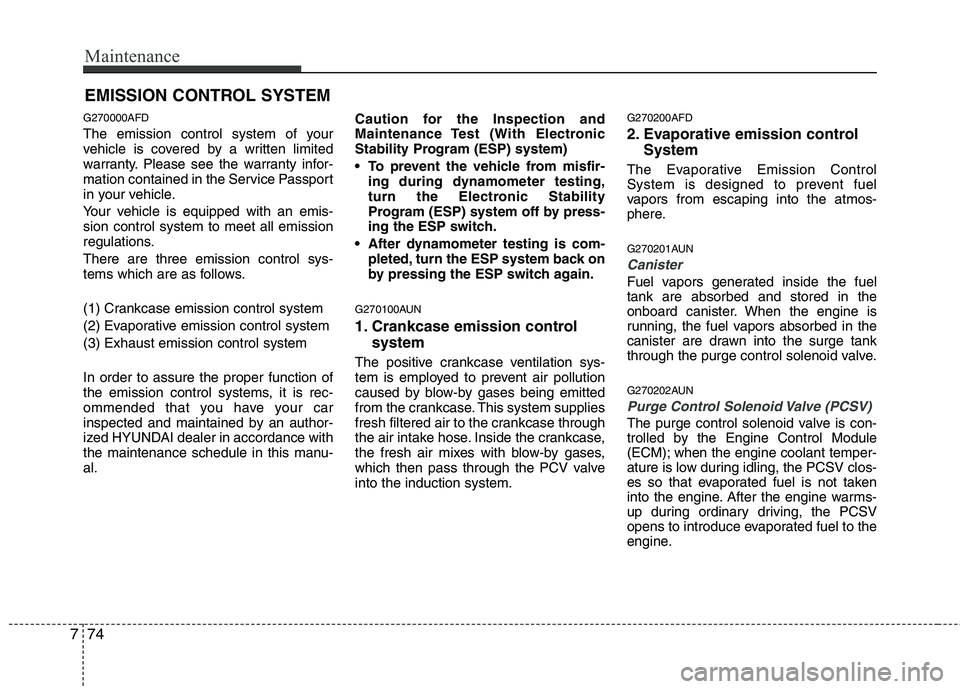
1. Crankcase emission control system
The positive crankcase ventilation sys-
tem is employed to prevent air pollution
caused by blow-by gases being emitted
from the crankcase. This system supplies
fresh filtered air to the crankcase through
the air intake hose. Inside the crankcase,
the fresh air mixes with blow-by gases,
which then pass through the PCV valveinto the induction system. G270200AFD
2. Evaporative emission control
System
The Evaporative Emission Control
System is designed to prevent fuel
vapors from escaping into the atmos-
phere.
G270201AUN
Canister
Fuel vapors generated inside the fuel tank are absorbed and stored in the
onboard canister. When the engine is
running, the fuel vapors absorbed in the
canister are drawn into the surge tank
through the purge control solenoid valve.
G270202AUN
Purge Control Solenoid Valve (PCSV)
The purge control solenoid valve is con-
trolled by the Engine Control Module
(ECM); when the engine coolant temper-
ature is low during idling, the PCSV clos-
es so that evaporated fuel is not taken
into the engine. After the engine warms-
up during ordinary driving, the PCSV
opens to introduce evaporated fuel to the
engine.
Page 393 of 635
Maintenance
76
7
Do not modify or tamper with any part
of the engine or emission control sys-
tem. All inspections and adjustments
must be made by an authorized
HYUNDAI dealer.
Avoid driving with a very low fuel level. If you run out of gasoline, it couldcause the engine to misfire and result
in excessive loading of the catalytic
converter.
Failure to observe these precautionscould result in damage to the catalytic
converter and to your vehicle.
Additionally, such actions could void your
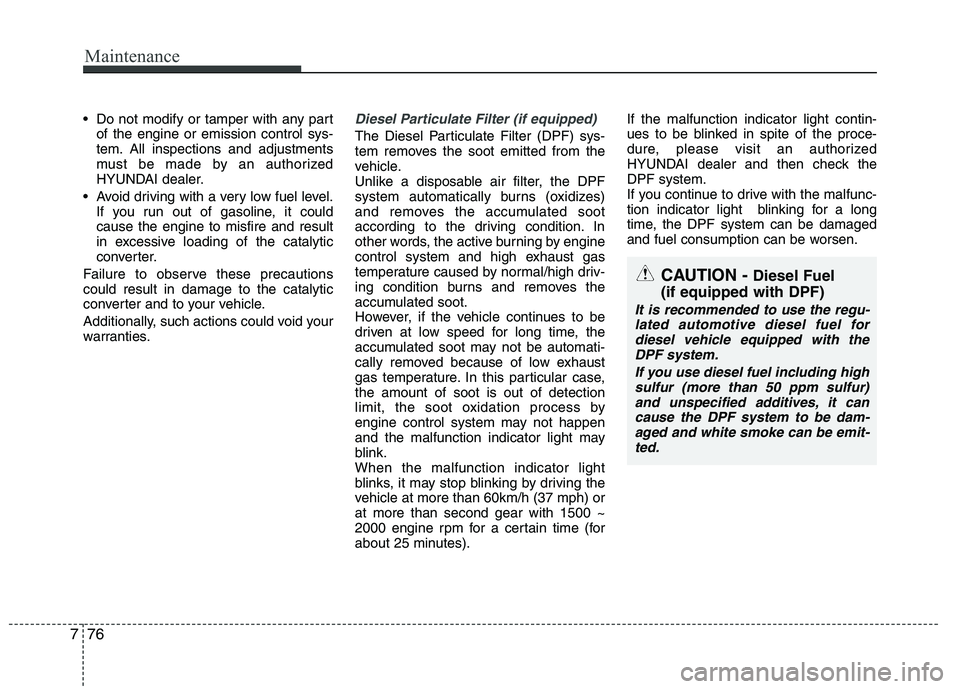
warranties.Diesel Particulate Filter (if equipped)
The Diesel Particulate Filter (DPF) sys-
tem removes the soot emitted from the
vehicle.
Unlike a disposable air filter, the DPF
system automatically burns (oxidizes)
and removes the accumulated soot
according to the driving condition. In
other words, the active burning by engine
control system and high exhaust gas
temperature caused by normal/high driv-
ing condition burns and removes the
accumulated soot.
However, if the vehicle continues to be
driven at low speed for long time, the
accumulated soot may not be automati-
cally removed because of low exhaust
gas temperature. In this particular case,the amount of soot is out of detection
limit, the soot oxidation process by
engine control system may not happen
and the malfunction indicator light may
blink.When the malfunction indicator light
blinks, it may stop blinking by driving the
vehicle at more than 60km/h (37 mph) orat more than second gear with 1500 ~
2000 engine rpm for a certain time (for
about 25 minutes). If the malfunction indicator light contin-
ues to be blinked in spite of the proce-
dure, please visit an authorized
HYUNDAI dealer and then check theDPF system.
If you continue to drive with the malfunc-
tion indicator light blinking for a long
time, the DPF system can be damaged
and fuel consumption can be worsen.
CAUTION -
Diesel Fuel
(if equipped with DPF)
It is recommended to use the regu- lated automotive diesel fuel for
diesel vehicle equipped with the DPF system.
If you use diesel fuel including highsulfur (more than 50 ppm sulfur) and unspecified additives, it can
cause the DPF system to be dam-aged and white smoke can be emit- ted.
Page 401 of 635
Specifications
4
9
RECOMMENDED LUBRICANTS AND CAPACITIES
I040000CFD
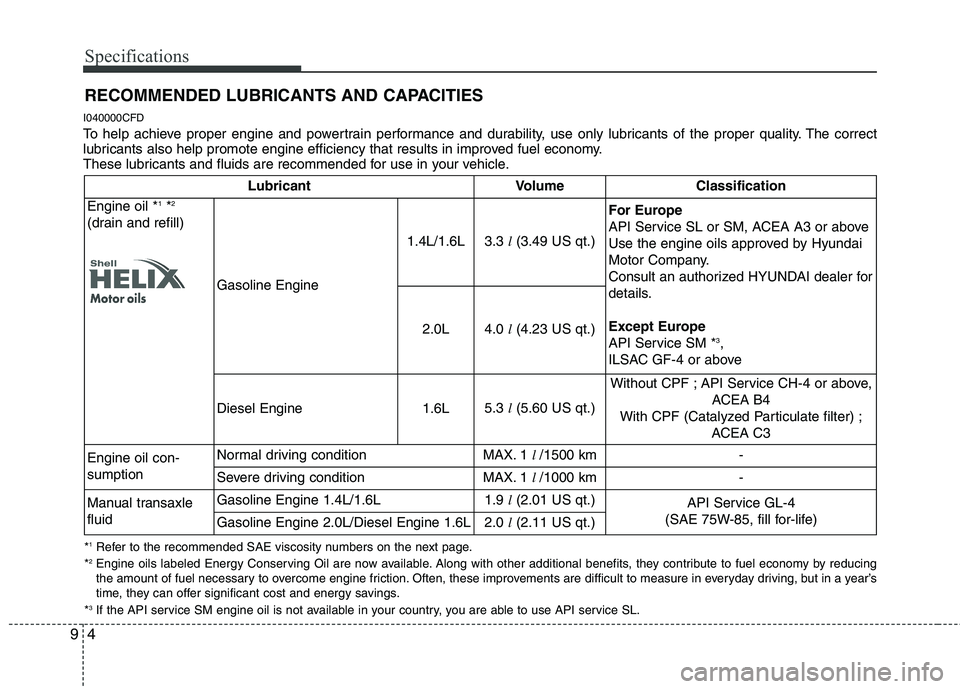
To help achieve proper engine and powertrain performance and durability, use only lubricants of the proper quality. The correct
lubricants also help promote engine efficiency that results in improved fuel economy.
These lubricants and fluids are recommended for use in your vehicle.
* 1
Refer to the recommended SAE viscosity numbers on the next page.
* 2
Engine oils labeled Energy Conserving Oil are now available. Along with other additional benefits, they contribute to fuel econo my by reducing
the amount of fuel necessary to overcome engine friction. Often, these improvements are difficult to measure in everyday driving, but in a year’s
time, they can offer significant cost and energy savings.
* 3
If the API service SM engine oil is not available in your country, you are able to use API service SL. Lubricant Volume Classification
Engine oil * 1
*2
(drain and refill)
Gasoline Engine 1.4L/1.6L
3.3
l(3.49 US qt.) For Europe
API Service SL or SM, ACEA A3 or above
Use the engine oils approved by Hyundai
Motor Company.
Consult an authorized HYUNDAI dealer for
details.
Except Europe
API Service SM *
3
,
ILSAC GF-4 or above
2.0L
4.0
l(4.23 US qt.)
Diesel Engine 1.6L 5.3
l(5.60 US qt.) Without CPF ; API Service CH-4 or above,
ACEA B4
With CPF (Catalyzed Particulate filter) ; ACEA C3
Engine oil con- sumptionNormal driving conditionMAX. 1l /1500 km-
Severe driving conditionMAX. 1 l /1000 km -
Manual transaxle fluid Gasoline Engine 1.4L/1.6L
1.9
l(2.01 US qt.)
API Service GL-4
(SAE 75W-85, fill for-life)
Gasoline Engine 2.0L/Diesel Engine 1.6L 2.0
l(2.11 US qt.)
Page 408 of 635
I5
Index
Folding the rear seat ······················································3-10
Front fog light bulb replacement ···································7-64
Front seat adjustment ························································3-4
Fuel filler lid ···································································4-21
Fuel filter (for diesel) ······················································7-32
Fuel gauge ·······································································4-38
Fuel requirements ·····························································1-2
Fuses ···············································································7-53
Fuse/relay panel description······································7-57
Main fuse···································································7-56
Memory fuse ·····························································7-55
Gauge Engine temperature gauge ·········································4-37
Fuel gauge ·································································4-38
Glassroof, see sunroof ····················································4-24
Glove box ········································································4-88
Hazard warning flasher ···················································4-53
Hazardous driving conditions ·········································5-33
Headlight bulb replacement ············································7-63
Headlight escort function················································4-54
Headlight welcome function ··········································4-55
Headlight leveling device················································4-59 Headrest ·····································································3-5, 3-9
Heating and air conditioning ··········································4-69
High mounted stop light replacement·····························7-66
Highway driving ·····························································5-35
Hood················································································4-19
Horn ················································································4-29
How to use this manual ····················································1-2
Ignition key interlock system··········································5-15
Immobilizer system···························································4-3
Indicators and warnings ··················································4-41
Indicator symbols on the instrument cluster·····················1-7
Inside rearview mirror ····················································4-31
Instrument cluster ···························································4-35
Engine temperature gauge ·········································4-37
Fuel gauge ·································································4-38
Instrument panel illumination ···································4-36
Odometer/Tripmeter ··················································4-38
Speedometer ······························································4-36
Tachometer ································································4-37
Trip computer ····························································4-39
Warning and indicators ·············································4-41
Instrument panel illumination ·········································4-36
Instrument panel overview················································2-4
Interior care ·····································································7-73
Interior features ·······························································4-92
G
H
I
Page 522 of 635
Features of your vehicle
50
4
D150329AFD
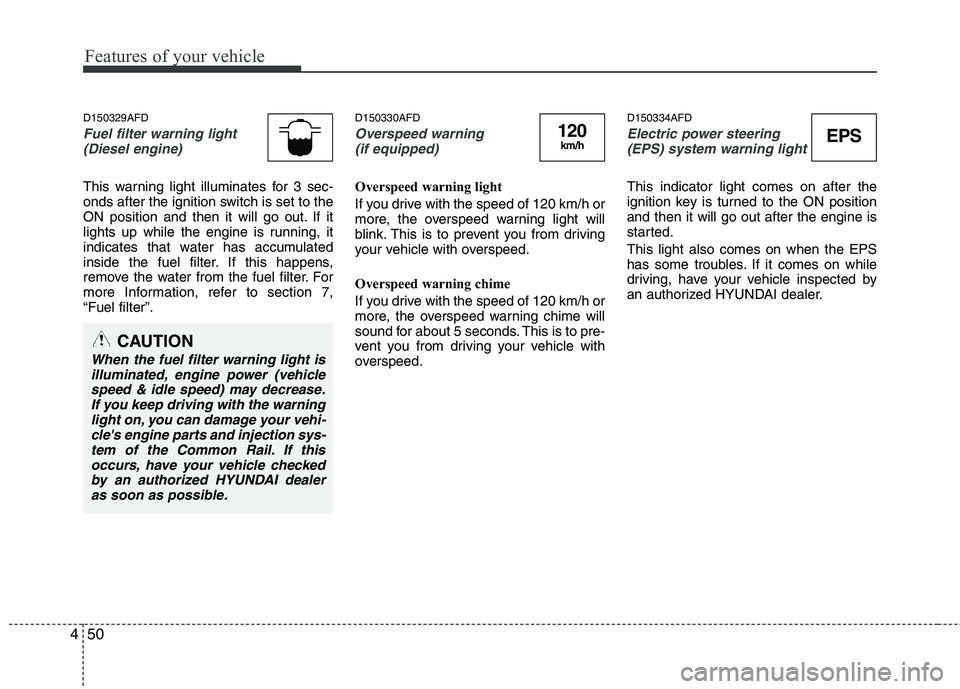
Fuel filter warning light
(Diesel engine)
This warning light illuminates for 3 sec-
onds after the ignition switch is set to the
ON position and then it will go out. If it
lights up while the engine is running, it
indicates that water has accumulated
inside the fuel filter. If this happens,
remove the water from the fuel filter. For
more Information, refer to section 7,“Fuel filter”. D150330AFD
Overspeed warning
(if equipped)
Overspeed warning light
If you drive with the speed of 120 km/h or
more, the overspeed warning light will
blink. This is to prevent you from driving
your vehicle with overspeed.
Overspeed warning chime
If you drive with the speed of 120 km/h or
more, the overspeed warning chime will
sound for about 5 seconds. This is to pre-
vent you from driving your vehicle with
overspeed. D150334AFD
Electric power steering
(EPS) system warning light
This indicator light comes on after the
ignition key is turned to the ON positionand then it will go out after the engine is
started. This light also comes on when the EPS
has some troubles. If it comes on while
driving, have your vehicle inspected by
an authorized HYUNDAI dealer.
EPS120km/h
CAUTION
When the fuel filter warning light is illuminated, engine power (vehicle
speed & idle speed) may decrease.If you keep driving with the warninglight on, you can damage your vehi-cle's engine parts and injection sys-
tem of the Common Rail. If thisoccurs, have your vehicle checked by an authorized HYUNDAI dealer as soon as possible.