engine coolant HYUNDAI I30 2012 Owner's Manual
[x] Cancel search | Manufacturer: HYUNDAI, Model Year: 2012, Model line: I30, Model: HYUNDAI I30 2012Pages: 635, PDF Size: 40.66 MB
Page 343 of 635
Maintenance
26
7
-15°C (5°F) 35 65
-25°C (-13°F) 40 60
-35°C (-31°F) 50 50
-45°C (-49°F) 60 40
Ambient
Temperature Mixture Percentage (volume)
Antifreeze Water
Check the condition and connections of all cooling system hoses and heater
hoses. Replace any swollen or deterio-
rated hoses.
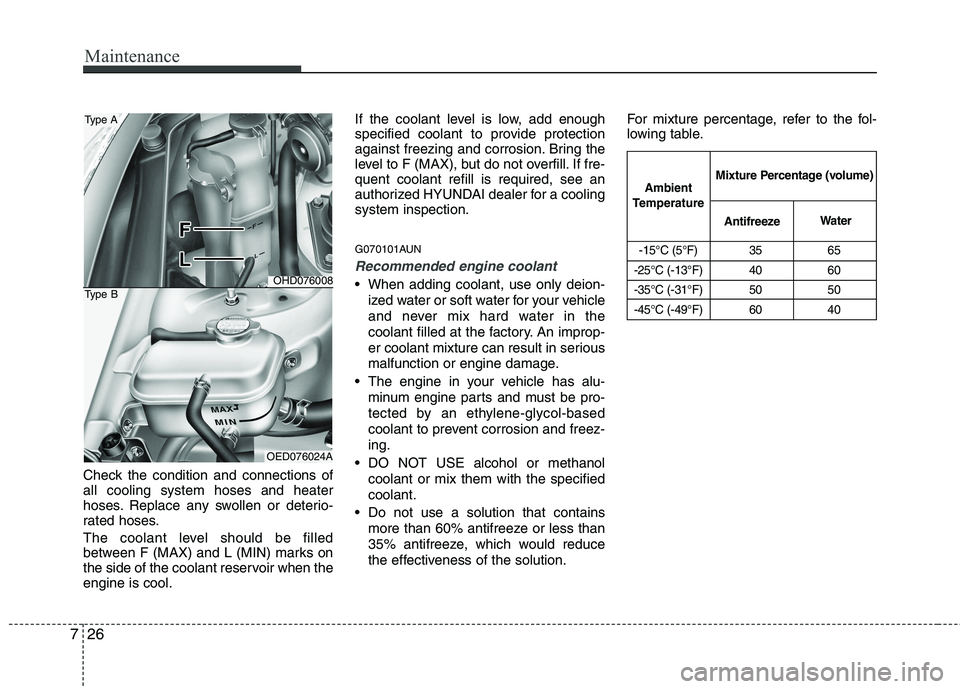
The coolant level should be filled
between F (MAX) and L (MIN) marks on
the side of the coolant reservoir when theengine is cool. If the coolant level is low, add enough
specified coolant to provide protection
against freezing and corrosion. Bring the
level to F (MAX), but do not overfill. If fre-quent coolant refill is required, see an
authorized HYUNDAI dealer for a coolingsystem inspection.
G070101AUN
Recommended engine coolant
When adding coolant, use only deion-
ized water or soft water for your vehicle
and never mix hard water in the
coolant filled at the factory. An improp-
er coolant mixture can result in serious
malfunction or engine damage.
The engine in your vehicle has alu- minum engine parts and must be pro-
tected by an ethylene-glycol-based
coolant to prevent corrosion and freez-ing.
DO NOT USE alcohol or methanol coolant or mix them with the specifiedcoolant.
Do not use a solution that contains more than 60% antifreeze or less than
35% antifreeze, which would reduce
the effectiveness of the solution. For mixture percentage, refer to the fol-
lowing table.OHD076008
Type A
OED076024A
Type B
Page 344 of 635
727
Maintenance
G070200AFD Changing the coolant
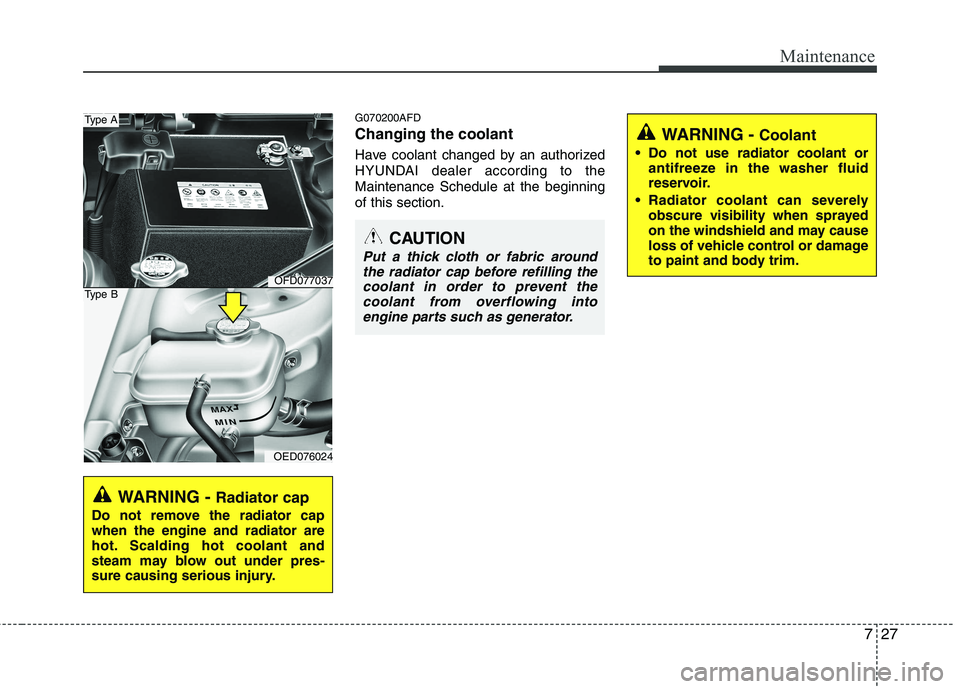
Have coolant changed by an authorized
HYUNDAI dealer according to theMaintenance Schedule at the beginningof this section.
WARNING - Radiator cap
Do not remove the radiator cap when the engine and radiator are
hot. Scalding hot coolant and
steam may blow out under pres-
sure causing serious injury.
CAUTION
Put a thick cloth or fabric around the radiator cap before refilling the
coolant in order to prevent the coolant from overflowing intoengine parts such as generator.
WARNING - Coolant
Do not use radiator coolant or antifreeze in the washer fluid
reservoir.
Radiator coolant can severely obscure visibility when sprayed
on the windshield and may cause
loss of vehicle control or damage
to paint and body trim.
OFD077037
Type A
OED076024
Type B
Page 391 of 635
Maintenance
74
7
EMISSION CONTROL SYSTEM
G270000AFD
The emission control system of your
vehicle is covered by a written limited
warranty. Please see the warranty infor-
mation contained in the Service Passport
in your vehicle.
Your vehicle is equipped with an emis- sion control system to meet all emission
regulations. There are three emission control sys-
tems which are as follows.
(1) Crankcase emission control system
(2) Evaporative emission control system(3) Exhaust emission control system In order to assure the proper function of
the emission control systems, it is rec-
ommended that you have your car
inspected and maintained by an author-
ized HYUNDAI dealer in accordance with
the maintenance schedule in this manu-al. Caution for the Inspection and
Maintenance Test (With Electronic
Stability Program (ESP) system)
To prevent the vehicle from misfir-
ing during dynamometer testing,
turn the Electronic Stability
Program (ESP) system off by press-
ing the ESP switch.
After dynamometer testing is com- pleted, turn the ESP system back on
by pressing the ESP switch again.
G270100AUN
1. Crankcase emission control system
The positive crankcase ventilation sys-
tem is employed to prevent air pollution
caused by blow-by gases being emitted
from the crankcase. This system supplies
fresh filtered air to the crankcase through
the air intake hose. Inside the crankcase,
the fresh air mixes with blow-by gases,
which then pass through the PCV valveinto the induction system. G270200AFD
2. Evaporative emission control
System
The Evaporative Emission Control
System is designed to prevent fuel
vapors from escaping into the atmos-
phere.
G270201AUN
Canister
Fuel vapors generated inside the fuel tank are absorbed and stored in the
onboard canister. When the engine is
running, the fuel vapors absorbed in the
canister are drawn into the surge tank
through the purge control solenoid valve.
G270202AUN
Purge Control Solenoid Valve (PCSV)
The purge control solenoid valve is con-
trolled by the Engine Control Module
(ECM); when the engine coolant temper-
ature is low during idling, the PCSV clos-
es so that evaporated fuel is not taken
into the engine. After the engine warms-
up during ordinary driving, the PCSV
opens to introduce evaporated fuel to the
engine.
Page 402 of 635
95
Specifications
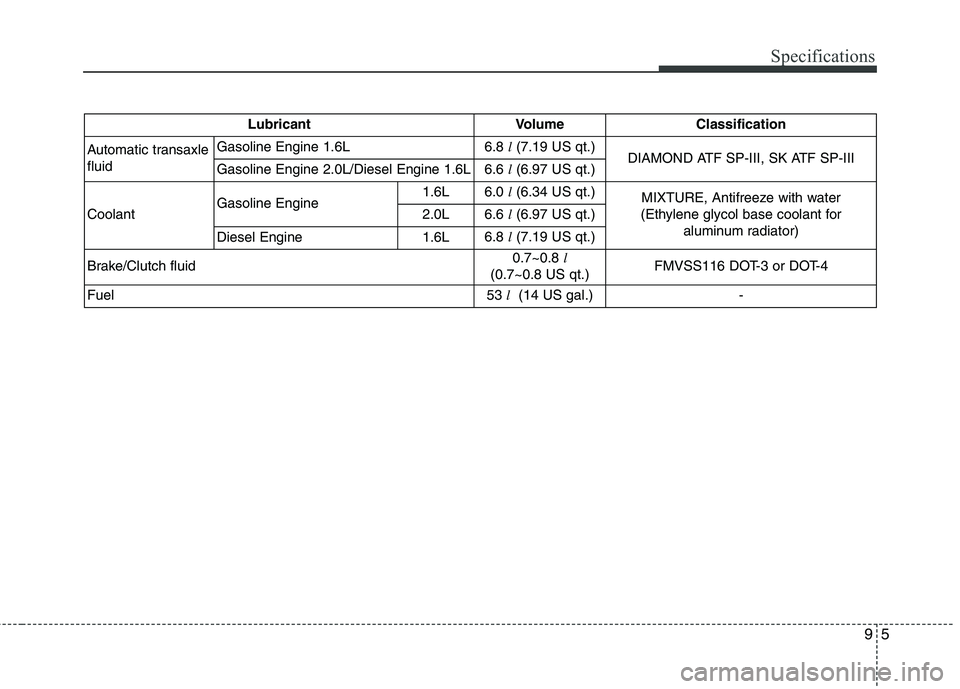
Lubricant Volume Classification
Automatic transaxle fluid Gasoline Engine 1.6L
6.8
l(7.19 US qt.)
DIAMOND ATF SP-III, SK ATF SP-III
Gasoline Engine 2.0L/Diesel Engine 1.6L 6.6
l(6.97 US qt.)
Coolant Gasoline Engine 1.6L
6.0
l(6.34 US qt.)
MIXTURE, Antifreeze with water
(Ethylene glycol base coolant for aluminum radiator)
2.0L
6.6
l(6.97 US qt.)
Diesel Engine 1.6L 6.8
l(7.19 US qt.)
Brake/Clutch fluid 0.7~0.8
l
(0.7~0.8 US qt.) FMVSS116 DOT-3 or DOT-4
Fuel 53
l(14 US gal.)
-
Page 406 of 635
I3
Index
Capacities (Lubricants) ·····················································9-4 Care
Exterior care ······························································7-68
Interior care ·······························································7-73
Tire care·····································································7-43
Cargo security screen ····················································4-100
Cargo weight ···································································5-49
Center console storage ····················································4-88
Central door lock switch ···················································4-9
Changing tires ·································································6-13Chains Tire chains ·································································5-38
Checking tire inflation pressure ······································7-45
Child restraint system ·····················································3-28 ISOFIX system ·························································3-34
Tether anchor system·················································3-32
Child-protector rear door lock ·······································4-11
Climate control system (Automatic)·······························4-76 Air conditioning ·······················································4-83Automatic heating and air conditioning ···················4-78
Manual heating and air conditioning ·······················4-79
Climate control system (Manual) ··································4-68 Air conditioning ························································4-73
Climate control air filter············································4-75
Heating and air conditioning ·····································4-69
Cigarette lighter ······························································4-92 Climate control air filter ········································4-75, 7-34
Clock (Digital) ·········································4-94, 4-114, 4-127
Clothes hanger ································································4-96
Combined instrument, see instrument cluster ················4-35
Compact spare tire ··························································6-18
Compact spare tire replacement ·····································7-48
Coolant ············································································7-25
Cooling fluid, see engine coolant ···································7-25
Crankcase emission control system ·······························7-74
Cruise control system ····················································5-27
Cup holder·······································································4-93
Curtain air bag ································································3-48
Dashboard, see instrument cluster ··································4-35
Dashboard illumination, see instrument
panel illumination ························································4-36
Deadlocks········································································4-10
Defogging (Windshield) ·················································4-84
Defogging logic (Windshield) ········································4-86
Defroster ·········································································4-66 Front windshield deicer·············································4-67
Rear window defroster ··············································4-67
Defrosting (Windshield) ·················································4-84
Digital clock ·············································4-94, 4-114, 4-127
Dimensions ·······································································9-2
Displays, see instrument cluster ·····································4-35
C
D
Page 407 of 635
Index
4
I
Display illumination, see instrument
panel illumination ·······················································4-36
Door locks ·········································································4-8 Central door lock switch ············································4-9
Child-protector rear door lock ·································4-11
Deadlocks ··································································4-10
Drinks holders, see cup holders ·····································4-93
Driver's air bag ·······························································3-40
Driving at night ······························································5-34
Driving in flooded areas ················································5-35
Driving in the rain ··························································5-35
Economical operation ····················································5-31
Electric chromic mirror (ECM) ·····································4-31
Electric power steering ··················································4-28
Emergency starting ··························································6-4 Jump starting ······························································6-4
Push starting ·······························································6-5
Emergency tailgate safety release ··································4-13
Emergency towing ·························································6-22
Emergency while driving ·················································6-2
Emergency commodity ··················································6-25
Emission control system ················································7-74 Crankcase emission control system ·························7-74
Evaporative emission control system ·······················7-74 Exhaust emission control system ·····························7-75
Engine compartment ························································7-2
Engine coolant ·······························································7-25
Engine number ·································································8-4
Engine oil ·······································································7-24
Engine overheats ······························································6-6
Engine temperature gauge ·············································4-37
Engine will not start ·························································6-3
Evaporative emission control system ····························7-74
Exhaust emission control system ···································7-75Explanation of scheduled maintenance items ················7-21
Exterior care ···································································7-68
Exterior features ···························································4-101 Mounting bracket for roof carrier ··························4-101
Roof rack ································································4-102
Flat tire ···········································································6-12 Changing tires ··························································6-13
Compact spare tire ···················································6-18
Jack and tools ···························································6-12
Removing and storing the spare tire ························6-13
Floor mat anchor(s) ·······················································4-96Fluid Automatic transaxle ··················································7-29
Brakes/clutch fluid ···················································7-28
Washer fluid ·····························································7-31
E
F
Page 509 of 635
437
Features of your vehicle
D150202AFD
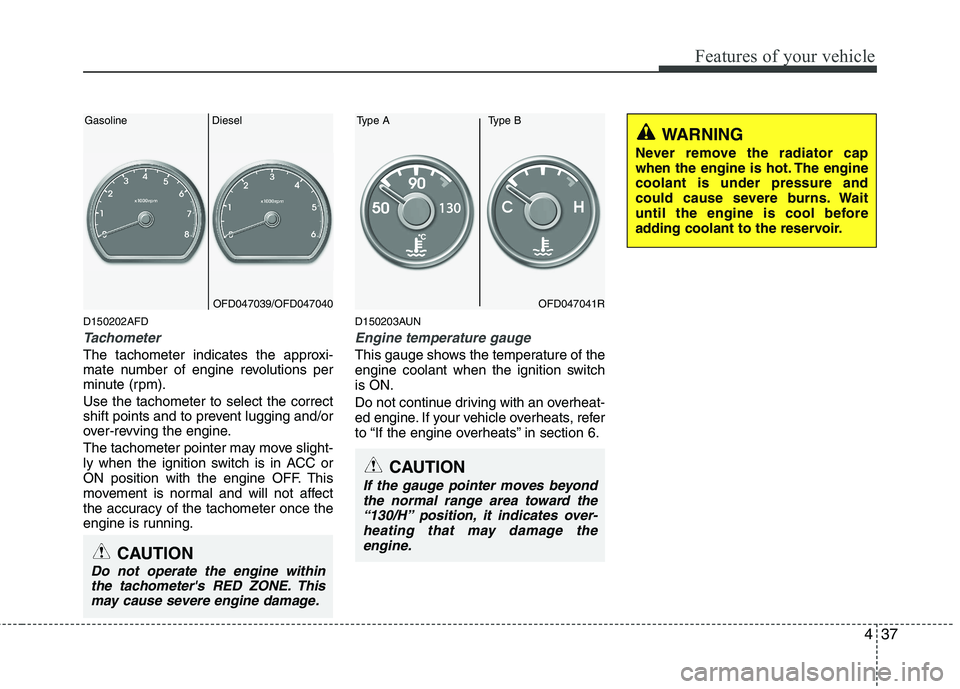
Tachometer
The tachometer indicates the approxi-
mate number of engine revolutions per
minute (rpm). Use the tachometer to select the correct
shift points and to prevent lugging and/or
over-revving the engine.
The tachometer pointer may move slight-
ly when the ignition switch is in ACC or
ON position with the engine OFF. This
movement is normal and will not affect
the accuracy of the tachometer once the
engine is running.D150203AUN
Engine temperature gauge
This gauge shows the temperature of the
engine coolant when the ignition switchis ON.
Do not continue driving with an overheat-
ed engine. If your vehicle overheats, refer
to “If the engine overheats” in section 6.
OFD047041R
CAUTION
If the gauge pointer moves beyond
the normal range area toward the “130/H” position, it indicates over-
heating that may damage theengine.
WARNING
Never remove the radiator cap
when the engine is hot. The enginecoolant is under pressure and
could cause severe burns. Wait
until the engine is cool before
adding coolant to the reservoir.
OFD047039/OFD047040
Gasoline
Type A Type B
Diesel
CAUTION
Do not operate the engine within
the tachometer's RED ZONE. This may cause severe engine damage.