rear HYUNDAI I30 2014 User Guide
[x] Cancel search | Manufacturer: HYUNDAI, Model Year: 2014, Model line: I30, Model: HYUNDAI I30 2014Pages: 635, PDF Size: 40.66 MB
Page 32 of 635
313
Safety system of your vehicle
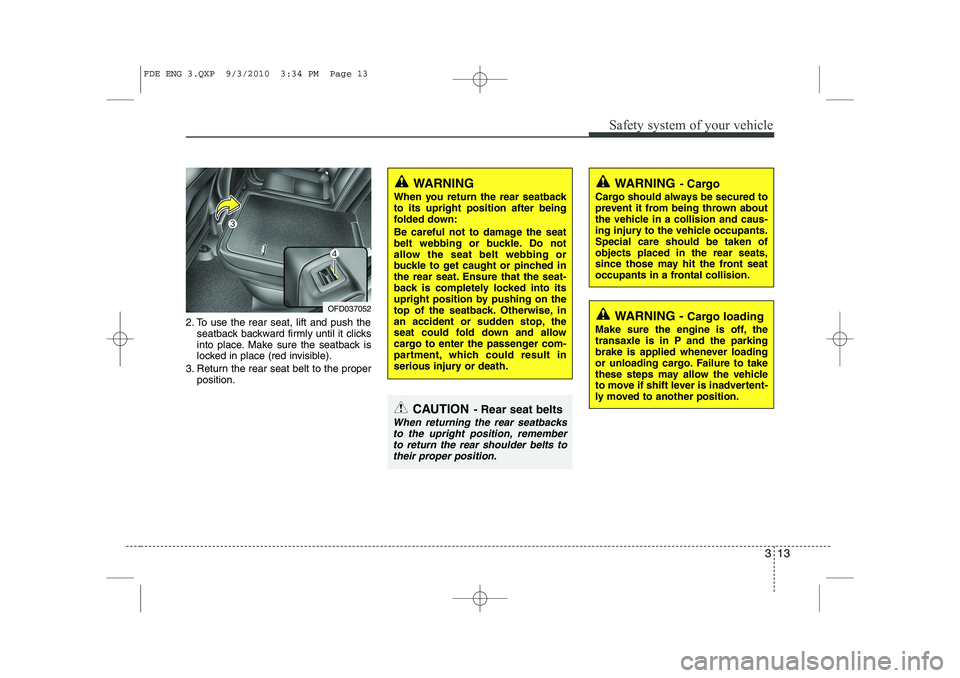
2. To use the rear seat, lift and push theseatback backward firmly until it clicks
into place. Make sure the seatback is
locked in place (red invisible).
3. Return the rear seat belt to the proper position.
WARNING
When you return the rear seatback to its upright position after being
folded down:
Be careful not to damage the seat
belt webbing or buckle. Do not
allow the seat belt webbing or
buckle to get caught or pinched in
the rear seat. Ensure that the seat-
back is completely locked into its
upright position by pushing on the
top of the seatback. Otherwise, in
an accident or sudden stop, the
seat could fold down and allow
cargo to enter the passenger com-
partment, which could result in
serious injury or death.
CAUTION - Rear seat belts
When returning the rear seatbacks
to the upright position, remember to return the rear shoulder belts totheir proper position.
WARNING - Cargo loading
Make sure the engine is off, the transaxle is in P and the parking
brake is applied whenever loading
or unloading cargo. Failure to take
these steps may allow the vehicle
to move if shift lever is inadvertent-
ly moved to another position.
WARNING - Cargo
Cargo should always be secured to
prevent it from being thrown about
the vehicle in a collision and caus-
ing injury to the vehicle occupants.Special care should be taken ofobjects placed in the rear seats,
since those may hit the front seat
occupants in a frontal collision.
OFD037052
FDE ENG 3.QXP 9/3/2010 3:34 PM Page 13
Page 33 of 635
Safety system of your vehicle
14
3
C020100AUN Seat belt restraint system SEAT BELTS(Continued)
Avoid wearing twisted seat belts.
A twisted belt can't do its job as
well. In a collision, it could even
cut into you. Be sure the beltwebbing is straight and not twist-ed.
Be careful not to damage the belt webbing or hardware. If the belt
webbing or hardware is dam-
aged, replace it.
WARNING
Seat belts are designed to bear
upon the bony structure of the
body, and should be worn low
across the front of the pelvis or the
pelvis, chest and shoulders, as
applicable; wearing the lap section
of the belt across the abdominal
area must be avoided. Seat belts should be adjusted as
firmly as possible, consistent with
comfort, to provide the protection
for which they have been designed.
A slack belt will greatly reduce the
protection afforded to the wearer.
(Continued)
(Continued)
Care should be taken to avoid con- tamination of the webbing with pol-
ishes, oils and chemicals, and par-
ticularly battery acid. Cleaning may
safely be carried out using mild
soap and water. The belt should bereplaced if webbing becomes
frayed, contaminated or damaged.It is essential to replace the entire
assembly after it has been worn in
a severe impact even if damage to
the assembly is not obvious. Belts
should not be worn with straps
twisted. Each seat belt assembly
must only be used by one occu-
pant; it is dangerous to put a belt
around a child being carried on theoccupant's lap.
WARNING
No modifications or additions
should be made by the user which
will either prevent the seat belt
adjusting devices from operating to
remove slack, or prevent the seat
belt assembly from being adjusted
to remove slack.
WARNING
For maximum restraint system protection, the seat belts must
always be used whenever the car
is moving.
Seat belts are most effective when seatbacks are in theupright position.
Children age 12 and younger must always be properly
restrained in the rear seat. Never
allow children to ride in the front
passenger seat. If a child over 12
must be seated in the front seat,
he/she must be properly belted
and the seat should be moved as
far back as possible.
Never wear the shoulder belt under your arm or behind your
back. An improperly positionedshoulder belt can cause serious
injuries in a crash. The shoulder
belt should be positioned midway
over your shoulder across your
collarbone.
(Continued)
FDE ENG 3.QXP 9/3/2010 3:34 PM Page 14
Page 35 of 635
Safety system of your vehicle
16
3
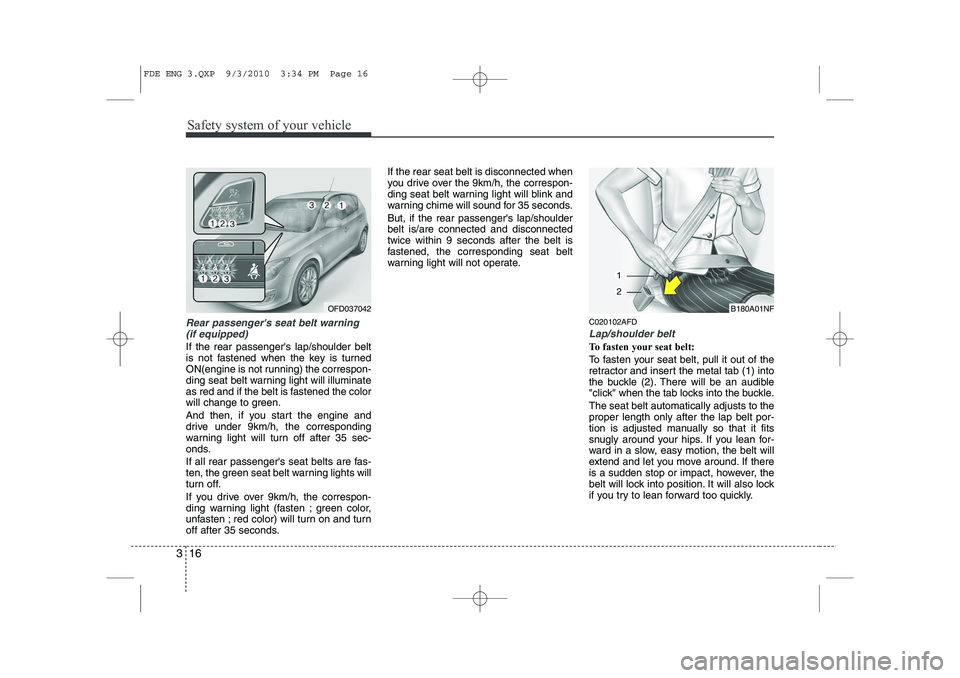
Rear passenger's seat belt warning
(if equipped)
If the rear passenger's lap/shoulder belt
is not fastened when the key is turned
ON(engine is not running) the correspon-
ding seat belt warning light will illuminate
as red and if the belt is fastened the color
will change to green.
And then, if you start the engine and
drive under 9km/h, the corresponding
warning light will turn off after 35 sec-
onds.
If all rear passenger's seat belts are fas-
ten, the green seat belt warning lights will
turn off.
If you drive over 9km/h, the correspon-
ding warning light (fasten ; green color,
unfasten ; red color) will turn on and turn
off after 35 seconds. If the rear seat belt is disconnected when
you drive over the 9km/h, the correspon-
ding seat belt warning light will blink and
warning chime will sound for 35 seconds. But, if the rear passenger's lap/shoulder belt is/are connected and disconnectedtwice within 9 seconds after the belt is
fastened, the corresponding seat belt
warning light will not operate.
C020102AFD
Lap/shoulder belt
To fasten your seat belt:
To fasten your seat belt, pull it out of the
retractor and insert the metal tab (1) into
the buckle (2). There will be an audible
"click" when the tab locks into the buckle. The seat belt automatically adjusts to the proper length only after the lap belt por-
tion is adjusted manually so that it fits
snugly around your hips. If you lean for-
ward in a slow, easy motion, the belt will
extend and let you move around. If there
is a sudden stop or impact, however, the
belt will lock into position. It will also lock
if you try to lean forward too quickly.
B180A01NF
1
2
OFD037042
FDE ENG 3.QXP 9/3/2010 3:34 PM Page 16
Page 38 of 635
319
Safety system of your vehicle
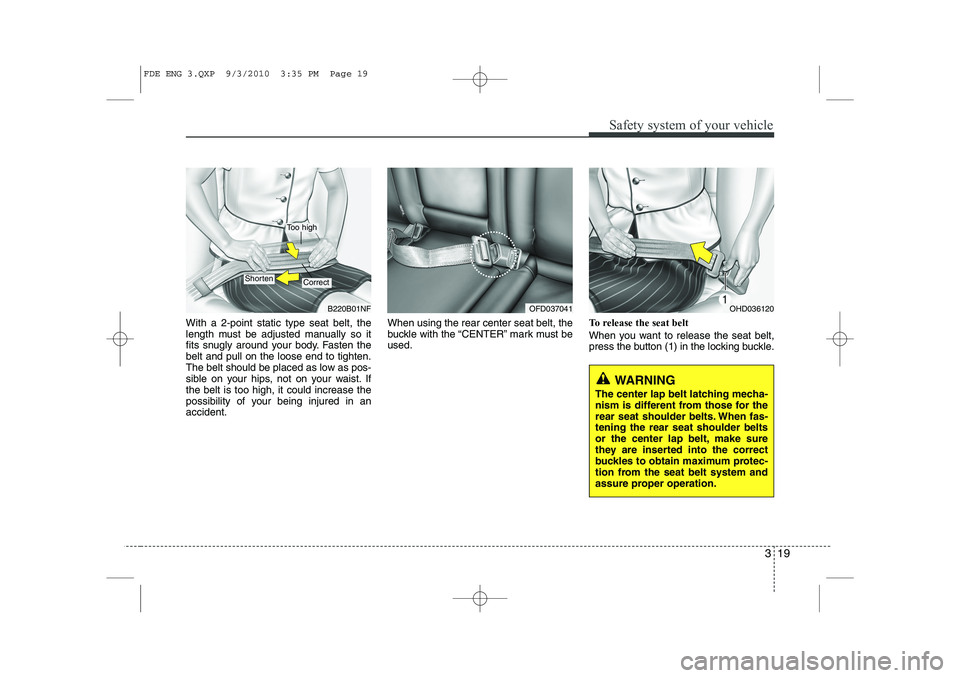
With a 2-point static type seat belt, the
length must be adjusted manually so it
fits snugly around your body. Fasten thebelt and pull on the loose end to tighten.
The belt should be placed as low as pos-
sible on your hips, not on your waist. Ifthe belt is too high, it could increase the
possibility of your being injured in anaccident.When using the rear center seat belt, the
buckle with the “CENTER” mark must beused.
To release the seat belt
When you want to release the seat belt,
press the button (1) in the locking buckle.
B220B01NF
Too high
ShortenCorrect
OFD037041OHD036120
WARNING
The center lap belt latching mecha-
nism is different from those for the
rear seat shoulder belts. When fas-tening the rear seat shoulder belts
or the center lap belt, make sure
they are inserted into the correct
buckles to obtain maximum protec-
tion from the seat belt system and
assure proper operation.
FDE ENG 3.QXP 9/3/2010 3:35 PM Page 19
Page 39 of 635
Safety system of your vehicle
20
3
C020104AUN
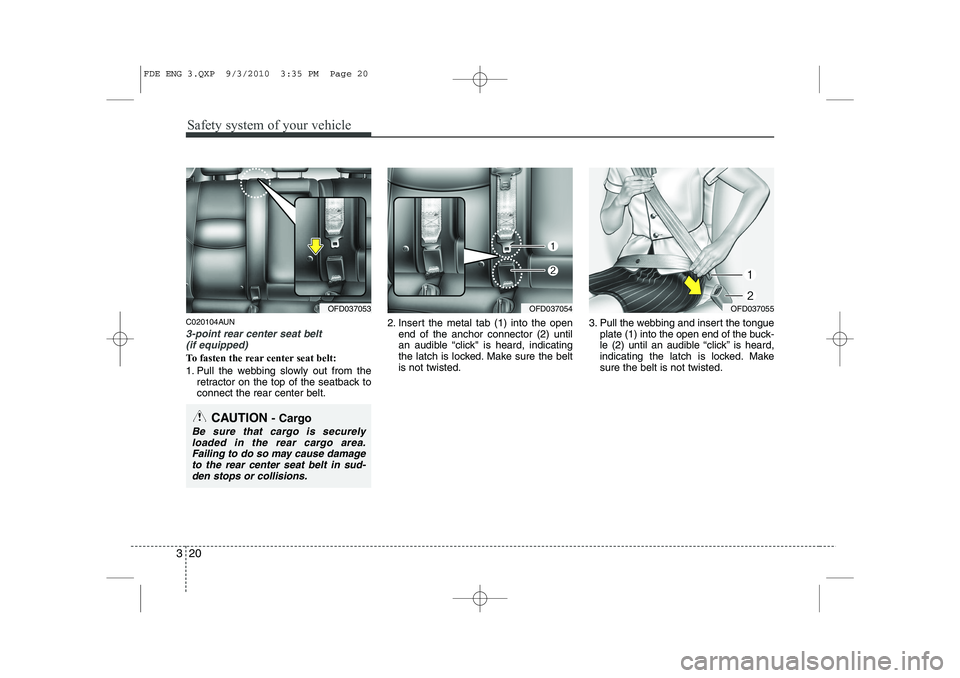
3-point rear center seat belt
(if equipped)
To fasten the rear center seat belt:
1. Pull the webbing slowly out from the retractor on the top of the seatback to connect the rear center belt. 2. Insert the metal tab (1) into the open
end of the anchor connector (2) until
an audible “click" is heard, indicating
the latch is locked. Make sure the beltis not twisted. 3. Pull the webbing and insert the tongue
plate (1) into the open end of the buck-
le (2) until an audible “click” is heard,
indicating the latch is locked. Makesure the belt is not twisted.
OFD037055OFD037054OFD037053
CAUTION - Cargo
Be sure that cargo is securely
loaded in the rear cargo area. Failing to do so may cause damage
to the rear center seat belt in sud-den stops or collisions.
FDE ENG 3.QXP 9/3/2010 3:35 PM Page 20
Page 40 of 635
321
Safety system of your vehicle
There will be an audible “click” when the
tab locks in the buckle. The seat beltautomatically adjusts to the proper length
only after the lap belt is adjusted manu-
ally so that it fits snugly around your hips.
If you lean forward in a slow, easy
motion, the belt will extend and let you
move around. If there is a sudden stop or
impact, the belt will lock into position. It
will also lock if you try to lean forward too
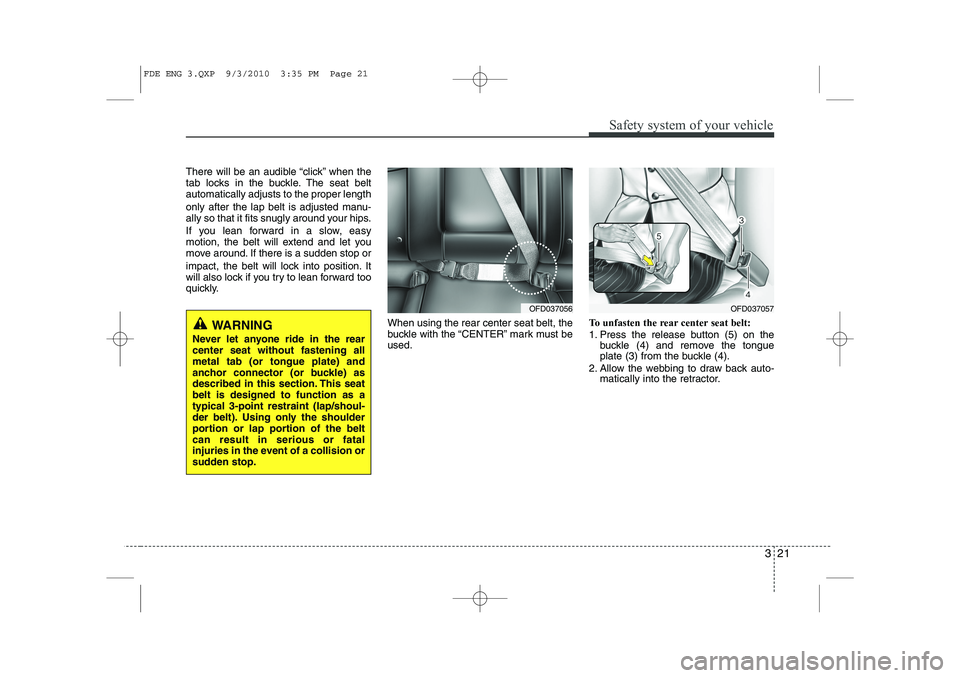
quickly.When using the rear center seat belt, the
buckle with the “CENTER” mark must beused.To unfasten the rear center seat belt:
1. Press the release button (5) on the
buckle (4) and remove the tongue
plate (3) from the buckle (4).
2. Allow the webbing to draw back auto- matically into the retractor.
OFD037056
WARNING
Never let anyone ride in the rear center seat without fastening allmetal tab (or tongue plate) and
anchor connector (or buckle) as
described in this section. This seatbelt is designed to function as atypical 3-point restraint (lap/shoul-
der belt). Using only the shoulder
portion or lap portion of the beltcan result in serious or fatal
injuries in the event of a collision or
sudden stop.
OFD037057
FDE ENG 3.QXP 9/3/2010 3:35 PM Page 21
Page 44 of 635
325
Safety system of your vehicle
C020300AUN Seat belt precautionsC020306AUN
Infant or small child
You should be aware of the specific
requirements in your country. Child
and/or infant seats must be properly
placed and installed in the rear seat. For
more information about the use of these
restraints, refer to “Child restraint sys-
tem” in this section.
✽✽
NOTICE
Small children are best protected from
injury in an accident when properly
restrained in the rear seat by a child
restraint system that meets the require-
ments of the Safety Standards of your
country. Before buying any child
restraint system, make sure that it has alabel certifying that it meets Safety
Standards of your country. The restraint
must be appropriate for your child'sheight and weight. Check the label on
the child restraint for this information.
Refer to “Child restraint system” in thissection.
WARNING
All occupants of the vehicle must wear their seat belts at all times.
Seat belts and child restraintsreduce the risk of serious or fatal
injuries for all occupants in the
event of a collision or sudden stop.
Without a seat belt, occupants
could be shifted too close to a
deploying air bag, strike the interior
structure or be thrown from the
vehicle. Properly worn seat belts
greatly reduce these hazards.
Always follow the precautions
about seat belts, air bags and occu-
pant seat contained in this manual.
WARNING
Every person in your vehicle needs
to be properly restrained at all
times, including infants and chil-
dren. Never hold a child in yourarms or lap when riding in a vehi-
cle. The violent forces created dur-
ing a crash will tear the child from
your arms and throw the child
against the interior. Always use a
child restraint appropriate for your
child's height and weight.
FDE ENG 3.QXP 9/3/2010 3:35 PM Page 25
Page 45 of 635
Safety system of your vehicle
26
3
C020301AUN
Larger children
Children who are too large for child
restraint systems should always occupy
the rear seat and use the available
lap/shoulder belts. The lap portion should
be fastened snugly on the hips and as
low as possible. Check belt fit periodical-
ly. A child's squirming could put the belt
out of position. Children are afforded the
most safety in the event of an accident
when they are restrained by a proper
restraint system in the rear seat. If a larg-
er child (over age 12) must be seated inthe front seat, the child should be secure-
ly restrained by the available lap/shoul-der belt and the seat should be placed in
the rearmost position. Children age 12
and under should be restrained securely
in the rear seat. NEVER place a child age
12 and under in the front seat. NEVER
place a rear facing child seat in the front
seat of a vehicle. If the shoulder belt portion slightly touch-
es the child’s neck or face, try placing the
child closer to the center of the vehicle. If
the shoulder belt still touches their face
or neck they need to be returned to a
child restraint system.
C020302AUN
Pregnant women
The use of a seat belt is recommended
for pregnant women to lessen the chance
of injury in an accident. When a seat belt
is used, the lap belt portion should be
placed as low and snugly as possible on
the hips, not across the abdomen. For
specific recommendations, consult a
physician.
C020303AUN
Injured person
A seat belt should be used when an
injured person is being transported.
When this is necessary, you should con-
sult a physician for recommendations.
C020304AUN
One person per belt
Two people (including children) should
never attempt to use a single seat belt.
This could increase the severity of
injuries in case of an accident.
WARNING
- Shoulder belts
on small children
Never allow a shoulder belt to be in contact with a child’s neck or
face while the vehicle is inmotion.
If seat belts are not properly worn and adjusted on children, there is
a risk of death or serious injury.
FDE ENG 3.QXP 9/3/2010 3:35 PM Page 26
Page 46 of 635
327
Safety system of your vehicle
C020305AFD
Do not lie down
To reduce the chance of injuries in the
event of an accident and to achieve max-
imum effectiveness of the restraint sys-tem, all passengers should be sitting upand the front seats should be in an
upright position when the car is moving. A
seat belt cannot provide proper protection
if the person is lying down in the rear seator if the front seat is in a reclined position.C020400AUN Care of seat belts
Seat belt systems should never be disas-
sembled or modified. In addition, care
should be taken to assure that seat belts
and belt hardware are not damaged by
seat hinges, doors or other abuse.
C020401AUN
Periodic inspection
It is recommended that all seat belts be
inspected periodically for wear or dam-
age of any kind. Any damaged parts
should be replaced as soon as possible.
C020402AUN
Keep belts clean and dry
Seat belts should be kept clean and dry.
If belts become dirty, they can be
cleaned by using a mild soap solution
and warm water. Bleach, dye, strong
detergents or abrasives should not be
used because they may damage and
weaken the fabric. C020403AFD
When to replace seat belts
Entire in-use seat belt assembly or
assemblies should be replaced if the
vehicle has been involved in an accident.
This should be done even if no damage
is visible. Additional questions concern-
ing seat belt operation should be directed
to an authorized HYUNDAI dealer.
WARNING
Riding with a reclined seatback
increases your chance of serious
or fatal injuries in the event of a col-
lision or sudden stop. The protec-
tion of your restraint system (seat
belts and air bags) is greatly
reduced by reclining your seat.
Seat belts must be snug against
your hips and chest to work proper-
ly. The more the seatback is
reclined, the greater the chancethat an occupant's hips will slideunder the lap belt causing seriousinternal injuries or the occupant's
neck could strike the shoulder belt.
Drivers and passengers should
always sit well back in their seats,
properly belted, and with the seat-
backs upright.
WARNING
When you return the rear seatback to its upright position after the rear
seatback was folded down, be care-
ful not to damage the seat belt web-
bing or buckle. Be sure that the
webbing or buckle does not get
caught or pinched in the rear seat.
A seat belt with damaged webbing
or buckle will not be as strong and
could possibly fail during a colli-
sion or sudden stop, resulting in
serious injury.
FDE ENG 3.QXP 9/3/2010 3:35 PM Page 27
Page 47 of 635
Safety system of your vehicle
28
3
CHILD RESTRAINT SYSTEM
C030000BUN
Children riding in the car should sit in the
rear seat and must always be properly
restrained to minimize the risk of injury inan accident, sudden stop or sudden
maneuver. According to accident statis-
tics, children are safer when properly
restrained in the rear seats than in the
front seat. Larger children not in a child
restraint should use one of the seat belts
provided.
You should be aware of the specific
requirements in your country. Child and/or
infant safety seats must be properly
placed and installed in the rear seat. You
must use a commercially available child
restraint system that meets the require-
ments of the Safety Standards of your
country. Child restraint systems are
designed to be secured in vehicle seats by
lap belts or the lap belt portion of a
lap/shoulder belt, or by a tether anchorand/or ISOFIX anchors (if equipped). Children could be injured or killed in a
crash if their restraints are not properly
secured. For small children and babies, a
child seat or infant seat must be used.
Before buying a particular child restraint
system, make sure it fits your car seat
and seat belts, and fits your child. Follow
all the instructions provided by the man-
ufacturer when installing the child
restraint system.
WARNING
A child restraint system must be placed in the rear seat. Never
install a child or infant seat on the
front passenger's seat. Should anaccident occur and cause the
passenger side air bag to deploy,
it could severely injure or kill an
infant or child seated in an infant
or child seat. Thus only use a
child restraint in the rear seat of
your vehicle.
A seat belt or child restraint sys- tem can become very hot if it is
left in a closed vehicle on a sunny
day, even if the outside tempera-
ture does not feel hot. Be sure to
check the seat cover and buckles
before placing a child there.
When the child restraint system is not in use, store it in the lug-
gage area or fasten it with a seat
belt so that it will not be thrown
forward in the case of a suddenstop or an accident.
Children may be seriously injured or killed by an inflating air bag.
All children, even those too large
for child restraints, must ride inthe rear seat.WARNING
To reduce the chance or serious or fatal injuries:
Children of all ages are safer when restrained in the rear seat.
A child riding in the front passen-
ger seat can be forcefully struck
by an inflating air bag resulting inserious or fatal injuries.
Always follow the instructions for installation and use of the child
restraint maker.
Always make sure the child seat is secured properly in the car and
your child is securely restrained
in the child seat.
Never hold a child in your arms or lap when riding in a vehicle. The
violent forces created during a
crash will tear the child from your
arms and throw the child against
the car’s interior.
Never put a seat belt over your- self and a child. During a crash,the belt could press deep into the
child causing serious internalinjuries.
(Continued)
FDE ENG 3.QXP 9/3/2010 3:35 PM Page 28