rear HYUNDAI I30 2014 Owner's Manual
[x] Cancel search | Manufacturer: HYUNDAI, Model Year: 2014, Model line: I30, Model: HYUNDAI I30 2014Pages: 635, PDF Size: 40.66 MB
Page 48 of 635
329
Safety system of your vehicle
C030100AFD
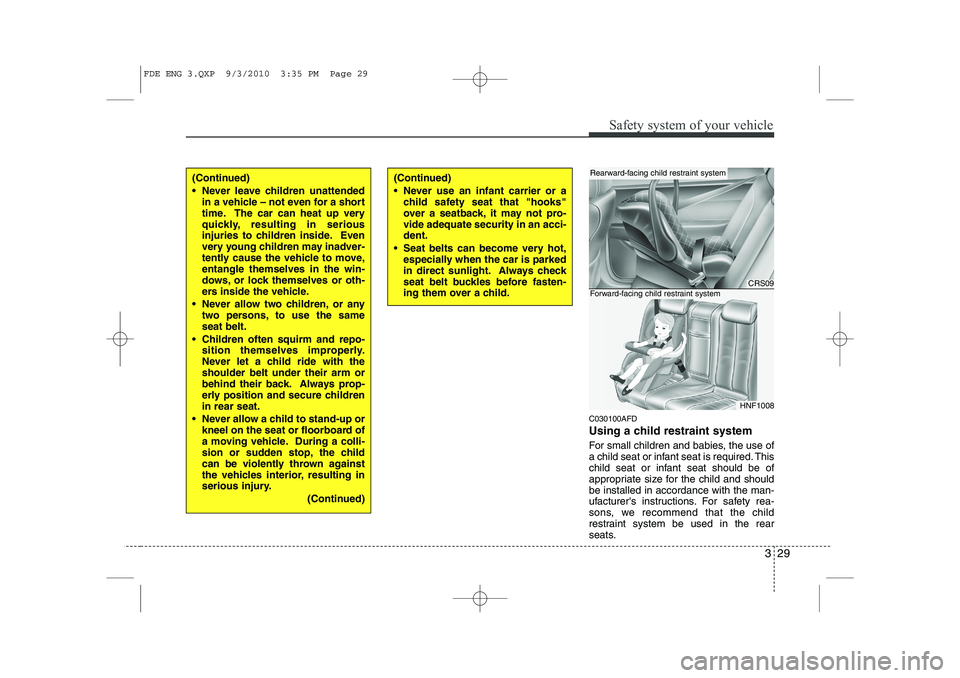
Using a child restraint system
For small children and babies, the use of
a child seat or infant seat is required. This
child seat or infant seat should be of
appropriate size for the child and shouldbe installed in accordance with the man-
ufacturer's instructions. For safety rea-
sons, we recommend that the child
restraint system be used in the rear
seats.
(Continued)
Never leave children unattendedin a vehicle – not even for a short
time. The car can heat up very
quickly, resulting in serious
injuries to children inside. Even
very young children may inadver-
tently cause the vehicle to move,entangle themselves in the win-
dows, or lock themselves or oth-
ers inside the vehicle.
Never allow two children, or any two persons, to use the sameseat belt.
Children often squirm and repo- sition themselves improperly.
Never let a child ride with theshoulder belt under their arm or
behind their back. Always prop-
erly position and secure childrenin rear seat.
Never allow a child to stand-up or kneel on the seat or floorboard of
a moving vehicle. During a colli-
sion or sudden stop, the child
can be violently thrown against
the vehicles interior, resulting in
serious injury.
(Continued)(Continued)
Never use an infant carrier or achild safety seat that "hooks"
over a seatback, it may not pro-vide adequate security in an acci-dent.
Seat belts can become very hot, especially when the car is parked
in direct sunlight. Always check
seat belt buckles before fasten-
ing them over a child.
CRS09
HNF1008
Rearward-facing child restraint system
Forward-facing child restraint system
FDE ENG 3.QXP 9/3/2010 3:35 PM Page 29
Page 49 of 635
Safety system of your vehicle
30
3
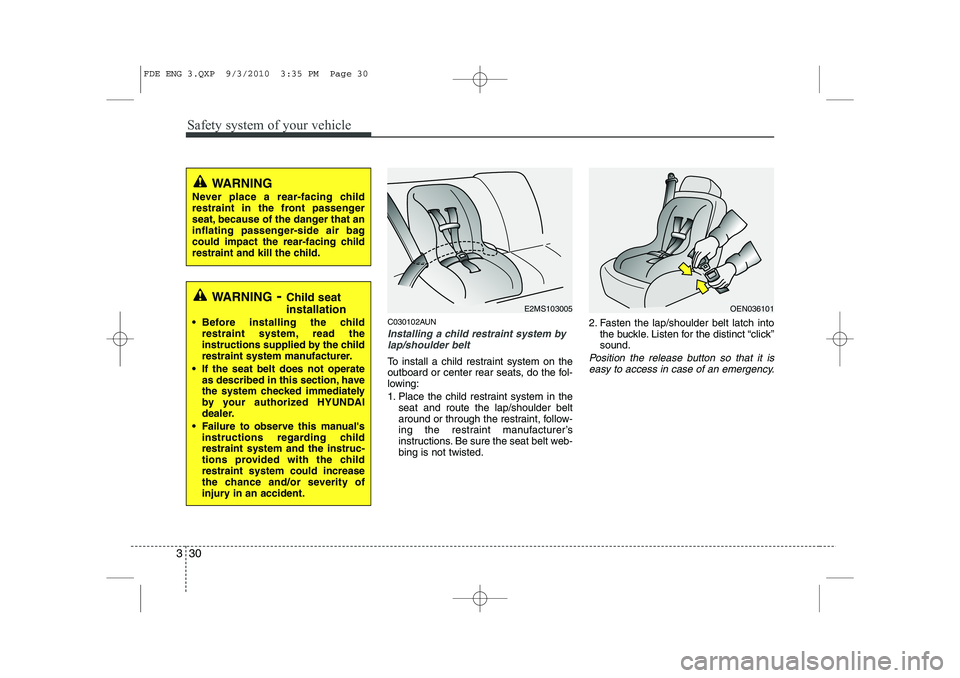
C030102AUN
Installing a child restraint system by
lap/shoulder belt
To install a child restraint system on the
outboard or center rear seats, do the fol-
lowing:
1. Place the child restraint system in the seat and route the lap/shoulder belt
around or through the restraint, follow-
ing the restraint manufacturer’s
instructions. Be sure the seat belt web-bing is not twisted. 2. Fasten the lap/shoulder belt latch into
the buckle. Listen for the distinct “click”sound.Position the release button so that it is
easy to access in case of an emergency.
E2MS103005OEN036101WARNING - Child seat installation
Before installing the child restraint system, read the
instructions supplied by the child
restraint system manufacturer.
If the seat belt does not operate as described in this section, have
the system checked immediately
by your authorized HYUNDAI
dealer.
Failure to observe this manual's instructions regarding childrestraint system and the instruc-
tions provided with the childrestraint system could increase
the chance and/or severity of
injury in an accident.
WARNING
Never place a rear-facing child
restraint in the front passenger
seat, because of the danger that an
inflating passenger-side air bag
could impact the rear-facing child
restraint and kill the child.
FDE ENG 3.QXP 9/3/2010 3:35 PM Page 30
Page 50 of 635
331
Safety system of your vehicle
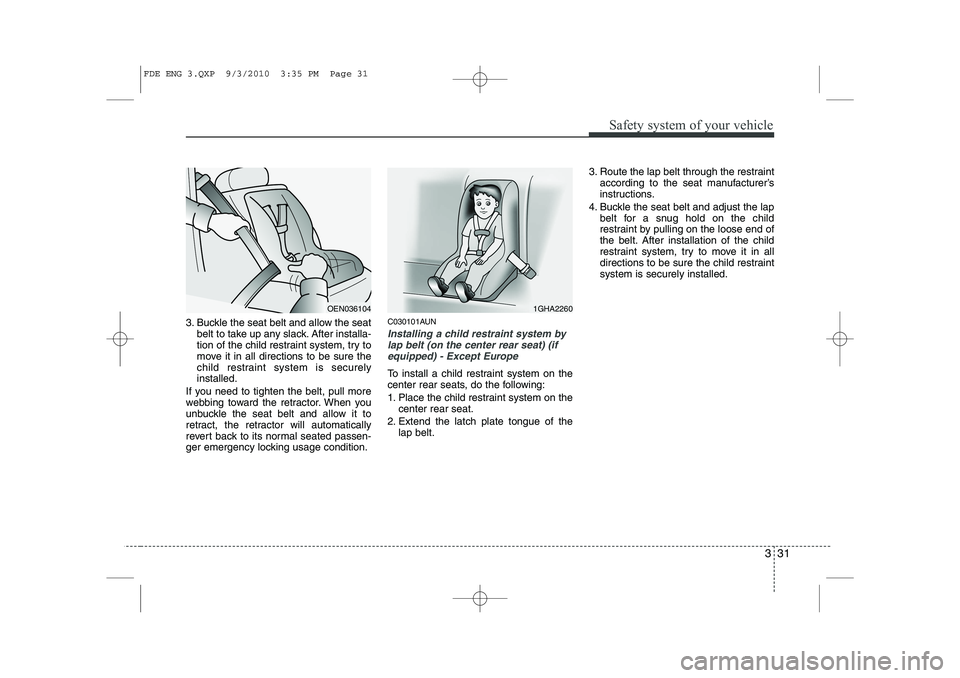
3. Buckle the seat belt and allow the seatbelt to take up any slack. After installa-
tion of the child restraint system, try to
move it in all directions to be sure the
child restraint system is securelyinstalled.
If you need to tighten the belt, pull more
webbing toward the retractor. When you
unbuckle the seat belt and allow it to
retract, the retractor will automatically
revert back to its normal seated passen-
ger emergency locking usage condition. C030101AUNInstalling a child restraint system by
lap belt (on the center rear seat) (if equipped) - Except Europe
To install a child restraint system on the
center rear seats, do the following:
1. Place the child restraint system on the center rear seat.
2. Extend the latch plate tongue of the lap belt. 3. Route the lap belt through the restraint
according to the seat manufacturer’s
instructions.
4. Buckle the seat belt and adjust the lap belt for a snug hold on the child
restraint by pulling on the loose end of
the belt. After installation of the child
restraint system, try to move it in all
directions to be sure the child restraintsystem is securely installed.
OEN0361041GHA2260
FDE ENG 3.QXP 9/3/2010 3:35 PM Page 31
Page 51 of 635
Safety system of your vehicle
32
3
C030103AFD
Securing a child restraint seat with
“Tether Anchor” system
(if equipped)
Child restraint hook holders are located
on the floor behind the rear seats.
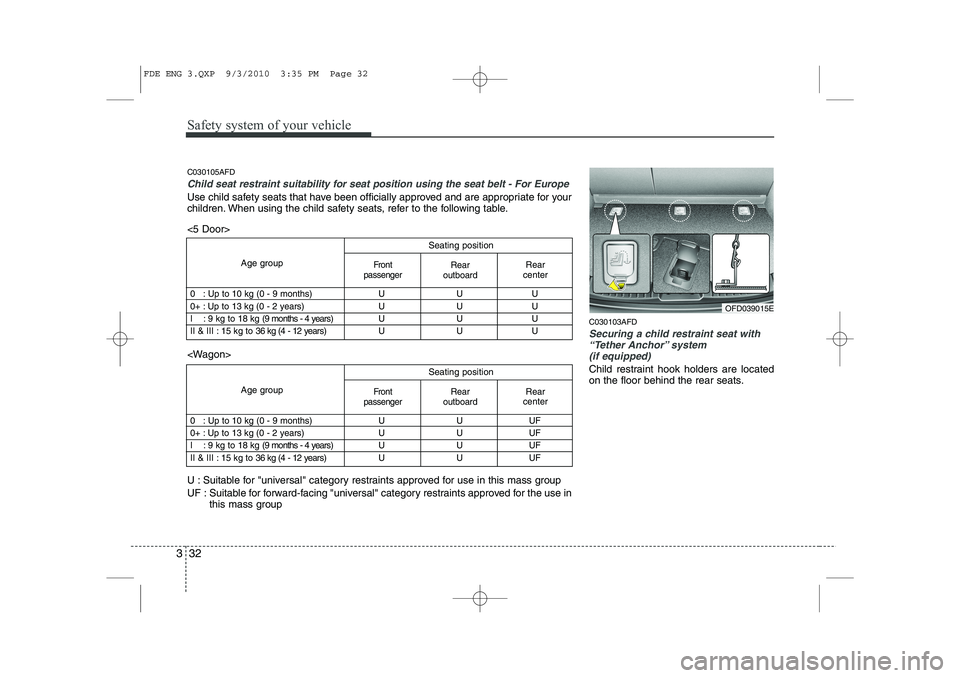
C030105AFD
Child seat restraint suitability for seat position using the seat belt - For Europe
Use child safety seats that have been officially approved and are appropriate for your
children. When using the child safety seats, refer to the following table.
U : Suitable for "universal" category restraints approved for use in this mass group
UF : Suitable for forward-facing "universal" category restraints approved for the use in this mass group
OFD039015E
<5 Door>
Seating position
Age group
0 : Up to 10 kg (0 - 9 months) U U U
0+ : Up to 13 kg (0 - 2 years) U U U
I : 9 k g to 1 8 k g (9 months - 4 years) U
UU
II & III : 15 kg to 36 kg (4 - 12 y ears) U U U
Front
passengerRear
outboard Rear
center
Seating position
Age group
0 : Up to 10 kg (0 - 9 months) U U UF
0+ : Up to 13 kg (0 - 2 years) U U UF
I : 9 k g to 1 8 k g (9 months - 4 years) U
UU F
II & III : 15 kg to 36 kg (4 - 12 y ears) U U UF
Front
passengerRear
outboard Rear
center
FDE ENG 3.QXP 9/3/2010 3:35 PM Page 32
Page 53 of 635
Safety system of your vehicle
34
3
C030104AFD
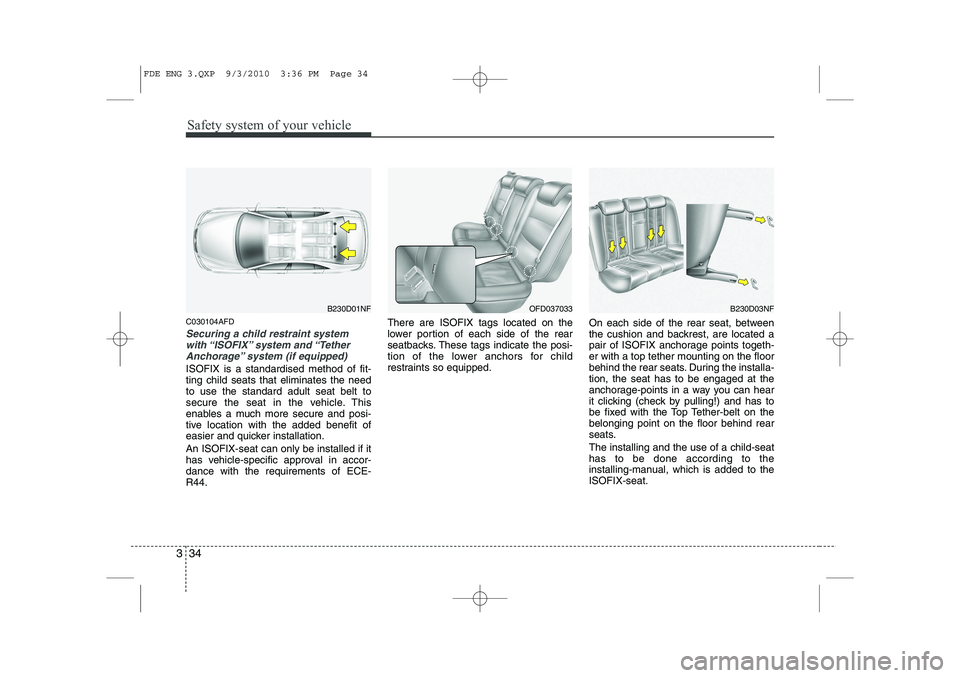
Securing a child restraint system
with “ISOFIX” system and “TetherAnchorage” system (if equipped)
ISOFIX is a standardised method of fit- ting child seats that eliminates the needto use the standard adult seat belt to
secure the seat in the vehicle. This
enables a much more secure and posi-
tive location with the added benefit of
easier and quicker installation. An ISOFIX-seat can only be installed if it
has vehicle-specific approval in accor-dance with the requirements of ECE-R44. There are ISOFIX tags located on the
lower portion of each side of the rear
seatbacks. These tags indicate the posi-
tion of the lower anchors for child
restraints so equipped.
On each side of the rear seat, between
the cushion and backrest, are located a
pair of ISOFIX anchorage points togeth-er with a top tether mounting on the floor
behind the rear seats. During the installa-tion, the seat has to be engaged at the
anchorage-points in a way you can hear
it clicking (check by pulling!) and has to
be fixed with the Top Tether-belt on thebelonging point on the floor behind rear
seats. The installing and the use of a child-seat has to be done according to the
installing-manual, which is added to theISOFIX-seat.
B230D01NFOFD037033B230D03NF
FDE ENG 3.QXP 9/3/2010 3:36 PM Page 34
Page 54 of 635
335
Safety system of your vehicle
To secure the child restraint seat
1. To engage the child restraint seat tothe ISOFIX anchor, insert the child
restraint seat latch into the ISOFIX
anchor. Listen for the audible “click”sound.
2. Connect the tether strap hook to the child restraint hook holder and tighten
to secure the seat. (Refer to the previ-
ous page.)
WARNING
Do not install a child restraint seat at the center of the rear seat
using the vehicle's ISOFIX
anchors. The ISOFIX anchors are
only provided for the left and
right outboard rear seating posi-
tions. Do not misuse the ISOFIX
anchors by attempting to attach a
child restraint seat in the middleof the rear seat to the ISOFIX
anchors.
(Continued)
WARNING
When using the vehicle's "ISOFIX"
system to install a child restraint
system in the rear seat, all unused
vehicle rear seat belt metal latch
plates or tabs must be latched
securely in their seat belt buckles
and the seat belt webbing must be
retracted behind the child restraint
to prevent the child from reachingand taking hold of unretracted seat
belts. Unlatched metal latch plates
or tabs may allow the child to reach
the unretracted seat belts which
may result in strangulation and a
serious injury or death to the child
in the child restraint.
WARNING
Install the child restraint seat fully
rearward against the seatback with
the seatback in a vertical position,
not reclined.(Continued)
In a crash, the child restraint seat
ISOFIX attachments may not be
strong enough to secure the child
restraint seat properly in the cen-
ter of the rear seat and may
break, causing serious injury ordeath.
Do not mount more than one child restraint to a child restraint
lower anchorage point. The
improper increased load may
cause the anchorage points or
tether anchor to break, causing
serious injury or death.
Attach the ISOFIX or ISOFIX-com- patible child restraint seat only to
the appropriate locations shownin the illustration.
Always follow the installation and use instructions provided by the
manufacturer of the childrestraint.
CAUTION
Do not allow the rear seat belt web-
bing to get scratched or pinched bythe ISOFIX-seat latch and ISOFIX anchor during the installation.
FDE ENG 3.QXP 9/3/2010 3:36 PM Page 35
Page 55 of 635
Safety system of your vehicle
36
3
F ISO/L1 - X X -
G ISO/L2 - X X - E ISO/R1 - IUF IUF -
E ISO/R1 - IUF IUF -
D ISO/R2 - IUF IUF -
C ISO/R3 - IUF IUF -
D ISO/R2 - IUF IUF -
C ISO/R3 - IUF IUF - B ISO/F2 - IUF IUF -
B1 ISO/F2X - IUF IUF - A ISO/F3 - IUF IUF -
Rear Outboard
(Passenger side)
Rear Outboard
(Driver side)
Front Passenger
Fixture
Size Class
Mass Group
Carrycot
0 : UP to 10kg
0+ : UP to 13kg
I : 9 to 18kg Rear Center
vehicle ISOFIX positions
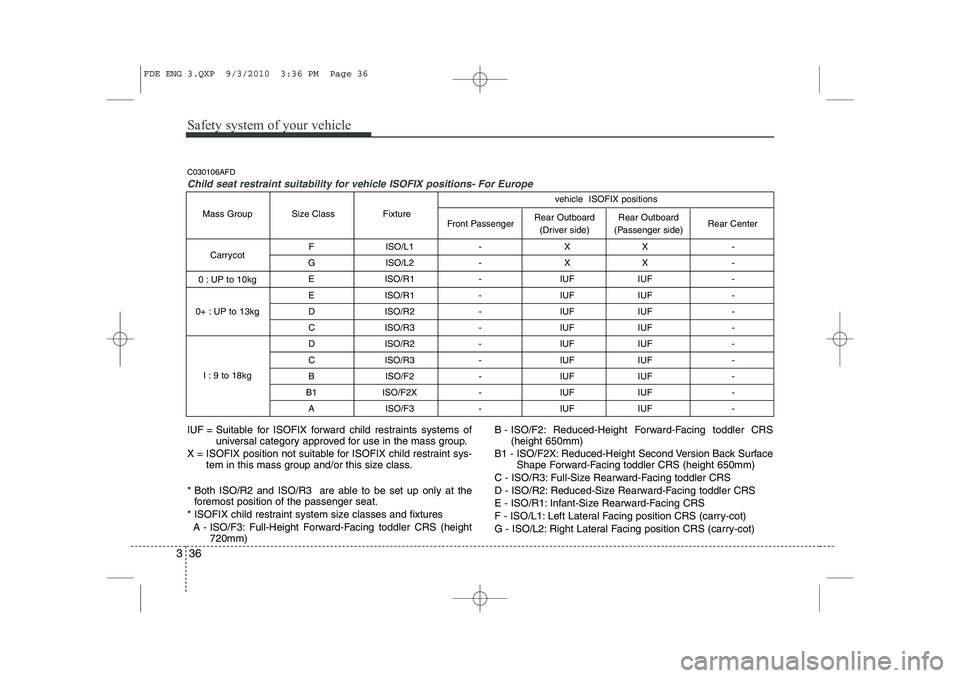
IUF = Suitable for ISOFIX forward child restraints systems of
universal category approved for use in the mass group.
X = ISOFIX position not suitable for ISOFIX child restraint sys- tem in this mass group and/or this size class.
* Both ISO/R2 and ISO/R3 are able to be set up only at the foremost position of the passenger seat.
* ISOFIX child restraint system size classes and fixtures A - ISO/F3: Full-Height Forward-Facing toddler CRS (height 720mm) B - ISO/F2: Reduced-Height Forward-Facing toddler CRS
(height 650mm)
B1 - ISO/F2X: Reduced-Height Second Version Back Surface Shape Forward-Facing toddler CRS (height 650mm)
C - ISO/R3: Full-Size Rearward-Facing toddler CRS
D - ISO/R2: Reduced-Size Rearward-Facing toddler CRS
E - ISO/R1: Infant-Size Rearward-Facing CRS
F - ISO/L1: Left Lateral Facing position CRS (carry-cot)
G - ISO/L2: Right Lateral Facing position CRS (carry-cot)
C030106AFD
Child seat restraint suitability for vehicle ISOFIX positions- For Europe
FDE ENG 3.QXP 9/3/2010 3:36 PM Page 36
Page 61 of 635
Safety system of your vehicle
42
3
1VQA2087
1JBA3514
1JBA3522
Rear impact
Side impact
Rollover
(Continued)
No objects should be placed over
or near the air bag modules on
the steering wheel, instrument
panel, and the front passenger's
panel above the glove box,
because any such object could
cause harm if the vehicle is in a
crash severe enough to cause
the air bags to deploy.
Do not tamper with or disconnect SRS wiring or other components
of the SRS system. Doing so
could result in injury, due to acci-
dental deployment of the air bags
or by rendering the SRS inopera-
tive.
If the SRS air bag warning light remains illuminated while the
vehicle is being driven, have an
authorized HYUNDAI dealer
inspect the air bag system as
soon as possible.
(Continued)(Continued)
Air bags can only be used once –have an authorized HYUNDAI
dealer replace the air bag imme-
diately after deployment.
The SRS is designed to deploy the front air bags only when an
impact is sufficiently severe andwhen the impact angle is less
than 30° from the forward longitu-
dinal axis of the vehicle.
Additionally, the air bags will only
deploy once. Seat belts must be
worn at all times.
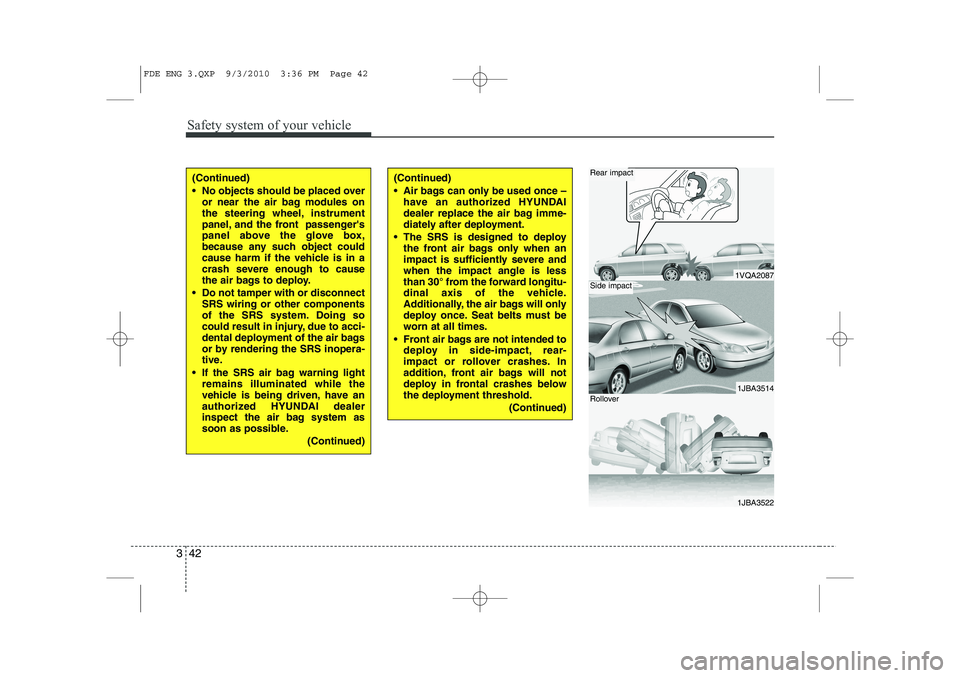
Front air bags are not intended to deploy in side-impact, rear-
impact or rollover crashes. In
addition, front air bags will not
deploy in frontal crashes below
the deployment threshold.
(Continued)
FDE ENG 3.QXP 9/3/2010 3:36 PM Page 42
Page 62 of 635
343
Safety system of your vehicle
C040501AFD
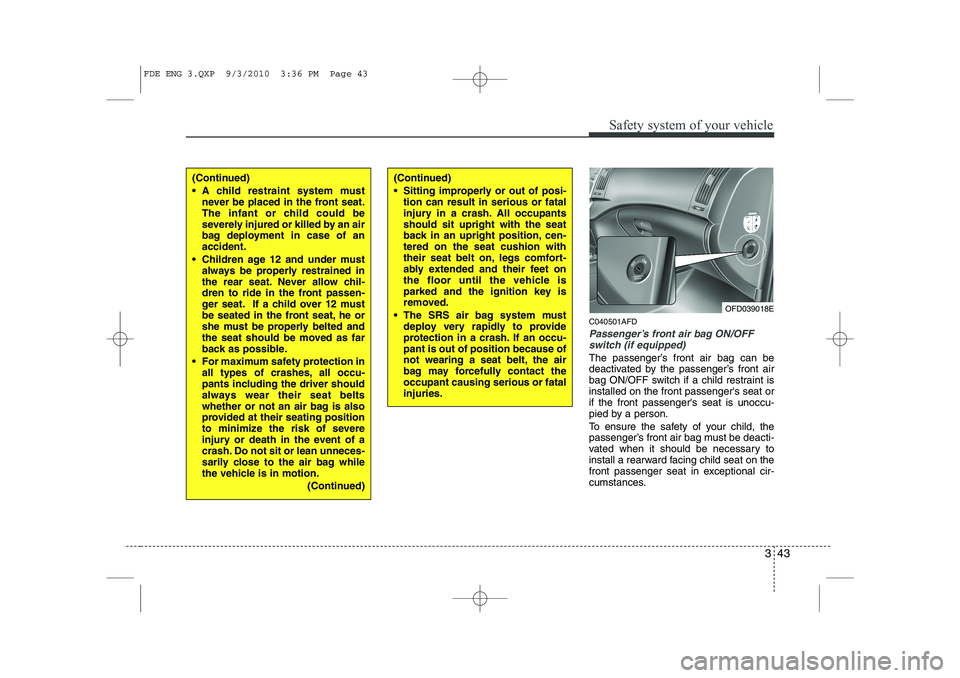
Passenger’s front air bag ON/OFFswitch (if equipped)
The passenger’s front air bag can be
deactivated by the passenger’s front air
bag ON/OFF switch if a child restraint isinstalled on the front passenger's seat orif the front passenger's seat is unoccu-
pied by a person.
To ensure the safety of your child, the
passenger’s front air bag must be deacti-
vated when it should be necessary to
install a rearward facing child seat on the
front passenger seat in exceptional cir-
cumstances.
(Continued)
Sitting improperly or out of posi- tion can result in serious or fatal
injury in a crash. All occupantsshould sit upright with the seat
back in an upright position, cen-tered on the seat cushion with
their seat belt on, legs comfort-
ably extended and their feet on
the floor until the vehicle is
parked and the ignition key is
removed.
The SRS air bag system must deploy very rapidly to provide
protection in a crash. If an occu-pant is out of position because of
not wearing a seat belt, the air
bag may forcefully contact theoccupant causing serious or fatalinjuries.(Continued)
A child restraint system mustnever be placed in the front seat.
The infant or child could be
severely injured or killed by an air
bag deployment in case of anaccident.
Children age 12 and under must always be properly restrained in
the rear seat. Never allow chil-
dren to ride in the front passen-
ger seat. If a child over 12 must
be seated in the front seat, he or
she must be properly belted and
the seat should be moved as far
back as possible.
For maximum safety protection in all types of crashes, all occu-
pants including the driver should
always wear their seat belts
whether or not an air bag is also
provided at their seating position
to minimize the risk of severe
injury or death in the event of a
crash. Do not sit or lean unneces-
sarily close to the air bag while
the vehicle is in motion.
(Continued)
OFD039018E
FDE ENG 3.QXP 9/3/2010 3:36 PM Page 43
Page 64 of 635
345
Safety system of your vehicle
(Continued)
Even though your vehicle isequipped with the passenger's
front air bag ON/OFF switch, do
not install a child restraint sys-
tem in the front passenger's seat.
A child restraint system must
never be placed in the front seat.
Children who are too large for
child restraint systems should
always occupy the rear seat and
use the available lap/shoulder
belts. Children are afforded the
most safety in the event of an
accident when they are
restrained by a proper restraintsystem in the rear seat.
As soon as the child seat is no longer needed on the front pas-
senger's seat, reactivate the front
passenger's air bag.WARNING
The driver is responsible for the proper position of the passen-
ger’s front air bag ON/OFF switch.
Deactivate the passenger's front air bag only when the ignition
switch is switched off, or the mal-
function may occur in the SRS
Control Module.
And there may be a danger that
the driver's and/or front passen-
ger’s and/or side and curtain air
bag may fail to trigger, or not trig-
ger correctly during a collision.
Never install a rearward facing child seat on the front passen-
ger's seat unless the passenger's
front air bag has been deactivat-
ed. The infant or child could be
severely injured or killed by an air
bag deployment in case of anaccident.
(Continued)WARNING
The passenger’s front air bag is much larger than the steering
wheel air bag and inflates with
considerably more force. It can
seriously hurt or kill a passenger
who is not in the proper position
and wearing the seat belt proper-
ly. The front passengers should
always move their seat as far
back as practical and sit back intheir seat.
It is essential that the front pas- sengers always wear their seat
belts when vehicle is in motion,
even when the vehicle is moving
in a parking lot or up a driveway
into garage. (Continued)
FDE ENG 3.QXP 9/3/2010 3:36 PM Page 45