light HYUNDAI I30 2023 Owners Manual
[x] Cancel search | Manufacturer: HYUNDAI, Model Year: 2023, Model line: I30, Model: HYUNDAI I30 2023Pages: 533, PDF Size: 59.13 MB
Page 408 of 533
6-2
The hazard warning flasher serves
as a warning to other drivers to exer-
cise extreme caution when approach-
ing, overtaking, or passing your vehi-
cle.
It should be used whenever emer-
gency repairs are being made or
when the vehicle is stopped near the
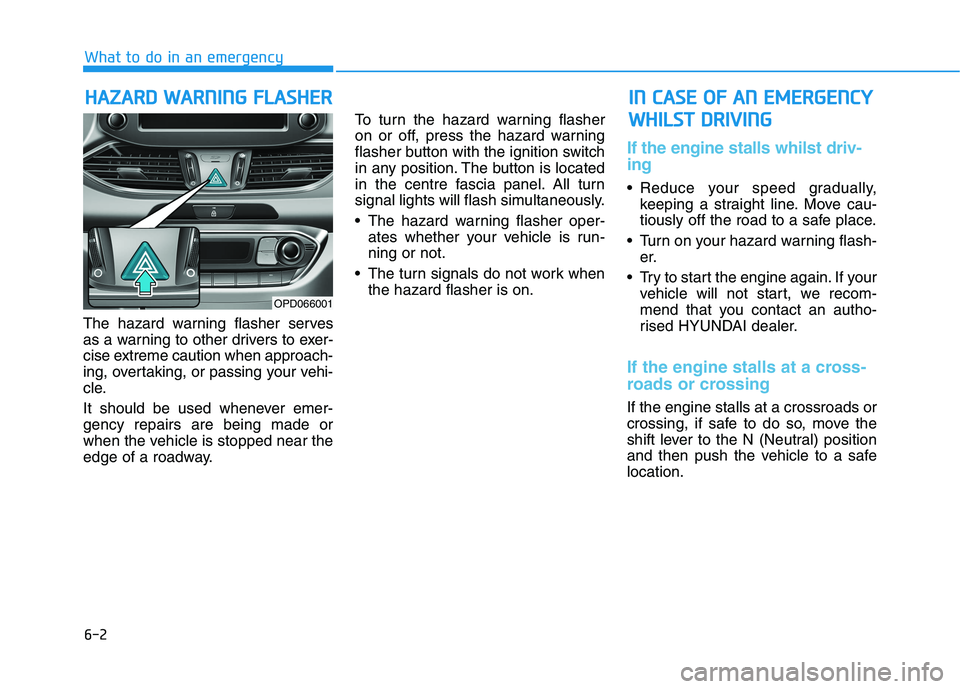
edge of a roadway.To turn the hazard warning flasher
on or off, press the hazard warning
flasher button with the ignition switch
in any position. The button is located
in the centre fascia panel. All turn
signal lights will flash simultaneously.
• The hazard warning flasher oper-
ates whether your vehicle is run-
ning or not.
The turn signals do not work when
the hazard flasher is on.
If the engine stalls whilst driv-
ing
Reduce your speed gradually,
keeping a straight line. Move cau-
tiously off the road to a safe place.
Turn on your hazard warning flash-
er.
Try to start the engine again. If your
vehicle will not start, we recom-
mend that you contact an autho-
rised HYUNDAI dealer.
If the engine stalls at a cross-
roads or crossing
If the engine stalls at a crossroads or
crossing, if safe to do so, move the
shift lever to the N (Neutral) position
and then push the vehicle to a safe
location.
H HA
AZ
ZA
AR
RD
D
W
WA
AR
RN
NI
IN
NG
G
F
FL
LA
AS
SH
HE
ER
R
What to do in an emergency
I
IN
N
C
CA
AS
SE
E
O
OF
F
A
AN
N
E
EM
ME
ER
RG
GE
EN
NC
CY
Y
W WH
HI
IL
LS
ST
T
D
DR
RI
IV
VI
IN
NG
G
OPD066001
Page 409 of 533
6-3
What to do in an emergency
If you have a flat tyre whilst
driving
If a tyre goes flat whilst you are driv-
ing:
Take your foot off the accelerator
pedal and let the vehicle slow
down whilst driving straight ahead.
Do not apply the brakes immedi-
ately or attempt to pull off the road
as this may cause loss of vehicle
control resulting in an accident.
When the vehicle has slowed to
such a speed that it is safe to do
so, brake carefully and pull off the
road. Drive off the road as far as
possible and park on firm, level
ground. If you are on a divided
highway, do not park in the median
area between the two traffic lanes. When the vehicle is stopped, press
the hazard warning flasher button,
move the shift lever into P (Park,
for automatic transmission/dual
clutch transmission vehicle) or neu-
tral (for manual transmission vehi-
cle), apply the parking brake, and
place the ignition switch in the
LOCK/OFF position.
Have all passengers get out of the
vehicle. Be sure they all get out on
the side of the vehicle that is away
from traffic.
When changing a flat tyre, follow
the instructions provided later in
this chapter.If the engine doesn't turn over
or turns over slowly
Be sure the shift lever is in N
(Neutral) or P (Park) if it is an auto-
matic transmission/dual clutch
transmission vehicle. The engine
starts only when the shift lever is in
N (Neutral) or P (Park).
Check the battery connections to
be sure they are clean and tight.
Turn on the interior light. If the light
dims or goes out when you operate
the starter, the battery is drained.
Do not push or pull the vehicle to start
it. This could cause damage to your
vehicle.See instructions for "Jump
Starting" provided in this chapter.
6
I IF
F
T
TH
HE
E
E
EN
NG
GI
IN
NE
E
W
WI
IL
LL
L
N
NO
OT
T
S ST
TA
AR
RT
T
Push or pull starting the vehicle
may cause the catalytic con-
verter to overload which can
lead to damage to the emission
control system.
CAUTION
Page 411 of 533
6-5
What to do in an emergency
To prevent damage to your vehi-
cle:
Only use a 12-volt power supply
(battery or jumper system) to
jump start your vehicle.
Do not attempt to jump start
your vehicle by push-starting.
Information
An inappropriately disposed
battery can be harmful to the
environment and human
health. Dispose of the battery
according to your local law(s)
or regulations.
Jump starting procedure
1. Position the vehicles close enough
that the jumper cables will reach,
but do not allow the vehicles to
touch.
2. Avoid fans or any moving parts in
the engine compartment at all
times, even when the vehicles are
turned off.
3. Turn off all electrical devices such
as radios, lights, air conditioning,
etc. Put the vehicles in P (Park, for
automatic transmission/dual
clutch transmission vehicle) or
neutral (for manual transmission
vehicle), and set the parking
brake. Turn both vehicles OFF.
i
NOTICE
6
(Continued)
When lifting a plastic-cased
battery, excessive pressure
on the case may cause battery
acid to leak. Lift with a battery
carrier or with your hands on
opposite corners.
Do not attempt to jump start
your vehicle if your battery is
frozen.
NEVER attempt to recharge
the battery when the vehicle’s
battery cables are connected
to the battery.
The electrical ignition system
works with high voltage.
NEVER touch these compo-
nents with the engine running
or when the ignition switch is
in the ON position.
Do not allow the (+) and (-)
jumper cables to touch. It may
cause sparks.
The battery may rupture or
explode when you jump start
with a low or frozen battery.
Pb
Page 416 of 533
6-10
What to do in an emergency
Your vehicle has also been equipped
with a TPMS malfunction indicator to
indicate when the system is not
operating properly. The TPMS mal-
function indicator is combined with
the low tyre pressure telltale. When
the system detects a malfunction,
the telltale will flash for approximate-
ly one minute and then remain con-
tinuously illuminated. This sequence
will continue upon subsequent vehi-
cle start-ups as long as the malfunc-
tion exists. When the malfunction
indicator is illuminated, the system
may not be able to detect or signal
low tyre pressure as intended.
TPMS malfunctions may occur for a
variety of reasons, including the
installation of replacement or alter-
nate tyres or wheels on the vehicle
that prevent the TPMS from function-
ing properly. Always check the TPMS
malfunction telltale after replacing
one or more tyres or wheels on your
vehicle to ensure that the replace-
ment or alternate tyres and wheels
allow the TPMS to continue to func-
tion properly.If any of the below happens, we
recommend that the system be
checked by an authorised HYUNDAI
dealer.
1. The low tyre pressure telltale/
TPMS malfunction indicator
does not illuminate for 3 sec-
onds when the ignition switch is
turned to the ON position or the
engine is running.
2. The TPMS malfunction indicator
remains illuminated after blink-
ing for approximately 1 minute.
3. The Low tyre pressure position
telltale remains illuminated.
Low tyre pressure
telltale
Low tyre pressure
position telltale
and tyre pressure
telltale
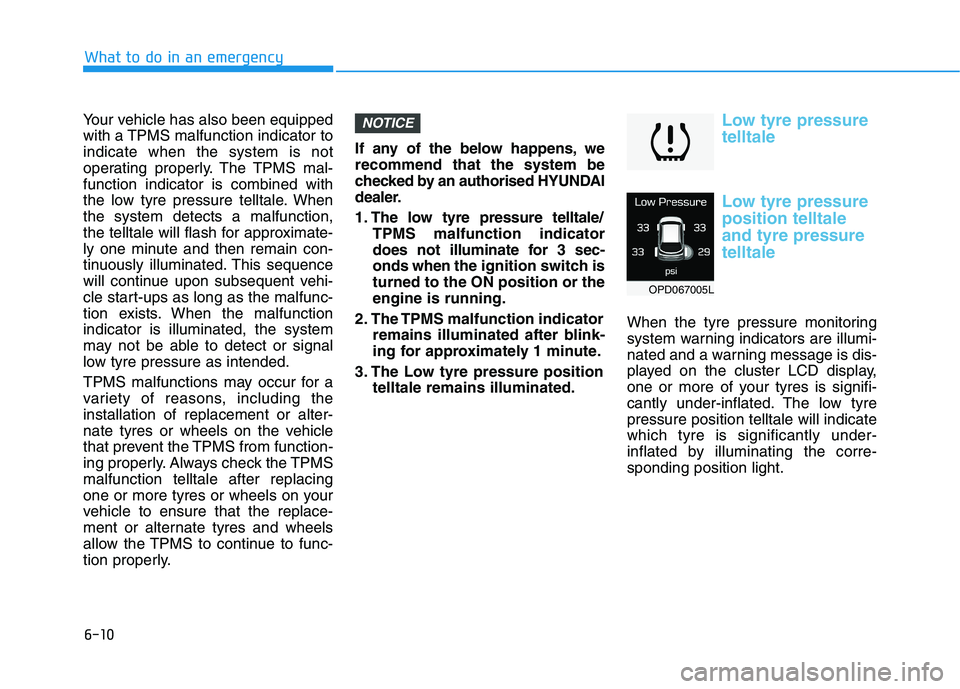
When the tyre pressure monitoring
system warning indicators are illumi-
nated and a warning message is dis-
played on the cluster LCD display,
one or more of your tyres is signifi-
cantly under-inflated. The low tyre
pressure position telltale will indicate
which tyre is significantly under-
inflated by illuminating the corre-
sponding position light.
NOTICE
OPD067005L
Page 419 of 533
6-13
What to do in an emergency
6
Also, the TPMS Malfunction Indicator
will illuminate after blinking for one
minute if the vehicle is driven at
speed above 25 km/h for approxi-
mately 10 minutes.
Once the original tyre equipped with
a tyre pressure monitoring sensor is
reinflated to the recommended pres-
sure and reinstalled on the vehicle,
the Low Tyre Pressure Telltale and
TPMS Malfunction Indicator will go
off within a few minutes of driving.
If the indicators do not extinguish
after a few minutes, please visit an
authorised HYUNDAI dealer.
Each wheel is equipped with a tyre
pressure sensor mounted inside the
tyre behind the valve stem (except
for the spare tyre). You must use
TPMS specific wheels. It is recom-
mended that you have your tyres
serviced by an authorised HYUNDAI
dealer.You may not be able identify a tyre
with low pressure by simply looking
at it. Always use a good quality tyre
pressure gauge to measure the
tyre's inflation pressure. Please note
that a tyre that is hot (from being
driven) will have a higher pressure
measurement than a tyre that is cold.
A cold tyre means the vehicle has
been sitting for 3 hours and driven for
less than 1.6 km in that 3 hour peri-
od.
Allow the tyre to cool before measur-
ing the inflation pressure. Always be
sure the tyre is cold before inflating
to the recommended pressure.
The TPMS cannot alert you to
severe and sudden tyre dam-
age caused by external factors
such as nails or road debris.
If you feel any vehicle instabil-
ity, immediately take your foot
off the accelerator, apply the
brakes gradually and with
light force, and slowly move to
a safe position off the road.
WARNING
Page 433 of 533
7
Tyres and wheels .................................................7-47
Tyre care ...........................................................................7-47
Recommended cold tyre inflation pressures ...........7-48
Check tyre inflation pressure ......................................7-49
Tyre rotation ....................................................................7-49
Wheel alignment and tyre balance.............................7-50
Tyre replacement ............................................................7-53
Wheel replacement .........................................................7-53
Tyre traction .....................................................................7-53
Tyre maintenance ...........................................................7-54
Tyre sidewall labelling ....................................................7-54
Low aspect ratio tyres...................................................7-57
Fuses ......................................................................7-59
Instrument panel fuse replacement ...........................7-60
Engine compartment panel fuse replacement.........7-61
Fuse/Relay panel description ......................................7-63
Light bulbs.............................................................7-66
Headlamp, position lamp, turn signal lamp and
daytime running light bulb replacement ...................7-67
Side repeater lamp replacement .................................7-70
Rear combination lamp bulb replacement ................7-71
Rear fog lamp ..................................................................7-74
High mounted stop lamp replacement .......................7-75
Licence plate light bulb replacement .........................7-75
Interior light bulb replacement ....................................7-75
Appearance care ..................................................7-77
Exterior care ....................................................................7-77
Interior care......................................................................7-83
Emission control system .....................................7-86
Crankcase emission control system ...........................7-86
Evaporative emission control system.........................7-86
Exhaust emission control system ...............................7-87
Page 438 of 533
7-7
7
Maintenance
Owner maintenance schedule
When you stop for fuel:
Check the engine oil level.
Check the coolant level in the
engine coolant reservoir.
Check the windscreen washer fluid
level.
Check for low or under-inflated
tyres.
Whilst operating your vehicle:
Note any changes in the sound of
the exhaust or any smell of exhaust
fumes in the vehicle.
Check for vibrations in the steering
wheel. Notice if there is any
increased steering effort or loose-
ness in the steering wheel, or
change in its straight-ahead position.
Notice if your vehicle constantly turns
slightly or “pulls” to one side when
travelling on smooth, level road.
When stopping, listen and check for
unusual sounds, pulling to one side,
increased brake pedal travel or
“hard-to-push” brake pedal.
If any slipping or changes in the
operation of your transmissiom
occurs, check the transmissiom fluid
level.
Check the automatic transmission/
dual clutch transmission P (Park)
function.
Check the parking brake.
Check for fluid leaks under your
vehicle (water dripping from the air
conditioning system during or after
use is normal). Be careful when checking your
engine coolant level when the
engine is hot. This may result in
coolant being blown out of the
opening and cause serious
burns and other injuries.
WARNING
Diesel Engine
Never manipulate or modify the
injection system whilst running
the diesel engine or within 30
seconds after turning OFF the
diesel engine. The high-pressure
pump, high-pressure pipes, rail,
and injectors are still subject to
high pressure immediately after
stopping the diesel engine.
When the fuel leakage vents out,
it may cause serious body injury.
Any people, who are implanted
with the artificial cardiac pace-
maker, should remain away from
the ECU or the wiring harness by
at least 30 cm, whilst running the
diesel engine. The high currents
of the electronic engine control
system produce a considerable
amount of magnetic fields.
WARNING
Page 439 of 533
7-8
Maintenance
At least monthly:
Check coolant level in the engine
coolant reservoir.
Check the operation of all exterior
lights, including the stoplights, turn
signals and hazard warning flashers.
Check the inflation pressures of all
tyres including the spare for tyres
that are worn, show uneven wear,
or are damaged.
Check for loose wheel nuts.
At least twice a year:
(i.e., every Spring and Autumn)
Check radiator, heater and air condi-
tioning hoses for leaks or damage.
Check windscreen washer spray
and wiper operation. Clean wiper
blades with a clean cloth damp-
ened with washer fluid.
Check headlamp alignment.
Check muffler, exhaust pipes,
shields and clamps.
Check the seat belts for wear and
function.
At least once a year:
Clean body and door drain holes.
Lubricate door hinges and bonnet
hinges.
Lubricate door and bonnet locks
and latches.
Lubricate door rubber weather
strips.
Check the air conditioning system.
Inspect and lubricate automatic
transmission linkage and controls.
Clean the battery and terminals.
Check the brake fluid level.
Page 467 of 533
7-36
Maintenance
A AI
IR
R
C
CL
LE
EA
AN
NE
ER
R F
FU
UE
EL
L
F
FI
IL
LT
TE
ER
R
(
(F
FO
OR
R
D
DI
IE
ES
SE
EL
L)
)
Draining water from fuel filter
The fuel filter in the diesel engine
operates the critical function of sepa-
rating water from the fuels and pre-
venting accumulating of water in the
base.
When enough water has accumulat-
ed inside the fuel filter, the warning
light ( ) illuminates with the igni-
tion switch in the ON position.
In this case, we recommend you to
have the system checked by an
authorised HYUNDAI dealer.
When the accumulated water is not
drained at the proper timing, water
may permeate in the fuel filter,
damaging the major vehicle com-
ponents, such as the fuel system.
Fuel filter cartridge replace-
ment
We recommend the fuel filter car-
tridge be replaced by an authorised
HYUNDAI dealer according to the
Maintenance Schedule at the begin-
ning of this chapter.
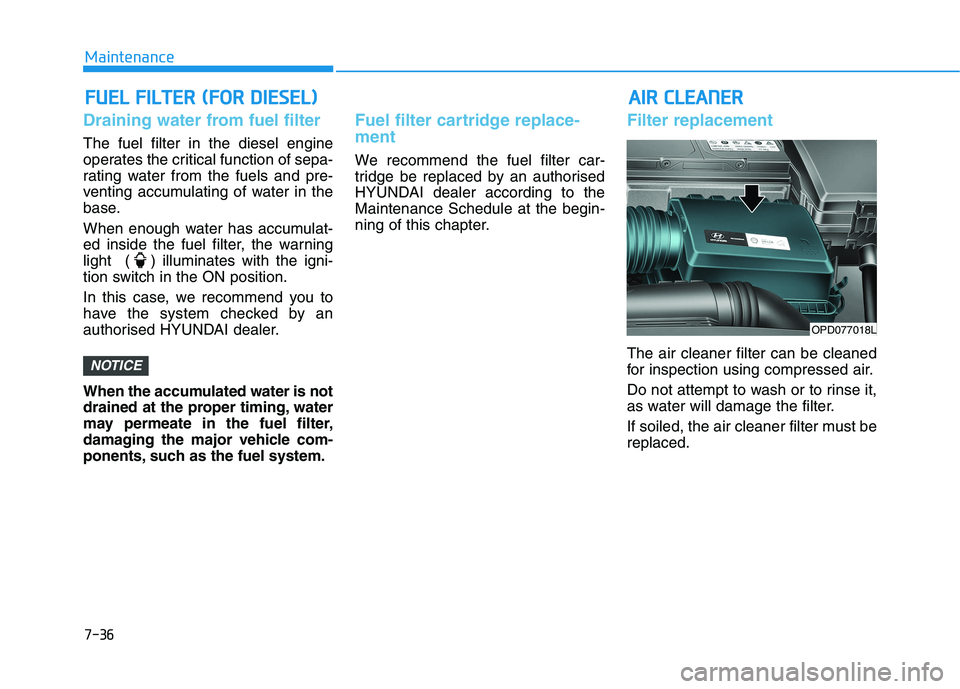
Filter replacement
The air cleaner filter can be cleaned
for inspection using compressed air.
Do not attempt to wash or to rinse it,
as water will damage the filter.
If soiled, the air cleaner filter must be
replaced.NOTICE
OPD077018L
Page 473 of 533

7-42
Maintenance
3. Remove the wiper blade from the
wiper arm (5).
4. Install a new wiper blade assem-
bly in the reverse order of removal.
5. Return the wiper arm on the wind-
screen.
Rear window wiper blade
1. Raise the wiper arm and pull out
the wiper blade assembly.2. Install the new blade assembly by
inserting the centre part into the
slot in the wiper arm until it clicks
into place.
3. Make sure the blade assembly is
installed firmly by trying to pull it
slightly.
To prevent damage to the wiper arms
or other components, we recommend
that the wiper blades be replaced by
an authorised HYUNDAI dealer.
OTL075051
OTL075050
OAD075076R