maintenance HYUNDAI I30 2023 User Guide
[x] Cancel search | Manufacturer: HYUNDAI, Model Year: 2023, Model line: I30, Model: HYUNDAI I30 2023Pages: 533, PDF Size: 59.13 MB
Page 268 of 533
Winter driving .....................................................5-127
Snow or icy conditions ................................................5-127
Winter Precautions .......................................................5-130
Trailer towing .....................................................5-132
Trailer towing equipment ............................................5-133
Driving with a trailer ....................................................5-134
Maintenance when towing a trailer .........................5-138
If you do decide to pull a trailer (For Australia) ..5-138
If you do decide to pull a trailer
(For New Zealand) ........................................................5-140
Vehicle weight ....................................................5-141
Overloading ....................................................................5-141
5
Page 395 of 533
5-130
Driving your vehicle
Use wire chains less than 12 mm
wide to prevent damage to the
chain’s connection.
Winter Precautions
Use high quality ethylene glycol
coolant
Your vehicle is delivered with high
quality ethylene glycol coolant in the
cooling system. It is the only type of
coolant that should be used because
it helps prevent corrosion in the cool-
ing system, lubricates the water
pump and prevents freezing. Be sure
to replace or replenish your coolant
in accordance with the maintenance
schedule in chapter 7. Before winter,
have your coolant tested to assure
that its freezing point is sufficient for
the temperatures anticipated during
the winter.
Check battery and cables
Winter temperatures affect battery
performance.Inspect the battery
and cables, as specified in the
chapter 7.The battery charging level
can be checked by an authorised
HYUNDAI dealer or in a service sta-
tion.Change to "winter weight" oil if
necessary
In some regions during winter, it is
recommended to use the "winter
weight" oil with lower viscosity. For
further information, refer to chapter
8. When you are not sure about a
type of winter weight oil, consult an
authorised HYUNDAI dealer.
Check spark plugs and ignition
system
Inspect the spark plugs, as speci-
fied in chapter 7.If necessary,
replace them. Also check all ignition
wirings and components for any
cracks, wear-out, and damage.
To prevent locks from freezing
To prevent the locks from being
frozen, spray approved de-icing fluid
or glycerin into key holes. When a
lock opening is already covered with
ice, spray approved de-icing fluid
over the ice to remove it. When an
internal part of a lock freezes, try to
thaw it with a heated key. Carefully
use the heated key to avoid an injury.
Page 403 of 533
5-138
Driving your vehicle
Ready to leave after parking on
a hill
1. With the shift lever in P (Park, for
automatic transmission/dual clutch
transmission vehicle) or neutral (for
manual transmission vehicle),
apply your brakes and hold the
brake pedal down whilst you:
and
2. Slowly remove your foot from the
brake pedal.
3. Drive slowly until the trailer is clear
of the chocks.
4. Stop and have someone pick up
and store the chocks.
Maintenance when towing a
trailer
Your vehicle will need service more
often when you regularly pull a trail-
er. Important items to pay particular
attention to include engine oil, auto-
matic transmission fluid, axle lubri-
cant and cooling system fluid. Brake
condition is another important item to
frequently check. If you’re towing, it’s
a good idea to review these items
before you start your trip. Don’t forget
to also maintain your trailer and tow-
bar. Follow the maintenance sched-
ule that accompanied your trailer and
check it periodically. Preferably, con-
duct the check at the start of each
day’s driving. Most importantly, all
towbar nuts and bolts should be
tight.To prevent vehicle damage:
Due to higher load during trailer
usage, overheating might occur
on hot days or during uphill driv-
ing. If the coolant gauge indi-
cates over-heating, switch off
the air conditioner and stop the
vehicle in a safe area to cool
down the engine.
Do not switch off the engine
whilst the coolant gauge indi-
cates over-heating.
(Keep the engine idle to cool
down the engine)
When towing check automatic
transmission fluid more fre-
quently.
If your vehicle is not equipped
with an air conditioner, you
should install a condenser fan
to improve engine performance
when towing a trailer.
NOTICE
Page 432 of 533
7
Maintenance
7
Maintenance
Engine compartment .............................................7-3
Maintenance services ...........................................7-5
Owner's responsibility ......................................................7-5
Owner maintenance precautions ..................................7-5
Owner maintenance ...............................................7-6
Owner maintenance schedule ........................................7-7
Scheduled maintenance services.........................7-9
Normal Maintenance Schedule
(Petrol Engine [1.6 T-GDI]) ..........................................7-10
Maintenance Under Severe Usage and
Low Mileage Conditions
(Petrol Engine [1.6 T-GDI]) ..........................................7-13
Normal Maintenance Schedule
(Petrol Engine [2.0 GDI])...............................................7-15
Maintenance Under Severe Usage and
Low Mileage Conditions
(Petrol Engine [2.0 GDI])...............................................7-18
Normal Maintenance Schedule (Diesel Engine) ......7-20
Maintenance Under Severe Usage and
Low Mileage Conditions (Diesel Engine) ...................7-23
Explanation of scheduled maintenance items .7-25
Engine oil ..............................................................7-28
Checking the engine oil level (Petrol engine) ..........7-28
Checking the engine oil level (Diesel Engine)..........7-29
Checking the engine oil and filter ..............................7-30
Engine coolant......................................................7-31
Checking the engine coolant level..............................7-31
Changing the engine coolant .......................................7-33
Brake/clutch fluid ................................................7-34
Checking the brake/clutch fluid level ........................7-34
Washer fluid .........................................................7-35
Checking the washer fluid level ..................................7-35
Parking brake .......................................................7-35
Checking the parking brake .........................................7-35
Fuel filter (For Diesel) ........................................7-36
Draining water from fuel filter ....................................7-36
Fuel filter cartridge replacement ................................7-36
Air cleaner ............................................................7-36
Filter replacement ...........................................................7-36
Climate control air filter .....................................7-38
Filter inspection ...............................................................7-38
Filter replacement ...........................................................7-38
Wiper blades .........................................................7-39
Blade inspection ..............................................................7-39
Blade replacement ..........................................................7-40
Battery...................................................................7-43
For best battery service................................................7-44
Battery capacity label ...................................................7-44
Battery recharging .........................................................7-44
Reset items .......................................................................7-46
7
Page 433 of 533
7
Tyres and wheels .................................................7-47
Tyre care ...........................................................................7-47
Recommended cold tyre inflation pressures ...........7-48
Check tyre inflation pressure ......................................7-49
Tyre rotation ....................................................................7-49
Wheel alignment and tyre balance.............................7-50
Tyre replacement ............................................................7-53
Wheel replacement .........................................................7-53
Tyre traction .....................................................................7-53
Tyre maintenance ...........................................................7-54
Tyre sidewall labelling ....................................................7-54
Low aspect ratio tyres...................................................7-57
Fuses ......................................................................7-59
Instrument panel fuse replacement ...........................7-60
Engine compartment panel fuse replacement.........7-61
Fuse/Relay panel description ......................................7-63
Light bulbs.............................................................7-66
Headlamp, position lamp, turn signal lamp and
daytime running light bulb replacement ...................7-67
Side repeater lamp replacement .................................7-70
Rear combination lamp bulb replacement ................7-71
Rear fog lamp ..................................................................7-74
High mounted stop lamp replacement .......................7-75
Licence plate light bulb replacement .........................7-75
Interior light bulb replacement ....................................7-75
Appearance care ..................................................7-77
Exterior care ....................................................................7-77
Interior care......................................................................7-83
Emission control system .....................................7-86
Crankcase emission control system ...........................7-86
Evaporative emission control system.........................7-86
Exhaust emission control system ...............................7-87
Page 434 of 533
7-3
7
Maintenance
E EN
NG
GI
IN
NE
E
C
CO
OM
MP
PA
AR
RT
TM
ME
EN
NT
T
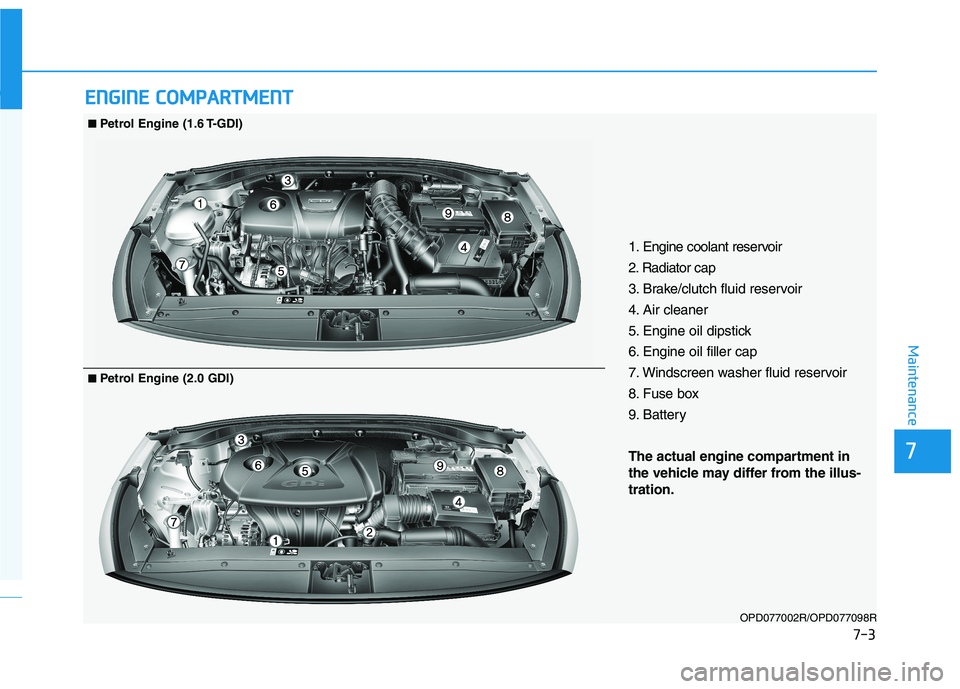
1. Engine coolant reservoir
2. Radiator cap
3. Brake/clutch fluid reservoir
4. Air cleaner
5. Engine oil dipstick
6. Engine oil filler cap
7. Windscreen washer fluid reservoir
8. Fuse box
9. Battery
The actual engine compartment in
the vehicle may differ from the illus-
tration.
OPD077002R/OPD077098R ■ ■
Petrol Engine (1.6 T-GDI)
■ ■Petrol Engine (2.0 GDI)
Page 435 of 533
7-4
Maintenance
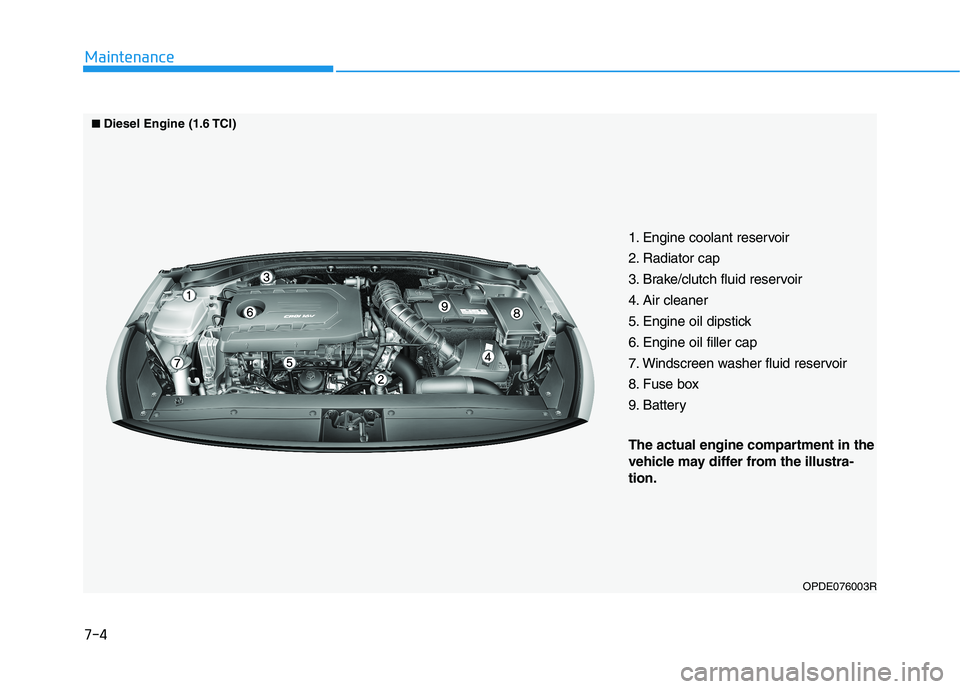
1. Engine coolant reservoir
2. Radiator cap
3. Brake/clutch fluid reservoir
4. Air cleaner
5. Engine oil dipstick
6. Engine oil filler cap
7. Windscreen washer fluid reservoir
8. Fuse box
9. Battery
The actual engine compartment in the
vehicle may differ from the illustra-
tion.
OPDE076003R
■ ■Diesel Engine (1.6 TCI)
Page 436 of 533
7-5
7
Maintenance
M MA
AI
IN
NT
TE
EN
NA
AN
NC
CE
E
S
SE
ER
RV
VI
IC
CE
ES
S
You should exercise the utmost care
to prevent damage to your vehicle
and injury to yourself whenever per-
forming any maintenance or inspec-
tion procedures.
We recommend you have your vehi-
cle maintained and repaired by an
authorised HYUNDAI dealer. An
authorised HYUNDAI dealer meets
HYUNDAI’s high service quality stan-
dards and receives technical support
from HYUNDAI in order to provide
you with a high level of service satis-
faction.
Owner’s responsibility
Maintenance service and record reten-
tion are the owner’s responsibility.
You should retain documents that show
proper maintenance has been per-
formed on your vehicle in accordance
with the scheduled maintenance serv-
ice charts shown on the following
pages. You need this information to
establish your compliance with the
servicing and maintenance require-
ments of your vehicle warranties.Detailed warranty information is pro-
vided in your Service Passport.
Repairs and adjustments required as
a result of improper maintenance or
a lack of required maintenance are
not covered.
Owner maintenance precautions
Inadequate, incomplete or insufficient
servicing may result in operational
problems with your vehicle that could
lead to vehicle damage, an accident,
or personal injury. This chapter pro-
vides instructions only for the mainte-
nance items that are easy to perform.
Several procedures can be done only
by an authorised HYUNDAI dealer
with special tools.
Your vehicle should not be modified in
any way. Such modifications may
adversely affect the performance,
safety or durability of your vehicle and
may, in addition, violate conditions of
the limited warranties covering the
vehicle.Improper owner maintenance dur-
ing the warranty period may affect
warranty coverage. For details, read
the separate Service Passport pro-
vided with the vehicle. If you're
unsure about any servicing or main-
tenance procedure, we recommend
that the system be serviced by an
authorised HYUNDAI dealer.
NOTICE
Page 437 of 533
7-6
Maintenance
O OW
WN
NE
ER
R
M
MA
AI
IN
NT
TE
EN
NA
AN
NC
CE
E
The following lists are vehicle checks
and inspections that should be per-
formed by the owner or an authorised
HYUNDAI dealer at the frequencies
indicated to help ensure safe, depend-
able operation of your vehicle.
Any adverse conditions should be
brought to the attention of your dealer
as soon as possible.
These Owner Maintenance vehicle
checks are generally not covered by
warranties and you may be charged
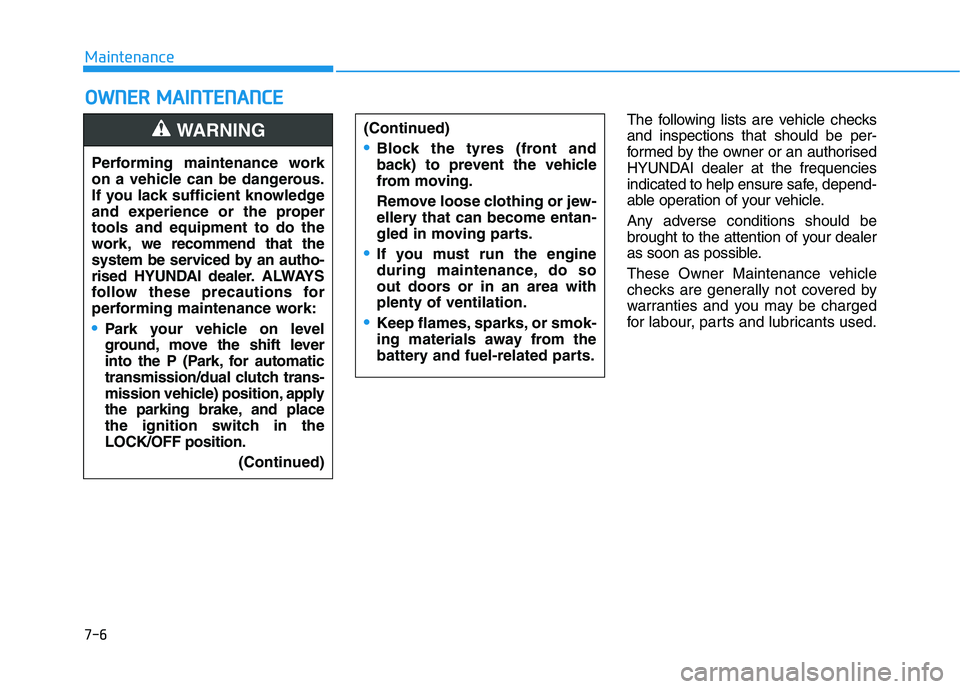
for labour, parts and lubricants used. Performing maintenance work
on a vehicle can be dangerous.
If you lack sufficient knowledge
and experience or the proper
tools and equipment to do the
work, we recommend that the
system be serviced by an autho-
rised HYUNDAI dealer. ALWAYS
follow these precautions for
performing maintenance work:
Park your vehicle on level
ground, move the shift lever
into the P (Park, for automatic
transmission/dual clutch trans-
mission vehicle) position, apply
the parking brake, and place
the ignition switch in the
LOCK/OFF position.
(Continued)
WARNING (Continued)
Block the tyres (front and
back) to prevent the vehicle
from moving.
Remove loose clothing or jew-
ellery that can become entan-
gled in moving parts.
If you must run the engine
during maintenance, do so
out doors or in an area with
plenty of ventilation.
Keep flames, sparks, or smok-
ing materials away from the
battery and fuel-related parts.
Page 438 of 533
7-7
7
Maintenance
Owner maintenance schedule
When you stop for fuel:
Check the engine oil level.
Check the coolant level in the
engine coolant reservoir.
Check the windscreen washer fluid
level.
Check for low or under-inflated
tyres.
Whilst operating your vehicle:
Note any changes in the sound of
the exhaust or any smell of exhaust
fumes in the vehicle.
Check for vibrations in the steering
wheel. Notice if there is any
increased steering effort or loose-
ness in the steering wheel, or
change in its straight-ahead position.
Notice if your vehicle constantly turns
slightly or “pulls” to one side when
travelling on smooth, level road.
When stopping, listen and check for
unusual sounds, pulling to one side,
increased brake pedal travel or
“hard-to-push” brake pedal.
If any slipping or changes in the
operation of your transmissiom
occurs, check the transmissiom fluid
level.
Check the automatic transmission/
dual clutch transmission P (Park)
function.
Check the parking brake.
Check for fluid leaks under your
vehicle (water dripping from the air
conditioning system during or after
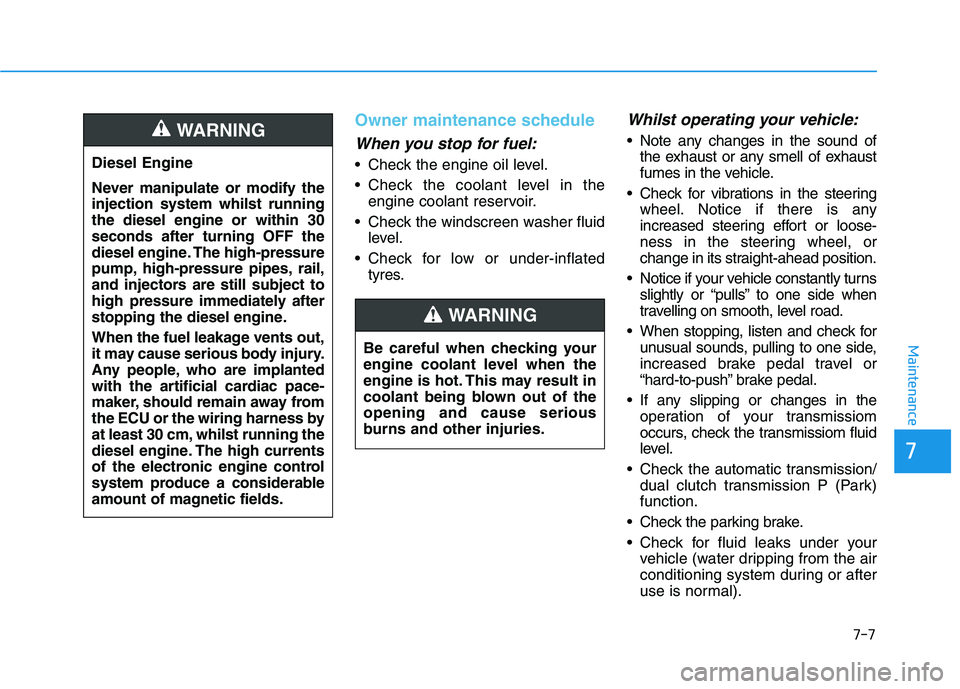
use is normal). Be careful when checking your
engine coolant level when the
engine is hot. This may result in
coolant being blown out of the
opening and cause serious
burns and other injuries.
WARNING
Diesel Engine
Never manipulate or modify the
injection system whilst running
the diesel engine or within 30
seconds after turning OFF the
diesel engine. The high-pressure
pump, high-pressure pipes, rail,
and injectors are still subject to
high pressure immediately after
stopping the diesel engine.
When the fuel leakage vents out,
it may cause serious body injury.
Any people, who are implanted
with the artificial cardiac pace-
maker, should remain away from
the ECU or the wiring harness by
at least 30 cm, whilst running the
diesel engine. The high currents
of the electronic engine control
system produce a considerable
amount of magnetic fields.
WARNING