towing HYUNDAI I30 2023 User Guide
[x] Cancel search | Manufacturer: HYUNDAI, Model Year: 2023, Model line: I30, Model: HYUNDAI I30 2023Pages: 533, PDF Size: 59.13 MB
Page 401 of 533
5-136
Driving your vehicle
Driving on hills
Reduce speed and shift to a lower
gear before you start down a long or
steep downgrade. If you don’t shift
down, you might have to use your
brakes so much that they would get
overheated and may not operate effi-
ciently.
On a long uphill grade, shift down
and reduce your speed to around 70
km/h to reduce the possibility of
engine and transmission overheat-
ing.
If your trailer weighs more than the
maximum trailer weight without trail-
er brakes and you have an automat-
ic transmission/dual clutch transmis-
sion, you should drive in D (Drive)
when towing a trailer.
Operating your vehicle in D (Drive)
when towing a trailer will minimise
heat build-up and extend the life of
your transmission.To prevent engine and/or trans-
mission overheating:
When towing a trailer on steep
grades (in excess of 6%) pay
close attention to the engine
coolant temperature gauge to
ensure the engine does not
overheat. If the needle of the
coolant temperature gauge
moves towards "H" (HOT), pull
over and stop as soon as it is
safe to do so, and allow the
engine to idle until it cools
down. You may proceed once the
engine has cooled sufficiently.
If you tow a trailer with the max-
imum gross vehicle weight and
maximum trailer weight, it can
cause the engine or transmis-
sion to overheat. When driving
in such conditions, allow the
engine to idle until it cools
down. You may proceed once the
engine or transmission has
cooled sufficiently.
(Continued)(Continued)
When towing a trailer, your vehi-
cle speed may be much slower
than the general flow of traffic,
especially when climbing an
uphill grade. Use the left hand
lane when towing a trailer on an
uphill grade. Choose your vehi-
cle speed according to the max-
imum posted speed limit for
vehicles with trailers, the steep-
ness of the grade, and your trail-
er weight.
Vehicles equipped with a dual
clutch transmission when tow-
ing a trailer on steep grades,
need to be aware that the clutch
in the transmission could over-
heat.
When the clutch is overheated,
the safe protection mode
engages. If the safe protection
mode engages, the gear posi-
tion indicator on the cluster
blinks with a chime sound.
(Continued)
NOTICE
Page 403 of 533
5-138
Driving your vehicle
Ready to leave after parking on
a hill
1. With the shift lever in P (Park, for
automatic transmission/dual clutch
transmission vehicle) or neutral (for
manual transmission vehicle),
apply your brakes and hold the
brake pedal down whilst you:
and
2. Slowly remove your foot from the
brake pedal.
3. Drive slowly until the trailer is clear
of the chocks.
4. Stop and have someone pick up
and store the chocks.
Maintenance when towing a
trailer
Your vehicle will need service more
often when you regularly pull a trail-
er. Important items to pay particular
attention to include engine oil, auto-
matic transmission fluid, axle lubri-
cant and cooling system fluid. Brake
condition is another important item to
frequently check. If you’re towing, it’s
a good idea to review these items
before you start your trip. Don’t forget
to also maintain your trailer and tow-
bar. Follow the maintenance sched-
ule that accompanied your trailer and
check it periodically. Preferably, con-
duct the check at the start of each
day’s driving. Most importantly, all
towbar nuts and bolts should be
tight.To prevent vehicle damage:
Due to higher load during trailer
usage, overheating might occur
on hot days or during uphill driv-
ing. If the coolant gauge indi-
cates over-heating, switch off
the air conditioner and stop the
vehicle in a safe area to cool
down the engine.
Do not switch off the engine
whilst the coolant gauge indi-
cates over-heating.
(Keep the engine idle to cool
down the engine)
When towing check automatic
transmission fluid more fre-
quently.
If your vehicle is not equipped
with an air conditioner, you
should install a condenser fan
to improve engine performance
when towing a trailer.
NOTICE
Page 404 of 533
5-139
Driving your vehicle
5
If you do decide to pull a trail-
er (For Australia)
Here are some important points if
you decide to pull a trailer:
Do not do any towing with your
vehicle during its first 2,000 km in
order to allow the engine to proper-
ly run in. Failure to heed this cau-
tion may result in serious engine or
transmission damage.
When towing a trailer, be sure to
consult an authorised HYUNDAI
dealer for further information on
additional requirements such as a
towing kit, etc.
Always drive your vehicle at a mod-
erate speed (less than 100 km/h).
On a long uphill grade, do not
exceed 70 km/h or the posted
speed limit, whichever is lower.
Towing Trailer
The recommended towing capacity of this vehicle will be provided with the
Genuine HYUNDAI Approved Tow Bar, which will meet the requirements of
Australian Standard: AS 4177.
For further information with regard to trailer towing:
on Genuine HYUNDAI parts and accessories (including the Genuine
HYUNDAI Approved Tow Bar and its availability for purchase) please consult
your nearest authorised HYUNDAI dealeror visit www
.hyundai.com.au.
on Rules and Regulations please consult your State or Territory road
authorities.
It is the owner's responsibility to ensure that any tow bar used is compatible
with and suitable for your vehicle, and is within the towing capacity of your
vehicle. Your HYUNDAI vehicle should not be used to tow heavy loads as it
is not designed for such use.
Subject to applicable law, HYUNDAI Motor Company Australia Pty Ltd shall
not be liable for any losses, damages, costs, expenses (including but not lim-
ited to consequential and indirect losses, personal injury and deaths) caused
by towing which is not in compliance with the instructions set out in this
owner's manual and under relevant law, rules and regulation.
HYUNDAI DO NOT recommend the use of load levelling devices of
any type. The use of a load levelling devices may place undue stress
on the chassis causing chassis or mounting point failure.
WARNING
Page 405 of 533
5-140
Driving your vehicle
If you do decide to pull a trail-
er (For New Zealand)
Here are some important points if
you decide to pull a trailer:
Do not do any towing with your
vehicle during its first 2,000 km in
order to allow the engine to proper-
ly run in. Failure to heed this cau-
tion may result in serious engine or
transmission damage.
When towing a trailer, be sure to
consult an authorised HYUNDAI
dealer for further information on
additional requirements such as a
towing kit, etc.
Always drive your vehicle at a mod-
erate speed (less than 100 km/h).
On a long uphill grade, do not
exceed 70 km/h or the posted
speed limit, whichever is lower.
Towing Capacity Note
The recommended towing capacity of this vehicle will be provided with the
Genuine HYUNDAI Approved Tow Bar.
To enquire about the towing capacity of this vehicle, please visit
www
.hyundai.co.nz, or call us on 0800 HYUNDAI.
To enquire about Genuine HYUNDAI parts and accessories (including the
Genuine HYUNDAI Approved Tow Bar and its availability for purchase)
please consult your nearest authorised HYUNDAI dealer/service agent,
call us on 0800 HYUNDAI or visit www
.hyundai.co.nz.
It is the owner's responsibility to ensure that any tow bar used is compatible
with and suitable for their vehicle, and is within the towing capacity of their
vehicle. Your HYUNDAI vehicle should not be used to tow heavy loads
beyond the recommended towing capacities displayed on
www
.hyundai.co.nzas it is not designed for such use.
Subject to applicable law, HYUNDAI Motors New Zealand Ltd shall not be
liable for any losses, damages, costs, expenses (including but not limited to
consequential and indirect losses, personal injury and deaths) caused by
towing which is not in compliance with instructions set out in the owner's
manual.
HYUNDAI DO NOT recommend the use of load levelling devices of
any type. The use of a load levelling devices may place undue stress
on the chassis causing chassis or mounting point failure.
WARNING
Page 407 of 533
What to do in an emergency
Hazard warning flasher ........................................6-2
In case of an emergency whilst driving .............6-2
If the engine stalls whilst driving ..................................6-2
If the engine stalls at a crossroads or crossing .......6-2
If you have a flat tyre whilst driving ...........................6-3
If the engine will not start ...................................6-3
If the engine doesn't turn over or
turns over slowly ...............................................................6-4
If the engine turns over normally
but doesn't start ................................................................6-4
Jump starting ..........................................................6-4
If the engine overheats ........................................6-7
Tyre pressure monitoring system (TPMS) .........6-8
Check tyre pressure .........................................................6-8
Tyre pressure monitoring system .................................6-9
Low tyre pressure telltale.............................................6-10
Low tyre pressure position telltale and
tyre pressure telltale ......................................................6-10
TPMS (Tyre Pressure Monitoring System)
malfunction indicator .....................................................6-12
Changing a tyre with TPMS .........................................6-12
If you have a flat tyre (with spare tyre) .........6-15
Jack and tools ..................................................................6-15
Changing tyres .................................................................6-16
Towing ...................................................................6-22
Towing service .................................................................6-22
Removable towing hook ................................................6-23
Emergency towing ..........................................................6-24
6
Page 410 of 533
6-4
What to do in an emergency
If the engine turns over nor-
mally but doesn’t start
Check the fuel level and add fuel if
necessary.
If the engine still does not start, we
recommend that you call an autho-
rised HYUNDAI dealer for assis-
tance.Jump starting can be dangerous if
done incorrectly. Follow the jump
starting procedure in this section to
avoid serious injury or damage to
your vehicle. If in doubt about how to
properly jump start your vehicle, we
strongly recommend that you have a
service technician or towing service
do it for you.
J JU
UM
MP
P
S
ST
TA
AR
RT
TI
IN
NG
G
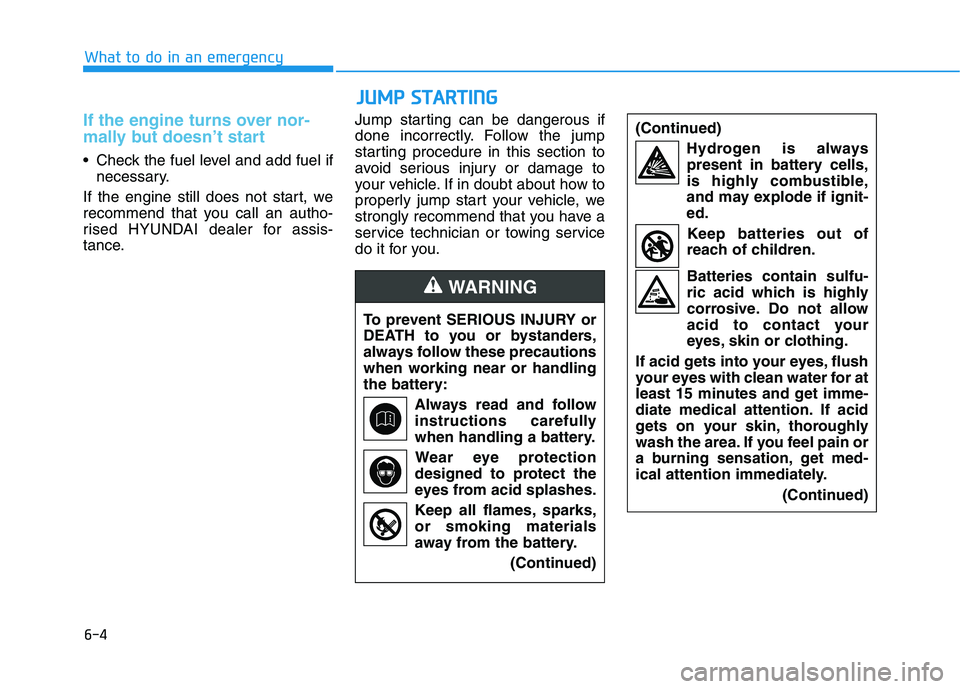
To prevent SERIOUS INJURY or
DEATH to you or bystanders,
always follow these precautions
when working near or handling
the battery:
Always read and follow
instructions carefully
when handling a battery.
Wear eye protection
designed to protect the
eyes from acid splashes.
Keep all flames, sparks,
or smoking materials
away from the battery.
(Continued)
WARNING
(Continued)
Hydrogen is always
present in battery cells,
is highly combustible,
and may explode if ignit-
ed.
Keep batteries out of
reach of children.
Batteries contain sulfu-
ric acid which is highly
corrosive. Do not allow
acid to contact your
eyes, skin or clothing.
If acid gets into your eyes, flush
your eyes with clean water for at
least 15 minutes and get imme-
diate medical attention. If acid
gets on your skin, thoroughly
wash the area. If you feel pain or
a burning sensation, get med-
ical attention immediately.
(Continued)
Page 428 of 533
6-22
What to do in an emergency
Towing service
If emergency towing is necessary,
we recommend having it done by an
authorised HYUNDAI dealer or a
commercial tow-truck service.
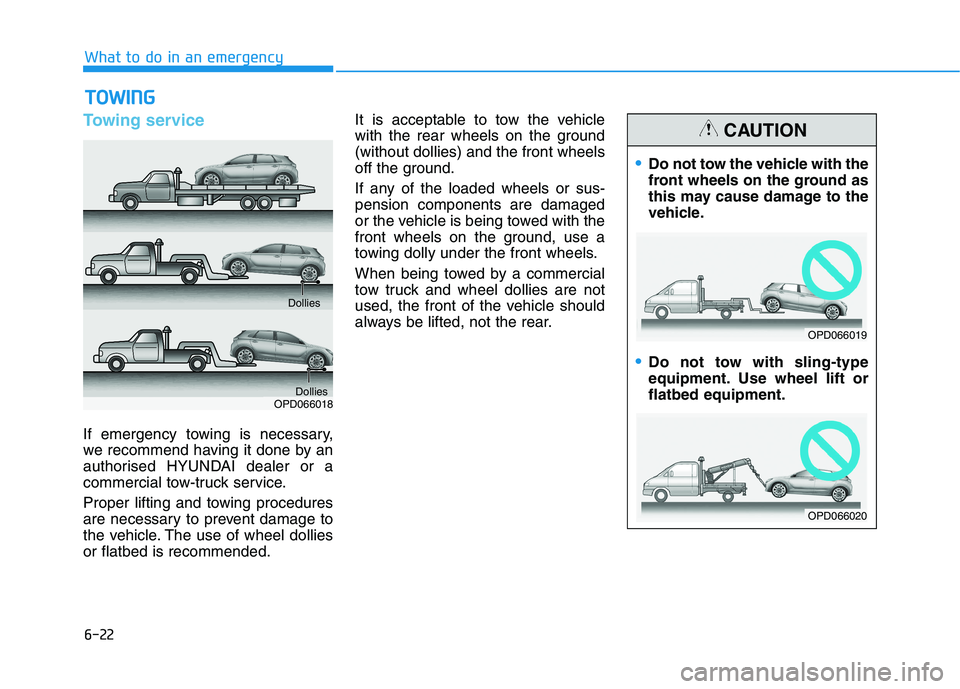
Proper lifting and towing procedures
are necessary to prevent damage to
the vehicle. The use of wheel dollies
or flatbed is recommended.It is acceptable to tow the vehicle
with the rear wheels on the ground
(without dollies) and the front wheels
off the ground.
If any of the loaded wheels or sus-
pension components are damaged
or the vehicle is being towed with the
front wheels on the ground, use a
towing dolly under the front wheels.
When being towed by a commercial
tow truck and wheel dollies are not
used, the front of the vehicle should
always be lifted, not the rear.
T TO
OW
WI
IN
NG
G
OPD066018Dollies Dollies
Do not tow the vehicle with the
front wheels on the ground as
this may cause damage to the
vehicle.
Do not tow with sling-type
equipment. Use wheel lift or
flatbed equipment.
CAUTION
OPD066019
OPD066020
Page 429 of 533
6-23
What to do in an emergency
6
When towing your vehicle in an
emergency without wheel dollies:
1. Place the ignition switch in the
ACC position.
2. Place the shift lever in N (Neutral).
3. Release the parking brake.Removable towing hook
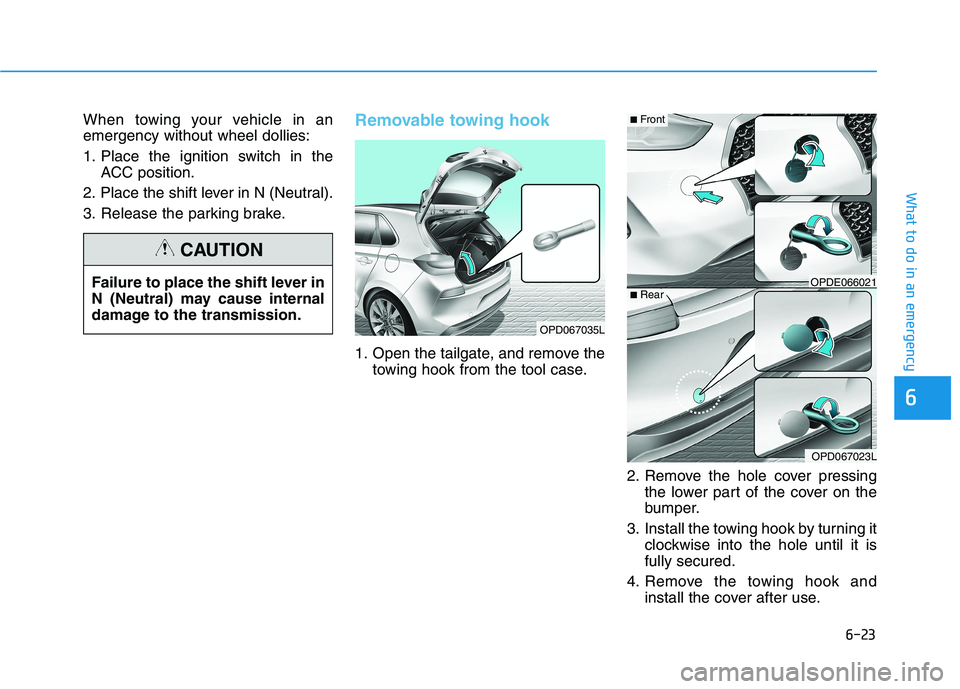
1. Open the tailgate, and remove the
towing hook from the tool case.
2. Remove the hole cover pressing
the lower part of the cover on the
bumper.
3. Install the towing hook by turning it
clockwise into the hole until it is
fully secured.
4. Remove the towing hook and
install the cover after use. Failure to place the shift lever in
N (Neutral) may cause internal
damage to the transmission.
CAUTION
OPD067035L
OPDE066021
OPD067023L
■Front
■Rear
Page 430 of 533
6-24
What to do in an emergency
Emergency towing
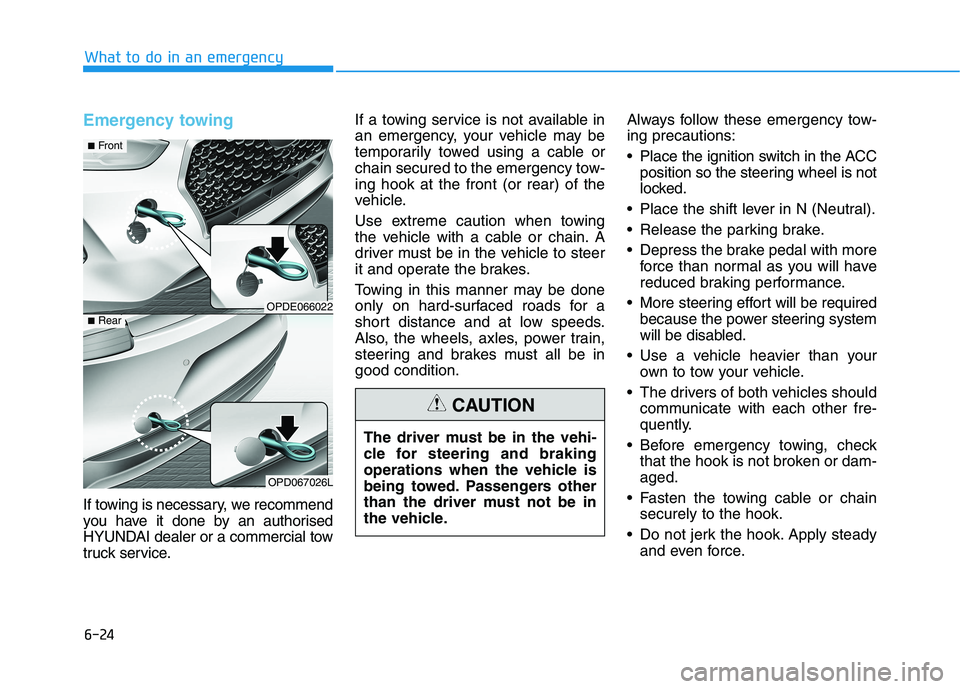
If towing is necessary, we recommend
you have it done by an authorised
HYUNDAI dealer or a commercial tow
truck service.If a towing service is not available in
an emergency, your vehicle may be
temporarily towed using a cable or
chain secured to the emergency tow-
ing hook at the front (or rear) of the
vehicle.
Use extreme caution when towing
the vehicle with a cable or chain. A
driver must be in the vehicle to steer
it and operate the brakes.
Towing in this manner may be done
only on hard-surfaced roads for a
short distance and at low speeds.
Also, the wheels, axles, power train,
steering and brakes must all be in
good condition.Always follow these emergency tow-
ing precautions:
Place the ignition switch in the ACC
position so the steering wheel is not
locked.
Place the shift lever in N (Neutral).
Release the parking brake.
Depress the brake pedal with more
force than normal as you will have
reduced braking performance.
More steering effort will be required
because the power steering system
will be disabled.
Use a vehicle heavier than your
own to tow your vehicle.
The drivers of both vehicles should
communicate with each other fre-
quently.
Before emergency towing, check
that the hook is not broken or dam-
aged.
Fasten the towing cable or chain
securely to the hook.
Do not jerk the hook. Apply steady
and even force.
OPDE066022
OPD067026L
■Front
■Rear
The driver must be in the vehi-
cle for steering and braking
operations when the vehicle is
being towed. Passengers other
than the driver must not be in
the vehicle.
CAUTION
Page 431 of 533
6-25
What to do in an emergency
6
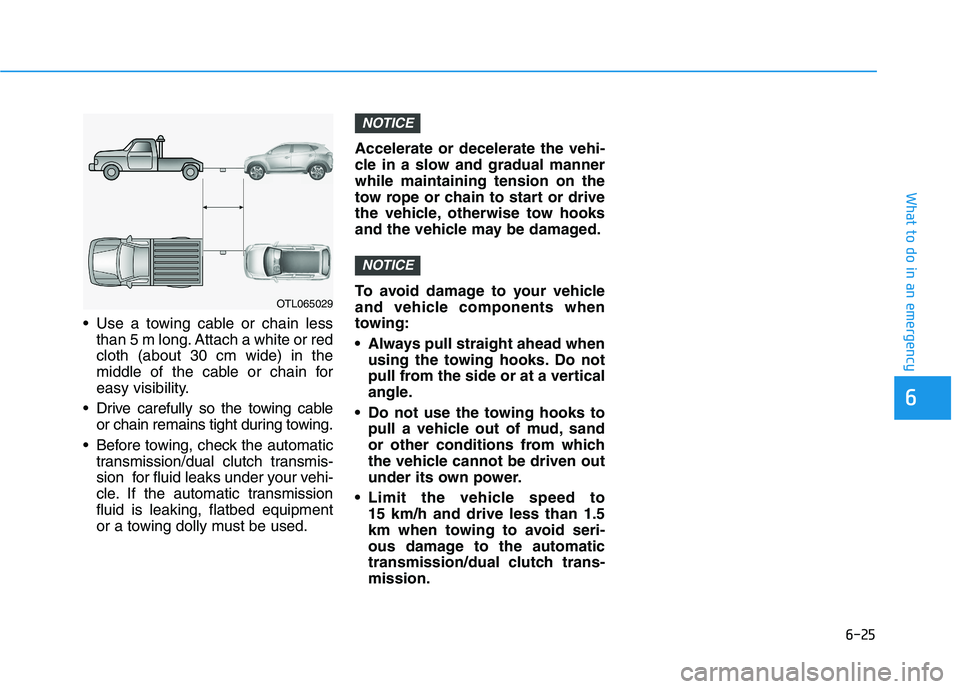
Use a towing cable or chain less
than 5 m long. Attach a white or red
cloth (about 30 cm wide) in the
middle of the cable or chain for
easy visibility.
Drive carefully so the towing cable
or chain remains tight during towing.
Before towing, check the automatic
transmission/dual clutch transmis-
sion for fluid leaks under your vehi-
cle. If the automatic transmission
fluid is leaking, flatbed equipment
or a towing dolly must be used.Accelerate or decelerate the vehi-
cle in a slow and gradual manner
while maintaining tension on the
tow rope or chain to start or drive
the vehicle, otherwise tow hooks
and the vehicle may be damaged.
To avoid damage to your vehicle
and vehicle components when
towing:
Always pull straight ahead when
using the towing hooks. Do not
pull from the side or at a vertical
angle.
Do not use the towing hooks to
pull a vehicle out of mud, sand
or other conditions from which
the vehicle cannot be driven out
under its own power.
Limit the vehicle speed to
15 km/h and drive less than 1.5
km when towing to avoid seri-
ous damage to the automatic
transmission/dual clutch trans-
mission.
NOTICE
NOTICE
OTL065029