ABS HYUNDAI I30 2023 Owner's Manual
[x] Cancel search | Manufacturer: HYUNDAI, Model Year: 2023, Model line: I30, Model: HYUNDAI I30 2023Pages: 533, PDF Size: 59.13 MB
Page 499 of 533
7-68
Maintenance
Always handle them carefully, and
avoid scratches and abrasions. If
the bulbs are lit, avoid contact with
liquids.
Never touch the glass with bare
hands. Residual oil may cause the
bulb to overheat and burst when lit.
A bulb should be operated only
when installed in a headlamp.
If a bulb becomes damaged or
cracked, replace it immediately
and carefully dispose of it.
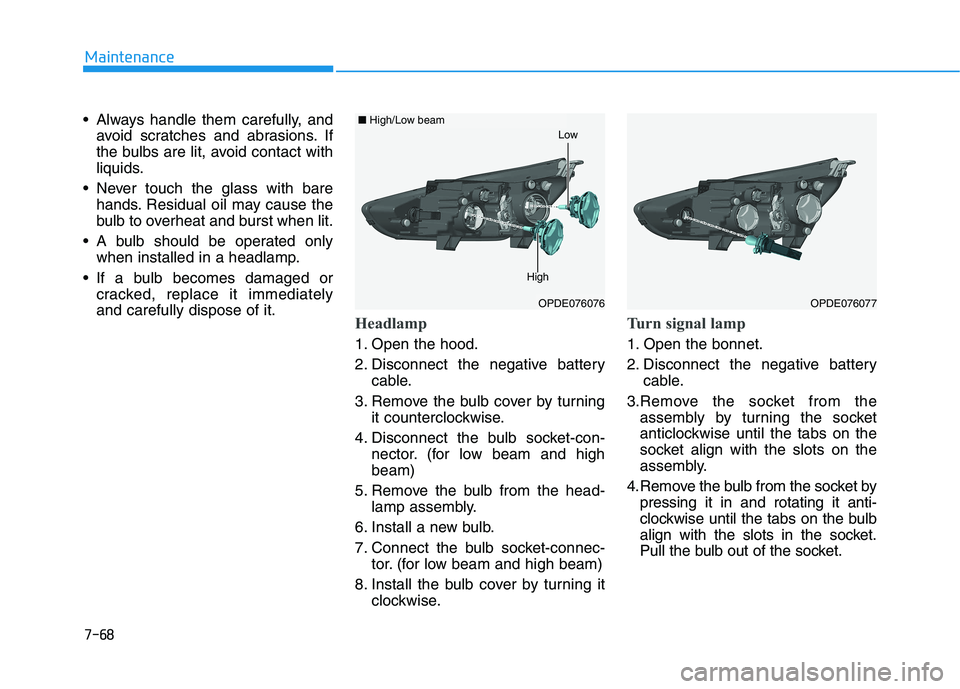
Headlamp
1. Open the hood.
2. Disconnect the negative battery
cable.
3. Remove the bulb cover by turning
it counterclockwise.
4. Disconnect the bulb socket-con-
nector. (for low beam and high
beam)
5. Remove the bulb from the head-
lamp assembly.
6. Install a new bulb.
7. Connect the bulb socket-connec-
tor. (for low beam and high beam)
8. Install the bulb cover by turning it
clockwise.
Turn signal lamp
1. Open the bonnet.
2. Disconnect the negative battery
cable.
3.Remove the socket from the
assembly by turning the socket
anticlockwise until the tabs on the
socket align with the slots on the
assembly.
4.Remove the bulb from the socket by
pressing it in and rotating it anti-
clockwise until the tabs on the bulb
align with the slots in the socket.
Pull the bulb out of the socket.
OPDE076077OPDE076076
■High/Low beam
High
Low
Page 500 of 533
7-69
7
Maintenance
5.Insert a new bulb by inserting it into
the socket and rotating it until it
locks into place.
6.Install the socket in the assembly
by aligning the tabs on the socket
with the slots in the assembly.
7.Push the socket into the assembly
and turn the socket clockwise.
Parking lamp and daytime running
light
If the LED lamp does not operate, we
recommend you to have the vehicle
checked by an authorised HYUNDAI
dealer.
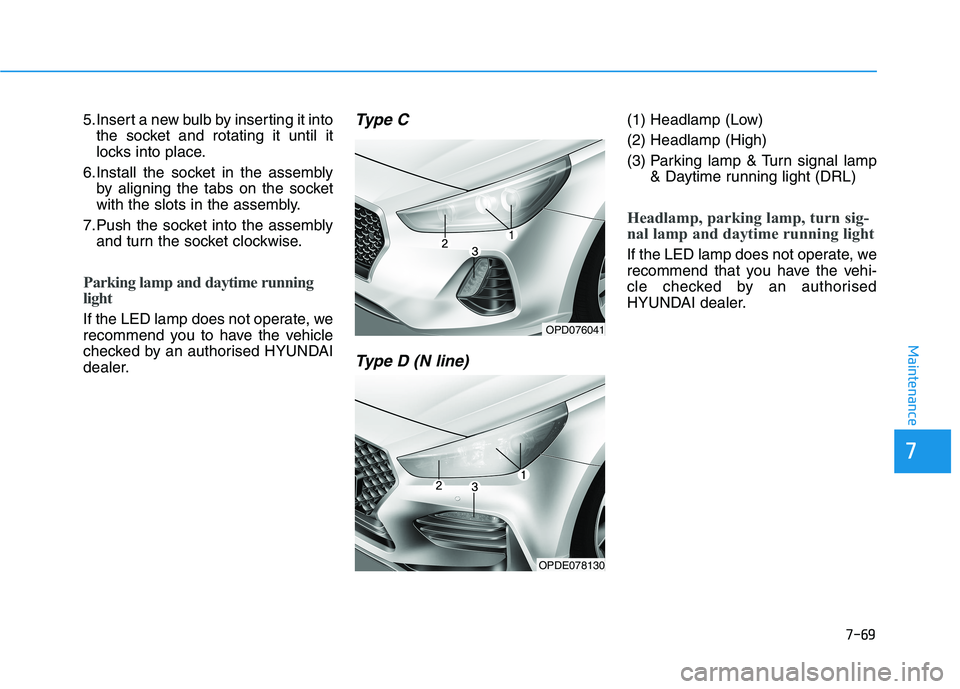
Type C
Type D (N line)(1) Headlamp (Low)
(2) Headlamp (High)
(3) Parking lamp & Turn signal lamp
& Daytime running light (DRL)
Headlamp, parking lamp, turn sig-
nal lamp and daytime running light
If the LED lamp does not operate, we
recommend that you have the vehi-
cle checked by an authorised
HYUNDAI dealer.
OPD076041
OPDE078130
Page 501 of 533
7-70
Maintenance
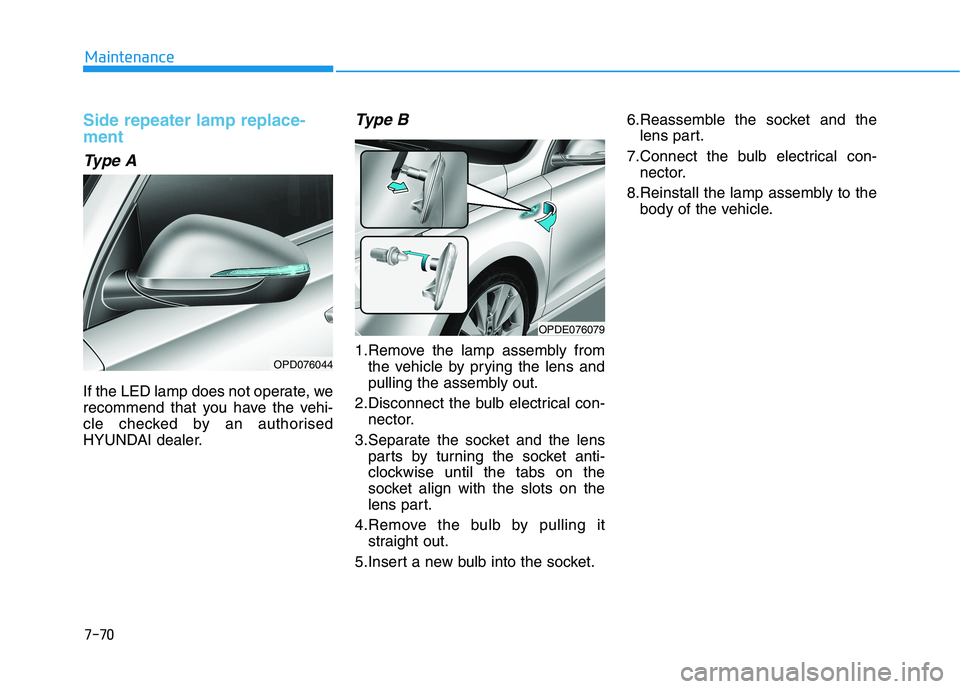
Side repeater lamp replace-
ment
Type A
If the LED lamp does not operate, we
recommend that you have the vehi-
cle checked by an authorised
HYUNDAI dealer.
Type B
1.Remove the lamp assembly from
the vehicle by prying the lens and
pulling the assembly out.
2.Disconnect the bulb electrical con-
nector.
3.Separate the socket and the lens
parts by turning the socket anti-
clockwise until the tabs on the
socket align with the slots on the
lens part.
4.Remove the bulb by pulling it
straight out.
5.Insert a new bulb into the socket.6.Reassemble the socket and the
lens part.
7.Connect the bulb electrical con-
nector.
8.Reinstall the lamp assembly to the
body of the vehicle.
OPDE076079
OPD076044
Page 503 of 533
7-72
Maintenance
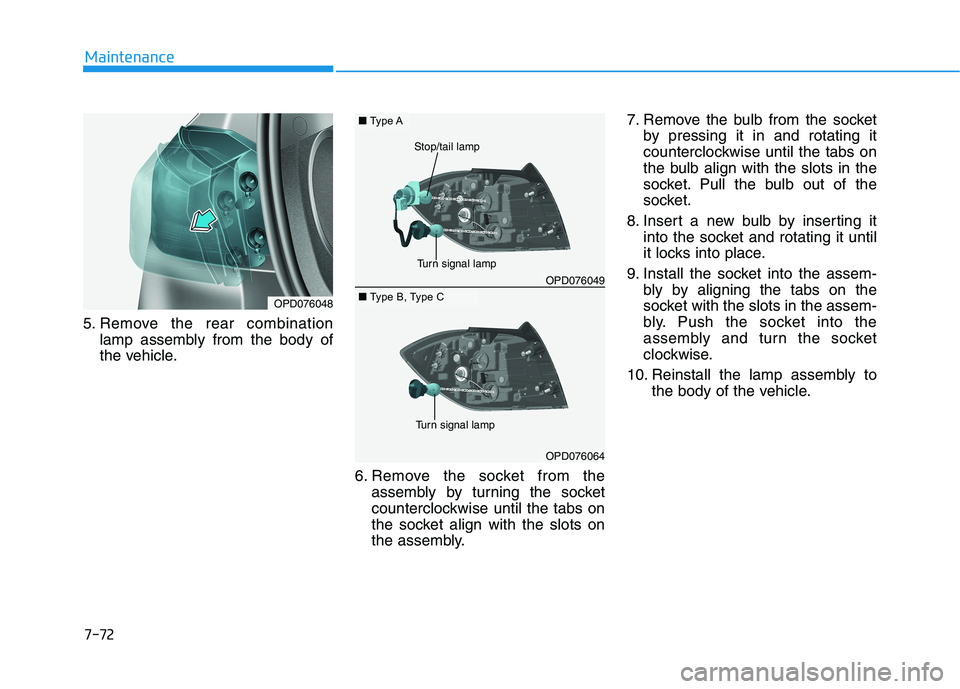
5. Remove the rear combination
lamp assembly from the body of
the vehicle.
6. Remove the socket from the
assembly by turning the socket
counterclockwise until the tabs on
the socket align with the slots on
the assembly.7. Remove the bulb from the socket
by pressing it in and rotating it
counterclockwise until the tabs on
the bulb align with the slots in the
socket. Pull the bulb out of the
socket.
8. Insert a new bulb by inserting it
into the socket and rotating it until
it locks into place.
9. Install the socket into the assem-
bly by aligning the tabs on the
socket with the slots in the assem-
bly. Push the socket into the
assembly and turn the socket
clockwise.
10. Reinstall the lamp assembly to
the body of the vehicle.
OPD076049
Stop/tail lamp
Turn signal lamp
OPD076064
Turn signal lamp
■Type A
■Type B, Type COPD076048
Page 504 of 533
7-73
7
Maintenance
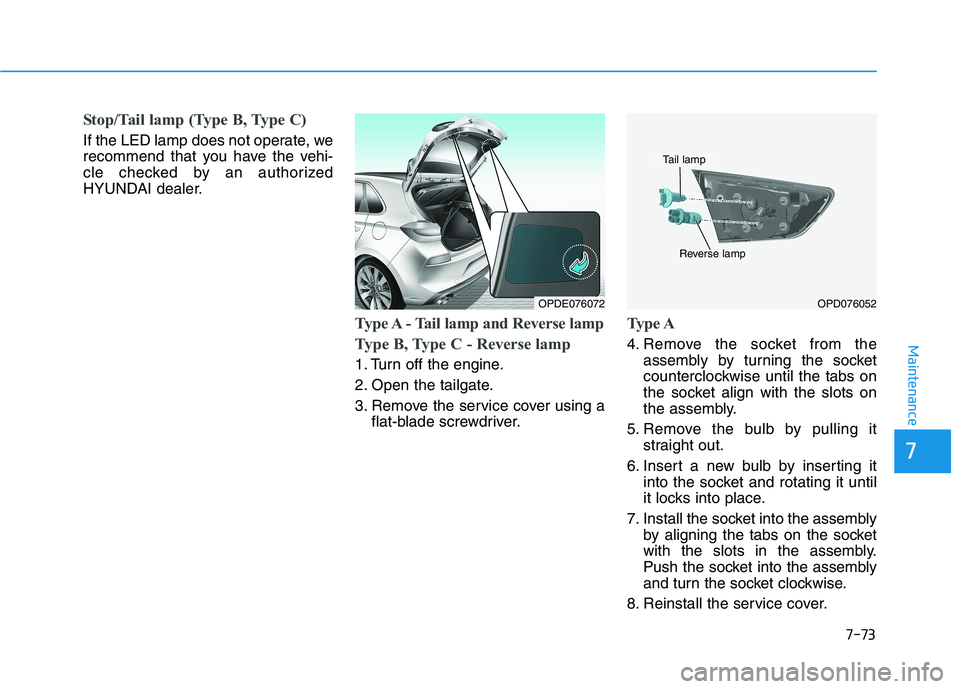
Stop/Tail lamp (Type B, Type C)
If the LED lamp does not operate, we
recommend that you have the vehi-
cle checked by an authorized
HYUNDAI dealer.
Type A - Tail lamp and Reverse lamp
Type B, Type C - Reverse lamp
1. Turn off the engine.
2. Open the tailgate.
3. Remove the service cover using a
flat-blade screwdriver.
Type A
4. Remove the socket from the
assembly by turning the socket
counterclockwise until the tabs on
the socket align with the slots on
the assembly.
5. Remove the bulb by pulling it
straight out.
6. Insert a new bulb by inserting it
into the socket and rotating it until
it locks into place.
7. Install the socket into the assembly
by aligning the tabs on the socket
with the slots in the assembly.
Push the socket into the assembly
and turn the socket clockwise.
8. Reinstall the service cover.
OPDE076072OPD076052
Reverse lamp
Tail lamp
Page 505 of 533
7-74
Maintenance
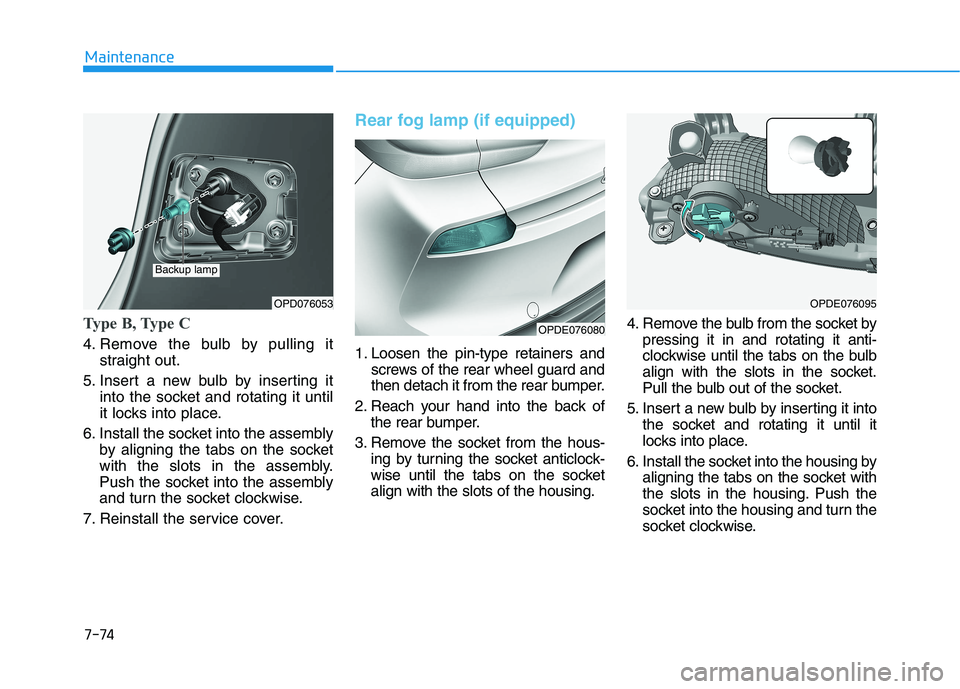
Type B, Type C
4. Remove the bulb by pulling it
straight out.
5. Insert a new bulb by inserting it
into the socket and rotating it until
it locks into place.
6. Install the socket into the assembly
by aligning the tabs on the socket
with the slots in the assembly.
Push the socket into the assembly
and turn the socket clockwise.
7. Reinstall the service cover.
Rear fog lamp (if equipped)
1. Loosen the pin-type retainers and
screws of the rear wheel guard and
then detach it from the rear bumper.
2. Reach your hand into the back of
the rear bumper.
3. Remove the socket from the hous-
ing by turning the socket anticlock-
wise until the tabs on the socket
align with the slots of the housing.4. Remove the bulb from the socket by
pressing it in and rotating it anti-
clockwise until the tabs on the bulb
align with the slots in the socket.
Pull the bulb out of the socket.
5. Insert a new bulb by inserting it into
the socket and rotating it until it
locks into place.
6. Install the socket into the housing by
aligning the tabs on the socket with
the slots in the housing. Push the
socket into the housing and turn the
socket clockwise.
OPD076053
Backup lamp
OPDE076080
OPDE076095
Page 507 of 533
7-76
Maintenance
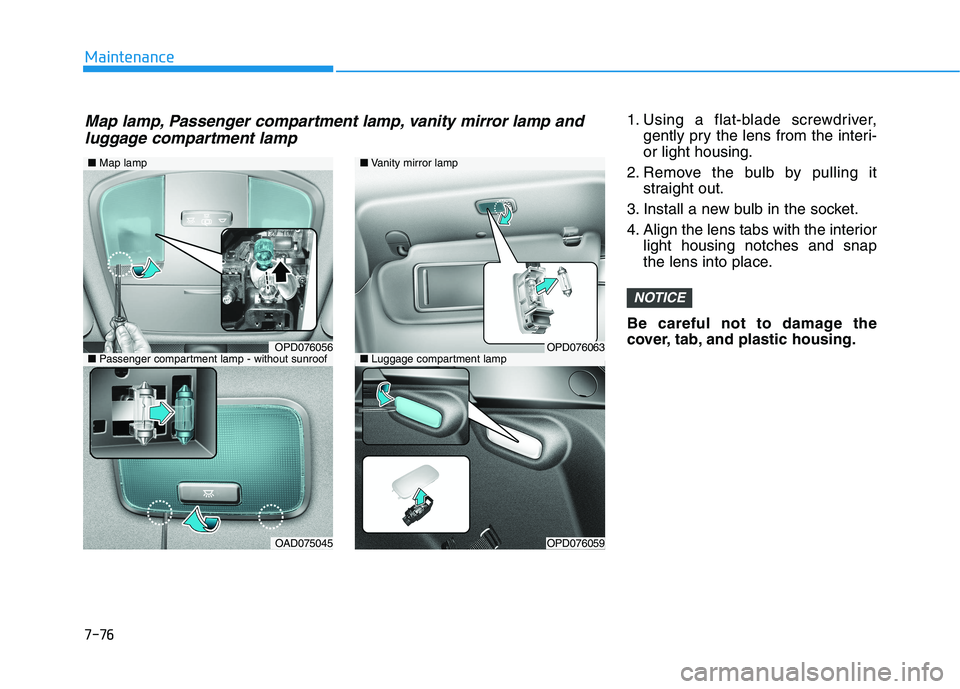
1. Using a flat-blade screwdriver,
gently pry the lens from the interi-
or light housing.
2. Remove the bulb by pulling it
straight out.
3. Install a new bulb in the socket.
4. Align the lens tabs with the interior
light housing notches and snap
the lens into place.
Be careful not to damage the
cover, tab, and plastic housing.
NOTICE
■Map lamp
OPD076056
OAD075045
■Vanity mirror lamp
■Luggage compartment lampOPD076063
OPD076059
■Passenger compartment lamp - without sunroof
Map lamp, Passenger compartment lamp, vanity mirror lamp and
luggage compartment lamp
Page 516 of 533
7-85
7
Maintenance
Cleaning the leather seats
- Remove all contaminations instant-
ly. Refer to instructions below for
removal of each contaminant.
- Cosmetic products (sunscreen,
foundation, etc.)
Apply cleansing cream on a cloth
and wipe the contaminated spot.
Wipe off the cream with a wet cloth
and remove water with a dry cloth.
- Beverages (coffee, soft drink, etc.)
Apply a small amount of neutral
detergent and wipe until contami-
nations do not smear.
- Oil
Remove oil instantly with
absorbable cloth and wipe with
stain remover used only for natu-
ral leather.
- Chewing gum
Harden the gum with ice and
remove gradually.Cleaning the lap/shoulder belt
webbing
Clean the belt webbing with any mild
soap solution recommended for clean-
ing upholstery or carpet. Follow the
instructions provided with the soap. Do
not bleach or re-dye the webbing
because this may weaken it.
Cleaning the interior window
glass
If the interior glass surfaces of the
vehicle become fogged (that is, cov-
ered with an oily, greasy or waxy film),
they should be cleaned with glass
cleaner. Follow the directions on the
glass cleaner container.
Do not scrape or scratch the inside
of the rear window. This may result
in damage to the rear window
defroster grid.
NOTICE
Page 518 of 533
7-87
7
Maintenance
Canister
Fuel vapours generated inside the
fuel tank are absorbed and stored in
the onboard canister. When the
engine is running, the fuel vapours
absorbed in the canister are drawn
into the surge tank through the purge
control solenoid valve.
Purge Control Solenoid Valve
(PCSV)
The purge control solenoid valve is
controlled by the Engine Control
Module (ECM); when the engine
coolant temperature is low during
idling, the PCSV closes so that evap-
orated fuel is not taken into the
engine. After the engine warms-up
during ordinary driving, the PCSV
opens to introduce evaporated fuel to
the engine.
3. Exhaust emission control
system
The Exhaust Emission Control System
is a highly effective system which con-
trols exhaust emissions whilst main-
taining good vehicle performance.
Engine exhaust gas precautions
(carbon monoxide)
Carbon monoxide can be present
with other exhaust fumes. Therefore,
if you smell exhaust fumes of any
kind inside your vehicle, have it
inspected and repaired immediately.
If you ever suspect exhaust fumes
are coming into your vehicle, drive it
only with all the windows fully open.
Have your vehicle checked and
repaired immediately. Do not operate the engine in con-
fined or closed areas (such as
garages) any more than what is
necessary to move the vehicle in or
out of the area.
When the vehicle is stopped in an
open area for more than a short
time with the engine running,
adjust the ventilation system (as
needed) to draw outside air into the
vehicle.
Never sit in a parked or stopped
vehicle for any extended time with
the engine running.
When the engine stalls or fails to
start, excessive attempts to restart
the engine may cause damage to
the emission control system.
Engine exhaust gases contain
carbon monoxide (CO). Though
colourless and odourless, it is
dangerous and could be lethal if
inhaled. Follow the instructions
following to avoid CO poisoning.
WARNING