Wheels HYUNDAI I30 2023 Owner's Manual
[x] Cancel search | Manufacturer: HYUNDAI, Model Year: 2023, Model line: I30, Model: HYUNDAI I30 2023Pages: 533, PDF Size: 59.13 MB
Page 416 of 533
6-10
What to do in an emergency
Your vehicle has also been equipped
with a TPMS malfunction indicator to
indicate when the system is not
operating properly. The TPMS mal-
function indicator is combined with
the low tyre pressure telltale. When
the system detects a malfunction,
the telltale will flash for approximate-
ly one minute and then remain con-
tinuously illuminated. This sequence
will continue upon subsequent vehi-
cle start-ups as long as the malfunc-
tion exists. When the malfunction
indicator is illuminated, the system
may not be able to detect or signal
low tyre pressure as intended.
TPMS malfunctions may occur for a
variety of reasons, including the
installation of replacement or alter-
nate tyres or wheels on the vehicle
that prevent the TPMS from function-
ing properly. Always check the TPMS
malfunction telltale after replacing
one or more tyres or wheels on your
vehicle to ensure that the replace-
ment or alternate tyres and wheels
allow the TPMS to continue to func-
tion properly.If any of the below happens, we
recommend that the system be
checked by an authorised HYUNDAI
dealer.
1. The low tyre pressure telltale/
TPMS malfunction indicator
does not illuminate for 3 sec-
onds when the ignition switch is
turned to the ON position or the
engine is running.
2. The TPMS malfunction indicator
remains illuminated after blink-
ing for approximately 1 minute.
3. The Low tyre pressure position
telltale remains illuminated.
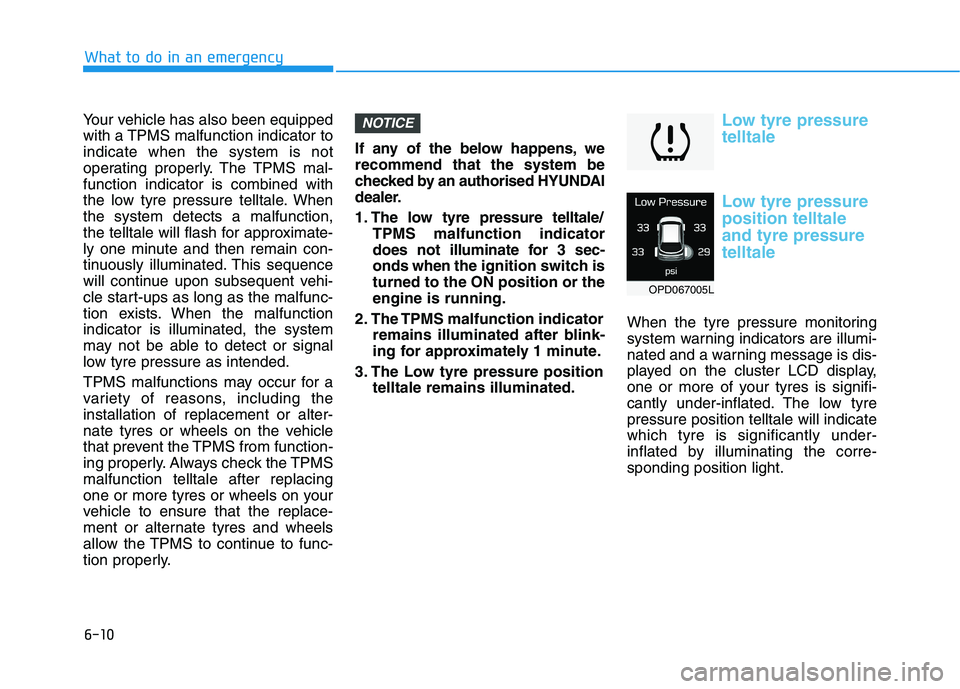
Low tyre pressure
telltale
Low tyre pressure
position telltale
and tyre pressure
telltale
When the tyre pressure monitoring
system warning indicators are illumi-
nated and a warning message is dis-
played on the cluster LCD display,
one or more of your tyres is signifi-
cantly under-inflated. The low tyre
pressure position telltale will indicate
which tyre is significantly under-
inflated by illuminating the corre-
sponding position light.
NOTICE
OPD067005L
Page 419 of 533
6-13
What to do in an emergency
6
Also, the TPMS Malfunction Indicator
will illuminate after blinking for one
minute if the vehicle is driven at
speed above 25 km/h for approxi-
mately 10 minutes.
Once the original tyre equipped with
a tyre pressure monitoring sensor is
reinflated to the recommended pres-
sure and reinstalled on the vehicle,
the Low Tyre Pressure Telltale and
TPMS Malfunction Indicator will go
off within a few minutes of driving.
If the indicators do not extinguish
after a few minutes, please visit an
authorised HYUNDAI dealer.
Each wheel is equipped with a tyre
pressure sensor mounted inside the
tyre behind the valve stem (except
for the spare tyre). You must use
TPMS specific wheels. It is recom-
mended that you have your tyres
serviced by an authorised HYUNDAI
dealer.You may not be able identify a tyre
with low pressure by simply looking
at it. Always use a good quality tyre
pressure gauge to measure the
tyre's inflation pressure. Please note
that a tyre that is hot (from being
driven) will have a higher pressure
measurement than a tyre that is cold.
A cold tyre means the vehicle has
been sitting for 3 hours and driven for
less than 1.6 km in that 3 hour peri-
od.
Allow the tyre to cool before measur-
ing the inflation pressure. Always be
sure the tyre is cold before inflating
to the recommended pressure.
The TPMS cannot alert you to
severe and sudden tyre dam-
age caused by external factors
such as nails or road debris.
If you feel any vehicle instabil-
ity, immediately take your foot
off the accelerator, apply the
brakes gradually and with
light force, and slowly move to
a safe position off the road.
WARNING
Page 420 of 533
6-14
What to do in an emergency
Protecting TPMS
Tampering with, modifying, or
disabling the Tyre Pressure
Monitoring System (TPMS) com-
ponents may interfere with the
system's ability to warn the driv-
er of low tyre pressure condi-
tions and/or TPMS malfunctions.
Tampering with, modifying, or
disabling the Tyre Pressure
Monitoring System (TPMS) com-
ponents may void the warranty
for that portion of the vehicle.
WARNING
Do not modify the vehicle; it
may interfere with the TPMS
function.
The wheels on the market do
not have a TPMS sensor.
For your safety, we recom-
mend that you use parts for
replacement from an autho-
rised HYUNDAI dealer.
If you use the wheels on the
market, use a TPMS sensor
approved by a HYUNDAI deal-
er. If your vehicle is not
equipped with a TPMS sensor
or TPMS does not work prop-
erly, you may fail the periodic
vehicle inspection conducted
in your country.
WARNING
Page 425 of 533
6-19
What to do in an emergency
6
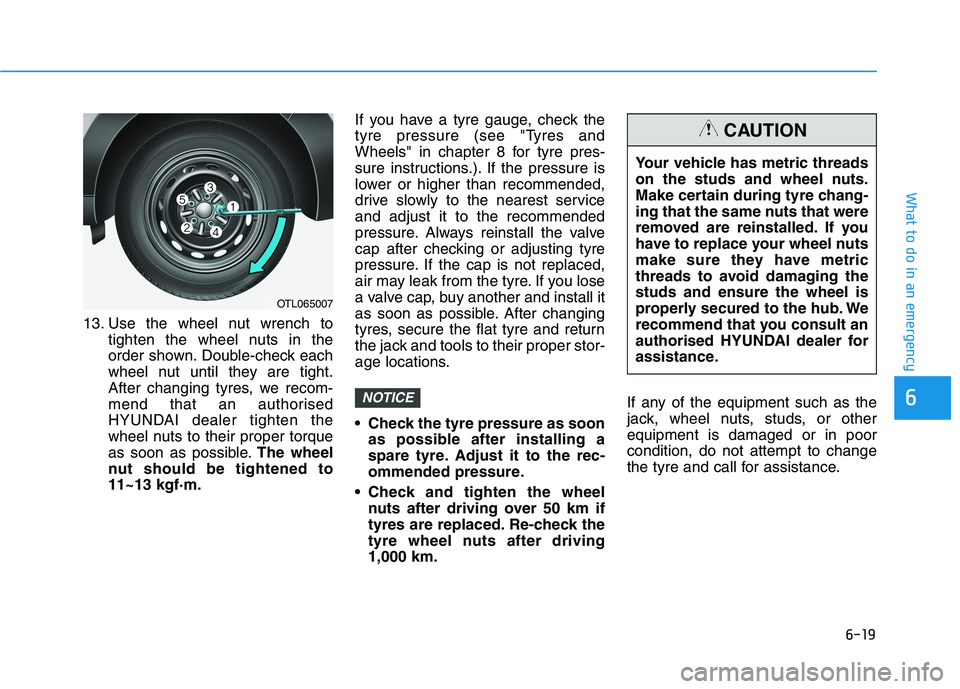
13. Use the wheel nut wrench to
tighten the wheel nuts in the
order shown. Double-check each
wheel nut until they are tight.
After changing tyres, we recom-
mend that an authorised
HYUNDAI dealer tighten the
wheel nuts to their proper torque
as soon as possible.The wheel
nut should be tightened to
11~13 kgf·m.If you have a tyre gauge, check the
tyre pressure (see "Tyres and
Wheels" in chapter 8 for tyre pres-
sure instructions.). If the pressure is
lower or higher than recommended,
drive slowly to the nearest service
and adjust it to the recommended
pressure. Always reinstall the valve
cap after checking or adjusting tyre
pressure. If the cap is not replaced,
air may leak from the tyre. If you lose
a valve cap, buy another and install it
as soon as possible. After changing
tyres, secure the flat tyre and return
the jack and tools to their proper stor-
age locations.
Check the tyre pressure as soon
as possible after installing a
spare tyre. Adjust it to the rec-
ommended pressure.
Check and tighten the wheel
nuts after driving over 50 km if
tyres are replaced. Re-check the
tyre wheel nuts after driving
1,000 km.If any of the equipment such as the
jack, wheel nuts, studs, or other
equipment is damaged or in poor
condition, do not attempt to change
the tyre and call for assistance.
NOTICE
OTL065007
Your vehicle has metric threads
on the studs and wheel nuts.
Make certain during tyre chang-
ing that the same nuts that were
removed are reinstalled. If you
have to replace your wheel nuts
make sure they have metric
threads to avoid damaging the
studs and ensure the wheel is
properly secured to the hub. We
recommend that you consult an
authorised HYUNDAI dealer for
assistance.
CAUTION
Page 427 of 533
6-21
What to do in an emergency
6
To prevent damaging the com-
pact spare tyre and your vehicle:
Drive slowly enough for the
road conditions to avoid all
hazards, such as a potholes
or debris.
Avoid driving over obstacles.
The compact spare tyre diam-
eter is smaller than the diame-
ter of a conventional tyre and
reduces the ground clearance
approximately 25 mm.
Do not use tyre chains on the
compact spare tyre. Because
of the smaller size, a tyre
chain will not fit properly.
Do not use the compact spare
tyre on any other wheels, nor
should standard tyres, snow
tyres, wheel covers or trim
rings be used with the com-
pact spare wheel.
CAUTION
Page 428 of 533
6-22
What to do in an emergency
Towing service
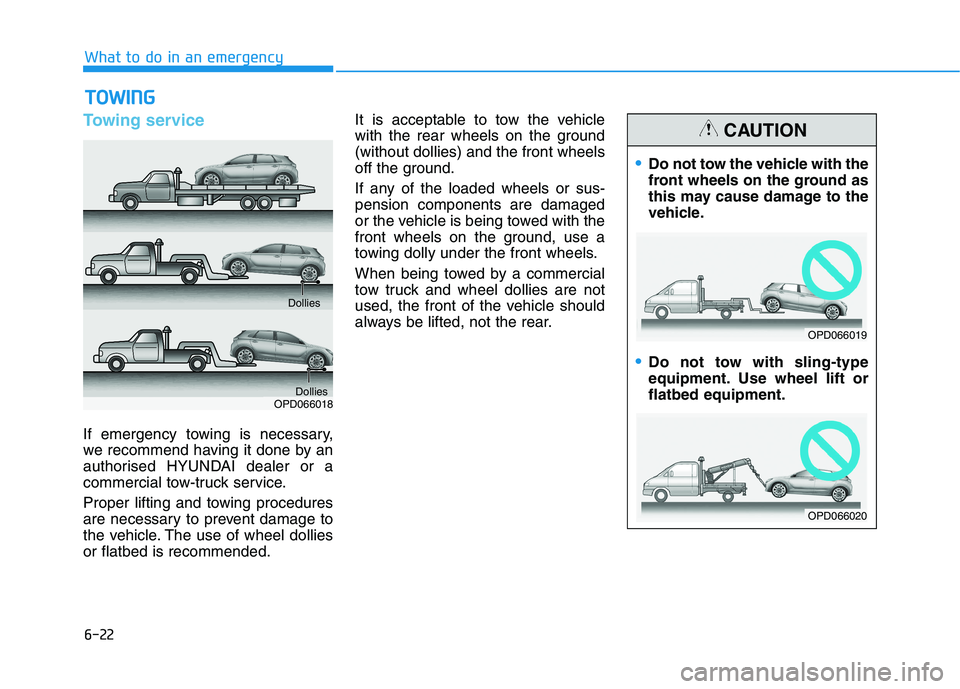
If emergency towing is necessary,
we recommend having it done by an
authorised HYUNDAI dealer or a
commercial tow-truck service.
Proper lifting and towing procedures
are necessary to prevent damage to
the vehicle. The use of wheel dollies
or flatbed is recommended.It is acceptable to tow the vehicle
with the rear wheels on the ground
(without dollies) and the front wheels
off the ground.
If any of the loaded wheels or sus-
pension components are damaged
or the vehicle is being towed with the
front wheels on the ground, use a
towing dolly under the front wheels.
When being towed by a commercial
tow truck and wheel dollies are not
used, the front of the vehicle should
always be lifted, not the rear.
T TO
OW
WI
IN
NG
G
OPD066018Dollies Dollies
Do not tow the vehicle with the
front wheels on the ground as
this may cause damage to the
vehicle.
Do not tow with sling-type
equipment. Use wheel lift or
flatbed equipment.
CAUTION
OPD066019
OPD066020
Page 430 of 533
6-24
What to do in an emergency
Emergency towing
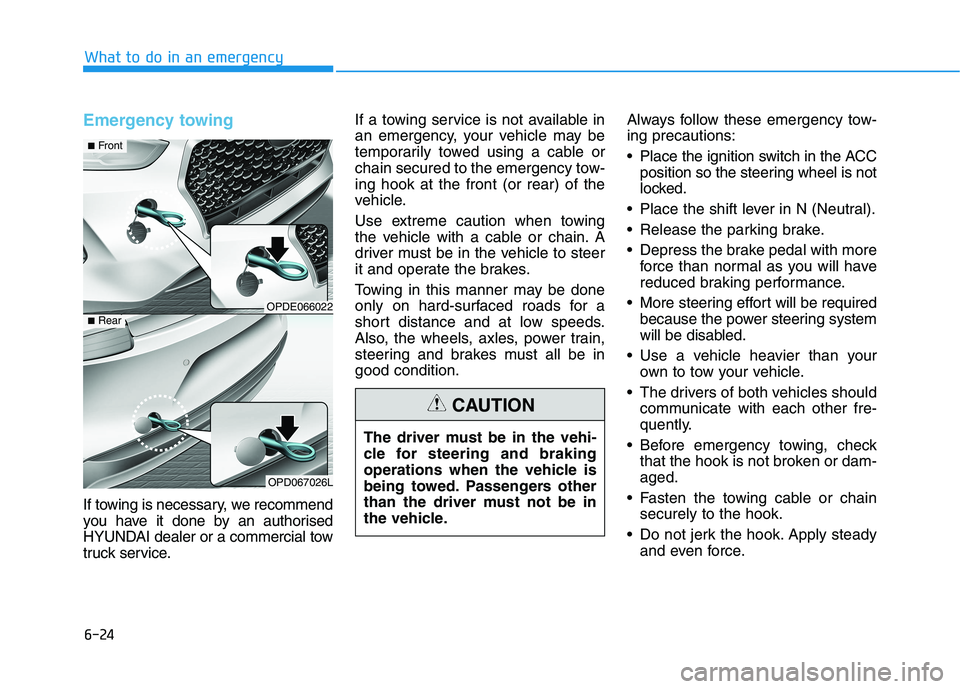
If towing is necessary, we recommend
you have it done by an authorised
HYUNDAI dealer or a commercial tow
truck service.If a towing service is not available in
an emergency, your vehicle may be
temporarily towed using a cable or
chain secured to the emergency tow-
ing hook at the front (or rear) of the
vehicle.
Use extreme caution when towing
the vehicle with a cable or chain. A
driver must be in the vehicle to steer
it and operate the brakes.
Towing in this manner may be done
only on hard-surfaced roads for a
short distance and at low speeds.
Also, the wheels, axles, power train,
steering and brakes must all be in
good condition.Always follow these emergency tow-
ing precautions:
Place the ignition switch in the ACC
position so the steering wheel is not
locked.
Place the shift lever in N (Neutral).
Release the parking brake.
Depress the brake pedal with more
force than normal as you will have
reduced braking performance.
More steering effort will be required
because the power steering system
will be disabled.
Use a vehicle heavier than your
own to tow your vehicle.
The drivers of both vehicles should
communicate with each other fre-
quently.
Before emergency towing, check
that the hook is not broken or dam-
aged.
Fasten the towing cable or chain
securely to the hook.
Do not jerk the hook. Apply steady
and even force.
OPDE066022
OPD067026L
■Front
■Rear
The driver must be in the vehi-
cle for steering and braking
operations when the vehicle is
being towed. Passengers other
than the driver must not be in
the vehicle.
CAUTION
Page 433 of 533
7
Tyres and wheels .................................................7-47
Tyre care ...........................................................................7-47
Recommended cold tyre inflation pressures ...........7-48
Check tyre inflation pressure ......................................7-49
Tyre rotation ....................................................................7-49
Wheel alignment and tyre balance.............................7-50
Tyre replacement ............................................................7-53
Wheel replacement .........................................................7-53
Tyre traction .....................................................................7-53
Tyre maintenance ...........................................................7-54
Tyre sidewall labelling ....................................................7-54
Low aspect ratio tyres...................................................7-57
Fuses ......................................................................7-59
Instrument panel fuse replacement ...........................7-60
Engine compartment panel fuse replacement.........7-61
Fuse/Relay panel description ......................................7-63
Light bulbs.............................................................7-66
Headlamp, position lamp, turn signal lamp and
daytime running light bulb replacement ...................7-67
Side repeater lamp replacement .................................7-70
Rear combination lamp bulb replacement ................7-71
Rear fog lamp ..................................................................7-74
High mounted stop lamp replacement .......................7-75
Licence plate light bulb replacement .........................7-75
Interior light bulb replacement ....................................7-75
Appearance care ..................................................7-77
Exterior care ....................................................................7-77
Interior care......................................................................7-83
Emission control system .....................................7-86
Crankcase emission control system ...........................7-86
Evaporative emission control system.........................7-86
Exhaust emission control system ...............................7-87
Page 459 of 533
7-28
Maintenance
E EN
NG
GI
IN
NE
E
O
OI
IL
L
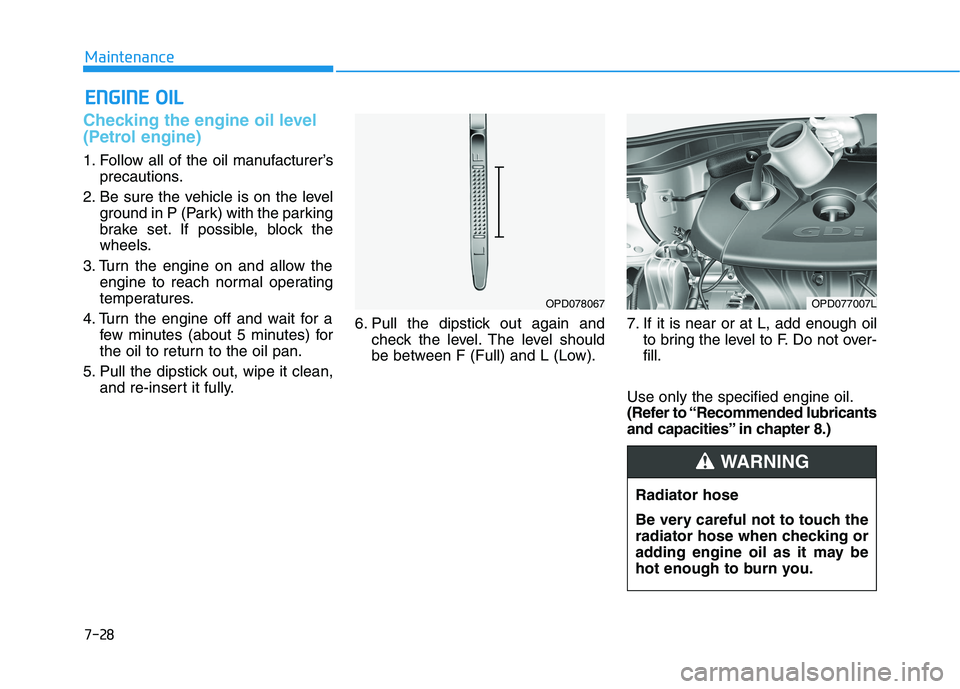
Checking the engine oil level
(Petrol engine)
1. Follow all of the oil manufacturer’s
precautions.
2. Be sure the vehicle is on the level
ground in P (Park) with the parking
brake set. If possible, block the
wheels.
3. Turn the engine on and allow the
engine to reach normal operating
temperatures.
4. Turn the engine off and wait for a
few minutes (about 5 minutes) for
the oil to return to the oil pan.
5. Pull the dipstick out, wipe it clean,
and re-insert it fully.6. Pull the dipstick out again and
check the level. The level should
be between F (Full) and L (Low).7. If it is near or at L, add enough oil
to bring the level to F. Do not over-
fill.
Use only the specified engine oil.
(Refer to “Recommended lubricants
and capacities” in chapter 8.)
OPD077007L
Radiator hose
Be very careful not to touch the
radiator hose when checking or
adding engine oil as it may be
hot enough to burn you.
WARNING
OPD078067
Page 460 of 533
7-29
7
Maintenance
To prevent damage to your engine:
Do not overfill with engine oil.
Add oil in small quantities and
recheck level to ensure engine
is not overfilled.
Do not spill engine oil when
adding or changing engine oil.
Use a funnel to help prevent oil
from being spilled on engine
components. Wipe off spilled oil
immediately.
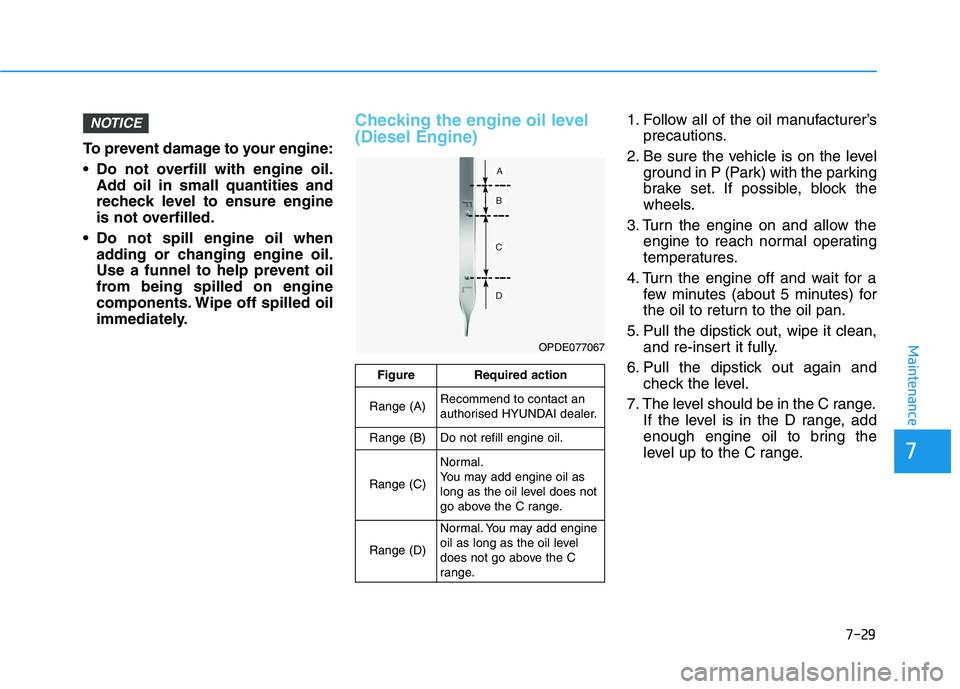
Checking the engine oil level
(Diesel Engine)1. Follow all of the oil manufacturer’s
precautions.
2. Be sure the vehicle is on the level
ground in P (Park) with the parking
brake set. If possible, block the
wheels.
3. Turn the engine on and allow the
engine to reach normal operating
temperatures.
4. Turn the engine off and wait for a
few minutes (about 5 minutes) for
the oil to return to the oil pan.
5. Pull the dipstick out, wipe it clean,
and re-insert it fully.
6. Pull the dipstick out again and
check the level.
7. The level should be in the C range.
If the level is in the D range, add
enough engine oil to bring the
level up to the C range.NOTICE
OPDE077067
FigureRequired action
Range (A)Recommend to contact an
authorised HYUNDAI dealer.
Range (B)Do not refill engine oil.
Range (C)
Normal.
You may add engine oil as
long as the oil level does not
go above the C range.
Range (D)
Normal. You may add engine
oil as long as the oil level
does not go above the C
range.