warning HYUNDAI I30 2023 Owner's Guide
[x] Cancel search | Manufacturer: HYUNDAI, Model Year: 2023, Model line: I30, Model: HYUNDAI I30 2023Pages: 533, PDF Size: 59.13 MB
Page 51 of 533
2-30
Safety system of your vehicle
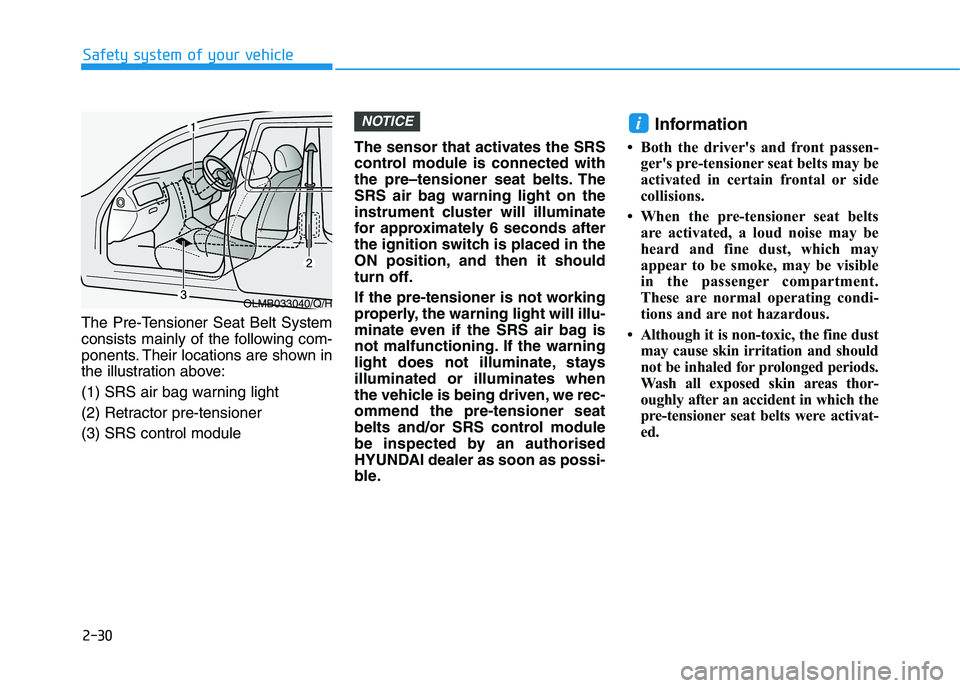
The Pre-Tensioner Seat Belt System
consists mainly of the following com-
ponents. Their locations are shown in
the illustration above:
(1) SRS air bag warning light
(2) Retractor pre-tensioner
(3) SRS control moduleThe sensor that activates the SRS
control module is connected with
the pre–tensioner seat belts. The
SRS air bag warning light on the
instrument cluster will illuminate
for approximately 6 seconds after
the ignition switch is placed in the
ON position, and then it should
turn off.
If the pre-tensioner is not working
properly, the warning light will illu-
minate even if the SRS air bag is
not malfunctioning. If the warning
light does not illuminate, stays
illuminated or illuminates when
the vehicle is being driven, we rec-
ommend the pre-tensioner seat
belts and/or SRS control module
be inspected by an authorised
HYUNDAI dealer as soon as possi-
ble.
Information
• Both the driver's and front passen-
ger's pre-tensioner seat belts may be
activated in certain frontal or side
collisions.
• When the pre-tensioner seat belts
are activated, a loud noise may be
heard and fine dust, which may
appear to be smoke, may be visible
in the passenger compartment.
These are normal operating condi-
tions and are not hazardous.
• Although it is non-toxic, the fine dust
may cause skin irritation and should
not be inhaled for prolonged periods.
Wash all exposed skin areas thor-
oughly after an accident in which the
pre-tensioner seat belts were activat-
ed.
iNOTICE
OLMB033040/Q/H
Page 52 of 533
2-31
Safety system of your vehicle
2
Additional seat belt safety pre-
cautions
Seat belt use during pregnancy
Seat belts should always be used
during pregnancy. The best way to
protect your unborn child is to protect
yourself by always wearing a seat
belt.
Pregnant women should always wear
a lap-shoulder seat belt. Place the
shoulder belt across your chest and
away from your neck. Place the lap
belt below your belly so that it fits
SNUGLY across your hips and pelvic
bone, under the rounded part of the
belly.
Seat belt use and children
Infant and small children
Most countries have Child Restraint
System laws which require children to
travel in approved Child Restraint
System devices, including booster
seats. The age at which seat belts can
be used instead of Child Restraint
System differs between countries, so
you should be aware of the specific
requirements in your country, and
where you are travelling. Infant and
Child Restraint System must be prop-
erly placed and installed in a rear seat.
For more information refer to the “Child
Restraint Systems” in this chapter. To reduce the risk of serious
injury or death to an unborn
child during an accident, preg-
nant women should NEVER
place the lap portion of the seat
belt above or over the area of
the abdomen where the unborn
child is located.
WARNING
Page 53 of 533
2-32
Safety system of your vehicle
Small children are best protected
from injury in an accident when prop-
erly restrained in the rear seat by a
Child Restraint System that meets the
requirements of the Australian/New
Zealand standards. Before buying
any Child Restraint System, make
sure that it has a label certifying that
it meets the requirements of the
Australian/New Zealand standards.
The Child Restraint System must be
appropriate for your child's height
and weight. Check the label on the
Child Restraint System for this infor-
mation. Refer to “Child Restraint
Systems” in this chapter.
Larger children
Children under age 13 and who are
too large for a booster seat should
always occupy the rear seat and use
the available lap/shoulder belts. A
seat belt should lie across the upper
thighs and be snug across the shoul-
der and chest to restrain the child
safely. Check belt fit periodically. A
child's squirming could put the belt
out of position. In the event of an acci-
dent, children are afforded the best
restrained by a proper Child Restraint
System in the rear seats.
If a larger child over age 13 must be
seated in the front seat, the child
must be securely restrained by the
available lap/shoulder belt and the
seat should be placed in the rear-
most position.
If the shoulder belt portion slightly
touches the child’s neck or face, try
placing the child closer to the centre
of the vehicle. If the shoulder belt still
touches their face or neck, they need
to be returned to an appropriate
booster seat in the rear seat. ALWAYS properly restrain
infants and small children in a
Child Restraint System appropri-
ate for the child’s height and
weight.
To reduce the risk of serious
injury or death to a child and
other passengers, NEVER hold a
child in your lap or arms when
the vehicle is moving. The violent
forces created during an acci-
dent will tear the child from your
arms and throw the child against
the interior of the vehicle.WARNING
Page 54 of 533
2-33
Safety system of your vehicle
2
Seat belt use and injured people
A seat belt should be used when an
injured person is being transported.
Consult a doctor for specific recom-
mendations.
One person per belt
Two people (including children) should
never attempt to use a single seat belt.
This could increase the severity of
injuries in case of an accident.
Do not lie down
Sitting in a reclined position when
the vehicle is in motion can be dan-
gerous. Even when buckled up, the
protections of your restraint system
(seat belts and/or air bags) is greatly
reduced by reclining your seatback.
Seat belts must be snug against your
hips and chest to work properly.
During an accident, you could be
thrown into the seat belt, causing
neck or other injuries.The more the seat back is reclined,
the greater the chance for the pas-
senger's hips to slide under the lap
belt or the passenger's neck to strike
the shoulder belt.
NEVER ride with a reclined
seatback when the vehicle is
moving.
Riding with a reclined seat-
back increases your chance
of serious or fatal injuries in
the event of a collision or sud-
den stop.
The driver and passengers
should always sit well back in
their seats, properly
restrained, and with the seat-
backs upright.
WARNING
Always make sure larger chil-
dren’s seat belts are worn and
properly adjusted.
NEVER allow the shoulder
belt to contact the child’s
neck or face.
Do not allow more than one
child to use a single seat belt.
WARNING
Page 56 of 533
2-35
Safety system of your vehicle
Our recommendation:
Children always in the rear
seat
Children under age 13 should always
ride in the rear seats and must
always be properly restrained to min-
imise the risk of injury in an accident,
sudden stop or sudden manoeuvre.
According to accident statistics, chil-
dren are safer when properly
restrained in the rear seats than in
the front seat. Children too large for a
Child Restraint System must use the
seat belts provided.Most countries have regulations
which require children to travel in
approved Child Restraint Systems.
The laws governing the age or
height/weight restrictions at which
seat belts can be used instead of
Child Restraint System differs
between countries, so you should be
aware of the specific requirements in
your country, and where you are trav-
elling.
Child Restraint Systems must be
properly installed in the vehicle seat.
Always use a commercially available
Child Restraint System that meets the
requirements of the Australian/New
Zealand standards.
Child Restraint System (CRS)
Infants and younger children must be
restrained in an appropriate rear-
ward-facing or forward-facing CRS
that has first been properly secured
to the seat of the vehicle. Read and
comply with the instructions for
installation and use provided by the
manufacturer of the Child Restraint
System.
C CH
HI
IL
LD
D
R
RE
ES
ST
TR
RA
AI
IN
NT
T
S
SY
YS
ST
TE
EM
M
(
(C
CR
RS
S)
)
2
Always properly restrain chil-
dren in the vehicle. Children of
all ages are safer when riding in
the rear seats. Never place a
rearward-facing Child Restraint
System on the front passenger
seat.
WARNING
Page 57 of 533
2-36
Safety system of your vehicle
Selecting a Child Restraint
System (CRS)
When selecting a Child Restraint
System for your child, always:
Make sure the CRS has a label
certifying that it meets the require-
ments of the Australian/New
Zealand standards.
Select a Child Restraint System
based on your child’s height and
weight. The required label or the
instructions for use typically pro-
vide this information.
Select a Child Restraint System
that fits the vehicle seating position
where it will be used.
Read and comply with the warn-
ings and instructions for installation
and use provided with the Child
Restraint System.
Child Restraint System types
There are three main types of Child
Restraint Systems: rearward-facing,
forward-facing and booster Child
Restraint Systems.
They are classified according to the
child’s age, height and weight.
Always follow the Child
Restraint System manufactur-
er’s instructions for installation
and use.
Always properly restrain your
child in the Child Restraint
System.
Do not use an infant carrier or
a child safety seat that
“hooks” over a seatback, it
may not provide adequate
protection in an accident.
After an accident, we recom-
mend a HYUNDAI dealer to
check the Child Restraint
System, seat belts, ISOFIX
anchorages and top-tether
anchorages.
WARNING
Page 58 of 533
2-37
Safety system of your vehicle
2
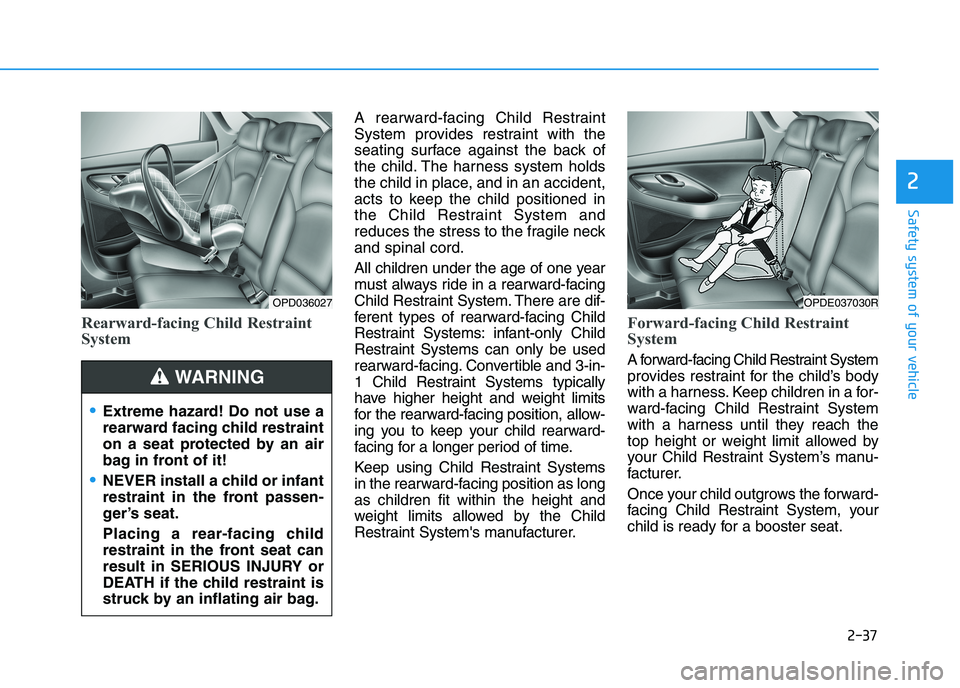
Rearward-facing Child Restraint
System
A rearward-facing Child Restraint
System provides restraint with the
seating surface against the back of
the child. The harness system holds
the child in place, and in an accident,
acts to keep the child positioned in
the Child Restraint System and
reduces the stress to the fragile neck
and spinal cord.
All children under the age of one year
must always ride in a rearward-facing
Child Restraint System. There are dif-
ferent types of rearward-facing Child
Restraint Systems: infant-only Child
Restraint Systems can only be used
rearward-facing. Convertible and 3-in-
1 Child Restraint Systems typically
have higher height and weight limits
for the rearward-facing position, allow-
ing you to keep your child rearward-
facing for a longer period of time.
Keep using Child Restraint Systems
in the rearward-facing position as long
as children fit within the height and
weight limits allowed by the Child
Restraint System's manufacturer.
Forward-facing Child Restraint
System
A forward-facing Child Restraint System
provides restraint for the child’s body
with a harness. Keep children in a for-
ward-facing Child Restraint System
with a harness until they reach the
top height or weight limit allowed by
your Child Restraint System’s manu-
facturer.
Once your child outgrows the forward-
facing Child Restraint System, your
child is ready for a booster seat.
OPD036027
Extreme hazard! Do not use a
rearward facing child restraint
on a seat protected by an air
bag in front of it!
NEVER install a child or infant
restraint in the front passen-
ger’s seat.
Placing a rear-facing child
restraint in the front seat can
result in SERIOUS INJURY or
DEATH if the child restraint is
struck by an inflating air bag.
WARNING
OPDE037030R
Page 59 of 533
2-38
Safety system of your vehicle
Booster seats
A booster seat is a Child Restraint
System designed to improve the fit of
the vehicle’s seat belt system. A boost-
er seat positions the seat belt so that it
fits properly over the stronger parts of
your child’s body. Keep your children in
booster seats until they are big
enough to fit in a seat belt properly.
For a seat belt to fit properly, the lap
belt must lie comfortably across the
upper thighs, not the stomach. The
shoulder belt should lie comfortably
across the shoulder and chest and
not across the neck or face. Children
under age 13 must always be proper-
ly restrained to minimise the risk of
injury in an accident, sudden stop or
sudden manoeuvre.
Installing a Child Restraint
System (CRS) (if equipped)After selecting a proper Child Restraint
System for your child and checking
that the Child Restraint System fits
properly on the seating position, there
are three general steps for a proper
installation:
1.Properly secure the Child
Restraint System to the vehicle.
All child restraint systems must be
installed or secured in accordance
with their manufacturer instruc-
tions.
2.Make sure the Child Restraint
System is firmly secured.After
installing a Child Restraint System
to the vehicle, push and pull the
seat forward and from side-to-side
to verify that it is securely attached
to the seat. A Child Restraint
System secured with a seat belt
should be installed as firmly as
possible. However, some side-to-
side movement can be expected. Before installing your Child
Restraint System always:
Read and follow the instructions
provided by the manufacturer of
the Child Restraint System.
Failure to follow all warnings
and instructions could increase
the risk of SERIOUS INJURY or
DEATH if an accident occurs.
WARNING
If the vehicle headrest prevents
proper installation of a Child
Restraint System, the headrest
of the respective seating posi-
tion should be readjusted or
entirely removed.
WARNING
Page 61 of 533
2-40
Safety system of your vehicle
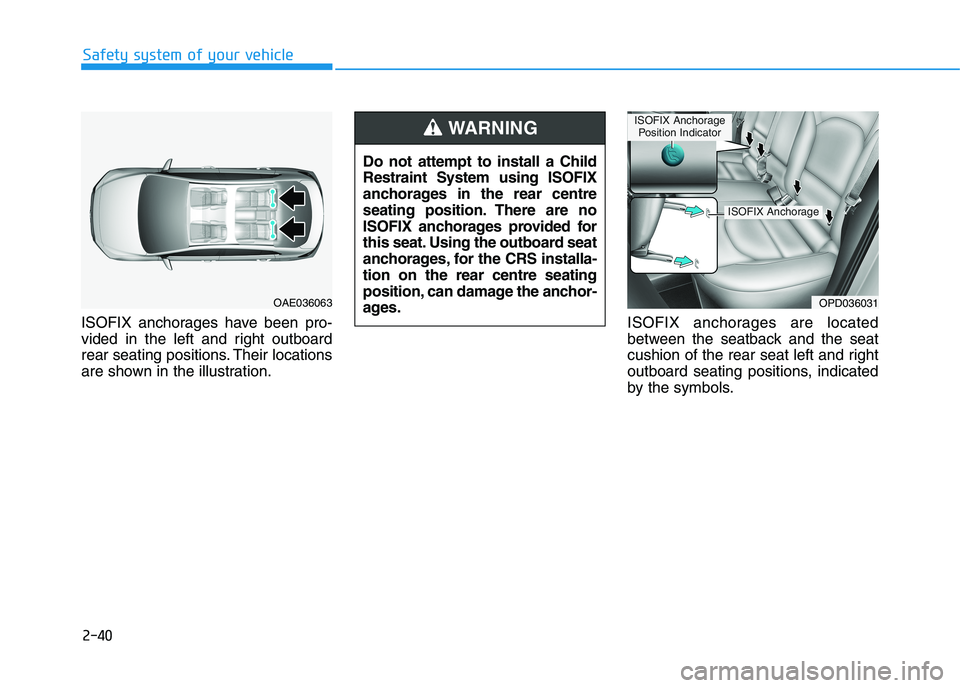
ISOFIX anchorages have been pro-
vided in the left and right outboard
rear seating positions. Their locations
are shown in the illustration.ISOFIX anchorages are located
between the seatback and the seat
cushion of the rear seat left and right
outboard seating positions, indicated
by the symbols. Do not attempt to install a Child
Restraint System using ISOFIX
anchorages in the rear centre
seating position. There are no
ISOFIX anchorages provided for
this seat. Using the outboard seat
anchorages, for the CRS installa-
tion on the rear centre seating
position, can damage the anchor-
ages.
WARNING
OPD036031
ISOFIX Anchorage
Position Indicator
ISOFIX Anchorage
OAE036063
Page 62 of 533
2-41
Safety system of your vehicle
2
Securing a Child Restraint
System with the “ISOFIX
Anchorage System” (if equipped)
To install an ISOFIX-compatible Child
Restraint System in either of the rear
outboard seating positions:
1. Move the seat belt buckle away
from the ISOFIX anchorages.
2. Move any other objects away from
the anchorages that could prevent
a secure connection between the
Child Restraint System and the
ISOFIX anchorages.
3. Place the Child Restraint System
on the vehicle seat, then attach the
seat to the ISOFIX anchorages
according to the instructions provid-
ed by the Child Restraint System
manufacturer.
4. Follow the instructions of the Child
Restraint System's manufacturer
for proper installation and connec-
tion of the ISOFIX attachments on
the Child Restraint System to the
ISOFIX anchorages.
Securing a Child Restraint
System seat with “Top-tether
Anchorage” system
(if equipped)
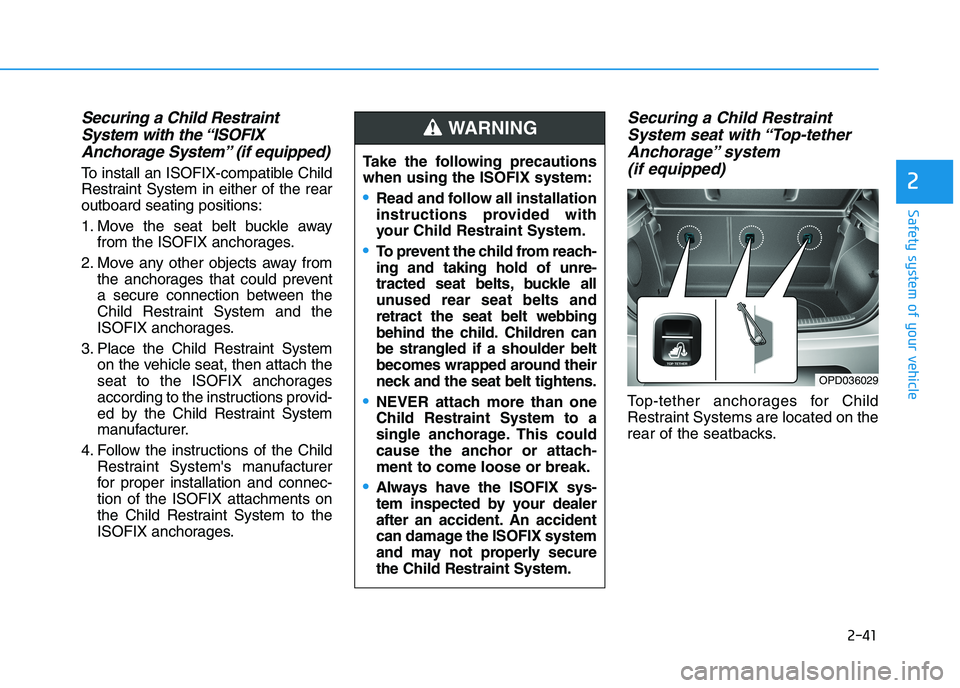
Top-tether anchorages for Child
Restraint Systems are located on the
rear of the seatbacks. Take the following precautions
when using the ISOFIX system:
Read and follow all installation
instructions provided with
your Child Restraint System.
To prevent the child from reach-
ing and taking hold of unre-
tracted seat belts, buckle all
unused rear seat belts and
retract the seat belt webbing
behind the child. Children can
be strangled if a shoulder belt
becomes wrapped around their
neck and the seat belt tightens.
NEVER attach more than one
Child Restraint System to a
single anchorage. This could
cause the anchor or attach-
ment to come loose or break.
Always have the ISOFIX sys-
tem inspected by your dealer
after an accident. An accident
can damage the ISOFIX system
and may not properly secure
the Child Restraint System.
WARNING
OPD036029