fuel HYUNDAI I30 2023 Service Manual
[x] Cancel search | Manufacturer: HYUNDAI, Model Year: 2023, Model line: I30, Model: HYUNDAI I30 2023Pages: 533, PDF Size: 59.13 MB
Page 438 of 533
7-7
7
Maintenance
Owner maintenance schedule
When you stop for fuel:
Check the engine oil level.
Check the coolant level in the
engine coolant reservoir.
Check the windscreen washer fluid
level.
Check for low or under-inflated
tyres.
Whilst operating your vehicle:
Note any changes in the sound of
the exhaust or any smell of exhaust
fumes in the vehicle.
Check for vibrations in the steering
wheel. Notice if there is any
increased steering effort or loose-
ness in the steering wheel, or
change in its straight-ahead position.
Notice if your vehicle constantly turns
slightly or “pulls” to one side when
travelling on smooth, level road.
When stopping, listen and check for
unusual sounds, pulling to one side,
increased brake pedal travel or
“hard-to-push” brake pedal.
If any slipping or changes in the
operation of your transmissiom
occurs, check the transmissiom fluid
level.
Check the automatic transmission/
dual clutch transmission P (Park)
function.
Check the parking brake.
Check for fluid leaks under your
vehicle (water dripping from the air
conditioning system during or after
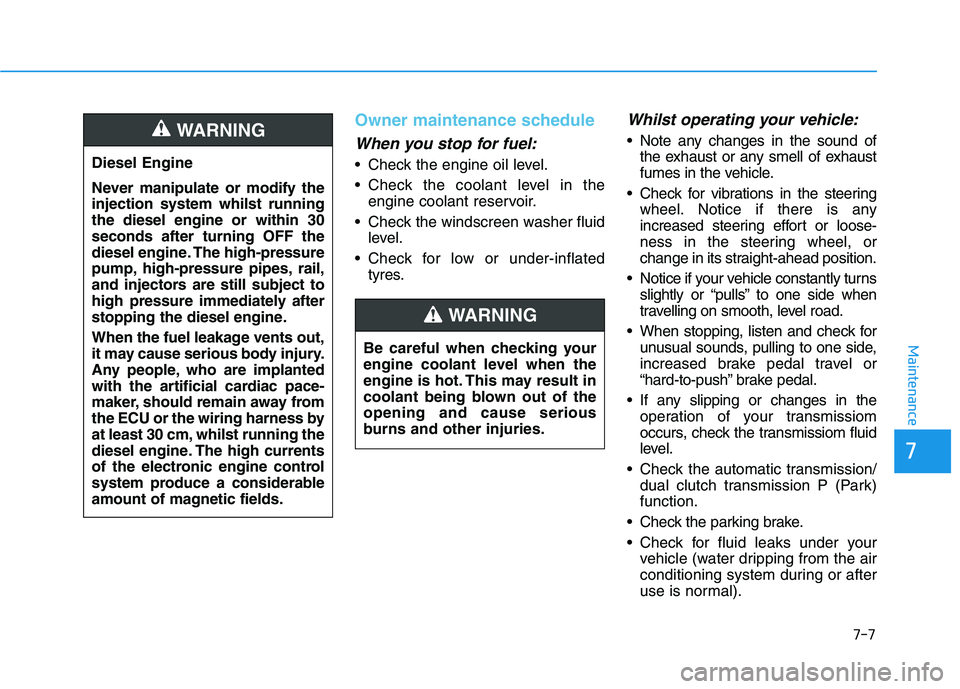
use is normal). Be careful when checking your
engine coolant level when the
engine is hot. This may result in
coolant being blown out of the
opening and cause serious
burns and other injuries.
WARNING
Diesel Engine
Never manipulate or modify the
injection system whilst running
the diesel engine or within 30
seconds after turning OFF the
diesel engine. The high-pressure
pump, high-pressure pipes, rail,
and injectors are still subject to
high pressure immediately after
stopping the diesel engine.
When the fuel leakage vents out,
it may cause serious body injury.
Any people, who are implanted
with the artificial cardiac pace-
maker, should remain away from
the ECU or the wiring harness by
at least 30 cm, whilst running the
diesel engine. The high currents
of the electronic engine control
system produce a considerable
amount of magnetic fields.
WARNING
Page 441 of 533
![HYUNDAI I30 2023 Service Manual Maintenance
7-10
Normal Maintenance Schedule (Petrol Engine [1.6 T-GDI])
Months1224364860728496
Km x 1,0001020304050607080
Drive belts *1IIII
Engine oil and engine oil filter *2 *3RRRRRRRR
Intercoole](/img/35/56144/w960_56144-440.png "HYUNDAI I30 2023 Service Manual Maintenance
7-10
Normal Maintenance Schedule (Petrol Engine [1.6 T-GDI])
Months1224364860728496
Km x 1,0001020304050607080
Drive belts *1IIII
Engine oil and engine oil filter *2 *3RRRRRRRR
Intercoole")
Maintenance
7-10
Normal Maintenance Schedule (Petrol Engine [1.6 T-GDI])
Months1224364860728496
Km x 1,0001020304050607080
Drive belts *1IIII
Engine oil and engine oil filter *2 *3RRRRRRRR
Intercooler, in/out hose, air intake hoseIIIIIIII
Fuel additives *4Add every 10,000 km or 12 months
Air cleaner filterIIIRIIIR
Spark plugs *5Replace every 70,000 km or 84 months
Vapour hose and fuel filler capI
Fuel tank air filterI
I : Inspect and if necessary, adjust, correct, clean or replace.
R : Replace or change.
*
1: Inspect drive belt tensioner, idler and alternator pulley and if necessary correct or replace.
*2: Check the engine oil level for leaks every 500 km or before starting a long trip.
*3: The engine oil level should be checked regularly and maintained properly. Operating with an insufficient amount of oil can dam-
age the engine, and such damage is not covered by warranty.
*
4: If good quality petrols meet Europe Fuel standards (EN228) or equivalents including fuel additives is not available, one bottle
of additive is recommended. Additives are available from your authorised HYUNDAI dealer along with information on how to
use them. Do not mix other additives.
*
5: For your convenience, it can be replaced prior to it's interval when you do maintenance of other items.
MAINTENANCE
INTERVALS
MAINTENANCE
ITEM
Page 442 of 533
![HYUNDAI I30 2023 Service Manual 7-11
7
Maintenance
Normal Maintenance Schedule (Petrol Engine [1.6 T-GDI]) (Cont.)
Months1224364860728496
Km x 1,0001020304050607080
Fuel filter *6R
Fuel line, hoses and connectionsI
Cooling system
In](/img/35/56144/w960_56144-441.png "HYUNDAI I30 2023 Service Manual 7-11
7
Maintenance
Normal Maintenance Schedule (Petrol Engine [1.6 T-GDI]) (Cont.)
Months1224364860728496
Km x 1,0001020304050607080
Fuel filter *6R
Fuel line, hoses and connectionsI
Cooling system
In")
7-11
7
Maintenance
Normal Maintenance Schedule (Petrol Engine [1.6 T-GDI]) (Cont.)
Months1224364860728496
Km x 1,0001020304050607080
Fuel filter *6R
Fuel line, hoses and connectionsI
Cooling system
Inspect coolant level for leaks every day
At first, inspect 40,000 km or 48 months :
after that, inspect every 20,000 km or 24 months
Engine coolant *7At first, replace at 210,000 km or 120 months :
after that, replace every 30,000 km or 24 months *5
Battery conditionIIIIIIII
Brake lines, hoses and connectionsIIIIIIII
Parking brake (if equipped)IIIIIIII
Brake/clutch fluidIIIIIIII
MAINTENANCE
INTERVALS
MAINTENANCE
ITEM
I : Inspect and if necessary, adjust, correct, clean or replace.
R : Replace or change.
*
5: For your convenience, it can be replaced prior to it's interval when you do maintenance of other items.
*6: The fuel filter is considered to be maintenance free but periodic inspection is recommended for this maintenance schedule
depending on fuel quality. If there are some important matters like fuel flow restriction, surging, loss of power, or hard starting
problems etc, we recommend replacing the fuel filter immediately regardless of maintenance schedule and consulting with an
authorised HYUNDAI dealer for details.
*
7: When adding coolant, use only deionised water or soft water for your vehicle and never mix hard water in the coolant filled at
the factory. An improper coolant mixture can result in serious malfunction or engine damage. For your convenience, it can be
replaced prior to it's interval when you do maintenance of other items.
Page 446 of 533
![HYUNDAI I30 2023 Service Manual 7-15
7
Maintenance
Normal Maintenance Schedule (Petrol Engine [2.0 GDI])
Months1224364860728496
Km x 1,000153045607590105120
Drive belts *1IIII
Engine oil and engine oil filter *2 *3RRRRRRRR
Fuel add](/img/35/56144/w960_56144-445.png "HYUNDAI I30 2023 Service Manual 7-15
7
Maintenance
Normal Maintenance Schedule (Petrol Engine [2.0 GDI])
Months1224364860728496
Km x 1,000153045607590105120
Drive belts *1IIII
Engine oil and engine oil filter *2 *3RRRRRRRR
Fuel add")
7-15
7
Maintenance
Normal Maintenance Schedule (Petrol Engine [2.0 GDI])
Months1224364860728496
Km x 1,000153045607590105120
Drive belts *1IIII
Engine oil and engine oil filter *2 *3RRRRRRRR
Fuel additives *4Add every 15,000 km or 12 months
Air cleaner filterIIRIIRII
Spark plugs *5Replace every 150,000 km or 120 months
Vapour hose and fuel filler capII
Fuel tank air filterII
I : Inspect and if necessary, adjust, correct, clean or replace.
R : Replace or change.
*
1: Inspect drive belt tensioner, idler and alternator pulley and if necessary correct or replace.
*2: Check the engine oil level for leaks every 500 km or before starting a long trip.
*3: The engine oil level should be checked regularly and maintained properly. Operating with an insufficient amount of oil can dam-
age the engine, and such damage is not covered by warranty.
*
4: If good quality petrols meet Europe Fuel standards (EN228) or equivalents including fuel additives is not available, one bottle
of additive is recommended. Additives are available from your authorised HYUNDAI dealer along with information on how to
use them. Do not mix other additives.
*
5: For your convenience, it can be replaced prior to it's interval when you do maintenance of other items.
MAINTENANCE
INTERVALS
MAINTENANCE
ITEM
Page 447 of 533
Maintenance
7-16
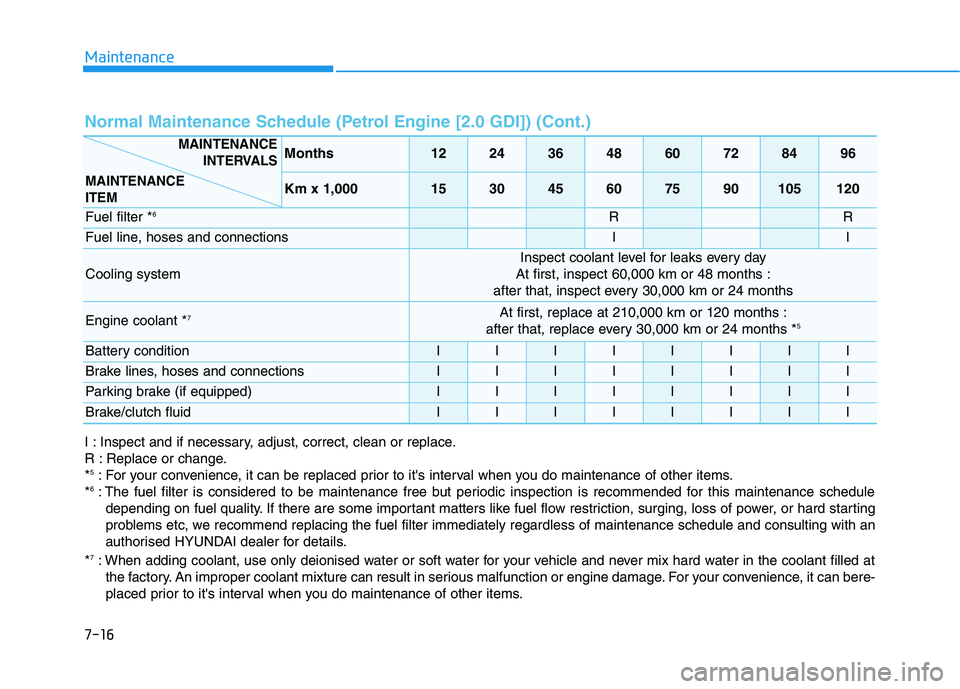
Months1224364860728496
Km x 1,000153045607590105120
Fuel filter *6RR
Fuel line, hoses and connectionsII
Cooling system
Inspect coolant level for leaks every day
At first, inspect 60,000 km or 48 months :
after that, inspect every 30,000 km or 24 months
Engine coolant *7At first, replace at 210,000 km or 120 months :
after that, replace every 30,000 km or 24 months *5
Battery conditionIIIIIIII
Brake lines, hoses and connectionsIIIIIIII
Parking brake (if equipped)IIIIIIII
Brake/clutch fluidIIIIIIII
Normal Maintenance Schedule (Petrol Engine [2.0 GDI]) (Cont.)
MAINTENANCE
INTERVALS
MAINTENANCE
ITEM
I : Inspect and if necessary, adjust, correct, clean or replace.
R : Replace or change.
*
5: For your convenience, it can be replaced prior to it's interval when you do maintenance of other items.
*6: The fuel filter is considered to be maintenance free but periodic inspection is recommended for this maintenance schedule
depending on fuel quality. If there are some important matters like fuel flow restriction, surging, loss of power, or hard starting
problems etc, we recommend replacing the fuel filter immediately regardless of maintenance schedule and consulting with an
authorised HYUNDAI dealer for details.
*
7: When adding coolant, use only deionised water or soft water for your vehicle and never mix hard water in the coolant filled at
the factory. An improper coolant mixture can result in serious malfunction or engine damage. For your convenience, it can bere-
placed prior to it's interval when you do maintenance of other items.
Page 451 of 533
Maintenance
7-20
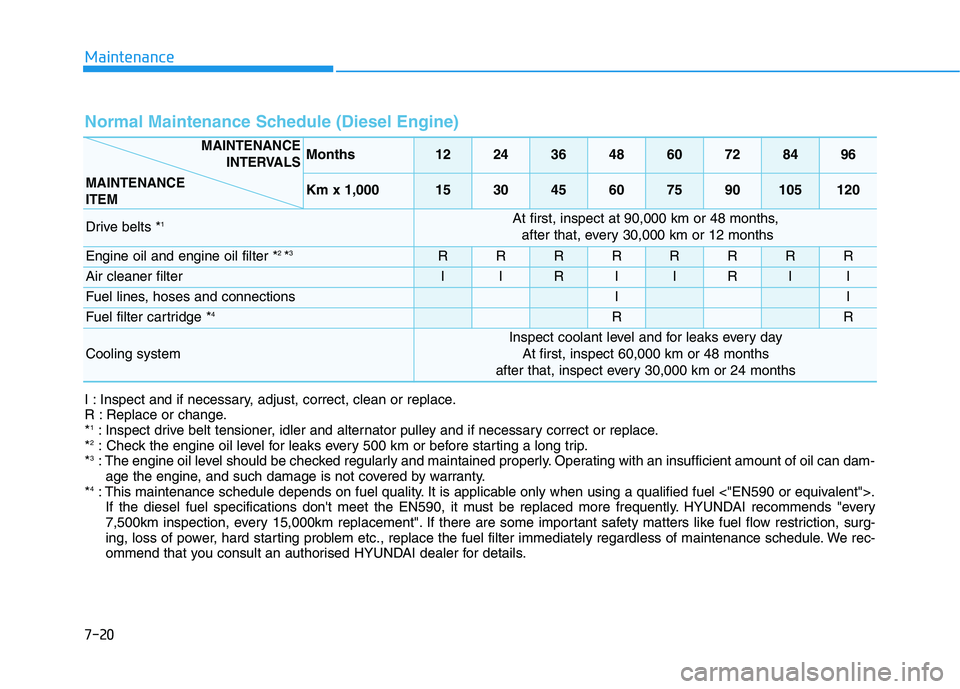
Normal Maintenance Schedule (Diesel Engine)
Months1224364860728496
Km x 1,000153045607590105120
Drive belts *1At first, inspect at 90,000 km or 48 months,
after that, every 30,000 km or 12 months
Engine oil and engine oil filter *2 *3RRRRRRRR
Air cleaner filter IIRIIRII
Fuel lines, hoses and connectionsII
Fuel filter cartridge *4RR
Cooling system
Inspect coolant level and for leaks every day
At first, inspect 60,000 km or 48 months
after that, inspect every 30,000 km or 24 months
I : Inspect and if necessary, adjust, correct, clean or replace.
R : Replace or change.
*
1: Inspect drive belt tensioner, idler and alternator pulley and if necessary correct or replace.
*2: Check the engine oil level for leaks every 500 km or before starting a long trip.
*3 : The engine oil level should be checked regularly and maintained properly. Operating with an insufficient amount of oil can dam-
age the engine, and such damage is not covered by warranty.
*
4: This maintenance schedule depends on fuel quality. It is applicable only when using a qualified fuel <"EN590 or equivalent">.
If the diesel fuel specifications don't meet the EN590, it must be replaced more frequently. HYUNDAI recommends "every
7,500km inspection, every 15,000km replacement". If there are some important safety matters like fuel flow restriction, surg-
ing, loss of power, hard starting problem etc., replace the fuel filter immediately regardless of maintenance schedule. We rec-
ommend that you consult an authorised HYUNDAI dealer for details.
MAINTENANCE
INTERVALS
MAINTENANCE
ITEM
Page 456 of 533
7-25
7
Maintenance
E EX
XP
PL
LA
AN
NA
AT
TI
IO
ON
N
O
OF
F
S
SC
CH
HE
ED
DU
UL
LE
ED
D
M
MA
AI
IN
NT
TE
EN
NA
AN
NC
CE
E
I
IT
TE
EM
MS
S
Engine oil and filter
The engine oil and filter should be
changed at the intervals specified in
the maintenance schedule. If the
vehicle is being driven in severe con-
ditions, more frequent oil and filter
changes are required.
Drive belts
Inspect all drive belts for evidence of
cuts, cracks, excessive wear or oil
saturation and replace if necessary.
Drive belts should be checked peri-
odically for proper tension and
adjusted as necessary.
Fuel filter (cartridge)
A clogged filter can limit the speed at
which the vehicle may be driven,
damage the emission system and
cause multiple issues such as hard
starting.
If an excessive amount of foreign
matter accumulates in the fuel tank,
the filter may require replacement
more frequently.
After installing a new filter, run the
engine for several minutes, and
check for leaks at the connections.
We recommend that the fuel filter be
replaced by an authorised HYUNDAI
dealer.
Fuel lines, fuel hoses and con-
nections
Check the fuel lines, fuel hoses and
connections for leakage and dam-
age. We recommend that the fuel
lines, fuel hoses and connections be
replaced by an authorised HYUNDAI
dealer.
Vapour hose and fuel filler cap
The vapour hose and fuel filler cap
should be inspected at those inter-
vals specified in the maintenance
schedule. Make sure that a new
vapour hose or fuel filler cap is cor-
rectly replaced.
Vacuum crankcase ventilation
hoses (if equipped)
Inspect the surface of hoses for evi-
dence of heat and/or mechanical
damage. Hard and brittle rubber,
cracking, tears, cuts, abrasions, and
excessive swelling indicate deterio-
ration. Particular attention should be
paid to examine those hose surfaces
nearest to high heat sources, such
as the exhaust manifold.
Inspect the hose routing to ensure
that the hoses do not come in con-
tact with any heat source, sharp
edges or moving component which
might cause heat damage or
mechanical wear. Inspect all hose
connections, such as clamps and
couplings, to make sure they are
secure, and that no leaks are pres-
ent. Hoses should be replaced
immediately if there is any evidence
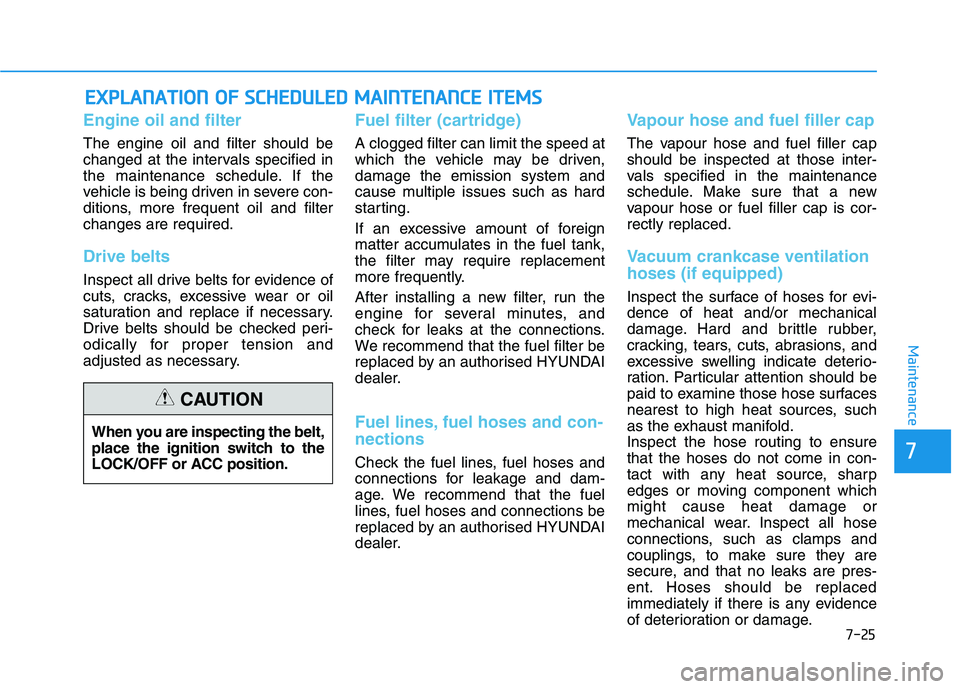
of deterioration or damage. When you are inspecting the belt,
place the ignition switch to the
LOCK/OFF or ACC position.
CAUTION
Page 467 of 533
7-36
Maintenance
A AI
IR
R
C
CL
LE
EA
AN
NE
ER
R F
FU
UE
EL
L
F
FI
IL
LT
TE
ER
R
(
(F
FO
OR
R
D
DI
IE
ES
SE
EL
L)
)
Draining water from fuel filter
The fuel filter in the diesel engine
operates the critical function of sepa-
rating water from the fuels and pre-
venting accumulating of water in the
base.
When enough water has accumulat-
ed inside the fuel filter, the warning
light ( ) illuminates with the igni-
tion switch in the ON position.
In this case, we recommend you to
have the system checked by an
authorised HYUNDAI dealer.
When the accumulated water is not
drained at the proper timing, water
may permeate in the fuel filter,
damaging the major vehicle com-
ponents, such as the fuel system.
Fuel filter cartridge replace-
ment
We recommend the fuel filter car-
tridge be replaced by an authorised
HYUNDAI dealer according to the
Maintenance Schedule at the begin-
ning of this chapter.
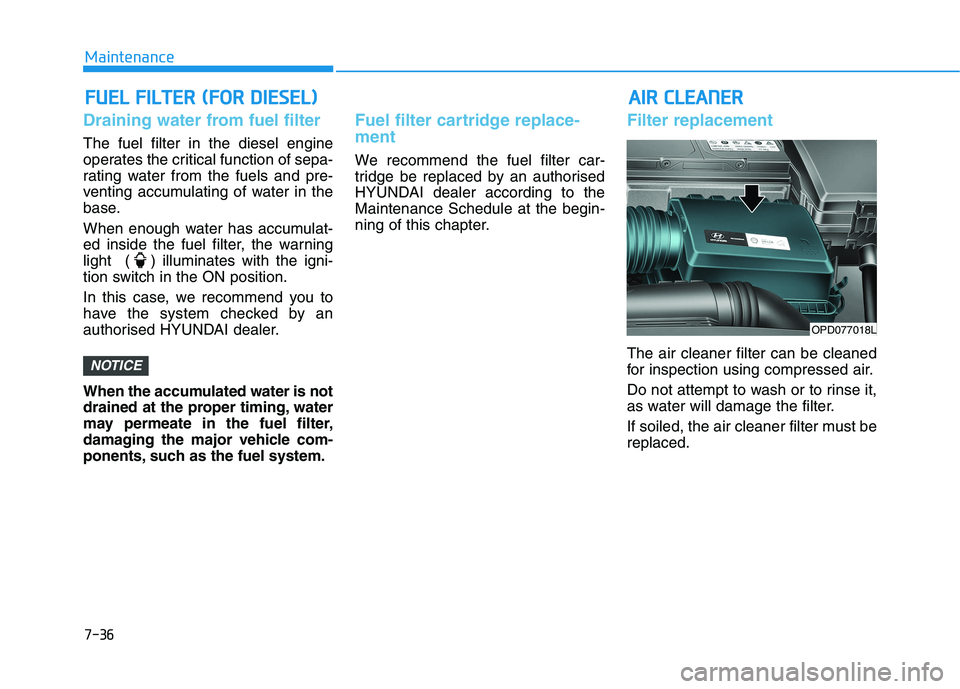
Filter replacement
The air cleaner filter can be cleaned
for inspection using compressed air.
Do not attempt to wash or to rinse it,
as water will damage the filter.
If soiled, the air cleaner filter must be
replaced.NOTICE
OPD077018L
Page 478 of 533
7-47
7
Maintenance
T TY
YR
RE
ES
S
A
AN
ND
D
W
WH
HE
EE
EL
LS
S
Tyre care
For proper maintenance, safety, and
maximum fuel economy, you must
always maintain recommended tyre
inflation pressures and stay within the
load limits and weight distribution rec-
ommended for your vehicle.
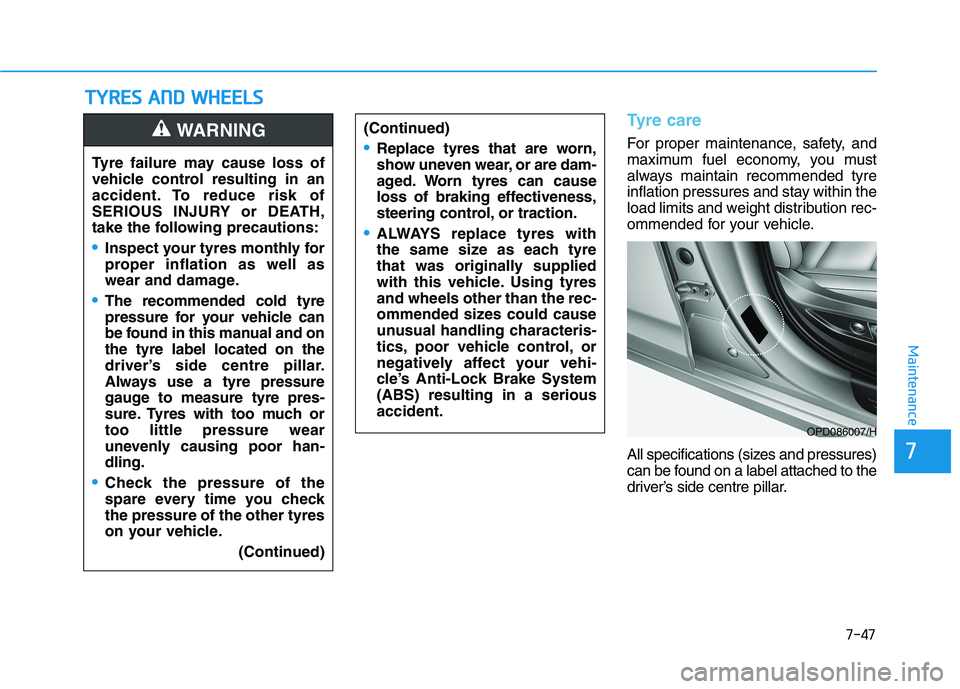
All specifications (sizes and pressures)
can be found on a label attached to the
driver’s side centre pillar. (Continued)Replace tyres that are worn,
show uneven wear, or are dam-
aged. Worn tyres can cause
loss of braking effectiveness,
steering control, or traction.
ALWAYS replace tyres with
the same size as each tyre
that was originally supplied
with this vehicle. Using tyres
and wheels other than the rec-
ommended sizes could cause
unusual handling characteris-
tics, poor vehicle control, or
negatively affect your vehi-
cle’s Anti-Lock Brake System
(ABS) resulting in a serious
accident.
Tyre failure may cause loss of
vehicle control resulting in an
accident. To reduce risk of
SERIOUS INJURY or DEATH,
take the following precautions:
Inspect your tyres monthly for
proper inflation as well as
wear and damage.
The recommended cold tyre
pressure for your vehicle can
be found in this manual and on
the tyre label located on the
driver’s side centre pillar.
Always use a tyre pressure
gauge to measure tyre pres-
sure. Tyres with too much or
too little pressure wear
unevenly causing poor han-
dling.
Check the pressure of the
spare every time you check
the pressure of the other tyres
on your vehicle.
(Continued)
WARNING
OPD086007/H
Page 479 of 533

7-48
Maintenance
Recommended cold tyre infla-
tion pressures
All tyre pressures (including the
spare) should be checked when the
tyres are cold. “Cold tyres” means
the vehicle has not been driven for at
least three hours or driven less than
1.6 km.
Warm tyres normally exceed recom-
mended cold tyre pressures by 28 to
41 kPa (4 to 6 psi). Do not release air
from warm tyres to adjust the pres-
sure or the tyres will be under-inflat-
ed. For recommended inflation pres-
sure, refer to “Tyre and Wheels” in
chapter 8.Recommended pressures must
be maintained for the best ride,
vehicle handling, and minimum
tyre wear.
Over-inflation or under-inflation
can reduce tyre life, adversely
affect vehicle handling, and
lead to sudden tyre failure that
could result in loss of vehicle
control resulting in an accident.
Severe under-inflation can lead
to severe heat build-up, causing
blowouts, tread separation and
other tyre failures that can
result in the loss of vehicle con-
trol resulting in an accident.
This risk is much higher on hot
days and when driving for long
periods at high speeds.
WARNING
Under-inflation results in
excessive wear, poor handling
and reduced fuel economy.
Wheel deformation is also
possible. Keep your tyre pres-
sures at the proper levels. If a
tyre frequently needs refilling,
we recommend it be checked
by an authorised HYUNDAI
dealer.
Over-inflation produces a
harsh ride, excessive wear at
the centre of the tyre tread,
and a greater possibility of
damage from road hazards.
CAUTION