seat HYUNDAI I30 2023 Manual Online
[x] Cancel search | Manufacturer: HYUNDAI, Model Year: 2023, Model line: I30, Model: HYUNDAI I30 2023Pages: 533, PDF Size: 59.13 MB
Page 391 of 533
5-126
Driving your vehicle
Reducing the risk of a rollover
Your multi-purpose passenger vehi-
cle is defined as a Sports Utility
Vehicle (SUV). SUV’s have higher
ground clearance and a narrower
track to make them capable of per-
forming in a wide variety of off-road
applications. The specific design
characteristics give them a higher
centre of gravity than ordinary vehi-
cles making them more likely to roll
over if you make abrupt turns. Utility
vehicles have a significantly higher
rollover rate than other types of vehi-
cles. Due to this risk, driver and pas-
sengers are strongly recommended
to buckle their seat belts. In a rollover
crash, an unrestrained person is sig-
nificantly more likely to die than a
person wearing a seat belt.
There are steps that a driver can
make to reduce the risk of a rollover.
If at all possible, avoid sharp turns or
abrupt manoeuvres, do not load your
vehicle with heavy luggage on the
roof, and never modify your vehicle in
any way.Utility vehicles have a signifi-
cantly higher rollover rate than
other types of vehicles. To pre-
vent rollovers or loss of control:
Take corners at slower speeds
than you would with a passen-
ger vehicle.
Avoid sharp turns and abrupt
manoeuvres.
Do not modify your vehicle in
any way that you would raise
the centre of gravity.
Keep tyres properly inflated.
Do not carry heavy luggage
on the roof.
WARNING
In a rollover crash, an unre-
strained person is significantly
more likely to die than a person
wearing a seat belt. Make sure
all passengers are wearing their
seat belts.
WARNING
Page 439 of 533
7-8
Maintenance
At least monthly:
Check coolant level in the engine
coolant reservoir.
Check the operation of all exterior
lights, including the stoplights, turn
signals and hazard warning flashers.
Check the inflation pressures of all
tyres including the spare for tyres
that are worn, show uneven wear,
or are damaged.
Check for loose wheel nuts.
At least twice a year:
(i.e., every Spring and Autumn)
Check radiator, heater and air condi-
tioning hoses for leaks or damage.
Check windscreen washer spray
and wiper operation. Clean wiper
blades with a clean cloth damp-
ened with washer fluid.
Check headlamp alignment.
Check muffler, exhaust pipes,
shields and clamps.
Check the seat belts for wear and
function.
At least once a year:
Clean body and door drain holes.
Lubricate door hinges and bonnet
hinges.
Lubricate door and bonnet locks
and latches.
Lubricate door rubber weather
strips.
Check the air conditioning system.
Inspect and lubricate automatic
transmission linkage and controls.
Clean the battery and terminals.
Check the brake fluid level.
Page 514 of 533
7-83
7
Maintenance
Keep paint and trim in good condition
Scratches or chips in the finish
should be covered with "touch-up"
paint as soon as possible to reduce
the possibility of corrosion. If bare
metal is showing through, the atten-
tion of a qualified body and paint
shop is recommended.
Bird droppings : Bird droppings are
highly corrosive and may damage
painted surfaces in just a few hours.
Always remove bird droppings as
soon as possible.
Don't neglect the interior
Moisture can collect under the floor
mats and carpeting to cause corro-
sion. Check under the mats periodi-
cally to be sure the carpeting is dry.
Use particular care if you carry fer-
tilisers, cleaning materials or chemi-
cals in the vehicle.
These should be carried only in
proper containers and any spills or
leaks should be cleaned up, flushed
with clean water and thoroughly
dried.
Interior care
Interior general precautions
Prevent chemicals such as perfume,
cosmetic oil, sun cream, hand clean-
er and air freshener from contacting
the interior parts because they may
cause damage or discolouration. If
they do contact the interior parts,
wipe them off immediately.
See the instructions that follow for
the proper way to clean vinyl.
Never allow water or other liquids to
come in contact with electrical/elec-
tronic components inside the vehi-
cle as this may damage them.
When cleaning leather products
(steering wheel, seats etc.), use
neutral detergents or low alcohol
content solutions. If you use high
alcohol content solutions or acid/
alkaline detergents, the colour of
the leather may fade or the sur-
face may get stripped off.
Cleaning the upholstery and
interior trim
Vinyl (if equipped)
Remove dust and loose dirt from
vinyl with a whisk broom or vacuum
cleaner. Clean vinyl surfaces with a
vinyl cleaner.
Fabric (if equipped)
Remove dust and loose dirt from fabric
with a whisk broom or vacuum cleaner.
Clean with a mild soap solution recom-
mended for upholstery or carpets.
Remove fresh spots immediately with
a fabric spot cleaner. If fresh spots do
not receive immediate attention, the
fabric can be stained and its colour can
be affected. Also, its fire-resistant prop-
erties can be reduced if the material is
not properly maintained.
Using anything but recommended
cleaners and procedures may affect
the fabric’s appearance and fire-
resistant properties.
NOTICE
NOTICE
NOTICE
Page 515 of 533
7-84
Maintenance
Leather (if equipped)
Features of seat leather
- Leather is made from the outer
skin of an animal, which goes
through a special process to be
available for use. Since it is a nat-
ural product, each part differs in
thickness or density.
Wrinkles may appear as a natural
result of stretching and shrinking
depending on the temperature
and humidity.
- The seat is made of stretchable
fabric to improve comfort.
- The parts contacting the body are
curved and the side supporting
area is high which provides driv-
ing comfort and stability.
- Wrinkles may appear naturally
from usage. It is not a fault of the
product. Caring for the leather seats
- Vacuum the seat periodically to
remove dust and sand on the seat.
It will prevent abrasion or damage
of the leather and maintain its qual-
ity.
- Wipe the natural leather seat cover
often with dry or soft cloth.
- Use of proper leather protector
may prevent abrasion of the cover
and helps maintain the colour. Be
sure to read the instructions and
consult a specialist when using
leather coating or protective agent.
- Light coloured (beige, cream
beige) leather is easily contaminat-
ed and the stain is noticeable.
Clean the seats frequently.
- Avoid wiping with wet cloth. It may
cause the surface to crack.
Wrinkles or abrasions which
appear naturally from usage
are not covered by warranty.
Belts with metallic acces-
sories, zippers or keys inside
the back pocket may damage
the seat fabric.
Make sure not to wet the seat.
It may change the nature of
natural leather.
Jeans or clothes which could
bleach may contaminate the
surface of the seat covering
fabric.
CAUTION
Page 516 of 533
7-85
7
Maintenance
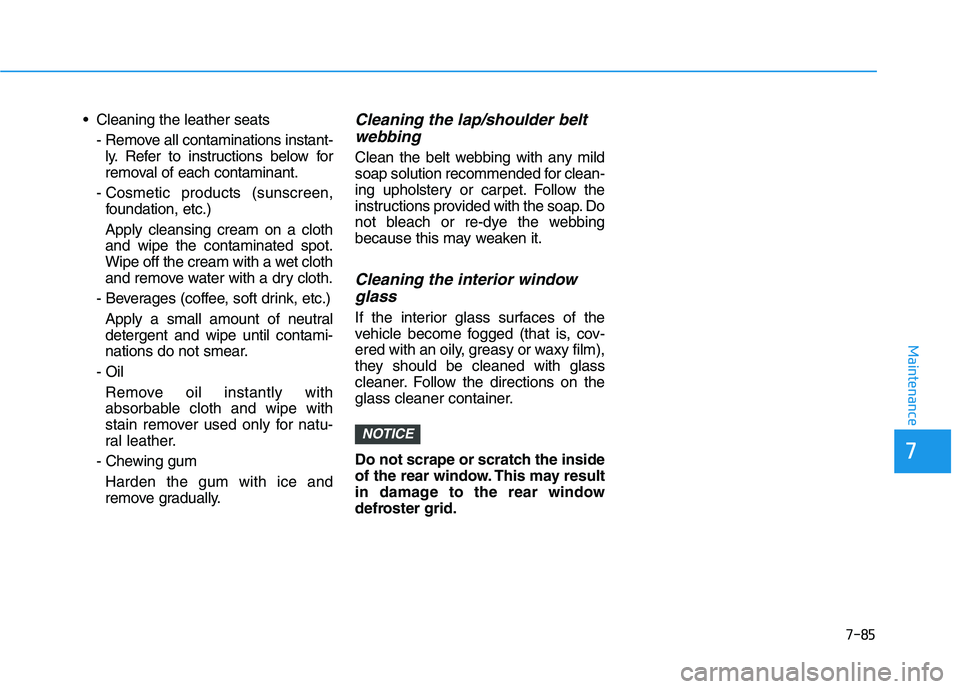
Cleaning the leather seats
- Remove all contaminations instant-
ly. Refer to instructions below for
removal of each contaminant.
- Cosmetic products (sunscreen,
foundation, etc.)
Apply cleansing cream on a cloth
and wipe the contaminated spot.
Wipe off the cream with a wet cloth
and remove water with a dry cloth.
- Beverages (coffee, soft drink, etc.)
Apply a small amount of neutral
detergent and wipe until contami-
nations do not smear.
- Oil
Remove oil instantly with
absorbable cloth and wipe with
stain remover used only for natu-
ral leather.
- Chewing gum
Harden the gum with ice and
remove gradually.Cleaning the lap/shoulder belt
webbing
Clean the belt webbing with any mild
soap solution recommended for clean-
ing upholstery or carpet. Follow the
instructions provided with the soap. Do
not bleach or re-dye the webbing
because this may weaken it.
Cleaning the interior window
glass
If the interior glass surfaces of the
vehicle become fogged (that is, cov-
ered with an oily, greasy or waxy film),
they should be cleaned with glass
cleaner. Follow the directions on the
glass cleaner container.
Do not scrape or scratch the inside
of the rear window. This may result
in damage to the rear window
defroster grid.
NOTICE
Page 527 of 533
8-6
Specifications & Consumer information
A AI
IR
R
C
CO
ON
ND
DI
IT
TI
IO
ON
NI
IN
NG
G
S
SY
YS
ST
TE
EM
M
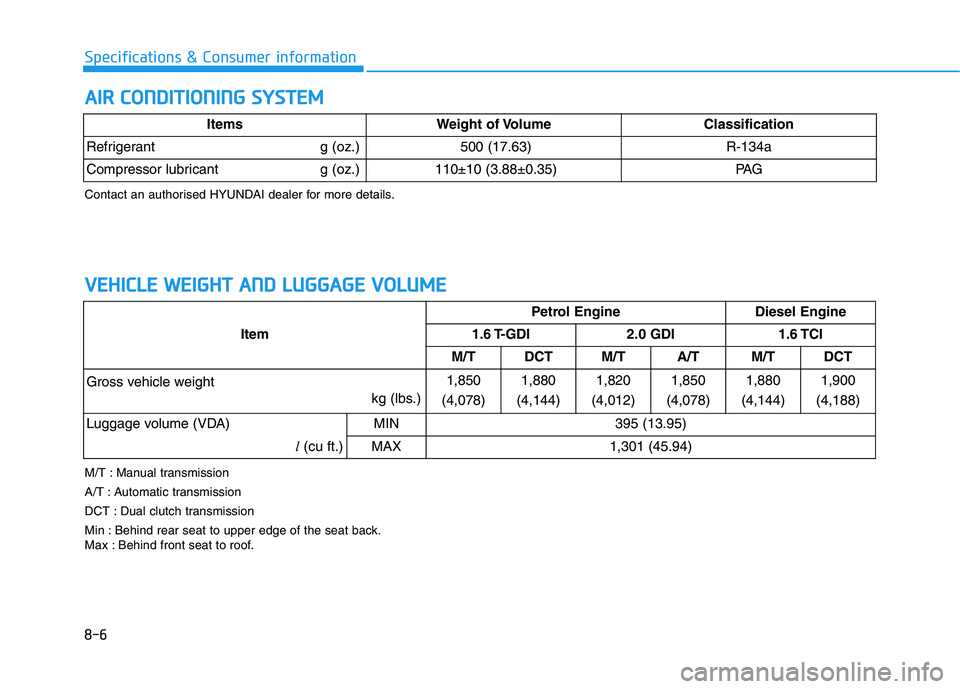
ItemPetrol Engine Diesel Engine
1.6 T-GDI 2.0 GDI 1.6 TCI
M/T DCT M/T A/T M/T DCT
Gross vehicle weight
kg (lbs.)1,850
(4,078)1,880
(4,144)1,820
(4,012)1,850
(4,078)1,880
(4,144)1,900
(4,188)
Luggage volume (VDA)
l(cu ft.)MIN 395 (13.95)
MAX 1,301 (45.94)
V VE
EH
HI
IC
CL
LE
E
W
WE
EI
IG
GH
HT
T
A
AN
ND
D
L
LU
UG
GG
GA
AG
GE
E
V
VO
OL
LU
UM
ME
E
ItemsWeight of Volume Classification
Refrigerant g (oz.)500 (17.63)R-134a
Compressor lubricant g (oz.)110±10 (3.88±0.35)PA G
Contact an authorised HYUNDAI dealer for more details.
M/T : Manual transmission
A/T : Automatic transmission
DCT : Dual clutch transmission
Min : Behind rear seat to upper edge of the seat back.
Max : Behind front seat to roof.
Page 531 of 533
8-10
Specifications & Consumer information
V VE
EH
HI
IC
CL
LE
E
C
CE
ER
RT
TI
IF
FI
IC
CA
AT
TI
IO
ON
N
L LA
AB
BE
EL
L
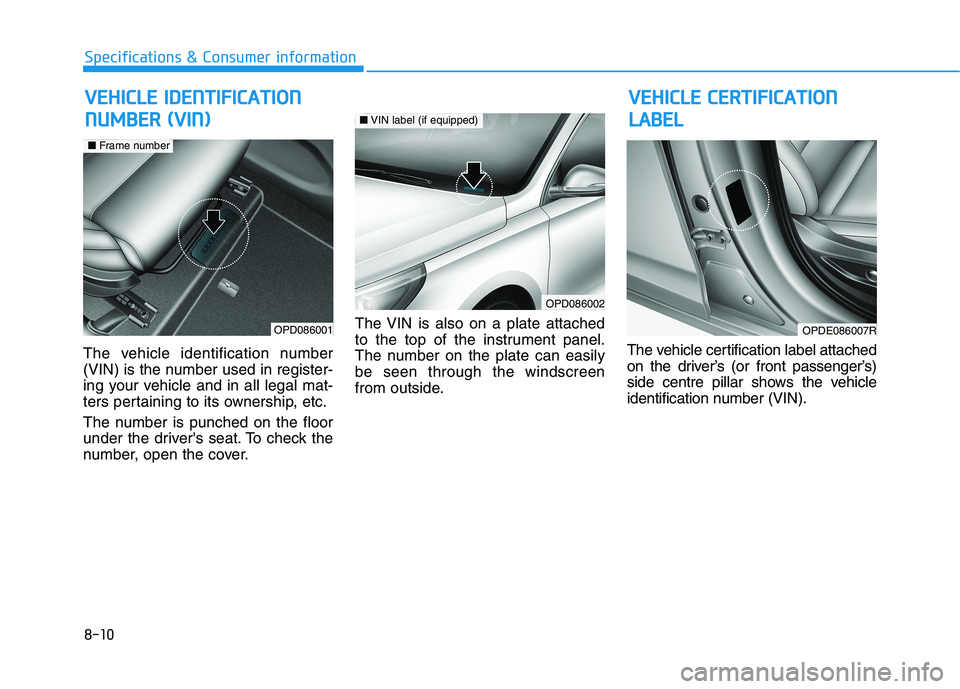
The vehicle identification number
(VIN) is the number used in register-
ing your vehicle and in all legal mat-
ters pertaining to its ownership, etc.
The number is punched on the floor
under the driver's seat. To check the
number, open the cover.The VIN is also on a plate attached
to the top of the instrument panel.
The number on the plate can easily
be seen through the windscreen
from outside.The vehicle certification label attached
on the driver’s (or front passenger’s)
side centre pillar shows the vehicle
identification number (VIN).
OPDE086007ROPD086001
■Frame number
V
VE
EH
HI
IC
CL
LE
E
I
ID
DE
EN
NT
TI
IF
FI
IC
CA
AT
TI
IO
ON
N
N NU
UM
MB
BE
ER
R
(
(V
VI
IN
N)
)
OPD086002
■VIN label (if equipped)