tire pressure HYUNDAI I40 2011 Owner's Manual
[x] Cancel search | Manufacturer: HYUNDAI, Model Year: 2011, Model line: I40, Model: HYUNDAI I40 2011Pages: 534, PDF Size: 11.05 MB
Page 399 of 534
Downloaded from www.Manualslib.com manuals search engine What to do in an emergency
24
6
Distributing the sealant
Immediately drive approximately 3 km
(2 miles) to evenly distribute the
sealant in the tire. Producing the tire inflation pres-
sure
1) After driving approximately 3 km (2
miles), stop at a suitable location.
2) Connect connection hose 9 of the compressor directly to the tire
valve.
3) Connect between compressor and the vehicle power outlet using
the cable and connectors.
4) Adjust the tire inflation pressure to the recommended tire pressure in
section 8. With the ignition
switched on, proceed as follows.
- To increase the inflation pres- sure: Switch on the compressor,
position I. To check the current
inflation pressure setting, briefly
switch off the compressor. - To reduce the inflation pres-
sure: Press the button 8 on the
compressor.
WARNING
Do not let the compressor run for
more than 10 minutes, otherwise
the device will overheat and may
be damaged.
WARNING
The tire inflation pressure must
be at least 200 kPa (29 psi). If it is
not, do not continue driving. Call
for road side service or towing.
CAUTION
Do not exceed a speed of 80 km/h (50 mph). If possible, donot fall below a speed of 20km/h (12 mph).
While driving, if you experienceany unusual vibration, ride dis-turbance or noise, reduce yourspeed and drive with cautionuntil you can safely pull off ofthe side of the road.
Call for road side service or tow-ing.
CAUTION
If the inflation pressure is notmaintained, drive the vehicle asecond time, refer toDistributing the sealant. Thenrepeat steps 1 to 4.
Use of the TireMobilityKit maybe ineffectual for tire damagelarger than approximately 4 mm(0.16 in).
Please contact the nearestHYUNDAI dealer, or a workshopthat works according toHYUNDAI repair procedureswith correspondingly trainedpersonnel if the tire cannot bemade roadworthy with theTireMobilityKit.
Page 400 of 534
Downloaded from www.Manualslib.com manuals search engine 625
What to do in an emergency
Notes on the safe use of the
TireMobilityKit
Park your car at the side of theroad so that you can work with the
TireMobilityKit away from moving
traffic. Place your warning triangle
in a prominent place to make pass-
ing vehicles aware of your location.
To be sure your vehicle won't move, even when you're on fairly
level ground, always set your park-
ing brake.
Only use the TireMobilityKit for sealing/inflation passenger car
tires. Do not use on motorcycles,
bicycles or any other type of tires.
Do not remove any foreign objects- such as nails or screws -that have
penetrated the tire.
Before using the TireMobilityKit, read the precautionary advice
printed on the sealant bottle!
Provided the car is outdoors, leave the engine running. Otherwise
operating the compressor may
eventually drain the car battery.
Never leave the TireMobilityKit unattended while it is being used.
Do not leave the compressor run- ning for more than 10 min. at a time
or it may overheat. Do not use the TireMobilityKit if the
ambient temperature is below -
30°C (-22°F).
Do not use the sealing compound after its expiration date which can
be found on the label of the bottle.
Keep away from children. Technical Data
System voltage: DC 12 V
Working voltage: DC 10 - 15 V
Amperage rating: max. 15 A
Suitable for use at temperatures:
-30 ~ +70°C (-22 ~ +158°F)
Max. working pressure: 6 bar (87 psi)
Size
Compressor: 168 x 150 x 68 mm (6.6 x 5.9 x 2.7 in.)
Sealant bottle: 104 x ø 85 mm (4.1 x ø 3.3 in.)
Compressor weight: 1.05 kg (2.31 lbs)
Sealant volume: 300 ml (18.3 cu. in.)
✽ ✽NOTICE
Sealing compound and spare parts can
be obtained and replaced at an author-
ized vehicle or tire dealer. Empty sealing
compound bottles may be disposed of at
home. Liquid residue from the sealing
compound should be disposed of by your
vehicle or tire dealer or in accordance
with local waste disposal regulations.
WARNING
Have your tire repaired as soon
as possible. The tire may loose
air pressure at any time after
inflating with the TMK.
CAUTION
The Tire Mobility Kit is a tempo-
rary fix to the tire and the tireshould be inspected by anauthorized HYUNDAI dealer assoon as possible.
CAUTION -TPMS
(if equipped
)
When using Tire Mobility Kit, thetire sealant can damage the tirepressure sensor. After using theTire Mobility Kit, have the tirepressure sensor checked by anauthorized HYUNDAI dealer.
Page 405 of 534

Downloaded from www.Manualslib.com manuals search engine EMERGENCY COMMODITY (IF EQUIPPED)
There are some emergency commodities
in the vehicle to help you respond to the
emergency situation.
Fire extinguisher
If there is small fire and you know how to
use the fire extinguisher, take the follow-
ing steps carefully.
1. Pull the pin at the top of the extin-guisher that keeps the handle from
being accidentally pressed.
2. Aim the nozzle toward the base of the fire.
3. Stand approximately 2.5 m (8 ft) away from the fire and squeeze the handle
to discharge the extinguisher. If you
release the handle, the discharge will
stop.
4. Sweep the nozzle back and forth at the base of the fire. After the fire appears
to be out, watch it carefully since it
may re-ignite.
First aid kit
There are some items such as scissors,
bandage and adhesive tape and etc. in
the kit to give first aid to an injured per-
son.
Triangle reflector
Place the triangle reflector on the road to
warn oncoming vehicles during emer-
gencies, such as when the vehicle is
parked by the roadside due to any prob-
lems.
Tire pressure gauge
(If equipped)
Tires normally lose some air in day-to-
day use, and you may have to add a few
pounds of air periodically and it is not
usually a sign of a leaking tire, but of nor-
mal wear. Always check tire pressure
when the tires are cold because tire pres-
sure increases with temperature. To check the tire pressure, take the fol-
lowing steps:
1. Unscrew the inflation valve cap that is
located on the rim of the tire.
2. Press and hold the gauge against the tire valve. Some air will escape as you
begin and more will escape if you don't
press the gauge in firmly.
3. A firm non-leaking push will activate the gauge.
4. Read the tire pressure on the gauge to know whether the tire pressure is low
or high.
5. Adjust the tire pressures to the speci- fied pressure. Refer to “Tires and
wheels” in section 8.
6. Reinstall the inflation valve cap.
630
What to do in an emergency
Page 412 of 534
Downloaded from www.Manualslib.com manuals search engine 77
Maintenance
OWNER MAINTENANCE
The following lists are vehicle checks and
inspections that should be performed by
the owner or an authorized HYUNDAI
dealer at the frequencies indicated to
help ensure safe, dependable operation
of your vehicle.
Any adverse conditions should be
brought to the attention of your dealer as
soon as possible.
These Owner Maintenance Checks are
generally not covered by warranties and
you may be charged for labor, parts and
lubricants used.Owner maintenance schedule
When you stop for fuel:
Check the engine oil level.
Check coolant level in coolant reser-voir.
Check the windshield washer fluid level.
Look for low or under-inflated tires.
While operating your vehicle:
Note any changes in the sound of the exhaust or any smell of exhaust fumes
in the vehicle.
Check for vibrations in the steering wheel. Notice any increased steering
effort or looseness in the steering
wheel, or change in its straight-ahead
position.
Notice if your vehicle constantly turns slightly or “pulls” to one side when trav-
eling on smooth, level road.
When stopping, listen and check for unusual sounds, pulling to one side,
increased brake pedal travel or “hard-
to-push” brake pedal.
If any slipping or changes in the oper- ation of your transaxle occurs, check
the transaxle fluid level.
Check manual transaxle operation, including clutch operation.
Check automatic transaxle P (Park) function.
Check parking brake.
Check for fluid leaks under your vehicle (water dripping from the air condition-
ing system during or after use is nor-
mal).
WARNING
Be careful when checking your
engine coolant level when the
engine is hot. Scalding hot coolant
and steam may blow out under
pressure. This could cause burns
or other serious injury.
Page 413 of 534
Downloaded from www.Manualslib.com manuals search engine Maintenance
87
At least monthly:
Check coolant level in the enginecoolant reservoir.
Check the operation of all exterior lights, including the stoplights, turn sig-
nals and hazard warning flashers.
Check the inflation pressures of all tires including the spare.
At least twice a year (i.e., every Spring and Fall) :
Check radiator, heater and air condi- tioning hoses for leaks or damage.
Check windshield washer spray and wiper operation. Clean wiper blades
with clean cloth dampened with wash-
er fluid.
Check headlight alignment.
Check muffler, exhaust pipes, shields and clamps.
Check the lap/shoulder belts for wear and function.
Check for worn tires and loose wheel lug nuts.
At least once a year :
Clean body and door drain holes.
Lubricate door hinges and checks, andhood hinges.
Lubricate door and hood locks and latches.
Lubricate door rubber weatherstrips.
Check the air conditioning system.
Check the power steering fluid level.
Inspect and lubricate automatic transaxle linkage and controls.
Clean battery and terminals.
Check the brake (and clutch) fluid level.
Page 416 of 534
Downloaded from www.Manualslib.com manuals search engine 711
Maintenance
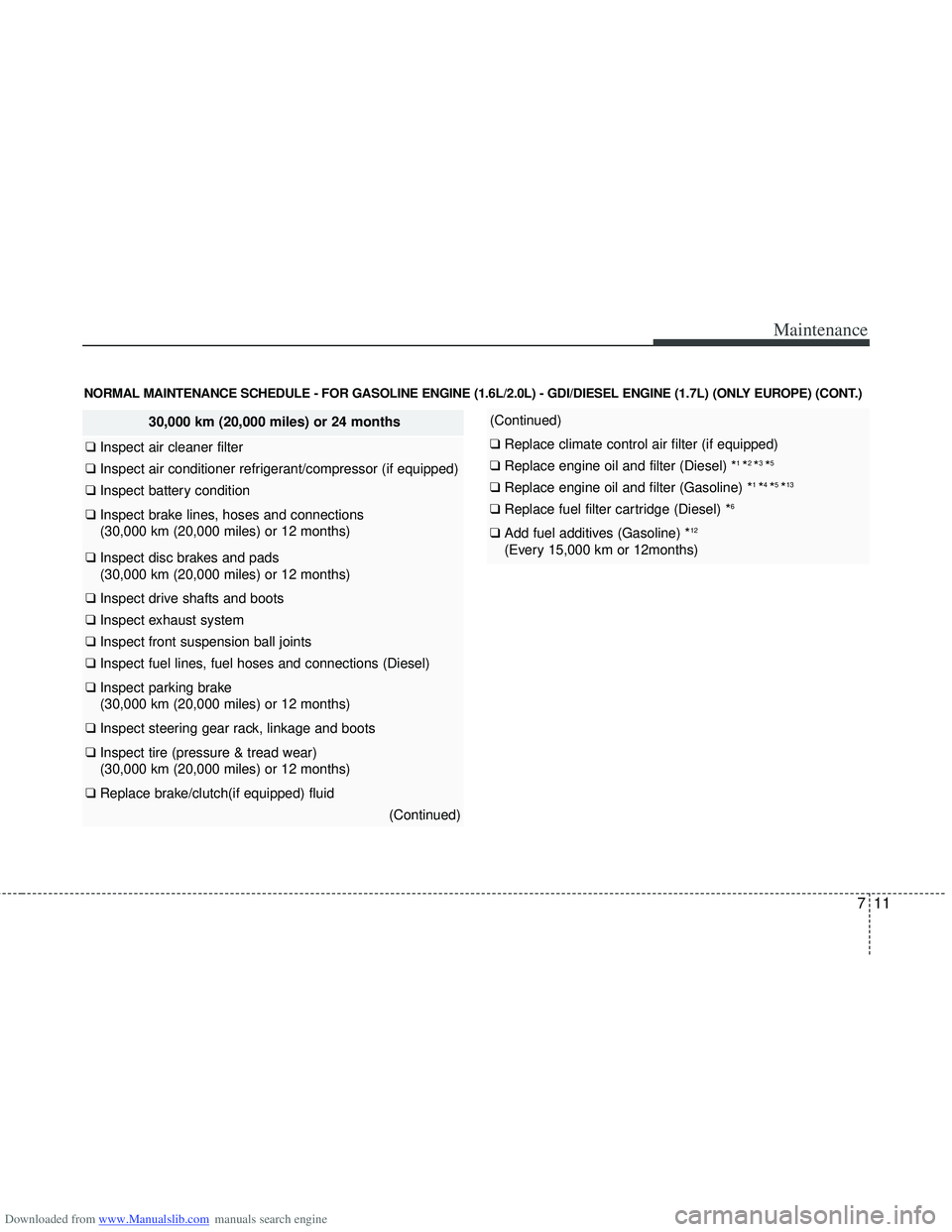
30,000 km (20,000 miles) or 24 months
❑ Inspect air cleaner filter
❑ Inspect air conditioner refrigerant/compressor (if equipped)
❑ Inspect battery condition
❑ Inspect brake lines, hoses and connections
(30,000 km (20,000 miles) or 12 months)
❑ Inspect disc brakes and pads
(30,000 km (20,000 miles) or 12 months)
❑ Inspect drive shafts and boots
❑ Inspect exhaust system
❑ Inspect front suspension ball joints
❑ Inspect fuel lines, fuel hoses and connections (Diesel)
❑ Inspect parking brake
(30,000 km (20,000 miles) or 12 months)
❑ Inspect steering gear rack, linkage and boots
❑ Inspect tire (pressure & tread wear)
(30,000 km (20,000 miles) or 12 months)
❑ Replace brake/clutch(if equipped) fluid
(Continued)
NORMAL MAINTENANCE SCHEDULE - FOR GASOLINE ENGINE (1.6L/2.0L) - GDI/DIESEL ENGINE (1.7L) (ONLY EUROPE) (CONT.)
(Continued)
❑ Replace climate control air filter (if equipped)
❑ Replace engine oil and filter (Diesel) *1 *2 *3 *5
❑ Replace engine oil and filter (Gasoline) *1 *4 *5 *13
❑ Replace fuel filter cartridge (Diesel) *6
❑ Add fuel additives (Gasoline) *12
(Every 15,000 km or 12months)
Page 417 of 534
Downloaded from www.Manualslib.com manuals search engine Maintenance
7
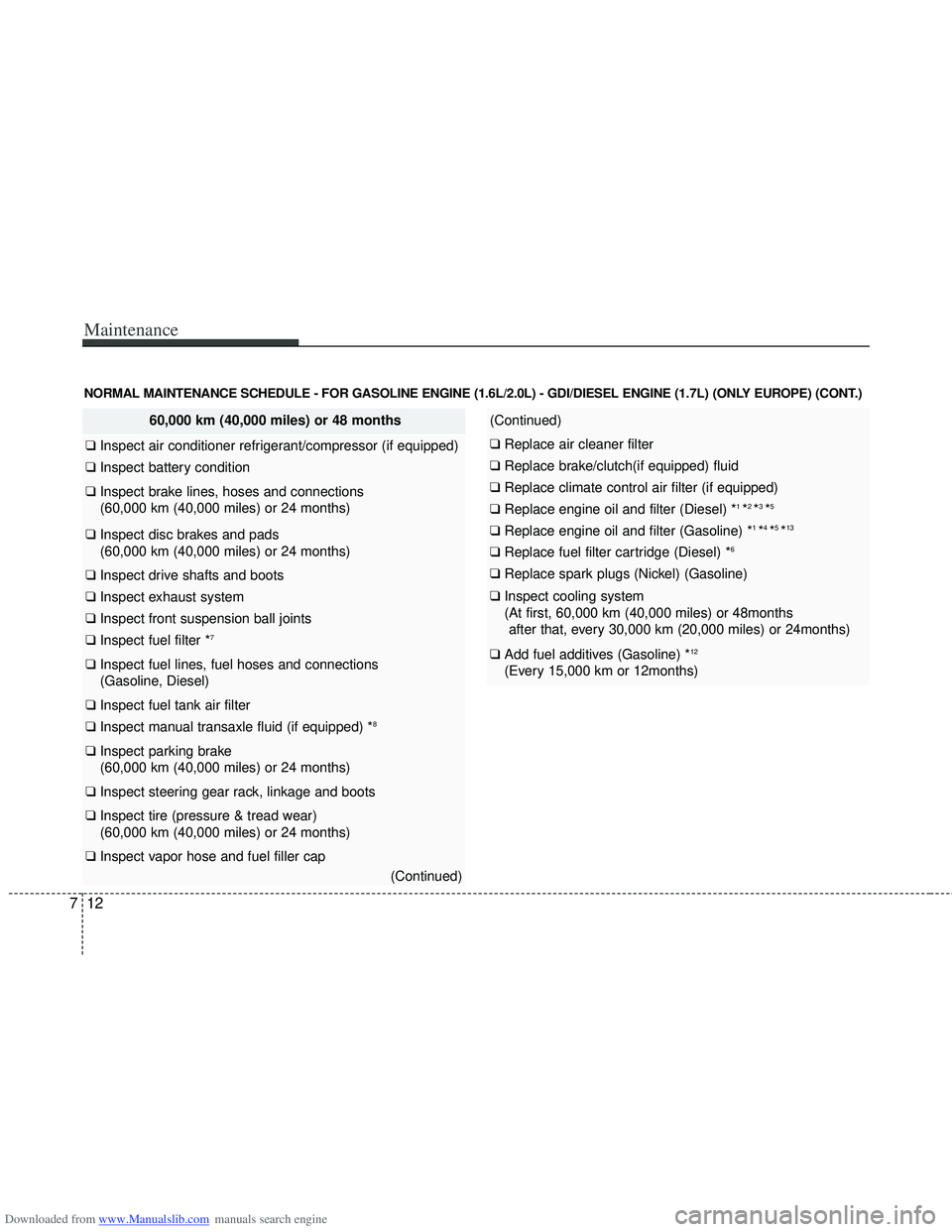
NORMAL MAINTENANCE SCHEDULE - FOR GASOLINE ENGINE (1.6L/2.0L) - GDI/DIESEL ENGINE (1.7L) (ONLY EUROPE) (CONT.)
60,000 km (40,000 miles) or 48 months
❑ Inspect air conditioner refrigerant/compressor (if equipped)
❑ Inspect battery condition
❑ Inspect brake lines, hoses and connections
(60,000 km (40,000 miles) or 24 months)
❑ Inspect disc brakes and pads
(60,000 km (40,000 miles) or 24 months)
❑ Inspect drive shafts and boots
❑ Inspect exhaust system
❑ Inspect front suspension ball joints
❑ Inspect fuel filter *7
❑ Inspect fuel lines, fuel hoses and connections
(Gasoline, Diesel)
❑ Inspect fuel tank air filter
❑ Inspect manual transaxle fluid (if equipped) *8
❑ Inspect parking brake
(60,000 km (40,000 miles) or 24 months)
❑ Inspect steering gear rack, linkage and boots
❑ Inspect tire (pressure & tread wear)
(60,000 km (40,000 miles) or 24 months)
❑ Inspect vapor hose and fuel filler cap
(Continued)
(Continued)
❑ Replace air cleaner filter
❑ Replace brake/clutch(if equipped) fluid
❑ Replace climate control air filter (if equipped)
❑ Replace engine oil and filter (Diesel) *1 *2 *3 *5
❑ Replace engine oil and filter (Gasoline) *1 *4 *5 *13
❑ Replace fuel filter cartridge (Diesel) *6
❑ Replace spark plugs (Nickel) (Gasoline)
❑ Inspect cooling system
(At first, 60,000 km (40,000 miles) or 48months
after that, every 30,000 km (20,000 miles) or 24months)
❑ Add fuel additives (Gasoline) *12
(Every 15,000 km or 12months)
12
Page 418 of 534
Downloaded from www.Manualslib.com manuals search engine 713
Maintenance
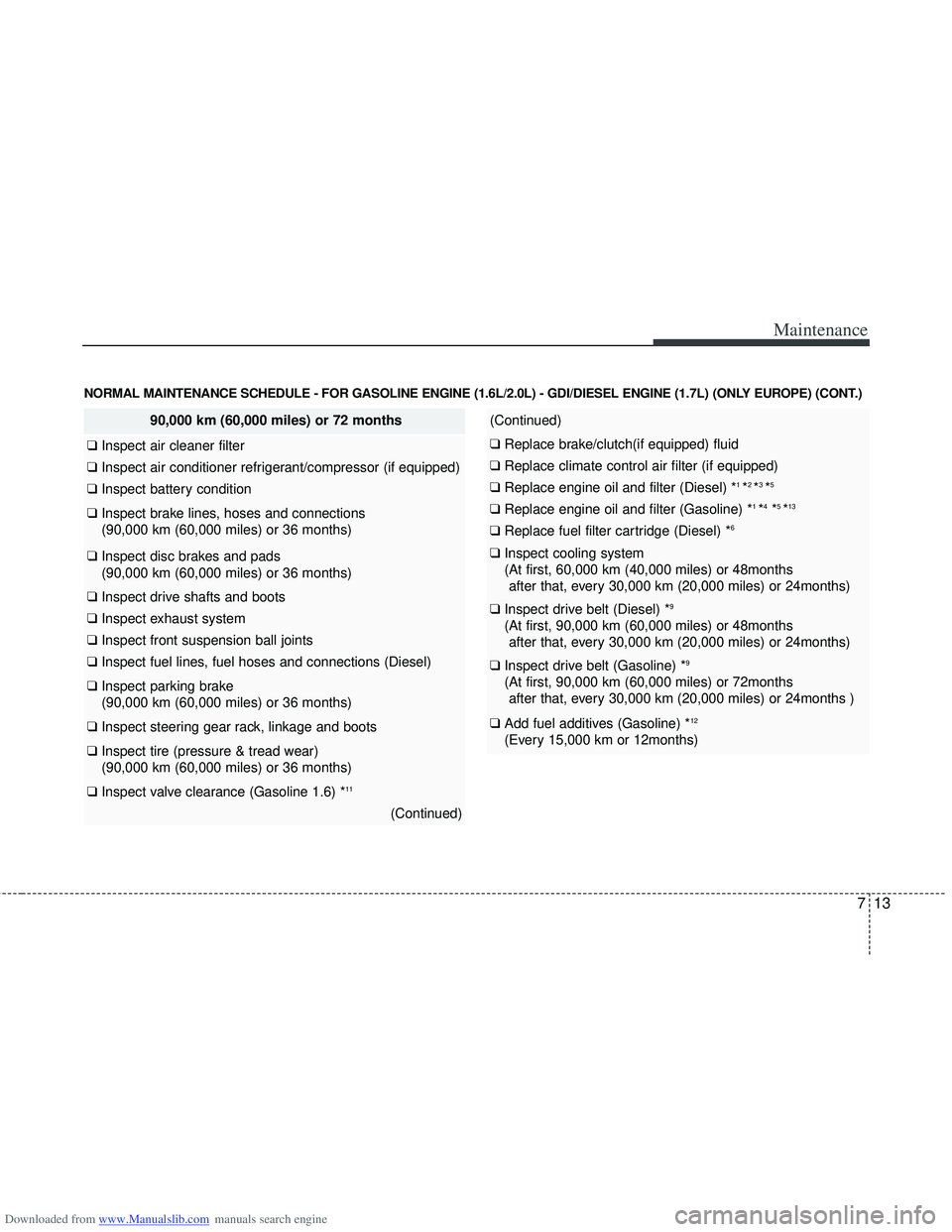
NORMAL MAINTENANCE SCHEDULE - FOR GASOLINE ENGINE (1.6L/2.0L) - GDI/DIESEL ENGINE (1.7L) (ONLY EUROPE) (CONT.)
90,000 km (60,000 miles) or 72 months
❑ Inspect air cleaner filter
❑ Inspect air conditioner refrigerant/compressor (if equipped)
❑ Inspect battery condition
❑ Inspect brake lines, hoses and connections
(90,000 km (60,000 miles) or 36 months)
❑ Inspect disc brakes and pads
(90,000 km (60,000 miles) or 36 months)
❑ Inspect drive shafts and boots
❑ Inspect exhaust system
❑ Inspect front suspension ball joints
❑ Inspect fuel lines, fuel hoses and connections (Diesel)
❑ Inspect parking brake
(90,000 km (60,000 miles) or 36 months)
❑ Inspect steering gear rack, linkage and boots
❑ Inspect tire (pressure & tread wear)
(90,000 km (60,000 miles) or 36 months)
❑ Inspect valve clearance (Gasoline 1.6) *11
(Continued)
(Continued)
❑ Replace brake/clutch(if equipped) fluid
❑ Replace climate control air filter (if equipped)
❑ Replace engine oil and filter (Diesel) *1 *2 *3 *5
❑ Replace engine oil and filter (Gasoline) *1 *4 *5 *13
❑ Replace fuel filter cartridge (Diesel) *6
❑ Inspect cooling system
(At first, 60,000 km (40,000 miles) or 48months
after that, every 30,000 km (20,000 miles) or 24months)
❑ Inspect drive belt (Diesel) *9
(At first, 90,000 km (60,000 miles) or 48months
after that, every 30,000 km (20,000 miles) or 24months)
❑ Inspect drive belt (Gasoline) *9
(At first, 90,000 km (60,000 miles) or 72months
after that, every 30,000 km (20,000 miles) or 24months )
❑ Add fuel additives (Gasoline) *12
(Every 15,000 km or 12months)
Page 419 of 534
Downloaded from www.Manualslib.com manuals search engine Maintenance
14
7
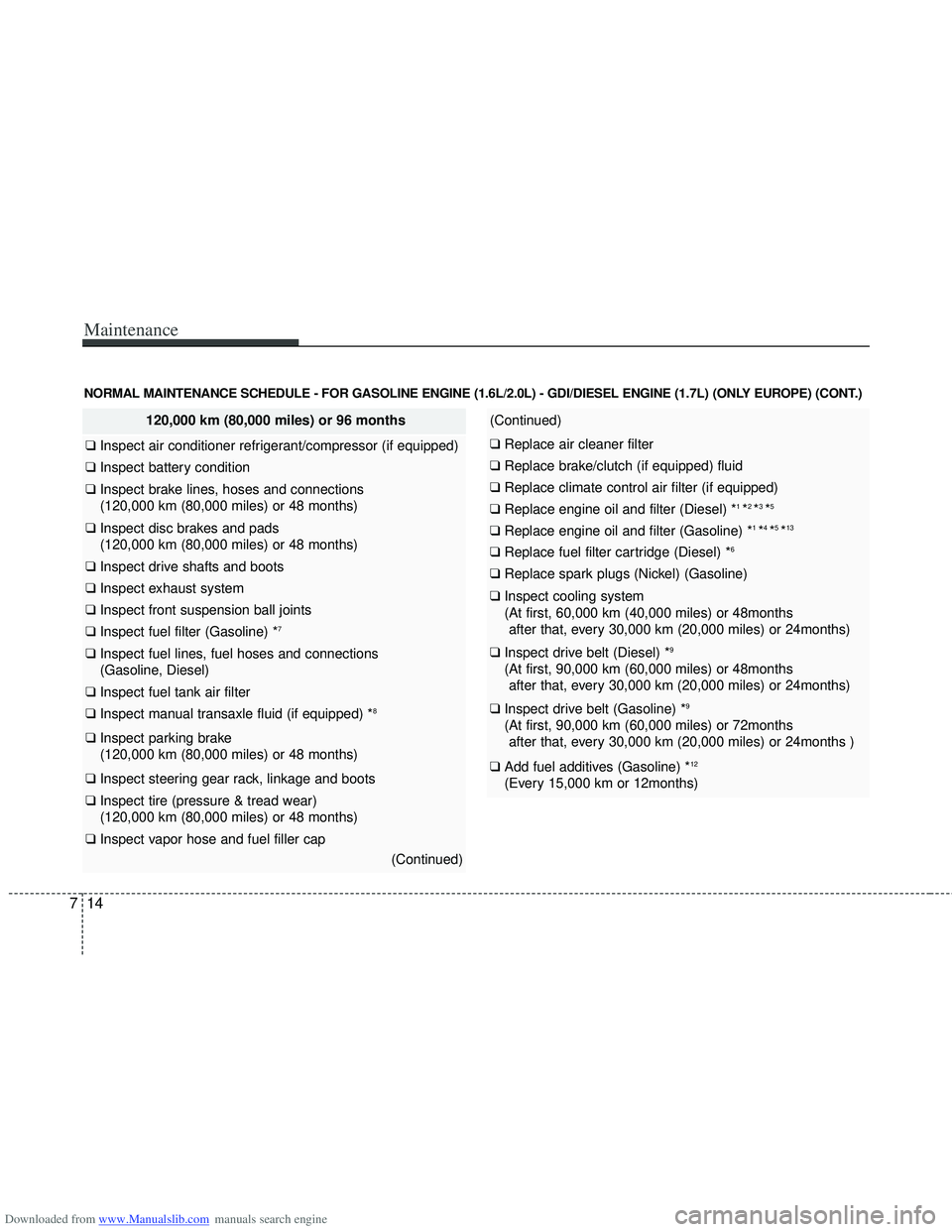
NORMAL MAINTENANCE SCHEDULE - FOR GASOLINE ENGINE (1.6L/2.0L) - GDI/DIESEL ENGINE (1.7L) (ONLY EUROPE) (CONT.)
120,000 km (80,000 miles) or 96 months
❑ Inspect air conditioner refrigerant/compressor (if equipped)
❑ Inspect battery condition
❑ Inspect brake lines, hoses and connections
(120,000 km (80,000 miles) or 48 months)
❑ Inspect disc brakes and pads
(120,000 km (80,000 miles) or 48 months)
❑ Inspect drive shafts and boots
❑ Inspect exhaust system
❑ Inspect front suspension ball joints
❑ Inspect fuel filter (Gasoline) *7
❑ Inspect fuel lines, fuel hoses and connections
(Gasoline, Diesel)
❑ Inspect fuel tank air filter
❑ Inspect manual transaxle fluid (if equipped) *8
❑ Inspect parking brake
(120,000 km (80,000 miles) or 48 months)
❑ Inspect steering gear rack, linkage and boots
❑ Inspect tire (pressure & tread wear)
(120,000 km (80,000 miles) or 48 months)
❑ Inspect vapor hose and fuel filler cap
(Continued)
(Continued)
❑ Replace air cleaner filter
❑ Replace brake/clutch (if equipped) fluid
❑ Replace climate control air filter (if equipped)
❑ Replace engine oil and filter (Diesel) *1 *2 *3 *5
❑ Replace engine oil and filter (Gasoline) *1 *4 *5 *13
❑ Replace fuel filter cartridge (Diesel) *6
❑ Replace spark plugs (Nickel) (Gasoline)
❑ Inspect cooling system
(At first, 60,000 km (40,000 miles) or 48months
after that, every 30,000 km (20,000 miles) or 24months)
❑ Inspect drive belt (Diesel) *9
(At first, 90,000 km (60,000 miles) or 48months
after that, every 30,000 km (20,000 miles) or 24months)
❑ Inspect drive belt (Gasoline) *9
(At first, 90,000 km (60,000 miles) or 72months
after that, every 30,000 km (20,000 miles) or 24months )
❑ Add fuel additives (Gasoline) *12
(Every 15,000 km or 12months)
Page 420 of 534
Downloaded from www.Manualslib.com manuals search engine 715
Maintenance
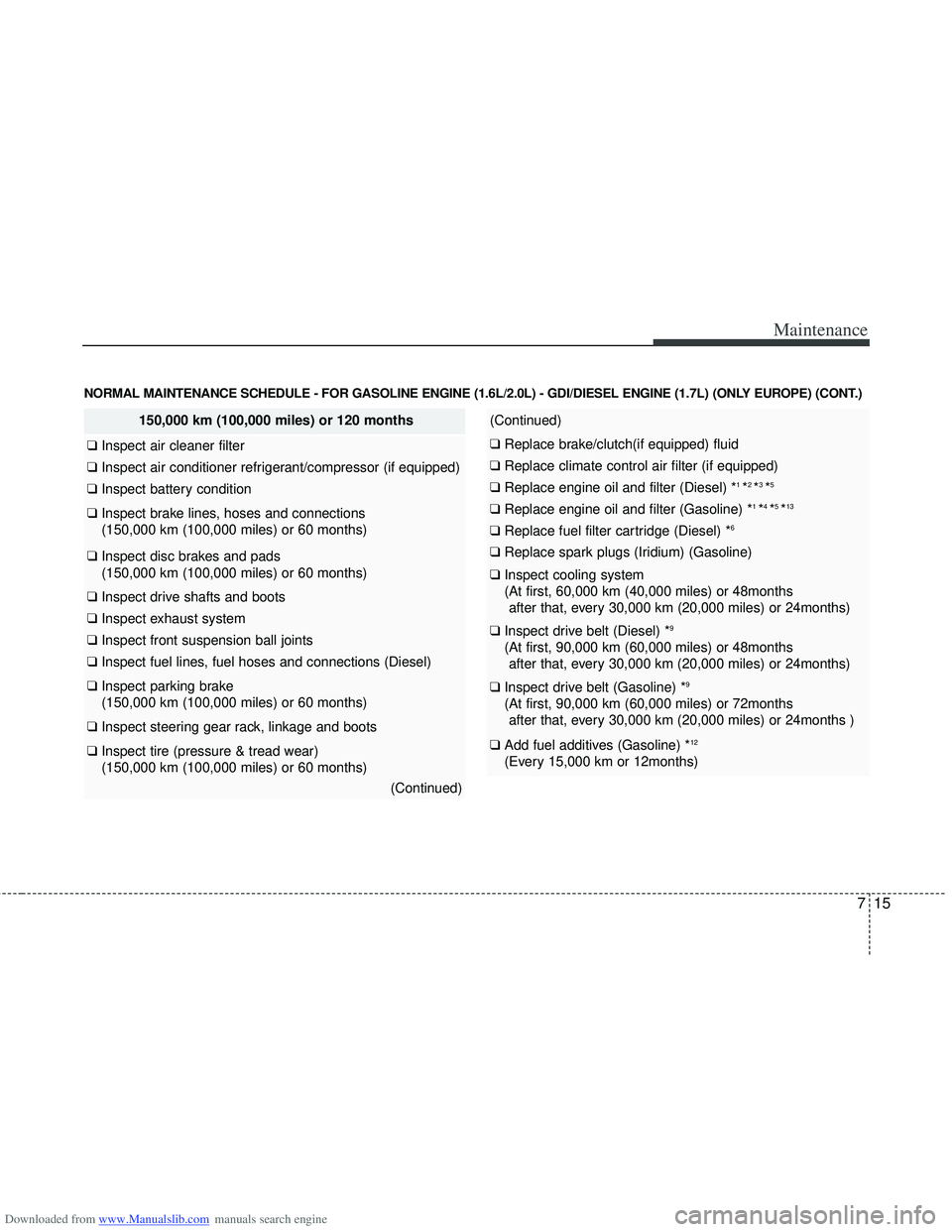
NORMAL MAINTENANCE SCHEDULE - FOR GASOLINE ENGINE (1.6L/2.0L) - GDI/DIESEL ENGINE (1.7L) (ONLY EUROPE) (CONT.)
150,000 km (100,000 miles) or 120 months
❑ Inspect air cleaner filter
❑ Inspect air conditioner refrigerant/compressor (if equipped)
❑ Inspect battery condition
❑ Inspect brake lines, hoses and connections
(150,000 km (100,000 miles) or 60 months)
❑ Inspect disc brakes and pads
(150,000 km (100,000 miles) or 60 months)
❑ Inspect drive shafts and boots
❑ Inspect exhaust system
❑ Inspect front suspension ball joints
❑ Inspect fuel lines, fuel hoses and connections (Diesel)
❑ Inspect parking brake
(150,000 km (100,000 miles) or 60 months)
❑ Inspect steering gear rack, linkage and boots
❑ Inspect tire (pressure & tread wear)
(150,000 km (100,000 miles) or 60 months)
(Continued)
(Continued)
❑ Replace brake/clutch(if equipped) fluid
❑ Replace climate control air filter (if equipped)
❑ Replace engine oil and filter (Diesel) *1 *2 *3 *5
❑ Replace engine oil and filter (Gasoline) *1 *4 *5 *13
❑ Replace fuel filter cartridge (Diesel) *6
❑ Replace spark plugs (Iridium) (Gasoline)
❑ Inspect cooling system
(At first, 60,000 km (40,000 miles) or 48months
after that, every 30,000 km (20,000 miles) or 24months)
❑ Inspect drive belt (Diesel) *9
(At first, 90,000 km (60,000 miles) or 48months
after that, every 30,000 km (20,000 miles) or 24months)
❑ Inspect drive belt (Gasoline) *9
(At first, 90,000 km (60,000 miles) or 72months
after that, every 30,000 km (20,000 miles) or 24months )
❑ Add fuel additives (Gasoline) *12
(Every 15,000 km or 12months)