park assist HYUNDAI I40 2017 Owner's Manual
[x] Cancel search | Manufacturer: HYUNDAI, Model Year: 2017, Model line: I40, Model: HYUNDAI I40 2017Pages: 534, PDF Size: 11.05 MB
Page 180 of 534
Downloaded from www.Manualslib.com manuals search engine 493
Features of your vehicle
✽
✽NOTICE
• In the below conditions the system
will be cancelled. Park your vehicle
manually.
1. Search for parking space
- When the ABS/ESP is activated
- When the vehicle speed is over40km/h (24.8mph)
- When you press the Smart Parking Assist System button (the front and
rear Parking Assist System operates)
- When you shift the shift lever to R (Reverse)
2. Steering wheel control - When the ABS/ESP is activated
- When the vehicle speed is over7km/h (4.3 mph)
- When you press the Smart Parking Assist System button (the front and
rear Parking Assist System operates)
- When you shift the shift lever to D (Drive) before entering the parking
space
- When you hold the steering wheel firmly
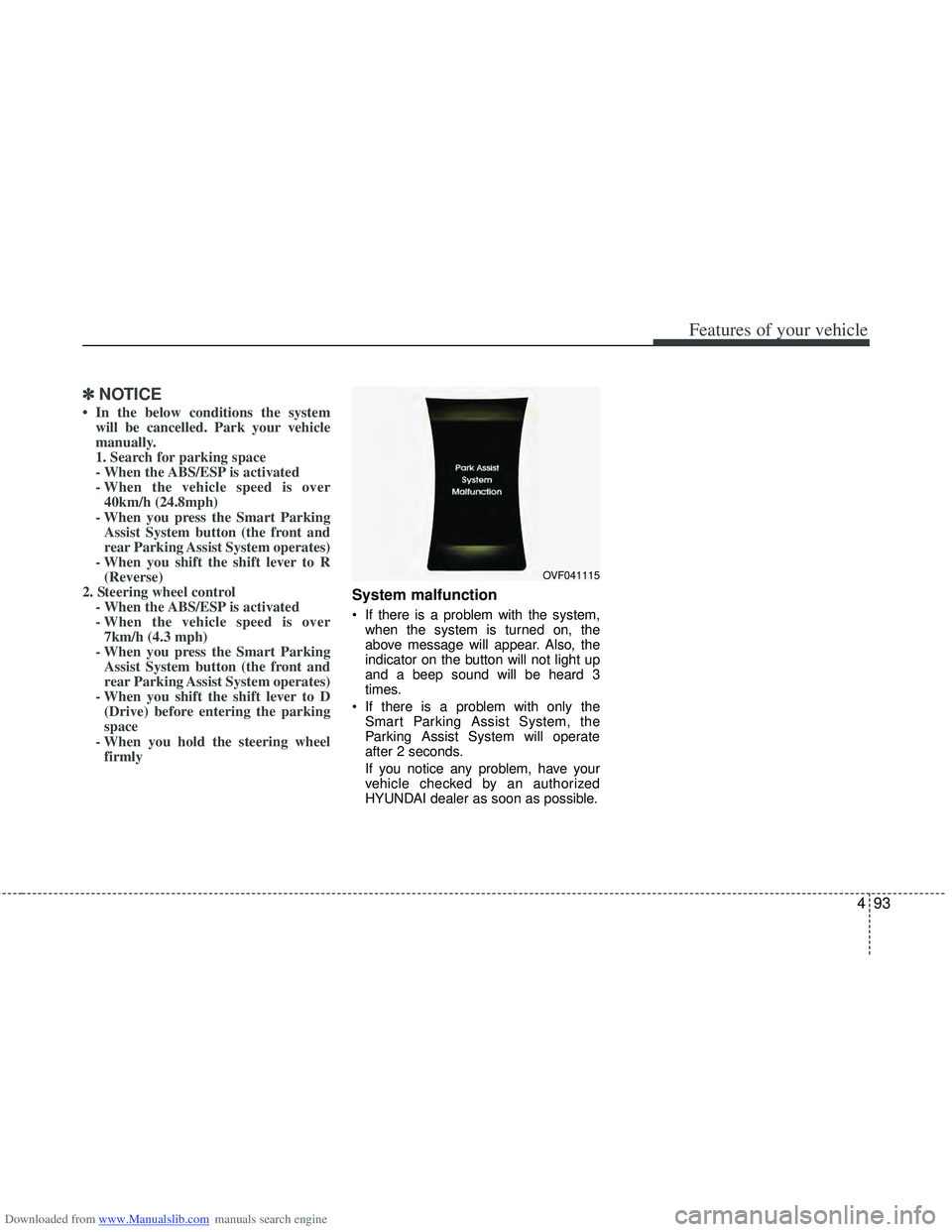
System malfunction
If there is a problem with the system,
when the system is turned on, the
above message will appear. Also, the
indicator on the button will not light up
and a beep sound will be heard 3
times.
If there is a problem with only the Smart Parking Assist System, the
Parking Assist System will operate
after 2 seconds.
If you notice any problem, have your
vehicle checked by an authorized
HYUNDAI dealer as soon as possible.
OVF041115
Page 338 of 534
Downloaded from www.Manualslib.com manuals search engine 545
Driving your vehicle
Hill-start assist control (HAC)
A vehicle has the tendency to slip back
on a steep hill when it starts to go after
stopping. The Hill-start Assist Control
(HAC) prevents the vehicle from slipping
back by operating the brakes automati-
cally for about 2 seconds. The brakes are
released when the accelerator pedal is
depressed or after about 2 seconds.
✽ ✽NOTICE
• The HAC does not operate when the
transaxle shift lever is in the P (Park)
or N (Neutral) position.
• The HAC activates even though the ESP is off but it does not activate
when the ESP has malfunctioned.
Emergency Stop Signal (ESS)
(if equipped)
The Emergency Stop Signal system
alerts the driver behind by blinking the
stop light when the vehicle is braked rap-
idly and severely.
The system is activated when:
The vehicle suddenly stops (vehicle
speed is over 55km/h and the vehicle
deceleration at greater than 7 m/s
2)
The ABS is activating
When the vehicle speed is under 40 km/h
and the ABS deactivates or the sudden
stop situation is over, the stop light will
not blink. Instead, the hazard warning
flasher will turn on automatically.
The hazard warning flasher will turn off
when vehicle speed is over 10km/h after
the vehicle has stopped. Also, it will turn
off when the vehicle is driven at low
speed for some time. You can turn it off
manually by pushing the hazard warning
flasher switch.
WARNING
The HAC is activated only for about
2 seconds, so when the vehicle is
starting off always depress the
accelerator pedal.
CAUTION
The Emergency Stop Signal (ESS) system will not work if the hazardwarning flasher is already on.
Page 339 of 534
Downloaded from www.Manualslib.com manuals search engine Driving your vehicle
46
5
Good braking practices Check to be sure the parking brake is
not engaged and that the parking
brake indicator light is out before driv-
ing away.
Driving through water may get the brakes wet. They can also get wet
when the vehicle is washed. Wet
brakes can be dangerous! Your vehicle
will not stop as quickly if the brakes are
wet. Wet brakes may cause the vehicle
to pull to one side.
To dry the brakes, apply the brakes
lightly until the braking action returns to
normal, taking care to keep the vehicle
under control at all times. If the braking
action does not return to normal, stop
as soon as it is safe to do so and call
an authorized HYUNDAI dealer for
assistance.
Do not coast down hills with the vehicle out of gear. This is extremely haz-
ardous. Keep the vehicle in gear at all
times, use the brakes to slow down,
then shift to a lower gear so that
engine braking will help you maintain a
safe speed.
Do not "ride" the brake pedal. Resting your foot on the brake pedal while driv-
ing can be dangerous because it can
result in the brakes overheating and
losing their effectiveness. It also
increases the wear of the brake com-
ponents. If a tire goes flat while you are driving,
apply the brakes gently and keep the
vehicle pointed straight ahead while
you slow down. When you are moving
slowly enough for it to be safe to do so,
pull off the road and stop in a safe
place.
If your vehicle is equipped with an automatic transaxle, do not let your
vehicle creep forward. To avoid creep-
ing forward, keep your foot firmly on
the brake pedal when the vehicle is
stopped.
Be cautious when parking on a hill. Firmly engage the parking brake and
place the shift lever in P (automatic
transaxle) or in first or reverse gear
(manual transaxle). If your vehicle is
facing downhill, turn the front wheels
into the curb to help keep the vehicle
from rolling. If your vehicle is facing
uphill, turn the front wheels away from
the curb to help keep the vehicle from
rolling. If there is no curb or if it is
required by other conditions to keep
the vehicle from rolling, block the
wheels.
WARNING
Whenever you leave or park yourvehicle, always set the parking
brake as far as possible and fully
engage the vehicle's transaxle
into the P (Park) position. If the
parking brake is not fully
engaged, the vehicle may move
inadvertently and injure yourself
and others.
All vehicles should always have the parking brake fully engaged
when parking to avoid inadver-
tent movement of the vehicle
which can injure occupants or
pedestrians.
Page 378 of 534
Downloaded from www.Manualslib.com manuals search engine 63
What to do in an emergency
IN CASE OF AN EMERGENCY WHILE DRIVING
If the engine stalls at a crossroad
or crossing
If the engine stalls at a crossroad orcrossing, set the shift lever in the N
(Neutral) position and then push the
vehicle to a safe place.
If your vehicle has a manual transaxle not equipped with a ignition lock
switch, the vehicle can move forward
by shifting to the 2(Second) or 3(Third)
gear and then turning the starter with-
out depressing the clutch pedal.
If you have a flat tire while driving
If a tire goes flat while you are driving:
1. Take your foot off the accelerator pedaland let the vehicle slow down while
driving straight ahead. Do not apply the
brakes immediately or attempt to pull
off the road as this may cause a loss of
control. When the vehicle has slowed
to such a speed that it is safe to do so,
brake carefully and pull off the road.
Drive off the road as far as possible
and park on firm, level ground. If you
are on a divided highway, do not park
in the median area between the two
traffic lanes.
2. When the vehicle is stopped, turn on your emergency hazard flashers, set
the parking brake and put the transaxle
in P (automatic transaxle) or reverse
(manual transaxle).
3. Have all passengers get out of the vehicle. Be sure they all get out on the
side of the vehicle that is away from
traffic.
4. When changing a flat tire, follow the instruction provided later in this sec-
tion.
If engine stalls while driving
1. Reduce your speed gradually, keeping a straight line. Move cautiously off the
road to a safe place.
2. Turn on your emergency flashers.
3. Try to start the engine again. If your vehicle does not start, contact an
authorized HYUNDAI dealer or seek
other qualified assistance.
Page 379 of 534
Downloaded from www.Manualslib.com manuals search engine What to do in an emergency
46
IF THE ENGINE DOES NOT START
If engine doesn't turn over or
turns over slowly
1. If your vehicle has an automatictransaxle, be sure the shift lever is in N
(Neutral) or P (Park) and the emer-
gency brake is set.
2. Check the battery connections to be sure they are clean and tight.
3. Turn on the interior light. If the light dims or goes out when you operate the
starter, the battery is discharged.
4. Check the starter connections to be sure they are securely tightened.
5. Do not push or pull the vehicle to start it. See instructions for "Jump starting".
If engine turns over normally but
does not start
1. Check fuel level.
2. With the ignition switch in the LOCK/OFF position, check all connectors at
ignition, coil and spark plugs.
Reconnect any that may be discon-
nected or loose.
3. Check the fuel line in the engine com- partment.
4. If the engine still does not start, call an authorized HYUNDAI dealer or seek
other qualified assistance.
WARNING
If the engine does not start, do not
push or pull the vehicle to start it.
This could result in a collision or
cause other damage. In addition,
push or pull starting may cause the
catalytic converter (if equipped) to
be overloaded and create a fire haz-
ard.
Page 380 of 534
Downloaded from www.Manualslib.com manuals search engine 65
What to do in an emergency
EMERGENCY STARTING
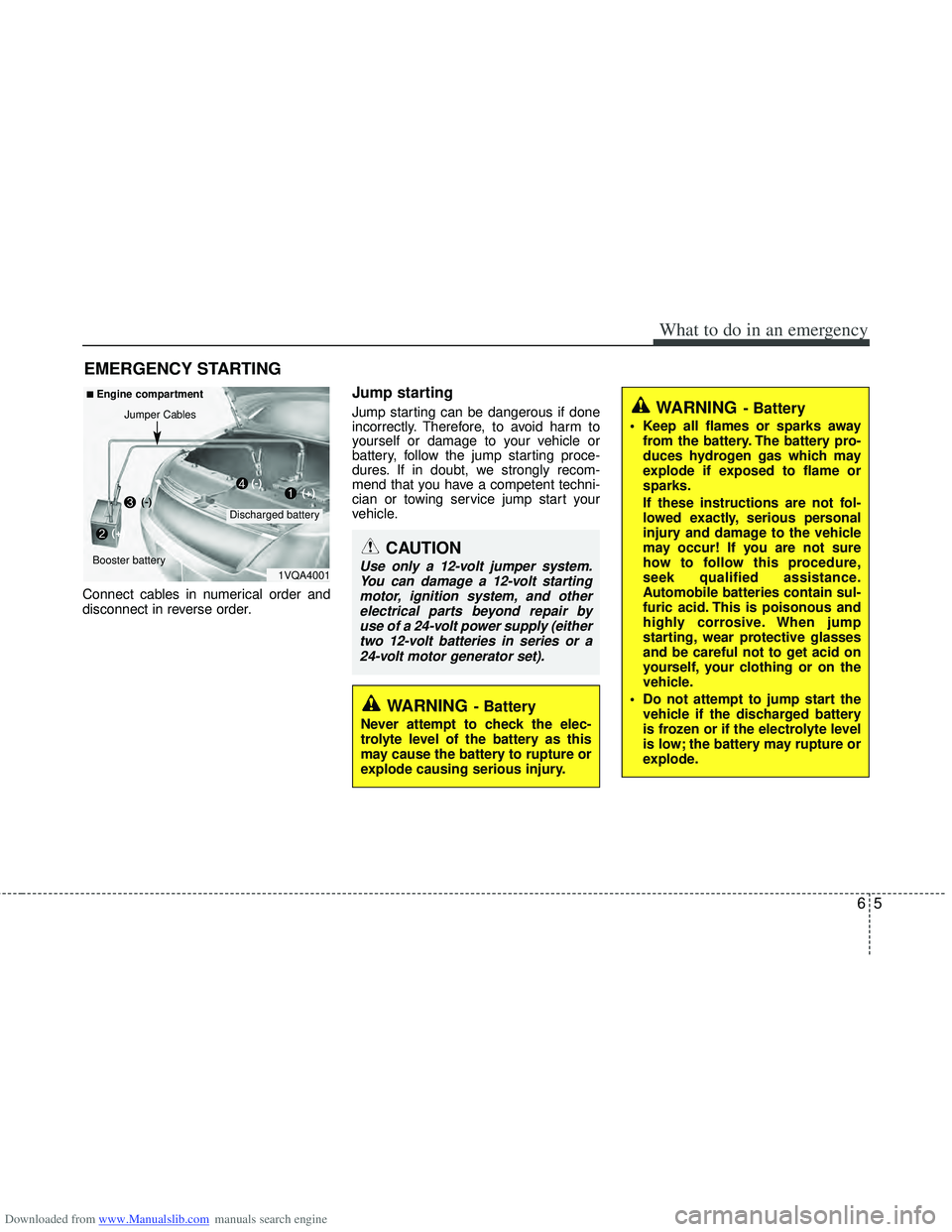
Connect cables in numerical order and
disconnect in reverse order.
Jump starting
Jump starting can be dangerous if done
incorrectly. Therefore, to avoid harm to
yourself or damage to your vehicle or
battery, follow the jump starting proce-
dures. If in doubt, we strongly recom-
mend that you have a competent techni-
cian or towing service jump start your
vehicle.
CAUTION
Use only a 12-volt jumper system.You can damage a 12-volt starting motor, ignition system, and otherelectrical parts beyond repair byuse of a 24-volt power supply (eithertwo 12-volt batteries in series or a24-volt motor generator set).
WARNING- Battery
• Keep all flames or sparks away from the battery. The battery pro-
duces hydrogen gas which may
explode if exposed to flame or
sparks.
If these instructions are not fol-
lowed exactly, serious personal
injury and damage to the vehicle
may occur! If you are not sure
how to follow this procedure,
seek qualified assistance.
Automobile batteries contain sul-
furic acid. This is poisonous and
highly corrosive. When jump
starting, wear protective glasses
and be careful not to get acid on
yourself, your clothing or on the
vehicle.
Do not attempt to jump start the vehicle if the discharged battery
is frozen or if the electrolyte level
is low; the battery may rupture or
explode.
WARNING- Battery
Never attempt to check the elec-
trolyte level of the battery as this
may cause the battery to rupture or
explode causing serious injury.
1VQA4001
Discharged battery
Jumper Cables
■Engine compartment
Booster battery
(-)
(+)
(+)(-)
Page 382 of 534
Downloaded from www.Manualslib.com manuals search engine 67
What to do in an emergency
IF THE ENGINE OVERHEATS
If your temperature gauge indicates over-
heating, you will experience a loss of
power, or hear loud pinging or knocking,
the engine is probably too hot. If this hap-
pens, you should:
1. Pull off the road and stop as soon as itis safe to do so.
2. Place the shift lever in P (automatic transaxle) or neutral (manual
transaxle) and set the parking brake. If
the air conditioning is on, turn it off.
3. If engine coolant is running out under the vehicle or steam is coming out
from the hood, stop the engine. Do not
open the hood until the coolant has
stopped running or the steaming has
stopped. If there is no visible loss of
engine coolant and no steam, leave
the engine running and check to be
sure the engine cooling fan is operat-
ing. If the fan is not running, turn the
engine off.
4. Check to see if the water pump drive belt is missing. If it is not missing,
check to see that it is tight. If the drive
belt seems to be satisfactory, check
for coolant leaking from the radiator,
hoses or under the vehicle. (If the air
conditioning had been in use, it is nor-
mal for cold water to be draining from
it when you stop). 5. If the water pump drive belt is broken
or engine coolant is leaking out, stop
the engine immediately and call the
nearest authorized HYUNDAI dealer
for assistance. 6. If you cannot find the cause of the
overheating, wait until the engine tem-
perature has returned to normal. Then,
if coolant has been lost, carefully add
coolant to the reservoir to bring the
fluid level in the reservoir up to the
halfway mark.
7. Proceed with caution, keeping alert for further signs of overheating. If over-
heating happens again, call an author-
ized HYUNDAI dealer for assistance.
CAUTION
Serious loss of coolant indicates
there is a leak in the cooling systemand this should be checked as soonas possible by an authorizedHYUNDAI dealer.
WARNING
While the engine is running, keep
hair, hands and clothing away from
moving parts such as the fan and
drive belts to prevent injury.
WARNING
Do not remove the radiator cap
when the engine is hot. This can
allow coolant to blow out of the
opening and cause serious burns.
Page 530 of 534
Downloaded from www.Manualslib.com manuals search engine I7
Index
Jack and tools...................................................................6-8
Jump starting....................................................................6-5
Key positions ...................................................................5-4
Keys ........................................................................\
.........4-3
LabelAir bag warning label ..................................................3-63
E-mark label ................................................................8-10
Tire sidewall labeling ..................................................7-67
Tire specification and pressure label .............................8-9
Vehicle certification label ..............................................8-8
Lane keeping assist system............................................5-56
Lap/shoulder belt ...........................................................3-20
LCD display ...................................................................4-53
Light bulbs .....................................................................7-8\
5
Lighting........................................................................\
..4-96 AFLS (Adaptive Front Lighting System) .................4-103
Auto light/AFLS position ............................................4-98
Battery saver function .................................................4-96
Daytime running light ...............................................4-102
Front fog light............................................................4-101 Headlight (Headlamp) escort function ........................4-96
Headlight (Headlamp) welcome function ...................4-96
Headlight leveling device ..........................................4-102
Headlight position .......................................................4-98
High - beam operation .................................................4-99
Parking light position ..................................................4-97
Rear fog light .............................................................4-101
Smart cornering light ...................................................4-97
Traffic change ..............................................................4-99
Turn signals ...............................................................4-100
Lubricants and capacities.................................................8-5
Luggage net (holder) ...................................................4-145
Luggage rail system .....................................................4-149
Luggage room lamp .....................................................4-109
Luggage side partition .................................................4-138
Luggage side tray.........................................................4-138
Luggage tray ................................................................4-138
Main fuse .......................................................................7\
-74
Maintenance Explanation of scheduled maintenance items .............7-41
Maintenance services....................................................\
.7-5
Maintenance under severe usage conditions .....7-19,30,39
Normal maintenance schedule...........................7-10,21,32
Owner maintenance .......................................................7-7
L
M
K
J
Page 531 of 534

Downloaded from www.Manualslib.com manuals search engine Index
8I
Scheduled maintenance service .....................................7-9
Tire maintenance .........................................................7-67
Maintenance schedule......................................................7-9 Maintenance under severe usage conditions .....7-19,30,39
Normal maintenance schedule...........................7-10,21,32
Maintenance services .......................................................7-5
Manual climate control system ....................................4-112 Air conditioning.........................................................4-117
Climate control air filter ............................................4-120
Heating and air conditioning .....................................4-113
Manual transaxle............................................................5-19
Manual transaxle shift indicator ....................................4-52
Map lamp .....................................................................4-1\
08
Memory system .............................................................4-39
Mirrors ........................................................................\
...4-44 Day/night rearview mirror ...........................................4-44
Electric chromic mirror (ECM) ...................................4-44
Inside rearview mirror .................................................4-44
Outside rearview mirror ..............................................4-45
Moonroof, see panorama sunroof ..................................4-35
Mounting bracket for roof carrier................................4-151
Multi fuse .......................................................................7\
-74
Non-powered tailgate.....................................................4-20 Odometer .......................................................................4\
-53
Oil (Engine) ...................................................................7-44
Outside rearview mirror.................................................4-45
Outside temperature .......................................................4-51
Overheats ........................................................................\
.6-7
Owner maintenance .........................................................7-7
Paddle shifter .................................................................5-25
Panorama sunroof ..........................................................4-35
Parking light position.....................................................4-97
Passenger’s front air bag ON indicator .........................3-44
Passenger’s front air bag ON/OFF switch.....................3-50
Power brakes..................................................................5-29
Power outlet .................................................................4-142
Power tailgate ................................................................4-21
Power window lock button ............................................4-29
Pre-tensioner seat belt....................................................3-23
Push starting.....................................................................6-6\
Rear parking assist system.............................................4-79
Rear seat........................................................................\
.3-12
N
O
P
R
Page 532 of 534

Downloaded from www.Manualslib.com manuals search engine I9
Index
Rear seat floor pocket ..................................................4-139
Rear view camera ..........................................................4-94
Recommended cold tire inflation pressures ..................7-61
Recommended lubricants and capacities .........................8-5Recommended SAE viscosity number ..........................8-7
Remote keyless entry .......................................................4-5
Replacement light bulb ..................................................7-85
Road warning ...................................................................6-2
Rocking the vehicle .......................................................5-65
Roof antenna ................................................................4-153
Room lamp...................................................................4-109\
Scheduled maintenance service .......................................7-9 Maintenance under severe usage conditions .....7-19,30,39
Normal maintenance schedule...........................7-10,21,32
Seat belt warning ...........................................................3-19
Seat belts ........................................................................\
3-18 Height adjustment........................................................3-20
Lap/shoulder belt .........................................................3-20
Pre-tensioner seat belt .................................................3-23
Seat belt warning .........................................................3-19
Seat warmer(front) .........................................................3-10
Seat warmer(rear) ..........................................................3-14
Seatback pocket .............................................................3-12 Seats ........................................................................\
.........3-2
Air ventilation seat ......................................................3-11
Armrest ........................................................................\
3-14
Folding the rear seat ....................................................3-15
Front seat adjustment...................................................\
..3-5
Headrest(front) ..............................................................3-8
Headrest(rear) ..............................................................3-12
Rear seat ......................................................................3-\
12
Seat warmer(front)....................................................\
...3-10
Seat warmer(rear) ........................................................3-14
Seatback pocket ...........................................................3-12
Shift lock system ...........................................................5-26
Side impact air bag ........................................................3-53
Smart cornering light .....................................................4-97
Smart key ........................................................................\
.4-9
Smooth cornering...........................................................5-66
Snow tires ......................................................................5-\
69
Smart parking assist system...........................................4-83
Spare tire Compact spare tire .......................................................6-14
Compact spare tire replacement ..................................7-66
Removing and storing the spare tire .............................6-9
Special driving conditions .............................................5-65 Driving at night ...........................................................5-66
Driving in flooded areas ..............................................5-67
Driving in the rain .......................................................5-67
S