change HYUNDAI I40 2019 Manual Online
[x] Cancel search | Manufacturer: HYUNDAI, Model Year: 2019, Model line: I40, Model: HYUNDAI I40 2019Pages: 534, PDF Size: 11.05 MB
Page 383 of 534
Downloaded from www.Manualslib.com manuals search engine What to do in an emergency
86
IF YOU HAVE A FLAT TIRE
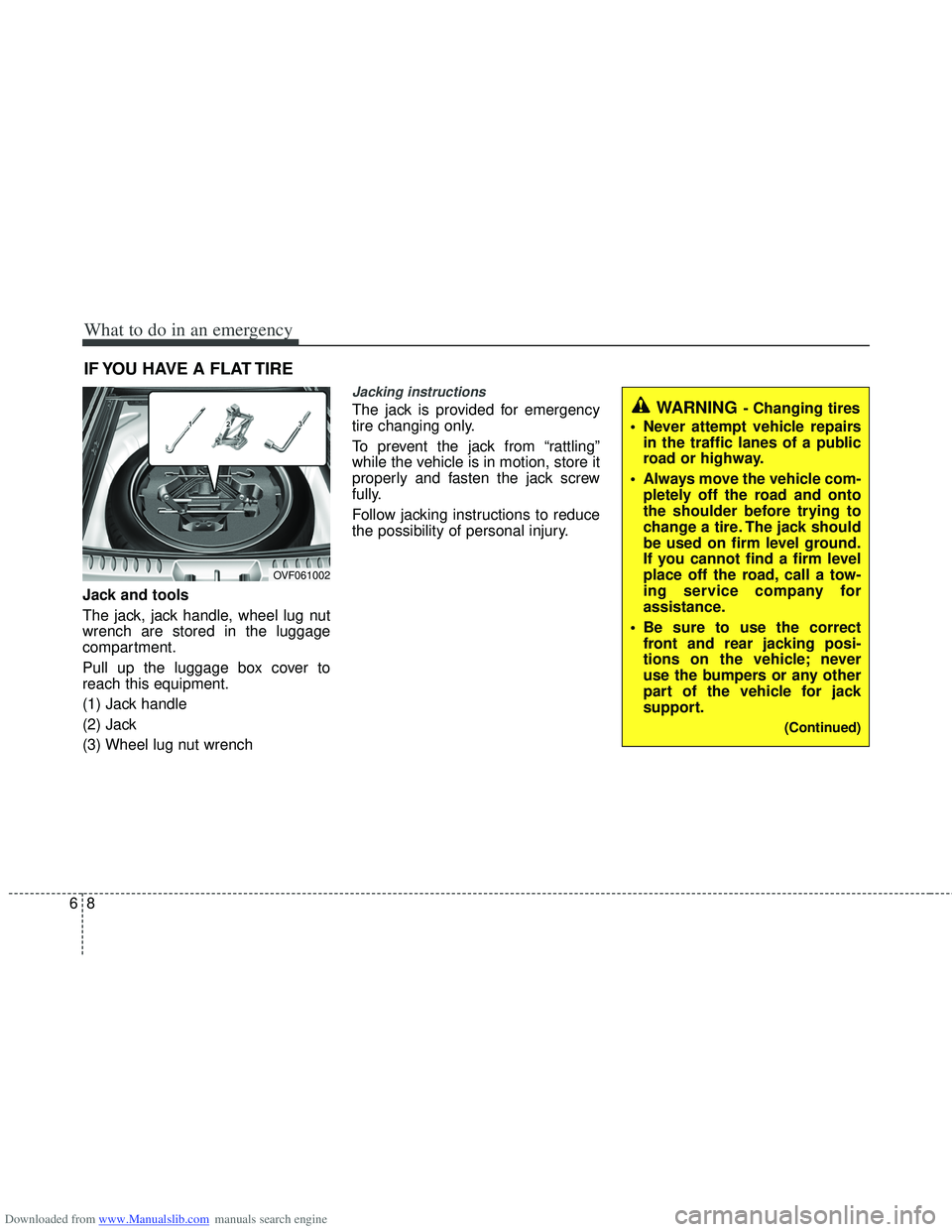
Jack and tools
The jack, jack handle, wheel lug nut
wrench are stored in the luggage
compartment.
Pull up the luggage box cover to
reach this equipment.
(1) Jack handle
(2) Jack
(3) Wheel lug nut wrench
Jacking instructions
The jack is provided for emergency
tire changing only.
To prevent the jack from “rattling”
while the vehicle is in motion, store it
properly and fasten the jack screw
fully.
Follow jacking instructions to reduce
the possibility of personal injury.
OVF061002
WARNING- Changing tires
Never attempt vehicle repairs in the traffic lanes of a public
road or highway.
Always move the vehicle com- pletely off the road and onto
the shoulder before trying to
change a tire. The jack should
be used on firm level ground.
If you cannot find a firm level
place off the road, call a tow-
ing service company for
assistance.
Be sure to use the correct front and rear jacking posi-
tions on the vehicle; never
use the bumpers or any other
part of the vehicle for jack
support.
(Continued)
Page 385 of 534
Downloaded from www.Manualslib.com manuals search engine What to do in an emergency
10
6
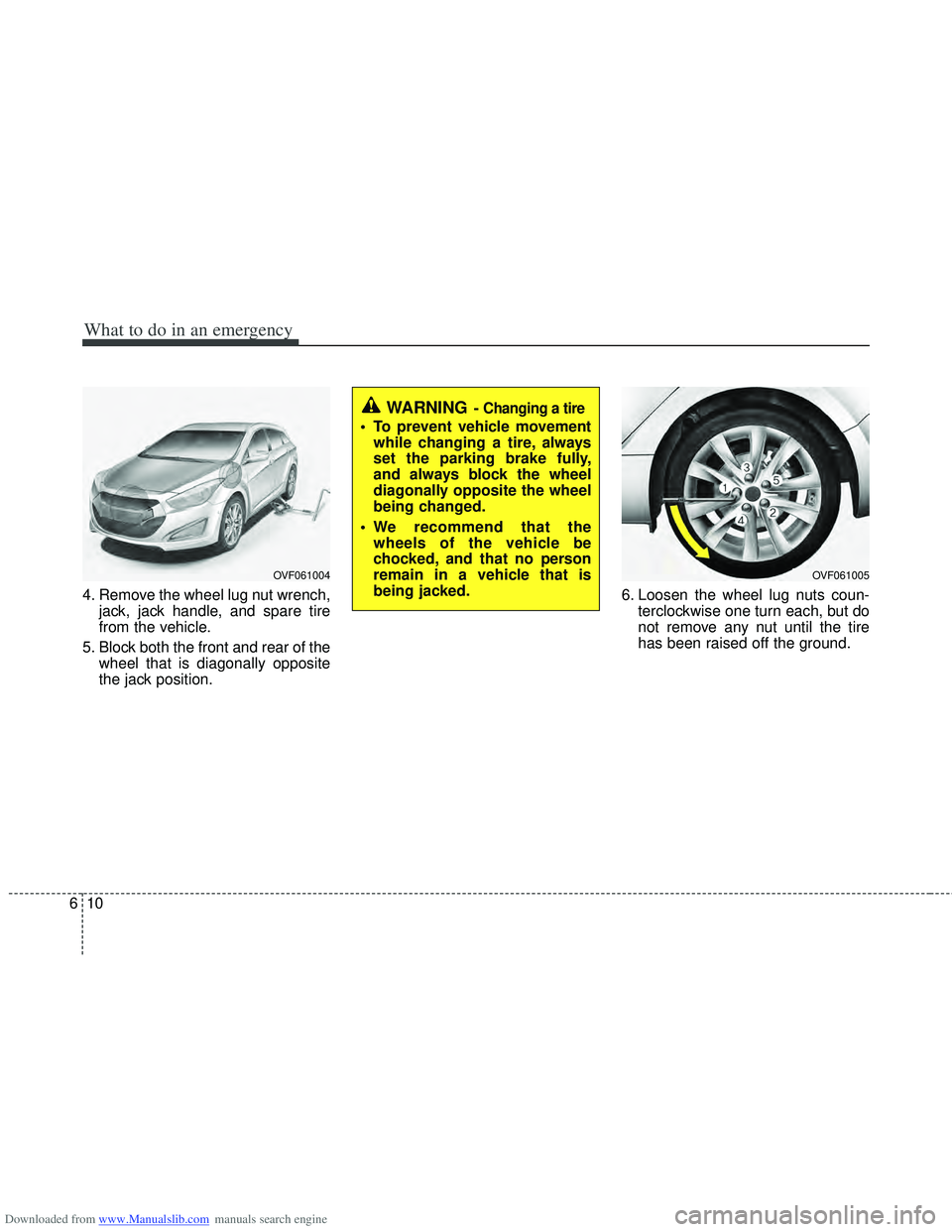
4. Remove the wheel lug nut wrench,
jack, jack handle, and spare tire
from the vehicle.
5. Block both the front and rear of the wheel that is diagonally opposite
the jack position. 6. Loosen the wheel lug nuts coun-
terclockwise one turn each, but do
not remove any nut until the tire
has been raised off the ground.
WARNING- Changing a tire
To prevent vehicle movementwhile changing a tire, always
set the parking brake fully,
and always block the wheel
diagonally opposite the wheel
being changed.
We recommend that the wheels of the vehicle be
chocked, and that no person
remain in a vehicle that is
being jacked.
OVF061004OVF061005
Page 388 of 534
Downloaded from www.Manualslib.com manuals search engine 613
What to do in an emergency
Wheel nut tightening torque:
Steel wheel & aluminium alloy wheel:
9~11 kg.m (65~79 lb.ft)
If you have a tire gauge, remove the
valve cap and check the air pressure.
If the pressure is lower than recom-
mended, drive slowly to the nearest
service station and inflate to the cor-
rect pressure. If it is too high, adjust
it until it is correct. Always reinstall
the valve cap after checking or
adjusting tire pressure. If the cap is
not replaced, air may leak from the
tire. If you lose a valve cap, buy
another and install it as soon as pos-
sible.
After you have changed wheels,
always secure the flat tire in its place
and return the jack and tools to their
proper storage locations.To prevent the jack, jack handle,
wheel lug nut wrench and spare tire
from rattling while the vehicle is in
motion, store them properly.
CAUTION
Your vehicle has metric threads
on the wheel studs and nuts.Make certain during wheelremoval that the same nuts thatwere removed are reinstalled -or, if replaced, that nuts withmetric threads and the samechamfer configuration are used.Installation of a non-metricthread nut on a metric stud orvice-versa will not secure thewheel to the hub properly andwill damage the stud so that itmust be replaced.
Note that most lug nuts do nothave metric threads. Be sure touse extreme care in checkingfor thread style before installingaftermarket lug nuts or wheels.If in doubt, consult an author-ized HYUNDAI dealer.
WARNING- Wheel studs
If the studs are damaged, they
may lose their ability to retain
the wheel. This could lead to the
loss of the wheel and a collision
resulting in serious injuries.
WARNING - Inadequate
spare tire pressure
Check the inflation pressures as
soon as possible after installing
the spare tire. Adjust it to the
specified pressure, if necessary.
Refer to “Tires and wheels” in
section 8.
Page 392 of 534

Downloaded from www.Manualslib.com manuals search engine 617
What to do in an emergency
TPMS malfunctions may occur for a
variety of reasons, including the
installation of replacement or alter-
nate tires or wheels on the vehicle
that prevent the TPMS from function-
ing properly. Always check the
TPMS malfunction telltale after
replacing one or more tires or wheels
on your vehicle to ensure that the
replacement or alternate tires and
wheels allow the TPMS to continue
to function properly.
✽ ✽NOTICE
Take your vehicle to the nearest
authorized HYUNDAI dealer and
have the system checked if any of
the below happens:
1.The low tire pressure telltale/
TPMS malfunction indicator and
low tire pressure position telltale
do not illuminate.
2. The TPMS malfunction indicator remains illuminated after blinking
for approximately 1 minute.
3. The Low tire pressure position telltale remains illuminated.
Low tire pressure tell-
tale
Low tire pressure posi-
tion telltale
When the tire pressure monitoring
system warning indicators are illumi-
nated, one or more of your tires is
significantly under-inflated. The low
tire pressure position telltale light will
indicate which tire is significantly
under-inflated by illuminating the cor-
responding position light.
If either telltale illuminates, immedi-
ately reduce your speed, avoid hard
cornering and anticipate increased
stopping distances. You should stop
and check your tires as soon as pos-
sible. Inflate the tires to the proper
pressure as indicated on the vehi-
cle’s placard or tire inflation pressure
label located on the driver’s side cen-
ter pillar outer panel. If you cannot
reach a service station or if the tire
cannot hold the newly added air,
replace the low pressure tire with a
spare tire. After you replace the low pressure
tire with the spare tire, one of the fol-
lowing will happen:
The TPMS malfunction indicator
may blink for approximately 1
minute and then remain continuous-
ly illuminated because the TPMS
sensor is not mounted on the spare
wheel. (changed tire equipped with
a sensor not in the vehicle)
The TPMS malfunction indicator will remain continuously illuminated
while driving because the TPMS
sensor is not mounted on the spare
wheel. (changed tire equipped with
a sensor in the vehicle)
Page 394 of 534
Downloaded from www.Manualslib.com manuals search engine 619
What to do in an emergency
Changing a tire with TPMS
If you have a flat tire, the low Tire
Pressure and Position telltales will
come on. Have the flat tire repaired
by an authorized HYUNDAI dealer
as soon as possible or replace the
flat tire with the spare tire.
Each wheel is equipped with a tire
pressure sensor mounted inside the
tire behind the valve stem. You must
use TPMS specific wheels. It is rec-
ommended that you always have
your tires serviced by an authorized
HYUNDAI dealer.After you replace the low pressure
tire with the spare tire, one of the fol-
lowing will happen:
The TPMS malfunction indicator
may blink for approximately 1
minute and then remain continuous-
ly illuminated because the TPMS
sensor is not mounted on the spare
wheel. (changed tire equipped with
a sensor not in the vehicle)
The TPMS malfunction indicator will remain continuously illuminated
while driving because the TPMS
sensor is not mounted on the spare
wheel. (changed tire equipped with
a sensor in the vehicle)CAUTION
The TPMS malfunction indica- tor may blink for approximate-ly 1 minute and then remaincontinuously illuminated if thevehicle is moving around elec-tric power supply cables orradios transmitter such as atpolice stations, governmentand public offices, broadcast-ing stations, military installa-tions, airports, or transmittingtowers, etc. This can interferewith normal operation of theTire Pressure MonitoringSystem (TPMS).
The TPMS malfunction indica- tor may blink for approximate-ly 1 minute and then remaincontinuously illuminated ifsnow chains are used or someseparate electronic devicessuch as notebook computer,mobile charger, remote starteror navigation etc., are used inthe vehicle. This can interferewith normal operation of theTire Pressure MonitoringSystem (TPMS).
CAUTION
Never use a puncture-repairingagent not approved by HYUNDAIto repair and/or inflate a lowpressure tire. The tire sealant notapproved by HYUNDAI may dam-age the tire pressure sensor.
The sealant on the tire pressuresensor and wheel shall be elem-inated when you replace the tirewith a new one.
Page 412 of 534
Downloaded from www.Manualslib.com manuals search engine 77
Maintenance
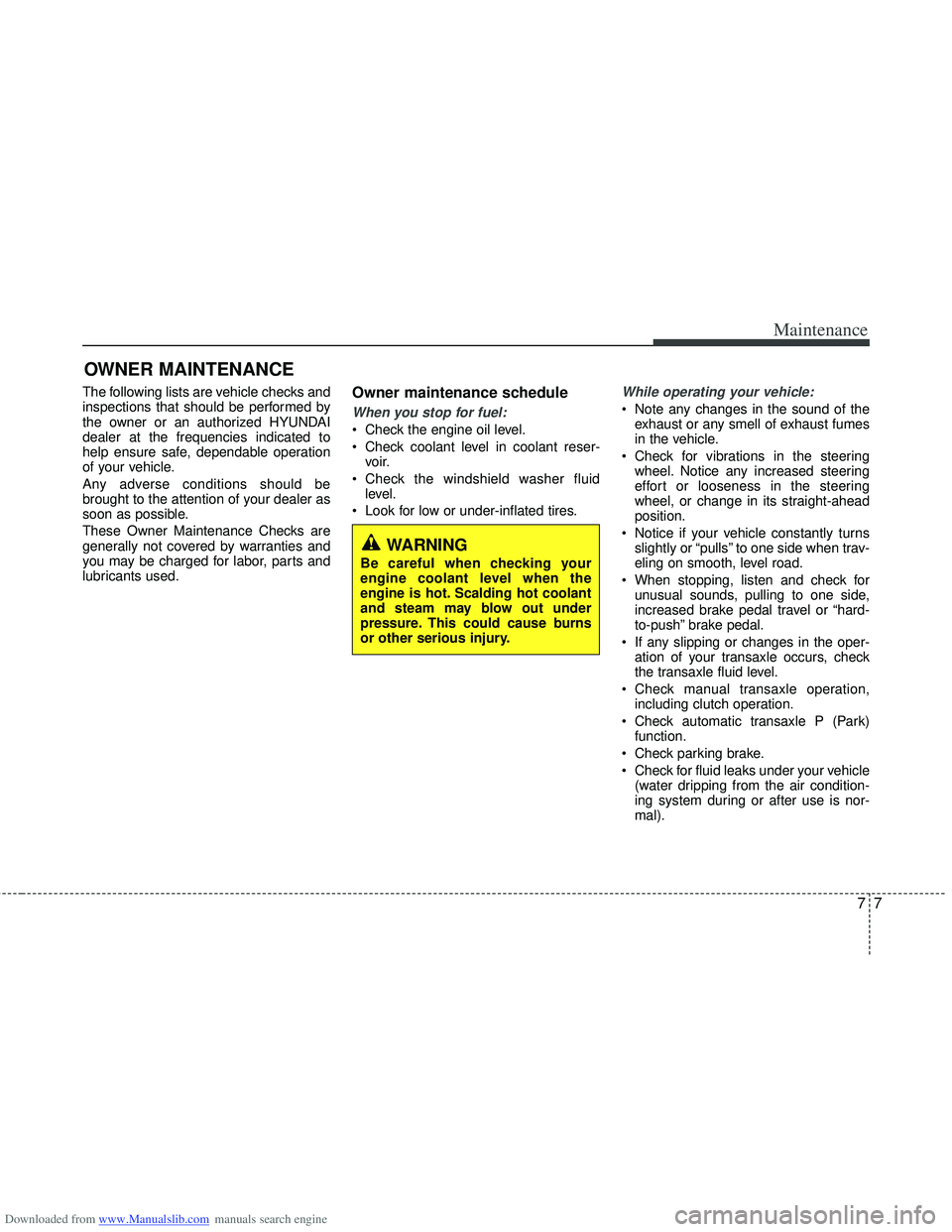
OWNER MAINTENANCE
The following lists are vehicle checks and
inspections that should be performed by
the owner or an authorized HYUNDAI
dealer at the frequencies indicated to
help ensure safe, dependable operation
of your vehicle.
Any adverse conditions should be
brought to the attention of your dealer as
soon as possible.
These Owner Maintenance Checks are
generally not covered by warranties and
you may be charged for labor, parts and
lubricants used.Owner maintenance schedule
When you stop for fuel:
Check the engine oil level.
Check coolant level in coolant reser-voir.
Check the windshield washer fluid level.
Look for low or under-inflated tires.
While operating your vehicle:
Note any changes in the sound of the exhaust or any smell of exhaust fumes
in the vehicle.
Check for vibrations in the steering wheel. Notice any increased steering
effort or looseness in the steering
wheel, or change in its straight-ahead
position.
Notice if your vehicle constantly turns slightly or “pulls” to one side when trav-
eling on smooth, level road.
When stopping, listen and check for unusual sounds, pulling to one side,
increased brake pedal travel or “hard-
to-push” brake pedal.
If any slipping or changes in the oper- ation of your transaxle occurs, check
the transaxle fluid level.
Check manual transaxle operation, including clutch operation.
Check automatic transaxle P (Park) function.
Check parking brake.
Check for fluid leaks under your vehicle (water dripping from the air condition-
ing system during or after use is nor-
mal).
WARNING
Be careful when checking your
engine coolant level when the
engine is hot. Scalding hot coolant
and steam may blow out under
pressure. This could cause burns
or other serious injury.
Page 415 of 534
Downloaded from www.Manualslib.com manuals search engine Maintenance
10
7
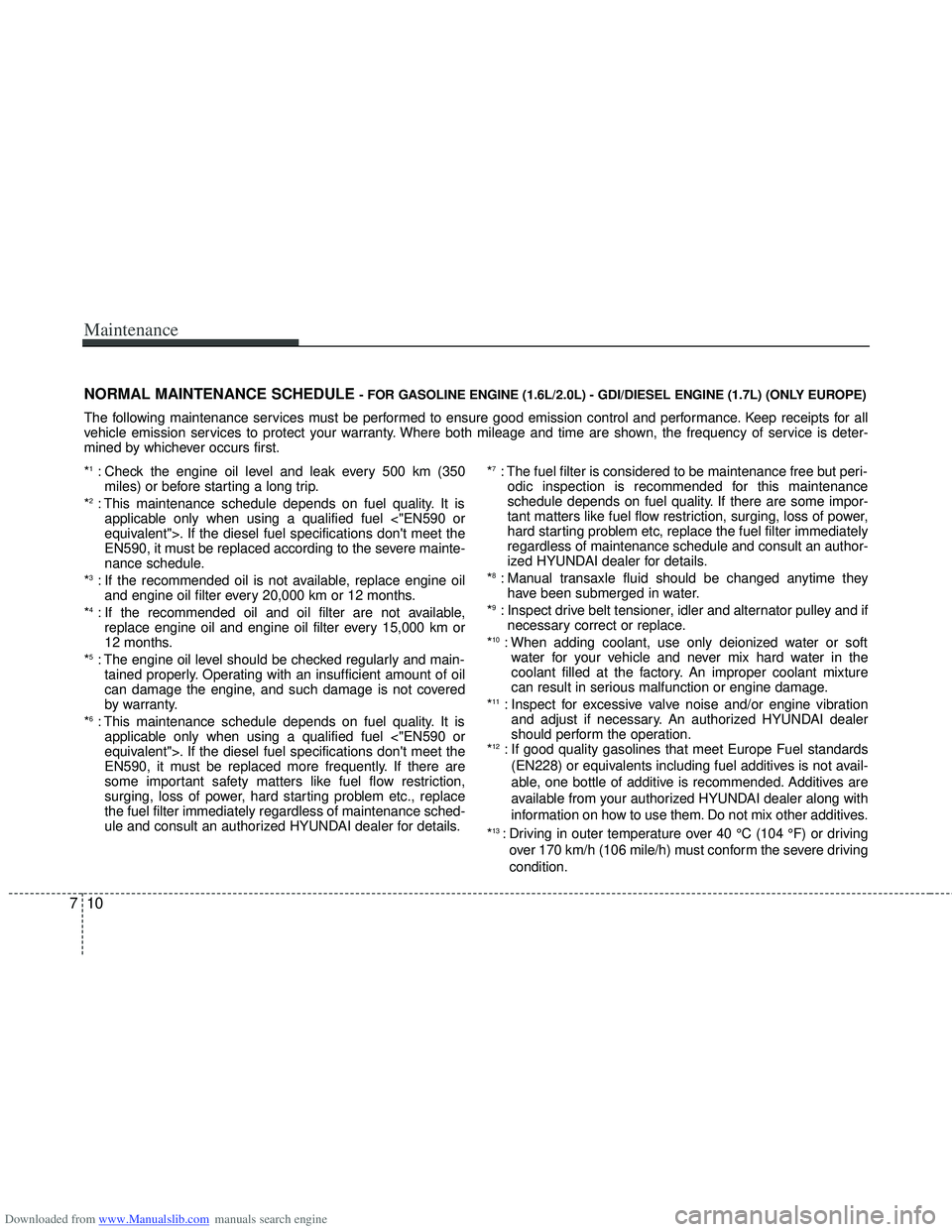
NORMAL MAINTENANCE SCHEDULE - FOR GASOLINE ENGINE (1.6L/2.0L) - GDI/DIESEL ENGINE (1.7L) (ONLY EUROPE)
The following maintenance services must be performed to ensure good emission control and performance. Keep receipts for all
vehicle emission services to protect your warranty. Where both mileage and time are shown, the frequency of service is deter-
mined by whichever occurs first.
*
1: Check the engine oil level and leak every 500 km (350
miles) or before starting a long trip.
*
2: This maintenance schedule depends on fuel quality. It is applicable only when using a qualified fuel <"EN590 or
equivalent">. If the diesel fuel specifications don't meet the
EN590, it must be replaced according to the severe mainte-
nance schedule.
*
3: If the recommended oil is not available, replace engine oil and engine oil filter every 20,000 km or 12 months.
*
4: If the recommended oil and oil filter are not available, replace engine oil and engine oil filter every 15,000 km or
12 months.
*
5: The engine oil level should be checked regularly and main- tained properly. Operating with an insufficient amount of oil
can damage the engine, and such damage is not covered
by warranty.
*
6: This maintenance schedule depends on fuel quality. It is applicable only when using a qualified fuel <"EN590 or
equivalent">. If the diesel fuel specifications don't meet the
EN590, it must be replaced more frequently. If there are
some important safety matters like fuel flow restriction,
surging, loss of power, hard starting problem etc., replace
the fuel filter immediately regardless of maintenance sched-
ule and consult an authorized HYUNDAI dealer for details. *
7: The fuel filter is considered to be maintenance free but peri-
odic inspection is recommended for this maintenance
schedule depends on fuel quality. If there are some impor-
tant matters like fuel flow restriction, surging, loss of power,
hard starting problem etc, replace the fuel filter immediately
regardless of maintenance schedule and consult an author-
ized HYUNDAI dealer for details.
*
8: Manual transaxle fluid should be changed anytime they have been submerged in water.
*
9: Inspect drive belt tensioner, idler and alternator pulley and if necessary correct or replace.
*
10: When adding coolant, use only deionized water or soft water for your vehicle and never mix hard water in the
coolant filled at the factory. An improper coolant mixture
can result in serious malfunction or engine damage.
*
11: Inspect for excessive valve noise and/or engine vibration and adjust if necessary. An authorized HYUNDAI dealer
should perform the operation.
*
12: If good quality gasolines that meet Europe Fuel standards
(EN228) or equivalents including fuel additives is not avail-
able, one bottle of additive is recommended. Additives are
available from your authorized HYUNDAI dealer along with
information on how to use them. Do not mix other additives.
*
13: Driving in outer temperature over 40 °C (104 °F) or driving over 170 km/h (106 mile/h) must conform the severe driving
condition.
Page 426 of 534
Downloaded from www.Manualslib.com manuals search engine 721
Maintenance
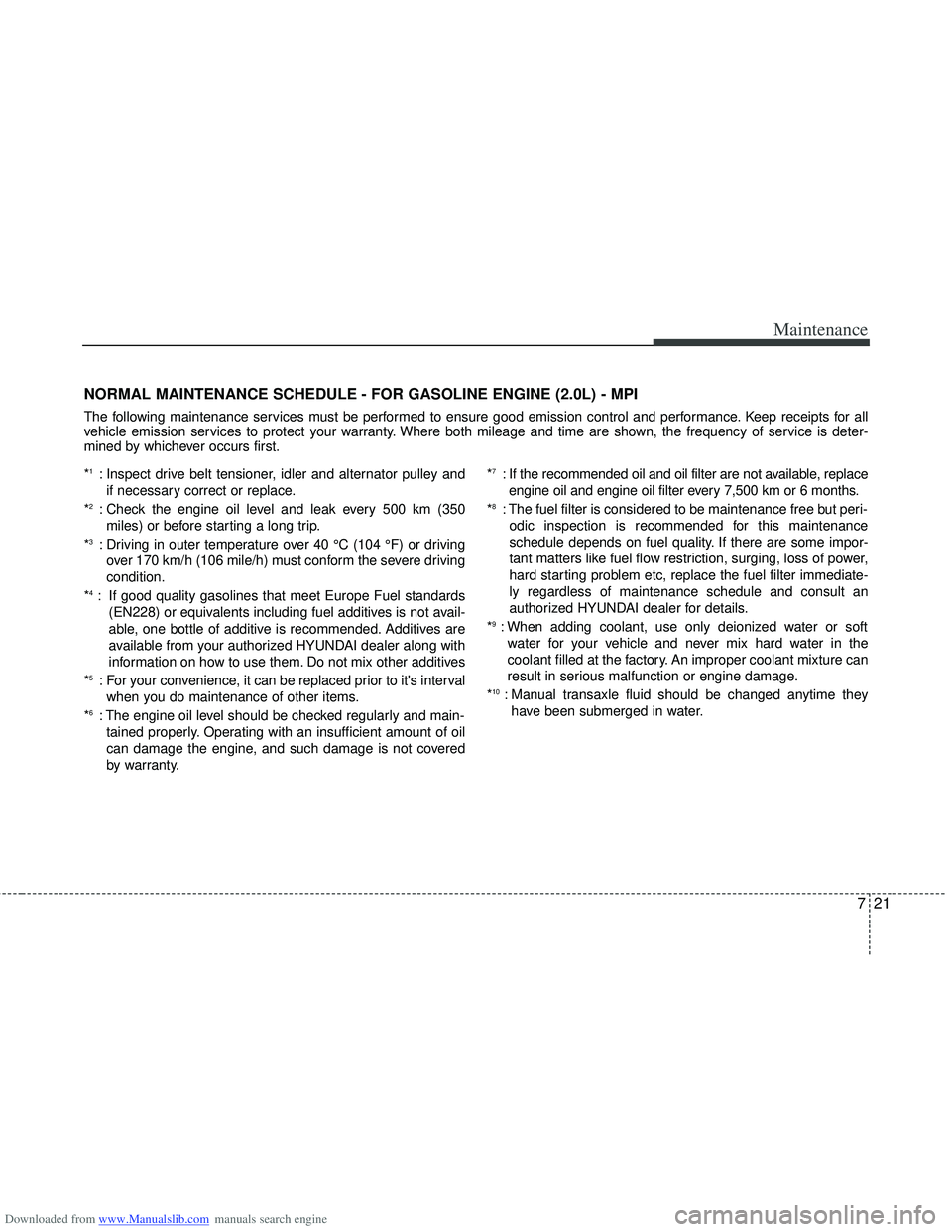
NORMAL MAINTENANCE SCHEDULE - FOR GASOLINE ENGINE (2.0L) - MPI
The following maintenance services must be performed to ensure good emission control and performance. Keep receipts for all
vehicle emission services to protect your warranty. Where both mileage and time are shown, the frequency of service is deter-
mined by whichever occurs first.
*
1: Inspect drive belt tensioner, idler and alternator pulley andif necessary correct or replace.
*
2: Check the engine oil level and leak every 500 km (350 miles) or before starting a long trip.
*
3: Driving in outer temperature over 40 °C (104 °F) or driving over 170 km/h (106 mile/h) must conform the severe driving
condition.
*
4: If good quality gasolines that meet Europe Fuel standards (EN228) or equivalents including fuel additives is not avail-
able, one bottle of additive is recommended. Additives are
available from your authorized HYUNDAI dealer along with
information on how to use them. Do not mix other additives
*
5: For your convenience, it can be replaced prior to it's interval when you do maintenance of other items.
*
6: The engine oil level should be checked regularly and main- tained properly. Operating with an insufficient amount of oil
can damage the engine, and such damage is not covered
by warranty. *
7: If the recommended oil and oil filter are not available, replace
engine oil and engine oil filter every 7,500 km or 6 months.
*
8: The fuel filter is considered to be maintenance free but peri- odic inspection is recommended for this maintenance
schedule depends on fuel quality. If there are some impor-
tant matters like fuel flow restriction, surging, loss of power,
hard starting problem etc, replace the fuel filter immediate-
ly regardless of maintenance schedule and consult an
authorized HYUNDAI dealer for details.
*
9: When adding coolant, use only deionized water or soft water for your vehicle and never mix hard water in the
coolant filled at the factory. An improper coolant mixture can
result in serious malfunction or engine damage.
*
10: Manual transaxle fluid should be changed anytime they have been submerged in water.
Page 437 of 534
Downloaded from www.Manualslib.com manuals search engine Maintenance
32
7
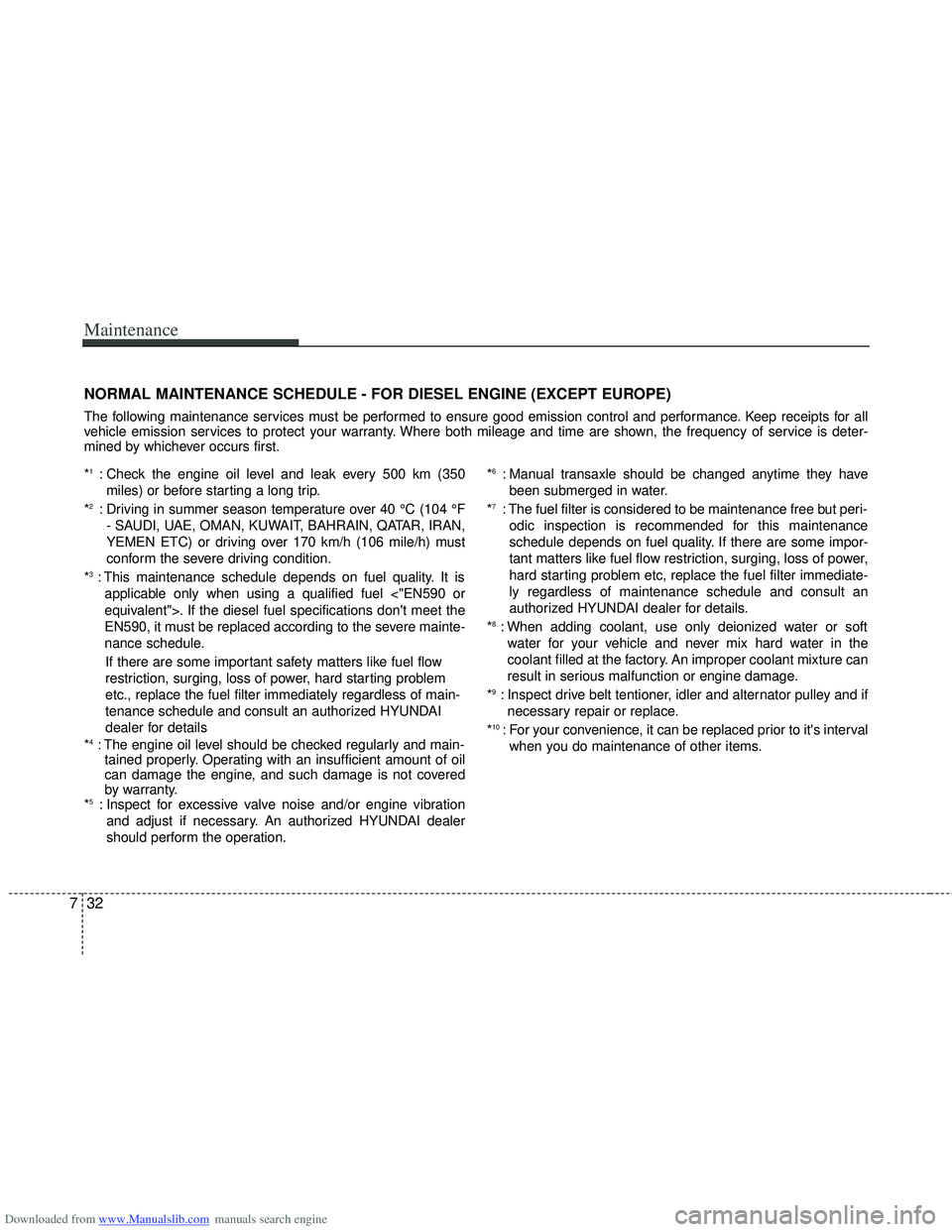
NORMAL MAINTENANCE SCHEDULE - FOR DIESEL ENGINE (EXCEPT EUROPE)
The following maintenance services must be performed to ensure good emission control and performance. Keep receipts for all
vehicle emission services to protect your warranty. Where both mileage and time are shown, the frequency of service is deter-
mined by whichever occurs first.
*
1: Check the engine oil level and leak every 500 km (350
miles) or before starting a long trip.
*
2: Driving in summer season temperature over 40 °C (104 °F - SAUDI, UAE, OMAN, KUWAIT, BAHRAIN, QATAR, IRAN,
YEMEN ETC) or driving over 170 km/h (106 mile/h) must
conform the severe driving condition.
*
3: This maintenance schedule depends on fuel quality. It is applicable only when using a qualified fuel <"EN590 or
equivalent">. If the diesel fuel specifications don't meet the
EN590, it must be replaced according to the severe mainte-
nance schedule.
If there are some important safety matters like fuel flow
restriction, surging, loss of power, hard starting problem
etc., replace the fuel filter immediately regardless of main-
tenance schedule and consult an authorized HYUNDAI
dealer for details
*
4: The engine oil level should be checked regularly and main- tained properly. Operating with an insufficient amount of oil
can damage the engine, and such damage is not covered
by warranty.
*
5: Inspect for excessive valve noise and/or engine vibration
and adjust if necessary. An authorized HYUNDAI dealer
should perform the operation. *
6: Manual transaxle should be changed anytime they have
been submerged in water.
*
7: The fuel filter is considered to be maintenance free but peri- odic inspection is recommended for this maintenance
schedule depends on fuel quality. If there are some impor-
tant matters like fuel flow restriction, surging, loss of power,
hard starting problem etc, replace the fuel filter immediate-
ly regardless of maintenance schedule and consult an
authorized HYUNDAI dealer for details.
*
8: When adding coolant, use only deionized water or soft water for your vehicle and never mix hard water in the
coolant filled at the factory. An improper coolant mixture can
result in serious malfunction or engine damage.
*
9: Inspect drive belt tentioner, idler and alternator pulley and if necessary repair or replace.
*
10: For your convenience, it can be replaced prior to it's interval when you do maintenance of other items.
Page 446 of 534
Downloaded from www.Manualslib.com manuals search engine 741
Maintenance
EXPLANATION OF SCHEDULED MAINTENANCE ITEMS
Engine oil and filter
The engine oil and filter should be
changed at the intervals specified in the
maintenance schedule. If the car is being
driven in severe conditions, more fre-
quent oil and filter changes are required.
Drive belts
Inspect all drive belts for evidence of
cuts, cracks, excessive wear or oil satu-
ration and replace if necessary. Drive
belts should be checked periodically for
proper tension and adjusted as neces-
sary.
Fuel filter (cartridge)
A clogged filter can limit the speed at
which the vehicle may be driven, damage
the emission system and cause multiple
issues such as hard starting. If an exces-
sive amount of foreign matter accumu-
lates in the fuel tank, the filter may
require replacement more frequently.
After installing a new filter, run the engine
for several minutes, and check for leaks
at the connections. Fuel filters should be
installed by an authorized HYUNDAI
dealer.
Fuel lines, fuel hoses and con-
nections
Check the fuel lines, fuel hoses and con-
nections for leakage and damage. Have
an authorized HYUNDAI dealer replace
any damaged or leaking parts immedi-
ately.
WARNING - Diesel only
Never work on injection system
with engine running or within 30
seconds after shutting off engine.
High pressure pump, rail, injectors
and high pressure pipes are sub-
ject to high pressure even after the
engine stopped. The fuel jet pro-
duced by fuel leaks may cause seri-
ous injury, if it touch the body.
People using pacemakers should
not move than 30cm closer to the
ECU or wiring harness within the
engine room while engine is run-
ning, since the high currents in the
Common Rail system produce con-
siderable magnetic fields.