engine HYUNDAI I800 2016 Owners Manual
[x] Cancel search | Manufacturer: HYUNDAI, Model Year: 2016, Model line: I800, Model: HYUNDAI I800 2016Pages: 419, PDF Size: 9.23 MB
Page 308 of 419
What to do in an emergency
4 6
IF THE ENGINE WILL NOT START
If engine cannot be cranked
1. If your car has an automatic transmis-
sion, be sure the gear selector lever is
in N (Neutral) or P (Park) and the
emergency brake is set.
2. Check the battery terminals and con-
nections to ensure that these are clean
and also tight.
3. If the ignition warning lights dim when
the engine is cranked and the battery
terminals have been checked, a dis-
charged battery is indicated.
4. Do not attempt to push or tow start the
vehicle, refer to "Jump Starting" for
information regarding engine starting
when the battery is discharged.
If engine turns over normally but
does not start
1. Check fuel level.
2. With the ignition switch in the LOCK
position, check all connectors at the
ignition coils and spark plugs.
Reconnect any that may be discon-
nected or loose.
3. Check the fuel line in the engine com-
partment.
4. If the engine still does not start, we
recommend that you call a HYUNDAI
authorised repairer.
WARNING
If the engine refuses to start, no
attempt should be made to push or
tow start the vehicle. Vehicles with
automatic transmission or fuel
injection will not be able to be start-
ed in this manner since no drive is
transmitted through the automatic
transmission whilst the engine is
not running, and in the case of fuel
injected derivatives, the fuel pump
will not operate under tow start
conditions. In addition, if the vehi-
cle is equipped with an exhaust cat-
alyst, damage to the catalyst may
result if the vehicle is tow started.
procarmanuals.com
Page 310 of 419
What to do in an emergency
6 6
Jump starting procedure
1. Make sure the booster battery is 12-
volt and that its negative terminal is
grounded.
2. If the booster battery is in another
vehicle, do not allow the vehicles to
touch.
3. Turn off all unnecessary electrical
loads.
4. Connect the jumper cables in the exact
sequence shown in the illustration.
First connect one end of a jumper
cable to the positive terminal of the
discharged battery (1), then connect
the other end to the positive terminal
on the booster battery (2).
Proceed to connect one end of the
other jumper cable to the negative ter-
minal of the booster battery (3), then
the other end to a solid, stationary,
metallic point (for example, the engine
lifting bracket) away from the battery
(4). Do not connect it to or near any
part that moves when the engine is
cranked.Do not allow the jumper cables to con-
tact anything except the correct battery
terminals or the correct ground. Do not
lean over the battery when making
connections.
5. Start the engine of the vehicle with the
booster battery and let it run at 2,000
rpm, then start the engine of the vehi-
cle with the discharged battery.
If the cause of your battery discharging is
not apparent, we recommend that the
system be checked by a HYUNDAI
authorised repairer.
Push-starting
Your manual transmission-equipped
vehicle should not be push-started
because it might damage the emission
control system.
Vehicles equipped with automatic trans-
mission cannot be push-started.
Follow the directions in this section for
jump-starting.
CAUTION- Battery cables
Do not connect the jumper cable
from the negative terminal of the
booster battery to the negative ter-
minal of the discharged battery.
This can cause the discharged bat-
tery to overheat and crack, releas-
ing battery acid.
WARNING
Never tow a vehicle to start it
because the sudden surge forward
when the engine starts could cause
a collision with the tow vehicle.
procarmanuals.com
Page 311 of 419
67
What to do in an emergency
IF THE ENGINE OVERHEATS
If your temperature gauge indicates over-
heating, you experience a loss of power,
or hear loud pinging or knocking, the
engine is probably too hot. If this hap-
pens, you should:
1. Pull off the road and stop as soon as it
is safe to do so.
2. Place the gear selector lever in P
(automatic transmission) or neutral
(manual transmission) and set the
parking brake. If the air conditioning is
on, turn it off.
3. If engine coolant is running out under
the car or steam is coming out from
the bonnet, stop the engine. Do not
open the bonnet until the coolant has
stopped running or the steaming has
stopped. If there is no visible loss of
engine coolant and no steam, leave
the engine running and check to be
sure the engine cooling fan is operat-
ing. If the fan is not running, turn the
engine off.4. Check to see if the water pump drive
belt is missing. If it is not missing,
check to see that it is tight. If the drive
belt seems to be satisfactory, check
for coolant leaking from the radiator,
hoses or under the car. (If the air con-
ditioning had been in use, it is normal
for cold water to be draining from it
when you stop).
5. If the water pump drive belt is broken
or engine coolant is leaking out, stop
the engine immediately and we recom-
mend that you call a HYUNDAI autho-
rised repairer.6. If the cause of the overheating cannot
be found, wait until the engine temper-
ature has returned to normal. Then, if
coolant has been lost, carefully add
coolant to the reservoir to bring the
fluid level in the reservoir up to the
base of the radiator fill opening. Fill the
coolant expansion tank to the halfway
mark. To ensure the correct water to
coolant mix is obtained after top up,
testing by an authorised repairer is
required.
7. Proceed with caution until it is estab-
lished that the engine is operating nor-
mally. If overheating happens again,
we recommend that you call a
HYUNDAI authorised repairer.
CAUTION
• Serious loss of coolant indicates
there is a leak in the cooling sys-
tem and we recommend that the
system be checked by a HYUNDAI
authorised repairer.
• When the engine overheats from
low engine coolant, suddenly
adding engine coolant may cause
cracks in the engine. To prevent
damage, add engine coolant
slowly in small quantities.
WARNING
Whilst the engine is running, keep
hair, hands and clothing away from
moving parts such as the fan and
drive belts to prevent injury.
WARNING
Do not remove the radiator cap
when the engine is hot since steam
and boiling water may be ejected
from the radiator resulting in burns
or scalding.
procarmanuals.com
Page 313 of 419
69
What to do in an emergency
Your vehicle has also been equipped
with a TPMS malfunction indicator to
indicate when the system is not
operating properly. The TPMS mal-
function indicator is combined with
the low tyre pressure telltale. When
the system detects a malfunction,
the telltale will flash for approximate-
ly one minute and then remain con-
tinuously illuminated. This sequence
will continue upon subsequent vehi-
cle start-ups as long as the malfunc-
tion exists. When the malfunction
indicator is illuminated, the system
may not be able to detect or signal
low tyre pressure as intended.
TPMS malfunctions may occur for a
variety of reasons, including the
installation of replacement or alter-
nate tyres or wheels on the vehicle
that prevent the TPMS from function-
ing properly. Always check the TPMS
malfunction telltale after replacing
one or more tyres or wheels on your
vehicle to ensure that the replace-
ment or alternate tyres and wheels
allow the TPMS to continue to func-
tion properly.✽NOTICE
If the TPMS Low Tyre Pressure
Telltale does not illuminate for three
seconds when the ignition switch is
in the ON position or when the
engine starts, or if it remains illumi-
nated after coming on for approxi-
mately three seconds, we recom-
mend that you contact a HYUNDAI
authorised repairer.
Low Tyre Pressure
Telltale
The TPMS is not a substitute for
manually checking tyre pressure with
a tyre pressure gauge. Changes in
temperature affect tyre pressure.
See “Tyres and Wheels” in chapter 9
for proper tyre inflating and tyre pres-
sure measurement procedures.
If the telltale illuminates, immediately
reduce your speed, avoid hard cor-
nering and anticipate increased stop-
ping distances. You should stop and
check your tyres as soon as possi-
ble. Inflate the tyres to the proper
pressure as indicated on the vehi-
cle’s placard or tyre inflation pres-
sure label located on the driver’s side
door jamb. If you cannot reach a
service station or if the tyre cannot
hold the newly added air, replace the
low pressure tyre with the spare tyre.
procarmanuals.com
Page 317 of 419
613
What to do in an emergency
Removing and storing the spare
tyre
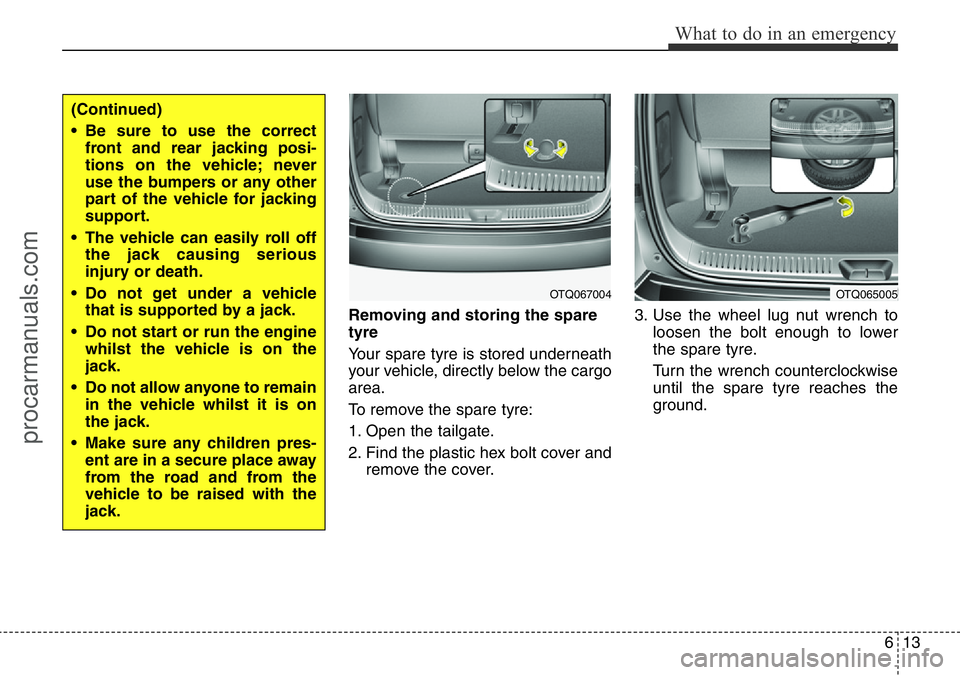
Your spare tyre is stored underneath
your vehicle, directly below the cargo
area.
To remove the spare tyre:
1. Open the tailgate.
2. Find the plastic hex bolt cover and
remove the cover.3. Use the wheel lug nut wrench to
loosen the bolt enough to lower
the spare tyre.
Turn the wrench counterclockwise
until the spare tyre reaches the
ground.
OTQ067004
(Continued)
• Be sure to use the correct
front and rear jacking posi-
tions on the vehicle; never
use the bumpers or any other
part of the vehicle for jacking
support.
• The vehicle can easily roll off
the jack causing serious
injury or death.
• Do not get under a vehicle
that is supported by a jack.
• Do not start or run the engine
whilst the vehicle is on the
jack.
• Do not allow anyone to remain
in the vehicle whilst it is on
the jack.
• Make sure any children pres-
ent are in a secure place away
from the road and from the
vehicle to be raised with the
jack.
OTQ065005
procarmanuals.com
Page 324 of 419
What to do in an emergency
20 6
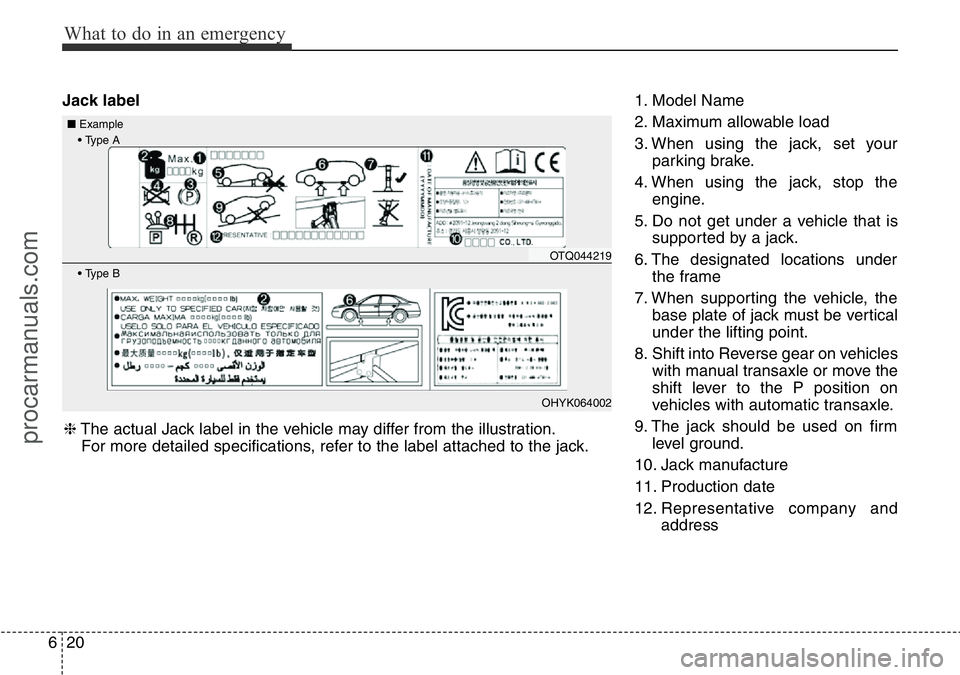
Jack label1. Model Name
2. Maximum allowable load
3. When using the jack, set your
parking brake.
4. When using the jack, stop the
engine.
5. Do not get under a vehicle that is
supported by a jack.
6. The designated locations under
the frame
7. When supporting the vehicle, the
base plate of jack must be vertical
under the lifting point.
8. Shift into Reverse gear on vehicles
with manual transaxle or move the
shift lever to the P position on
vehicles with automatic transaxle.
9. The jack should be used on firm
level ground.
10. Jack manufacture
11. Production date
12. Representative company and
address ❈The actual Jack label in the vehicle may differ from the illustration.
For more detailed specifications, refer to the label attached to the jack.
• Type A ■Example
• Type B
OTQ044219
OHYK064002
procarmanuals.com
Page 331 of 419
7
Engine compartment / 7-2
Maintenance services / 7-4
Owner maintenance / 7-6
Scheduled maintenance service / 7-8
Explanation of scheduled maintenance items / 7-9
Engine oil / 7-13
Engine coolant / 7-15
Brake and clutch fluid / 7-18
Power steering fluid / 7-19
Automatic transmission fluid / 7-20
Washer fluid / 7-22
Parking brake / 7-22
Fuel filter (for diesel) / 7-23
Air cleaner / 7-24
Climate control air filter / 7-25
Wiper blades / 7-27
Battery / 7-30
Tyres and wheels / 7-33
Fuses / 7-45
Light bulbs / 7-54
Appearance care / 7-62
Emission control system / 7-69
• Selective catalytic reduction / 7-72
• Urea gauge / 7-72
• Low urea warning message / 7-73
• Malfunction with the scr system / 7-74
• Clearing the vehicle-restarting restriction / 7-75
• Adding the urea solution / 7-76
• Storing the urea solution / 7-78
• Urea solution purity / 7-79
Maintenance
procarmanuals.com
Page 332 of 419
Maintenance
2 7
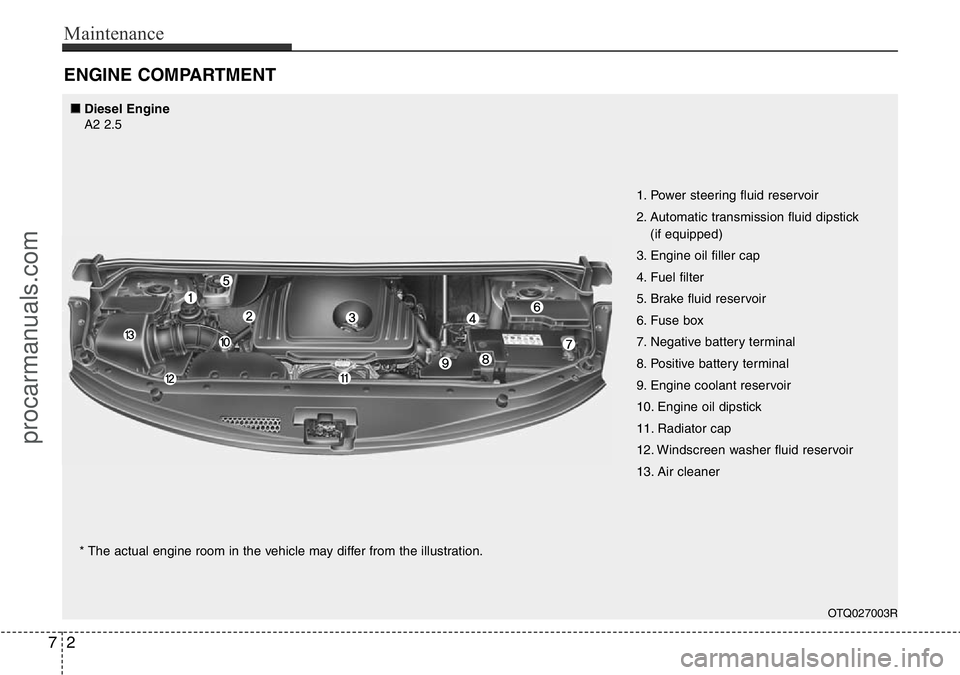
ENGINE COMPARTMENT
OTQ027003R
1. Power steering fluid reservoir
2. Automatic transmission fluid dipstick
(if equipped)
3. Engine oil filler cap
4. Fuel filter
5. Brake fluid reservoir
6. Fuse box
7. Negative battery terminal
8. Positive battery terminal
9. Engine coolant reservoir
10. Engine oil dipstick
11. Radiator cap
12. Windscreen washer fluid reservoir
13. Air cleaner
* The actual engine room in the vehicle may differ from the illustration.
■Diesel Engine
A2 2.5
procarmanuals.com
Page 333 of 419
73
Maintenance
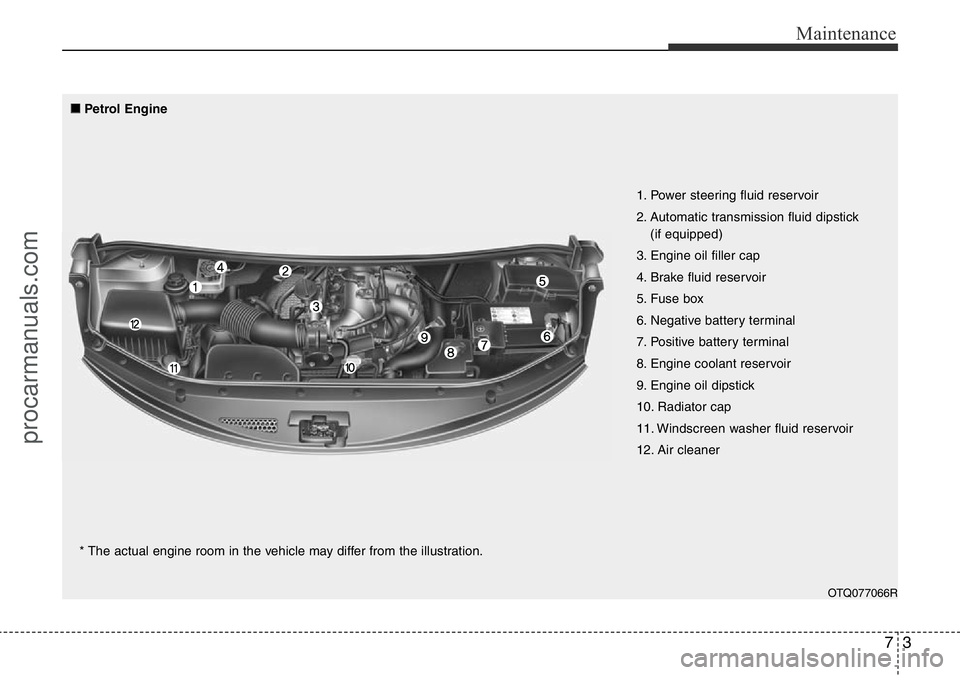
OTQ077066R
1. Power steering fluid reservoir
2. Automatic transmission fluid dipstick
(if equipped)
3. Engine oil filler cap
4. Brake fluid reservoir
5. Fuse box
6. Negative battery terminal
7. Positive battery terminal
8. Engine coolant reservoir
9. Engine oil dipstick
10. Radiator cap
11. Windscreen washer fluid reservoir
12. Air cleaner
■Petrol Engine
* The actual engine room in the vehicle may differ from the illustration.
procarmanuals.com
Page 335 of 419
75
Maintenance
WARNING- Maintenance
work
• Performing maintenance work on
a vehicle can be dangerous. You
can be seriously injured whilst
performing some maintenance
procedures. If you lack sufficient
knowledge and experience or the
proper tools and equipment to do
the work, we recommend that the
system be servied by a HYUNDAI
authorised repairer.
• Working under the bonnet with
the engine running is dangerous.
It becomes even more dangerous
when you wear jewellery or loose
clothing. These can become
entangled in moving parts and
result in injury. Therefore, if you
must run the engine whilst work-
ing under the bonnet, make cer-
tain that you remove all jewellery
(especially rings, bracelets,
watches, and necklaces) and all
neckties, scarves, and similar
loose clothing before getting
near the engine or cooling fans.
WARNING- Diesel Engine
Never work on injection system
with engine running or within 30
seconds after shutting off engine.
High-pressure pump, rail, injectors
and high-pressure pipes are sub-
ject to high pressure even after the
engine stopped. The fuel jet pro-
duced by fuel leaks may cause seri-
ous injury, if it touches the body.
People using pacemakers should
not move than 30cm closer to the
ECU or wiring harness within the
engine room whilst engine is run-
ning, since the high currents in the
electronic engine control system
produce considerable magnetic
fields.
CAUTION
• Do not put heavy objects or apply
excessive force on top of the
engine cover (if equipped) or fuel
related parts.
• When you inspect the fuel system
(fuel lines and fuel injection
devices), we recommend that you
contact a HYUNDAI authorised
repairer.
• Do not drive long time with the
engine cover (if equipped) removed.
• When checking the engine room,
do not go near fire.
Fuel, washer fluid, etc. are flam-
mable oils that may cause fire.
• Before touching the battery, igni-
tion cables and electrical wiring,
you should disconnect the bat-
tery "-" terminal. You may get an
electric shock from the electric
current.
• When you remove the interior
trim cover with a flat head (-) driv-
er, be careful not to damage the
cover.
• Be careful when you replace and
clean bulbs to avoid burns or
electrical shock.
procarmanuals.com