speed HYUNDAI I800 2016 Owners Manual
[x] Cancel search | Manufacturer: HYUNDAI, Model Year: 2016, Model line: I800, Model: HYUNDAI I800 2016Pages: 419, PDF Size: 9.23 MB
Page 395 of 419
765
Maintenance
Aluminum wheel maintenance
The aluminum wheels are coated with a
clear protective finish.
• Do not use any abrasive cleaner, pol-
ishing compound, solvent, or wire
brushes on aluminum wheels. They
may scratch or damage the finish.
• Clean the wheel when it has cooled.
• Use only a mild soap or neutral deter-
gent, and rinse thoroughly with water.
Also, be sure to clean the wheels after
driving on salted roads. This helps pre-
vent corrosion.
• Avoid washing the wheels with high-
speed car wash brushes.
• Do not use any alkaline or acid deter-
gent. It may damage and corrode the
aluminum wheels coated with a clear
protective finish.
Corrosion protection
Protecting your vehicle from corrosion
In using the most advanced design and
construction practices, every HYUNDAI
is built to retain its original factory finish
for many years. However, long term dura-
bility is also greatly dependant upon
maintaining the various protection sys-
tems and coatings used in manufacture
since constant exposure to the elements
will eventually result in their breakdown
and loss of effectiveness. The following
suggestions are made to assist in the
maintenance of the vehicle bodywork.
Common causes of corrosion
The most common causes of corrosion
on your car are:
• Road salt, dirt and moisture that is
allowed to accumulate underneath the
car.
• Removal of paint or protective coatings
by stones, gravel, abrasion or minor
scrapes and dents which leave unpro-
tected metal exposed to corrosion.High-corrosion areas
If you live in an area where your car is
regularly exposed to corrosive materials,
corrosion protection is particularly impor-
tant. Some of the common causes of
accelerated corrosion are road salts,
dust control chemicals, ocean air and
industrial pollution.
procarmanuals.com
Page 401 of 419
771
Maintenance
Operating precautions for catalytic
converters (if equipped)Your vehicle is equipped with a catalytic
converter emission control device.
Therefore, the following precautions
must be observed:
• Use only UNLEADED FUEL for petrol
engines.
• Do not operate the vehicle when there
are signs of engine malfunction, such
as misfire or a noticeable loss of per-
formance.
• Do not misuse or abuse the engine.
Examples of misuse are coasting with
the ignition off and descending steep
grades in gear with the ignition off.
• Do not operate the engine at high idle
speed for extended periods (5 minutes
or more).
• Do not modify or tamper with any part
of the engine or emission control sys-
tem. We recommend that the system
be inspected by a HYUNDAI autho-
rised repairer.
• Avoid driving with a very low fuel level.
If you run out of petrol, it could cause
the engine to misfire and result in
excessive loading of the catalytic con-
verter.
Failure to observe these precautions
could result in damage to the catalytic
converter and to your vehicle.
Additionally, such actions could void your
warranties.Diesel Particulate Filter (if equipped)
The Diesel Particulate Filter (DPF) sys-
tem removes the soot in the exhaust gas.
Unlike a disposable air filter, the DPF
system automatically burns (oxidizes)
and removes the accumulated soot
according to the driving condition. In
other words, the active burning by engine
control system and high exhaust gas
temperature caused by normal/high driv-
ing condition burns and removes the
accumulated soot.
However, if the vehicle continues to be
driven at repeated short distance or driv-
en at low speed for a long time, the accu-
mulate soot may not be automatically
removed because of low exhaust gas
temperature. More than a certain amount
of soot deposited, the malfunction indica-
tor light ( ) illuminates.
When the malfunction indicator light
blinks, it may stop blinking by driving the
vehicle at more than 37 mph (60km/h) or
at more than second gear with 1500 ~
2500 engine rpm for a certain time (for
about 25 minutes).
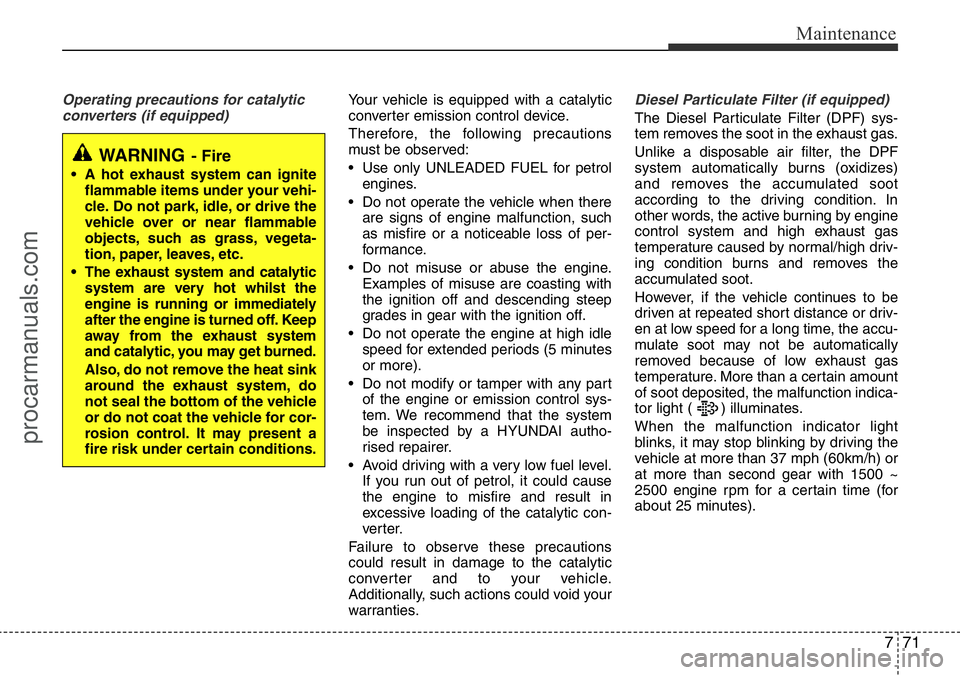
WARNING- Fire
• A hot exhaust system can ignite
flammable items under your vehi-
cle. Do not park, idle, or drive the
vehicle over or near flammable
objects, such as grass, vegeta-
tion, paper, leaves, etc.
• The exhaust system and catalytic
system are very hot whilst the
engine is running or immediately
after the engine is turned off. Keep
away from the exhaust system
and catalytic, you may get burned.
Also, do not remove the heat sink
around the exhaust system, do
not seal the bottom of the vehicle
or do not coat the vehicle for cor-
rosion control. It may present a
fire risk under certain conditions.
procarmanuals.com
Page 414 of 419
9
Dimensions / 9-2
Bulb wattage / 9-2
Tyres and wheels / 9-3
Load and speed capacity of tyre / 9-3
Recommended lubricants and capacities / 9-4
Specifications
procarmanuals.com
Page 416 of 419
93
Specifications
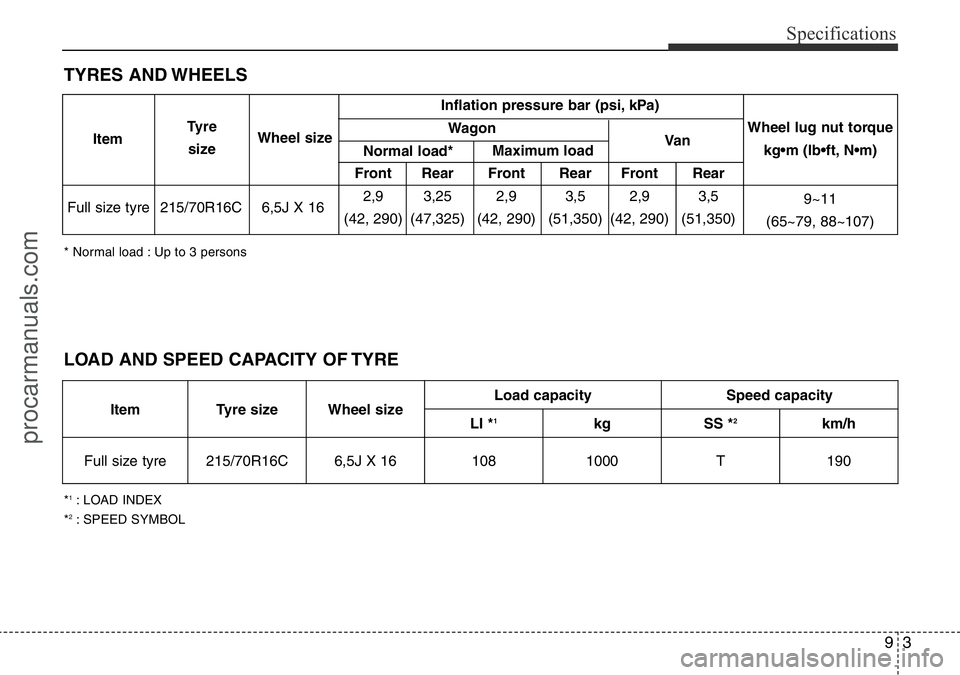
TYRES AND WHEELS
* Normal load : Up to 3 persons
*
1: LOAD INDEX
*2: SPEED SYMBOL
Inflation pressure bar (psi, kPa)
Wagon
Front Rear Front Rear Front Rear
215/70R16C 6,5J X 162,9 3,25 2,9 3,5 2,9 3,5
(42, 290) (47,325) (42, 290) (51,350) (42, 290) (51,350)
Full size tyreWheel lug nut torque
kg•m (lb•ft, N•m)
9~11
(65~79, 88~107) ItemTyre
sizeWheel size
Normal load*Maximum loadVa n
ItemTyre sizeWheel sizeLoad capacitySpeed capacity
LI *1kgSS *2km/h
Full size tyre215/70R16C6,5J X 161081000T190
LOAD AND SPEED CAPACITY OF TYRE
procarmanuals.com
Page 419 of 419
Specifications
6 9
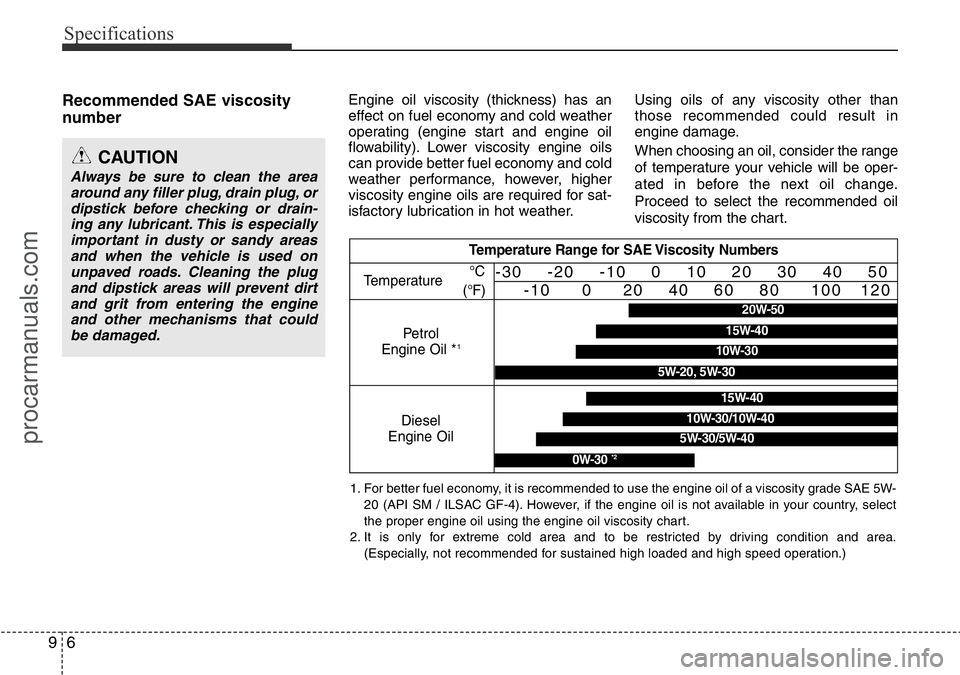
Recommended SAE viscosity
number Engine oil viscosity (thickness) has an
effect on fuel economy and cold weather
operating (engine start and engine oil
flowability). Lower viscosity engine oils
can provide better fuel economy and cold
weather performance, however, higher
viscosity engine oils are required for sat-
isfactory lubrication in hot weather.Using oils of any viscosity other than
those recommended could result in
engine damage.
When choosing an oil, consider the range
of temperature your vehicle will be oper-
ated in before the next oil change.
Proceed to select the recommended oil
viscosity from the chart.
CAUTION
Always be sure to clean the area
around any filler plug, drain plug, or
dipstick before checking or drain-
ing any lubricant. This is especially
important in dusty or sandy areas
and when the vehicle is used on
unpaved roads. Cleaning the plug
and dipstick areas will prevent dirt
and grit from entering the engine
and other mechanisms that could
be damaged.
Temperature Range for SAE Viscosity Numbers
Temperature
Petrol
Engine Oil *
1
°C
(°F)-30 -20 -10 0 10 20 30 40 50
-10 0 20 40 60 80 100 120
Diesel
Engine Oil
5W-30/5W-40
15W-40
10W-30/10W-40
0W-30 *2
1. For better fuel economy, it is recommended to use the engine oil of a viscosity grade SAE 5W-
20 (API SM / ILSAC GF-4). However, if the engine oil is not available in your country, select
the proper engine oil using the engine oil viscosity chart.
2. It is only for extreme cold area and to be restricted by driving condition and area.
(Especially, not recommended for sustained high loaded and high speed operation.)
20W-50
10W-30
15W-40
5W-20, 5W-30
procarmanuals.com