heater HYUNDAI I800 2016 User Guide
[x] Cancel search | Manufacturer: HYUNDAI, Model Year: 2016, Model line: I800, Model: HYUNDAI I800 2016Pages: 419, PDF Size: 9.23 MB
Page 248 of 419
Driving your vehicle
2 5
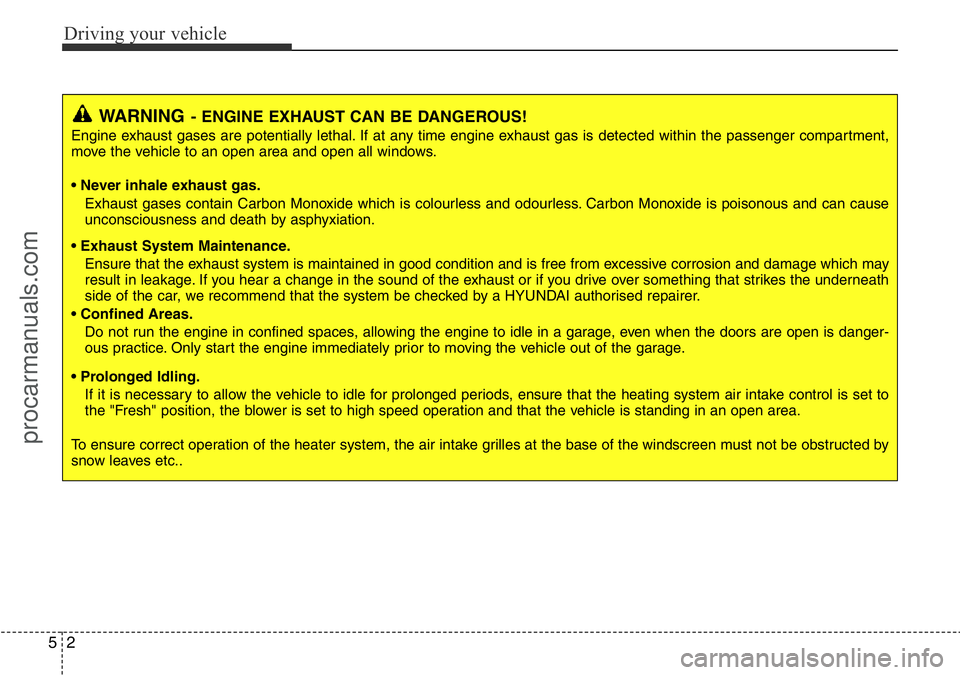
WARNING- ENGINE EXHAUST CAN BE DANGEROUS!
Engine exhaust gases are potentially lethal. If at any time engine exhaust gas is detected within the passenger compartment,
move the vehicle to an open area and open all windows.
• Never inhale exhaust gas.
Exhaust gases contain Carbon Monoxide which is colourless and odourless. Carbon Monoxide is poisonous and can cause
unconsciousness and death by asphyxiation.
• Exhaust System Maintenance.
Ensure that the exhaust system is maintained in good condition and is free from excessive corrosion and damage which may
result in leakage. If you hear a change in the sound of the exhaust or if you drive over something that strikes the underneath
side of the car, we recommend that the system be checked by a HYUNDAI authorised repairer.
• Confined Areas.
Do not run the engine in confined spaces, allowing the engine to idle in a garage, even when the doors are open is danger-
ous practice. Only start the engine immediately prior to moving the vehicle out of the garage.
• Prolonged Idling.
If it is necessary to allow the vehicle to idle for prolonged periods, ensure that the heating system air intake control is set to
the "Fresh" position, the blower is set to high speed operation and that the vehicle is standing in an open area.
To ensure correct operation of the heater system, the air intake grilles at the base of the windscreen must not be obstructed by
snow leaves etc..
procarmanuals.com
Page 337 of 419
77
Maintenance
At least monthly:
• Check coolant level in the engine
coolant reservoir.
• Check the operation of all exterior
lights, including the stoplights, turn sig-
nals and hazard warning flashers.
• Check the inflation pressures of all
tyres including the spare.
At least twice a year
(i.e., every Spring and Fall) :
• Check radiator, heater and air condi-
tioning hoses for leaks or damage.
• Check windscreen washer spray and
wiper operation. Clean wiper blades
with clean cloth dampened with wash-
er fluid.
• Check headlight alignment.
• Check muffler, exhaust pipes, shields
and clamps.
• Check the lap/shoulder belts for wear
and function.
• Check for worn tyres and loose wheel
lug nuts.
At least once a year:
• Clean body and door drain holes.
• Lubricate door hinges and checks, and
bonnet hinges.
• Lubricate door and bonnet locks and
latches.
• Lubricate door rubber weatherstrips.
• Check the air conditioning system.
• Check the power steering fluid level.
• Inspect and lubricate automatic trans-
mission linkage and controls.
• Clean battery and terminals.
• Check the brake fluid level.
procarmanuals.com
Page 346 of 419
Maintenance
16 7
Check the condition and connections of
all cooling system hoses and heater
hoses. Replace any swollen or deterio-
rated hoses.
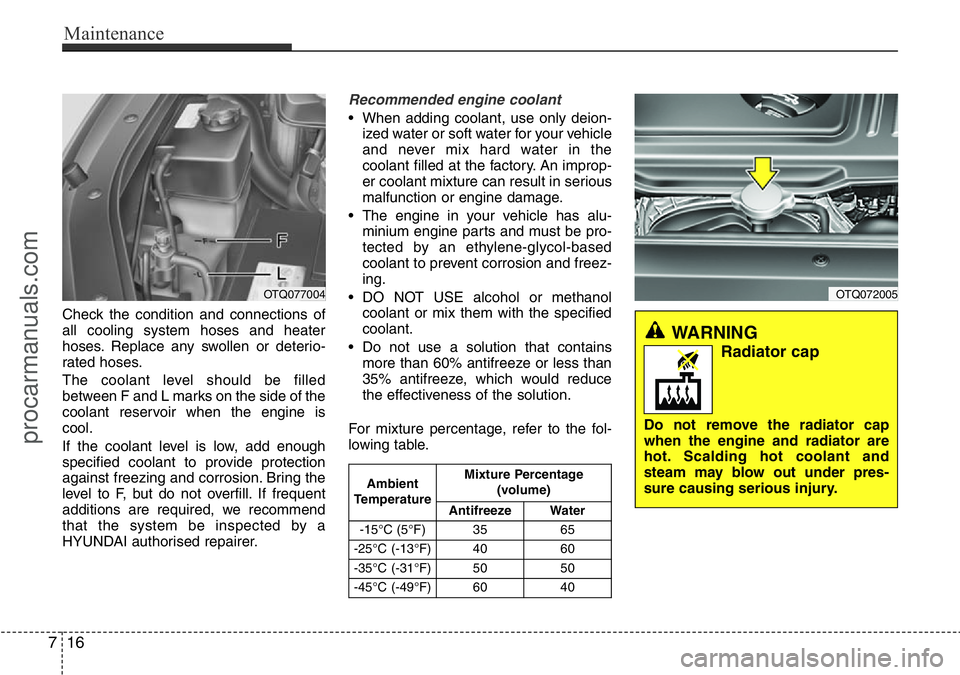
The coolant level should be filled
between F and L marks on the side of the
coolant reservoir when the engine is
cool.
If the coolant level is low, add enough
specified coolant to provide protection
against freezing and corrosion. Bring the
level to F, but do not overfill. If frequent
additions are required, we recommend
that the system be inspected by a
HYUNDAI authorised repairer.
Recommended engine coolant
• When adding coolant, use only deion-
ized water or soft water for your vehicle
and never mix hard water in the
coolant filled at the factory. An improp-
er coolant mixture can result in serious
malfunction or engine damage.
• The engine in your vehicle has alu-
minium engine parts and must be pro-
tected by an ethylene-glycol-based
coolant to prevent corrosion and freez-
ing.
• DO NOT USE alcohol or methanol
coolant or mix them with the specified
coolant.
• Do not use a solution that contains
more than 60% antifreeze or less than
35% antifreeze, which would reduce
the effectiveness of the solution.
For mixture percentage, refer to the fol-
lowing table.
OTQ077004
WARNING
Radiator cap
Do not remove the radiator cap
when the engine and radiator are
hot. Scalding hot coolant and
steam may blow out under pres-
sure causing serious injury.
OTQ072005
Ambient
TemperatureMixture Percentage
(volume)
Antifreeze Water
-15°C (5°F) 35 65
-25°C (-13°F) 40 60
-35°C (-31°F) 50 50
-45°C (-49°F) 60 40
procarmanuals.com
Page 380 of 419
Maintenance
50 7
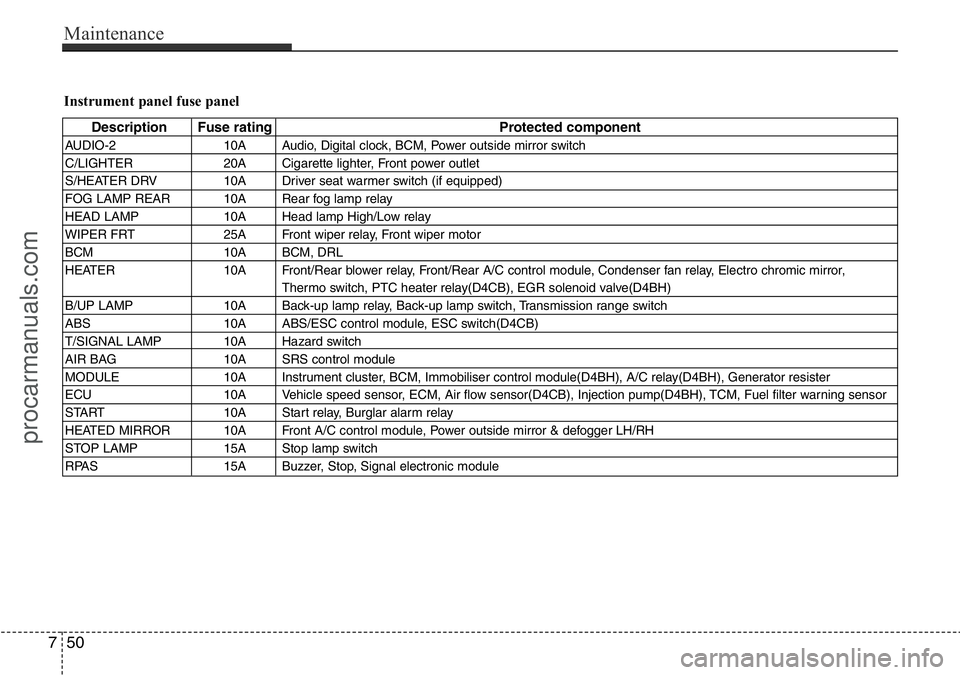
Instrument panel fuse panel
Description Fuse rating Protected component
AUDIO-2 10A Audio, Digital clock, BCM, Power outside mirror switch
C/LIGHTER 20A Cigarette lighter, Front power outlet
S/HEATER DRV 10A Driver seat warmer switch (if equipped)
FOG LAMP REAR 10A Rear fog lamp relay
HEAD LAMP 10A Head lamp High/Low relay
WIPER FRT 25A Front wiper relay, Front wiper motor
BCM 10A BCM, DRL
HEATER 10A Front/Rear blower relay, Front/Rear A/C control module, Condenser fan relay, Electro chromic mirror,
Thermo switch, PTC heater relay(D4CB), EGR solenoid valve(D4BH)
B/UP LAMP 10A Back-up lamp relay, Back-up lamp switch, Transmission range switch
ABS 10A ABS/ESC control module, ESC switch(D4CB)
T/SIGNAL LAMP 10A Hazard switch
AIR BAG 10A SRS control module
MODULE 10A Instrument cluster, BCM, Immobiliser control module(D4BH), A/C relay(D4BH), Generator resister
ECU 10A Vehicle speed sensor, ECM, Air flow sensor(D4CB), Injection pump(D4BH), TCM, Fuel filter warning sensor
START 10A Start relay, Burglar alarm relay
HEATED MIRROR 10A Front A/C control module, Power outside mirror & defogger LH/RH
STOP LAMP 15A Stop lamp switch
RPAS 15A Buzzer, Stop, Signal electronic module
procarmanuals.com
Page 382 of 419
Maintenance
52 7
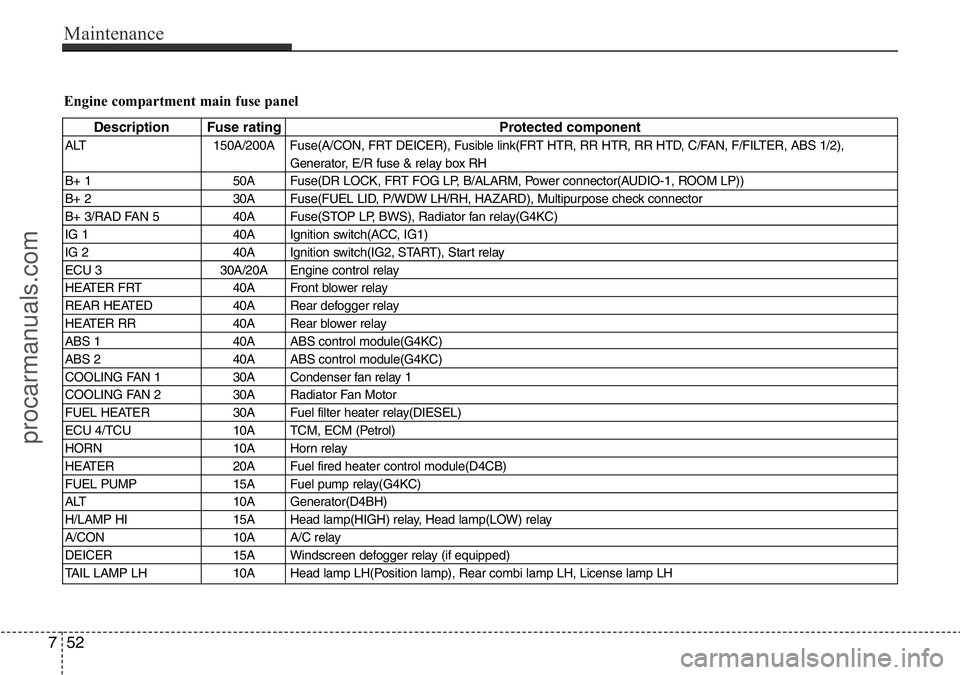
Engine compartment main fuse panel
Description Fuse rating Protected component
ALT 150A/200A Fuse(A/CON, FRT DEICER), Fusible link(FRT HTR, RR HTR, RR HTD, C/FAN, F/FILTER, ABS 1/2),
Generator, E/R fuse & relay box RH
B+ 1 50A Fuse(DR LOCK, FRT FOG LP, B/ALARM, Power connector(AUDIO-1, ROOM LP))
B+ 2 30A Fuse(FUEL LID, P/WDW LH/RH, HAZARD), Multipurpose check connector
B+ 3/RAD FAN 5 40A Fuse(STOP LP, BWS), Radiator fan relay(G4KC)
IG 1 40A Ignition switch(ACC, IG1)
IG 2 40A Ignition switch(IG2, START), Start relay
ECU 3 30A/20A Engine control relay
HEATER FRT 40A Front blower relay
REAR HEATED 40A Rear defogger relay
HEATER RR 40A Rear blower relay
ABS 1 40A ABS control module(G4KC)
ABS 2 40A ABS control module(G4KC)
COOLING FAN 1 30A Condenser fan relay 1
COOLING FAN 2 30A Radiator Fan Motor
FUEL HEATER 30A Fuel filter heater relay(DIESEL)
ECU 4/TCU 10A TCM, ECM (Petrol)
HORN 10A Horn relay
HEATER 20A Fuel fired heater control module(D4CB)
FUEL PUMP 15A Fuel pump relay(G4KC)
ALT 10A Generator(D4BH)
H/LAMP HI 15A Head lamp(HIGH) relay, Head lamp(LOW) relay
A/CON 10A A/C relay
DEICER 15A Windscreen defogger relay (if equipped)
TAIL LAMP LH 10A Head lamp LH(Position lamp), Rear combi lamp LH, License lamp LH
procarmanuals.com
Page 383 of 419
753
Maintenance
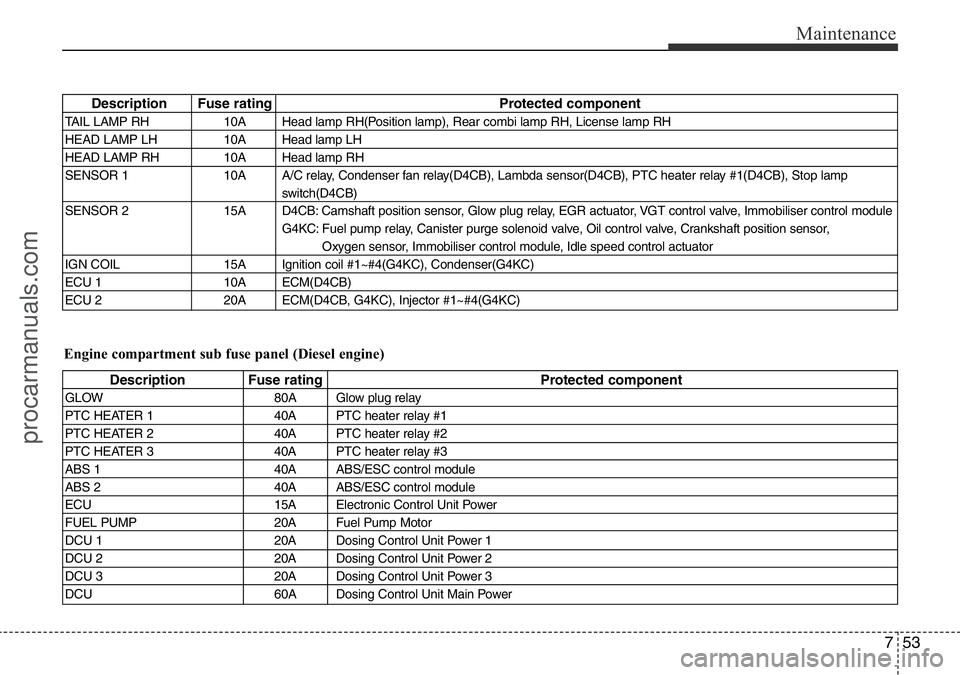
Description Fuse rating Protected component
TAIL LAMP RH 10A Head lamp RH(Position lamp), Rear combi lamp RH, License lamp RH
HEAD LAMP LH 10A Head lamp LH
HEAD LAMP RH 10A Head lamp RH
SENSOR 1 10A A/C relay, Condenser fan relay(D4CB), Lambda sensor(D4CB), PTC heater relay #1(D4CB), Stop lamp
switch(D4CB)
SENSOR 2 15A D4CB: Camshaft position sensor, Glow plug relay, EGR actuator, VGT control valve, Immobiliser control module
G4KC: Fuel pump relay, Canister purge solenoid valve, Oil control valve, Crankshaft position sensor,
Oxygen sensor, Immobiliser control module, Idle speed control actuator
IGN COIL 15A Ignition coil #1~#4(G4KC), Condenser(G4KC)
ECU 1 10A ECM(D4CB)
ECU 2 20A ECM(D4CB, G4KC), Injector #1~#4(G4KC)
Engine compartment sub fuse panel (Diesel engine)
Description Fuse rating Protected component
GLOW 80A Glow plug relay
PTC HEATER 1 40A PTC heater relay #1
PTC HEATER 2 40A PTC heater relay #2
PTC HEATER 3 40A PTC heater relay #3
ABS 1 40A ABS/ESC control module
ABS 2 40A ABS/ESC control module
ECU 15A Electronic Control Unit Power
FUEL PUMP 20A Fuel Pump Motor
DCU 1 20A Dosing Control Unit Power 1
DCU 2 20A Dosing Control Unit Power 2
DCU 3 20A Dosing Control Unit Power 3
DCU 60A Dosing Control Unit Main Power
procarmanuals.com
Page 410 of 419
Maintenance
80 7
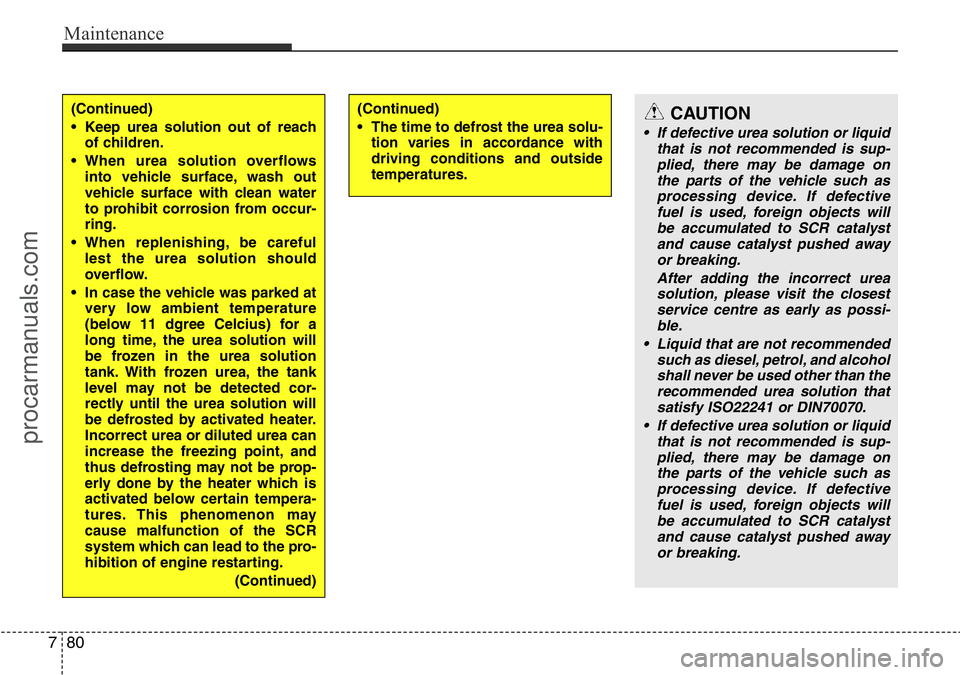
CAUTION
• If defective urea solution or liquid
that is not recommended is sup-
plied, there may be damage on
the parts of the vehicle such as
processing device. If defective
fuel is used, foreign objects will
be accumulated to SCR catalyst
and cause catalyst pushed away
or breaking.
After adding the incorrect urea
solution, please visit the closest
service centre as early as possi-
ble.
• Liquid that are not recommended
such as diesel, petrol, and alcohol
shall never be used other than the
recommended urea solution that
satisfy ISO22241 or DIN70070.
• If defective urea solution or liquid
that is not recommended is sup-
plied, there may be damage on
the parts of the vehicle such as
processing device. If defective
fuel is used, foreign objects will
be accumulated to SCR catalyst
and cause catalyst pushed away
or breaking.
(Continued)
• The time to defrost the urea solu-
tion varies in accordance with
driving conditions and outside
temperatures.(Continued)
• Keep urea solution out of reach
of children.
• When urea solution overflows
into vehicle surface, wash out
vehicle surface with clean water
to prohibit corrosion from occur-
ring.
• When replenishing, be careful
lest the urea solution should
overflow.
• In case the vehicle was parked at
very low ambient temperature
(below 11 dgree Celcius) for a
long time, the urea solution will
be frozen in the urea solution
tank. With frozen urea, the tank
level may not be detected cor-
rectly until the urea solution will
be defrosted by activated heater.
Incorrect urea or diluted urea can
increase the freezing point, and
thus defrosting may not be prop-
erly done by the heater which is
activated below certain tempera-
tures. This phenomenon may
cause malfunction of the SCR
system which can lead to the pro-
hibition of engine restarting.
(Continued)
procarmanuals.com