Seat HYUNDAI I800 2016 Owner's Manual
[x] Cancel search | Manufacturer: HYUNDAI, Model Year: 2016, Model line: I800, Model: HYUNDAI I800 2016Pages: 419, PDF Size: 9.23 MB
Page 34 of 419
319
Safety features of your vehicle
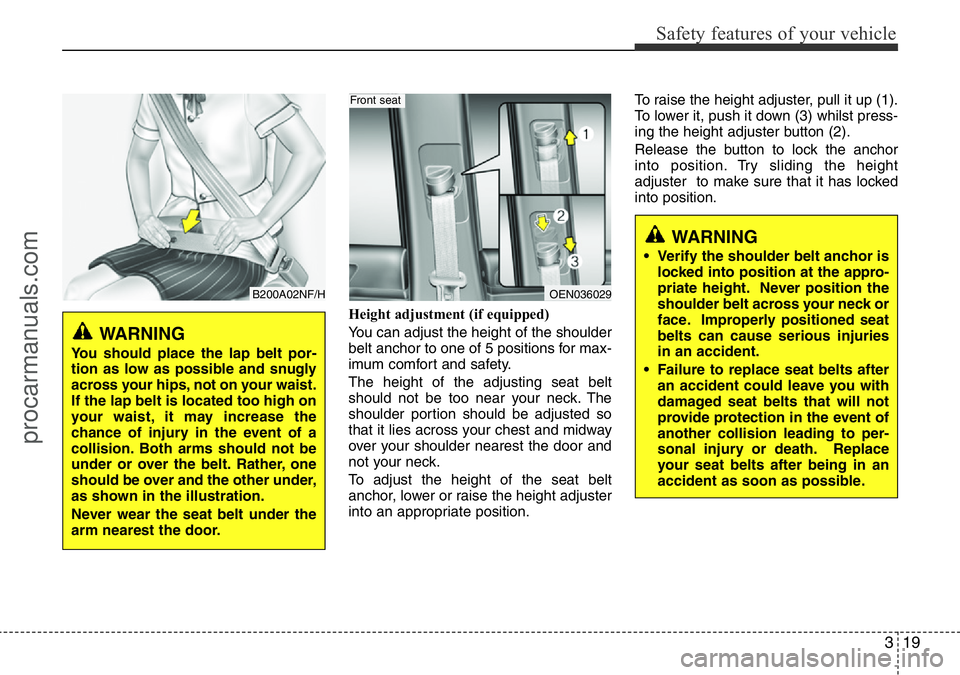
Height adjustment (if equipped)
You can adjust the height of the shoulder
belt anchor to one of 5 positions for max-
imum comfort and safety.
The height of the adjusting seat belt
should not be too near your neck. The
shoulder portion should be adjusted so
that it lies across your chest and midway
over your shoulder nearest the door and
not your neck.
To adjust the height of the seat belt
anchor, lower or raise the height adjuster
into an appropriate position.To raise the height adjuster, pull it up (1).
To lower it, push it down (3) whilst press-
ing the height adjuster button (2).
Release the button to lock the anchor
into position. Try sliding the height
adjuster to make sure that it has locked
into position.
B200A02NF/H
WARNING
You should place the lap belt por-
tion as low as possible and snugly
across your hips, not on your waist.
If the lap belt is located too high on
your waist, it may increase the
chance of injury in the event of a
collision. Both arms should not be
under or over the belt. Rather, one
should be over and the other under,
as shown in the illustration.
Never wear the seat belt under the
arm nearest the door.
WARNING
• Verify the shoulder belt anchor is
locked into position at the appro-
priate height. Never position the
shoulder belt across your neck or
face. Improperly positioned seat
belts can cause serious injuries
in an accident.
• Failure to replace seat belts after
an accident could leave you with
damaged seat belts that will not
provide protection in the event of
another collision leading to per-
sonal injury or death. Replace
your seat belts after being in an
accident as soon as possible.
OEN036029
Front seat
procarmanuals.com
Page 35 of 419
Safety features of your vehicle
20 3
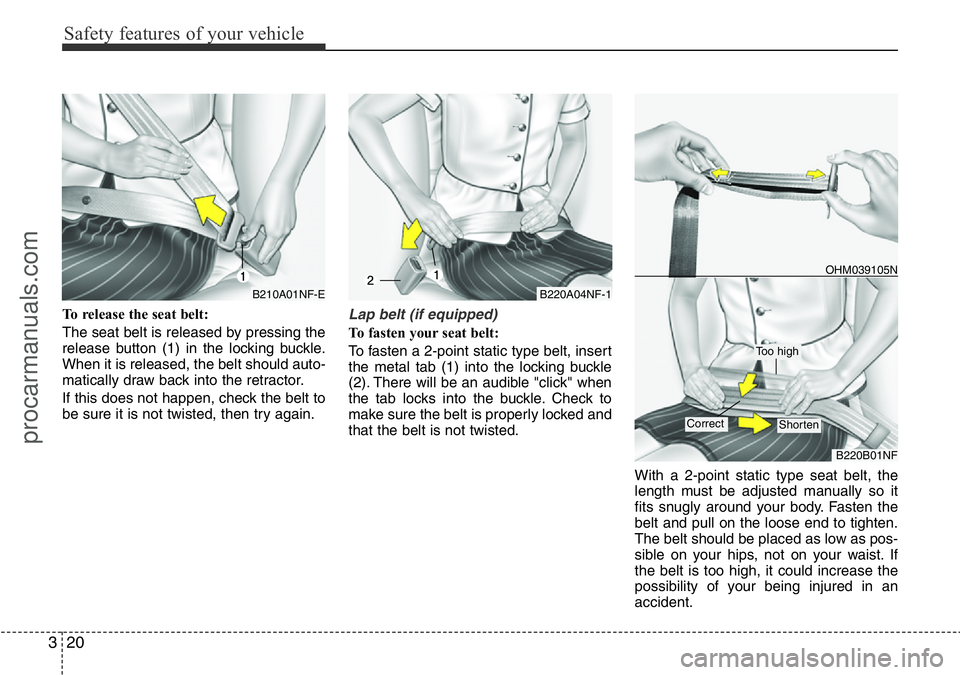
To release the seat belt:
The seat belt is released by pressing the
release button (1) in the locking buckle.
When it is released, the belt should auto-
matically draw back into the retractor.
If this does not happen, check the belt to
be sure it is not twisted, then try again.Lap belt (if equipped)
To fasten your seat belt:
To fasten a 2-point static type belt, insert
the metal tab (1) into the locking buckle
(2). There will be an audible "click" when
the tab locks into the buckle. Check to
make sure the belt is properly locked and
that the belt is not twisted.
With a 2-point static type seat belt, the
length must be adjusted manually so it
fits snugly around your body. Fasten the
belt and pull on the loose end to tighten.
The belt should be placed as low as pos-
sible on your hips, not on your waist. If
the belt is too high, it could increase the
possibility of your being injured in an
accident.
B210A01NF-EB220A04NF-1
OHM039105N
B220B01NF
Too high
ShortenCorrect
procarmanuals.com
Page 36 of 419
321
Safety features of your vehicle
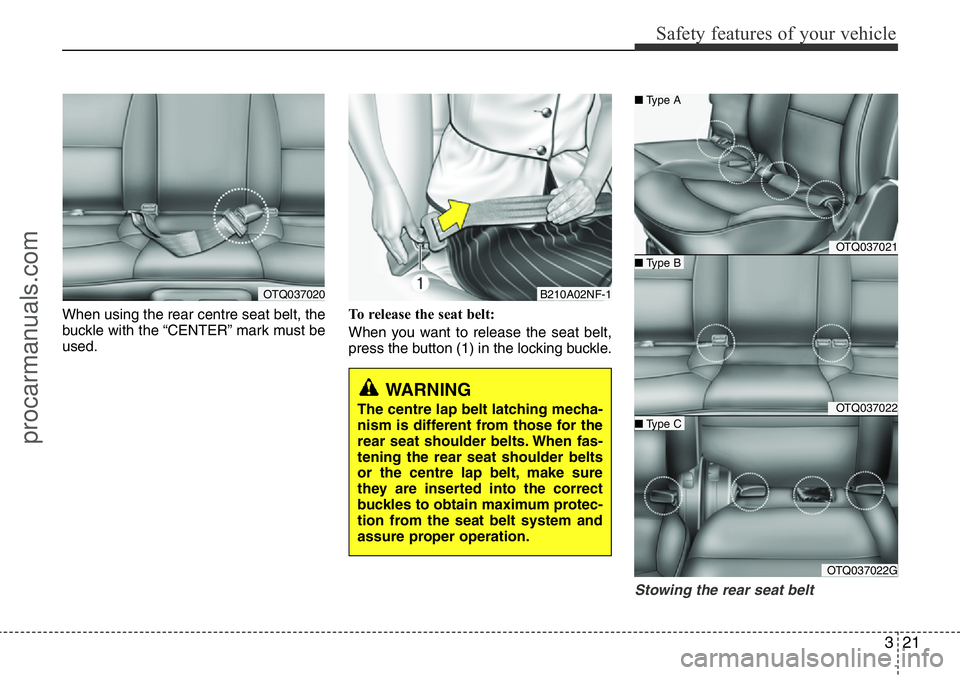
When using the rear centre seat belt, the
buckle with the “CENTER” mark must be
used.To release the seat belt:
When you want to release the seat belt,
press the button (1) in the locking buckle.
Stowing the rear seat belt
OTQ037020B210A02NF-1
WARNING
The centre lap belt latching mecha-
nism is different from those for the
rear seat shoulder belts. When fas-
tening the rear seat shoulder belts
or the centre lap belt, make sure
they are inserted into the correct
buckles to obtain maximum protec-
tion from the seat belt system and
assure proper operation.
OTQ037021
OTQ037022
OTQ037022G
■Type B ■Type A
■Type C
procarmanuals.com
Page 37 of 419
Safety features of your vehicle
22 3
• The rear seat belt buckles can be
stowed in the pocket between the rear
seatback and cushion when not in use.
• The centre seat belt can be stowed
with the plate and webbing rolled in the
pocket between the rear seatback and
cushion.
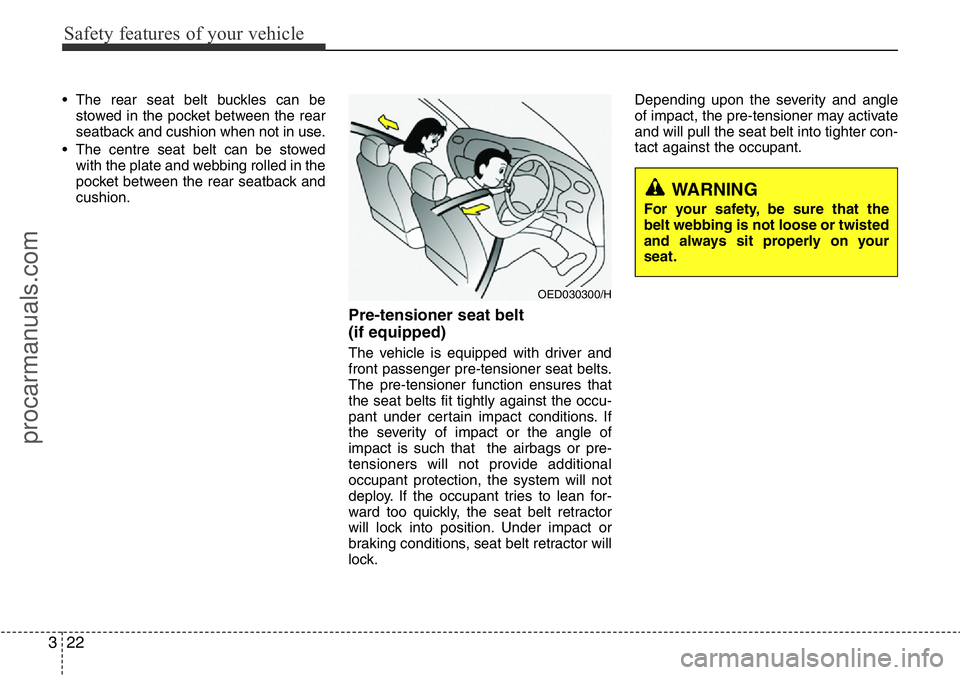
Pre-tensioner seat belt
(if equipped)
The vehicle is equipped with driver and
front passenger pre-tensioner seat belts.
The pre-tensioner function ensures that
the seat belts fit tightly against the occu-
pant under certain impact conditions. If
the severity of impact or the angle of
impact is such that the airbags or pre-
tensioners will not provide additional
occupant protection, the system will not
deploy. If the occupant tries to lean for-
ward too quickly, the seat belt retractor
will lock into position. Under impact or
braking conditions, seat belt retractor will
lock.Depending upon the severity and angle
of impact, the pre-tensioner may activate
and will pull the seat belt into tighter con-
tact against the occupant.
OED030300/H
WARNING
For your safety, be sure that the
belt webbing is not loose or twisted
and always sit properly on your
seat.
procarmanuals.com
Page 38 of 419
323
Safety features of your vehicle
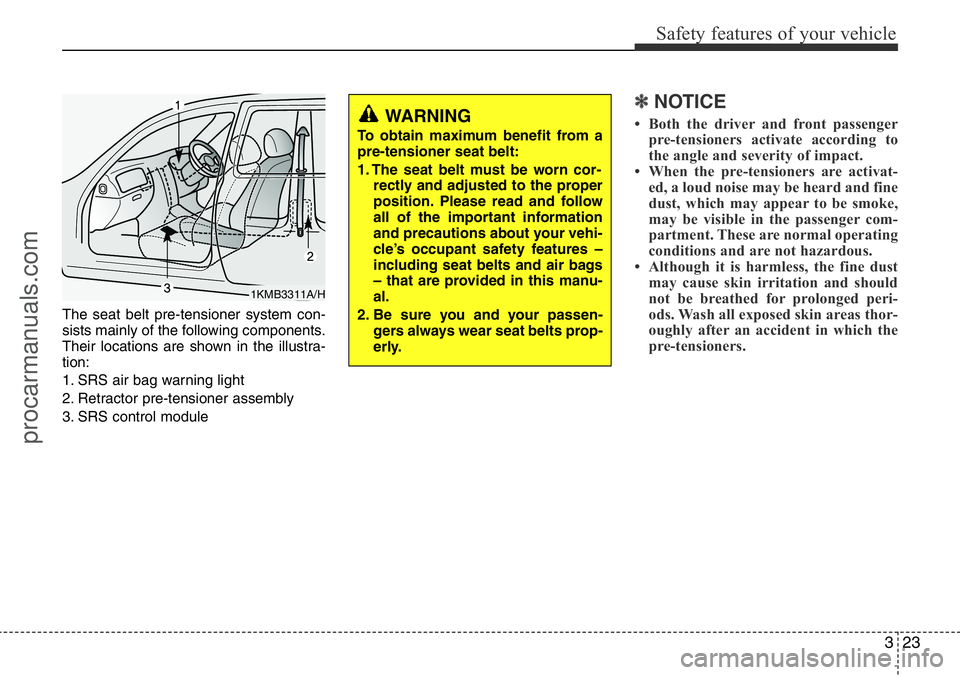
The seat belt pre-tensioner system con-
sists mainly of the following components.
Their locations are shown in the illustra-
tion:
1. SRS air bag warning light
2. Retractor pre-tensioner assembly
3. SRS control module
✽NOTICE
• Both the driver and front passenger
pre-tensioners activate according to
the angle and severity of impact.
• When the pre-tensioners are activat-
ed, a loud noise may be heard and fine
dust, which may appear to be smoke,
may be visible in the passenger com-
partment. These are normal operating
conditions and are not hazardous.
• Although it is harmless, the fine dust
may cause skin irritation and should
not be breathed for prolonged peri-
ods. Wash all exposed skin areas thor-
oughly after an accident in which the
pre-tensioners.
1KMB3311A/H
WARNING
To obtain maximum benefit from a
pre-tensioner seat belt:
1. The seat belt must be worn cor-
rectly and adjusted to the proper
position. Please read and follow
all of the important information
and precautions about your vehi-
cle’s occupant safety features –
including seat belts and air bags
– that are provided in this manu-
al.
2. Be sure you and your passen-
gers always wear seat belts prop-
erly.
procarmanuals.com
Page 39 of 419
Safety features of your vehicle
24 3
✽NOTICE
Because the sensor that activates the
SRS air bag is connected with the pre-
tensioner seat belt, the SRS air bag
warning light on the instrument
panel will illuminate for approximately
6 seconds after the ignition switch has
been turned to the ON position, and
then it should turn off.
CAUTION
If the pre-tensioner seat belt is not
working properly, this warning light
will illuminate even if there is no
malfunction of the SRS air bag.
If the SRS air bag warning light
does not illuminate when the igni-
tion switch is turned to ON, or if it
remains illuminated after illuminat-
ing for approximately 6 seconds, or
if it illuminates whilst the vehicle is
being driven, we recommend that
the system be inspected by a
HYUNDAI authorised repairer.
WARNING
• Pre-tensioners are designed to
operate only one time. After acti-
vation, pre-tensioner seat belts
must be replaced. All seat belts,
of any type, should always be
replaced after they have been
worn during a collision.
• The pre-tensioner seat belt
assembly mechanisms become
hot during activation. Do not
touch the pre-tensioner seat belt
assemblies for several minutes
after they have been activated.
• Do not attempt to inspect or
replace the pre-tensioner seat
belts yourself. We recommend
that the system be inspected by a
HYUNDAI authorised repairer.
• Do not strike the pre-tensioner
seat belt assemblies.
• Do not attempt to service or
repair the pre-tensioner seat belt
system in any manner.
(Continued)
(Continued)
• Improper handling of the pre-ten-
sioner seat belt assemblies, and
failure to heed the warnings not
to strike, modify, inspect, replace,
service or repair the pre-tension-
er seat belt assemblies may lead
to improper operation or inadver-
tent activation and serious injury.
• Always wear the seat belts when
driving or riding in a motor vehi-
cle.
• If the vehicle or pre-tensioner
seat belt must be discarded, we
recommend that you contact a
HYUNDAI authorised repairer.
procarmanuals.com
Page 40 of 419
325
Safety features of your vehicle
Seat belt precautionsInfant or small child
You should be aware of the specific
requirements in your country. Child
and/or infant seats must be properly
placed and installed in the rear seat. For
more information about the use of these
restraints, refer to “Child restraint sys-
tem” in this section.
WARNING
All occupants of the vehicle must
wear their seat belts at all times.
Seat belts and child restraints
reduce the risk of serious or fatal
injuries for all occupants in the
event of a collision or sudden stop.
Without a seat belt, occupants
could be shifted too close to a
deploying air bag, strike the interior
structure or be thrown from the
vehicle. Properly worn seat belts
greatly reduce these hazards.
Always follow the precautions
about seat belts, air bags and occu-
pant seating contained in this man-
ual.
WARNING
Every person in your vehicle needs
to be properly restrained at all
times, including infants and chil-
dren. Never hold a child in your
arms or lap when riding in a vehi-
cle. The violent forces created dur-
ing a crash will tear the child from
your arms and throw the child
against the interior. Always use a
child restraint appropriate for your
child's height and weight.
CAUTION
Body work on the front area of the
vehicle may damage the pre-ten-
sioner seat belt system. Therefore,
we recommend that the system be
serviced by a HYUNDAI authorised
repairer.
procarmanuals.com
Page 41 of 419
Safety features of your vehicle
26 3
✽NOTICE
Small children are best protected from
injury in an accident when properly
restrained in the rear seat by a child
restraint system that meets the require-
ments of the Safety Standards of your
country. Before buying any child
restraint system, make sure that it has a
label certifying that it meets Safety
Standards of your country. The restraint
must be appropriate for your child's
height and weight. Check the label on
the child restraint for this information.
Refer to “Child restraint system” in this
section.
Larger children
Children who are too large for child
restraint systems should always occupy
the rear seat and use the available
lap/shoulder belts. The lap portion should
be fastened snug on the hips and as low
as possible. Check belt fit periodically. A
child's squirming could put the belt out of
position. Children are afforded the most
safety in the event of an accident when
they are restrained by a proper restraint
system in the rear seat. If a larger child
(over age 12) must be seated in the front
seat, the child should be securely
restrained by the available lap/shoulder
belt and the seat should be placed in the
rearmost position. Children age 12 and
under should be restrained securely in
the rear seat. NEVER place a child age
12 and under in the front seat. NEVER
place a rear facing child seat in the front
seat of a vehicle.
If the shoulder belt portion slightly touch-
es the child’s neck or face, try placing the
child closer to the centre of the vehicle. If
the shoulder belt still touches their face
or neck they need to be returned to a
child restraint system.WARNING- Shoulder belts
on small children
• Never allow a shoulder belt to be
in contact with a child’s neck or
face whilst the vehicle is in
motion.
• If seat belts are not properly worn
and adjusted on children, there is
a risk of death or serious injury.
procarmanuals.com
Page 42 of 419
327
Safety features of your vehicle
Pregnant women
The use of a seat belt is recommended
for pregnant women. The seat belt should
be worn as low and snugly as possible
across the hips, not across the abdomen.
A qualified Medical Practitioner should
be consulted for further information.
Injured person
A seat belt should be used when an
injured person is being transported. For
specific recommendations, the advice of
a qualified Medical Practioner should be
sought.
One person per belt
The seat belts are designed to be used
by one seat occupant only. The use of a
seat belt by more than one person
increases the levels of injury which may
be sustained in the event of an accident.
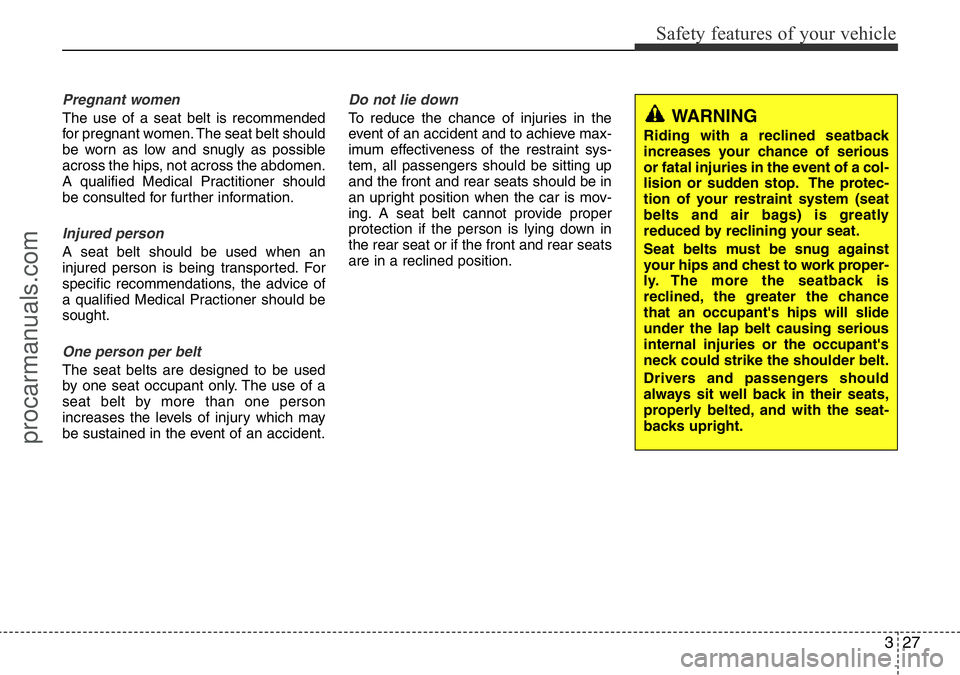
Do not lie down
To reduce the chance of injuries in the
event of an accident and to achieve max-
imum effectiveness of the restraint sys-
tem, all passengers should be sitting up
and the front and rear seats should be in
an upright position when the car is mov-
ing. A seat belt cannot provide proper
protection if the person is lying down in
the rear seat or if the front and rear seats
are in a reclined position.WARNING
Riding with a reclined seatback
increases your chance of serious
or fatal injuries in the event of a col-
lision or sudden stop. The protec-
tion of your restraint system (seat
belts and air bags) is greatly
reduced by reclining your seat.
Seat belts must be snug against
your hips and chest to work proper-
ly. The more the seatback is
reclined, the greater the chance
that an occupant's hips will slide
under the lap belt causing serious
internal injuries or the occupant's
neck could strike the shoulder belt.
Drivers and passengers should
always sit well back in their seats,
properly belted, and with the seat-
backs upright.
procarmanuals.com
Page 43 of 419
Safety features of your vehicle
28 3
Care of seat belts
Seat belt assemblies must never be dis-
assembled or modified in any way. In
addition, care should be exercised to
ensure that the belt assemblies do not
become damaged by being trapped in
seat mechanisms, door shuts etc.
Periodic inspection
All seat belts should be inspected peri-
odically for wear or damage of any kind.
Parts of the system that are damaged
should be replaced as soon as possible.
Under no circumstances must any part of
the seat belt assemblies be dismantled
or repaired.
Keep belts clean and dry
Seat belts should be kept clean and dry.
If belts become dirty, they can be
cleaned using a mild soap solution and
warm water. Bleach, dye, strong deter-
gents or abrasives should not be used
since the fabric may become damaged
and weakened.
When to replace seat belts
The entire seat belt assembly or assem-
blies should be inspected by an autho-
rised repairer if the vehicle has been
involved in an accident even if no dam-
age is evident. If you have additional
questions regarding seat belt operation,
we recommend that you consult a
HYUNDAI authorised repairer.
WARNING
When you return the rear seat to its
seating position after the rear seat
has been folded, be careful not to
damage the seat belt webbing or
buckle. Be sure that the webbing or
buckle does not get caught or
pinched in the rear seat. A seat belt
with damaged webbing or buckle
could possibly fail during a colli-
sion or sudden stop, resulting in
serious injury. If the webbing or
buckles are damaged, get them
replaced immediately.
procarmanuals.com