change time HYUNDAI I800 2016 Owner's Manual
[x] Cancel search | Manufacturer: HYUNDAI, Model Year: 2016, Model line: I800, Model: HYUNDAI I800 2016Pages: 419, PDF Size: 9.23 MB
Page 280 of 419
Driving your vehicle
34 5
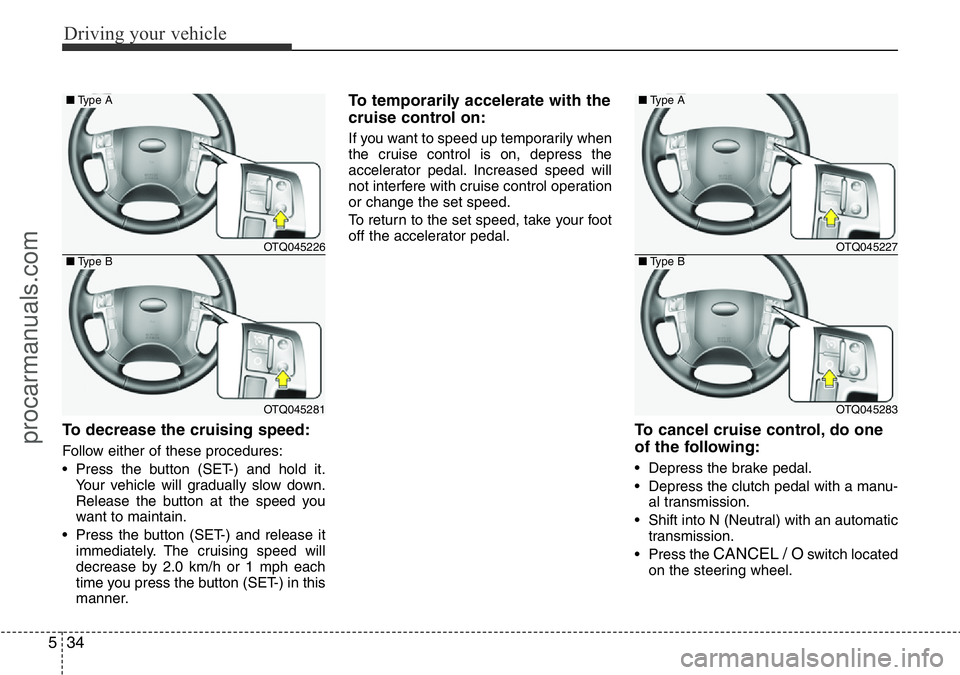
To decrease the cruising speed:
Follow either of these procedures:
• Press the button (SET-) and hold it.
Your vehicle will gradually slow down.
Release the button at the speed you
want to maintain.
• Press the button (SET-) and release it
immediately. The cruising speed will
decrease by 2.0 km/h or 1 mph each
time you press the button (SET-) in this
manner.
To temporarily accelerate with the
cruise control on:
If you want to speed up temporarily when
the cruise control is on, depress the
accelerator pedal. Increased speed will
not interfere with cruise control operation
or change the set speed.
To return to the set speed, take your foot
off the accelerator pedal.
To cancel cruise control, do one
of the following:
• Depress the brake pedal.
• Depress the clutch pedal with a manu-
al transmission.
• Shift into N (Neutral) with an automatic
transmission.
• Press the
CANCEL / Oswitch located
on the steering wheel.
OTQ045226
OTQ045281
■Type A
■Type BOTQ045227
OTQ045283
■Type A
■Type B
procarmanuals.com
Page 293 of 419
547
Driving your vehicle
Use high quality ethylene glycol
coolant
Your vehicle is delivered with high quality
ethylene glycol coolant in the cooling
system. It is the only type of coolant that
should be used because it helps prevent
corrosion in the cooling system, lubri-
cates the water pump and prevents
freezing. Be sure to replace or replenish
your coolant in accordance with the
maintenance schedule. Before winter,
have your coolant tested to assure that
its freezing point is sufficient for the tem-
peratures anticipated during the winter.
Check battery and cables
Winter puts additional burdens on the
battery system. Visually inspect the bat-
tery and cables as described in section
7. We recommend that the system be
checked by a HYUNDAI authorised
repairer.
Change to "winter weight" oil if
necessary
In some climates it is recommended that
a lower viscosity "winter weight" oil be
used during cold weather. See section 9
for recommendations. If you aren't sure
what weight oil you should use, we rec-
ommend that you consult a HYUNDAI
authorised repairer.
Check spark plugs and ignition
system
Inspect your spark plugs and replace
them if necessary. Also check all ignition
wiring and components to be sure they
are not cracked, worn or damaged in any
way.
WARNING- Tyre chains
• The use of chains may adversely
affect vehicle handling.
• Do not exceed 20 mph (30 km/h)
or the chain manufacturer’s rec-
ommended speed limit, whichev-
er is lower.
• Drive carefully and avoid bumps,
holes, sharp turns, and other
road hazards, which may cause
the vehicle to bounce.
• Avoid sharp turns or locked-
wheel braking.
CAUTION
• Chains that are the wrong size or
improperly installed can damage
your vehicle's brake lines, sus-
pension, body and wheels.
• Stop driving and retighten the
chains any time you hear them
hitting the vehicle.
procarmanuals.com
Page 295 of 419
549
Driving your vehicle
If you are considering towing with your
car, you should first check with your
Local Laws to determine their legal
requirements.
Since laws vary from country to country,
the requirements for towing trailers, cars,
or other types of vehicles or apparatus
may differ. We recommend that you ask a
HYUNDAI authorised repairer.✽NOTICE - For Europe
• The technically permissible maximum
load on the rear axle(s) may be
exceeded by not more than 15 % and
the technically permissible maximum
laden mass of the vehicle may be
exceeded by not more than 10 % or
100 kg (220.4 lbs), whichever value is
lower. In this case, do not exceed 100
km/h (62.1 mph) for vehicle of catego-
ry M1 or 80 km/h (49.7 mph) for vehi-
cle of category N1.
• When towing a trailer, the additional
load imposed at the trailer coupling
device may cause the rear tyre maxi-
mum load ratings to be exceeded, but
not by more than 15%. In such a case,
do not exceed 100 Km/h, and the rear
tyre pressure should be at least 20
kPa(0.2 bar) above the tyre pres-
sure(s) as recommended for normal
use (i.e. without a trailer attached).
Your vehicle can tow a trailer. To identify
what the vehicle trailering capacity is for
your vehicle, you should read the infor-
mation in “Weight of the trailer” that
appears later in this section.
Remember that trailering is different than
just driving your vehicle by itself.
Trailering means changes in handling,
durability, and fuel economy. Successful,
safe trailering requires correct equip-
ment, and it has to be used properly.
This section contains many time-tested,
important trailering tips and safety rules.
Many of these are important for your
safety and that of your passengers.
Please read this section carefully before
you pull a trailer.
Load-pulling components such as the
engine, transmission, wheel assemblies,
and tyres are forced to work harder
against the load of the added weight. The
engine is required to operate at relatively
higher speeds and under greater loads.
This additional burden generates extra
heat. The trailer also adds considerably
to wind resistance, increasing the pulling
requirements.
TRAILER TOWING
CAUTION
Pulling a trailer improperly can
damage your vehicle and result in
costly repairs not covered by your
warranty. To pull a trailer correctly,
follow the advice in this section.
WARNING- Towing a trail-
er
If you don't use the correct equip-
ment and drive improperly, you can
lose control when you pull a trailer.
For example, if the trailer is too
heavy, the brakes may not work
well - or even at all. You and your
passengers could be seriously or
fatally injured. Pull a trailer only if
you have followed all the steps in
this section.
WARNING- Weight limits
Before towing, make sure the total
trailer weight, gross combination
weight, gross vehicle weight, gross
axle weight and trailer nose weight
are all within the limits.
procarmanuals.com
Page 298 of 419
Driving your vehicle
52 5
Turn signals when towing a trailer
When you tow a trailer, your vehicle has
to have a different turn signal flasher and
extra wiring. The green arrows on your
instrument panel will flash whenever you
signal a turn or lane change. Properly
connected, the trailer lights will also flash
to alert other drivers you’re about to turn,
change lanes, or stop.
When towing a trailer, the green arrows
on your instrument panel will flash for
turns even if the bulbs on the trailer are
burned out. Thus, you may think drivers
behind you are seeing your signals
when, in fact, they are not. It’s important
to check occasionally to be sure the trail-
er bulbs are still working. You must also
check the lights every time you discon-
nect and then reconnect the wires.
Do not connect a trailer lighting system
directly to your vehicle’s lighting system.
Use only an approved trailer wiring har-
ness.
A HYUNDAI authorised repairer can
assist you in installing the wiring har-
ness.
Driving on grades
Reduce speed and shift to a lower gear
before you start down a long or steep
downgrade. If you don’t shift down, you
might have to use your brakes so much
that they would get hot and no longer
operate efficiently.
On a long uphill grade, shift down and
reduce your speed to around 70 km/h (45
mph) to reduce the possibility of engine
and transmission overheating.
If your trailer weighs more than the max-
imum trailer weight without trailer brakes
and you have an automatic transmission,
you should drive in D (Drive) when tow-
ing a trailer.
Operating your vehicle in D (Drive) when
towing a trailer will minimise heat build up
and extend the life of your transmission.WARNING
Failure to use an approved trailer
wiring harness could result in dam-
age to the vehicle electrical system
and/or personal injury.
procarmanuals.com
Page 408 of 419
Maintenance
78 7
Storing the urea solution
• It is improper to store the urea solution
in the containers made with the certain
materials (i.e. aluminum, copper, cop-
per alloy, non-alloyed still, and galva-
nized steel). The urea solution dis-
solves the metal materials, severely
damaging the exhaust purification sys-
tem to be non-repairable.
• Store the urea solution only in the con-
tainers made with the following materi-
als.
(DIN EN 10 088-1-/-2-/-3-specified CR-
Ni steel, Mo-Cr-Ni steel, polypropy-
lene, and polyethylene)(Continued)
• Store the urea solution tank only
in the well-ventilated locations.
When the urea solution is
exposed to the hot temperature at
approximately 50°C for an extend-
ed period of time (i.e. under the
direct sunlight), the chemical
decomposition may occur, emit-
ting the ammonia vapour.(Continued)
• When your cloth is contaminated
with the urea solution, immedi-
ately change your cloth.
• When you have an allergic reac-
tion to the urea solution, immedi-
ately consult a doctor.
• Do not allow a child to contact
the urea solution.
• Wipe off any urea solution
spillage with water or cloth. When
the urea solution is crystalized,
wipe it off with the sponge or the
cloth, which is dampened in the
cold water. When the urea solu-
tion spillage is exposed in the air
for an extended period of time, it
is crystalized in white, damaging
the vehicle surface.
• The urea solution is not the fuel
additives. Thus, it should not be
injected to the fuel tank.
Otherwise, it may damage the
engine.
• The urea solution is the aqueous
solution, which is inflammable,
non-toxic, colourless and odour-
less.
(Continued)
procarmanuals.com