child restraint HYUNDAI I800 2016 Owner's Manual
[x] Cancel search | Manufacturer: HYUNDAI, Model Year: 2016, Model line: I800, Model: HYUNDAI I800 2016Pages: 419, PDF Size: 9.23 MB
Page 64 of 419
349
Safety features of your vehicle
(Continued)
• No objects should be placed over
or near the air bag modules on
the steering wheel, instrument
panel, and the front passenger's
panel above the glove box,
because any such object could
cause harm if the vehicle is in a
crash severe enough to cause
the air bags to deploy.
• Do not tamper with or disconnect
SRS wiring or other components
of the SRS system. Doing so
could result in injury, due to acci-
dental deployment of the air bags
or by rendering the SRS inopera-
tive.
• If the SRS air bag warning light
( ) remains illuminated whilst
the vehicle is being driven, we
recommend that the system be
inspected by a HYUNDAI autho-
rised repairer.
(Continued)(Continued)
• Air bags can only be used once –
we recommend that the system
be replaced by a HYUNDAI autho-
rised repairer.
• The SRS is designed to deploy
the front air bags only when an
impact is sufficiently severe and
when the impact angle is less
than 30° from the forward longitu-
dinal axis of the vehicle.
Additionally, the air bags will only
deploy once. Seat belts must be
worn at all times.
• Front air bags are not intended to
deploy in side-impact, rear-
impact or rollover crashes. In
addition, front air bags will not
deploy in frontal crashes below
the deployment threshold.
(Continued)(Continued)
• A child restraint system must
never be placed in the front seat.
The infant or child could be
severely injured or killed by an air
bag deployment in case of an
accident.
• Children age 12 and under must
always be properly restrained in
the rear seat. Never allow chil-
dren to ride in the front passen-
ger seat. If a child over 12 must
be seated in the front seat, he or
she must be properly belted and
the seat should be moved as far
back as possible.
• For maximum safety protection in
all types of crashes, all occu-
pants including the driver should
always wear their seat belts
whether or not an air bag is also
provided at their seating position
to minimise the risk of severe
injury or death in the event of a
crash. Do not sit or lean unneces-
sarily close to the air bag whilst
the vehicle is in motion.
(Continued)
procarmanuals.com
Page 73 of 419
Safety features of your vehicle
58 3
•Keep occupants away from the air
bag covers.All occupants should sit
upright, fully back in their seats with
their seat belts on and their feet on the
floor. If occupants are too close to the
air bag covers, they could be injured if
the air bags inflate.
•Do not attach or place objects on or
near the air bag covers.Any object
attached to or placed on the front air
bag covers could interfere with the
proper operation of the air bags.
•Do not modify the front seats.
Modification of the front seats could
interfere with the operation of the sup-
plemental restraint system sensing
components.
•Do not place items under the front
seats.Placing items under the front
seats could interfere with the operation
of the supplemental restraint system
sensing components and wiring har-
nesses.
•Never hold an infant or child on your
lap.The infant or child could be seri-
ously injured or killed in the event of a
crash. All infants and children should
be properly restrained in appropriate
child safety seats or seat belts in the
rear seat.Adding equipment to or modify-
ing your air bag-equipped vehicle
If you modify your vehicle by changing
your vehicle's frame, bumper system,
front end or side sheet metal or ride
height, this may affect the operation of
your vehicle's air bag system.
WARNING
• Sitting improperly or out of posi-
tion can cause occupants to be
shifted too close to a deploying
air bag, strike the interior struc-
ture or be thrown from the vehicle
resulting in serious injury or
death.
• Always sit upright with the seat-
back in an upright position, cen-
tred on the seat cushion with
your seat belt on, legs comfort-
ably extended and your feet on
the floor.
procarmanuals.com
Page 104 of 419
Features of your vehicle
30 4
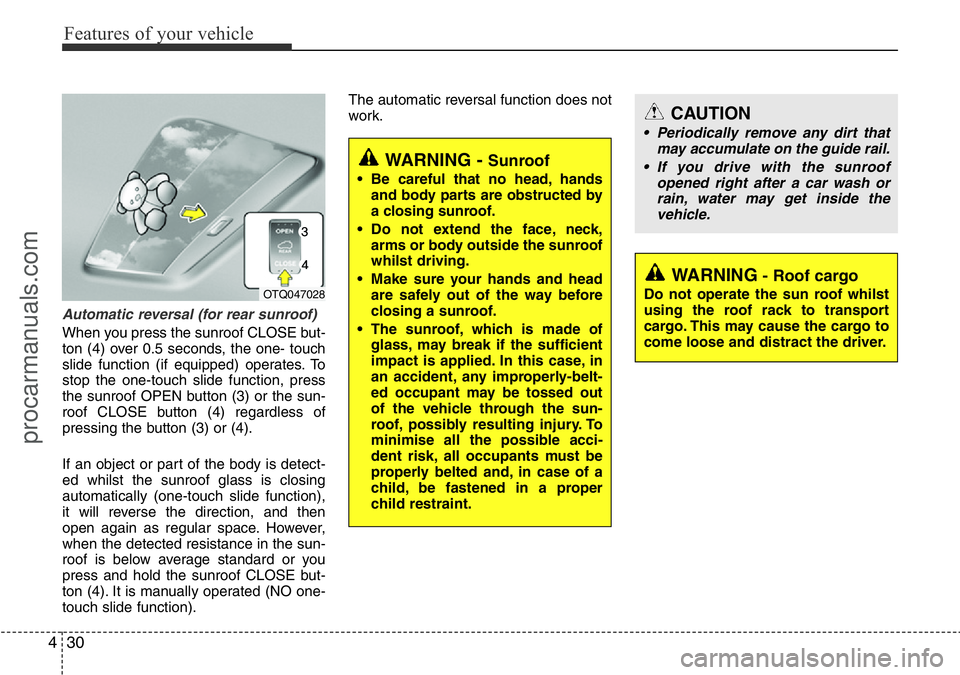
Automatic reversal (for rear sunroof)
When you press the sunroof CLOSE but-
ton (4) over 0.5 seconds, the one- touch
slide function (if equipped) operates. To
stop the one-touch slide function, press
the sunroof OPEN button (3) or the sun-
roof CLOSE button (4) regardless of
pressing the button (3) or (4).
If an object or part of the body is detect-
ed whilst the sunroof glass is closing
automatically (one-touch slide function),
it will reverse the direction, and then
open again as regular space. However,
when the detected resistance in the sun-
roof is below average standard or you
press and hold the sunroof CLOSE but-
ton (4). It is manually operated (NO one-
touch slide function).The automatic reversal function does not
work.
OTQ047028
WARNING - Sunroof
• Be careful that no head, hands
and body parts are obstructed by
a closing sunroof.
• Do not extend the face, neck,
arms or body outside the sunroof
whilst driving.
• Make sure your hands and head
are safely out of the way before
closing a sunroof.
• The sunroof, which is made of
glass, may break if the sufficient
impact is applied. In this case, in
an accident, any improperly-belt-
ed occupant may be tossed out
of the vehicle through the sun-
roof, possibly resulting injury. To
minimise all the possible acci-
dent risk, all occupants must be
properly belted and, in case of a
child, be fastened in a proper
child restraint.
CAUTION
• Periodically remove any dirt that
may accumulate on the guide rail.
• If you drive with the sunroof
opened right after a car wash or
rain, water may get inside the
vehicle.
WARNING- Roof cargo
Do not operate the sun roof whilst
using the roof rack to transport
cargo. This may cause the cargo to
come loose and distract the driver.
procarmanuals.com