engine coolant HYUNDAI I800 2016 Owner's Manual
[x] Cancel search | Manufacturer: HYUNDAI, Model Year: 2016, Model line: I800, Model: HYUNDAI I800 2016Pages: 419, PDF Size: 9.23 MB
Page 399 of 419
769
Maintenance
EMISSION CONTROL SYSTEM (IF EQUIPPED)
The emission control system of your
vehicle is covered by a written limited
warranty. Please see the warranty infor-
mation contained in the Service Passport
in your vehicle.
Your vehicle is equipped with an emis-
sion control system to meet all applicable
emission regulations.
There are three emission control sys-
tems, as follows.
(1) Crankcase emission control system
(2) Evaporative emission control system
(3) Exhaust emission control system
In order to assure the proper function of
the emission control systems, it is rec-
ommended that you have your car
inspected and maintained by a
HYUNDAI authorised repairer in accor-
dance with the maintenance schedule in
this manual.Caution for the Inspection and
Maintenance Test (With Electronic
Stability Control (ESC) system)
• To prevent the vehicle from misfir-
ing during dynamometer testing,
turn the Electronic Stability Control
(ESC) system off by pressing the
ESC switch.
• After dynamometer testing is com-
pleted, turn the ESC system back on
by pressing the ESC switch again.
1. Crankcase emission control
system
The positive crankcase ventilation sys-
tem is employed to prevent air pollution
caused by blow-by gases being emitted
from the crankcase. This system supplies
fresh filtered air to the crankcase through
the air intake hose. Inside the crankcase,
the fresh air mixes with blow-by gases,
which then pass through the PCV valve
into the induction system.
2. Evaporative emission control
system
The Evaporative Emission Control
System is designed to prevent fuel
vapours from escaping into the atmos-
phere.
Canister
Fuel vapours generated inside the fuel
tank are absorbed and stored in the
onboard canister. When the engine is
running, the fuel vapours absorbed in the
canister are drawn into the surge tank
through the purge control solenoid valve.
Purge Control Solenoid Valve (PCSV)
The purge control solenoid valve is con-
trolled by the Engine Control Module
(ECM); when the engine coolant temper-
ature is low during idling, the PCSV clos-
es so that evaporated fuel is not taken
into the engine. After the engine warms-
up during ordinary driving, the PCSV
opens to introduce evaporated fuel to the
engine.
procarmanuals.com
Page 418 of 419
95
Specifications
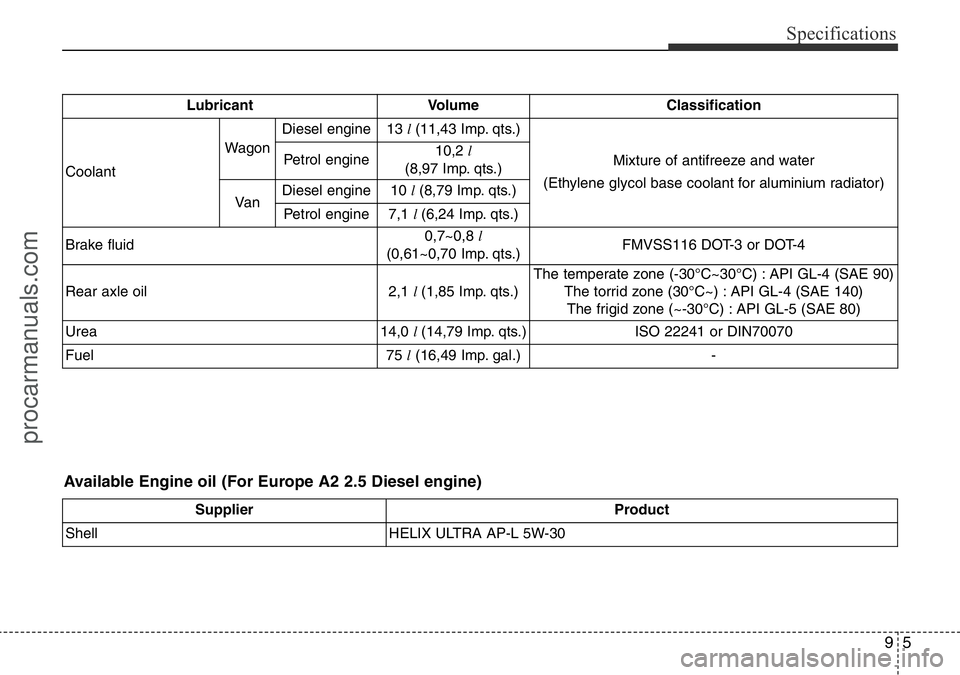
Available Engine oil (For Europe A2 2.5 Diesel engine)
Supplier Product
Shell HELIX ULTRA AP-L 5W-30
Lubricant Volume Classification
CoolantWagonDiesel engine13 l (11,43 Imp. qts.)
Mixture of antifreeze and water
(Ethylene glycol base coolant for aluminium radiator) Petrol engine10,2 l
(8,97 Imp. qts.)
Va nDiesel engine10 l (8,79 Imp. qts.)
Petrol engine7,1 l (6,24 Imp. qts.)
Brake fluid0,7~0,8 l
(0,61~0,70 Imp. qts.)FMVSS116 DOT-3 or DOT-4
Rear axle oil2,1l (1,85 Imp. qts.)The temperate zone (-30°C~30°C) : API GL-4 (SAE 90)
The torrid zone (30°C~) : API GL-4 (SAE 140)
The frigid zone (~-30°C) : API GL-5 (SAE 80)
Urea14,0l (14,79 Imp. qts.)ISO 22241 or DIN70070
Fuel75 l(16,49 Imp. gal.)
-
procarmanuals.com