stop start HYUNDAI I800 2016 Owners Manual
[x] Cancel search | Manufacturer: HYUNDAI, Model Year: 2016, Model line: I800, Model: HYUNDAI I800 2016Pages: 419, PDF Size: 9.23 MB
Page 10 of 419
15
Introduction
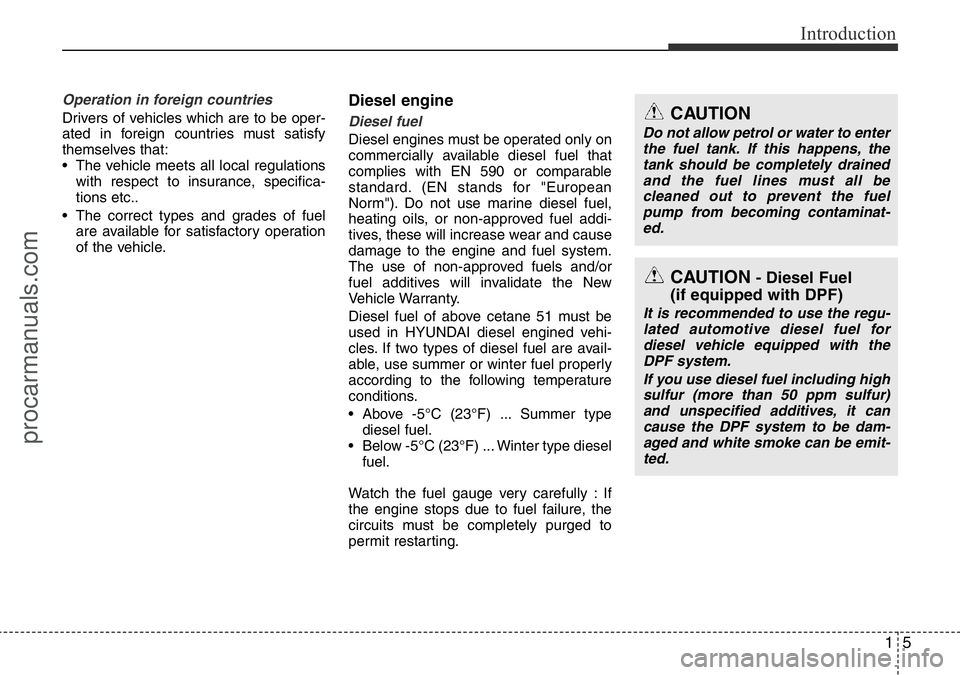
Operation in foreign countries
Drivers of vehicles which are to be oper-
ated in foreign countries must satisfy
themselves that:
• The vehicle meets all local regulations
with respect to insurance, specifica-
tions etc..
• The correct types and grades of fuel
are available for satisfactory operation
of the vehicle.
Diesel engine
Diesel fuel
Diesel engines must be operated only on
commercially available diesel fuel that
complies with EN 590 or comparable
standard. (EN stands for "European
Norm"). Do not use marine diesel fuel,
heating oils, or non-approved fuel addi-
tives, these will increase wear and cause
damage to the engine and fuel system.
The use of non-approved fuels and/or
fuel additives will invalidate the New
Vehicle Warranty.
Diesel fuel of above cetane 51 must be
used in HYUNDAI diesel engined vehi-
cles. If two types of diesel fuel are avail-
able, use summer or winter fuel properly
according to the following temperature
conditions.
• Above -5°C (23°F) ... Summer type
diesel fuel.
• Below -5°C (23°F) ... Winter type diesel
fuel.
Watch the fuel gauge very carefully : If
the engine stops due to fuel failure, the
circuits must be completely purged to
permit restarting.
CAUTION
Do not allow petrol or water to enter
the fuel tank. If this happens, the
tank should be completely drained
and the fuel lines must all be
cleaned out to prevent the fuel
pump from becoming contaminat-
ed.
CAUTION- Diesel Fuel
(if equipped with DPF)
It is recommended to use the regu-
lated automotive diesel fuel for
diesel vehicle equipped with the
DPF system.
If you use diesel fuel including high
sulfur (more than 50 ppm sulfur)
and unspecified additives, it can
cause the DPF system to be dam-
aged and white smoke can be emit-
ted.
procarmanuals.com
Page 72 of 419
357
Safety features of your vehicle
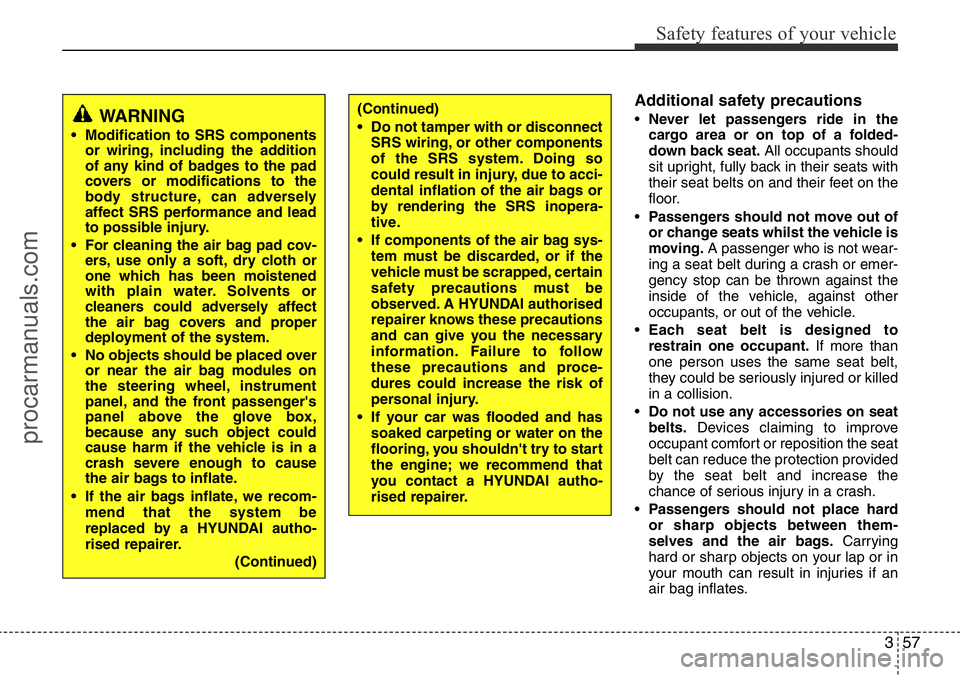
Additional safety precautions
•Never let passengers ride in the
cargo area or on top of a folded-
down back seat.All occupants should
sit upright, fully back in their seats with
their seat belts on and their feet on the
floor.
•Passengers should not move out of
or change seats whilst the vehicle is
moving.A passenger who is not wear-
ing a seat belt during a crash or emer-
gency stop can be thrown against the
inside of the vehicle, against other
occupants, or out of the vehicle.
•Each seat belt is designed to
restrain one occupant.If more than
one person uses the same seat belt,
they could be seriously injured or killed
in a collision.
•Do not use any accessories on seat
belts.Devices claiming to improve
occupant comfort or reposition the seat
belt can reduce the protection provided
by the seat belt and increase the
chance of serious injury in a crash.
•Passengers should not place hard
or sharp objects between them-
selves and the air bags.Carrying
hard or sharp objects on your lap or in
your mouth can result in injuries if an
air bag inflates.WARNING
• Modification to SRS components
or wiring, including the addition
of any kind of badges to the pad
covers or modifications to the
body structure, can adversely
affect SRS performance and lead
to possible injury.
• For cleaning the air bag pad cov-
ers, use only a soft, dry cloth or
one which has been moistened
with plain water. Solvents or
cleaners could adversely affect
the air bag covers and proper
deployment of the system.
• No objects should be placed over
or near the air bag modules on
the steering wheel, instrument
panel, and the front passenger's
panel above the glove box,
because any such object could
cause harm if the vehicle is in a
crash severe enough to cause
the air bags to inflate.
• If the air bags inflate, we recom-
mend that the system be
replaced by a HYUNDAI autho-
rised repairer.
(Continued)
(Continued)
• Do not tamper with or disconnect
SRS wiring, or other components
of the SRS system. Doing so
could result in injury, due to acci-
dental inflation of the air bags or
by rendering the SRS inopera-
tive.
• If components of the air bag sys-
tem must be discarded, or if the
vehicle must be scrapped, certain
safety precautions must be
observed. A HYUNDAI authorised
repairer knows these precautions
and can give you the necessary
information. Failure to follow
these precautions and proce-
dures could increase the risk of
personal injury.
• If your car was flooded and has
soaked carpeting or water on the
flooring, you shouldn't try to start
the engine; we recommend that
you contact a HYUNDAI autho-
rised repairer.
procarmanuals.com
Page 77 of 419
43
Features of your vehicle
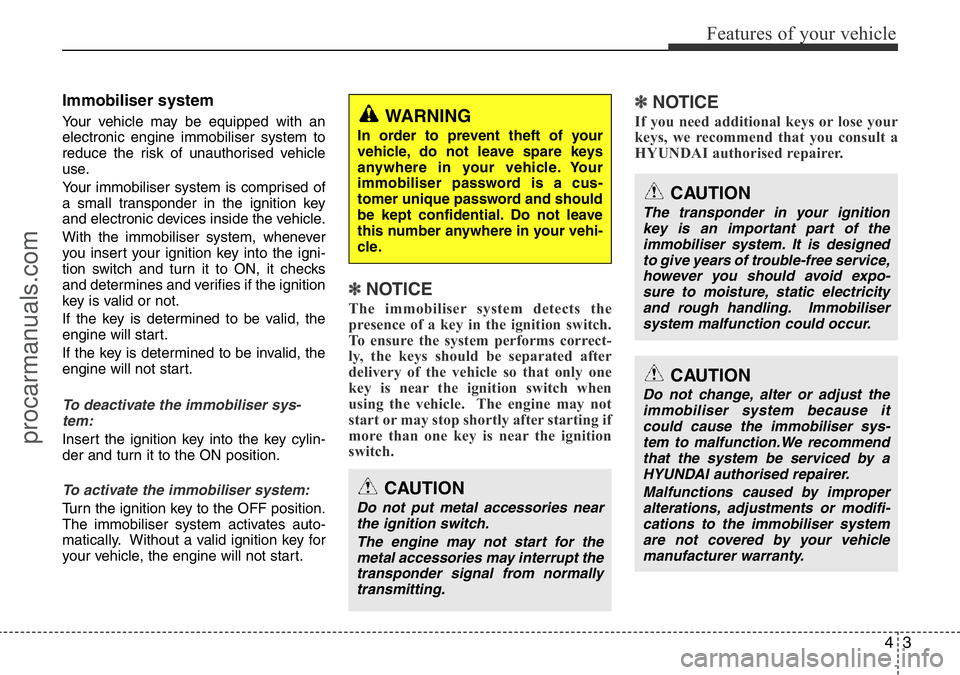
Immobiliser system
Your vehicle may be equipped with an
electronic engine immobiliser system to
reduce the risk of unauthorised vehicle
use.
Your immobiliser system is comprised of
a small transponder in the ignition key
and electronic devices inside the vehicle.
With the immobiliser system, whenever
you insert your ignition key into the igni-
tion switch and turn it to ON, it checks
and determines and verifies if the ignition
key is valid or not.
If the key is determined to be valid, the
engine will start.
If the key is determined to be invalid, the
engine will not start.
To deactivate the immobiliser sys-
tem:
Insert the ignition key into the key cylin-
der and turn it to the ON position.
To activate the immobiliser system:
Turn the ignition key to the OFF position.
The immobiliser system activates auto-
matically. Without a valid ignition key for
your vehicle, the engine will not start.
✽NOTICE
The immobiliser system detects the
presence of a key in the ignition switch.
To ensure the system performs correct-
ly, the keys should be separated after
delivery of the vehicle so that only one
key is near the ignition switch when
using the vehicle. The engine may not
start or may stop shortly after starting if
more than one key is near the ignition
switch.
✽NOTICE
If you need additional keys or lose your
keys, we recommend that you consult a
HYUNDAI authorised repairer.
CAUTION
The transponder in your ignition
key is an important part of the
immobiliser system. It is designed
to give years of trouble-free service,
however you should avoid expo-
sure to moisture, static electricity
and rough handling. Immobiliser
system malfunction could occur.
CAUTION
Do not change, alter or adjust the
immobiliser system because it
could cause the immobiliser sys-
tem to malfunction.We recommend
that the system be serviced by a
HYUNDAI authorised repairer.
Malfunctions caused by improper
alterations, adjustments or modifi-
cations to the immobiliser system
are not covered by your vehicle
manufacturer warranty.
CAUTION
Do not put metal accessories near
the ignition switch.
The engine may not start for the
metal accessories may interrupt the
transponder signal from normally
transmitting.
WARNING
In order to prevent theft of your
vehicle, do not leave spare keys
anywhere in your vehicle. Your
immobiliser password is a cus-
tomer unique password and should
be kept confidential. Do not leave
this number anywhere in your vehi-
cle.
procarmanuals.com
Page 106 of 419
Features of your vehicle
32 4
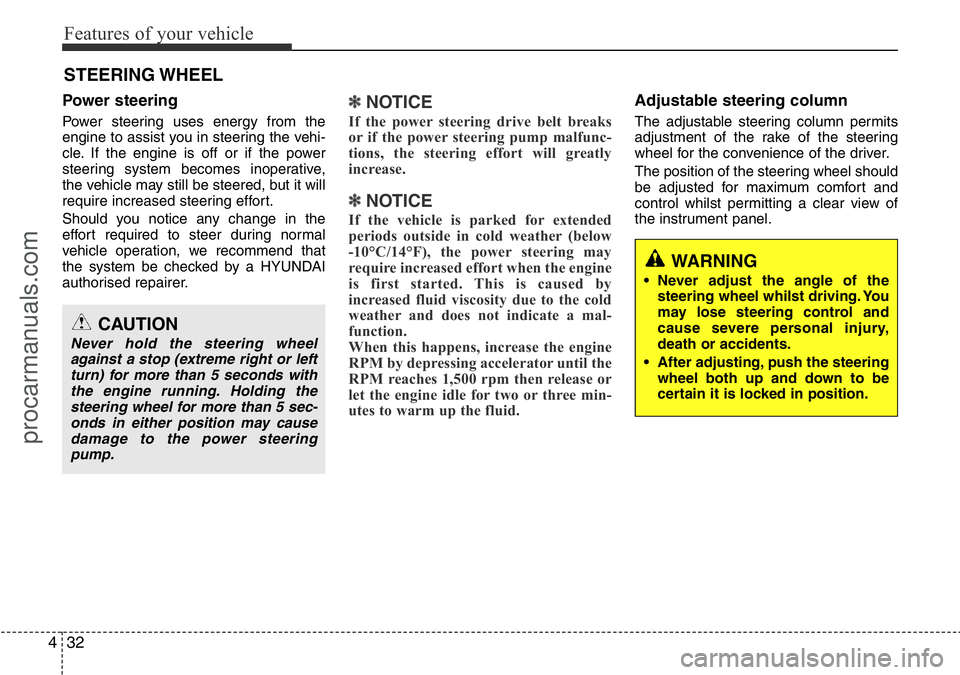
WARNING
• Never adjust the angle of the
steering wheel whilst driving. You
may lose steering control and
cause severe personal injury,
death or accidents.
• After adjusting, push the steering
wheel both up and down to be
certain it is locked in position.
Power steering
Power steering uses energy from the
engine to assist you in steering the vehi-
cle. If the engine is off or if the power
steering system becomes inoperative,
the vehicle may still be steered, but it will
require increased steering effort.
Should you notice any change in the
effort required to steer during normal
vehicle operation, we recommend that
the system be checked by a HYUNDAI
authorised repairer.
✽NOTICE
If the power steering drive belt breaks
or if the power steering pump malfunc-
tions, the steering effort will greatly
increase.
✽NOTICE
If the vehicle is parked for extended
periods outside in cold weather (below
-10°C/14°F), the power steering may
require increased effort when the engine
is first started. This is caused by
increased fluid viscosity due to the cold
weather and does not indicate a mal-
function.
When this happens, increase the engine
RPM by depressing accelerator until the
RPM reaches 1,500 rpm then release or
let the engine idle for two or three min-
utes to warm up the fluid.
Adjustable steering column
The adjustable steering column permits
adjustment of the rake of the steering
wheel for the convenience of the driver.
The position of the steering wheel should
be adjusted for maximum comfort and
control whilst permitting a clear view of
the instrument panel.
STEERING WHEEL
CAUTION
Never hold the steering wheel
against a stop (extreme right or left
turn) for more than 5 seconds with
the engine running. Holding the
steering wheel for more than 5 sec-
onds in either position may cause
damage to the power steering
pump.
procarmanuals.com
Page 124 of 419
Features of your vehicle
50 4
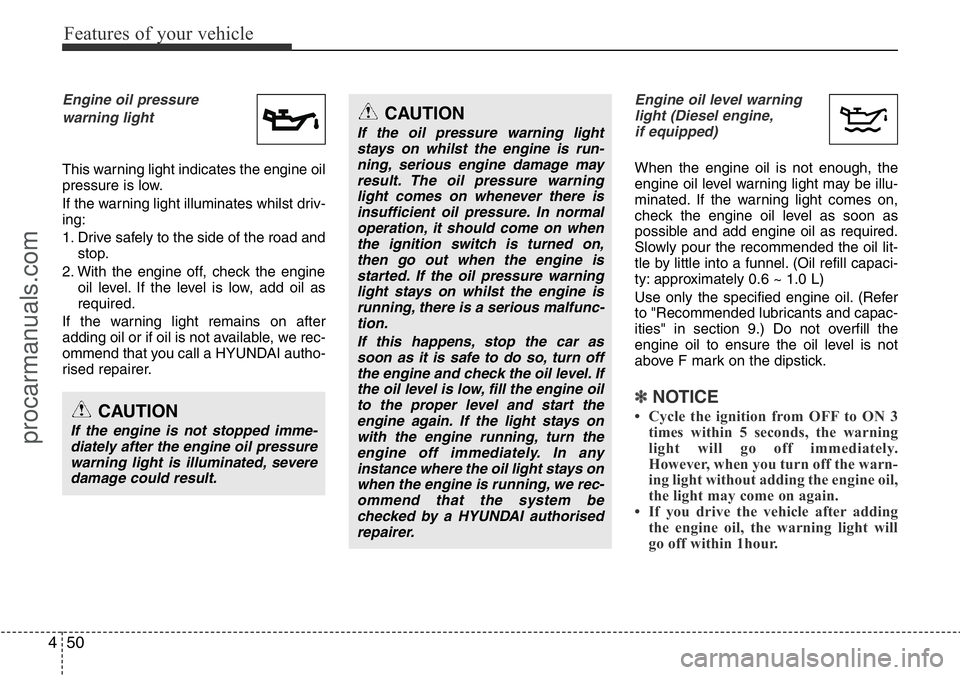
Engine oil pressure
warning light
This warning light indicates the engine oil
pressure is low.
If the warning light illuminates whilst driv-
ing:
1. Drive safely to the side of the road and
stop.
2. With the engine off, check the engine
oil level. If the level is low, add oil as
required.
If the warning light remains on after
adding oil or if oil is not available, we rec-
ommend that you call a HYUNDAI autho-
rised repairer.
Engine oil level warning
light (Diesel engine,
if equipped)
When the engine oil is not enough, the
engine oil level warning light may be illu-
minated. If the warning light comes on,
check the engine oil level as soon as
possible and add engine oil as required.
Slowly pour the recommended the oil lit-
tle by little into a funnel. (Oil refill capaci-
ty: approximately 0.6 ~ 1.0 L)
Use only the specified engine oil. (Refer
to "Recommended lubricants and capac-
ities" in section 9.) Do not overfill the
engine oil to ensure the oil level is not
above F mark on the dipstick.
✽NOTICE
• Cycle the ignition from OFF to ON 3
times within 5 seconds, the warning
light will go off immediately.
However, when you turn off the warn-
ing light without adding the engine oil,
the light may come on again.
• If you drive the vehicle after adding
the engine oil, the warning light will
go off within 1hour.CAUTION
If the engine is not stopped imme-
diately after the engine oil pressure
warning light is illuminated, severe
damage could result.
CAUTION
If the oil pressure warning light
stays on whilst the engine is run-
ning, serious engine damage may
result. The oil pressure warning
light comes on whenever there is
insufficient oil pressure. In normal
operation, it should come on when
the ignition switch is turned on,
then go out when the engine is
started. If the oil pressure warning
light stays on whilst the engine is
running, there is a serious malfunc-
tion.
If this happens, stop the car as
soon as it is safe to do so, turn off
the engine and check the oil level. If
the oil level is low, fill the engine oil
to the proper level and start the
engine again. If the light stays on
with the engine running, turn the
engine off immediately. In any
instance where the oil light stays on
when the engine is running, we rec-
ommend that the system be
checked by a HYUNDAI authorised
repairer.
procarmanuals.com
Page 125 of 419
451
Features of your vehicle
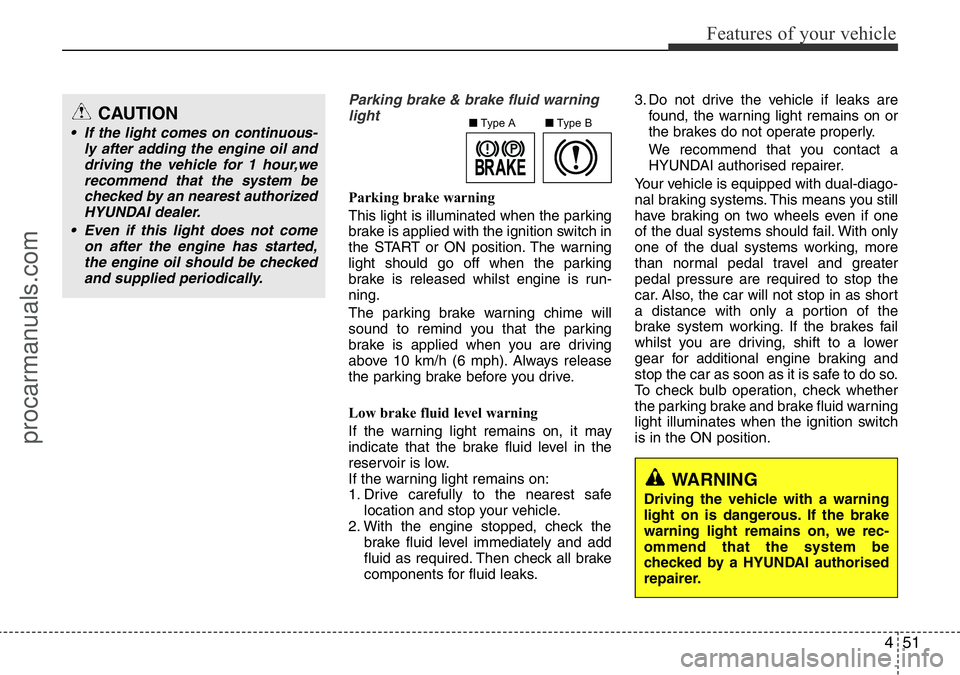
Parking brake & brake fluid warning
light
Parking brake warning
This light is illuminated when the parking
brake is applied with the ignition switch in
the START or ON position. The warning
light should go off when the parking
brake is released whilst engine is run-
ning.
The parking brake warning chime will
sound to remind you that the parking
brake is applied when you are driving
above 10 km/h (6 mph). Always release
the parking brake before you drive.
Low brake fluid level warning
If the warning light remains on, it may
indicate that the brake fluid level in the
reservoir is low.
If the warning light remains on:
1. Drive carefully to the nearest safe
location and stop your vehicle.
2. With the engine stopped, check the
brake fluid level immediately and add
fluid as required. Then check all brake
components for fluid leaks.3. Do not drive the vehicle if leaks are
found, the warning light remains on or
the brakes do not operate properly.
We recommend that you contact a
HYUNDAI authorised repairer.
Your vehicle is equipped with dual-diago-
nal braking systems. This means you still
have braking on two wheels even if one
of the dual systems should fail. With only
one of the dual systems working, more
than normal pedal travel and greater
pedal pressure are required to stop the
car. Also, the car will not stop in as short
a distance with only a portion of the
brake system working. If the brakes fail
whilst you are driving, shift to a lower
gear for additional engine braking and
stop the car as soon as it is safe to do so.
To check bulb operation, check whether
the parking brake and brake fluid warning
light illuminates when the ignition switch
is in the ON position.
CAUTION
• If the light comes on continuous-
ly after adding the engine oil and
driving the vehicle for 1 hour,we
recommend that the system be
checked by an nearest authorized
HYUNDAI dealer.
• Even if this light does not come
on after the engine has started,
the engine oil should be checked
and supplied periodically.■Type A■Type B
WARNING
Driving the vehicle with a warning
light on is dangerous. If the brake
warning light remains on, we rec-
ommend that the system be
checked by a HYUNDAI authorised
repairer.
procarmanuals.com
Page 133 of 419
459
Features of your vehicle
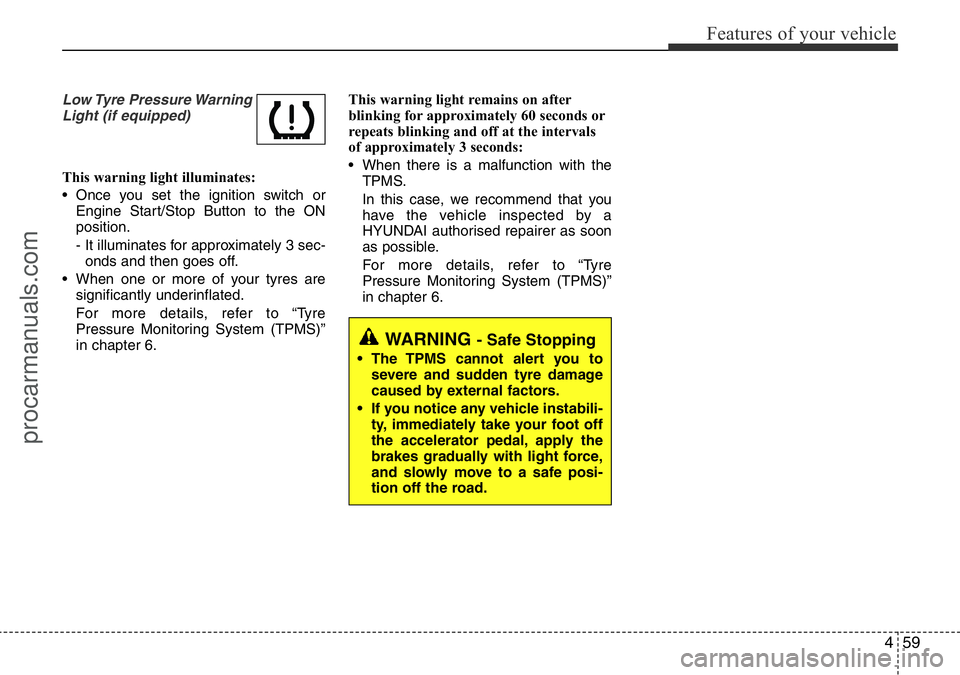
Low Tyre Pressure Warning
Light (if equipped)
This warning light illuminates:
• Once you set the ignition switch or
Engine Start/Stop Button to the ON
position.
- It illuminates for approximately 3 sec-
onds and then goes off.
• When one or more of your tyres are
significantly underinflated.
For more details, refer to “Tyre
Pressure Monitoring System (TPMS)”
in chapter 6.This warning light remains on after
blinking for approximately 60 seconds or
repeats blinking and off at the intervals
of approximately 3 seconds:
• When there is a malfunction with the
TPMS.
In this case, we recommend that you
have the vehicle inspected by a
HYUNDAI authorised repairer as soon
as possible.
For more details, refer to “Tyre
Pressure Monitoring System (TPMS)”
in chapter 6.
WARNING - Safe Stopping
• The TPMS cannot alert you to
severe and sudden tyre damage
caused by external factors.
• If you notice any vehicle instabili-
ty, immediately take your foot off
the accelerator pedal, apply the
brakes gradually with light force,
and slowly move to a safe posi-
tion off the road.
procarmanuals.com
Page 255 of 419
59
Driving your vehicle
Starting and stopping the engine for tur-
bocharger intercooler
1. Do not race or accelerate the engine
immediately after starting.
If the engine is cold, idle for several
seconds before sufficient lubrication is
ensured in the turbocharger unit.
2. After high speed or extended driving,
requiring a heavy engine load, run the
engine on idle condition about 1
minute before turning it off.
This idle time will allow the tur-
bocharger to cool prior to shutting the
engine off.
CAUTION
Do not turn the engine off immedi-
ately after it has been subjected to
a heavy load. Doing so may cause
severe damage to the engine or tur-
bocharger unit.
procarmanuals.com
Page 256 of 419
Driving your vehicle
10 5
MANUAL TRANSMISSION (IF EQUIPPED)
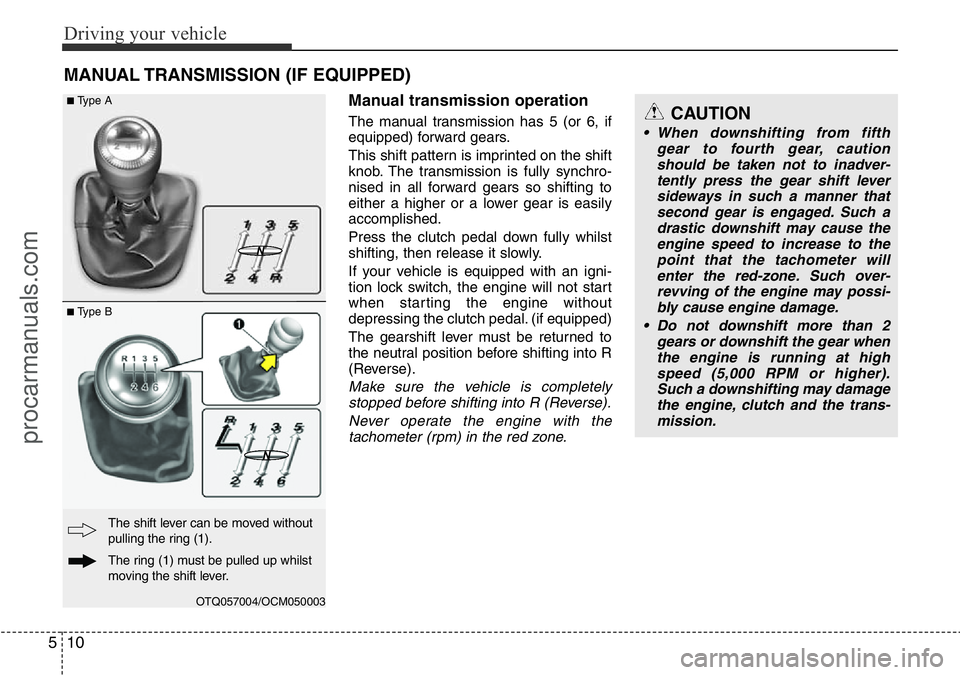
Manual transmission operation
The manual transmission has 5 (or 6, if
equipped) forward gears.
This shift pattern is imprinted on the shift
knob. The transmission is fully synchro-
nised in all forward gears so shifting to
either a higher or a lower gear is easily
accomplished.
Press the clutch pedal down fully whilst
shifting, then release it slowly.
If your vehicle is equipped with an igni-
tion lock switch, the engine will not start
when starting the engine without
depressing the clutch pedal. (if equipped)
The gearshift lever must be returned to
the neutral position before shifting into R
(Reverse).
Make sure the vehicle is completely
stopped before shifting into R (Reverse).
Never operate the engine with the
tachometer (rpm) in the red zone.
CAUTION
• When downshifting from fifth
gear to fourth gear, caution
should be taken not to inadver-
tently press the gear shift lever
sideways in such a manner that
second gear is engaged. Such a
drastic downshift may cause the
engine speed to increase to the
point that the tachometer will
enter the red-zone. Such over-
revving of the engine may possi-
bly cause engine damage.
• Do not downshift more than 2
gears or downshift the gear when
the engine is running at high
speed (5,000 RPM or higher).
Such a downshifting may damage
the engine, clutch and the trans-
mission.
OTQ057004/OCM050003
The ring (1) must be pulled up whilst
moving the shift lever. The shift lever can be moved without
pulling the ring (1).
■Type A
■Type B
N
N
procarmanuals.com
Page 257 of 419
511
Driving your vehicle
• During cold weather, shifting may be
difficult until the transmission lubricant
is warmed up. This is normal and not
harmful to the transmission.
• If you've come to a complete stop and
it's hard to shift into 1st or R(Reverse),
leave the shift lever at N(Neutral) posi-
tion and release the clutch. Press the
clutch pedal back down, and then shift
into 1st or R(Reverse) gear position.Using the clutch
The clutch should be pressed all the way
to the floor before shifting, then released
slowly. The clutch pedal should always be
fully released whilst driving. Do not rest
your foot on the clutch pedal whilst driv-
ing. This can cause unnecessary wear.
Do not partially engage the clutch to hold
the car on an incline. This causes unnec-
essary wear. Use the foot brake or park-
ing brake to hold the car on an incline. Do
not operate the clutch pedal rapidly and
repeatedly.
Downshifting
When you must slow down in heavy traf-
fic or whilst driving up steep hills, down-
shift before the engine starts to labour.
Downshifting reduces the chance of
stalling and gives better acceleration
when you again need to increase your
speed. When the vehicle is travelling
down steep hills, downshifting helps
maintain safe speed and prolongs brake
life.
CAUTION
• To avoid premature clutch wear
and damage, do not drive with
your foot resting on the clutch
pedal. Also, don’t use the clutch
to hold the vehicle stopped on an
uphill grade, whilst waiting for a
traffic light, etc.
• Do not use the shift lever as a
handrest during driving, as this
can result in premature wear of
the transmission shift forks.
• To prevent possible damage to
the clutch system, do not start
with the 2nd (second) gear
engaged except when you start
on a slippery road.
WARNING
• Before leaving the driver’s seat,
always set the parking brake fully
and shut the engine off. Then
make sure the transmission is
shifted into 1st gear when the
vehicle is parked on a level or
uphill grade, and shifted into R
(Reverse) on a downhill grade.
Unexpected and sudden vehicle
movement can occur if these pre-
cautions are not followed in the
order identified.
• If your vehicle has a manual
transmission not equipped with a
ignition lock switch, it may move
and cause a serious accident
when starting the engine without
depressing the clutch pedal
whilst the parking brake is
released and the shift lever not in
the N(Neutral) position.
• Do not use the engine brake
(shifting from a high gear to
lower gear) rapidly on slippery
roads. The vehicle may slip caus-
ing an accident.
procarmanuals.com