Replace HYUNDAI IONIQ 5 2023 Service Manual
[x] Cancel search | Manufacturer: HYUNDAI, Model Year: 2023, Model line: IONIQ 5, Model: HYUNDAI IONIQ 5 2023Pages: 680, PDF Size: 48.22 MB
Page 608 of 680
09
9 -7
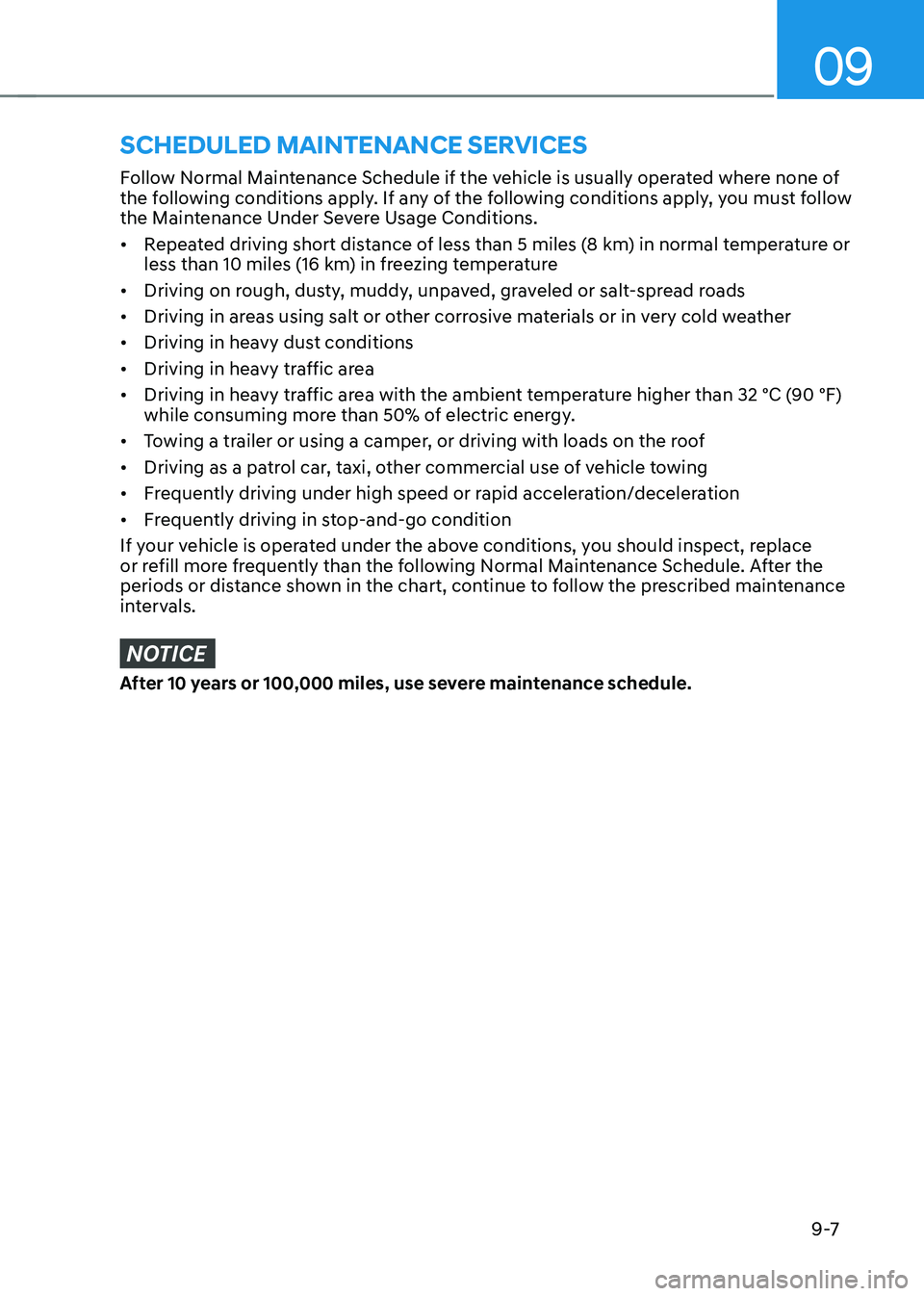
Follow Normal Maintenance Schedule if the vehicle is usually operated where none of
the following conditions apply. If any of the following conditions apply, you must follow
the Maintenance Under Severe Usage Conditions. • Repeated driving short distance of less than 5 miles (8 km) in normal temperature or
less than 10 miles (16 km) in freezing temperature
• Driving on rough, dusty, muddy, unpaved, graveled or salt-spread roads
• Driving in areas using salt or other corrosive materials or in very cold weather
• Driving in heavy dust conditions
• Driving in heavy traffic area
• Driving in heavy traffic area with the ambient temperature higher than 32 ºC (90 ºF)
while consuming more than 50% of electric energy.
• Towing a trailer or using a camper, or driving with loads on the roof
• Driving as a patrol car, taxi, other commercial use of vehicle towing
• Frequently driving under high speed or rapid acceleration/deceleration
• Frequently driving in stop-and-go condition
If your vehicle is operated under the above conditions, you should inspect, replace
or refill more frequently than the following Normal Maintenance Schedule. After the
periods or distance shown in the chart, continue to follow the prescribed maintenance
intervals.
NOTICE
After 10 years or 100,000 miles, use severe maintenance schedule.
scheduled Maintenance services
Page 609 of 680
9-8
Maintenance
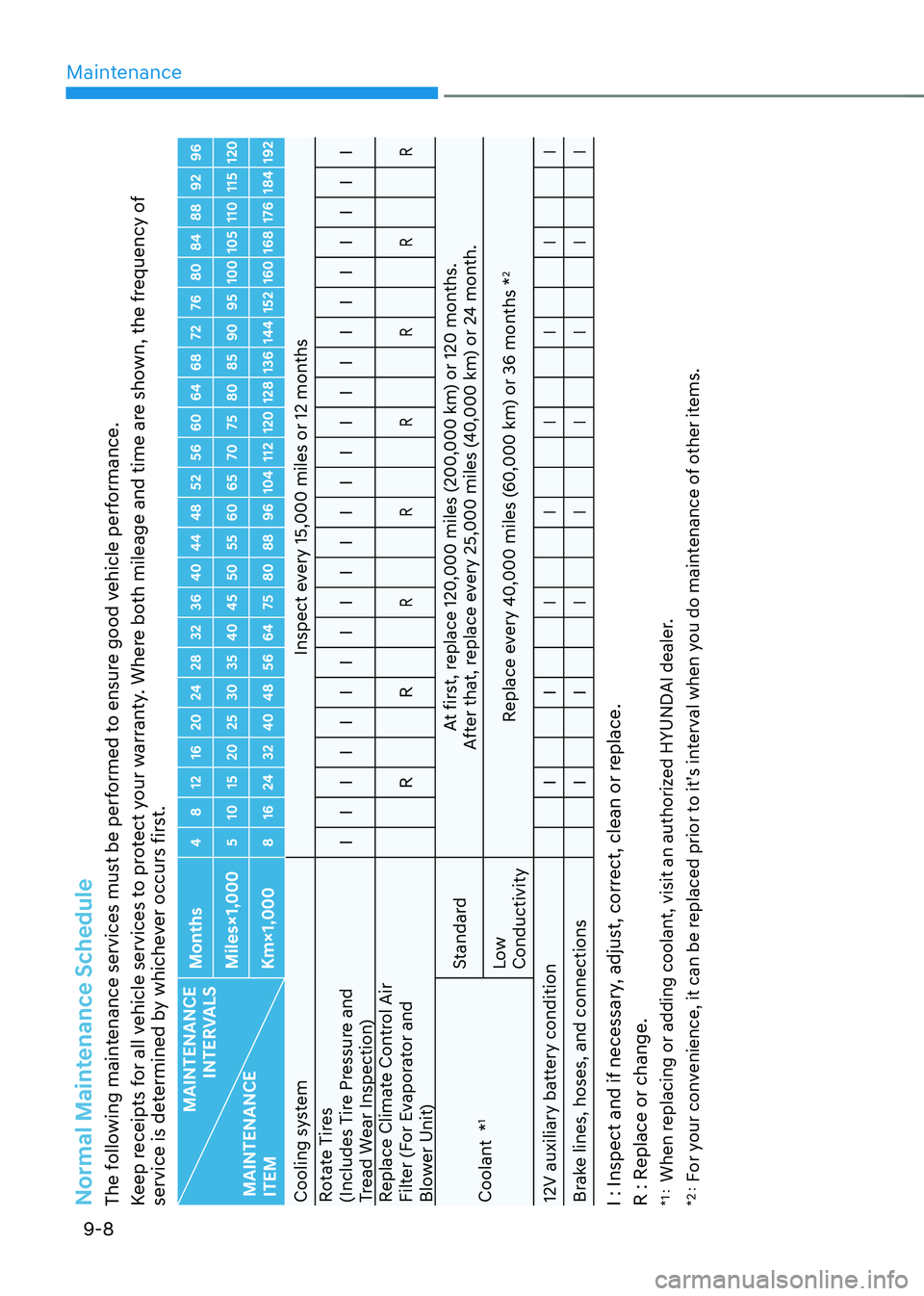
Normal Maintenance Schedule The following maintenance services must be performed to ensure good vehicle performance.
Keep receipts for all vehicle services to protect your warranty. Where both mileage and time are shown, the frequency of
service is determined by whichever occurs first.
MAINTENANCE INTERVALS
MAINTENANCE ITEM Months
4 8 12 16 20 24 28 32 36 40 44 48 52 56 60 64 68 72 76 80 84 88 92 96
Miles×1,000 5 10 15 20 25 30 35 40 45 50 55 60 65 70 75 80 85 90 95 100 105 110 115 120
Km×1,000 8 16 24 32 40 48 56 64 75 80 88 96 104 112 120 128 136 144 152 160 168 176 184 192
Cooling system
Inspect every 15,000 miles or 12 months
Rotate Tires
(Includes Tire Pressure and
Tread Wear Inspection) I I I I I I I I I I I I I I I I I I I I I I I I
Replace Climate Control Air
Filter (For Evaporator and
Blower Unit) R R
R R R R R R
Coolant *
1 Standard
At first, replace 120,000 miles (200,000 km) or 120 months.
After that, replace every 25,000 miles (40,000 km) or 24 month.
Low Conductivity Replace every 40,000 miles (60,000 km) or 36 months *
2
12V auxiliary battery condition I I
I I I I I I
Brake lines, hoses, and connections I I
I I I I I I
I : Inspect and if necessary, adjust, correct, clean or replace.
R : Replace or change. *1 : When replacing or adding coolant, visit an authorized HYUNDAI dealer.
*2 : For your convenience, it can be replaced prior to it’s interval when you do maintenance of other items.
Page 610 of 680
9-9
09
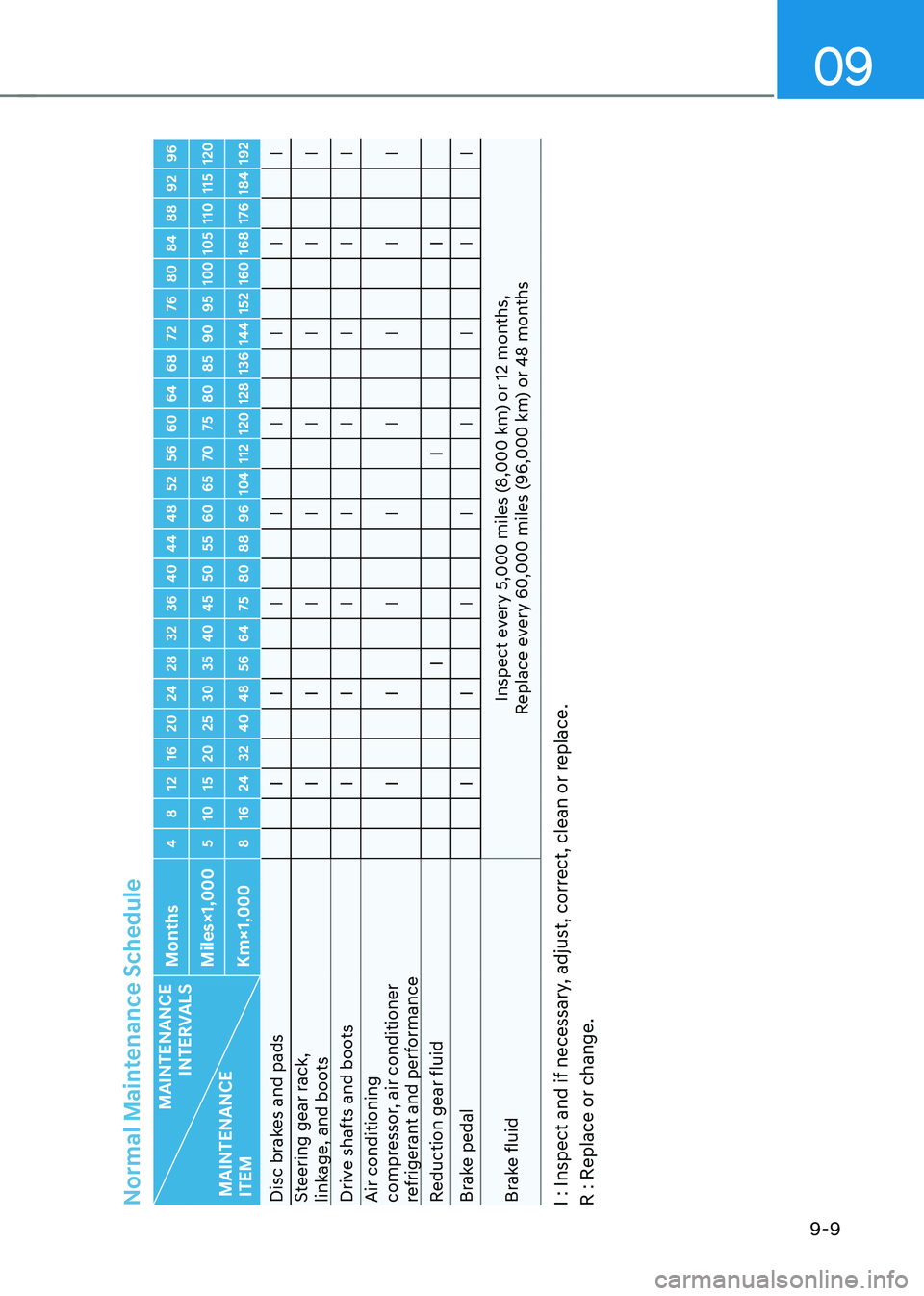
Normal Maintenance Schedule
MAINTENANCE INTERVALS
MAINTENANCE ITEM Months
4 8 12 16 20 24 28 32 36 40 44 48 52 56 60 64 68 72 76 80 84 88 92 96
Miles×1,000 5 10 15 20 25 30 35 40 45 50 55 60 65 70 75 80 85 90 95 100 105 110 115 120
Km×1,000 8 16 24 32 40 48 56 64 75 80 88 96 104 112 120 128 136 144 152 160 168 176 184 192
Disc brakes and pads I I
I I I I I I
Steering gear rack,
linkage, and boots I I
I I I I I I
Drive shafts and boots I I
I I I I I I
Air conditioning
compressor, air conditioner
refrigerant and performanceI I
I I I I I I
Reduction gear fluid
I I I
Brake pedal I I
I I I I I I
Brake fluid Inspect every 5,000 miles (8,000 km) or 12 months,
Replace every 60,000 miles (96,000 km) or 48 months
I : Inspect and if necessary, adjust, correct, clean or replace.
R : Replace or change.
Page 611 of 680
Maintenance
9-10
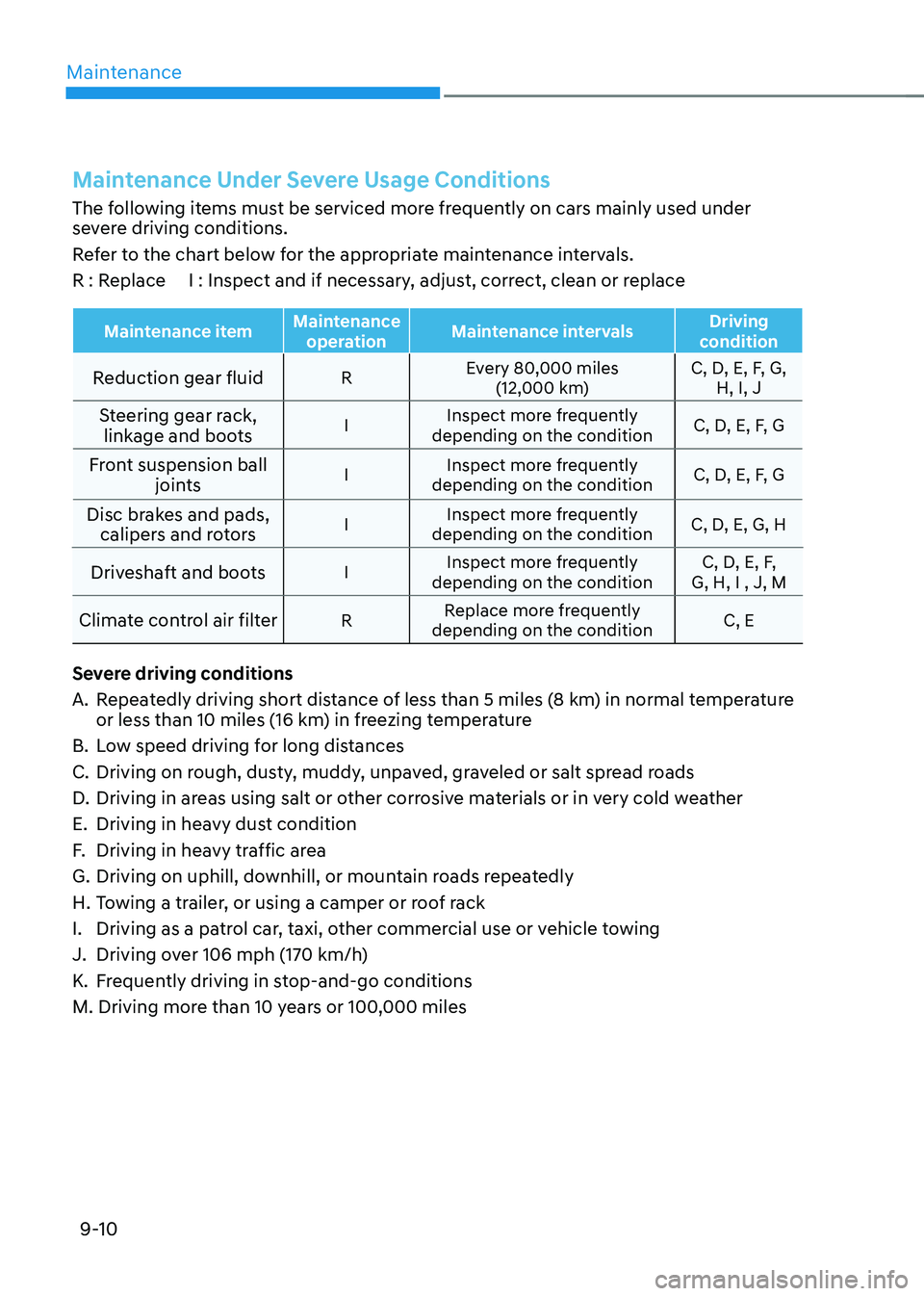
Maintenance Under Severe Usage Conditions
The following items must be serviced more frequently on cars mainly used under
severe driving conditions.
Refer to the chart below for the appropriate maintenance intervals.
R : Replace I : Inspect and if necessary, adjust, correct, clean or replace
Maintenance itemMaintenance
operation Maintenance intervals Driving
condition
Reduction gear fluid REvery 80,000 miles
(12,000 km) C, D, E, F, G,
H, I, J
Steering gear rack, linkage and boots I
Inspect more frequently
depending on the condition C, D, E, F, G
Front suspension ball joints I
Inspect more frequently
depending on the condition C, D, E, F, G
Disc brakes and pads, calipers and rotors I
Inspect more frequently
depending on the condition C, D, E, G, H
Driveshaft and boots IInspect more frequently
depending on the condition C, D, E, F,
G, H, I , J, M
Climate control air filter RReplace more frequently
depending on the condition C, E
Severe driving conditions
A. Repeatedly driving short distance of less than 5 miles (8 km) in normal temperature or less than 10 miles (16 km) in freezing temperature
B. Low speed driving for long distances
C. Driving on rough, dusty, muddy, unpaved, graveled or salt spread roads
D. Driving in areas using salt or other corrosive materials or in very cold weather
E. Driving in heavy dust condition
F. Driving in heavy traffic area
G. Driving on uphill, downhill, or mountain roads repeatedly
H. Towing a trailer, or using a camper or roof rack
I. Driving as a patrol car, taxi, other commercial use or vehicle towing
J. Driving over 106 mph (170 km/h)
K. Frequently driving in stop-and-go conditions
M. Driving more than 10 years or 100,000 miles
Page 612 of 680
09
9-11
Cooling System
Check cooling system components, such
as radiator, coolant reservoir, hoses and
connections for leakage and damage.
Replace any damaged parts.
Coolant
The coolant should be changed at the
intervals specified in the maintenance schedule.
Reduction Gear Fluid
The reduction gear fluid should be
inspected according to the intervals
specified in the maintenance schedule.
Brake Hoses and Lines
Visually check for proper installation,
chafing, cracks, deterioration and any
leakage. Replace any deteriorated or
damaged parts immediately.
Brake Fluid
Check the brake fluid level in the brake
fluid reservoir. The level should be
between the MIN and the MAX marks
on the side of the reservoir. Use only
hydraulic brake fluid conforming to DOT
4 specification.
Brake Discs, Pads, Calipers and
Rotors
Check the pads, the disc, and the rotor
for any excessive wear-out. Inspect
calipers for any fluid leakage.
Suspension Mounting Bolts
Check the suspension connections for
looseness or damage. Retighten to the
specified torque.
Steering Gear Box, Linkage &
Boots/Lower Arm Ball Joint
With the vehicle stopped and the vehicle
off, check for excessive free-play in the
steering wheel. Check the linkage for
bends or damage. Check the dust boots
and ball joints for deterioration, cracks, or damage.
Replace any damaged parts.
Drive Shafts and Boots
Check the drive shafts, boots and clamps
for cracks, deterioration, or damage.
Replace any damaged parts and, if
necessary, repack the grease.
Air Conditioning Refrigerant
Check the air conditioning lines and
connections for leakage and damage.
explanation of scheduled Maintenance iteMs
Page 613 of 680
Maintenance
9-12
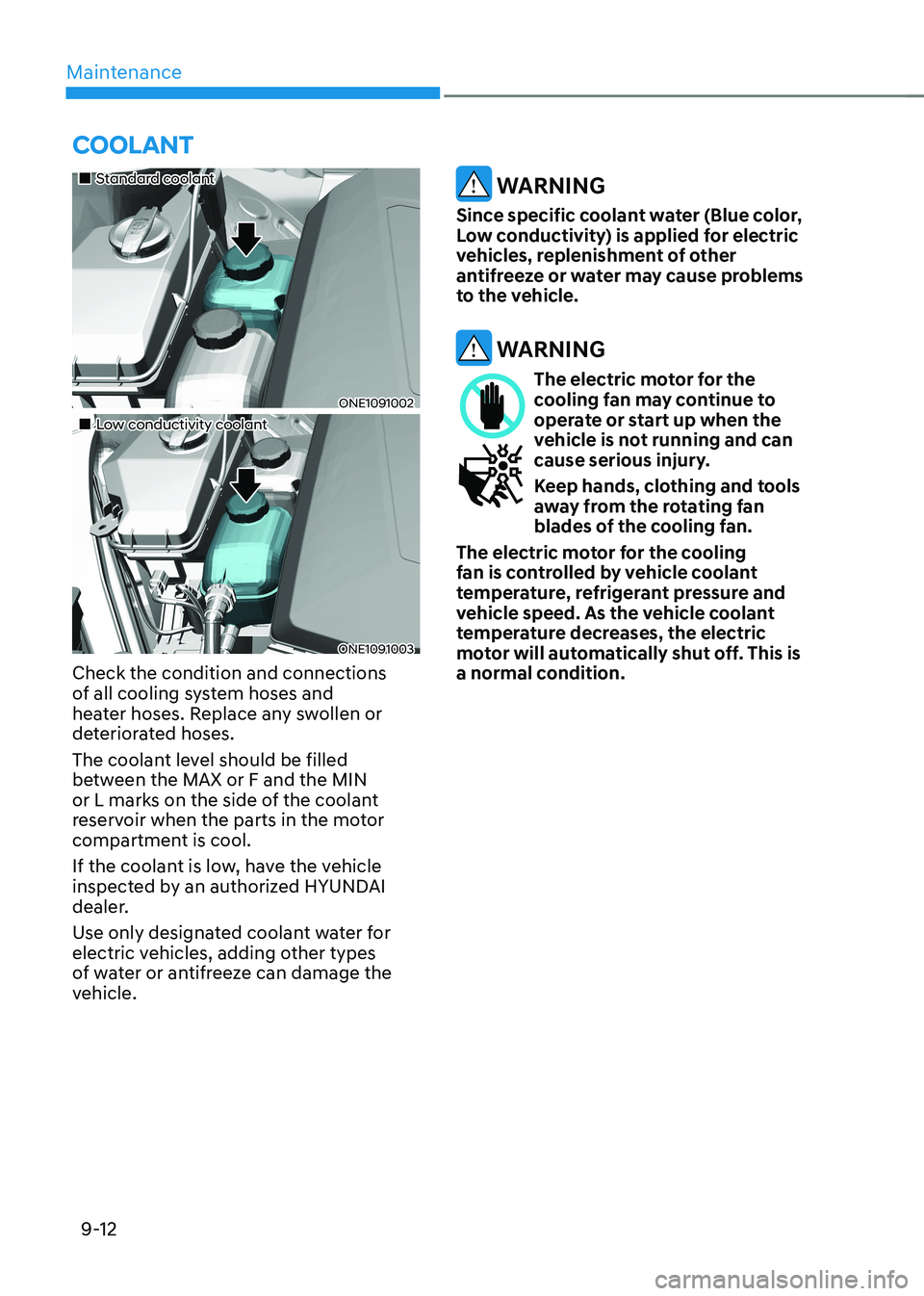
„„Standard coolant
ONE1091002
„„Low conductivity coolant
ONE1091003
Check the condition and connections
of all cooling system hoses and
heater hoses. Replace any swollen or
deteriorated hoses.
The coolant level should be filled
between the MAX or F and the MIN
or L marks on the side of the coolant
reservoir when the parts in the motor
compartment is cool.
If the coolant is low, have the vehicle
inspected by an authorized HYUNDAI
dealer.
Use only designated coolant water for
electric vehicles, adding other types
of water or antifreeze can damage the
vehicle.
WARNING
Since specific coolant water (Blue color,
Low conductivity) is applied for electric
vehicles, replenishment of other
antifreeze or water may cause problems
to the vehicle.
WARNING
The electric motor for the
cooling fan may continue to
operate or start up when the
vehicle is not running and can
cause serious injury.
Keep hands, clothing and tools
away from the rotating fan
blades of the cooling fan.
The electric motor for the cooling
fan is controlled by vehicle coolant
temperature, refrigerant pressure and
vehicle speed. As the vehicle coolant
temperature decreases, the electric
motor will automatically shut off. This is
a normal condition.
coolant
Page 616 of 680
09
9-15
Filter Inspection
The cabin air filter should be replaced
according to the Maintenance Schedule.
If the vehicle is operated in severely air-
polluted cities or on dusty rough roads
for a long period, it should be inspected
more frequently and replaced sooner.
Replace the cabin air filter by following
the procedure below and be careful to
avoid damaging other components.
Filter Replacement
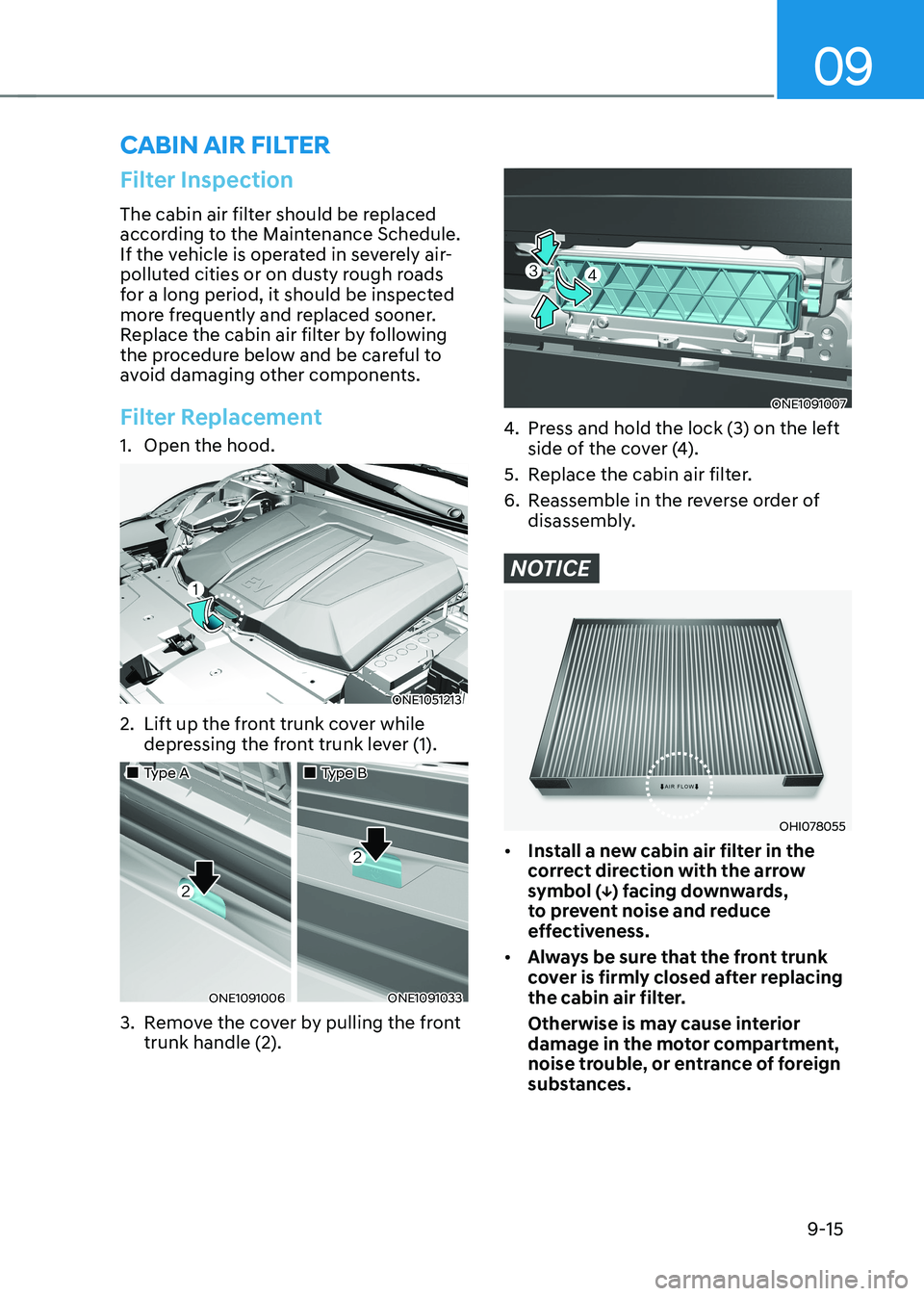
1. Open the hood.
ONE1051213
2. Lift up the front trunk cover while depressing the front trunk lever (1).
„„Type A „„Type B
ONE1091006ONE1091033
3. Remove the cover by pulling the front trunk handle (2).
ONE1091007
4. Press and hold the lock (3) on the left
side of the cover (4).
5. Replace the cabin air filter.
6. Reassemble in the reverse order of disassembly.
NOTICE
OHI078055
• Install a new cabin air filter in the
correct direction with the arrow
symbol (↓) facing downwards,
to prevent noise and reduce
effectiveness.
• Always be sure that the front trunk
cover is firmly closed after replacing
the cabin air filter.
Otherwise is may cause interior
damage in the motor compartment,
noise trouble, or entrance of foreign
substances.
caBin air filter
Page 617 of 680
Maintenance
9-16
Blade Inspection
Contamination of either the windshield
or the wiper blades with foreign matter
can reduce the effectiveness of the
windshield wipers.
Common sources of contamination are
insects, tree sap, and hot wax treatments
used by some commercial car washes. If
the blades are not wiping properly, clean
both the window and the blades with a
good cleaner or mild detergent, and rinse
thoroughly with clean water.
NOTICE
To prevent damage to the wiper blades,
arms or other components, do not: • Use gasoline, kerosene, paint
thinner, or other solvents on or near them.
• Attempt to move the wipers
manually.
• Use non-specified wiper blades.
Information
Commercial hot waxes applied by
automatic car washes have been known to make the windshield difficult to clean.
Information
Wiper blades are consumable items.
Normal wear of the wipers may not be
covered by your vehicle warranty.
Blade Replacement
When the wipers no longer clean
adequately, the blades may be worn or
cracked, and require replacement.
NOTICE
• In order to prevent damage to the hood and the wiper arms, the wiper
arms should only be lifted when in
the top wiping position.
• Always return the wiper arms to the
windshield before driving.
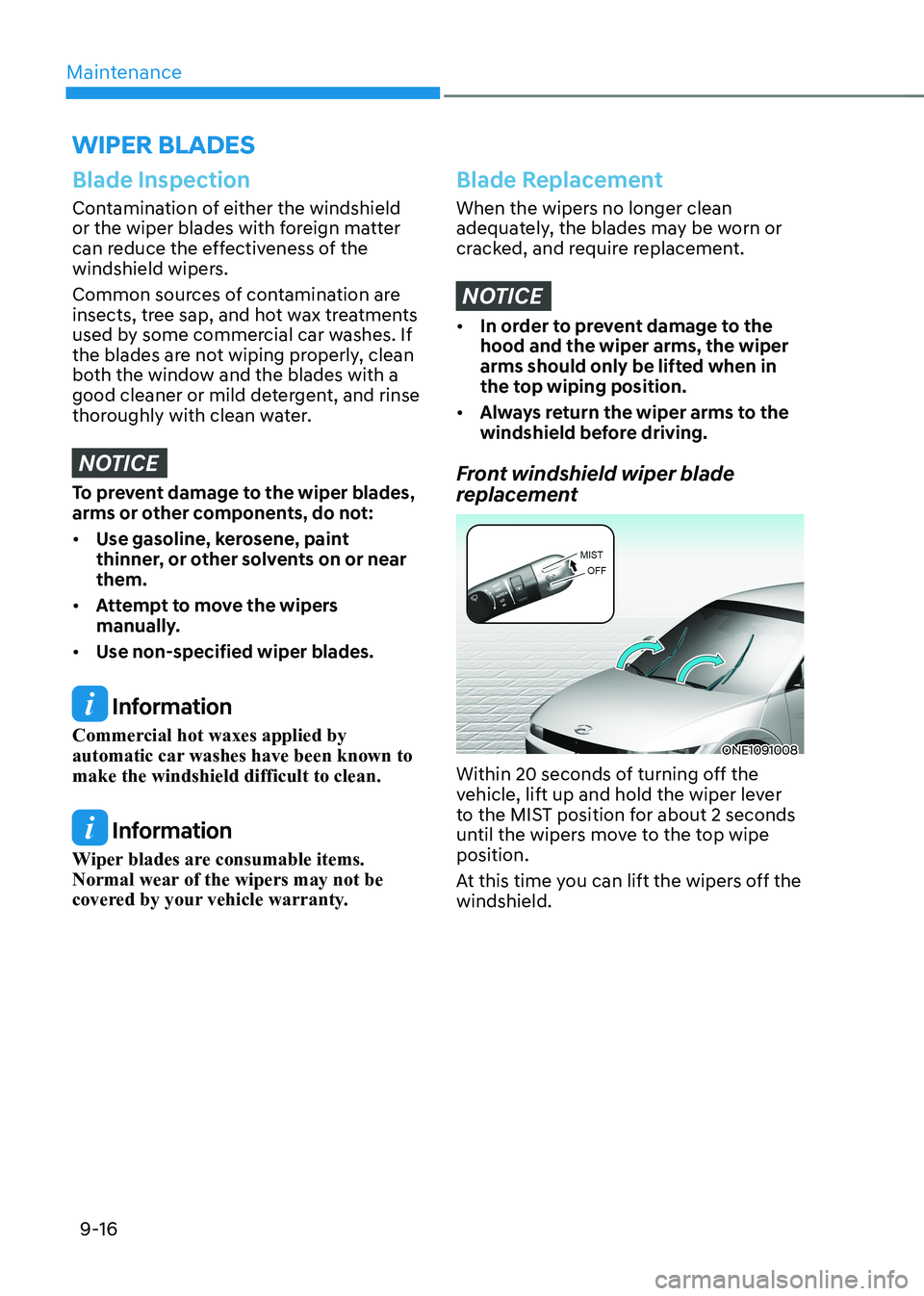
Front windshield wiper blade
replacement
ONE1091008
Within 20 seconds of turning off the
vehicle, lift up and hold the wiper lever
to the MIST position for about 2 seconds
until the wipers move to the top wipe position.
At this time you can lift the wipers off the windshield.
wiper Blades
Page 622 of 680
09
9-21
WARNING
Always follow these instructions when
recharging your vehicle’s battery to
avoid the risk of SERIOUS INJURY or
DEATH from explosions or acid burns: • Before performing maintenance or
recharging the battery, turn off all
accessories and stop the vehicle.
• Keep all flames, sparks, or smoking
materials away from the battery.
• Always work outdoors or in an area
with plenty of ventilation.
• Wear eye protection when checking
the battery during charging.
• The battery must be removed from
the vehicle and placed in a well
ventilated area.
• Watch the battery during charging,
and stop or reduce the charging
rate if the battery cells begin boiling
violently.
• The negative battery cable must
be removed first and installed last
when the battery is disconnected.
Disconnect the battery charger in the
following order:
1. Turn off the battery charger main
switch.
2. Unhook the negative clamp from the negative battery terminal.
3. Unhook the positive clamp from the positive battery terminal.
• Use batteries for replacement from
an authorized HYUNDAI dealer. By jump starting
After a jump start from a good battery,
drive the vehicle for 20-30 minutes
before it is shutoff. The vehicle may
not restart if you shut it off before the
battery had a chance to adequately
recharge. See “Jump Starting” in chapter
8 for more information on jump starting
procedures.
Information
An inappropriately disposed battery can be harmful to the
environment and human health. Dispose of the battery according
to your local law(s) or regulation.
Reset Items
The following items may need to be reset
after the battery has been discharged or
the battery has been disconnected. •
Driving info/After recharging/
Accumulated info (items in Utility
view) (see chapter 4)
• Integrated memory system (see
chapter 5)
• Power window (see chapter 5)
• Vision roof (see chapter 5)
• Power liftgate (see chapter 5)
• Climate control system (see chapter 5)
• Clock (see Infotainment system manual)
• Infotainment system (see
Infotainment system manual)
Page 623 of 680
Maintenance
9-22
WARNING
Tire failure may cause loss of vehicle
control resulting in an accident. To
reduce risk of SERIOUS INJURY or
DEATH, take the following precautions: • Inspect your tires monthly for proper
inflation as well as wear and damage.
• The recommended cold tire pressure
for your vehicle can be found in this
manual and on the tire label located
on the driver’s side center pillar.
Always use a tire pressure gauge to
measure tire pressure. Tires with
too much or too little pressure wear
unevenly causing poor handling.
• Check the pressure of the spare
every time you check the pressure of
the other tires on your vehicle.
• Replace tires that are worn, show
uneven wear, or are damaged.
Worn tires can cause loss of braking
effectiveness, steering control, or
traction.
• ALWAYS replace tires with the
same size, type, construction and
tread pattern as each tire that was
originally supplied with this vehicle.
Using tires and wheels other than
the recommended sizes could cause
unusual handling characteristics,
poor vehicle control, or negatively
affect your vehicle’s Anti-Lock Brake
System (ABS) resulting in a serious
accident.Tire Care
For proper maintenance, safety, and
maximum electric energy economy, you
must always maintain recommended
tire inflation pressures and stay within
the load limits and weight distribution
recommended for your vehicle.
OJK010021
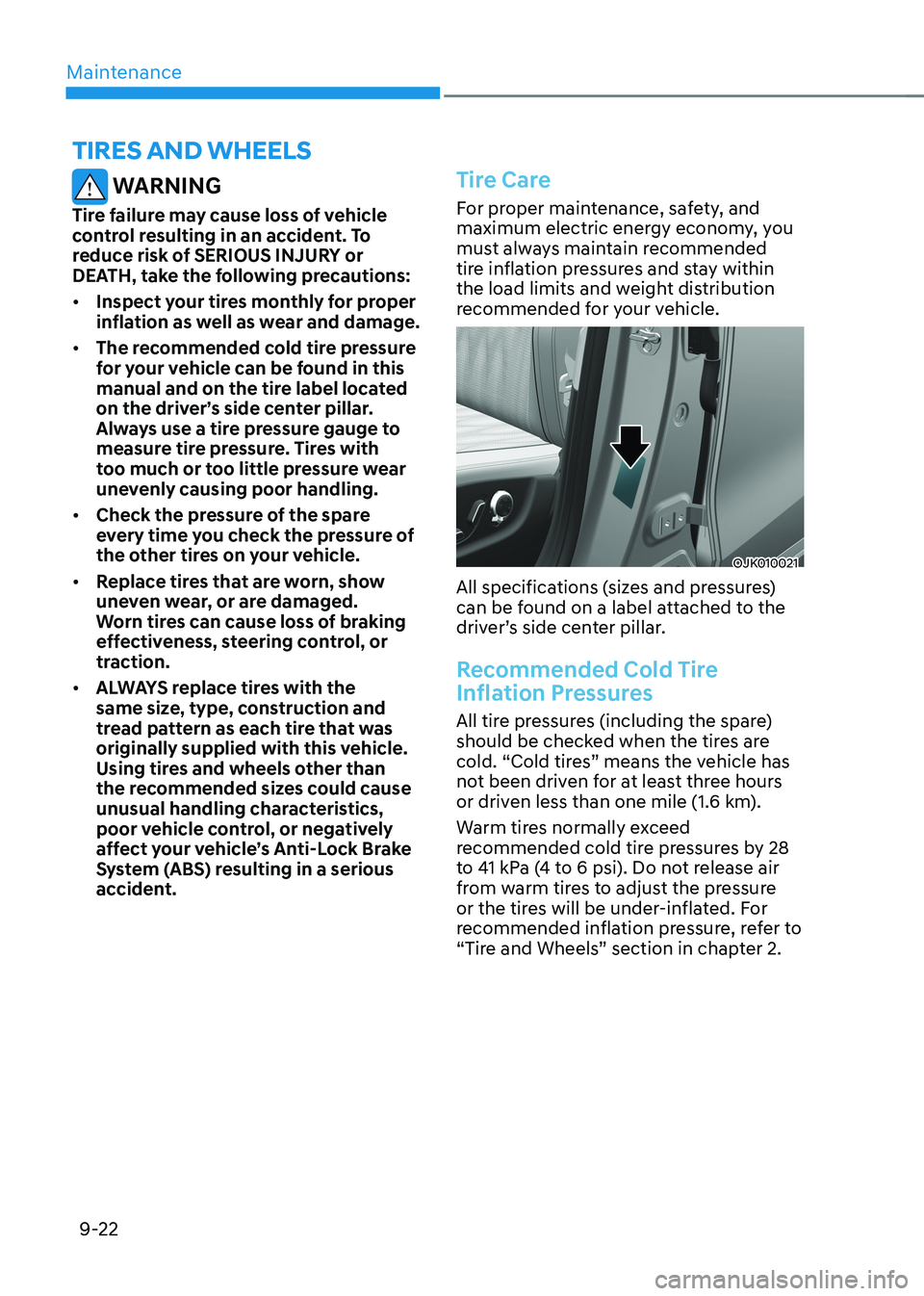
All specifications (sizes and pressures)
can be found on a label attached to the
driver’s side center pillar.
Recommended Cold Tire
Inflation Pressures
All tire pressures (including the spare)
should be checked when the tires are
cold. “Cold tires” means the vehicle has
not been driven for at least three hours
or driven less than one mile (1.6 km).
Warm tires normally exceed
recommended cold tire pressures by 28
to 41 kPa (4 to 6 psi). Do not release air
from warm tires to adjust the pressure
or the tires will be under-inflated. For
recommended inflation pressure, refer to
“Tire and Wheels” section in chapter 2.
tires and wheels