brake fluid Hyundai Ioniq Hybrid 2020 - RHD (UK, Australia) User Guide
[x] Cancel search | Manufacturer: HYUNDAI, Model Year: 2020, Model line: Ioniq Hybrid, Model: Hyundai Ioniq Hybrid 2020Pages: 613, PDF Size: 58.64 MB
Page 526 of 613
7-8
Maintenance
At least once a year:
Clean body and door drain holes.
Lubricate door hinges and bonnet
hinges.
Lubricate door and bonnet locks
and latches.
Lubricate door rubber weather
strips.
Check the air conditioning system.
Inspect and lubricate automatic
dual clutch transmission linkage
and controls.
Clean the battery and terminals.
Check the brake fluid level.Follow Normal Maintenance Schedule
if the vehicle is usually operated where
none of the following conditions apply.
If any of the following conditions apply,
you must follow the Maintenance
Under Severe Usage Conditions.
Repeated driving short distance of
less than 8 km (5 miles) in normal
temperature or less than 16 km
(10miles) in freezing temperature
Extensive engine idling or low
speed driving for long distances
Driving on rough, dusty, muddy,
unpaved, graveled or salt-spread
roads
Driving in areas using salt or other
corrosive materials or in very cold
weather
Driving in heavy dust condition
Driving in heavy traffic area
Driving on uphill, downhill, or
mountain road repeatedly Towing a trailer or using a camper,
or roof rack
Driving as a patrol car, taxi, other
commercial use of vehicle towing
Driving over 170 km/h (106
miles/h)
Frequently driving in stop-and-go
conditions
If your vehicle is operated under the
above conditions, you should
inspect, replace or refill more fre-
quently than the following Normal
Maintenance Schedule. After the
periods or distance shown in the
chart, continue to follow the pre-
scribed maintenance intervals.
S SC
CH
HE
ED
DU
UL
LE
ED
D
M
MA
AI
IN
NT
TE
EN
NA
AN
NC
CE
E
S
SE
ER
RV
VI
IC
CE
ES
S
Page 529 of 613
7-11
7
Maintenance
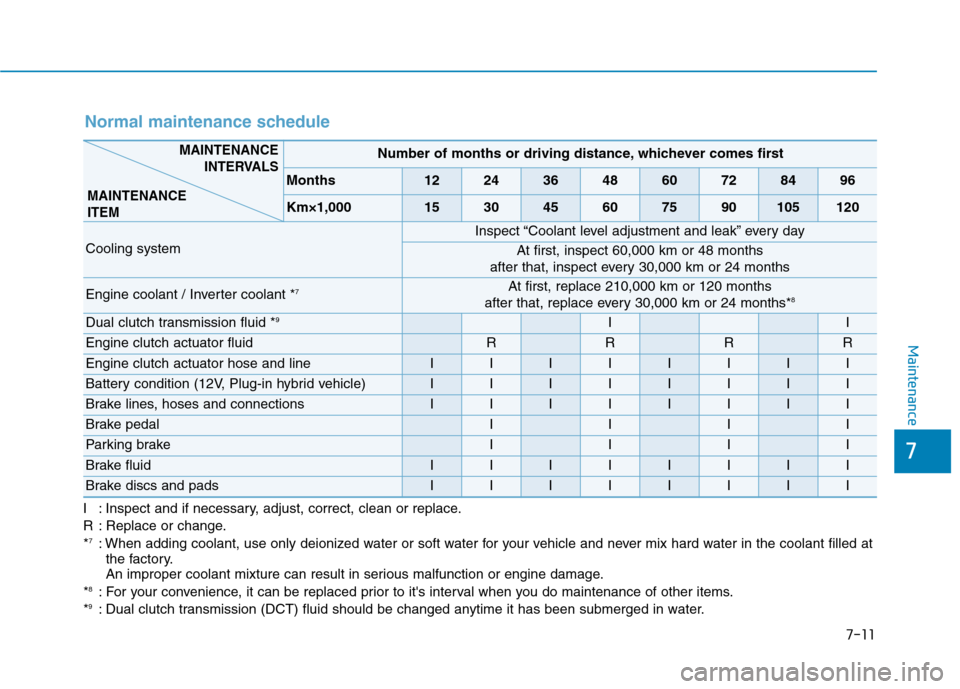
Normal maintenance schedule
Number of months or driving distance, whichever comes first
Months1224364860728496
Km×1,000153045607590105120
Cooling system
Inspect “Coolant level adjustment and leak” every day
At first, inspect 60,000 km or 48 months
after that, inspect every 30,000 km or 24 months
Engine coolant / Inverter coolant *7At first, replace 210,000 km or 120 months
after that, replace every 30,000 km or 24 months*8
Dual clutch transmission fluid *9II
Engine clutch actuator fluidRRRR
Engine clutch actuator hose and lineIIIIIIII
Battery condition (12V, Plug-in hybrid vehicle)IIIIIIII
Brake lines, hoses and connectionsIIIIIIII
Brake pedalIIII
Parking brakeIIII
Brake fluidIIIIIIII
Brake discs and padsIIIIIIII
MAINTENANCE
INTERVALS
MAINTENANCE
ITEM
I : Inspect and if necessary, adjust, correct, clean or replace.
R : Replace or change.
*
7: When adding coolant, use only deionized water or soft water for your vehicle and never mix hard water in the coolant filled at
the factory.
An improper coolant mixture can result in serious malfunction or engine damage.
*
8: For your convenience, it can be replaced prior to it's interval when you do maintenance of other items.
*9: Dual clutch transmission (DCT) fluid should be changed anytime it has been submerged in water.
Page 534 of 613
7-16
Maintenance
Dual clutch transmission fluid
The dual clutch transmission fluid
should be inspected according to the
intervals specified in the mainte-
nance schedule.
Engine clutch actuator fluid
The engine clutch actuator fluid level
should be inspected or replaced to
the intervals specified in the mainte-
nance schedule.
Brake hoses and lines
Visually check for proper installation,
chafing, cracks, deterioration and
any leakage. Replace any deteriorat-
ed or damaged parts immediately.
Brake fluid
Check the brake fluid level in the
brake fluid reservoir. The level should
be between the MIN and the MAX
marks on the side of the reservoir.
Use only hydraulic brake fluid con-
forming to DOT 3 or DOT 4 specifi-
cation.
Parking brake
Inspect the parking brake system
including the parking brake pedal
and cables.
Brake discs, pads, calipers
and rotors
Check the pads, the disc, and the
rotor for any excessive wear-out.
Inspect calipers for any fluid leakage.
Exhaust pipe and muffler
Visually inspect the exhaust pipes,
muffler and hangers for cracks, dete-
rioration, or damage. Start the
engine and listen carefully for any
exhaust gas leakage. Tighten con-
nections or replace parts as neces-
sary.
Suspension mounting bolts
Check the suspension connections
for looseness or damage. Retighten
to the specified torque.
Steering gear box, linkage &
boots/lower arm ball joint
With the vehicle stopped and the
hybrid system off, check for exces-
sive free-play in the steering wheel.
Check the linkage for bends or dam-
age. Check the dust boots and ball
joints for deterioration, cracks, or
damage.
Replace any damaged parts.
Drive shafts and boots
Check the drive shafts, boots and
clamps for cracks, deterioration, or
damage. Replace any damaged
parts and, if necessary, repack the
grease.
Air conditioning refrigerant
Check the air conditioning lines and
connections for leakage and damage.
Page 541 of 613
7-23
7
Maintenance
H HY
YB
BR
RI
ID
D
S
ST
TA
AR
RT
TE
ER
R
&
&
G
GE
EN
NE
ER
RA
AT
TO
OR
R
(
(H
HS
SG
G)
)
B
BE
EL
LT
T
Checking the hybrid starter &
generator (HSG) belt
We recommend that you have the
hybrid starter & generator (HSG)
belt inspected or replaced according
to the Maintenance Schedule in this
chapter by an authorised HYUNDAI
dealer.
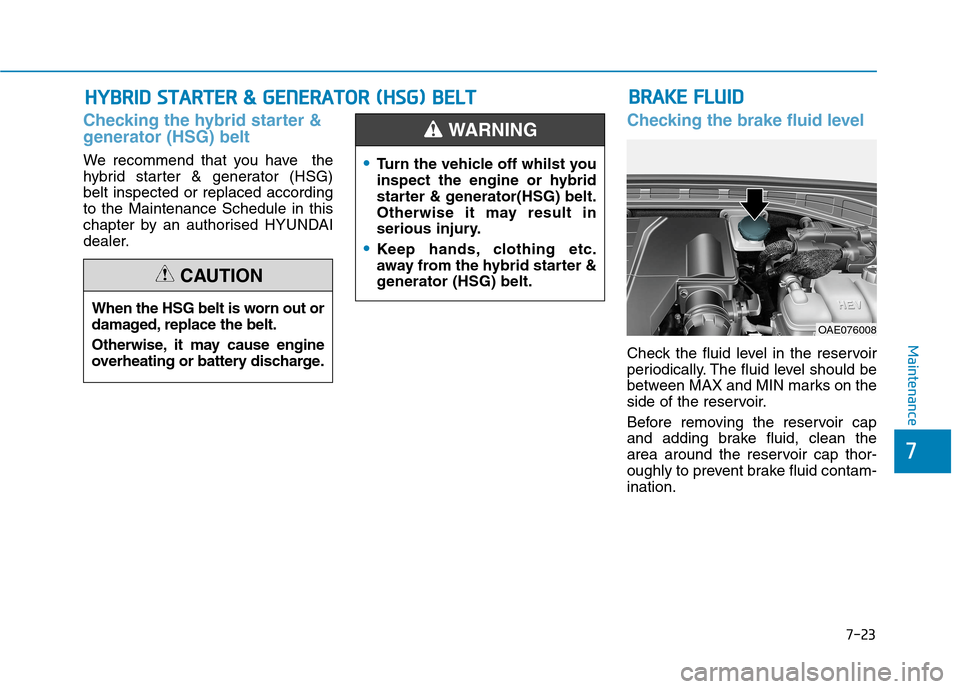
Checking the brake fluid level
Check the fluid level in the reservoir
periodically. The fluid level should be
between MAX and MIN marks on the
side of the reservoir.
Before removing the reservoir cap
and adding brake fluid, clean the
area around the reservoir cap thor-
oughly to prevent brake fluid contam-
ination.
Turn the vehicle off whilst you
inspect the engine or hybrid
starter & generator(HSG) belt.
Otherwise it may result in
serious injury.
Keep hands, clothing etc.
away from the hybrid starter &
generator (HSG) belt.
WARNING
When the HSG belt is worn out or
damaged, replace the belt.
Otherwise, it may cause engine
overheating or battery discharge.
CAUTION
OAE076008
B BR
RA
AK
KE
E
F
FL
LU
UI
ID
D
Page 542 of 613
7-24
Maintenance
If the level is low, add the specified
brake fluid to the MAX level. The level
will fall with accumulated mileage.
This is a normal condition associated
with the wear of the brake linings. If
the fluid level is excessively low, we
recommend that the brake system
be checked by an authorised
HYUNDAI dealer. Do not allow brake fluid to con-
tact the vehicle’s body paint, as
paint damage will result.
Brake fluid, which has been
exposed to open air for an
extended time should NEVER be
used as its quality cannot be
guaranteed. It should be dis-
posed of properly.
Do not use the wrong kind of
brake fluid. A few drops of miner-
al based oil, such as engine oil, in
your brake system can damage
brake system parts.
Information
Use only the specified brake fluid
Refer to “Recommended Lubricants
and Capacities” in chapter 8.
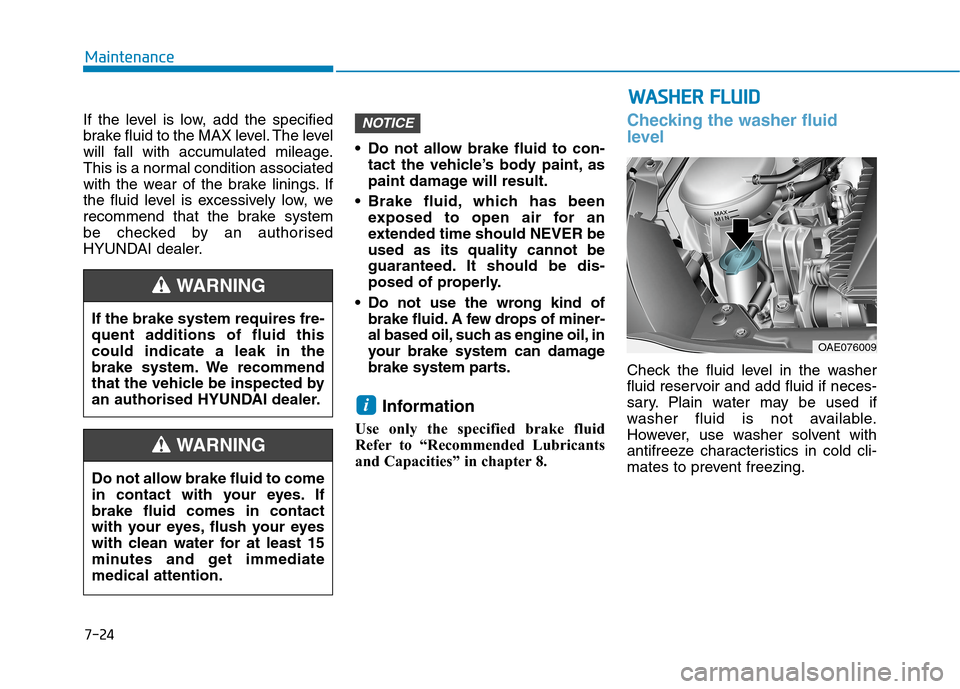
Checking the washer fluid
level
Check the fluid level in the washer
fluid reservoir and add fluid if neces-
sary. Plain water may be used if
washer fluid is not available.
However, use washer solvent with
antifreeze characteristics in cold cli-
mates to prevent freezing.
i
NOTICE
If the brake system requires fre-
quent additions of fluid this
could indicate a leak in the
brake system. We recommend
that the vehicle be inspected by
an authorised HYUNDAI dealer.
WARNING
Do not allow brake fluid to come
in contact with your eyes. If
brake fluid comes in contact
with your eyes, flush your eyes
with clean water for at least 15
minutes and get immediate
medical attention.
WARNING
W WA
AS
SH
HE
ER
R
F
FL
LU
UI
ID
D
OAE076009
Page 543 of 613
7-25
7
Maintenance
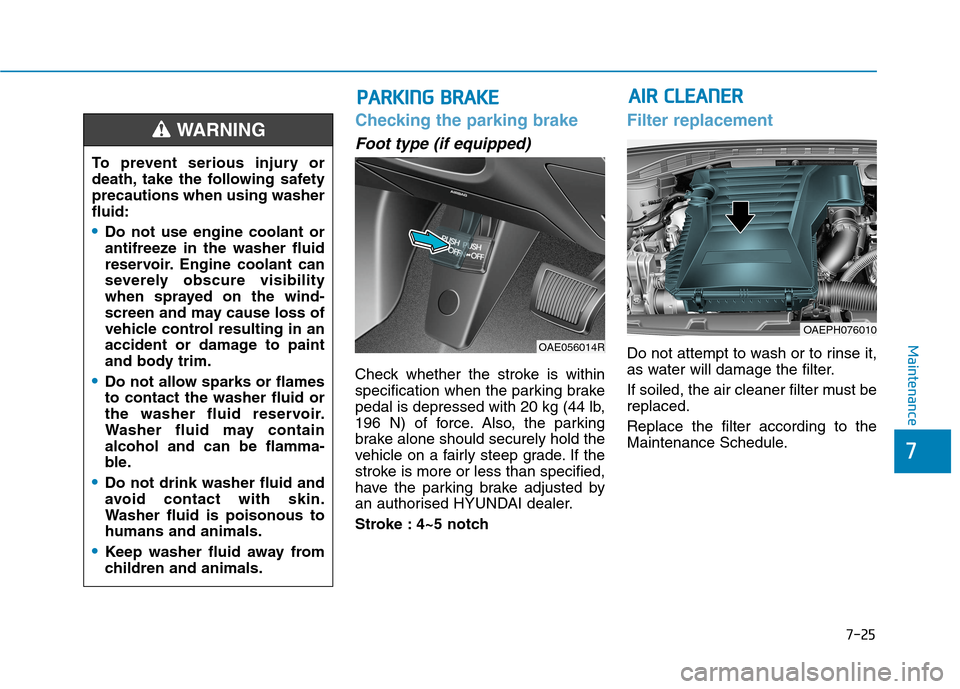
Checking the parking brake
Foot type (if equipped)
Check whether the stroke is within
specification when the parking brake
pedal is depressed with 20 kg (44 lb,
196 N) of force. Also, the parking
brake alone should securely hold the
vehicle on a fairly steep grade. If the
stroke is more or less than specified,
have the parking brake adjusted by
an authorised HYUNDAI dealer.
Stroke : 4~5 notch
Filter replacement
Do not attempt to wash or to rinse it,
as water will damage the filter.
If soiled, the air cleaner filter must be
replaced.
Replace the filter according to the
Maintenance Schedule.OAE056014R
P PA
AR
RK
KI
IN
NG
G
B
BR
RA
AK
KE
E
To prevent serious injury or
death, take the following safety
precautions when using washer
fluid:
Do not use engine coolant or
antifreeze in the washer fluid
reservoir. Engine coolant can
severely obscure visibility
when sprayed on the wind-
screen and may cause loss of
vehicle control resulting in an
accident or damage to paint
and body trim.
Do not allow sparks or flames
to contact the washer fluid or
the washer fluid reservoir.
Washer fluid may contain
alcohol and can be flamma-
ble.
Do not drink washer fluid and
avoid contact with skin.
Washer fluid is poisonous to
humans and animals.
Keep washer fluid away from
children and animals.
WARNING
A AI
IR
R
C
CL
LE
EA
AN
NE
ER
R
OAEPH076010
Page 609 of 613
8-6
Specifications & Consumer information
R RE
EC
CO
OM
MM
ME
EN
ND
DE
ED
D
L
LU
UB
BR
RI
IC
CA
AN
NT
TS
S
A
AN
ND
D
C
CA
AP
PA
AC
CI
IT
TI
IE
ES
S
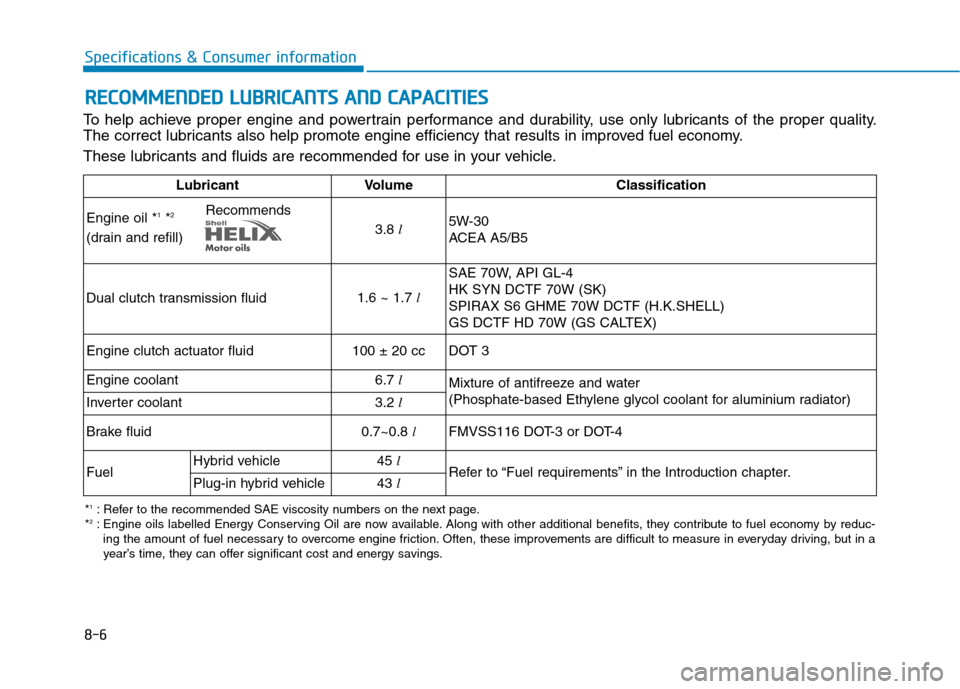
To help achieve proper engine and powertrain performance and durability, use only lubricants of the proper quality.
The correct lubricants also help promote engine efficiency that results in improved fuel economy.
These lubricants and fluids are recommended for use in your vehicle.
Lubricant Volume Classification
Engine oil *
1*2Recommends
(drain and refill)3.8 l5W-30
ACEA A5/B5
Dual clutch transmission fluid1.6 ~ 1.7 lSAE 70W, API GL-4
HK SYN DCTF 70W (SK)
SPIRAX S6 GHME 70W DCTF (H.K.SHELL)
GS DCTF HD 70W (GS CALTEX)
Engine clutch actuator fluid 100 ± 20 cc DOT 3
Engine coolant6.7 l
Mixture of antifreeze and water
(Phosphate-based Ethylene glycol coolant for aluminium radiator)
Inverter coolant3.2 l
Brake fluid0.7~0.8 l
FMVSS116 DOT-3 or DOT-4
FuelHybrid vehicle45 l
Refer to “Fuel requirements” in the Introduction chapter.
Plug-in hybrid vehicle43 l
*1: Refer to the recommended SAE viscosity numbers on the next page.
*2: Engine oils labelled Energy Conserving Oil are now available. Along with other additional benefits, they contribute to fuel economy by reduc-
ing the amount of fuel necessary to overcome engine friction. Often, these improvements are difficult to measure in everyday driving, but in a
year’s time, they can offer significant cost and energy savings.