child restraint Hyundai Ioniq Plug-in Hybrid 2019 Owner's Manual - RHD (UK, Australia)
[x] Cancel search | Manufacturer: HYUNDAI, Model Year: 2019, Model line: Ioniq Plug-in Hybrid, Model: Hyundai Ioniq Plug-in Hybrid 2019Pages: 599, PDF Size: 17.32 MB
Page 78 of 599
Safety system of your vehicle
2
Important safety precautions...............................2-2
Always wear your seat belt............................................2-2
Restrain all children ..........................................................2-2
Air bag hazards..................................................................2-2
Driver distraction ...............................................................2-2
Control your speed ...........................................................2-3
Keep your vehicle in safe condition .............................2-3
Seats ........................................................................\
2-4
Safety precautions............................................................2-5
Front seats ........................................................................\
..2-6
Rear seats ........................................................................\
.2-12
Head restraint ..................................................................2-15
Seat warmers and air ventilation seats.....................2-20
Seat belts ..............................................................2-24
Seat belt safety precautions ........................................2-24
Seat belt warning light ..................................................2-25
Seat belt restraint system ............................................2-27
Additional seat belt safety precautions ....................2-32
Care of seat belts ...........................................................2-35
Child restraint system (CRS) .............................2-36
Our recommendation:Children always in the rear ..2-36
Selecting a Child Restraint System (CRS) .................2-37
Installing a Child Restraint System (CRS)..................2-39
Air bag - supplemental restraint system .........2-49
Where are the air bags? ...............................................2-51
How does the air bags system operate? ..................2-56
What to expect after an air bag inflates..................2-60
Why didn't my air bag go off in a collision? ...........2-62
SRS care ........................................................................\
....2-67
Additional safety precautions ......................................2-68
Air bag warning labels ...................................................2-69
This chapter provides you with important information about how to protect yourself and your passengers.
It explains how to properly use your seats and seat belts, and how your air bags work.
Additionally, this chapter explains how to properly restrain infants and children in your vehicle.
Page 79 of 599
2-2
You will find many safety precautions
and recommendations throughout
this section, and throughout this man-
ual. The safety precautions in this sec-
tion are among the most important.
Always wear your seat belt
A seat belt is your best protection in
all types of accidents. Air bags are
designed to supplement seat belts,
not replace them. So even though
your vehicle is equipped with air bags,
ALWAYS make sure you and your
passengers wear your seat belts, and
wear them properly.
Restrain all children
All children under age 13 should ride
in your vehicle properly restrained in
a rear seat, not the front seat. Infants
and small children should be
restrained in an appropriate Child
Restraint System. Larger children
should use a booster seat with the
lap/shoulder belt until they can use
the seat belt properly without a
booster seat.
Air bag hazards
Whilst air bags can save lives, they
can also cause serious or fatal
injuries to occupants who sit too
close to them, or who are not prop-
erly restrained. Infants, young chil-
dren, and short adults are at the
greatest risk of being injured by an
inflating air bag. Follow all instruc-
tions and warnings in this manual.
Driver distraction
Driver distraction presents a serious
and potentially deadly danger, espe-
cially for inexperienced drivers. Safety
should be the first concern when
behind the wheel and drivers need to
be aware of the wide array of potential
distractions, such as drowsiness,
reaching for objects, eating, personal
grooming, other passengers, and
using mobile phones.
Drivers can become distracted when
they take their eyes and attention off
the road or their hands off the wheel
to focus on activities other than driv-
ing. To reduce your risk of distraction
and an accident:
• ALWAYS set up your mobile devices(i.e., MP3 players, phones, naviga-
tion units, etc.) when your vehicle is
parked or safely stopped.
ONLY use your mobile device when allowed by laws and conditions per-
mit safe use. NEVER text or email
whilst driving. Most countries have
laws prohibiting drivers from texting.
Some countries and cities also pro-
hibit drivers from using handheld
phones.
I IM
M P
PO
O R
RT
TA
A N
N T
T
S
S A
A F
FE
E T
T Y
Y
P
P R
R E
EC
CA
A U
U T
TI
IO
O N
NS
S
Safety system of your vehicle
Page 83 of 599
2-6
Safety system of your vehicle
Seat belts
Always fasten your seat belt before
starting any trip.
At all times, passengers should sit
upright and be properly restrained.
Infants and small children must be
restrained in appropriate Child
Restraint Systems. Children who
have outgrown a booster seat and
adults must be restrained using the
seat belts.
Front seats
The front seat can be adjusted by
using the control lever or switches
located on the outside of the seat
cushion. Before driving, adjust the
seat to the proper position so that you
can easily control the steering wheel,
foot pedals and controls on the instru-
ment panel.
Take the following precautions
when adjusting your seat belt:
NEVER use one seat belt for
more than one occupant.
Always position the seatback
upright with the lap portion of
the seat belt snug and low
across the hips.
NEVER allow children or small
infants to ride on a passenger’s
lap.
Do not route the seat belt
across your neck, across sharp
edges, or reroute the shoulder
strap away from your body.
Do not allow the seat belt to
become caught or jammed.
WARNING
Take the following precautions
when adjusting your seat:
NEVER attempt to adjust the
seat whilst the vehicle is mov-
ing. The seat could respond
with unexpected movement
and may cause loss of vehicle
control resulting in an acci-
dent.
Do not place anything under
the front seats. Loose objects
in the driver’s foot area could
interfere with the operation of
the foot pedals, causing an
accident.
(Continued)
WARNING
Page 110 of 599
2-33
Safety system of your vehicle
2
Seat belt use and children
Infant and small children
Most countries have Child Restraint
System laws which require children to
travel in approved Child Restraint
System devices, including booster
seats. The age at which seat belts can
be used instead of Child Restraint
System differs among countries, so
you should be aware of the specific
requirements in your country, and
where you are travelling. Infant and
Child Restraint System must be prop-
erly placed and installed in a rear seat.
For more information refer to the “Child
Restraint Systems” in this chapter.Small children are best protected
from injury in an accident when prop-
erly restrained in the rear seat by a
Child Restraint System that meets the
requirements of the Safety Standards
of your country. Before buying any
Child Restraint System, make sure
that it has a label certifying that it
meets Safety Standard of your coun-
try. The Child Restraint System must
be appropriate for your child's height
and weight. Check the label on the
Child Restraint System for this informa-
tion. Refer to “Child Restraint Systems”
in this chapter.
ALWAYS properly restrain infants
and small children in a Child
Restraint System appropriate for
the child’s height and weight.
To reduce the risk of serious
injury or death to a child and
other passengers, NEVER hold a
child in your lap or arms when
the vehicle is moving. The violent
forces created during an acci-
dent will tear the child from your
arms and throw the child against
the interior of the vehicle.
WARNING
Page 111 of 599
2-34
Safety system of your vehicle
Larger children
Children under age 13 and who are
too large for a booster seat should
always occupy the rear seat and use
the available lap/shoulder belts. A
seat belt should lie across the upper
thighs and be snug across the shoul-
der and chest to restrain the child
safely. Check belt fit periodically. A
child's squirming could put the belt
out of position. In the event of an acci-
dent, children are afforded the best
safety restrained by a proper Child
Restraint System in the rear seats.
If a larger child over age 13 must be
seated in the front seat, the child
must be securely restrained by the
available lap/shoulder belt and the
seat should be placed in the rear-
most position.
If the shoulder belt portion slightly
touches the child’s neck or face, try
placing the child closer to the centre
of the vehicle. If the shoulder belt still
touches their face or neck, they need
to be returned to an appropriate
booster seat in the rear seat.
Seat belt use and injured people
A seat belt should be used when an
injured person is being transported.
Consult a physician for specific rec-
ommendations.
One person per belt
Two people (including children) should
never attempt to use a single seat belt.
This could increase the severity of
injuries in case of an accident.
Do not lie down
Sitting in a reclined position when
the vehicle is in motion can be dan-
gerous. Even when buckled up, the
protections of your restraint system
(seat belts and/or air bags) is greatly
reduced by reclining your seatback.
Seat belts must be snug against your
hips and chest to work properly.
During an accident, you could be
thrown into the seat belt, causing
neck or other injuries.
Always make sure larger chil-
dren’s seat belts are worn and
properly adjusted.
NEVER allow the shoulder
belt to contact the child’s
neck or face.
Do not allow more than one
child to use a single seat belt.
WARNING
Page 113 of 599
2-36
Safety system of your vehicle
Our recommendation:
Children always in the rear
Children under age 13 should always
ride in the rear seats and must
always be properly restrained to min-
imise the risk of injury in an accident,
sudden stop or sudden manoeuvre.
According to accident statistics, chil-
dren are safer when properly restrained
in the rear seats than in the front
seat. Children too large for a Child
Restraint System must use the seat
belts provided.Most countries have regulations which
require children to travel in approved
Child Restraint Systems.
The laws governing the age or
height/weight restrictions at which seat
belts can be used instead of Child
Restraint System differs among coun-
tries, so you should be aware of the
specific requirements in your country,
and where you are travelling.
Child Restraint Systems must be
properly installed in the vehicle seat.
Always use a commercially available
Child Restraint System that meets the
requirements of your country.
Child Restraint System (CRS)
Infants and younger children must be
restrained in an appropriate rearward-
facing or forward-facing CRS that has
first been properly secured to the seat
of the vehicle. Read and comply with
the instructions for installation and use
provided by the manufacturer of the
Child Restraint System.
C C
H
H I
IL
L D
D
R
R E
ES
ST
T R
R A
A I
IN
N T
T
S
S Y
Y S
ST
T E
EM
M
(
( C
C R
R S
S)
)
Always properly restrain children
in the vehicle. Children of all ages
are safer when riding in the rear
seats. Never place a rearward-
facing Child Restraint System on
the front passenger seat, unless
the air bag is deactivated.
WARNING
Page 114 of 599
2-37
Safety system of your vehicle
2
Selecting a Child Restraint
System (CRS)
When selecting a Child Restraint
System for your child, always:
Make sure the Child RestraintSystem has a label certifying that it
meets applicable Safety Standards
of your country.
A Child Restraint System may only
be installed if it was approved in
accordance with the requirements of
ECE-R44 or ECE-R129.
Select a Child Restraint System based on your child’s height and
weight. The required label or the
instructions for use typically pro-
vide this information.
Select a Child Restraint System that fits the vehicle seating position
where it will be used.
Read and comply with the warn- ings and instructions for installation
and use provided with the Child
Restraint System.
Child Restraint System types
There are three main types of Child
Restraint Systems: rearward-facing,
forward-facing and booster Child
Restraint Systems.
They are classified according to the
child’s age, height and weight.
Always follow the Child Restraint
System manufacturer’s instruc-
tions for installation and use.
Always properly restrain your
child in the Child Restraint
System.
Do not use an infant carrier or
a child safety seat that “hooks”
over a seatback, it may not pro-
vide adequate protection in an
accident.
After an accident, we recom-
mend a HYUNDAI authorised
repairer to check the Child
Restraint System, seat belts,
ISOFIX anchorages and top-
tether anchorages.
WARNING
Page 115 of 599
2-38
Safety system of your vehicle
Rearward-facing Child Restraint
System
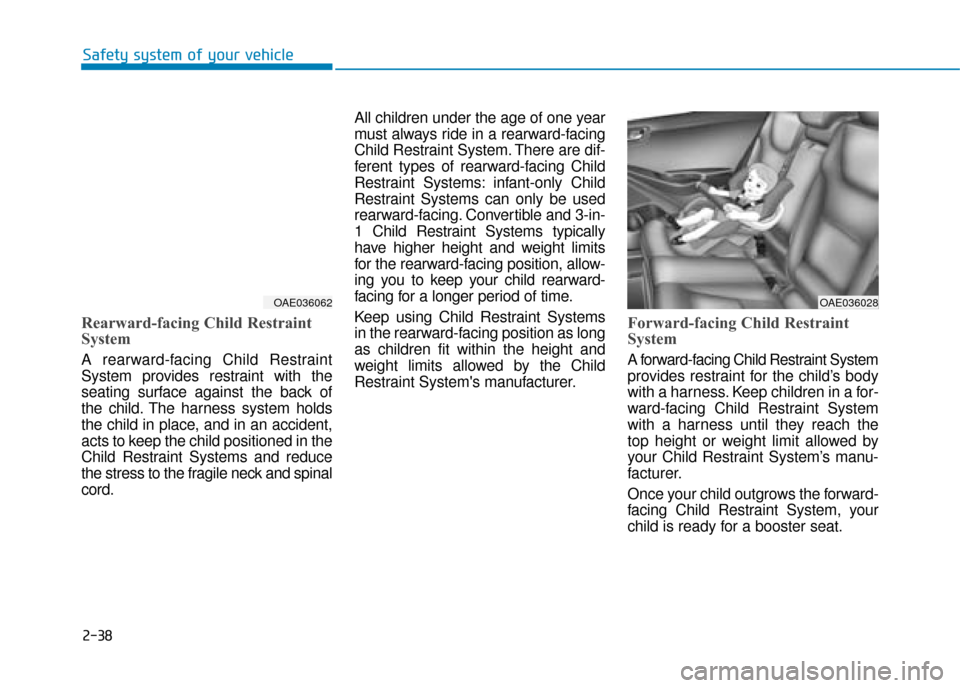
A rearward-facing Child Restraint
System provides restraint with the
seating surface against the back of
the child. The harness system holds
the child in place, and in an accident,
acts to keep the child positioned in the
Child Restraint Systems and reduce
the stress to the fragile neck and spinal
cord.All children under the age of one year
must always ride in a rearward-facing
Child Restraint System. There are dif-
ferent types of rearward-facing Child
Restraint Systems: infant-only Child
Restraint Systems can only be used
rearward-facing. Convertible and 3-in-
1 Child Restraint Systems typically
have higher height and weight limits
for the rearward-facing position, allow-
ing you to keep your child rearward-
facing for a longer period of time.
Keep using Child Restraint Systems
in the rearward-facing position as long
as children fit within the height and
weight limits allowed by the Child
Restraint System's manufacturer.
Forward-facing Child Restraint
System
A forward-facing Child Restraint System
provides restraint for the child’s body
with a harness. Keep children in a for-
ward-facing Child Restraint System
with a harness until they reach the
top height or weight limit allowed by
your Child Restraint System’s manu-
facturer.
Once your child outgrows the forward-
facing Child Restraint System, your
child is ready for a booster seat.
OAE036028OAE036062
Page 116 of 599
2-39
Safety system of your vehicle
2
Booster seats
A booster seat is a Child Restraint
System designed to improve the fit of
the vehicle’s seat belt system. A boost-
er seat positions the seat belt so that it
fits properly over the stronger parts of
your child’s body. Keep your children in
booster seats until they are big
enough to fit in a seat belt properly.
For a seat belt to fit properly, the lap
belt must lie comfortable across the
upper thighs, not the stomach. The
shoulder belt should lie comfortable
across the shoulder and chest and
not across the neck or face. Children
under age 13 must always be proper-
ly restrained to minimise the risk of
injury in an accident, sudden stop or
sudden manoeuvre.
Installing a Child Restraint
System (CRS)After selecting a proper Child Restraint
System for your child and checking
that the Child Restraint System fits
properly on the seating position, there
are three general steps for a proper
installation:
Properly secure the Child Restraint
System to the vehicle.
All Child
Restraint Systems must be secured
to the vehicle with the lap belt or lap
part of a lap/shoulder belt or with
the ISOFIX top-tether and/or ISOFIX
anchorage and/or with the support
leg.
Make sure the Child Restraint
System is firmly secured. After
installing a Child Restraint System
to the vehicle, push and pull the
seat forward and from side-to-side
to verify that it is securely attached
to the seat. A Child Restraint
System secured with a seat belt
should be installed as firmly as
possible. However, some side-to-
side movement can be expected.
Before installing your Child
Restraint System always:
Read and follow the instructions
provided by the manufacturer of
the Child Restraint System.
Failure to follow all warnings
and instructions could increase
the risk of the SERIOUS INJURY
or DEATH if an accident occurs.
WARNING
If the vehicle head restraint pre-
vents proper installation of a
Child Restraint System, the
head restraint of the respective
seating position shall be read-
justed or entirely removed.
WARNING
Page 117 of 599
2-40
Safety system of your vehicleWhen installing a Child Restraint
System, adjust the vehicle seat and
seatback (up and down, forward and
rearward) so that your child fits in
the Child Restraint System in a con-
fortable manner.
Secure the child in the Child
Restraint System. Make sure the
child is properly strapped in the
Child Restraint System according
to the Child Restraint System man-
ufacturer’s instructions.
ISOFIX anchorage and top-teth- er anchorage (ISOFIX anchoragesystem) for children
The ISOFIX system holds a Child
Restraint System during driving and in
an accident. This system is designed to
make installation of the Child Restraint
System easier and reduce the possi-
bility of improperly installing your
Child Restraint System. The ISOFIX
system uses anchors in the vehicle
and attachments on the Child
Restraint System. The ISOFIX sys-
tem eliminates the need to use seat
belts to secure the Child Restraint
System to the rear seats.
ISOFIX anchorages are metal bars
built into the vehicle. There are two
lower anchors for each ISOFIX seat-
ing position that will accommodate a
Child Restraint System with lower
attachments. To use the ISOFIX system in your vehi-
cle, you must have a Child Restraint
System with ISOFIX attachments.
The Child Restraint System manu-
facturer will provide you with instruc-
tions on how to use the Child
Restraint System with its attach-
ments for the ISOFIX anchorages.
A Child Restraint System in a
closed vehicle can become very
hot. To prevent burns, check the
seating surface and buckles
before placing your child in the
Child Restraint System.
CAUTION