sensor HYUNDAI IX20 2017 Owner's Manual
[x] Cancel search | Manufacturer: HYUNDAI, Model Year: 2017, Model line: IX20, Model: HYUNDAI IX20 2017Pages: 456, PDF Size: 9.46 MB
Page 302 of 456
What to do in an emergency
6
6
Jump starting procedure 1. Make sure the booster battery is 12-
volt and that its negative terminal is
grounded.
2. If the booster battery is in another vehicle, do not allow the vehicles comein contact.
3. Turn off all unnecessary electrical loads.
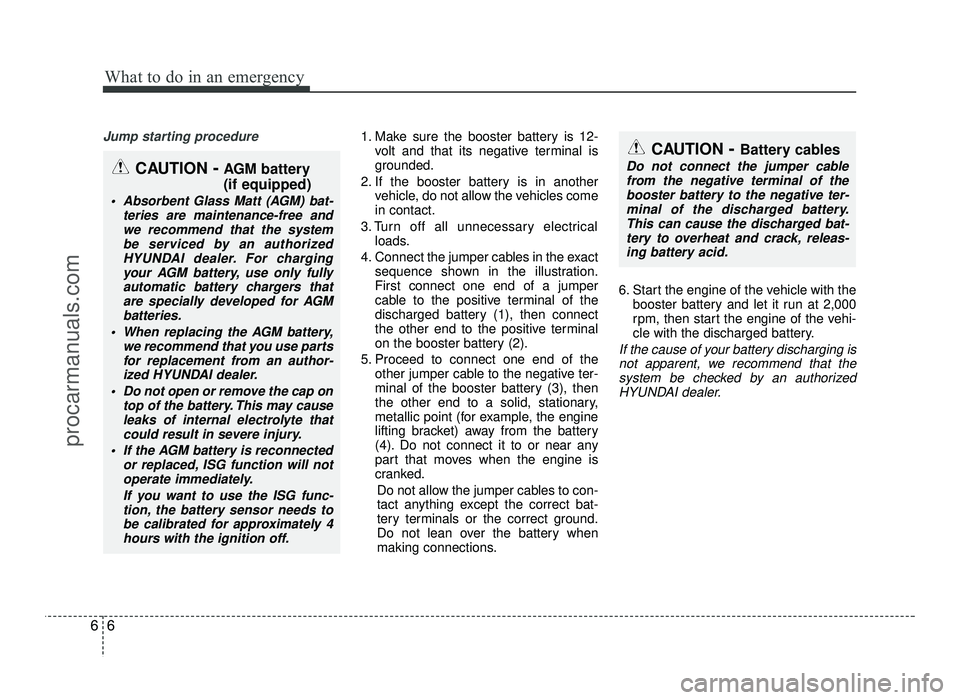
4. Connect the jumper cables in the exact sequence shown in the illustration.First connect one end of a jumper
cable to the positive terminal of the
discharged battery (1), then connect
the other end to the positive terminal
on the booster battery (2).
5. Proceed to connect one end of the other jumper cable to the negative ter-
minal of the booster battery (3), then
the other end to a solid, stationary,
metallic point (for example, the engine
lifting bracket) away from the battery
(4). Do not connect it to or near any
part that moves when the engine is
cranked.
Do not allow the jumper cables to con-
tact anything except the correct bat-
tery terminals or the correct ground.
Do not lean over the battery when
making connections. 6. Start the engine of the vehicle with the
booster battery and let it run at 2,000
rpm, then start the engine of the vehi-
cle with the discharged battery.
If the cause of your battery discharging is
not apparent, we recommend that the
system be checked by an authorizedHYUNDAI dealer.
CAUTION - Battery cables
Do not connect the jumper cable
from the negative terminal of thebooster battery to the negative ter-
minal of the discharged battery. This can cause the discharged bat-tery to overheat and crack, releas-
ing battery acid.CAUTION -AGM battery (if equipped)
Absorbent Glass Matt (AGM) bat-
teries are maintenance-free andwe recommend that the system
be serviced by an authorizedHYUNDAI dealer. For charging
your AGM battery, use only fullyautomatic battery chargers that
are specially developed for AGM batteries.
When replacing the AGM battery, we recommend that you use partsfor replacement from an author-ized HYUNDAI dealer.
Do not open or remove the cap on top of the battery. This may cause
leaks of internal electrolyte thatcould result in severe injury.
If the AGM battery is reconnected or replaced, ISG function will notoperate immediately.
If you want to use the ISG func-tion, the battery sensor needs tobe calibrated for approximately 4
hours with the ignition off.
procarmanuals.com
Page 318 of 456
What to do in an emergency
22
6
9. Switch off the compressor.
10. Detach the hoses from the
sealant bottle connector and
from the tire valve.
Return the Tire Mobility Kit to its stor-
age location in the vehicle. Distributing the sealant
11. Immediately drive approximately
4~6miles (7~10km or, about
10min) to evenly distribute the
sealant in the tire.
Do not exceed a speed of 50 mph
(80 km/h). If possible, do not fall
below a speed of 12 mph (20 km/h).
While driving, if you experience any
unusual vibration, ride disturbance or
noise, reduce your speed and drive
with caution until you can safely pulloff of the side of the road.
Call for road side service or towing.
When you use the Tire Mobility Kit, the tire pressure sensors and wheel
may be damaged by sealant, removethe sealant stained with tire pressuresensors and wheel and inspect in
authorized dealer. Checking the tire inflation pres- sure
1.After driving approximately 4
~6miles(7~10km or about 10min),
stop at a safety location.
2.Connect connection hose (9) of the compressor directly to the tire
valve.
3.Plug the compressor power cord into the vehicle power outlet.
4.Adjust the tire inflation pressure to the recommended tire inflation.
With the ignition switched on, pro-
ceed as follows.
- To increase the inflation pres-sure : Switch on the compressor,
position I. To check the current
inflation pressure setting, briefly
switch off the compressor.
CAUTION - Tire pressure
Do not attempt to drive your
vehicle if the tire pressure isbelow 29 PSI(200kpa). Thiscould result in an accident due to sudden tire failure.
WARNING - Carbon
monoxide
Do not leave your vehicle run-
ning in a poorly ventilated area
for extended periods of time.
Carbon monoxide poisoning
and suffocation can occur.
procarmanuals.com
Page 319 of 456
623
What to do in an emergency
✽✽NOTICE
The pressure gauge may show high-
er than actual reading when the
compressor is running. To get an
accurate tire pressure, the compres-
sor needs to be turned off.
- To reduce the inflation pres- sure: Loosen the screw cap (8)
on the compressor hose.
CAUTION - Tire pressure
sensor
We recommend that you use the
sealant of Tire Mobility Kit froman authorized HYUNDAI dealer.
The sealant on the tire pressuresensor and wheel should be removed when you replace thetire with a new one and inspectthe tire pressure sensors inauthorized dealer.
procarmanuals.com
Page 328 of 456
What to do in an emergency
32
6
Changing a tire with TPMS
If you have a flat tire, the Low Tire
Pressure will come on. We recom-
mend that the flat tire be checked by
an authorized HYUNDAI dealer. Each wheel is equipped with a tirepressure sensor mounted inside the
tire behind the valve stem. You must
use TPMS specific wheels. It is rec-
ommended that you have your tires
serviced by an authorized HYUNDAI
dealer.
Even if you replace the low pressure
tire with the spare tire, the Low Tire
Pressure Telltale will blink or remain
on until the low pressure tire is
repaired and placed on the vehicle.
After you replace the low pressure
tire with the spare tire, the Low Tire
Pressure Telltale may blink or illumi-
nate after a few minutes because theTPMS sensor mounted on the sparewheel is not initiated.
Once the low pressure tire is reinflat- ed to the recommended pressure
and installed on the vehicle or we
recommend that the TPMS sensormounted on the replaced spare
wheel be initiated by an authorized
HYUNDAI dealer, the TPMS mal-
function indicator and the low tire
pressure telltale will extinguish within
a few minutes of driving.If the indicator is not extinguished
after a few minutes of driving, Werecommend that the system be
checked by an authorized HYUNDAI
dealer.
CAUTION
If original mounted tire is
replaced with the spare tire, theTPMS sensor on the replacedspare wheel should be initiatedand we recommend that the TPMS sensor on the originalmounted wheel be deactivatedby a HYUNDAI dealer. If theTPMS sensor on the original mounted wheel located in thespare tire carrier still activates,the tire pressure monitoringsystem may not operate proper- ly. We recommend that the sys-tem be serviced by an author-ized HYUNDAI dealer.CAUTION
We recommend that you use apuncture-repairing agentapproved by HYUNDAI.
The sealant on the tire pressuresensor and wheel shall be elim-inated when you replace the tirewith a new one.
procarmanuals.com
Page 329 of 456
633
What to do in an emergency
You may not be able to identify a low
tire by simply looking at it. Alwaysuse a good quality tire pressuregauge to measure the tire's inflation
pressure. Please note that a tire that
is hot (from being driven) will have ahigher pressure measurement than atire that is cold.
A cold tire means the vehicle has
been sitting for 3 hours and driven forless than 1 mile (1.6 km) in that 3
hour period.
Allow the tire to cool before measur-
ing the inflation pressure. Always be
sure the tire is cold before inflating to
the recommended pressure.
CAUTION
We recommend that you use thetire sealant approved byHYUNDAI if your vehicle isequipped with a Tire PressureMonitoring System. The liquid sealant can damage the tirepressure sensors.
WARNING - Protecting
TPMS
Tampering with, modifying, or
disabling the Tire PressureMonitoring System (TPMS) com-
ponents may interfere with thesystem's ability to warn the driv-
er of low tire pressure condi-
tions and/or TPMS malfunctions.
Tampering with, modifying, or
disabling the Tire PressureMonitoring System (TPMS) com-
ponents may void the warranty
for that portion of the vehicle.
WARNING - TPMS
The TPMS cannot alert you to severe and sudden tire dam-
age caused by external fac-
tors such as nails or roaddebris.
If you feel any vehicle instabil- ity, immediately take your foot
off the accelerator, apply the
brakes gradually and with
light force, and slowly move to
a safe position off the road.WARNING - For EUROPE
Do not modify the vehicle, it may interfere with the TPMS function.
The wheels on the market do not have a TPMS sensor.
For your safety, we recom-
mend that you use parts for
replacement from an author-
ized HYUNDAI dealer.
If you use the wheels on the market, use a TPMS sensor
approved by a HYUNDAI deal-
er. If your vehicle is not
equipped with a TPMS sensor
or TPMS does not work prop-
erly, you may fail the periodic
vehicle inspection conducted
in your country.
❈
❈ All vehicles sold in the
EUROPE market during below
period must be equipped withTPMS.
- New model vehicle : Nov. 1,
2012 ~
- Current model vehicle : Nov. 1, 2014~ (Based on vehicle registrations)
procarmanuals.com
Page 332 of 456
What to do in an emergency
36
6
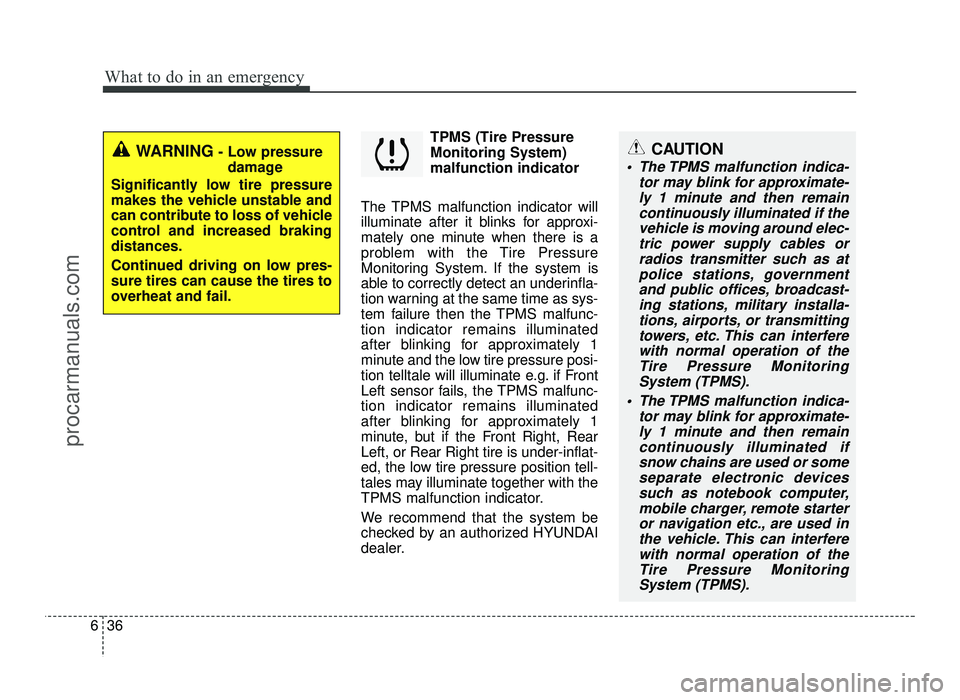
TPMS (Tire Pressure Monitoring System)malfunction indicator
The TPMS malfunction indicator will
illuminate after it blinks for approxi-
mately one minute when there is a
problem with the Tire Pressure
Monitoring System. If the system is
able to correctly detect an underinfla-
tion warning at the same time as sys-
tem failure then the TPMS malfunc-tion indicator remains illuminated
after blinking for approximately 1
minute and the low tire pressure posi-
tion telltale will illuminate e.g. if Front
Left sensor fails, the TPMS malfunc-tion indicator remains illuminated
after blinking for approximately 1
minute, but if the Front Right, RearLeft, or Rear Right tire is under-inflat-
ed, the low tire pressure position tell-
tales may illuminate together with the
TPMS malfunction indicator.
We recommend that the system be
checked by an authorized HYUNDAI
dealer.
WARNING - Low pressure
damage
Significantly low tire pressure
makes the vehicle unstable and
can contribute to loss of vehicle
control and increased brakingdistances.
Continued driving on low pres- sure tires can cause the tires to
overheat and fail.CAUTION
The TPMS malfunction indica- tor may blink for approximate-ly 1 minute and then remaincontinuously illuminated if thevehicle is moving around elec-tric power supply cables or radios transmitter such as atpolice stations, governmentand public offices, broadcast-ing stations, military installa-tions, airports, or transmitting towers, etc. This can interferewith normal operation of theTire Pressure MonitoringSystem (TPMS).
The TPMS malfunction indica- tor may blink for approximate-ly 1 minute and then remaincontinuously illuminated ifsnow chains are used or someseparate electronic devices such as notebook computer,mobile charger, remote starteror navigation etc., are used inthe vehicle. This can interferewith normal operation of the Tire Pressure MonitoringSystem (TPMS).
procarmanuals.com
Page 333 of 456
637
What to do in an emergency
Changing a tire with TPMS
If you have a flat tire, the low Tire
Pressure and Position telltales will
come on. We recommend that the
system be checked by an authorized
HYUNDAI dealer. Each wheel is equipped with a tire pressure sensor mounted inside the
tire behind the valve stem. You must
use TPMS specific wheels. It is rec-
ommended that you have your tires
serviced by an authorized HYUNDAI
dealer.After you replace the low pressure
tire with the spare tire, the TPMS
malfunction indicator may blink for
approximately 1 minute and then
remain continuously illuminated
because the TPMS sensor mountedon the spare wheel is not initiated.
Once the low pressure tire is reinflat- ed to the recommended pressure
and installed on the vehicle or theTPMS sensor mounted on the
replaced spare wheel is initiated by
an authorized HYUNDAI dealer, theTPMS malfunction indicator and the
low tire pressure and position tell-
tales will extinguish within a few min-
utes of driving.
If the indicator is not extinguished
after a few minutes of driving, werecommend that the system be
checked by an authorized HYUNDAI
dealer.CAUTION
If original mounted tire is
replaced with the spare tire, theTPMS sensor on the replacedspare wheel should be initiated and we recommend that theTPMS sensor on the originalmounted wheel be deactivatedby a HYUNDAI dealer. If theTPMS sensor on the original mounted wheel located in thespare tire carrier still activates,the tire pressure monitoringsystem may not operate proper- ly. We recommend that the sys-tem be serviced by an author-ized HYUNDAI dealer.
CAUTION
We recommend that you use apuncture-repairing agentapproved by HYUNDAI. Thesealant on the tire pressure sen- sor and wheel shall be eliminat-ed when you replace the tirewith a new one.
procarmanuals.com
Page 334 of 456
What to do in an emergency
38
6
You may not be able identify a low
tire by simply looking at it. Alwaysuse a good quality tire pressuregauge to measure the tire's inflation
pressure. Please note that a tire that
is hot (from being driven) will have ahigher pressure measurement than atire that is cold (from sitting station-
ary for at least 3 hours and driven
less than 1 mile (1.6 km) during that
3 hour period).
Allow the tire to cool before measur-
ing the inflation pressure. Always be
sure the tire is cold before inflating to
the recommended pressure.
A cold tire means the vehicle has
been sitting for 3 hours and driven forless than 1 mile (1.6 km) in that 3
hour period.
CAUTION
We recommend that you use the
tire sealant approved byHYUNDAI if your vehicle isequipped with a Tire Pressure Monitoring System. The liquidsealant can damage the tirepressure sensors.
WARNING - Protecting
TPMS
Tampering with, modifying, or
disabling the Tire PressureMonitoring System (TPMS)
components may interfere withthe system's ability to warn the
driver of low tire pressure con-
ditions and/or TPMS malfunc-
tions. Tampering with, modify-
ing, or disabling the TirePressure Monitoring System
(TPMS) components may void
the warranty for that portion of
the vehicle.
WARNING - TPMS
The TPMS cannot alert you to severe and sudden tire dam-
age caused by external fac-
tors such as nails or roaddebris.
If you feel any vehicle instabil- ity, immediately take your foot
off the accelerator, apply the
brakes gradually and with
light force, and slowly move to
a safe position off the road.WARNING - For EUROPE
Do not modify the vehicle, it may interfere with the TPMS function.
The wheels on the market do not have a TPMS sensor.
For your safety, we recom-
mend that you use parts for
replacement from an author-
ized HYUNDAI dealer.
If you use the wheels on the market, use a TPMS sensor
approved by a HYUNDAI deal-
er. If your vehicle is not
equipped with a TPMS sensor
or TPMS does not work prop-
erly, you may fail the periodic
vehicle inspection conducted
in your country.
❈
❈ All vehicles sold in the
EUROPE market during below
period must be equipped withTPMS.
- New model vehicle : Nov. 1,
2012 ~
- Current model vehicle : Nov. 1, 2014~ (Based on vehicle registrations)
procarmanuals.com
Page 381 of 456
Maintenance
42
7
AIR CLEANER
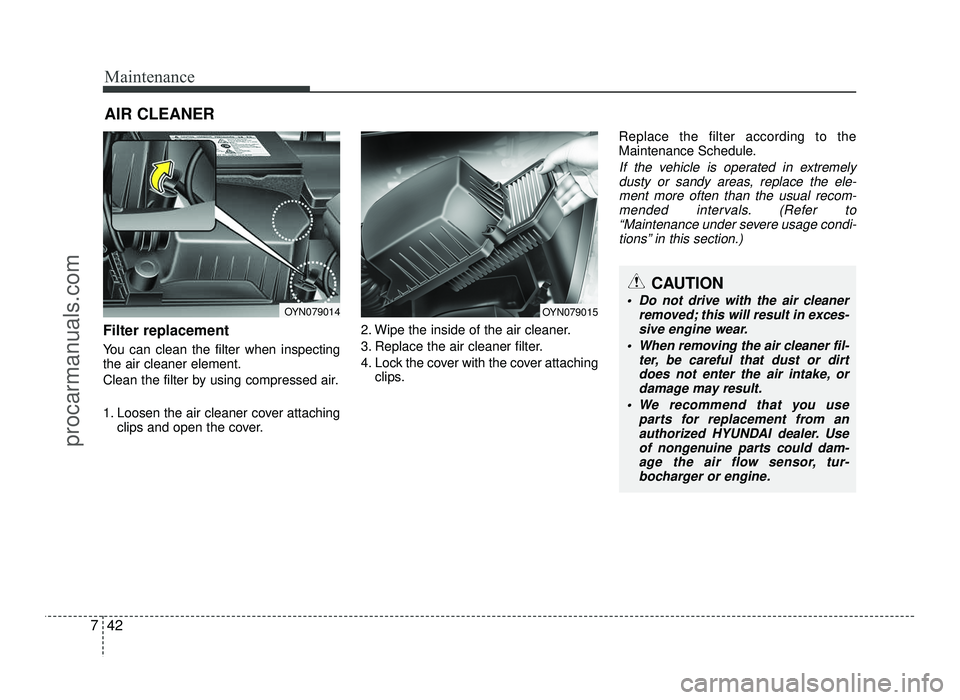
Filter replacement
You can clean the filter when inspecting the air cleaner element.
Clean the filter by using compressed air.
1. Loosen the air cleaner cover attaching clips and open the cover. 2. Wipe the inside of the air cleaner.
3. Replace the air cleaner filter.
4. Lock the cover with the cover attaching
clips. Replace the filter according to the
Maintenance Schedule.
If the vehicle is operated in extremely
dusty or sandy areas, replace the ele- ment more often than the usual recom-
mended intervals. (Refer to “Maintenance under severe usage condi-
tions” in this section.)
OYN079014OYN079015
CAUTION
Do not drive with the air cleaner removed; this will result in exces-
sive engine wear.
When removing the air cleaner fil- ter, be careful that dust or dirt
does not enter the air intake, or damage may result.
We recommend that you use parts for replacement from anauthorized HYUNDAI dealer. Use
of nongenuine parts could dam-age the air flow sensor, tur-
bocharger or engine.
procarmanuals.com
Page 389 of 456
Maintenance
50
7
Battery recharging
Your vehicle has a maintenance-free,
calcium-based battery.
If the battery becomes discharged in a
short time (because, for example, the
headlights or interior lights were left on
while the vehicle was not in use),
recharge it by slow charging (trickle)
for 10 hours.
If the battery gradually discharges because of high electric load while the
vehicle is being used, recharge it at 20-
30A for two hours.
WARNING - Recharging
battery
When recharging the battery,
observe the following precautions:
The battery must be removed from the vehicle and placed in an area with good ventilation.
Do not allow cigarettes, sparks, or flame near the battery.
Watch the battery during charg- ing, and stop or reduce the charg-
ing rate if the battery cells begin
gassing (boiling) violently or if
the temperature of the electrolyte
of any cell exceeds 49°C (120°F).
Wear eye protection when check- ing the battery during charging.
Disconnect the battery charger in the following order.
1. Turn off the battery charger main switch.
2. Unhook the negative clamp from the negative battery terminal.
3. Unhook the positive clamp from the positive battery terminal.CAUTION - AGM battery (if equipped)
Absorbent Glass Matt (AGM) bat-
teries are maintenance-free andwe recommend that the system
be serviced by an authorizedHYUNDAI dealer. For chargingyour AGM battery, use only fully
automatic battery chargers that are specially developed for AGM
batteries.
When replacing the AGM battery, we recommend that you use parts
for replacement from an author-ized HYUNDAI dealer.
Do not open or remove the cap on top of the battery. This may causeleaks of internal electrolyte that
could result in severe injury.
If the AGM battery is reconnected or replaced, ISG function will not
operate immediately.
If you want to use the ISG func-tion, the battery sensor needs to
be calibrated for approximately 4hours with the ignition off.
procarmanuals.com