tire pressure HYUNDAI IX20 2017 Workshop Manual
[x] Cancel search | Manufacturer: HYUNDAI, Model Year: 2017, Model line: IX20, Model: HYUNDAI IX20 2017Pages: 456, PDF Size: 9.46 MB
Page 393 of 456
Maintenance
54
7
Checking tire inflation pressure
Check your tires once a month or
more.
Also, check the tire pressure of the
spare tire.
How to check
Use a good quality gage to check tire
pressure. You can not tell if your tires
are properly inflated simply by look-
ing at them. Radial tires may look
properly inflated even when they're
underinflated.
Check the tire's inflation pressure
when the tires are cold. - "Cold"
means your vehicle has been sitting
for at least three hours or driven nomore than 1.6 km (1 mile).
Remove the valve cap from the tire
valve stem. Press the tire gage firm-
ly onto the valve to get a pressure
measurement. If the cold tire inflationpressure matches the recommendedpressure on the tire and loading
information label, no further adjust-
ment is necessary. If the pressure is
low, add air until you reach the rec-ommended amount. If you overfill the tire, release air bypushing on the metal stem in the
center of the tire valve. Recheck the
tire pressure with the tire gage. Be
sure to put the valve caps back on
the valve stems. They help prevent
leaks by keeping out dirt and mois-
ture.
WARNING
Inspect your tires frequently for proper inflation as well as
wear and damage. Always use
a tire pressure gauge.
Tires with too much or too little pressure wear unevenly caus-
ing poor handling, loss of vehi-
cle control, and sudden tirefailure leading to accidents,
injuries, and even death. Therecommended cold tire pres-
sure for your vehicle can be
found in this manual and onthe tire label located on the dri-
ver's side center pillar.
Worn tires can cause acci- dents. Replace tires that are
worn, show uneven wear, or
are damaged.
Remember to check the pres- sure of your spare tire.
HYUNDAI recommends that
you check the spare every
time you check the pressure
of the other tires on your vehi-
cle.
procarmanuals.com
Page 394 of 456
755
Maintenance
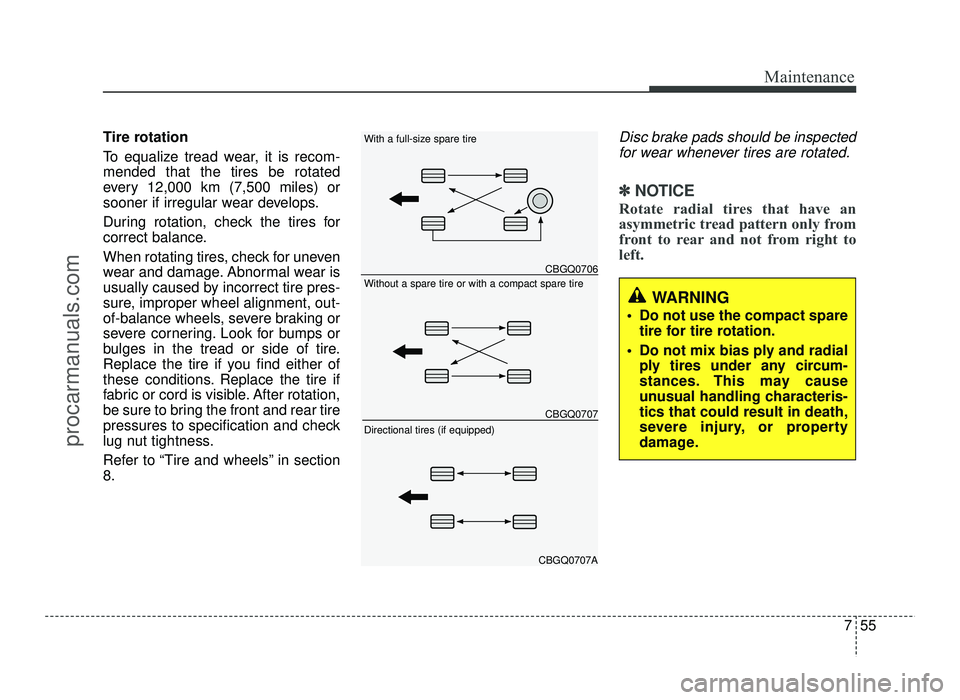
Tire rotation
To equalize tread wear, it is recom- mended that the tires be rotated
every 12,000 km (7,500 miles) or
sooner if irregular wear develops.
During rotation, check the tires for
correct balance.
When rotating tires, check for uneven
wear and damage. Abnormal wear is
usually caused by incorrect tire pres-
sure, improper wheel alignment, out-
of-balance wheels, severe braking or
severe cornering. Look for bumps or
bulges in the tread or side of tire.
Replace the tire if you find either of
these conditions. Replace the tire if
fabric or cord is visible. After rotation,
be sure to bring the front and rear tire
pressures to specification and check
lug nut tightness.
Refer to “Tire and wheels” in section 8.Disc brake pads should be inspectedfor wear whenever tires are rotated.
✽✽ NOTICE
Rotate radial tires that have an
asymmetric tread pattern only from
front to rear and not from right to
left.
WARNING
Do not use the compact spare tire for tire rotation.
Do not mix bias ply and radial ply tires under any circum-
stances. This may cause
unusual handling characteris-tics that could result in death,
severe injury, or property
damage.
CBGQ0706
CBGQ0707
CBGQ0707A
Without a spare tire or with a compact spare tire
With a full-size spare tire Directional tires (if equipped)
procarmanuals.com
Page 396 of 456
757
Maintenance
Compact spare tire replacement (if equipped)
A compact spare tire has a shorter
tread life than a regular size tire.
Replace it when you can see the
tread wear indicator bars on the tire.The replaced compact spare tire
should be the same size and design
tire as the one provided with your
new vehicle and should be mountedon the same compact spare tire
wheel. The compact spare tire is notdesigned to be mounted on a regular
size wheel, and the compact sparetire wheel is not designed to mount a
regular size tire.
WARNING - Replacing
tires
To reduce the chance or serious
or fatal injuries from an acci-
dent caused by tire failure or
loss of vehicle control:
When replacing tires (or wheels), it is recommended
to replace the two front or two
rear tires (or wheels) as a
pair. Replacing just one tire
can seriously affect your vehi-
cle’s handling.
Replace tires that are worn, show uneven wear, or are dam-
aged. Worn tires can cause
loss of braking effectiveness,
steering control, and traction.
Do not drive your vehicle with too little or too much pressure
in your tires. This can lead to
uneven wear and tire failure.
When replacing tires, never mix radial and bias-ply tires on
the same car. You must replace
all tires (including the spare) if
moving from radial to bias-plytires.
(Continued)(Continued)
Using tires and wheel otherthan the recommended sizes
could cause unusual handling
characteristics and poor vehi-
cle control, resulting in a seri-ous accident.
Wheels that do not meet HYUNDAI’s specifications may
fit poorly and result in damage
to the vehicle or unusual han-
dling and poor vehicle control.
The ABS works by comparing the speed of the wheels. Tire
size can affect wheel speed.
When replacing tires, all 4 tires
must use the same size origi-
nally supplied with the vehicle.
Using tires of a different size
can cause the ABS (Anti-lockBrake System) and ESC
(Electronic Stability Control) to
work irregularly. (if equipped)
procarmanuals.com
Page 399 of 456
Maintenance
60
7
3. Checking tire life (TIN : Tire
Identification Number)
Any tires that are over 6 years old,
based on the manufacturing date,(including the spare tire) should be
replaced by new ones. You can find
the manufacturing date on the tire
sidewall (possibly on the inside of the
wheel), displaying the DOT Code.
The DOT Code is a series of num-
bers on a tire consisting of numbers
and English letters. The manufactur-
ing date is designated by the last four
digits (characters) of the DOT code.
DOT : XXXX XXXX OOOO
The front part of the DOT means a
plant code number, tire size and
tread pattern and the last four num-
bers indicate week and year manu-
factured.
For example:
DOT XXXX XXXX 1617 represents
that the tire was produced in the 16th
week of 2017.
4. Tire ply composition and material
The number of layers or plies of rub-
ber-coated fabric in the tire. Tire
manufacturers also must indicate the
materials in the tire, which include
steel, nylon, polyester, and others.
The letter "R" means radial ply con-
struction; the letter "D" means diago-
nal or bias ply construction; and theletter "B" means belted-bias ply con-
struction.
5. Maximum permissible inflation
pressure
This number is the greatest amount of air pressure that should be put in the
tire. Do not exceed the maximum per-
missible inflation pressure. Refer to
the Tire and Loading Information label
for recommended inflation pressure.
6. Maximum load rating
This number indicates the maximum
load in kilograms and pounds that can
be carried by the tire. When replacing
the tires on the vehicle, always use a
tire that has the same load rating as
the factory installed tire.
WARNING - Tire age
Tires degrade over time, even
when they are not being used.
Regardless of the remaining
tread, it is recommended that
tires generally be replaced after
six (6) years of normal service.
Heat caused by hot climates orfrequent high loading condi-
tions can accelerate the aging
process. Failure to follow this
warning could cause sudden
tire failure, which could lead to
a loss of control and an acci-
dent involving serious injury ordeath.
procarmanuals.com
Page 401 of 456
Maintenance
62
7
Low aspect ratio tire (if equipped)
Low aspect ratio tires, whose aspect
ratio is lower than 50, are provided
for sporty looks.
Because the low aspect ratio tires
are optimized for handling and brak-
ing, it may be more uncomfortable to
ride in and there is more noise com-
pare with normal tires.
CAUTION
Because the sidewall of the low
aspect ratio tire is shorter thanthe normal, the wheel and tire ofthe low aspect ratio tire is easi-er to be damaged. So, follow the instructions below.
- When driving on a rough road or off road, drive cautiouslybecause tires and wheels maybe damaged. And after driving,inspect tires and wheels.
- When passing over a pothole, speed bump, manhole, or curbstone, drive slowly so that thetires and wheels are not dam-aged.
(Continued)CAUTION
It is not easy to recognize thetire damage with your owneyes. But if there is the slight-est hint of tire damage, eventhough you cannot see the tiredamage with your own eyes, have the tire checked orreplaced because the tiredamage may cause air leak-age from the tire.
If the tire is damaged by driv- ing on a rough road, off road,pothole, manhole, or curbstone, it will not be covered bythe warranty.
You can find out the tire infor- mation on the tire sidewall.
(Continued)
- If the tire is impacted, we rec- ommend that you inspect thetire condition or contact anauthorized HYUNDAI dealer.
- To prevent damage to the tire, inspect the tire condition andpressure every 3,000km.
procarmanuals.com
Page 435 of 456
8
Engine / 8-2
Dimensions / 8-2
Bulb wattage / 8-3
Tires and wheels / 8-4
Load and speed capacity tires / 8-5
Weight and volume / 8-5
Recommended lubricants and capacities / 8-6
Vehicle identification number (VIN) / 8-9
Vehicle certification label / 8-9
Tire specification and pressure label / 8-10
Engine number / 8-10
Air conditioner compressor label / 8-10
Refrigerant label / 8-11
Declaration of conformity / 8-11
Specifications & Consumer information
procarmanuals.com
Page 438 of 456
Specifications & Consumer information
4
8
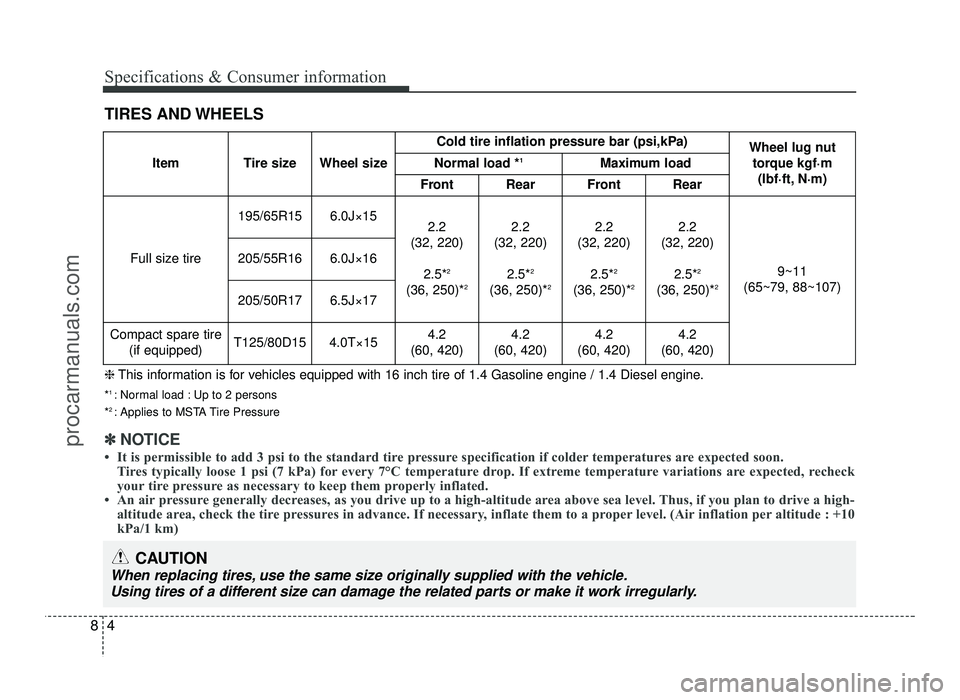
TIRES AND WHEELS
Item Tire size Wheel size Cold tire inflation pressure bar (psi,kPa)
Wheel lug nut
torque kgf·m (lbf·ft, N·m)
Normal load *
1
Maximum load
Front Rear Front Rear
Full size tire 195/65R15 6.0J×15
2.2
(32, 220)
2.5* 2
(36, 250)* 22.2
(32, 220)
2.5* 2
(36, 250)* 22.2
(32, 220)
2.5* 2
(36, 250)* 22.2
(32, 220)
2.5* 2
(36, 250)* 2 9~11
(65~79, 88~107)
205/55R16 6.0J×16 205/50R17 6.5J×17
Compact spare tire (if equipped) T125/80D15 4.0T×15 4.2
(60, 420) 4.2
(60, 420) 4.2
(60, 420) 4.2
(60, 420)
❈ This information is for vehicles equipped with 16 inch tire of 1.4 Gasoline engine / 1.4 Diesel engine.
* 1
: Normal load : Up to 2 persons
* 2
: Applies to MSTA Tire Pressure
✽✽ NOTICE
It is permissible to add 3 psi to the standard tire pressure specification if colde r temperatures are expected soon.
Tires typically loose 1 psi (7 kPa) for every 7°C temperature drop. If extreme temperature variations are expected, recheck
your tire pressure as necessary to keep them properly inflated.
An air pressure generally decreases, as you drive up to a high-altitude area above sea le vel. Thus, if you plan to drive a high-
altitude area, check the tire pressures in advance. If necessary, inflate them to a prope r level. (Air inflation per altitude : +10
kPa/1 km)
CAUTION
When replacing tires, use the same size originally supplied with the vehicle.
Using tires of a different size can damage the related parts or make it work irregularly.
procarmanuals.com
Page 444 of 456
Specifications & Consumer information
10
8
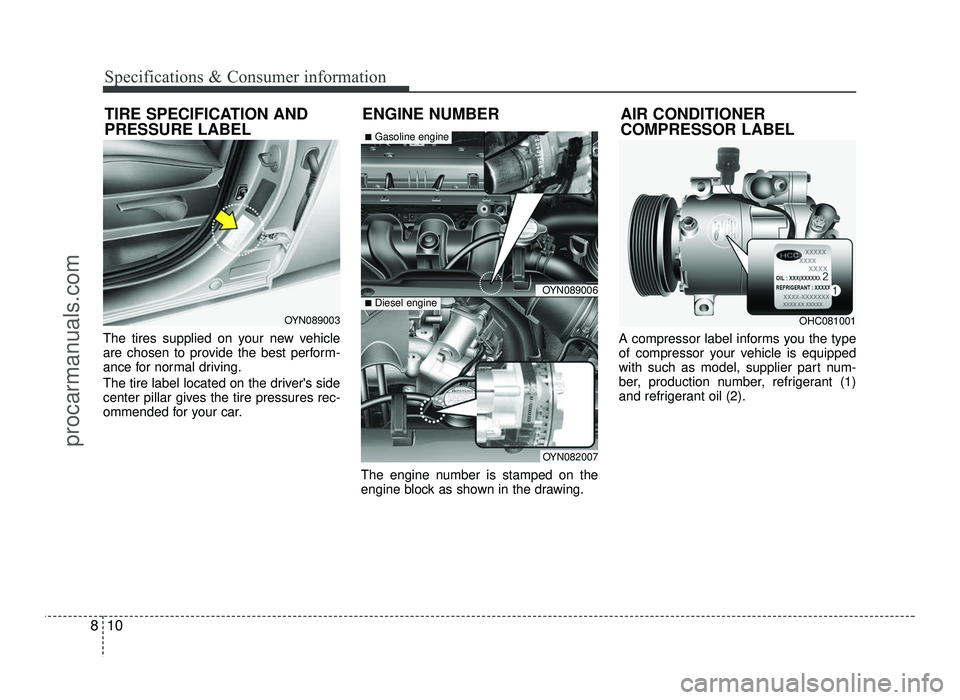
AIR CONDITIONER COMPRESSOR LABEL
The tires supplied on your new vehicle
are chosen to provide the best perform-
ance for normal driving.
The tire label located on the driver's side
center pillar gives the tire pressures rec-
ommended for your car. The engine number is stamped on the
engine block as shown in the drawing.A compressor label informs you the type
of compressor your vehicle is equipped
with such as model, supplier part num-
ber, production number, refrigerant (1)
and refrigerant oil (2).
OYN089003
TIRE SPECIFICATION AND PRESSURE LABEL
ENGINE NUMBER
OYN089006
OYN082007
■
Gasoline engine
■Diesel engine
OHC081001
procarmanuals.com
Page 448 of 456
I3
Index
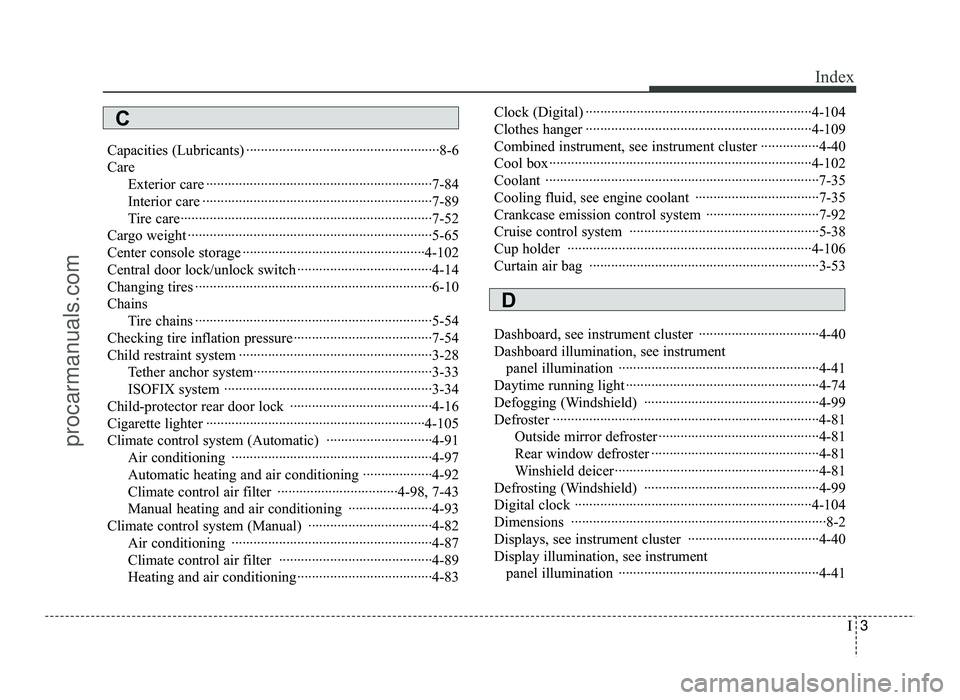
Capacities (Lubricants) ·····················································8-6
Care
Exterior care ······························································7-84
Interior care ·······························································7-89
Tire care·····································································7-52
Cargo weight ···································································5-65
Center console storage ··················································4-102
Central door lock/unlock switch ·····································4-14
Changing tires ·································································6-10
Chains Tire chains ·································································5-54
Checking tire inflation pressure ······································7-54
Child restraint system ·····················································3-28 Tether anchor system·················································3-33
ISOFIX system ·························································3-34
Child-protector rear door lock ·······································4-16
Cigarette lighter ····························································4-105
Climate control system (Automatic) ·····························4-91 Air conditioning ·······················································4-97
Automatic heating and air conditioning ···················4-92
Climate control air filter ·································4-98, 7-43
Manual heating and air conditioning ·······················4-93
Climate control system (Manual) ··································4-82 Air conditioning ·······················································4-87
Climate control air filter ··········································4-89
Heating and air conditioning ·····································4-83 Clock (Digital) ······························································4-104
Clothes hanger ······························································4-109
Combined instrument, see instrument cluster ················4-40
Cool box········································································4-102
Coolant ···········································································7-35
Cooling fluid, see engine coolant ··································7-35
Crankcase emission control system ·······························7-92
Cruise control system ····················································5-38
Cup holder ···································································4-106
Curtain air bag ·······························································3-53
Dashboard, see instrument cluster ·································4-40
Dashboard illumination, see instrument
panel illumination ·······················································4-41
Daytime running light ·····················································4-74
Defogging (Windshield) ················································4-99
Defroster ·········································································4-81 Outside mirror defroster ············································4-81
Rear window defroster ··············································4-81
Winshield deicer ························································4-81
Defrosting (Windshield) ················································4-99
Digital clock ·································································4-104
Dimensions ······································································8-2
Displays, see instrument cluster ····································4-40
Display illumination, see instrument panel illumination ·······················································4-41
C
D
procarmanuals.com
Page 451 of 456
Index
6
I
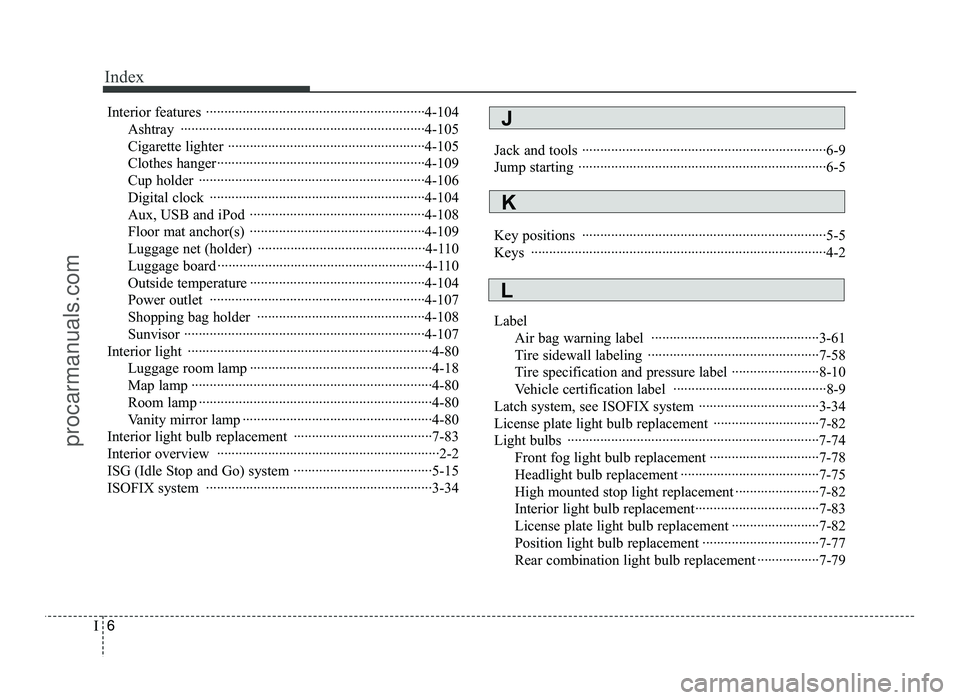
Interior features ····························································4-104
Ashtray ···································································4-105
Cigarette lighter ······················································4-105
Clothes hanger·························································4-109
Cup holder ······························································4-106
Digital clock ···························································4-104
Aux, USB and iPod ················································4-108
Floor mat anchor(s) ················································4-109
Luggage net (holder) ··············································4-110
Luggage board ·························································4-110
Outside temperature ················································4-104
Power outlet ···························································4-107
Shopping bag holder ··············································4-108
Sunvisor ··································································4-107
Interior light ···································································4-80 Luggage room lamp ··················································4-18
Map lamp ··································································4-80
Room lamp ································································4-80
Vanity mirror lamp ····················································4-80
Interior light bulb replacement ······································7-83
Interior overview ·····························································2-2
ISG (Idle Stop and Go) system ······································5-15
ISOFIX system ······························································3-34 Jack and tools ···································································6-9
Jump starting ····································································6-5
Key positions ···································································5-5
Keys ·················································································4-2
Label
Air bag warning label ··············································3-61
Tire sidewall labeling ···············································7-58
Tire specification and pressure label ························8-10
Vehicle certification label ··········································8-9
Latch system, see ISOFIX system ·································3-34
License plate light bulb replacement ·····························7-82
Light bulbs ·····································································7-74 Front fog light bulb replacement ······························7-78
Headlight bulb replacement ······································7-75
High mounted stop light replacement ·······················7-82
Interior light bulb replacement··································7-83
License plate light bulb replacement ························7-82
Position light bulb replacement ································7-77
Rear combination light bulb replacement ·················7-79
L
K
J
procarmanuals.com