climate control HYUNDAI IX20 2017 Owners Manual
[x] Cancel search | Manufacturer: HYUNDAI, Model Year: 2017, Model line: IX20, Model: HYUNDAI IX20 2017Pages: 456, PDF Size: 9.46 MB
Page 15 of 456
Your vehicle at a glance
4
2
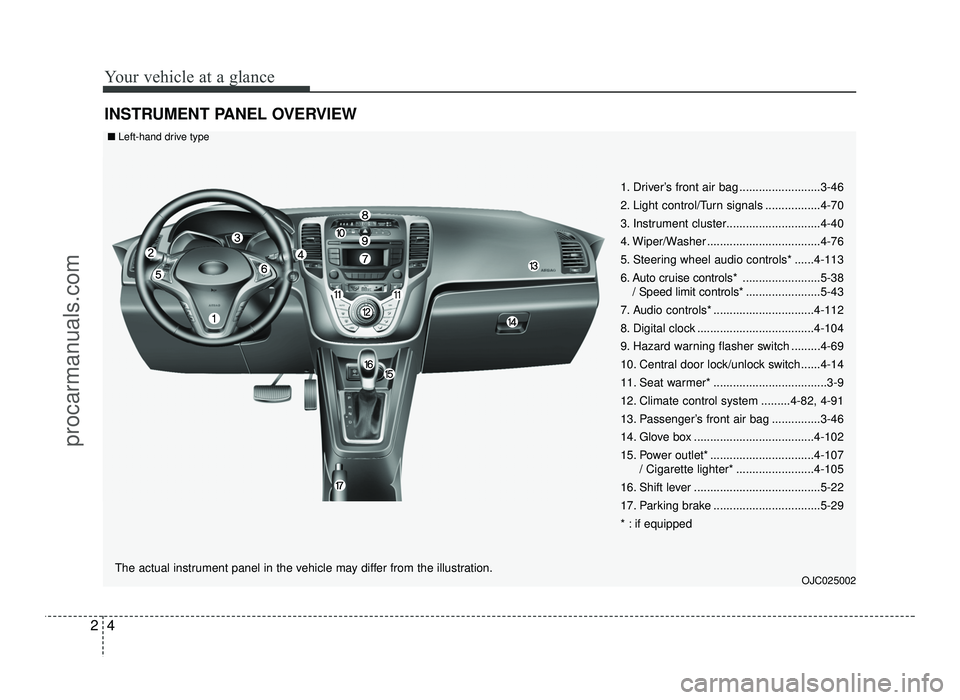
INSTRUMENT PANEL OVERVIEW
1. Driver’s front air bag .........................3-46
2. Light control/Turn signals .................4-70
3. Instrument cluster.............................4-40
4. Wiper/Washer ...................................4-76
5. Steering wheel audio controls* ......4-113
6. Auto cruise controls* ........................5-38
/ Speed limit controls* .......................5-43
7. Audio controls* ...............................4-112
8. Digital clock ....................................4-104
9. Hazard warning flasher switch .........4-69
10. Central door lock/unlock switch......4-14
11. Seat warmer* ...................................3-9
12. Climate control system .........4-82, 4-91
13. Passenger’s front air bag ...............3-46
14. Glove box .....................................4-102
15. Power outlet* ................................4-107 / Cigarette lighter* ........................4-105
16. Shift lever .......................................5-22
17. Parking brake .................................5-29
* : if equipped
OJC025002
The actual instrument panel in the vehicle may differ from the illustration.
■
Left-hand drive type
procarmanuals.com
Page 16 of 456
25
Your vehicle at a glance
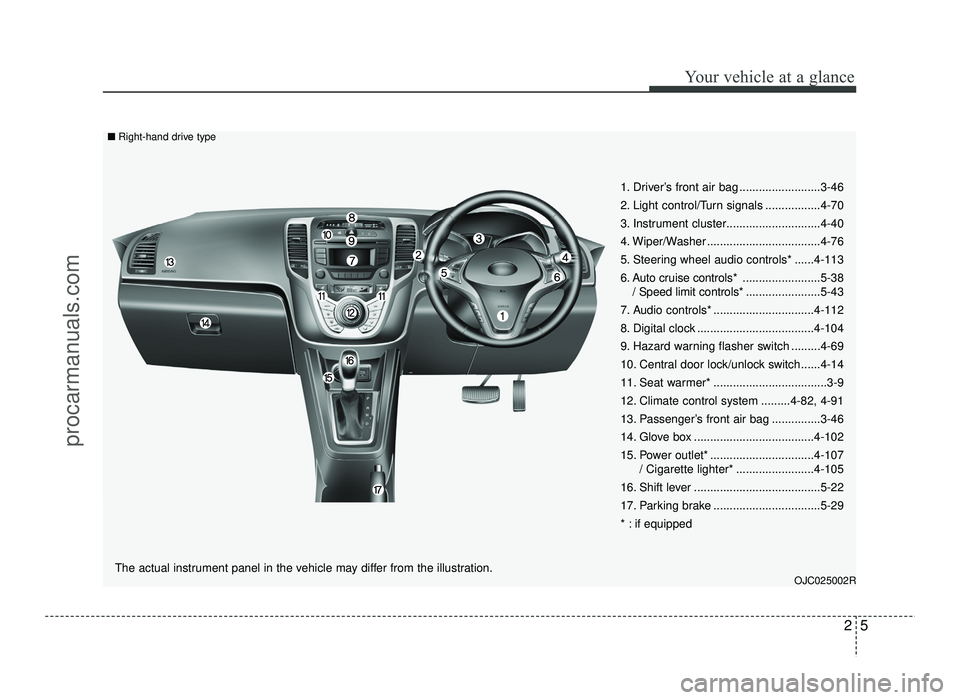
1. Driver’s front air bag .........................3-46
2. Light control/Turn signals .................4-70
3. Instrument cluster.............................4-40
4. Wiper/Washer ...................................4-76
5. Steering wheel audio controls* ......4-113
6. Auto cruise controls* ........................5-38
/ Speed limit controls* .......................5-43
7. Audio controls* ...............................4-112
8. Digital clock ....................................4-104
9. Hazard warning flasher switch .........4-69
10. Central door lock/unlock switch......4-14
11. Seat warmer* ...................................3-9
12. Climate control system .........4-82, 4-91
13. Passenger’s front air bag ...............3-46
14. Glove box .....................................4-102
15. Power outlet* ................................4-107 / Cigarette lighter* ........................4-105
16. Shift lever .......................................5-22
17. Parking brake .................................5-29
* : if equipped
OJC025002R
The actual instrument panel in the vehicle may differ from the illustration.
■
Right-hand drive type
procarmanuals.com
Page 79 of 456
4
Keys / 4-2
Remote keyless entry / 4-5
Smart key / 4-8
Theft-alarm system / 4-11
Door locks / 4-13
Tailgate / 4-17
Windows / 4-19
Hood / 4-24
Fuel filler lid / 4-26
Panorama sunroof / 4-29
Steering wheel / 4-33
Mirrors / 4-36
Instrument cluster / 4-40
Rear parking assist system / 4-64
Rearview camera / 4-68
Hazard warning flasher / 4-69
Lighting / 4-70
Wipers and washers / 4-76
Interior light / 4-80
Defroster / 4-81
Manual climate control system / 4-82
Automatic climate control system / 4-91
Windshield defrosting and defogging / 4-100
Storage compartment / 4-101
Interior features / 4-104
Audio system / 4-112
Features of your vehicle
procarmanuals.com
Page 98 of 456
Features of your vehicle
20
4
Power windows
The ignition switch must be in the ON
position for power windows to operate.
Each door has a power window switch
that controls the door's window. The driv-
er has a master power window switch
that controls all the windows in the vehi-
cle. Also, a power window lock switch
which that can block the operation of rear
passenger windows. The power windows
can be operated for approximately 30
seconds after the ignition key is removed
or turned to the ACC or LOCK position.
However, if the front doors are opened,
the power windows cannot be operated
within the 30 seconds period.✽✽
NOTICE
In cold and wet climates, power win- dows may not work properly due to
freezing conditions.
While driving with the rear windows down or with the sunroof (if equipped)
opened (or partially opened), your
vehicle may demonstrate a wind buf-
feting or pulsation noise. This noise is
a normal occurrence and can be
reduced or eliminated by taking the
following actions. If the noise occurs
with one or both of the rear windows
down, partially lower both front win-
dows approximately one inch. If you
experience the noise with the sunroof
open, slightly reduce the size of the
sunroof opening
Window opening and closing
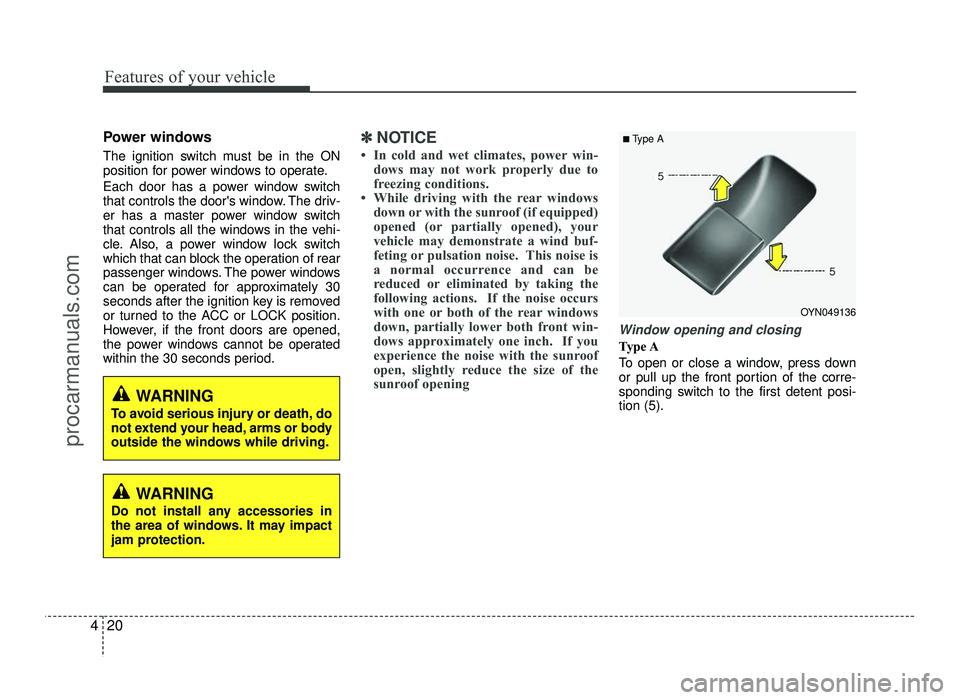
Type A
To open or close a window, press down
or pull up the front portion of the corre-
sponding switch to the first detent posi-tion (5).
OYN049136
■
Type A
WARNING
To avoid serious injury or death, do
not extend your head, arms or body
outside the windows while driving.
WARNING
Do not install any accessories in
the area of windows. It may impact
jam protection.
procarmanuals.com
Page 107 of 456
429
Features of your vehicle
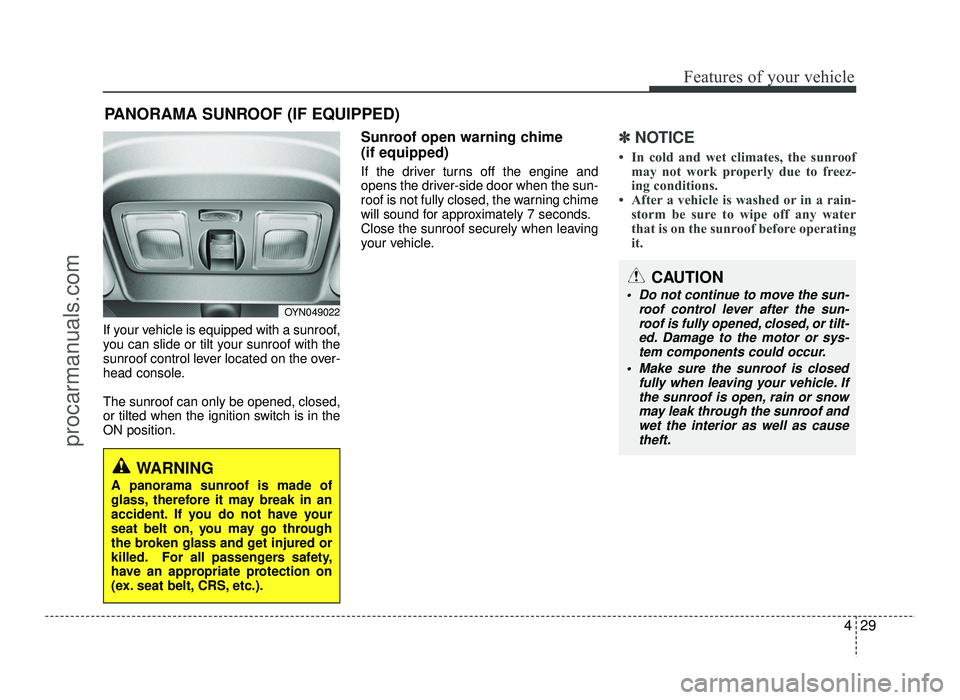
If your vehicle is equipped with a sunroof,
you can slide or tilt your sunroof with the
sunroof control lever located on the over-
head console. The sunroof can only be opened, closed,
or tilted when the ignition switch is in theON position.Sunroof open warning chime (if equipped)
If the driver turns off the engine and
opens the driver-side door when the sun-
roof is not fully closed, the warning chime
will sound for approximately 7 seconds.
Close the sunroof securely when leaving
your vehicle.
✽✽
NOTICE
In cold and wet climates, the sunroof may not work properly due to freez-
ing conditions.
After a vehicle is washed or in a rain-
storm be sure to wipe off any water
that is on the sunroof before operating
it.
PANORAMA SUNROOF (IF EQUIPPED)
OYN049022
CAUTION
Do not continue to move the sun-
roof control lever after the sun-
roof is fully opened, closed, or tilt-ed. Damage to the motor or sys- tem components could occur.
Make sure the sunroof is closed fully when leaving your vehicle. Ifthe sunroof is open, rain or snow
may leak through the sunroof and wet the interior as well as cause
theft.
WARNING
A panorama sunroof is made of
glass, therefore it may break in an
accident. If you do not have your
seat belt on, you may go through
the broken glass and get injured or
killed. For all passengers safety,
have an appropriate protection on
(ex. seat belt, CRS, etc.).
procarmanuals.com
Page 110 of 456
Features of your vehicle
32
4
✽✽
NOTICE
After washing the vehicle or after a rain,
be sure to wipe off the water on the sun-
roof before operating the sunroof.
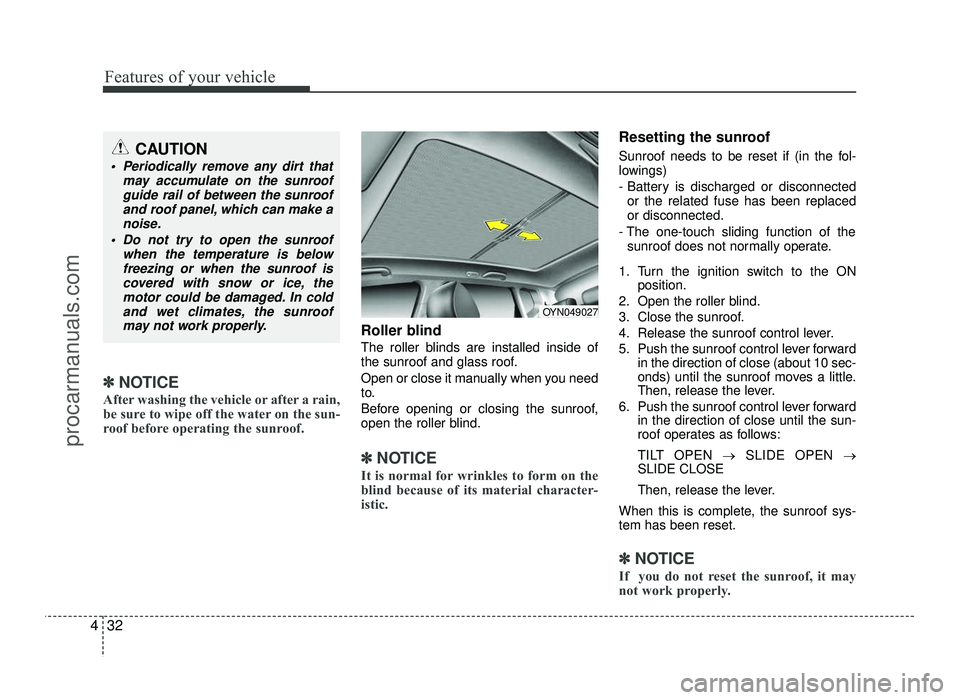
Roller blind
The roller blinds are installed inside of
the sunroof and glass roof.
Open or close it manually when you need
to.
Before opening or closing the sunroof,
open the roller blind.
✽✽ NOTICE
It is normal for wrinkles to form on the
blind because of its material character-
istic.
Resetting the sunroof
Sunroof needs to be reset if (in the fol-
lowings)
- Battery is discharged or disconnected or the related fuse has been replaced or disconnected.
- The one-touch sliding function of the sunroof does not normally operate.
1. Turn the ignition switch to the ON position.
2. Open the roller blind.
3. Close the sunroof.
4. Release the sunroof control lever.
5. Push the sunroof control lever forward in the direction of close (about 10 sec-
onds) until the sunroof moves a little.
Then, release the lever.
6. Push the sunroof control lever forward in the direction of close until the sun-
roof operates as follows:
TILT OPEN →SLIDE OPEN →
SLIDE CLOSE
Then, release the lever.
When this is complete, the sunroof sys- tem has been reset.
✽✽ NOTICE
If you do not reset the sunroof, it may
not work properly.
OYN049027
CAUTION
Periodically remove any dirt that may accumulate on the sunroofguide rail of between the sunroof
and roof panel, which can make anoise.
Do not try to open the sunroof when the temperature is belowfreezing or when the sunroof is
covered with snow or ice, themotor could be damaged. In coldand wet climates, the sunroof
may not work properly.
procarmanuals.com
Page 159 of 456
481
Features of your vehicle
✽✽NOTICE
If you want to defrost and defog the
front windshield, refer to “Windshield
defrosting and defogging” in this sec-
tion.
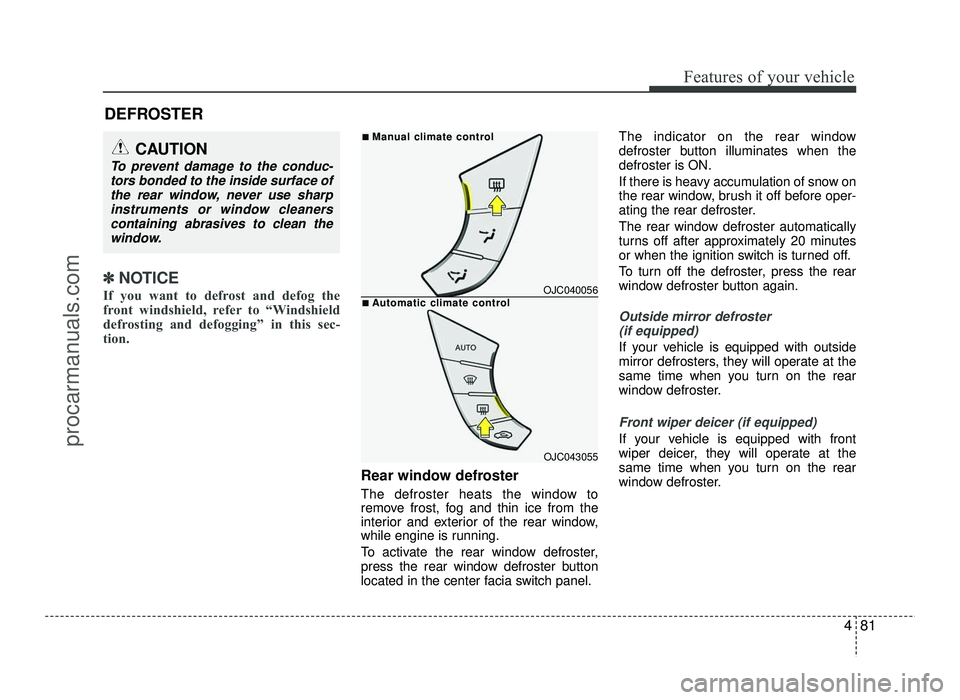
Rear window defroster
The defroster heats the window to
remove frost, fog and thin ice from the
interior and exterior of the rear window,
while engine is running.
To activate the rear window defroster,
press the rear window defroster button
located in the center facia switch panel. The indicator on the rear window
defroster button illuminates when thedefroster is ON.
If there is heavy accumulation of snow on
the rear window, brush it off before oper-
ating the rear defroster.
The rear window defroster automatically
turns off after approximately 20 minutes
or when the ignition switch is turned off.
To turn off the defroster, press the rear
window defroster button again.
Outside mirror defroster
(if equipped)
If your vehicle is equipped with outside
mirror defrosters, they will operate at the
same time when you turn on the rear
window defroster.
Front wiper deicer (if equipped)
If your vehicle is equipped with front
wiper deicer, they will operate at the
same time when you turn on the rear
window defroster.
DEFROSTER
CAUTION
To prevent damage to the conduc-
tors bonded to the inside surface ofthe rear window, never use sharp
instruments or window cleanerscontaining abrasives to clean thewindow.
OJC040056
OJC043055
■
ManManual cual climate contrlimate controlol
■AAutomatic cutomatic climate contrlimate controlol
procarmanuals.com
Page 160 of 456
Features of your vehicle
82
4
MANUAL CLIMATE CONTROL SYSTEM (IF EQUIPPED)
OJC040057/OJC043058
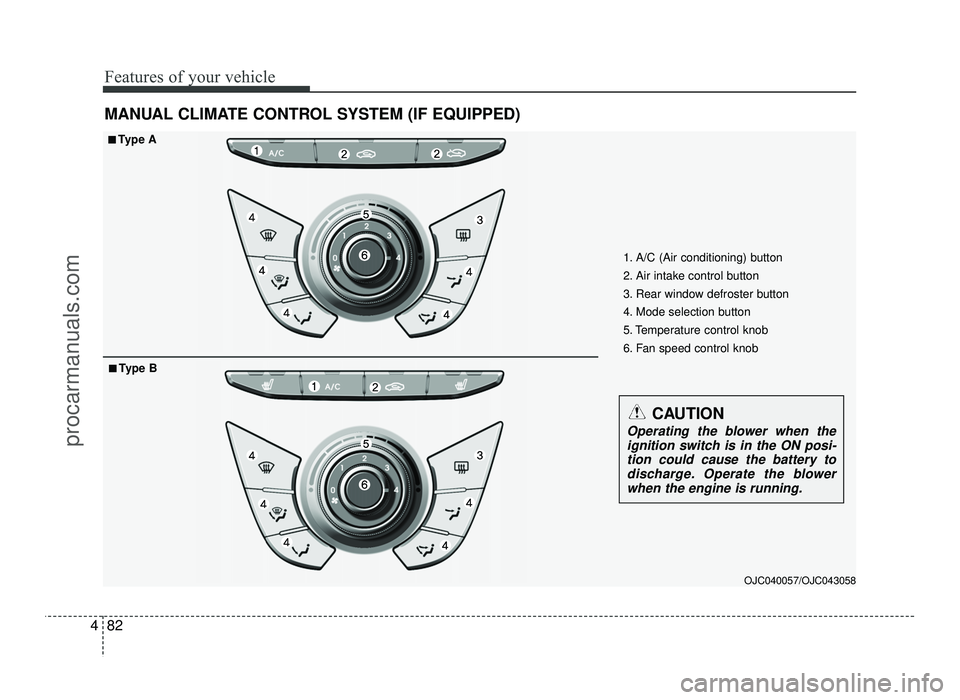
1. A/C (Air conditioning) button
2. Air intake control button
3. Rear window defroster button
4. Mode selection button
5. Temperature control knob
6. Fan speed control knob
■■
Type A
■
■ Type B
CAUTION
Operating the blower when the
ignition switch is in the ON posi-tion could cause the battery to
discharge. Operate the blowerwhen the engine is running.
procarmanuals.com
Page 167 of 456
489
Features of your vehicle
During air conditioning system opera-tion, you may occasionally notice a slight change in engine speed as the
air conditioning compressor cycles.
This is a normal system operation
characteristic.
Use the air conditioning system every month only for a few minutes to ensure
maximum system performance.
When using the air conditioning sys- tem, you may notice clear water drip-
ping (or even puddling) on the ground
under the passenger side of the vehi-
cle. This is a normal system operation
characteristic.
Operating the air conditioning system in the recirculated air position provides
maximum cooling, however, continual
operation in this mode may cause the
air inside the vehicle to become stale.
During cooling operation, you may occasionally notice a misty air flow
because of rapid cooling and humid air
intake. This is a normal system opera-
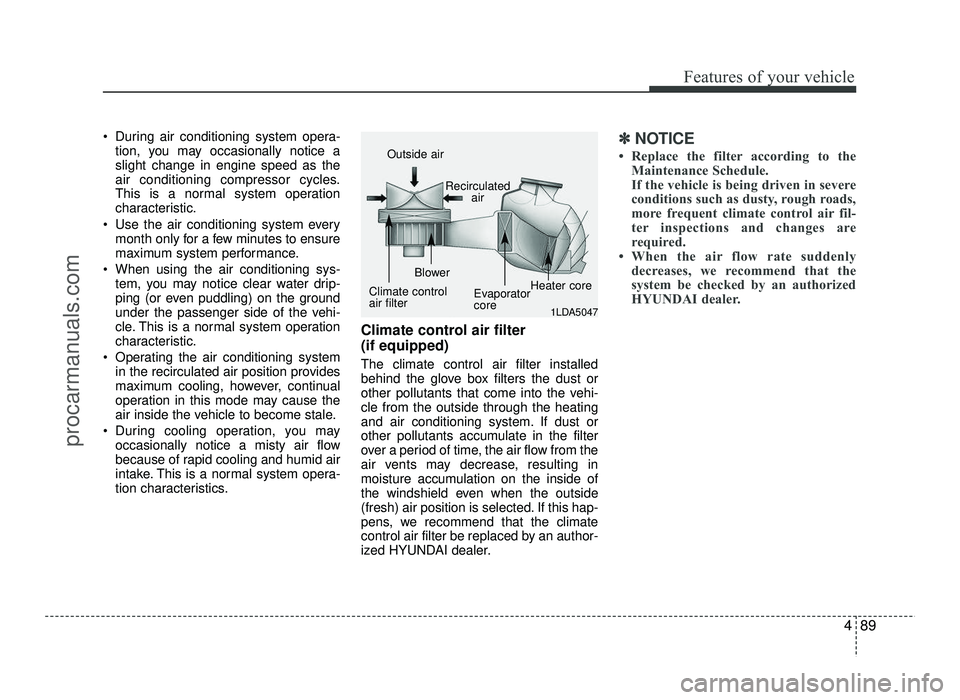
tion characteristics. Climate control air filter (if equipped) The climate control air filter installed
behind the glove box filters the dust or
other pollutants that come into the vehi-cle from the outside through the heating
and air conditioning system. If dust or
other pollutants accumulate in the filter
over a period of time, the air flow from the
air vents may decrease, resulting in
moisture accumulation on the inside of
the windshield even when the outside
(fresh) air position is selected. If this hap-
pens, we recommend that the climate
control air filter be replaced by an author-
ized HYUNDAI dealer.✽✽
NOTICE
Replace the filter according to the Maintenance Schedule.
If the vehicle is being driven in severe
conditions such as dusty, rough roads,
more frequent climate control air fil-
ter inspections and changes are
required.
When the air flow rate suddenly decreases, we recommend that the
system be checked by an authorized
HYUNDAI dealer.
1LDA5047
Outside air
Recirculatedair
Climate control air filter Blower
EvaporatorcoreHeater core
procarmanuals.com
Page 169 of 456
491
Features of your vehicle
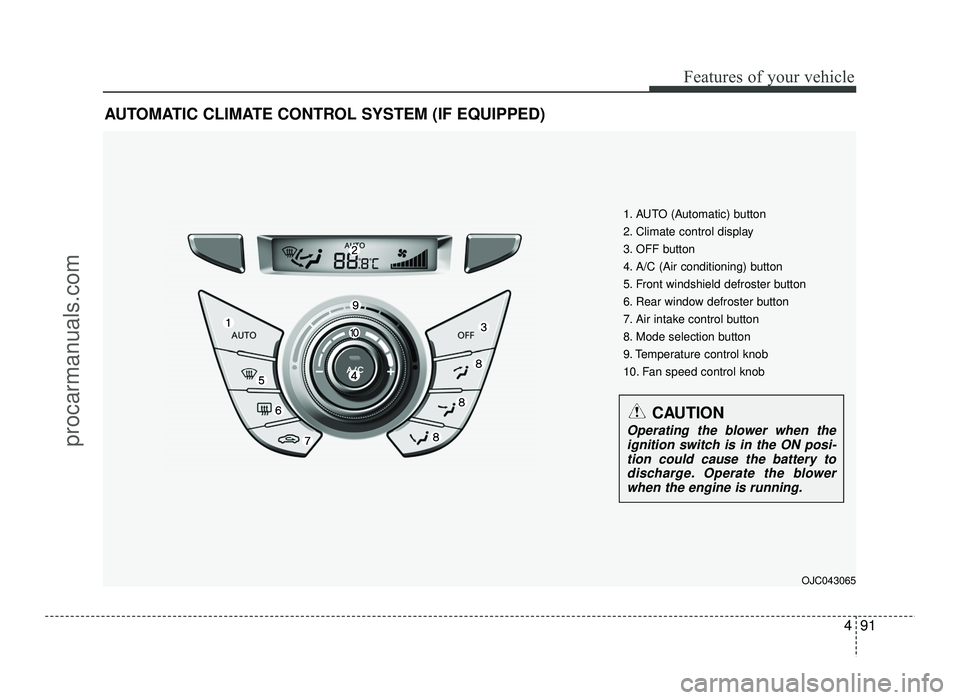
AUTOMATIC CLIMATE CONTROL SYSTEM (IF EQUIPPED)OJC043065
1. AUTO (Automatic) button
2. Climate control display
3. OFF button
4. A/C (Air conditioning) button
5. Front windshield defroster button
6. Rear window defroster button
7. Air intake control button
8. Mode selection button
9. Temperature control knob
10. Fan speed control knob
CAUTION
Operating the blower when theignition switch is in the ON posi-
tion could cause the battery to discharge. Operate the blowerwhen the engine is running.
procarmanuals.com