warning HYUNDAI IX35 2012 Owners Manual
[x] Cancel search | Manufacturer: HYUNDAI, Model Year: 2012, Model line: IX35, Model: HYUNDAI IX35 2012Pages: 560, PDF Size: 28.31 MB
Page 329 of 560
79
Maintenance
EXPLANATION OF SCHEDULED MAINTENANCE ITEMS
Engine oil and filter The engine oil and filter should be
changed at the intervals specified in the
maintenance schedule. If the car is being
driven in severe conditions, more fre-quent oil and filter changes are required. Drive belts
Inspect all drive belts for evidence of
cuts, cracks, excessive wear or oil satu-
ration and replace if necessary. Drive
belts should be checked periodically forproper tension and adjusted as neces-
sary. Fuel filter (cartridge) A clogged filter can limit the speed at
which the vehicle may be driven, damage
the emission system and cause multiple
issues such as hard starting. If an exces-
sive amount of foreign matter accumu-
lates in the fuel tank, the filter may
require replacement more frequently.
After installing a new filter, run the engine
for several minutes, and check for leaks
at the connections. Fuel filters should be
installed by a HYUNDAI authorised
repairer.
Fuel lines, fuel hoses and con- nections
Check the fuel lines, fuel hoses and con-
nections for leakage and damage. Have
a HYUNDAI authorised repairer replace
any damaged or leaking parts immedi-
ately.
WARNING -
Diesel only
Never work on injection system with engine running or within 30
seconds after shutting off engine.
High pressure pump, rail, injectorsand high pressure pipes are sub-
ject to high pressure even after the
engine stopped. The fuel jet pro-
duced by fuel leaks may cause seri-
ous injury, if it touch the body.
People using pacemakers should
not move than 30cm closer to theECU or wiring harness within the
engine room whilst engine is run-
ning, since the high currents in the
Common Rail system produce con-
siderable magnetic fields.
EL UK 7.QXP 1/25/2010 10:01 AM Page 9
Page 332 of 560
Maintenance
12
7
ENGINE OIL
Checking the engine oil level
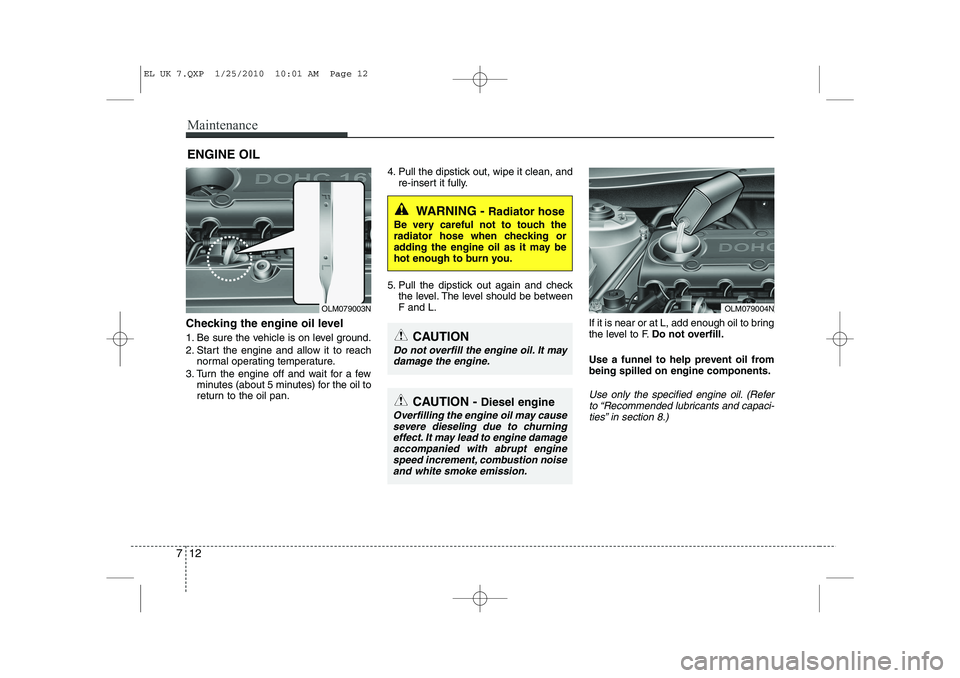
1. Be sure the vehicle is on level ground.
2. Start the engine and allow it to reach normal operating temperature.
3. Turn the engine off and wait for a few minutes (about 5 minutes) for the oil to
return to the oil pan. 4. Pull the dipstick out, wipe it clean, and
re-insert it fully.
5. Pull the dipstick out again and check the level. The level should be between F and L.
If it is near or at L, add enough oil to bring
the level to F.Do not overfill.
Use a funnel to help prevent oil frombeing spilled on engine components.
Use only the specified engine oil. (Refer to “Recommended lubricants and capaci-ties” in section 8.)
WARNING - Radiator hose
Be very careful not to touch the
radiator hose when checking or
adding the engine oil as it may be
hot enough to burn you.
OLM079003NOLM079004N
CAUTION
Do not overfill the engine oil. It may damage the engine.
CAUTION - Diesel engine
Overfilling the engine oil may cause
severe dieseling due to churning
effect. It may lead to engine damageaccompanied with abrupt engine speed increment, combustion noise and white smoke emission.
EL UK 7.QXP 1/25/2010 10:01 AM Page 12
Page 333 of 560
713
Maintenance
ENGINE COOLANT
Changing the engine oil and filter
Have engine oil and filter changed by a
HYUNDAI authorised repairer according
to the Maintenance Schedule. The high-pressure cooling system has a
reservoir filled with year-round antifreeze
coolant. The reservoir is filled at the fac-
tory.
Check the antifreeze protection and
coolant concentration level at least once
a year, at the beginning of the winter sea-
son, and before travelling to a colder cli-
mate.
Checking the coolant level
WARNING
- Removing
radiator cap
Never attempt to remove the radi- ator cap whilst the engine is
operating or hot. Doing so mightlead to cooling system and
engine damage and could result
in serious personal injury fromescaping hot coolant or steam.
(Continued)
WARNING
Prolonged and repeated contact
with used engine oils may result in
serious skin disorders including
dermatitis and cancer. Avoid con-
tact with skin as far as possible and
always wash thoroughly after any
contact. Keep used oils out of
reach of children. It is illegal to pol-
lute drains, water courses and soil.
Use only authorised waste collec-
tion facilities including civic ameni-
ty sites and garages for the dispos-
al of used oil and oil filters. If in
doubt, contact the local authority
for disposal instructions.
EL UK 7.QXP 1/25/2010 10:01 AM Page 13
Page 335 of 560
715
Maintenance
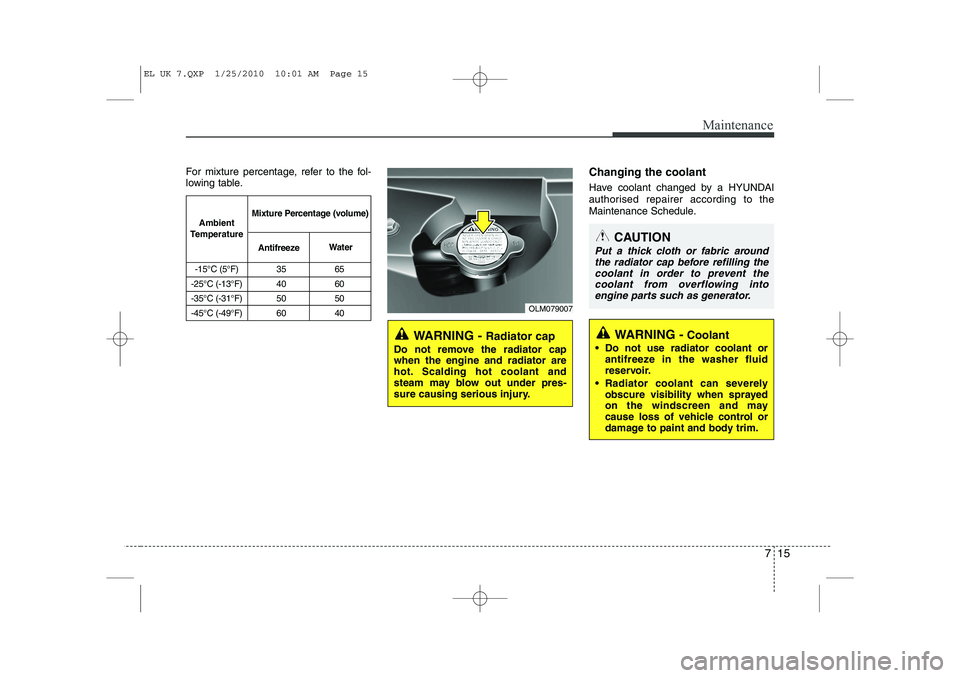
For mixture percentage, refer to the fol-
lowing table.Changing the coolant
Have coolant changed by a HYUNDAI
authorised repairer according to the
Maintenance Schedule.
WARNING -
Radiator cap
Do not remove the radiator cap when the engine and radiator are
hot. Scalding hot coolant and
steam may blow out under pres-
sure causing serious injury.
CAUTION
Put a thick cloth or fabric around the radiator cap before refilling the
coolant in order to prevent the coolant from overflowing into engine parts such as generator.
WARNING - Coolant
Do not use radiator coolant or antifreeze in the washer fluid
reservoir.
Radiator coolant can severely obscure visibility when sprayed
on the windscreen and may
cause loss of vehicle control or
damage to paint and body trim.
OLM079007
-15°C (5°F) 35 65
-25°C (-13°F) 40 60
-35°C (-31°F) 50 50
-45°C (-49°F) 60 40
Ambient
Temperature Mixture Percentage (volume)
Antifreeze Water
EL UK 7.QXP 1/25/2010 10:01 AM Page 15
Page 336 of 560
Maintenance
16
7
BRAKE/CLUTCH FLUID
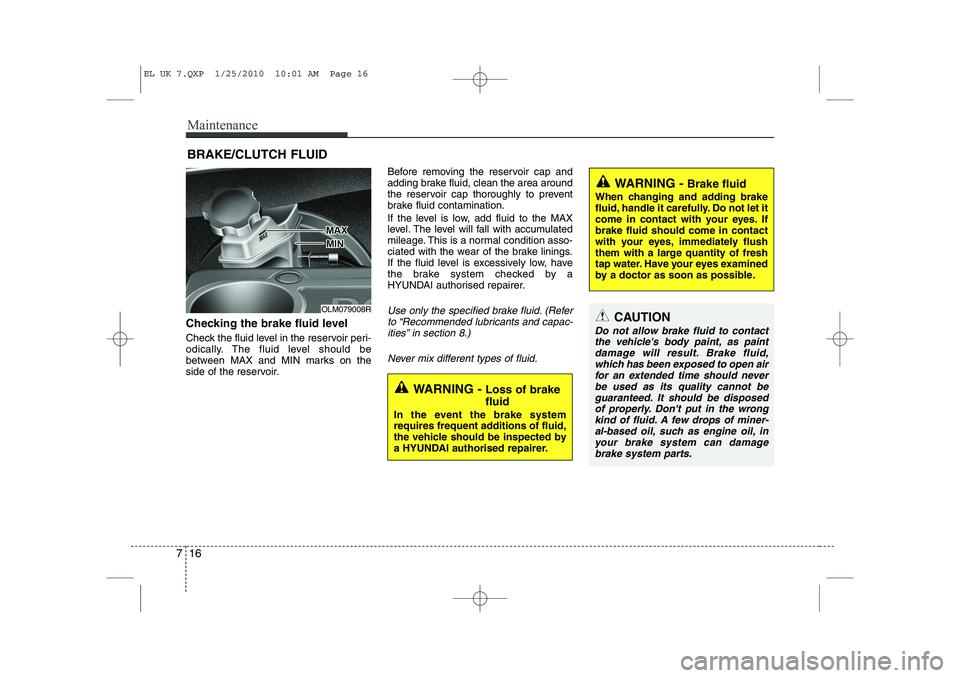
Checking the brake fluid level
Check the fluid level in the reservoir peri-
odically. The fluid level should be
between MAX and MIN marks on the
side of the reservoir. Before removing the reservoir cap and
adding brake fluid, clean the area around
the reservoir cap thoroughly to prevent
brake fluid contamination.
If the level is low, add fluid to the MAX
level. The level will fall with accumulated
mileage. This is a normal condition asso-
ciated with the wear of the brake linings.
If the fluid level is excessively low, have
the brake system checked by a
HYUNDAI authorised repairer.
Use only the specified brake fluid. (Refer
to “Recommended lubricants and capac-ities” in section 8.)
Never mix different types of fluid.
WARNING - Brake fluid
When changing and adding brake
fluid, handle it carefully. Do not let it
come in contact with your eyes. Ifbrake fluid should come in contact
with your eyes, immediately flush
them with a large quantity of fresh
tap water. Have your eyes examined
by a doctor as soon as possible.
WARNING - Loss of brake fluid
In the event the brake system
requires frequent additions of fluid,
the vehicle should be inspected by
a HYUNDAI authorised repairer.
CAUTION
Do not allow brake fluid to contact the vehicle's body paint, as paint
damage will result. Brake fluid,which has been exposed to open air for an extended time should neverbe used as its quality cannot be
guaranteed. It should be disposed of properly. Don't put in the wrongkind of fluid. A few drops of miner-al-based oil, such as engine oil, in
your brake system can damagebrake system parts.
OLM079008R
EL UK 7.QXP 1/25/2010 10:01 AM Page 16
Page 337 of 560
717
Maintenance
WASHER FLUID
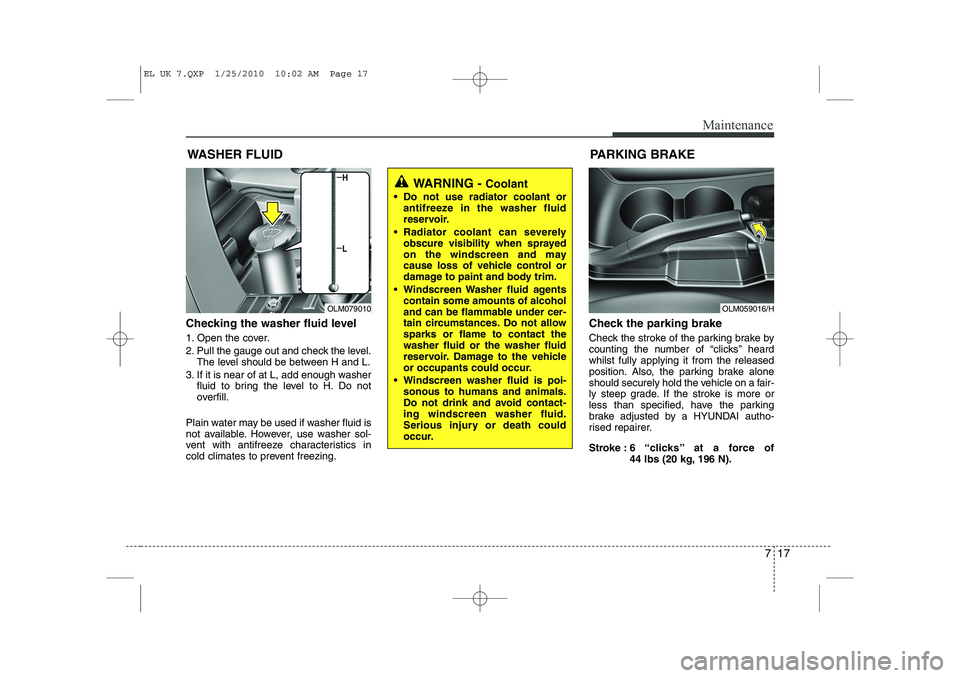
Checking the washer fluid level
1. Open the cover.
2. Pull the gauge out and check the level. The level should be between H and L.
3. If it is near of at L, add enough washer fluid to bring the level to H. Do not
overfill.
Plain water may be used if washer fluid is
not available. However, use washer sol-
vent with antifreeze characteristics in
cold climates to prevent freezing. Check the parking brake
Check the stroke of the parking brake by
counting the number of “clicks’’ heardwhilst fully applying it from the released
position. Also, the parking brake alone
should securely hold the vehicle on a fair-
ly steep grade. If the stroke is more or
less than specified, have the parking
brake adjusted by a HYUNDAI autho-
rised repairer.
Stroke : 6 “clicks’’ at a force of
44 lbs (20 kg, 196 N).
OLM079010
WARNING - Coolant
Do not use radiator coolant or antifreeze in the washer fluid
reservoir.
Radiator coolant can severely obscure visibility when sprayed
on the windscreen and may
cause loss of vehicle control or
damage to paint and body trim.
Windscreen Washer fluid agents contain some amounts of alcohol
and can be flammable under cer-
tain circumstances. Do not allowsparks or flame to contact thewasher fluid or the washer fluid
reservoir. Damage to the vehicle
or occupants could occur.
Windscreen washer fluid is poi- sonous to humans and animals.
Do not drink and avoid contact-ing windscreen washer fluid.
Serious injury or death could
occur.
PARKING BRAKE
OLM059016/H
EL UK 7.QXP 1/25/2010 10:02 AM Page 17
Page 338 of 560
Maintenance
18
7
FUEL FILTER (FOR DIESEL)
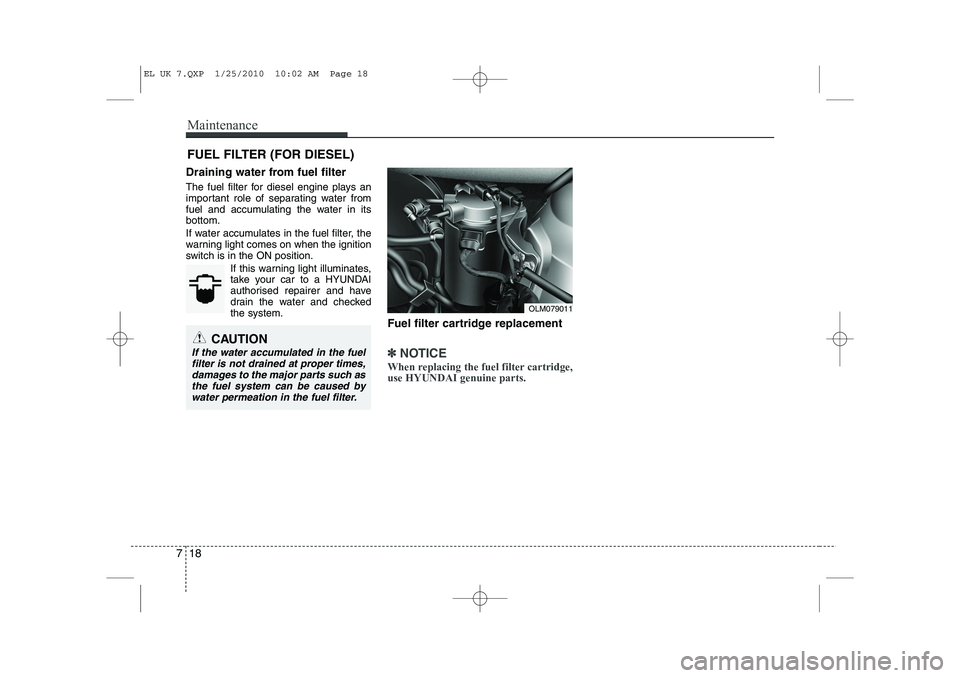
Draining water from fuel filter
The fuel filter for diesel engine plays an
important role of separating water from
fuel and accumulating the water in itsbottom.
If water accumulates in the fuel filter, the
warning light comes on when the ignition
switch is in the ON position. If this warning light illuminates,
take your car to a HYUNDAI
authorised repairer and have
drain the water and checkedthe system. Fuel filter cartridge replacement
✽✽NOTICE
When replacing the fuel filter cartridge, use HYUNDAI genuine parts.
OLM079011
CAUTION
If the water accumulated in the fuel filter is not drained at proper times,
damages to the major parts such asthe fuel system can be caused by water permeation in the fuel filter.
EL UK 7.QXP 1/25/2010 10:02 AM Page 18
Page 346 of 560
Maintenance
26
7
BATTERY
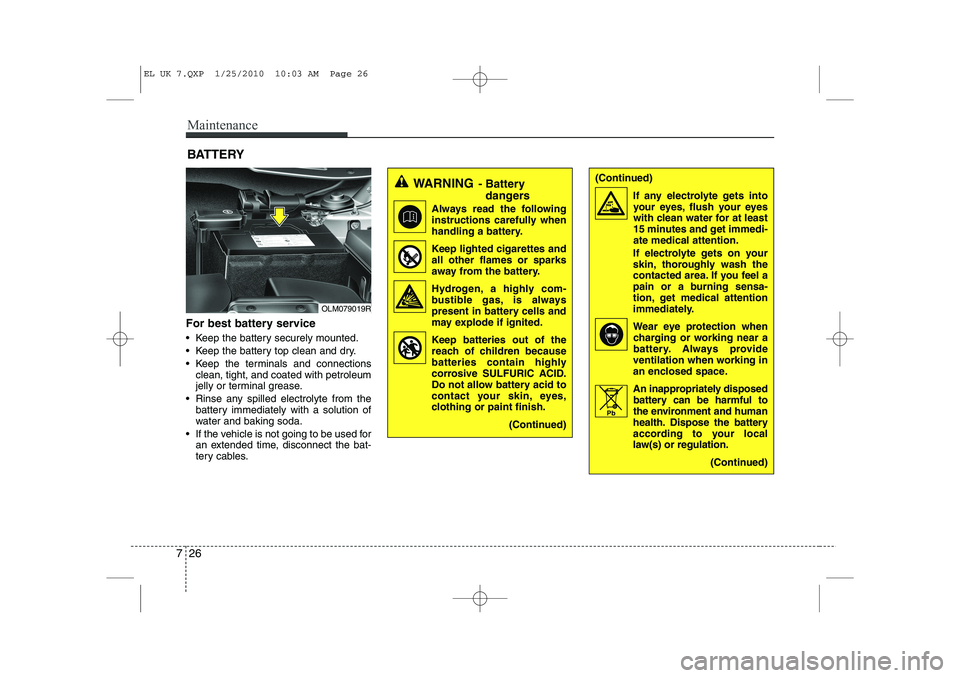
For best battery service
Keep the battery securely mounted.
Keep the battery top clean and dry.
Keep the terminals and connections clean, tight, and coated with petroleum
jelly or terminal grease.
Rinse any spilled electrolyte from the battery immediately with a solution of
water and baking soda.
If the vehicle is not going to be used for an extended time, disconnect the bat-
tery cables.
WARNING - Battery
dangers
Always read the following
instructions carefully when
handling a battery.
Keep lighted cigarettes and all other flames or sparks
away from the battery.
Hydrogen, a highly com- bustible gas, is always
present in battery cells and
may explode if ignited.
Keep batteries out of the reach of children because
batteries contain highly
corrosive SULFURIC ACID.
Do not allow battery acid to
contact your skin, eyes,
clothing or paint finish.
(Continued)(Continued)If any electrolyte gets intoyour eyes, flush your eyes
with clean water for at least
15 minutes and get immedi-ate medical attention.
If electrolyte gets on your
skin, thoroughly wash the
contacted area. If you feel a
pain or a burning sensa-
tion, get medical attention
immediately.
Wear eye protection when charging or working near a
battery. Always provide
ventilation when working in
an enclosed space.
An inappropriately disposed battery can be harmful to
the environment and human
health. Dispose the battery
according to your local
law(s) or regulation.
(Continued)
OLM079019R
Pb
EL UK 7.QXP 1/25/2010 10:03 AM Page 26
Page 347 of 560
727
Maintenance
Battery recharging
Your vehicle has a maintenance-free,
calcium-based battery.
If the battery becomes discharged in ashort time (because, for example, the
headlights or interior lights were left on
whilst the vehicle was not in use),
recharge it by slow charging (trickle)
for 10 hours.
If the battery gradually discharges because of high electric load whilst the
vehicle is being used, recharge it at 20-
30A for two hours.(Continued)
When lifting a plastic-cased bat-tery, excessive pressure on the
case may cause battery acid to
leak, resulting in personal injury.
Lift with a battery carrier or with
your hands on opposite corners.
Never attempt to recharge the battery when the battery cablesare connected.
The electrical ignition system works with high voltage. Never
touch these components with theengine running or the ignition
switched on.
Failure to follow the above warn-
ings can result in serious bodily
injury or death.WARNING - Recharging
battery
When recharging the battery,
observe the following precautions:
The battery must be removed from the vehicle and placed in an area with good ventilation.
Do not allow cigarettes, sparks, or flame near the battery.
Watch the battery during charg- ing, and stop or reduce the charg-
ing rate if the battery cells begin
gassing (boiling) violently or if
the temperature of the electrolyte
of any cell exceeds 49°C (120°F).
Wear eye protection when check- ing the battery during charging.
(Continued)
EL UK 7.QXP 1/25/2010 10:03 AM Page 27
Page 349 of 560
729
Maintenance
TYRES AND WHEELS
Tyre care
For proper maintenance, safety, and
maximum fuel economy, you must
always maintain recommended tyre
inflation pressures and stay within
the load limits and weight distribution
recommended for your vehicle. Recommended cold tyre inflation pressures All tyre pressures (including the
spare) should be checked when the
tyres are cold. “Cold Tyres” means
the vehicle has not been driven for at
least three hours or driven less than1 mile (1.6 km).
Recommended pressures must be
maintained for the best ride, top vehi-
cle handling, and minimum tyre
wear.
For recommended inflation pressure
refer to “Tyre and wheels” in section8. All specifications (sizes and pres-
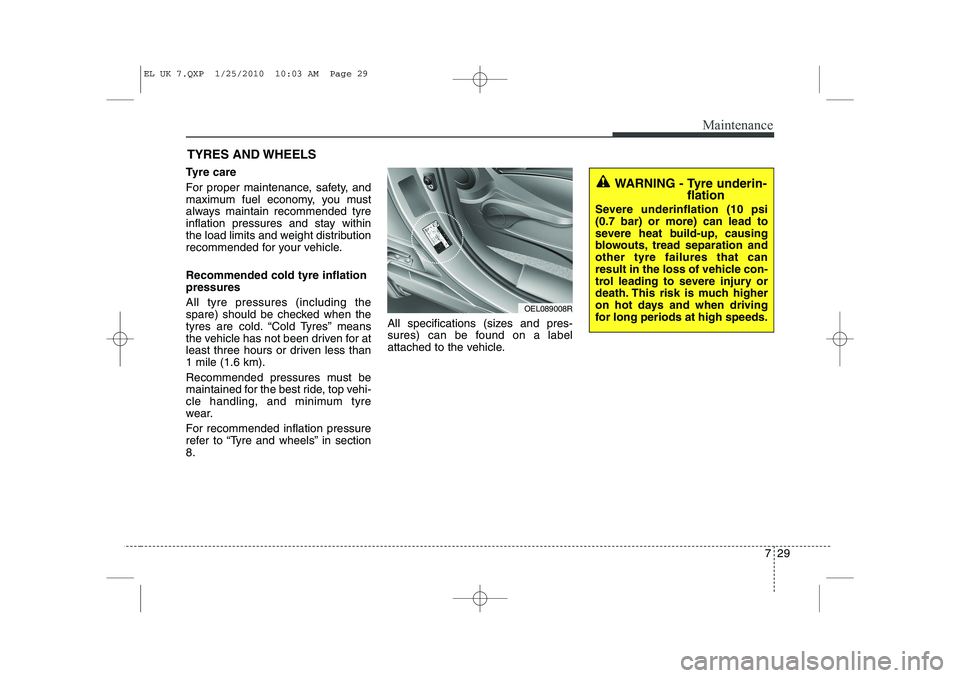
sures) can be found on a label
attached to the vehicle.
WARNING - Tyre underin-
flation
Severe underinflation (10 psi (0.7 bar) or more) can lead to
severe heat build-up, causing
blowouts, tread separation andother tyre failures that can
result in the loss of vehicle con-
trol leading to severe injury or
death. This risk is much higher
on hot days and when driving
for long periods at high speeds.
OEL089008R
EL UK 7.QXP 1/25/2010 10:03 AM Page 29