ESP HYUNDAI IX35 2014 Owner's Guide
[x] Cancel search | Manufacturer: HYUNDAI, Model Year: 2014, Model line: IX35, Model: HYUNDAI IX35 2014Pages: 1534, PDF Size: 39.76 MB
Page 259 of 1534
Driving your vehicle
54
5
✽✽
NOTICE
The ESC system (if equipped) should be
turned OFF prior to rocking the vehicle.
Smooth cornering
Avoid braking or gear changing in cor-
ners, especially when roads are wet.
Ideally, corners should always be taken
under gentle acceleration. If you follow
these suggestions, tyre wear will be held
to a minimum. Driving at night
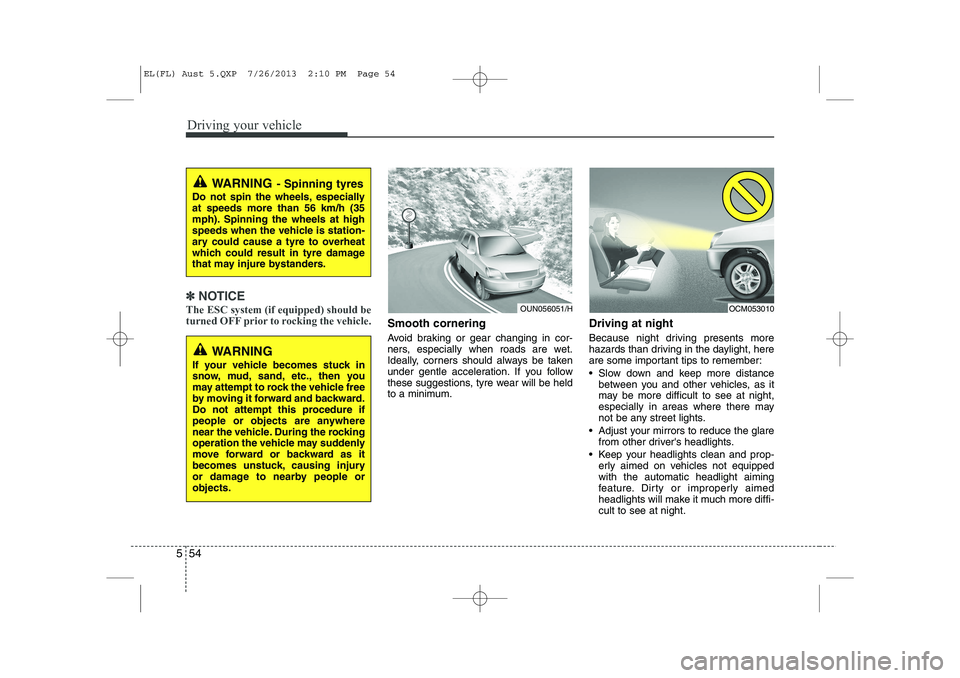
Because night driving presents more
hazards than driving in the daylight, here
are some important tips to remember:
Slow down and keep more distance
between you and other vehicles, as it
may be more difficult to see at night,
especially in areas where there may
not be any street lights.
Adjust your mirrors to reduce the glare from other driver's headlights.
Keep your headlights clean and prop- erly aimed on vehicles not equippedwith the automatic headlight aiming
feature. Dirty or improperly aimed
headlights will make it much more diffi-cult to see at night.
WARNING - Spinning tyres
Do not spin the wheels, especially at speeds more than 56 km/h (35
mph). Spinning the wheels at high
speeds when the vehicle is station-
ary could cause a tyre to overheat
which could result in tyre damage
that may injure bystanders.
WARNING
If your vehicle becomes stuck in
snow, mud, sand, etc., then you
may attempt to rock the vehicle free
by moving it forward and backward.
Do not attempt this procedure if
people or objects are anywhere
near the vehicle. During the rocking
operation the vehicle may suddenly
move forward or backward as it
becomes unstuck, causing injury
or damage to nearby people orobjects.
OUN056051/HOCM053010
EL(FL) Aust 5.QXP 7/26/2013 2:10 PM Page 54
Page 260 of 1534
555
Driving your vehicle
Avoid staring directly at the headlightsof oncoming vehicles. You could be
temporarily blinded, and it will take
several seconds for your eyes to read-
just to the darkness.
Driving in the rain
Rain and wet roads can make driving
dangerous, especially if you’re not pre-
pared for the slick pavement. Here are a
few things to consider when driving in the
rain:
A heavy rainfall will make it harder tosee and will increase the distance need-
ed to stop your vehicle, so slow down.
Keep your windscreen wiping equip- ment in good shape. Replace your
windscreen wiper blades when they
show signs of streaking or missingareas on the windscreen.
If your tyres are not in good condition, making a quick stop on wet pavement
can cause a skid and possibly lead to
an accident. Be sure your tyres are in
good shape. Turn on your headlights to make it easi-
er for others to see you.
Driving too fast through large puddles can affect your brakes. If you must go
through puddles, try to drive through
them slowly.
If you believe you may have gotten your brakes wet, apply them lightly whilst
driving until normal braking operation
returns.
Driving in flooded areas
Avoid driving through flooded areas
unless you are sure the water is no high-
er than the bottom of the wheel hub.
Drive through any water slowly. Allowadequate stopping distance because
brake performance may be affected.
After driving through water, dry the
brakes by gently applying them several
times whilst the vehicle is moving slowly.
Driving off-road
Drive carefully off-road because your
vehicle may be damaged by rocks or
roots of trees. Become familiar with the
off-road conditions where you are going
to drive before you begin driving.
1VQA3003/H
EL(FL) Aust 5.QXP 7/26/2013 2:10 PM Page 55
Page 268 of 1534
563
Driving your vehicle
Safety chains
You should always attach chains
between your vehicle and your trailer.
Cross the safety chains under the tongue
of the trailer so that the tongue will not
drop to the road if it becomes separated
from the towbar.
Instructions about safety chains may be
provided by the towbar manufacturer or
by the trailer manufacturer. Follow the
manufacturer’s recommendation for
attaching safety chains. Always leave just
enough slack so you can turn with your
trailer. And, never allow safety chains to
drag on the ground.Trailer brakes
If your trailer is equipped with a braking
system, make sure it conforms to your
country’s regulations and that it is prop-
erly installed and operating correctly.
If your trailer weight exceeds the maxi-
mum allowed weight without trailer
brakes, then the trailer will also require its
own brakes as well. Be sure to read and
follow the instructions for the trailer
brakes so you’ll be able to install, adjust
and maintain them properly.
Don’t tap into or modify your vehicle's
brake system. Driving with a trailer
Towing a trailer requires a certain
amount of experience. Before setting out
for the open road, you must get to know
your trailer. Acquaint yourself with the
feel of handling and braking with the
added weight of the trailer. And always
keep in mind that the vehicle you are
driving is now a good deal longer and not
nearly so responsive as your vehicle is
by itself.
Before you start, check the trailer towbar
and platform, safety chains, electrical
connector(s), lights, tyres and mirror
adjustment. If the trailer has electric
brakes, start your vehicle and trailer mov-
ing and then apply the trailer brake con-
troller by hand to be sure the brakes are
working. This lets you check your electri-
cal connection at the same time.
During your trip, check occasionally to be
sure that the load is secure, and that the
lights and any trailer brakes are still work-ing.
WARNING
- Trailer brakes
Do not use a trailer with its own
brakes unless you are absolutely
certain that you have properly set
up the brake system. This is not a
task for amateurs. Use an experi-
enced, competent trailer shop for
this work.
EL(FL) Aust 5.QXP 7/26/2013 2:10 PM Page 63
Page 273 of 1534
Driving your vehicle
68
5
If you do decide to pull a trailer
(For Australia)
Here are some important points if you
decide to pull a trailer:
Do not do any towing with your car dur-
ing its first 2,000 km (1,200 miles) in
order to allow the engine to properly
run in. Failure to heed this caution may
result in serious engine or transaxle
damage.
When towing a trailer, be sure to con- sult an authorised HYUNDAI dealer for
further information on additional
requirements such as a towing kit, etc.
Always drive your vehicle at a moder- ate speed (less than 100 km/h (60mph)).
On a long uphill grade, do not exceed 70 km/h (45 mph) or the posted speed
limit, whichever is lower.
WARNING
HYUNDAI DO NOT recommend the use of load levelling devices of any type.
The use of a load levelling devices may place undue stress on the chassis
causing chassis or mounting point failure.
Towing Trailer
The recommended towing capacity of this vehicle will be provided with the Genuine
HYUNDAI Approved Tow Bar, which will meet the requirements of Australian
Standard: AS 4177.
For further information with regards to trailer towing:
on Genuine HYUNDAI parts and accessories (including the Genuine HYUNDAI Approved Tow Bar and its availability for purchase) please consult your nearest
authorised HYUNDAI dealer or visit www
.hyundai.com.au.
on Rules and Regulations please consult your States or Territories road authorities.
It is the owner's responsibility to ensure that any tow bar used is compatible with and
suitable for your vehicle, and is within the towing capacity of your vehicle. Your
HYUNDAI vehicle should not be used to tow heavy loads as it is not designed for
such use.
Subject to applicable law, HYUNDAI Motor Company Australia Pty Ltd shall not be
liable for any losses, damages, costs, expenses (including but not limited to conse-
quential and indirect losses, personal injury and deaths) caused by towing which is
not in compliance with the instructions set out in this owner's manual and under rel-
evant law, rules and regulation.
EL(FL) Aust 5.QXP 7/26/2013 2:10 PM Page 68
Page 274 of 1534
569
Driving your vehicle
If you do decide to pull a trailer
(For New Zealand)
Here are some important points if you
decide to pull a trailer:
Do not do any towing with your car dur-ing its first 2,000 km (1,200 miles) in
order to allow the engine to properly
run in. Failure to heed this caution may
result in serious engine or transaxle
damage.
When towing a trailer, be sure to con- sult an authorised HYUNDAI dealer for
further information on additional
requirements such as a towing kit, etc.
Always drive your vehicle at a moder- ate speed (less than 100 km/h (60mph)).
On a long uphill grade, do not exceed 70 km/h (45 mph) or the posted speed
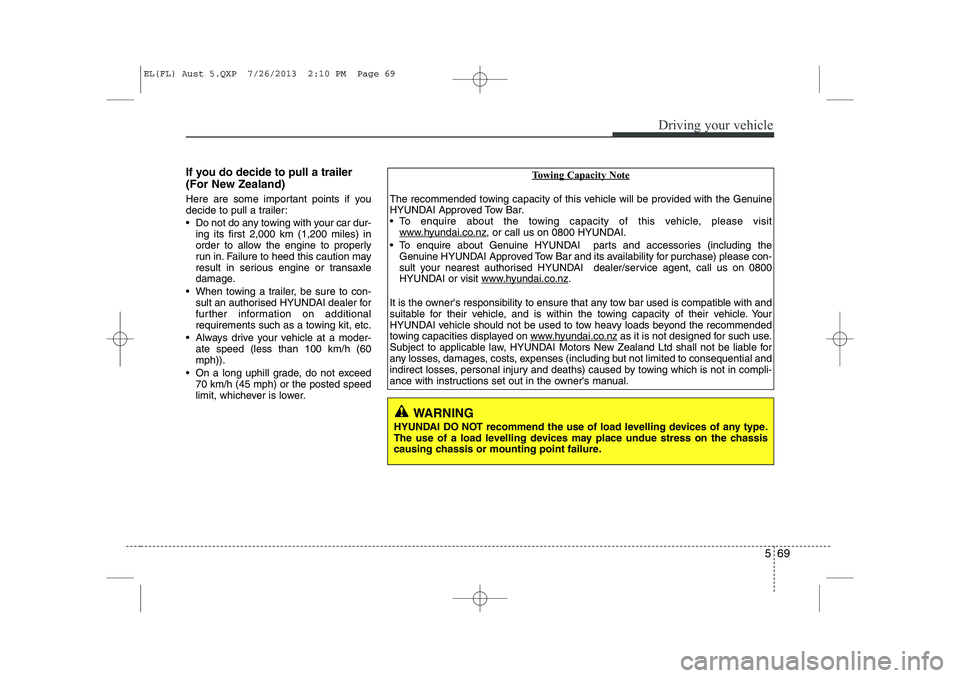
limit, whichever is lower. Towing Capacity Note
The recommended towing capacity of this vehicle will be provided with the Genuine
HYUNDAI Approved Tow Bar.
To enquire about the towing capacity of this vehicle, please visit
www
.hyundai.co.nz, or call us on 0800 HYUNDAI.
To enquire about Genuine HYUNDAI parts and accessories (including the Genuine HYUNDAI Approved Tow Bar and its availability for purchase) please con-
sult your nearest authorised HYUNDAI dealer/service agent, call us on 0800
HYUNDAI or visit www
.hyundai.co.nz.
It is the owner's responsibility to ensure that any tow bar used is compatible with and
suitable for their vehicle, and is within the towing capacity of their vehicle. Your
HYUNDAI vehicle should not be used to tow heavy loads beyond the recommended
towing capacities displayed on www
.hyundai.co.nzas it is not designed for such use.
Subject to applicable law, HYUNDAI Motors New Zealand Ltd shall not be liable for
any losses, damages, costs, expenses (including but not limited to consequential and
indirect losses, personal injury and deaths) caused by towing which is not in compli-
ance with instructions set out in the owner's manual.
WARNING
HYUNDAI DO NOT recommend the use of load levelling devices of any type.
The use of a load levelling devices may place undue stress on the chassis
causing chassis or mounting point failure.
EL(FL) Aust 5.QXP 7/26/2013 2:10 PM Page 69
Page 299 of 1534
75
Maintenance
MAINTENANCE SERVICES
You should exercise the utmost care to
prevent damage to your vehicle and
injury to yourself whenever performing
any maintenance or inspection proce-
dures.
Inadequate, incomplete or insufficient
servicing may result in operational prob-
lems with your vehicle that could lead to
vehicle damage, an accident, or person-
al injury. Owner’s responsibility
✽✽
NOTICE
Maintenance Service and Record
Retention are the owner's responsibility.
We recommend in general that you have
your vehicle serviced by an authorised
HYUNDAI dealer. You should retain doc-
uments that show proper maintenance
has been performed on your vehicle inaccordance with the scheduled mainte-
nance service charts shown on the fol-
lowing pages. You need this information
to establish your compliance with the
servicing and maintenance requirements
of your vehicle warranties. Detailed war-
ranty information is provided in your
Service Passport. Repairs and adjust-ments required as a result of improper
maintenance or a lack of required main-
tenance are not covered when your vehi-
cle is covered by warranty. Owner maintenance precautions
Improper or incomplete service may
result in problems. This section gives
instructions only for the maintenance
items that are easy to perform.✽✽
NOTICE
Improper owner maintenance during the warranty period may affect warran-
ty coverage. For details, read the sepa-
rate Service Passport provided with the
vehicle. If you're unsure about any serv-
icing or maintenance procedure, we rec-ommend that the system be serviced by
an authorised HYUNDAI dealer.
EL(FL) Aust 7.QXP 7/26/2013 2:22 PM Page 5
Page 300 of 1534
Maintenance
6
7
Engine compartment precautions (Diesel engine)
• The piezo injector operates at high
voltage (maximum 200v). Therefore,
the following accidents may occur.
- Direct contact with the injector or
injector wiring may cause electric
shock or damage your muscle or
nerve system.
- The electromagnetic wave from the operating injector may cause the arti-
ficial heart pacemaker to malfunction.
Follow the safety tips provided below, when you are checking the engine
room whilst the engine is running.
- Do not touch the injector, injector
wirings, and the engine computer
whilst the engine is running.
- Do not remove the injector connector whilst the engine is running.
- People using pacemakers must not go near the engine whilst the engine
is starting or running.
WARNING - Maintenance
work
Performing maintenance work on a vehicle can be dangerous. You
can be seriously injured whilst
performing some maintenance
procedures. If you lack sufficient
knowledge and experience or the
proper tools and equipment to do
the work, we recommend that the
system be serviced by an autho-
rised HYUNDAI dealer.
Working under the bonnet with the engine running is dangerous.
It becomes even more dangerous
when you wear jewelry or loose
clothing. These can become
entangled in moving parts and
result in injury. Therefore, if you
must run the engine whilst work-
ing under the bonnet, make cer-
tain that you remove all jewelry
(especially rings, bracelets,
watches, and necklaces) and all
neckties, scarves, and similar
loose clothing before gettingnear the engine or cooling fans.WARNING - Diesel Engine
Never work on injection system with engine running or within 30
seconds after shutting off engine.
High-pressure pump, rail, injectorsand high-pressure pipes are sub-
ject to high pressure even after the
engine stopped. The fuel jet pro-
duced by fuel leaks may cause seri-
ous injury, if it touches the body.
People using pacemakers should
not move than 30cm closer to theECU or wiring harness within the
engine room whilst engine is run-
ning, since the high currents in the
electronic engine control system
produce considerable magneticfields.
EL(FL) Aust 7.QXP 7/26/2013 2:22 PM Page 6
Page 341 of 1534
747
Maintenance
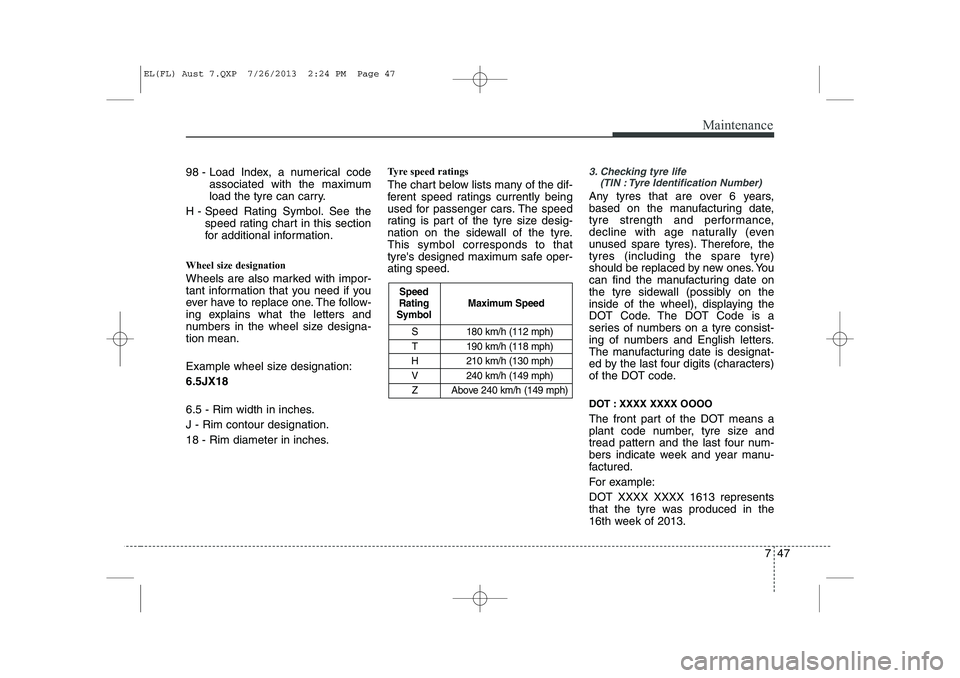
S 180 km/h (112 mph)T 190 km/h (118 mph)
H 210 km/h (130 mph)
V 240 km/h (149 mph) Z Above 240 km/h (149 mph)
Maximum Speed
Speed
Rating
Symbol
98 - Load Index, a numerical code
associated with the maximum
load the tyre can carry.
H - Speed Rating Symbol. See the speed rating chart in this section
for additional information.
Wheel size designation
Wheels are also marked with impor-
tant information that you need if you
ever have to replace one. The follow-
ing explains what the letters and
numbers in the wheel size designa-tion mean.
Example wheel size designation: 6.5JX18
6.5 - Rim width in inches. J - Rim contour designation.
18 - Rim diameter in inches. Tyre speed ratings
The chart below lists many of the dif-
ferent speed ratings currently being
used for passenger cars. The speed
rating is part of the tyre size desig-
nation on the sidewall of the tyre.This symbol corresponds to that
tyre's designed maximum safe oper-ating speed.3. Checking tyre life
(TIN : Tyre Identification Number)
Any tyres that are over 6 years,
based on the manufacturing date,
tyre strength and performance,
decline with age naturally (even
unused spare tyres). Therefore, thetyres (including the spare tyre)
should be replaced by new ones. You
can find the manufacturing date on
the tyre sidewall (possibly on the
inside of the wheel), displaying the
DOT Code. The DOT Code is a
series of numbers on a tyre consist-
ing of numbers and English letters.
The manufacturing date is designat-
ed by the last four digits (characters)
of the DOT code.
DOT : XXXX XXXX OOOO
The front part of the DOT means a
plant code number, tyre size and
tread pattern and the last four num-
bers indicate week and year manu-
factured.
For example:
DOT XXXX XXXX 1613 represents
that the tyre was produced in the
16th week of 2013.
EL(FL) Aust 7.QXP 7/26/2013 2:24 PM Page 47
Page 342 of 1534
Maintenance
48
7
4. Tyre ply composition and material
The number of layers or plies of rub-
ber-coated fabric are in the tyre. Tyre
manufacturers also must indicate the
materials in the tyre, which include
steel, nylon, polyester, and others.
The letter "R" means radial ply con-
struction; the letter "D" means diago-
nal or bias ply construction; and theletter "B" means belted-bias ply con-
struction.
5. Maximum permissible inflation
pressure
This number is the greatest amount of air pressure that should be put in
the tyre. Do not exceed the maximum
permissible inflation pressure. Refer
to the Tyre and Loading Information
label for recommended inflation
pressure.
6. Maximum load rating
This number indicates the maximum
load in kilograms and pounds that
can be carried by the tyre. When
replacing the tyres on the vehicle,
always use a tyre that has the same
load rating as the factory installed
tyre.
7. Uniform tyre quality grading
Quality grades can be found where
applicable on the tyre sidewall
between tread shoulder and maxi-
mum section width.
For example:
TREADWEAR 200
TRACTION AA
TEMPERATURE A Tread wear
The tread wear grade is a compara-
tive rating based on the wear rate ofthe tyre when tested under controlled
conditions on a specified govern-
ment test course. For example, a tyre
graded 150 would wear one-and-a-
half times (1½) as well on the gov-
ernment course as a tyre graded100.
The relative performance of tyres depends upon the actual conditions
of their use, however, and may
depart significantly from the norm
because of variations in driving
habits, service practices and differ-
ences in road characteristics and cli-
mate.
These grades are molded on the
side-walls of passenger vehicle
tyres. The tyres available as standard
or optional equipment on your vehi-
cles may vary with respect to grade.
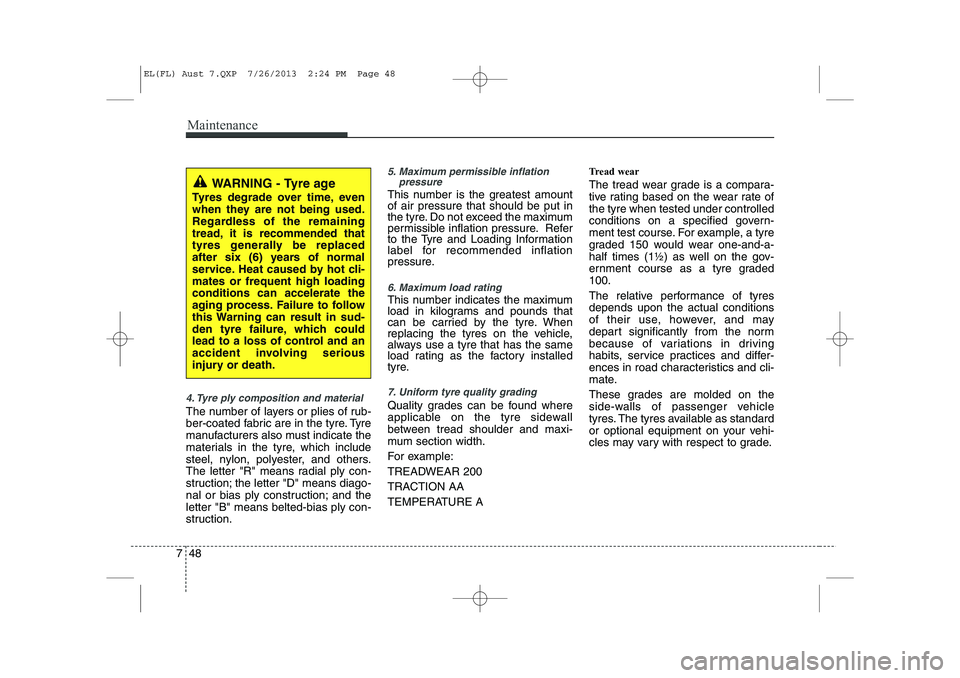
WARNING - Tyre age
Tyres degrade over time, even
when they are not being used.
Regardless of the remaining
tread, it is recommended that
tyres generally be replaced
after six (6) years of normal
service. Heat caused by hot cli-mates or frequent high loadingconditions can accelerate the
aging process. Failure to follow
this Warning can result in sud-
den tyre failure, which could
lead to a loss of control and an
accident involving serious
injury or death.
EL(FL) Aust 7.QXP 7/26/2013 2:24 PM Page 48
Page 352 of 1534
Maintenance
58
7
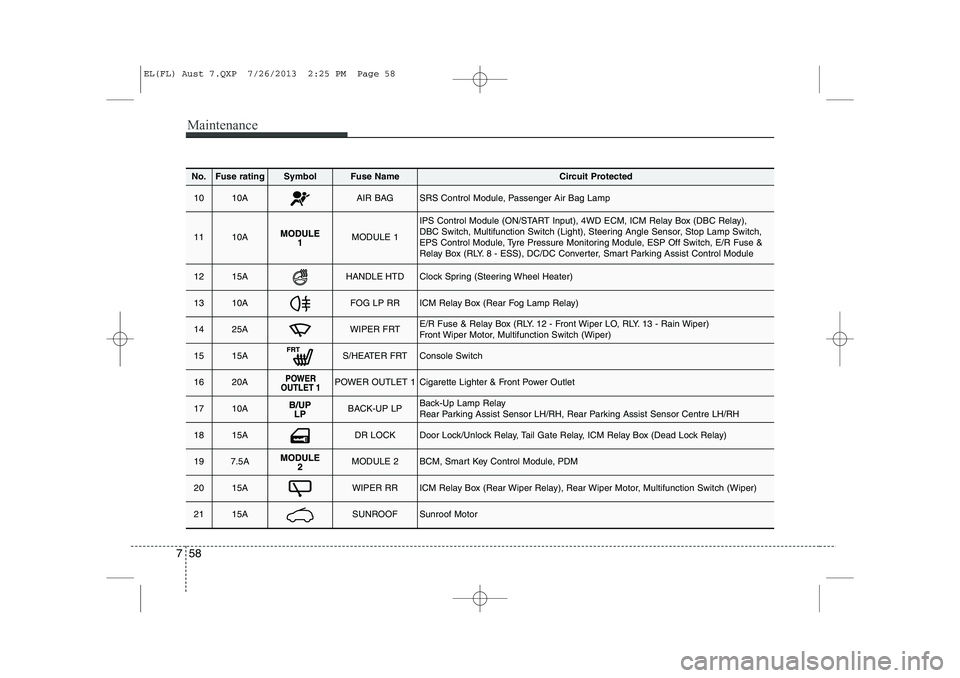
No.Fuse ratingSymbolFuse NameCircuit Protected
1010AAIR BAGSRS Control Module, Passenger Air Bag Lamp
1110AMODULE 1
IPS Control Module (ON/START Input), 4WD ECM, ICM Relay Box (DBC Relay),
DBC Switch, Multifunction Switch (Light), Steering Angle Sensor, Stop Lamp Switch,
EPS Control Module, Tyre Pressure Monitoring Module, ESP Off Switch, E/R Fuse &
Relay Box (RLY. 8 - ESS), DC/DC Converter, Smart Parking Assist Control Module
1215AHANDLE HTDClock Spring (Steering Wheel Heater)
1310AFOG LP RRICM Relay Box (Rear Fog Lamp Relay)
1425AWIPER FRTE/R Fuse & Relay Box (RLY. 12 - Front Wiper LO, RLY. 13 - Rain Wiper)
Front Wiper Motor, Multifunction Switch (Wiper)
1515AS/HEATER FRTConsole Switch
1620APOWER OUTLET 1Cigarette Lighter & Front Power Outlet
1710ABACK-UP LPBack-Up Lamp Relay
Rear Parking Assist Sensor LH/RH, Rear Parking Assist Sensor Centre LH/RH
1815ADR LOCKDoor Lock/Unlock Relay, Tail Gate Relay, ICM Relay Box (Dead Lock Relay)
197.5AMODULE 2BCM, Smart Key Control Module, PDM
2015AWIPER RRICM Relay Box (Rear Wiper Relay), Rear Wiper Motor, Multifunction Switch (Wiper)
2115ASUNROOFSunroof Motor
EL(FL) Aust 7.QXP 7/26/2013 2:25 PM Page 58