door lock HYUNDAI IX35 2014 Owner's Guide
[x] Cancel search | Manufacturer: HYUNDAI, Model Year: 2014, Model line: IX35, Model: HYUNDAI IX35 2014Pages: 1534, PDF Size: 39.76 MB
Page 401 of 1534
Index
4
I
Crankcase emission control system ................................7-83
Cruise control system ......................................................5-46
Cup holder......................................................................4-127
Curtain air bag ................................................................3-49 Dashboard illumination, see instrument panel
illumination ..................................................................4-47
Dashboard, see instrument cluster ..................................4-46
Day/night rearview mirror ..............................................4-39
Daytime running light ......................................................4-93
Declaration of conformity ................................................8-11
Defogging (Windscreen) ................................................4-120
Defroster (Rear window) ..............................................4-102
Defrosting (Windscreen) ................................................4-120
Digital clock ..................................................................4-129
Dimensions ........................................................................8-2Display illumination, see instrument panel illumination ..................................................................4-47
Displays, see instrument cluster ......................................4-46
Door locks ........................................................................4-15 Central door lock switch ............................................4-16
Child-protector rear door lock....................................4-18
Downhill brake control (DBC) ........................................5-41
Drinks holders, see cup holders ....................................4-127
Driver’s and passenger’s front air bag ............................3-45
Driving at night ................................................................5-54 Driving in flooded areas ..................................................5-55
Driving in the rain ............................................................5-55
Economical operation ......................................................5-51
Electric chromic mirror (ECM) ......................................4-39
Electric chromic mirror (ECM) with compass ................4-40
Electric power steering ....................................................4-34
Electronic stability control (ESC) ....................................5-36
Emergency starting ............................................................6-5
Jump starting ................................................................6-5
Emergency Stop Signal (ESS) ........................................5-43
Emission control system ..................................................7-83 Crankcase emission control system ..........................7-83
Evaporative emission control system ........................7-83
Exhaust emission control system ..............................7-84
Engine ................................................................................8-2
Engine compartment ..........................................................2-4
Engine coolant ................................................................7-23
Engine Coolant Temperature gauge ................................4-49
Engine number ................................................................8-10
Engine oil ........................................................................7-22
Engine overheats ................................................................6-7
Engine start/stop button ....................................................5-9
Evaporative emission control system ..............................7-83
Exhaust emission control system ....................................7-84
Explanation of scheduled maintenance items ..................7-19
E
D
EL(FL) Aust Index.qxp 7/26/2013 2:14 PM Page 4
Page 415 of 1534
17
Introduction
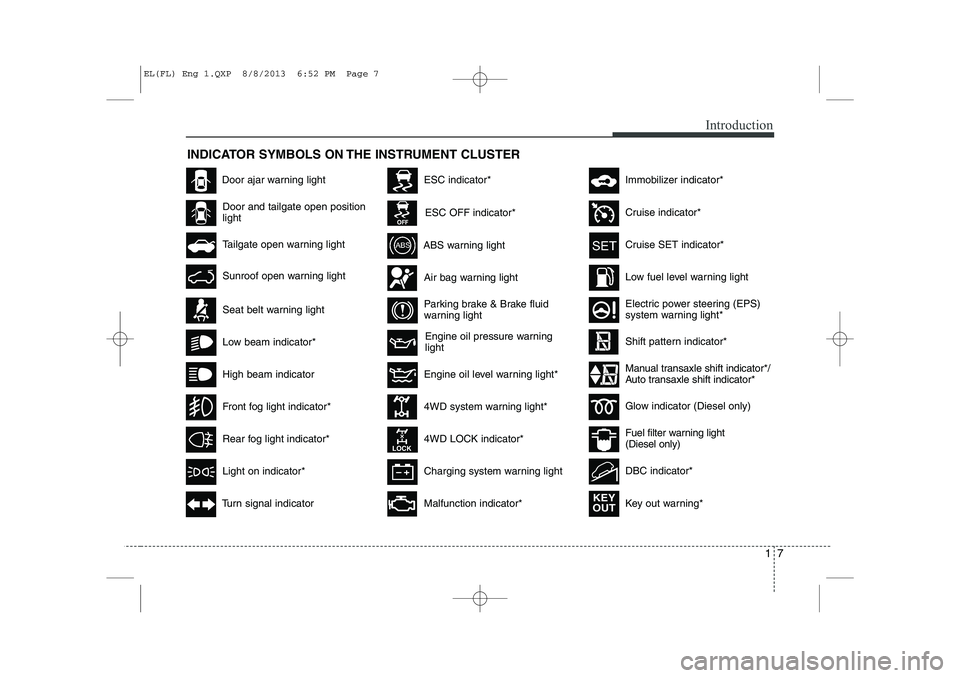
INDICATOR SYMBOLS ON THE INSTRUMENT CLUSTER
Engine oil pressure warning light
Seat belt warning light
Door and tailgate open position light
High beam indicator
Light on indicator*
Turn signal indicator
ABS warning light
Parking brake & Brake fluid
warning light
4WD system warning light* 4WD LOCK indicator*
Malfunction indicator*
Air bag warning light
Cruise SET indicator*
Low fuel level warning light
Charging system warning light
Door ajar warning light
Glow indicator (Diesel only)
Fuel filter warning light (Diesel only)
Cruise indicator*
ESC indicator*
ESC OFF indicator*
Immobilizer indicator*
Shift pattern indicator*
Front fog light indicator*
Rear fog light indicator*
Low beam indicator*
Electric power steering (EPS)
system warning light*
Key out warning*
KEY
OUT
DBC indicator*
Tailgate open warning light
Sunroof open warning light
Engine oil level warning light*Manual transaxle shift indicator*/
Auto transaxle shift indicator*
EL(FL) Eng 1.QXP 8/8/2013 6:52 PM Page 7
Page 418 of 1534
Your vehicle at a glance
2
2
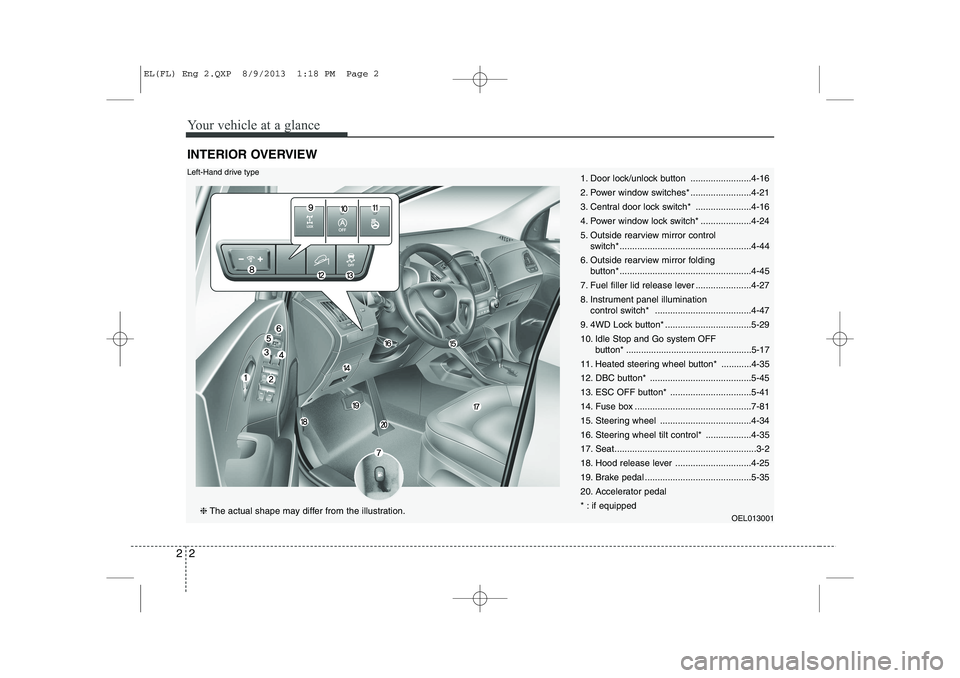
INTERIOR OVERVIEW
1. Door lock/unlock button ........................4-16
2. Power window switches* ........................4-21
3. Central door lock switch* ......................4-16
4. Power window lock switch* ....................4-24
5. Outside rearview mirror control
switch* ....................................................4-44
6. Outside rearview mirror folding button* ....................................................4-45
7. Fuel filler lid release lever ......................4-27
8. Instrument panel illumination control switch* ......................................4-47
9. 4WD Lock button* ..................................5-2910.
Idle Stop and Go system OFF
button* ..................................................5-17
11. Heated steering wheel button* ............4-35
12. DBC button* ........................................5-45
13. ESC OFF button* ................................5-41
14. Fuse box ..............................................7-81
15. Steering wheel ....................................4-34
16. Steering wheel tilt control* ..................4-35
17. Seat........................................................3-2
18. Hood release lever ..............................4-25
19. Brake pedal ..........................................5-35
20. Accelerator pedal
* : if equipped OEL013001
Left-Hand drive type
❈The actual shape may differ from the illustration.
EL(FL) Eng 2.QXP 8/9/2013 1:18 PM Page 2
Page 419 of 1534
23
Your vehicle at a glance
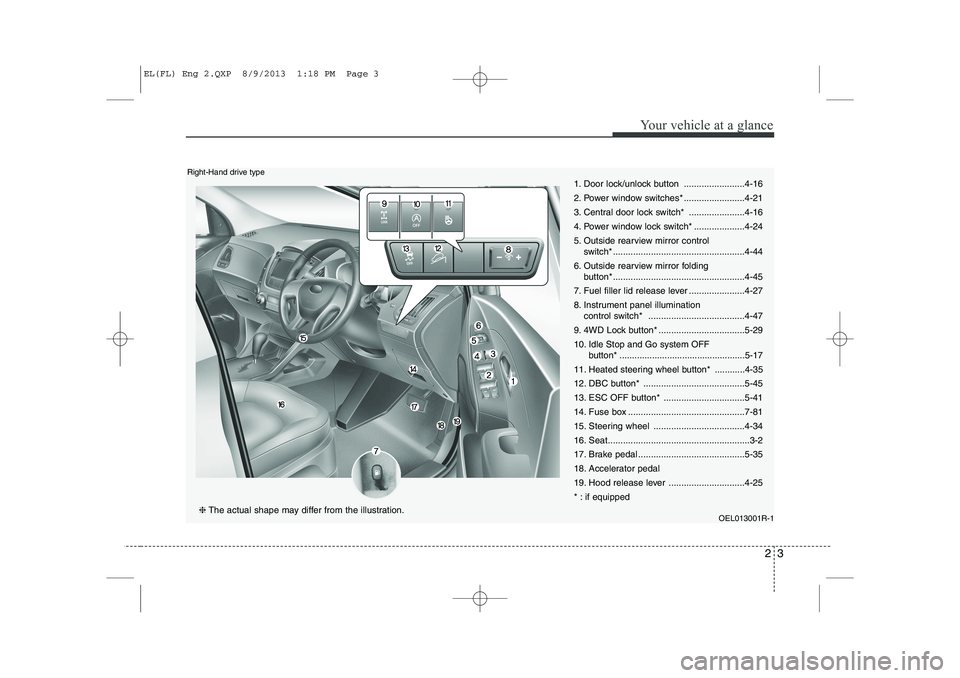
1. Door lock/unlock button ........................4-16
2. Power window switches* ........................4-21
3. Central door lock switch* ......................4-16
4. Power window lock switch* ....................4-24
5. Outside rearview mirror control switch* ....................................................4-44
6. Outside rearview mirror folding button* ....................................................4-45
7. Fuel filler lid release lever ......................4-27
8. Instrument panel illumination control switch* ......................................4-47
9. 4WD Lock button* ..................................5-2910.
Idle Stop and Go system OFF
button* ..................................................5-17
11. Heated steering wheel button* ............4-35
12. DBC button* ........................................5-45
13. ESC OFF button* ................................5-41
14. Fuse box ..............................................7-81
15. Steering wheel ....................................4-34
16. Seat........................................................3-2
17. Brake pedal ..........................................5-35
18. Accelerator pedal
19. Hood release lever ..............................4-25
* : if equipped
OEL013001R-1
Right-Hand drive type
❈The actual shape may differ from the illustration.
EL(FL) Eng 2.QXP 8/9/2013 1:18 PM Page 3
Page 445 of 1534
Safety features of your vehicle
20
3
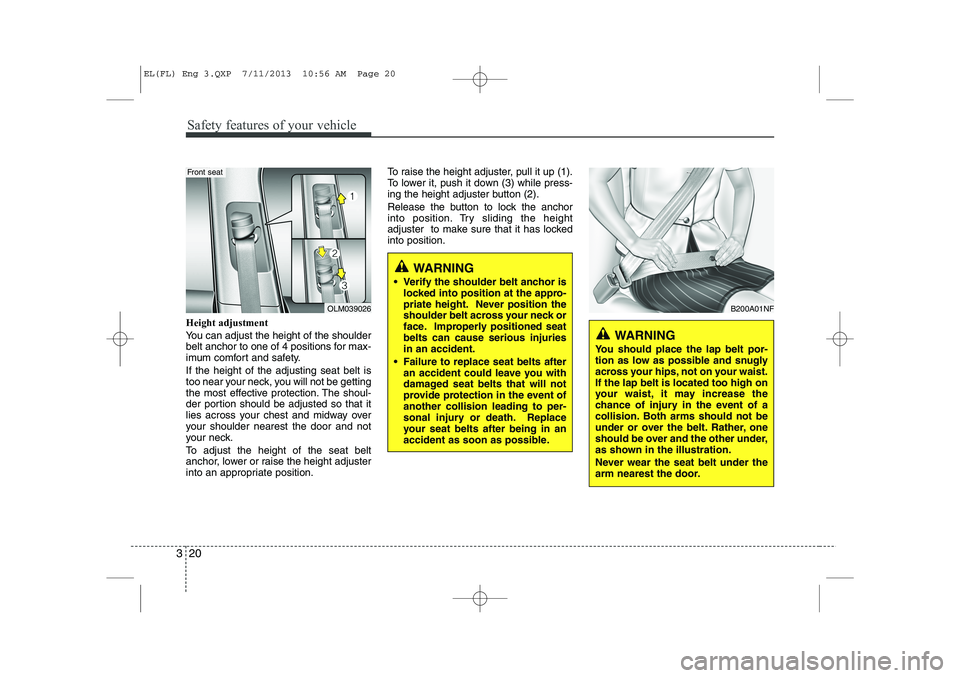
Height adjustment
You can adjust the height of the shoulder
belt anchor to one of 4 positions for max-
imum comfort and safety. If the height of the adjusting seat belt is
too near your neck, you will not be getting
the most effective protection. The shoul-
der portion should be adjusted so that it
lies across your chest and midway over
your shoulder nearest the door and not
your neck.
To adjust the height of the seat belt
anchor, lower or raise the height adjuster
into an appropriate position. To raise the height adjuster, pull it up (1).
To lower it, push it down (3) while press-
ing the height adjuster button (2).
Release the button to lock the anchor
into position. Try sliding the height
adjuster to make sure that it has lockedinto position.
OLM039026
Front seat
WARNING
Verify the shoulder belt anchor is locked into position at the appro-
priate height. Never position the
shoulder belt across your neck or
face. Improperly positioned seatbelts can cause serious injuriesin an accident.
Failure to replace seat belts after an accident could leave you with
damaged seat belts that will not
provide protection in the event ofanother collision leading to per-
sonal injury or death. Replace
your seat belts after being in an
accident as soon as possible.
B200A01NF
WARNING
You should place the lap belt por-
tion as low as possible and snugly
across your hips, not on your waist.If the lap belt is located too high on
your waist, it may increase the
chance of injury in the event of a
collision. Both arms should not be
under or over the belt. Rather, one
should be over and the other under,
as shown in the illustration.
Never wear the seat belt under the
arm nearest the door.
EL(FL) Eng 3.QXP 7/11/2013 10:56 AM Page 20
Page 470 of 1534
345
Safety features of your vehicle
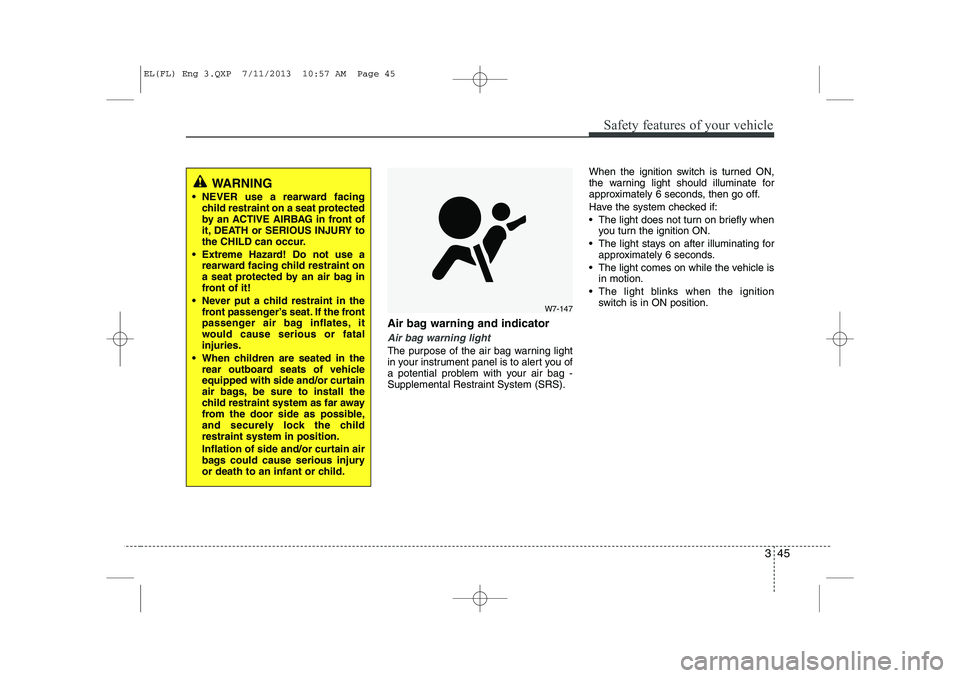
Air bag warning and indicator
Air bag warning light
The purpose of the air bag warning light
in your instrument panel is to alert you of
a potential problem with your air bag -
Supplemental Restraint System (SRS).When the ignition switch is turned ON,
the warning light should illuminate for
approximately 6 seconds, then go off.
Have the system checked if:
The light does not turn on briefly when
you turn the ignition ON.
The light stays on after illuminating for approximately 6 seconds.
The light comes on while the vehicle is in motion.
The light blinks when the ignition switch is in ON position.
WARNING
NEVER use a rearward facing child restraint on a seat protected
by an ACTIVE AIRBAG in front of
it, DEATH or SERIOUS INJURY to
the CHILD can occur.
Extreme Hazard! Do not use a rearward facing child restraint on
a seat protected by an air bag in
front of it!
Never put a child restraint in the front passenger’s seat. If the front
passenger air bag inflates, it
would cause serious or fatalinjuries.
When children are seated in the rear outboard seats of vehicle
equipped with side and/or curtain
air bags, be sure to install the
child restraint system as far away
from the door side as possible,
and securely lock the childrestraint system in position.
Inflation of side and/or curtain air
bags could cause serious injury
or death to an infant or child.
W7-147
EL(FL) Eng 3.QXP 7/11/2013 10:57 AM Page 45
Page 481 of 1534
Safety features of your vehicle
56
3
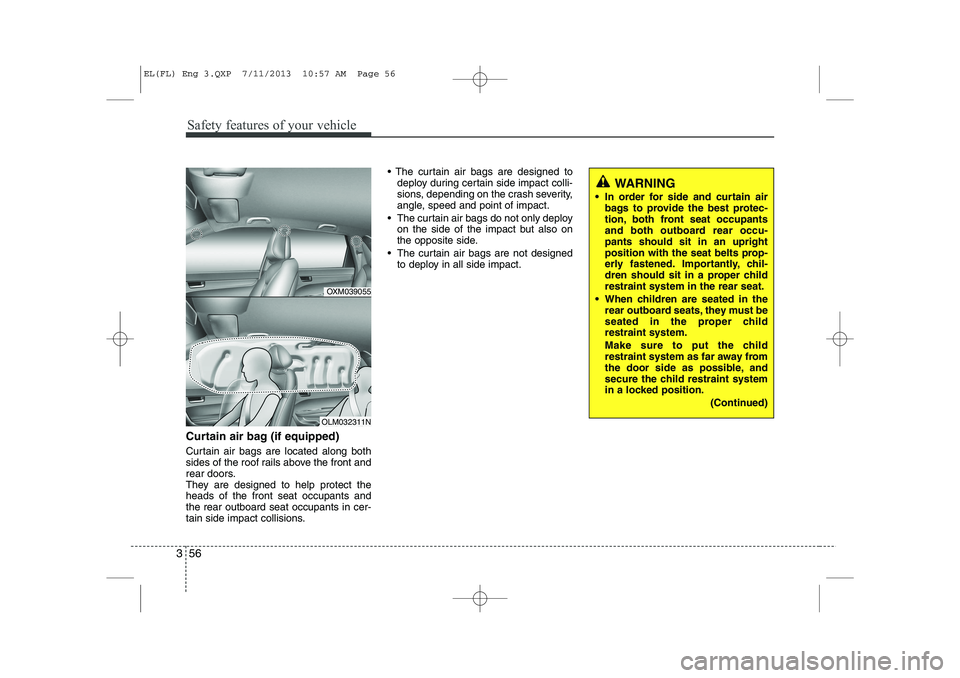
Curtain air bag (if equipped)
Curtain air bags are located along both
sides of the roof rails above the front and
rear doors.
They are designed to help protect theheads of the front seat occupants andthe rear outboard seat occupants in cer-
tain side impact collisions. The curtain air bags are designed to
deploy during certain side impact colli-
sions, depending on the crash severity,
angle, speed and point of impact.
The curtain air bags do not only deploy on the side of the impact but also on
the opposite side.
The curtain air bags are not designed to deploy in all side impact.
OXM039055
OLM032311N
WARNING
In order for side and curtain air bags to provide the best protec-
tion, both front seat occupants
and both outboard rear occu-pants should sit in an upright
position with the seat belts prop-
erly fastened. Importantly, chil-
dren should sit in a proper childrestraint system in the rear seat.
When children are seated in the rear outboard seats, they must be
seated in the proper childrestraint system.
Make sure to put the child
restraint system as far away from
the door side as possible, and
secure the child restraint system
in a locked position.
(Continued)
EL(FL) Eng 3.QXP 7/11/2013 10:57 AM Page 56
Page 494 of 1534
Features of your vehicle
4
4
Record your key number
The key code number is
stamped on the keycode tag attached to the
key set.
Should you lose your keys, we recom-
mend that you contact an authorized
HYUNDAI dealer. Remove the key code
tag and store it in a safe place. Also,
record the code number and keep it in a
safe and handy place, but not in the vehi-
cle. Key operations
• Used to start the engine.
Used to lock and unlock the doors.
Used to lock and unlock the glove box.
(if equipped)
KEYS
WARNING
- Ignition key
(Smart key)
Leaving children unattended in a
vehicle with the ignition key (Smart
key) is dangerous even if the key is
not in the ignition or start button is
ACC or ON position.
Children copy adults and they
could place the key in the ignition
or press the start button.
The ignition key (Smart key) would
enable children to operate power
windows or other controls, or even
make the vehicle move, which
could result in serious bodily injury
or even death.
Never leave the keys in your vehicle
with unsupervised children, whenthe engine is running.
WARNING
We recommend that you use parts
for replacement from an authorized
HYUNDAI dealer. If an aftermarket
key is used, the ignition switch may
not return to ON after START. If this
happens, the starter will continue
to operate causing damage to the
starter motor and possible fire due
to excessive current in the wiring.
EL(FL) Eng 4A.QXP 7/11/2013 11:29 AM Page 4
Page 497 of 1534
47
Features of your vehicle
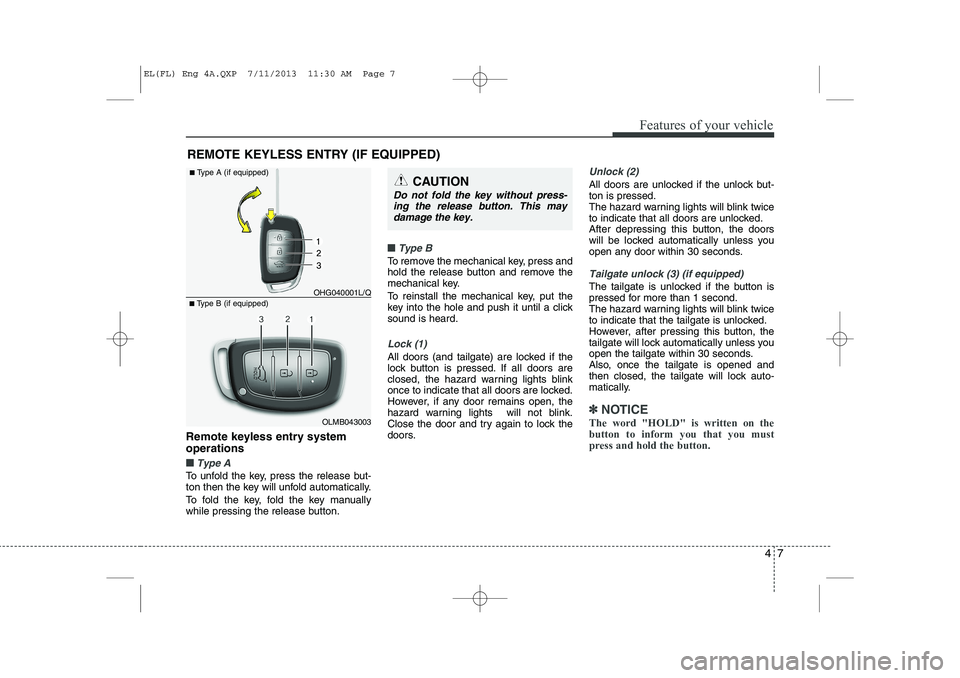
Remote keyless entry system operations
■■Type A
To unfold the key, press the release but-
ton then the key will unfold automatically.
To fold the key, fold the key manually
while pressing the release button.
■■Type B
To remove the mechanical key, press and
hold the release button and remove the
mechanical key.
To reinstall the mechanical key, put the
key into the hole and push it until a clicksound is heard.
Lock (1)
All doors (and tailgate) are locked if the
lock button is pressed. If all doors are
closed, the hazard warning lights blink
once to indicate that all doors are locked.
However, if any door remains open, the
hazard warning lights will not blink.
Close the door and try again to lock the
doors.
Unlock (2)
All doors are unlocked if the unlock but- ton is pressed.
The hazard warning lights will blink twice
to indicate that all doors are unlocked.
After depressing this button, the doors
will be locked automatically unless you
open any door within 30 seconds.
Tailgate unlock (3) (if equipped)
The tailgate is unlocked if the button is
pressed for more than 1 second.
The hazard warning lights will blink twice
to indicate that the tailgate is unlocked.
However, after pressing this button, the
tailgate will lock automatically unless you
open the tailgate within 30 seconds.
Also, once the tailgate is opened and
then closed, the tailgate will lock auto-
matically.
✽✽NOTICE
The word "HOLD" is written on the button to inform you that you must
press and hold the button.
REMOTE KEYLESS ENTRY (IF EQUIPPED)
OLMB043003
■
Type B (if equipped) OHG040001L/Q
■
Type A (if equipped)
CAUTION
Do not fold the key without press-
ing the release button. This may
damage the key.
EL(FL) Eng 4A.QXP 7/11/2013 11:30 AM Page 7
Page 500 of 1534
Features of your vehicle
10
4
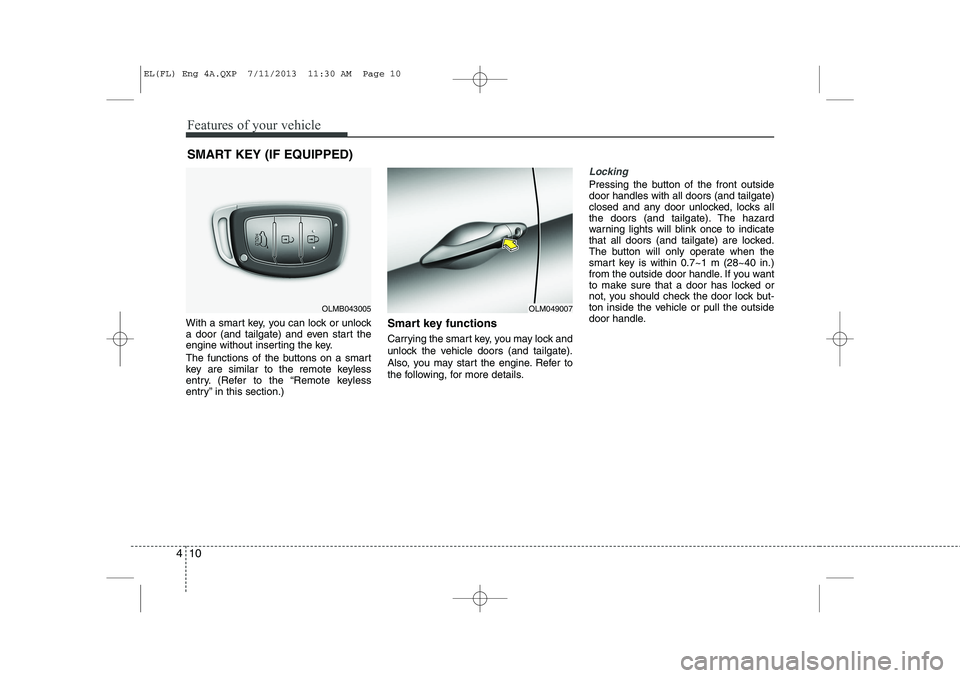
With a smart key, you can lock or unlock
a door (and tailgate) and even start the
engine without inserting the key.
The functions of the buttons on a smart
key are similar to the remote keyless
entry. (Refer to the “Remote keyless
entry” in this section.) Smart key functions
Carrying the smart key, you may lock and
unlock the vehicle doors (and tailgate).
Also, you may start the engine. Refer to
the following, for more details.
Locking
Pressing the button of the front outside door handles with all doors (and tailgate)
closed and any door unlocked, locks all
the doors (and tailgate). The hazard
warning lights will blink once to indicate
that all doors (and tailgate) are locked.
The button will only operate when the
smart key is within 0.7~1 m (28~40 in.)
from the outside door handle. If you want
to make sure that a door has locked or
not, you should check the door lock but-
ton inside the vehicle or pull the outside
door handle.
SMART KEY (IF EQUIPPED)
OLM049007OLMB043005
EL(FL) Eng 4A.QXP 7/11/2013 11:30 AM Page 10