oil HYUNDAI IX35 2014 Service Manual
[x] Cancel search | Manufacturer: HYUNDAI, Model Year: 2014, Model line: IX35, Model: HYUNDAI IX35 2014Pages: 1534, PDF Size: 39.76 MB
Page 401 of 1534
Index
4
I
Crankcase emission control system ................................7-83
Cruise control system ......................................................5-46
Cup holder......................................................................4-127
Curtain air bag ................................................................3-49 Dashboard illumination, see instrument panel
illumination ..................................................................4-47
Dashboard, see instrument cluster ..................................4-46
Day/night rearview mirror ..............................................4-39
Daytime running light ......................................................4-93
Declaration of conformity ................................................8-11
Defogging (Windscreen) ................................................4-120
Defroster (Rear window) ..............................................4-102
Defrosting (Windscreen) ................................................4-120
Digital clock ..................................................................4-129
Dimensions ........................................................................8-2Display illumination, see instrument panel illumination ..................................................................4-47
Displays, see instrument cluster ......................................4-46
Door locks ........................................................................4-15 Central door lock switch ............................................4-16
Child-protector rear door lock....................................4-18
Downhill brake control (DBC) ........................................5-41
Drinks holders, see cup holders ....................................4-127
Driver’s and passenger’s front air bag ............................3-45
Driving at night ................................................................5-54 Driving in flooded areas ..................................................5-55
Driving in the rain ............................................................5-55
Economical operation ......................................................5-51
Electric chromic mirror (ECM) ......................................4-39
Electric chromic mirror (ECM) with compass ................4-40
Electric power steering ....................................................4-34
Electronic stability control (ESC) ....................................5-36
Emergency starting ............................................................6-5
Jump starting ................................................................6-5
Emergency Stop Signal (ESS) ........................................5-43
Emission control system ..................................................7-83 Crankcase emission control system ..........................7-83
Evaporative emission control system ........................7-83
Exhaust emission control system ..............................7-84
Engine ................................................................................8-2
Engine compartment ..........................................................2-4
Engine coolant ................................................................7-23
Engine Coolant Temperature gauge ................................4-49
Engine number ................................................................8-10
Engine oil ........................................................................7-22
Engine overheats ................................................................6-7
Engine start/stop button ....................................................5-9
Evaporative emission control system ..............................7-83
Exhaust emission control system ....................................7-84
Explanation of scheduled maintenance items ..................7-19
E
D
EL(FL) Aust Index.qxp 7/26/2013 2:14 PM Page 4
Page 405 of 1534
Index
8
I
Moonroof, see panorama sunroof ....................................4-30
Multi fuse ........................................................................7-55
Odometer..........................................................................4-50
Oil (Engine) ....................................................................7-22
Outside mirror defroster ................................................4-103
Outside rearview mirror ..................................................4-43
Outside Temperature Gauge ............................................4-51
Overheats ..........................................................................6-7
Owner maintenance ..........................................................7-7
Panorama sunroof ............................................................4-30
Parking assist system ......................................................4-82
Parking brake ..................................................................5-32
Parking light position ......................................................4-89
Power brakes ....................................................................5-31
Power outlet ..................................................................4-128
Power window lock button ..............................................4-24
Pre-tensioner seat belt ......................................................3-24 Rear seat ..........................................................................3-12
Rear view camera ............................................................4-87
Rear window wiper and washer ......................................4-98
Recommended cold tyre inflation pressures ....................7-40
Recommended lubricants and capacities ..........................8-6
Recommended SAE viscosity number ........................8-8
Reducing the risk of a rollover ........................................5-28
Remote keyless entry ........................................................4-7
Replacement light bulb ....................................................7-63
Road warning ....................................................................6-2
Rocking the vehicle ........................................................5-53
Roof rack........................................................................4-133
Room lamp ....................................................................4-100
Rotation (Tyre) ................................................................7-43
O
P
R
EL(FL) Aust Index.qxp 7/26/2013 2:14 PM Page 8
Page 412 of 1534
Introduction
4
1
Use of MTBE
HYUNDAI recommends avoiding fuels
containing MTBE (Methyl Tertiary Butyl
Ether) over 15.0% vol. (Oxygen Content
2.7% weight) in your vehicle.
Fuel containing MTBE over 15.0% vol.
(Oxygen Content 2.7% weight) may
reduce vehicle performance and produce
vapor lock or hard starting.
Do not use methanol
Fuels containing methanol (wood alco-
hol) should not be used in your vehicle.
This type of fuel can reduce vehicle per-
formance and damage components ofthe fuel system.
Fuel Additives
HYUNDAI recommends that you use good quality gasolines meet Europe Fuel
standards (EN228) or equivalents.
For customers who do not use good
quality gasolines including fuel additives
regularly, and have problems starting or
the engine does not run smoothly, one
bottle of additives added to the fuel tank
at every 15,000km (For Europe)/
5,000km (Except Europe). Additives are
available from your authorized HYUNDAI
dealer along with information on how to
use them. Do not mix other additives.
Operation in foreign countries
If you are going to drive your vehicle in
another country, be sure to:
Observe all regulations regarding reg-
istration and insurance.
Determine that acceptable fuel is avail- able. Diesel engine
Diesel fuel
Diesel engine must be operated only on
commercially available diesel fuel that
complies with EN 590 or comparable
standard. (EN stands for "European
Norm"). Do not use marine diesel fuel,
heating oils, or non-approved fuel addi-
tives, as this will increase wear andcause damage to the engine and fuel
system. The use of non-approved fuels
and / or fuel additives will result in a limi-
tation of your warranty rights.
Diesel fuel of above cetane 51 is used in
your vehicle. If two types of diesel fuel
are available, use summer or winter fuel
properly according to the following tem-
perature conditions.
Above -5°C(23°F) ... Summer type
diesel fuel.
Below -5°C(23°F) ... Winter type diesel fuel.
Watch the fuel level in the tank very care-
fully : If the engine stops through fuel fail-
ure, the circuits must be completely
purged to permit restarting.
CAUTION
Your New Vehicle Limited Warranty may not cover damage to the fuelsystem and any performance prob-lems that are caused by the use of
fuels containing methanol or fuelscontaining MTBE (Methyl TertiaryButyl Ether) over 15.0% vol. (Oxygen Content 2.7% weight.)
EL(FL) Eng 1.QXP 8/8/2013 6:52 PM Page 4
Page 413 of 1534
15
Introduction
Biodiesel
Commercially supplied Diesel blends of no more than 7% biodiesel, commonly
known as "B7 Diesel" may be used in
your vehicle if Biodiesel meets EN 14214
or equivalent specifications. (EN stands
for "European Norm"). The use of biofu-
els exceeding 7% made from rapeseed
methyl ester (RME), fatty acid methyl
ester (FAME), vegetable oil methyl ester
(VME) etc. or mixing diesel exceeding7% with biodiesel will cause increased
wear or damage to the engine and fuel
system. Repair or replacement of worn ordamaged components due to the use of
non approved fuels will not be covered by
the manufactures warranty.CAUTION
Do not let any gasoline or waterenter the tank. This would make it
necessary to drain it out and to bleed the lines to avoid jammingthe injection pump and damagingthe engine.
In winter, in order to cut down incidents due to freezing, paraffinoil may be added to the fuel if thetemperature drops to below -10°C
(14°F). Never use more than 20% paraffin oil.
CAUTION - Diesel Fuel
It is recommended to use the regu-
lated automotive diesel fuel fordiesel vehicle equipped with the DPF system.
If you use diesel fuel including highsulfur (more than 50 ppm sulfur)and unspecified additives, it can cause the DPF system to be dam-aged and white smoke can be emit-
ted.CAUTION
Never use any fuel, whether diesel, B7 biodiesel or otherwise,that fails to meet the latest petro-leum industry specification.
Never use any fuel additives or treatments that are not recom-mended or approved by the vehi- cle manufacturer.
EL(FL) Eng 1.QXP 8/8/2013 6:52 PM Page 5
Page 415 of 1534
17
Introduction
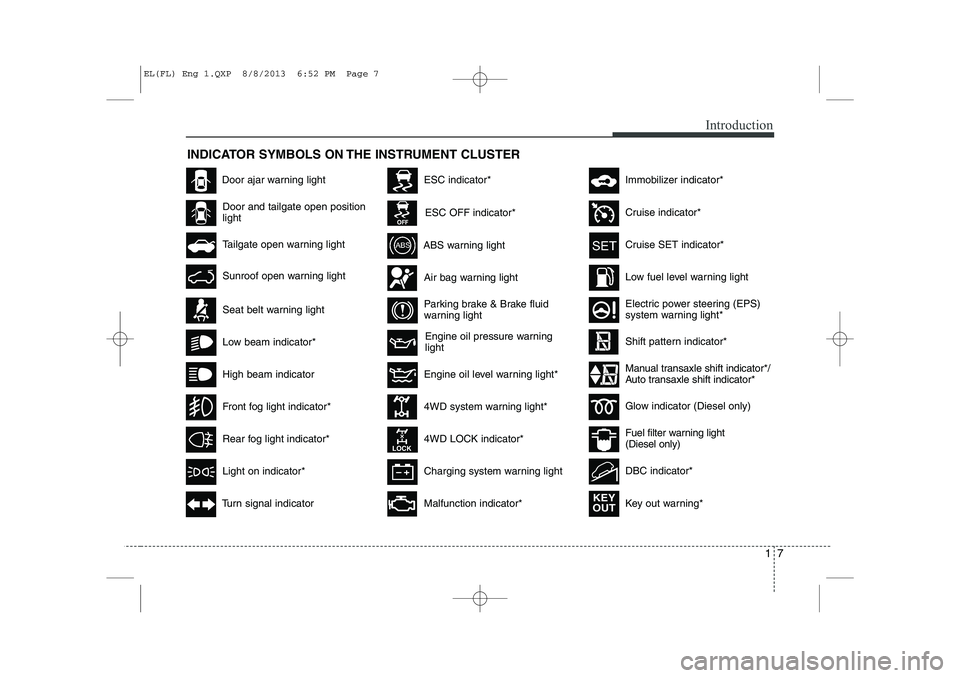
INDICATOR SYMBOLS ON THE INSTRUMENT CLUSTER
Engine oil pressure warning light
Seat belt warning light
Door and tailgate open position light
High beam indicator
Light on indicator*
Turn signal indicator
ABS warning light
Parking brake & Brake fluid
warning light
4WD system warning light* 4WD LOCK indicator*
Malfunction indicator*
Air bag warning light
Cruise SET indicator*
Low fuel level warning light
Charging system warning light
Door ajar warning light
Glow indicator (Diesel only)
Fuel filter warning light (Diesel only)
Cruise indicator*
ESC indicator*
ESC OFF indicator*
Immobilizer indicator*
Shift pattern indicator*
Front fog light indicator*
Rear fog light indicator*
Low beam indicator*
Electric power steering (EPS)
system warning light*
Key out warning*
KEY
OUT
DBC indicator*
Tailgate open warning light
Sunroof open warning light
Engine oil level warning light*Manual transaxle shift indicator*/
Auto transaxle shift indicator*
EL(FL) Eng 1.QXP 8/8/2013 6:52 PM Page 7
Page 422 of 1534
Your vehicle at a glance
6
2
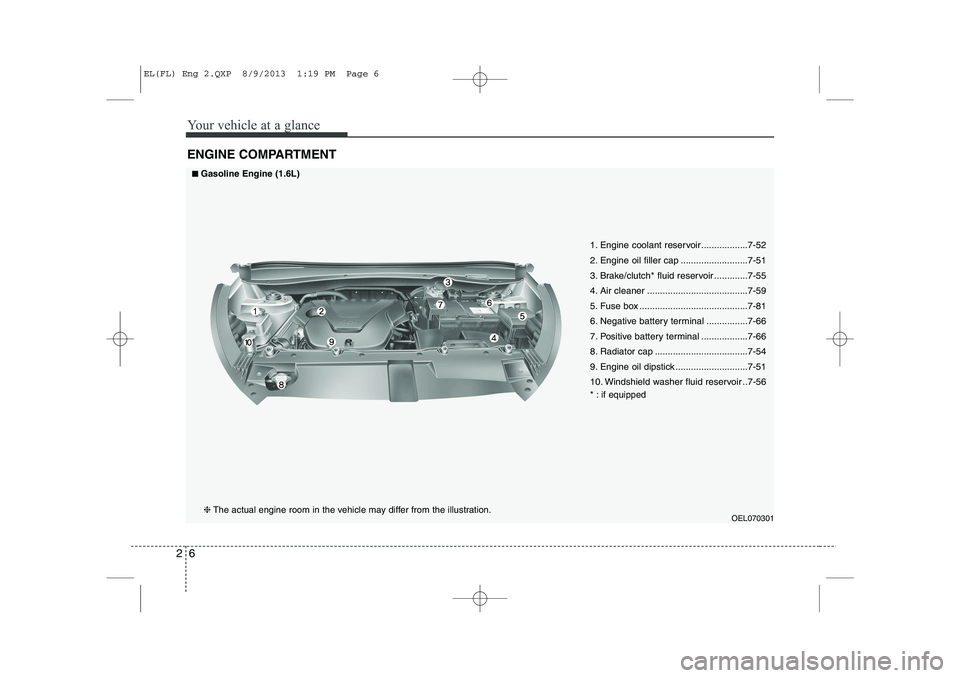
ENGINE COMPARTMENT
OEL070301
1. Engine coolant reservoir ..................7-52
2. Engine oil filler cap ..........................7-51
3. Brake/clutch* fluid reservoir .............7-55
4. Air cleaner .......................................7-59
5. Fuse box ..........................................7-81
6. Negative battery terminal ................7-66
7. Positive battery terminal ..................7-66
8. Radiator cap ....................................7-54
9. Engine oil dipstick ............................7-51
10. Windshield washer fluid reservoir ..7-56
* : if equipped
■■
Gasoline Engine (1.6L)
❈ The actual engine room in the vehicle may differ from the illustration.
EL(FL) Eng 2.QXP 8/9/2013 1:19 PM Page 6
Page 423 of 1534
27
Your vehicle at a glance
OLM073300
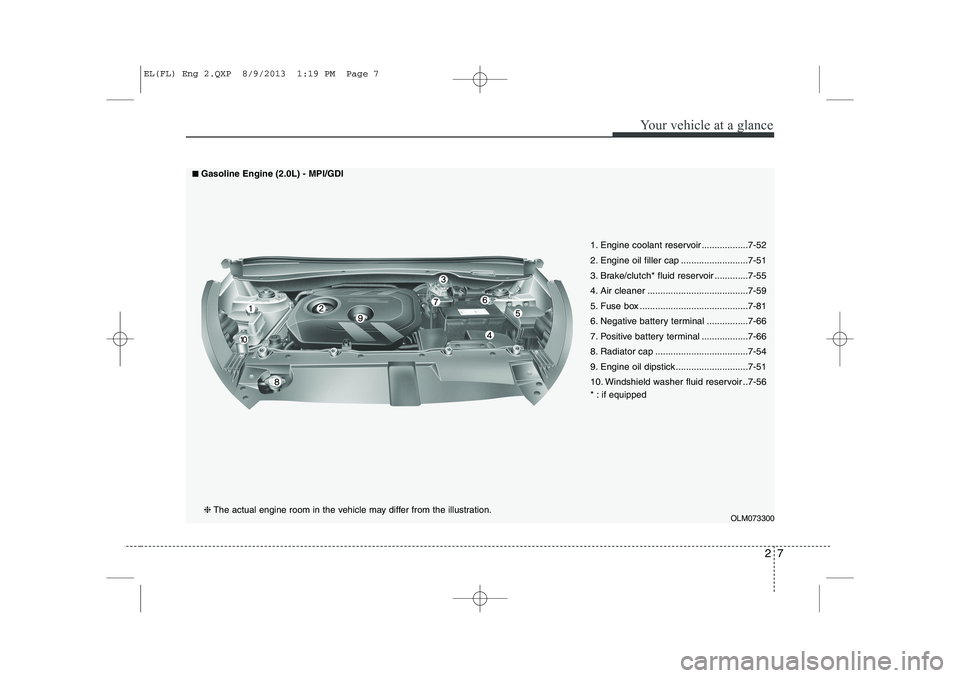
1. Engine coolant reservoir ..................7-52
2. Engine oil filler cap ..........................7-51
3. Brake/clutch* fluid reservoir .............7-55
4. Air cleaner .......................................7-59
5. Fuse box ..........................................7-81
6. Negative battery terminal ................7-66
7. Positive battery terminal ..................7-66
8. Radiator cap ....................................7-54
9. Engine oil dipstick ............................7-51
10. Windshield washer fluid reservoir ..7-56
* : if equipped
■■Gasoline Engine (2.0L) - MPI/GDI
❈ The actual engine room in the vehicle may differ from the illustration.
EL(FL) Eng 2.QXP 8/9/2013 1:19 PM Page 7
Page 424 of 1534

Your vehicle at a glance
8
2
OEL070302
1. Engine coolant reservoir ..................7-52
2. Fuse box ..........................................7-81
3. Fuel filter ..........................................7-57
4. Engine oil dipstick ............................7-51
5. Engine oil filler cap ..........................7-51
6. Brake/clutch* fluid reservoir ............7-55
7. Air cleaner ........................................7-59
8. Negative battery terminal ................7-66
9. Positive battery terminal ..................7-66
10. Radiator cap ..................................7-54
11. Windshield washer fluid reservoir ..7-56
* : if equipped
■■
Diesel Engine (1.7L)
❈ The actual engine room in the vehicle may differ from the illustration.
EL(FL) Eng 2.QXP 8/9/2013 1:19 PM Page 8
Page 425 of 1534
29
Your vehicle at a glance
OLM079002
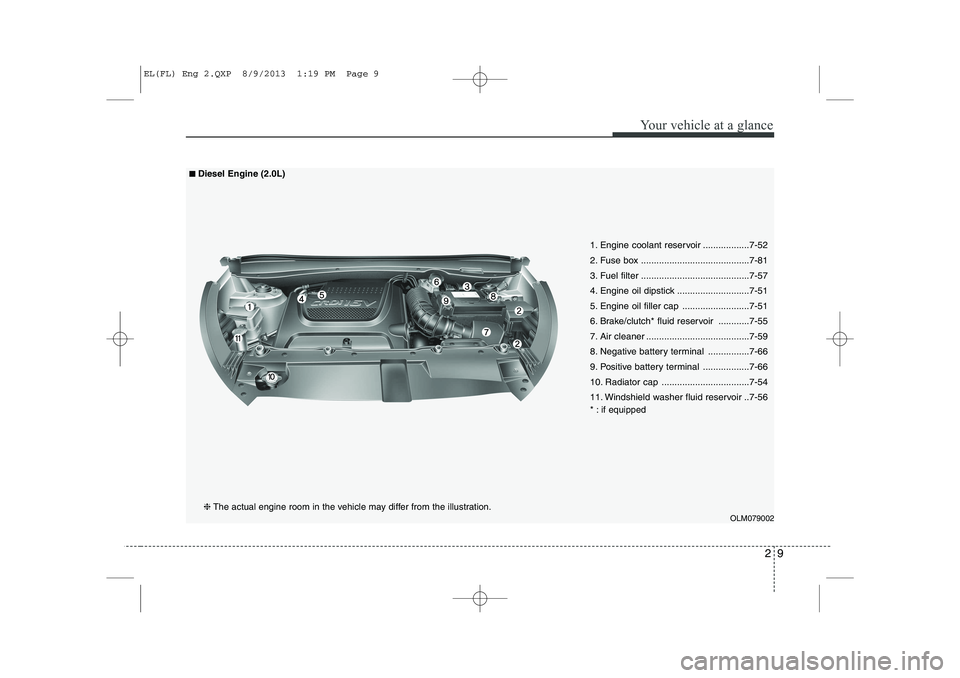
1. Engine coolant reservoir ..................7-52
2. Fuse box ..........................................7-81
3. Fuel filter ..........................................7-57
4. Engine oil dipstick ............................7-51
5. Engine oil filler cap ..........................7-51
6. Brake/clutch* fluid reservoir ............7-55
7. Air cleaner ........................................7-59
8. Negative battery terminal ................7-66
9. Positive battery terminal ..................7-66
10. Radiator cap ..................................7-54
11. Windshield washer fluid reservoir ..7-56
* : if equipped
■■Diesel Engine (2.0L)
❈ The actual engine room in the vehicle may differ from the illustration.
EL(FL) Eng 2.QXP 8/9/2013 1:19 PM Page 9
Page 442 of 1534
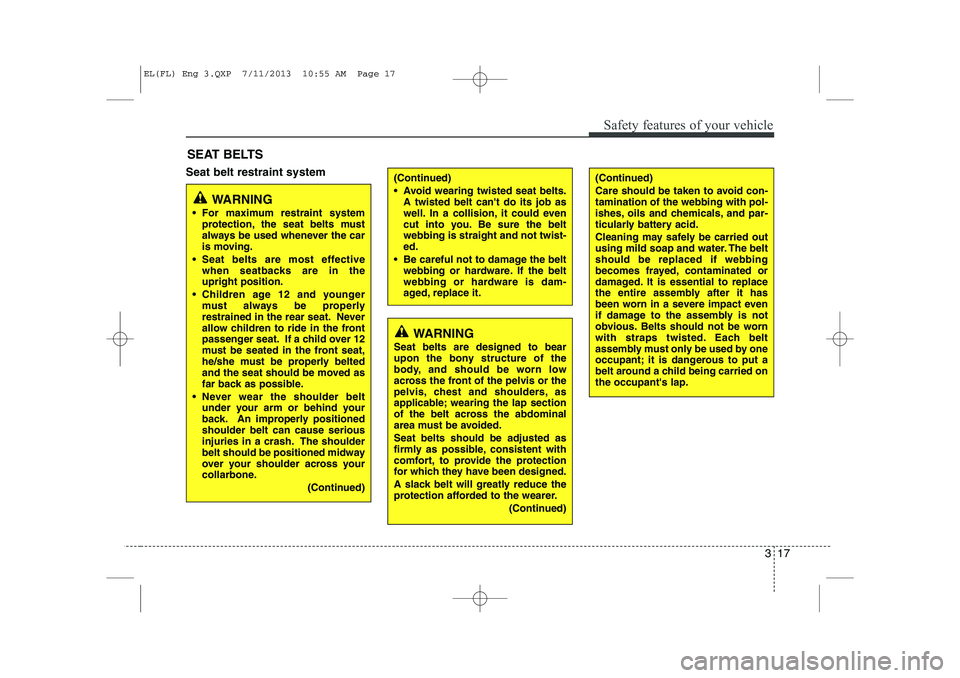
317
Safety features of your vehicle
Seat belt restraint systemSEAT BELTS(Continued)
Avoid wearing twisted seat belts.
A twisted belt can't do its job as
well. In a collision, it could even
cut into you. Be sure the beltwebbing is straight and not twist-ed.
Be careful not to damage the belt webbing or hardware. If the belt
webbing or hardware is dam-
aged, replace it.
WARNING
Seat belts are designed to bear
upon the bony structure of the
body, and should be worn low
across the front of the pelvis or the
pelvis, chest and shoulders, as
applicable; wearing the lap section
of the belt across the abdominal
area must be avoided. Seat belts should be adjusted as
firmly as possible, consistent with
comfort, to provide the protection
for which they have been designed.
A slack belt will greatly reduce the
protection afforded to the wearer.
(Continued)
WARNING
For maximum restraint system protection, the seat belts must
always be used whenever the car
is moving.
Seat belts are most effective when seatbacks are in theupright position.
Children age 12 and younger must always be properly
restrained in the rear seat. Never
allow children to ride in the front
passenger seat. If a child over 12
must be seated in the front seat,
he/she must be properly belted
and the seat should be moved as
far back as possible.
Never wear the shoulder belt under your arm or behind your
back. An improperly positionedshoulder belt can cause serious
injuries in a crash. The shoulder
belt should be positioned midway
over your shoulder across your
collarbone.
(Continued)
(Continued)
Care should be taken to avoid con- tamination of the webbing with pol-
ishes, oils and chemicals, and par-
ticularly battery acid.
Cleaning may safely be carried out
using mild soap and water. The beltshould be replaced if webbing
becomes frayed, contaminated or
damaged. It is essential to replace
the entire assembly after it has
been worn in a severe impact even
if damage to the assembly is not
obvious. Belts should not be worn
with straps twisted. Each belt
assembly must only be used by one
occupant; it is dangerous to put a
belt around a child being carried onthe occupant's lap.
EL(FL) Eng 3.QXP 7/11/2013 10:55 AM Page 17