fuel filter HYUNDAI IX35 2014 Workshop Manual
[x] Cancel search | Manufacturer: HYUNDAI, Model Year: 2014, Model line: IX35, Model: HYUNDAI IX35 2014Pages: 1534, PDF Size: 39.76 MB
Page 908 of 1534
743
Maintenance
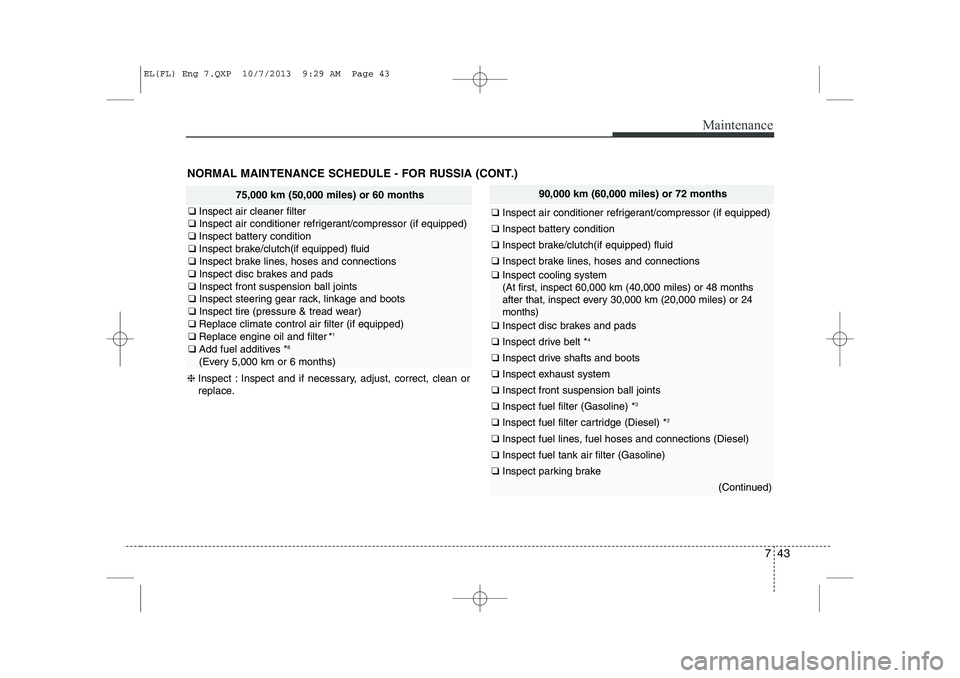
NORMAL MAINTENANCE SCHEDULE - FOR RUSSIA (CONT.)
90,000 km (60,000 miles) or 72 months
❑ Inspect air conditioner refrigerant/compressor (if equipped)
❑ Inspect battery condition
❑ Inspect brake/clutch(if equipped) fluid
❑ Inspect brake lines, hoses and connections
❑ Inspect cooling system
(At first, inspect 60,000 km (40,000 miles) or 48 months
after that, inspect every 30,000 km
(20,000 miles) or 24
months)
❑ Inspect disc brakes and pads
❑ Inspect drive belt * 4
❑
Inspect drive shafts and boots
❑ Inspect exhaust system
❑ Inspect front suspension ball joints
❑ Inspect fuel filter (Gasoline) * 3
❑
Inspect fuel filter cartridge (Diesel) * 2
❑
Inspect fuel lines, fuel hoses and connections (Diesel)
❑ Inspect fuel tank air filter (Gasoline)
❑ Inspect parking brake
(Continued)
75,000 km (50,000 miles) or 60 months
❑ Inspect air cleaner filter
❑ Inspect air conditioner refrigerant/compressor (if equipped)
❑ Inspect battery condition
❑ Inspect brake/clutch(if equipped) fluid
❑ Inspect brake lines, hoses and connections
❑ Inspect disc brakes and pads
❑ Inspect front suspension ball joints
❑ Inspect steering gear rack, linkage and boots
❑ Inspect tire (pressure & tread wear)
❑ Replace climate control air filter (if equipped)
❑ Replace engine oil and filter * 1
❑ Add fuel additives * 8
(Every 5,000 km or 6 months)
❈ Inspect : Inspect and if necessary, adjust, correct, clean or
replace.
EL(FL) Eng 7.QXP 10/7/2013 9:29 AM Page 43
Page 909 of 1534
Maintenance
44
7
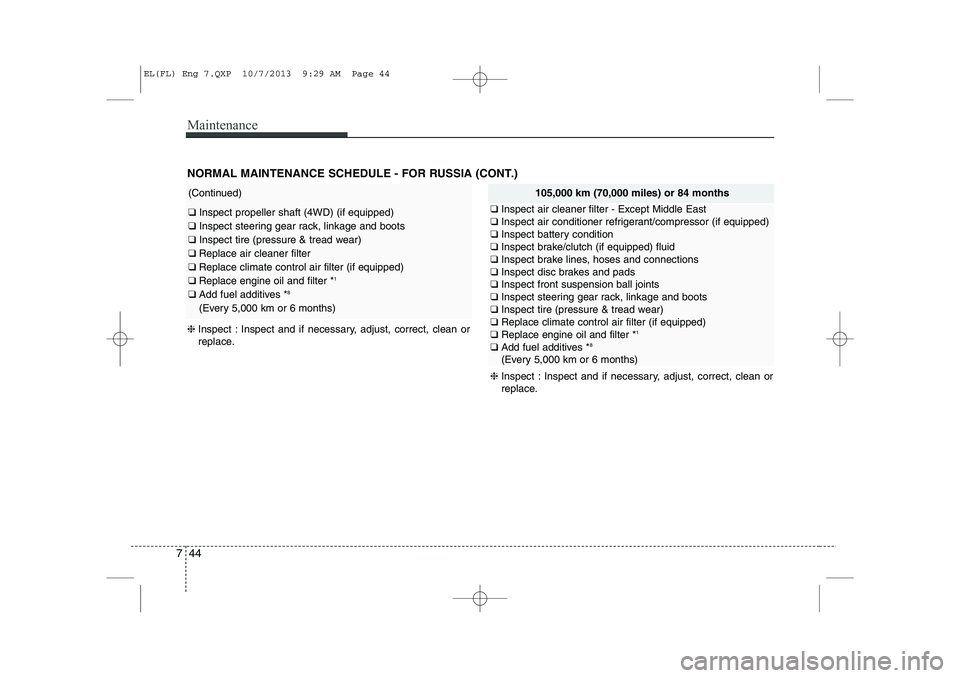
NORMAL MAINTENANCE SCHEDULE - FOR RUSSIA (CONT.)
105,000 km (70,000 miles) or 84 months
❑ Inspect air cleaner filter - Except Middle East
❑ Inspect air conditioner refrigerant/compressor (if equipped)
❑ Inspect battery condition
❑ Inspect brake/clutch (if equipped) fluid
❑ Inspect brake lines, hoses and connections
❑ Inspect disc brakes and pads
❑ Inspect front suspension ball joints
❑ Inspect steering gear rack, linkage and boots
❑ Inspect tire (pressure & tread wear)
❑ Replace climate control air filter (if equipped)
❑ Replace engine oil and filter * 1
❑ Add fuel additives * 8
(Every 5,000 km or 6 months)
(Continued)
❑ Inspect propeller shaft (4WD) (if equipped)
❑ Inspect steering gear rack, linkage and boots
❑ Inspect tire (pressure & tread wear)
❑ Replace air cleaner filter
❑ Replace climate control air filter (if equipped)
❑ Replace engine oil and filter * 1
❑ Add fuel additives * 8
(Every 5,000 km or 6 months)
❈ Inspect : Inspect and if necessary, adjust, correct, clean or
replace.
❈Inspect : Inspect and if necessary, adjust, correct, clean or
replace.
EL(FL) Eng 7.QXP 10/7/2013 9:29 AM Page 44
Page 910 of 1534
745
Maintenance
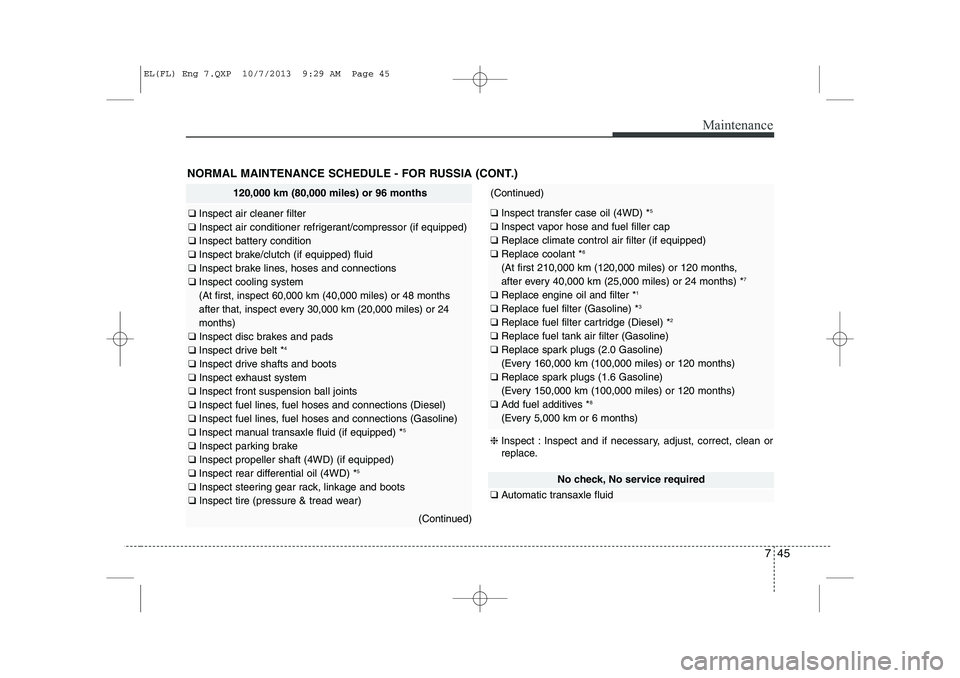
NORMAL MAINTENANCE SCHEDULE - FOR RUSSIA (CONT.)
No check, No service required
❑Automatic transaxle fluid
❈ Inspect : Inspect and if necessary, adjust, correct, clean or
replace.
120,000 km (80,000 miles) or 96 months
❑ Inspect air cleaner filter
❑ Inspect air conditioner refrigerant/compressor (if equipped)
❑ Inspect battery condition
❑ Inspect brake/clutch (if equipped) fluid
❑ Inspect brake lines, hoses and connections
❑ Inspect cooling system
(At first, inspect 60,000 km (40,000 miles) or 48 months
after that, inspect every 30,000 km
(20,000 miles)or 24
months)
❑ Inspect disc brakes and pads
❑ Inspect drive belt * 4
❑ Inspect drive shafts and boots
❑ Inspect exhaust system
❑ Inspect front suspension ball joints
❑ Inspect fuel lines, fuel hoses and connections (Diesel)
❑ Inspect fuel lines, fuel hoses and connections (Gasoline)
❑ Inspect manual transaxle fluid (if equipped) * 5
❑ Inspect parking brake
❑ Inspect propeller shaft (4WD) (if equipped)
❑ Inspect rear differential oil (4WD) * 5
❑ Inspect steering gear rack, linkage and boots
❑ Inspect tire (pressure & tread wear)
(Continued)
(Continued)
❑ Inspect transfer case oil (4WD) * 5
❑ Inspect vapor hose and fuel filler cap
❑ Replace climate control air filter (if equipped)
❑ Replace coolant * 6
(At first 210,000 km (120,000 miles) or 120 months,
after every 40,000 km (25,000 miles) or 24 months) * 7
❑ Replace engine oil and filter * 1
❑ Replace fuel filter (Gasoline) * 3
❑ Replace fuel filter cartridge (Diesel) * 2
❑ Replace fuel tank air filter (Gasoline)
❑ Replace spark plugs (2.0 Gasoline)
(Every 160,000 km (100,000 miles) or 120 months)
❑ Replace spark plugs (1.6 Gasoline)
(Every 150,000 km (100,000 miles) or 120 months)
❑ Add fuel additives * 8
(Every 5,000 km or 6 months)
EL(FL) Eng 7.QXP 10/7/2013 9:29 AM Page 45
Page 913 of 1534
Maintenance
48
7
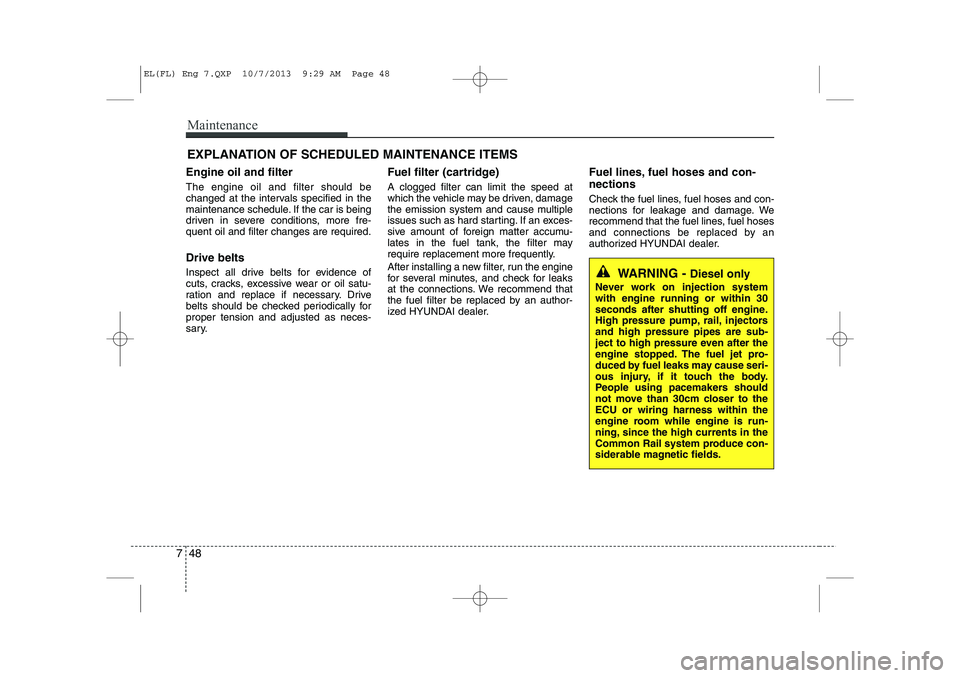
EXPLANATION OF SCHEDULED MAINTENANCE ITEMS
Engine oil and filter The engine oil and filter should be
changed at the intervals specified in the
maintenance schedule. If the car is being
driven in severe conditions, more fre-quent oil and filter changes are required. Drive belts
Inspect all drive belts for evidence of
cuts, cracks, excessive wear or oil satu-
ration and replace if necessary. Drive
belts should be checked periodically forproper tension and adjusted as neces-
sary. Fuel filter (cartridge) A clogged filter can limit the speed at
which the vehicle may be driven, damage
the emission system and cause multiple
issues such as hard starting. If an exces-
sive amount of foreign matter accumu-
lates in the fuel tank, the filter may
require replacement more frequently.
After installing a new filter, run the engine
for several minutes, and check for leaks
at the connections. We recommend that
the fuel filter be replaced by an author-
ized HYUNDAI dealer.
Fuel lines, fuel hoses and con- nections
Check the fuel lines, fuel hoses and con-
nections for leakage and damage. We
recommend that the fuel lines, fuel hoses
and connections be replaced by an
authorized HYUNDAI dealer.
WARNING -
Diesel only
Never work on injection system with engine running or within 30
seconds after shutting off engine.
High pressure pump, rail, injectorsand high pressure pipes are sub-
ject to high pressure even after the
engine stopped. The fuel jet pro-
duced by fuel leaks may cause seri-
ous injury, if it touch the body.
People using pacemakers should
not move than 30cm closer to theECU or wiring harness within the
engine room while engine is run-
ning, since the high currents in the
Common Rail system produce con-
siderable magnetic fields.
EL(FL) Eng 7.QXP 10/7/2013 9:29 AM Page 48
Page 914 of 1534
749
Maintenance
Vapor hose and fuel filler cap
The vapor hose and fuel filler cap should
be inspected at those intervals specified
in the maintenance schedule. Make sure
that a new vapor hose or fuel filler cap iscorrectly replaced.
Vacuum crankcase ventilation hoses (if equipped)
Inspect the surface of hoses for evidence
of heat and/or mechanical damage. Hard
and brittle rubber, cracking, tears, cuts,
abrasions, and excessive swelling indi-
cate deterioration. Particular attention
should be paid to examine those hose
surfaces nearest to high heat sources,
such as the exhaust manifold. Inspect the hose routing to assure that the hoses do not come in contact with
any heat source, sharp edges or movingcomponent which might cause heat dam-
age or mechanical wear. Inspect all hose
connections, such as clamps and cou-
plings, to make sure they are secure, and
that no leaks are present. Hoses should
be replaced immediately if there is any
evidence of deterioration or damage.Air cleaner filter
We recommend that you use air cleaner
filter for replacement from an authorized
HYUNDAI dealer.
Spark plugs (for gasoline engine)
Make sure to install new spark plugs of
the correct heat range. Cooling system
Check the cooling system parts, such as
radiator, coolant reservoir, hoses and
connections for leakage and damage.
Replace any damaged parts. Coolant The coolant should be changed at the
intervals specified in the maintenance
schedule.
Manual transaxle fluid (if equipped)
Inspect the manual transaxle fluid
according to the maintenance schedule.
Automatic transaxle fluid (if equipped)
Automatic transaxle fluid should not be
checked under normal usage conditions.
But in severe conditions, we recommend
that the fluid be changed by an author-
ized HYUNDAI dealer in accordance tothe scheduled maintenance at the begin-
ning of this chapter.
✽✽
NOTICE
Automatic transaxle fluid color is basi-
cally red. As the vehicle is driven, the automatic
transaxle fluid will begin to look darker.It is normal condition and you should
not judge the need to replace the fluid
based upon the changed color.
EL(FL) Eng 7.QXP 10/7/2013 9:29 AM Page 49
Page 922 of 1534

757
Maintenance
FUEL FILTER (FOR DIESEL)
Draining water from fuel filter
The fuel filter for diesel engine plays an
important role of separating water from
fuel and accumulating the water in itsbottom.
If water accumulates in the fuel filter, the
warning light comes on when the ignition
switch is in the ON position. If this warning light illuminates,
we recommend that the system
by checked by an authorized
HYUNDAI dealer.
Extracting air from the fuel filter
If you drive until you have no fuel left or if
you replace the fuel filter, be sure to
extract air from the fuel system as it
makes it difficult to start the engine.
1. Pump up and down(1) approximately50 times until the pump is hard.
2. Extract air from the fuel filter by remov- ing the bolt(2) with a cross-tip screw
driver and reinstall the bolt(2).
3. Pump up and down(1) approximately 15 times.
4. Extract air from the fuel filter by remov- ing the bolt(2) with a cross-tip screw
driver and reinstall the bolt(2).
5. Pump up and down(1) approximately 5 times.
✽✽ NOTICE
Page 923 of 1534

Maintenance
58
7
Fuel filter cartridge replacement
✽✽
NOTICE
When replacing the fuel filter cartridge,
we recommend that you use parts for
replacement from an authorized
HYUNDAI dealer.
OLM079011
■ Type B
EL(FL) Eng 7.QXP 10/7/2013 9:30 AM Page 58
Page 955 of 1534
Maintenance
90
7
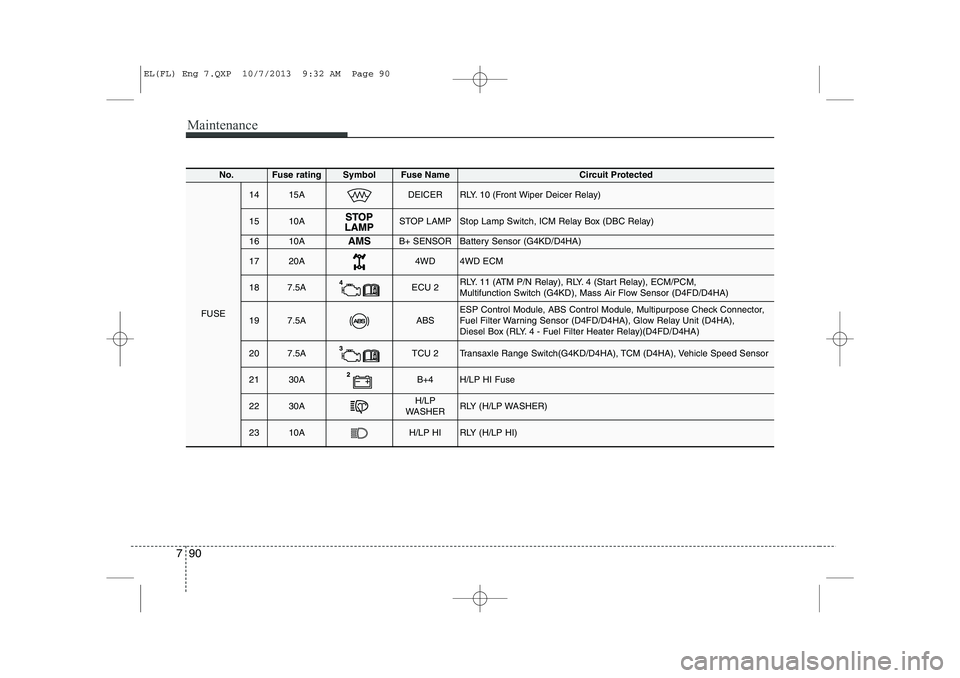
No.Fuse ratingSymbolFuse Name Circuit Protected
FUSE
1415ADEICERRLY. 10 (Front Wiper Deicer Relay)
1510ASTOP LAMPStop Lamp Switch, ICM Relay Box (DBC Relay)
1610AAMSB+ SENSORBattery Sensor (G4KD/D4HA)
1720A4WD4WD ECM
187.5AECU 2RLY. 11 (ATM P/N Relay), RLY. 4 (Start Relay), ECM/PCM,
Multifunction Switch (G4KD), Mass Air Flow Sensor (D4FD/D4HA)
197.5AABSESP Control Module, ABS Control Module, Multipurpose Check Connector,
Fuel Filter Warning Sensor (D4FD/D4HA), Glow Relay Unit (D4HA),
Diesel Box (RLY. 4 - Fuel Filter Heater Relay)(D4FD/D4HA)
207.5ATCU 2Transaxle Range Switch(G4KD/D4HA), TCM (D4HA), Vehicle Speed Sensor
2130AB+4H/LP HI Fuse
2230AH/LP
WASHERRLY (H/LP WASHER)
2310AH/LP HIRLY (H/LP HI)
EL(FL) Eng 7.QXP 10/7/2013 9:32 AM Page 90
Page 956 of 1534
791
Maintenance
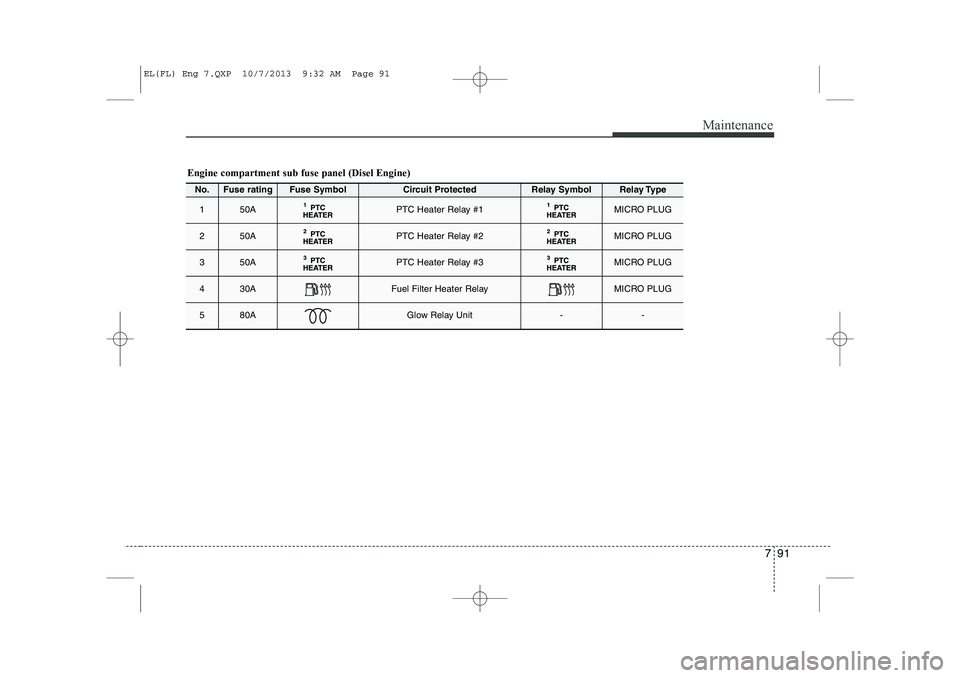
Engine compartment sub fuse panel (Disel Engine)
No.Fuse ratingFuse SymbolCircuit ProtectedRelay SymbolRelay Type
150APTC Heater Relay #1 MICRO PLUG
250APTC Heater Relay #2MICRO PLUG
350APTC Heater Relay #3 MICRO PLUG
430AFuel Filter Heater Relay MICRO PLUG
580AGlow Relay Unit--
EL(FL) Eng 7.QXP 10/7/2013 9:32 AM Page 91
Page 978 of 1534
7 113
Maintenance
EMISSION CONTROL SYSTEM
The emission control system of your
vehicle is covered by a written limited
warranty. Please see the warranty infor-
mation contained in the Service Passport
in your vehicle.
Your vehicle is equipped with an emis- sion control system to meet all emission
regulations. There are three emission control sys-
tems which are as follows.
(1) Crankcase emission control system
(2) Evaporative emission control system(3) Exhaust emission control system In order to assure the proper function of
the emission control systems, it is rec-
ommended that you have your car
inspected and maintained by an author-
ized HYUNDAI dealer or other repairshops that use qualified technicians inaccordance with the maintenance sched-
ule in this manual. Caution for the Inspection and
Maintenance Test (With Electronic
Stability Program (ESP) system)
To prevent the vehicle from misfir-
ing during dynamometer testing,
turn the Electronic Stability
Program (ESP) system off by press-
ing the ESP switch.
After dynamometer testing is com- pleted, turn the ESP system back on
by pressing the ESP switch again.
1. Crankcase emission control system
The positive crankcase ventilation sys-
tem is employed to prevent air pollution
caused by blow-by gases being emitted
from the crankcase. This system supplies
fresh filtered air to the crankcase through
the air intake hose. Inside the crankcase,
the fresh air mixes with blow-by gases,
which then pass through the PCV valveinto the induction system. 2. Evaporative emission control
System
The Evaporative Emission Control
System is designed to prevent fuel
vapors from escaping into the atmos-
phere.
Canister
Fuel vapors generated inside the fuel tank are absorbed and stored in the
onboard canister. When the engine is
running, the fuel vapors absorbed in the
canister are drawn into the surge tank
through the purge control solenoid valve.
Purge Control Solenoid Valve (PCSV)
The purge control solenoid valve is con-
trolled by the Engine Control Module
(ECM); when the engine coolant temper-
ature is low during idling, the PCSV clos-
es so that evaporated fuel is not taken
into the engine. After the engine warms-
up during ordinary driving, the PCSV
opens to introduce evaporated fuel to the
engine.
EL(FL) Eng 7.QXP 10/7/2013 9:33 AM Page 113