safety switch Hyundai Kona 2018 - RHD (UK, Australia) User Guide
[x] Cancel search | Manufacturer: HYUNDAI, Model Year: 2018, Model line: Kona, Model: Hyundai Kona 2018Pages: 497, PDF Size: 11.7 MB
Page 40 of 497
2-24
Safety system of your vehicle
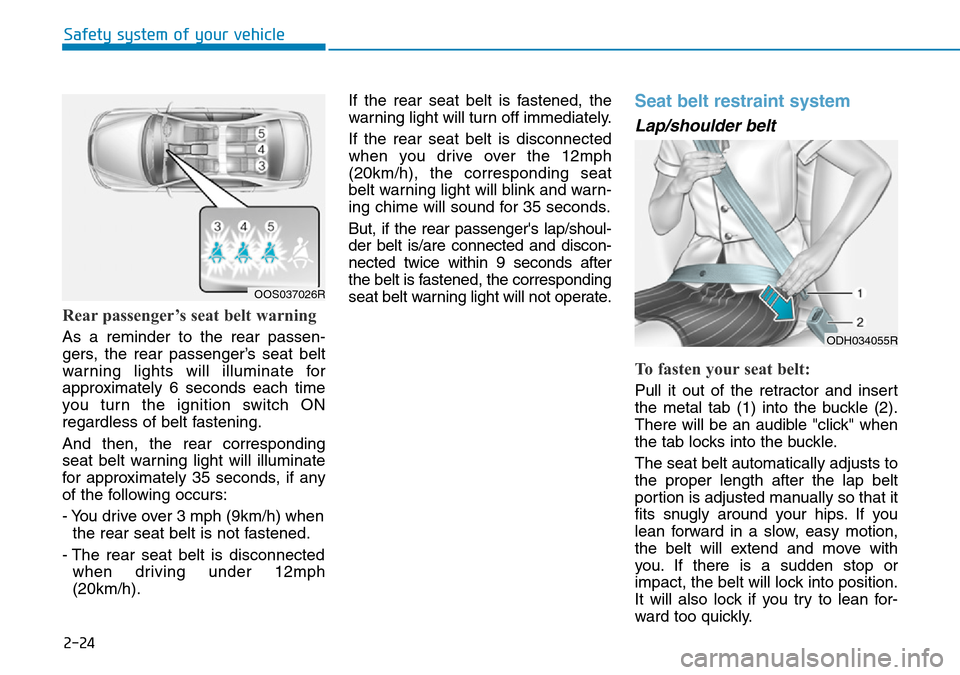
Rear passenger’s seat belt warning
As a reminder to the rear passen-
gers, the rear passenger’s seat belt
warning lights will illuminate for
approximately 6 seconds each time
you turn the ignition switch ON
regardless of belt fastening.
And then, the rear corresponding
seat belt warning light will illuminate
for approximately 35 seconds, if any
of the following occurs:
- You drive over 3 mph (9km/h) whenthe rear seat belt is not fastened.
- The rear seat belt is disconnected when driving under 12mph
(20km/h). If the rear seat belt is fastened, the
warning light will turn off immediately.
If the rear seat belt is disconnected
when you drive over the 12mph
(20km/h), the corresponding seat
belt warning light will blink and warn-
ing chime will sound for 35 seconds.
But, if the rear passenger's lap/shoul-
der belt is/are connected and discon-
nected twice within 9 seconds after
the belt is fastened, the corresponding
seat belt warning light will not operate.
Seat belt restraint system
Lap/shoulder belt
To fasten your seat belt:
Pull it out of the retractor and insert
the metal tab (1) into the buckle (2).
There will be an audible "click" when
the tab locks into the buckle.
The seat belt automatically adjusts to
the proper length after the lap belt
portion is adjusted manually so that it
fits snugly around your hips. If you
lean forward in a slow, easy motion,
the belt will extend and move with
you. If there is a sudden stop or
impact, the belt will lock into position.
It will also lock if you try to lean for-
ward too quickly.
OOS037026R
ODH034055R
Page 44 of 497
2-28
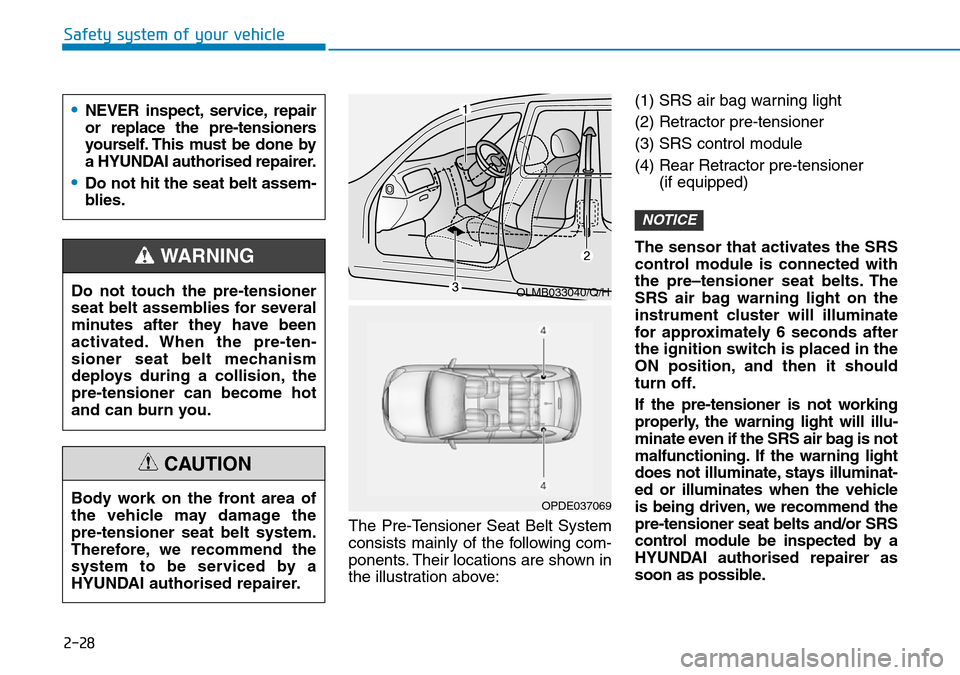
Safety system of your vehicleThe Pre-Tensioner Seat Belt System
consists mainly of the following com-
ponents. Their locations are shown in
the illustration above: (1) SRS air bag warning light
(2) Retractor pre-tensioner
(3) SRS control module
(4) Rear Retractor pre-tensioner
(if equipped)
The sensor that activates the SRS
control module is connected with
the pre–tensioner seat belts. The
SRS air bag warning light on the
instrument cluster will illuminate
for approximately 6 seconds after
the ignition switch is placed in the
ON position, and then it should
turn off.
If the pre-tensioner is not working
properly, the warning light will illu-
minate even if the SRS air bag is not
malfunctioning. If the warning light
does not illuminate, stays illuminat-
ed or illuminates when the vehicle
is being driven, we recommend the
pre-tensioner seat belts and/or SRS
control module be inspected by a
HYUNDAI authorised repairer as
soon as possible.
NOTICE
Do not touch the pre-tensioner
seat belt assemblies for several
minutes after they have been
activated. When the pre-ten-
sioner seat belt mechanism
deploys during a collision, the
pre-tensioner can become hot
and can burn you.
WARNING
Body work on the front area of
the vehicle may damage the
pre-tensioner seat belt system.
Therefore, we recommend the
system to be serviced by a
HYUNDAI authorised repairer.
CAUTION
OLMB033040/Q/H
OPDE037069
•NEVER inspect, service, repair
or replace the pre-tensioners
yourself. This must be done by
a HYUNDAI authorised repairer.
•Do not hit the seat belt assem-
blies.
Page 58 of 497
2-42
Safety system of your vehicle
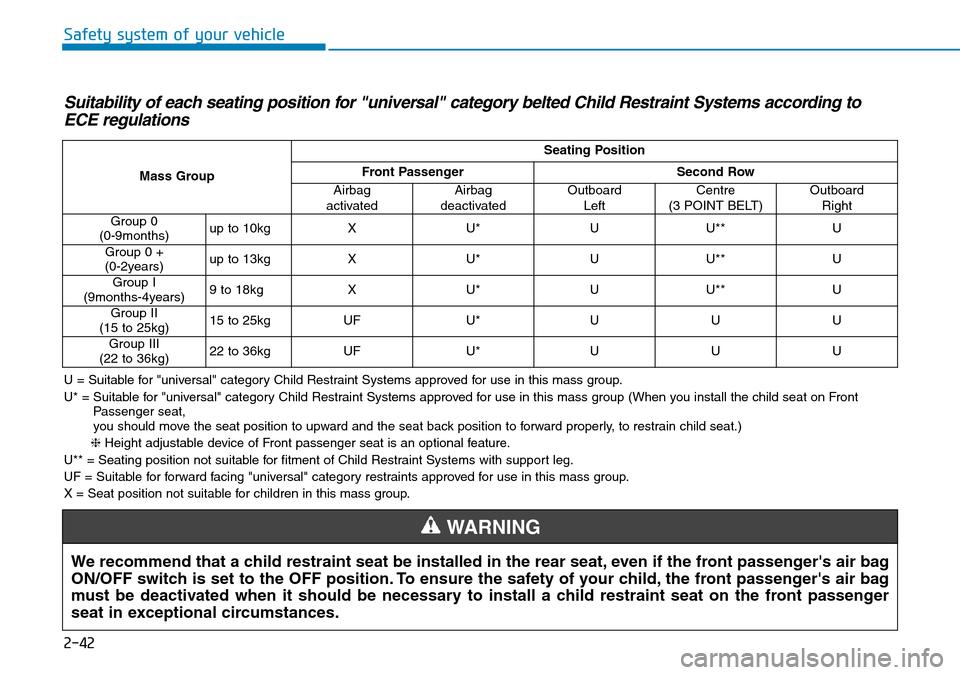
Suitability of each seating position for "universal" category belted Child Restraint Systems according toECE regulations
U = Suitable for "universal" category Child Restraint Systems approved for use in this mass group.
U* = Suitable for "universal" category Child Restraint Systems approved for use in this mass group (When you install the child seat on Front
Passenger seat,
you should move the seat position to upward and the seat back position to forward properly, to restrain child seat.)
❈ Height adjustable device of Front passenger seat is an optional feature.
U** = Seating position not suitable for fitment of Child Restraint Systems with support leg.
UF = Suitable for forward facing "universal" category restraints approved for use in this mass group.
X = Seat position not suitable for children in this mass group.
We recommend that a child restraint seat be installed in the rear seat, even if the front passenger's air bag
ON/OFF switch is set to the OFF position. To ensure the safety of your child, the front passenger's air bag
must be deactivated when it should be necessary to install a child restraint seat on the front passenger
seat in exceptional circumstances.
WARNING
Mass Group
Seating Position
Front PassengerSecond Row
Airbag
activatedAirbag
deactivatedOutboard LeftCentre
(3 POINT BELT)Outboard Right
Group 0
(0-9months)up to 10kgXU*UU**U
Group 0 +
(0-2years)up to 13kgXU*UU**U
Group I
(9months-4years)9 to 18kgXU*UU**U
Group II
(15 to 25kg)15 to 25kgUFU*UUU
Group III
(22 to 36kg)22 to 36kgUFU*UUU
Page 60 of 497
2-44
Safety system of your vehicle
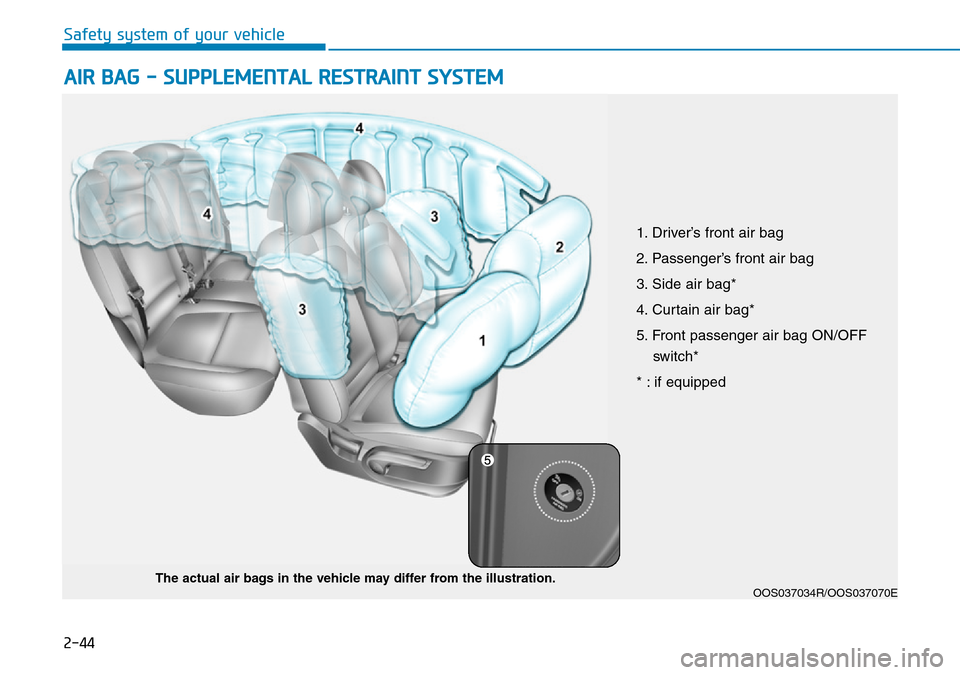
AIR BAG - SUPPLEMENTAL RESTRAINT SYSTEM
OOS037034R/OOS037070EThe actual air bags in the vehicle may differ from the illustration.
1. Driver’s front air bag
2. Passenger’s front air bag
3. Side air bag*
4. Curtain air bag*
5. Front passenger air bag ON/OFFswitch*
* : if equipped
Page 63 of 497
2-47
Safety system of your vehicle
2
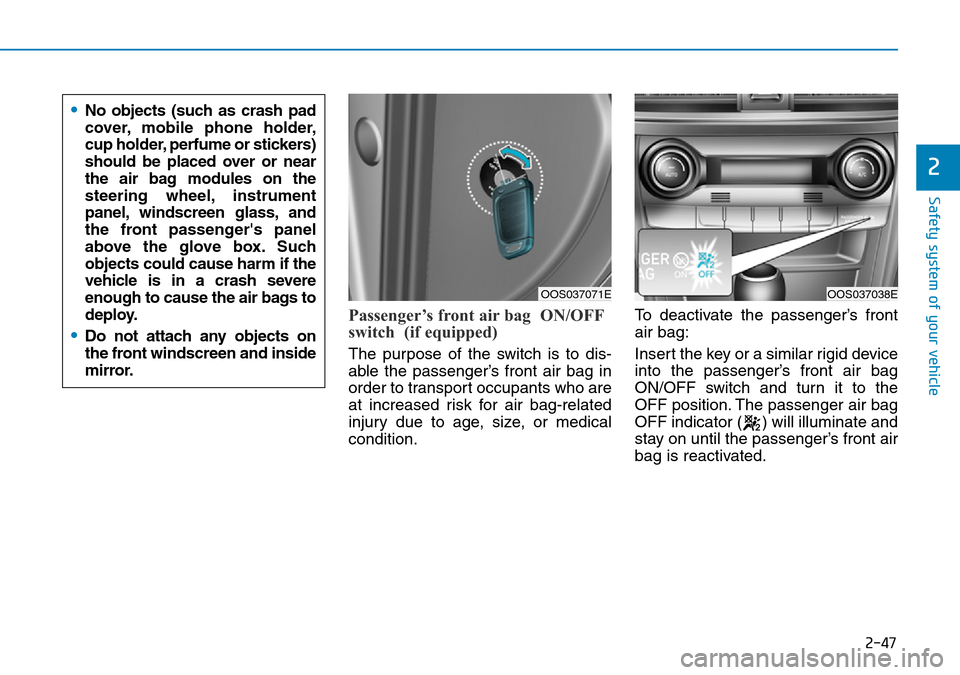
Passenger’s front air bag ON/OFF
switch (if equipped)
The purpose of the switch is to dis-
able the passenger’s front air bag in
order to transport occupants who are
at increased risk for air bag-related
injury due to age, size, or medical
condition.To deactivate the passenger’s front
air bag:
Insert the key or a similar rigid device
into the passenger’s front air bag
ON/OFF switch and turn it to the
OFF position. The passenger air bag
OFF indicator ( ) will illuminate and
stay on until the passenger’s front air
bag is reactivated.
OOS037071EOOS037038E
•No objects (such as crash pad
cover, mobile phone holder,
cup holder, perfume or stickers)
should be placed over or near
the air bag modules on the
steering wheel, instrument
panel, windscreen glass, and
the front passenger's panel
above the glove box. Such
objects could cause harm if the
vehicle is in a crash severe
enough to cause the air bags to
deploy.
•Do not attach any objects on
the front windscreen and inside
mirror.
Page 64 of 497
2-48
Safety system of your vehicle
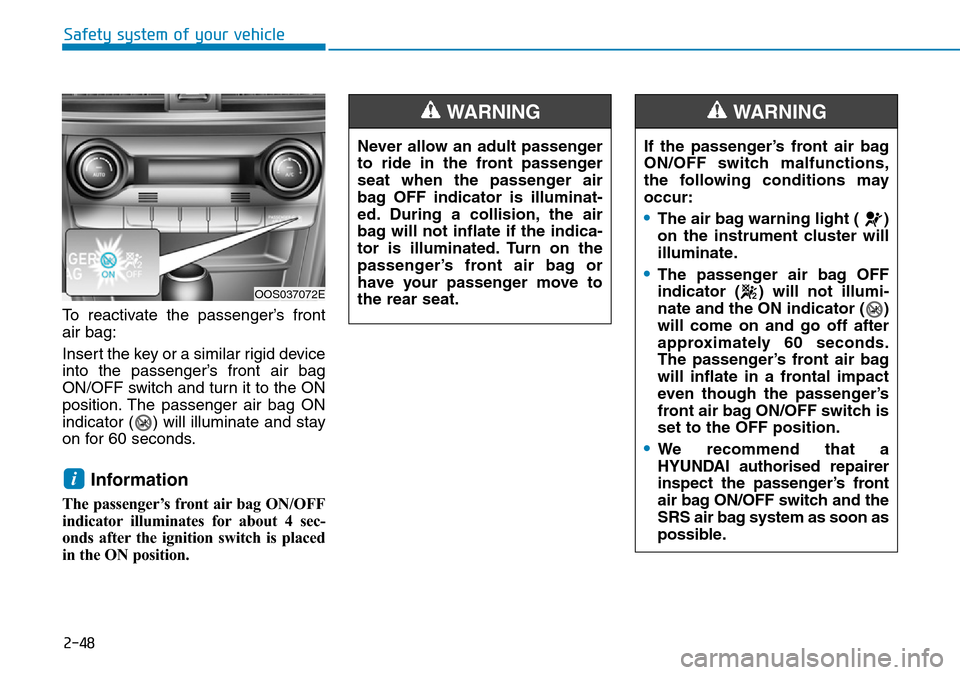
To reactivate the passenger’s front
air bag:
Insert the key or a similar rigid device
into the passenger’s front air bag
ON/OFF switch and turn it to the ON
position. The passenger air bag ON
indicator ( ) will illuminate and stay
on for 60 seconds.
Information
The passenger’s front air bag ON/OFF
indicator illuminates for about 4 sec-
onds after the ignition switch is placed
in the ON position.
i
Never allow an adult passenger
to ride in the front passenger
seat when the passenger air
bag OFF indicator is illuminat-
ed. During a collision, the air
bag will not inflate if the indica-
tor is illuminated. Turn on the
passenger’s front air bag or
have your passenger move to
the rear seat.
WARNING
If the passenger’s front air bag
ON/OFF switch malfunctions,
the following conditions may
occur:
•The air bag warning light ( )
on the instrument cluster will
illuminate.
•The passenger air bag OFF
indicator ( ) will not illumi-
nate and the ON indicator ( )
will come on and go off after
approximately 60 seconds.
The passenger’s front air bag
will inflate in a frontal impact
even though the passenger’s
front air bag ON/OFF switch is
set to the OFF position.
•We recommend that a
HYUNDAI authorised repairer
inspect the passenger’s front
air bag ON/OFF switch and the
SRS air bag system as soon as
possible.
WARNING
OOS037072E
Page 66 of 497
2-50
Safety system of your vehicle
Curtain air bags (if equipped)
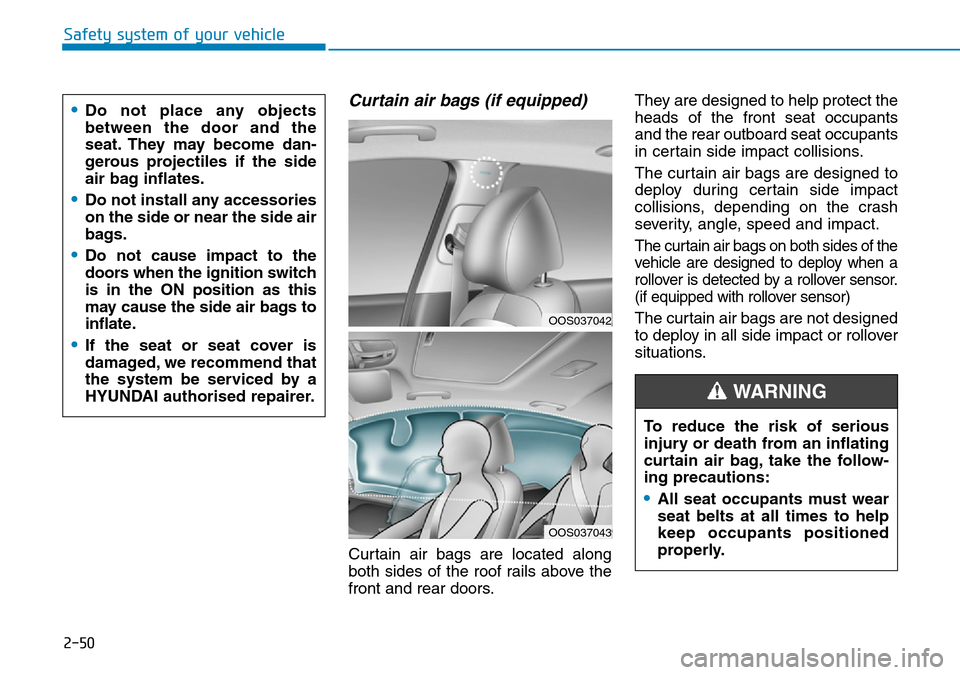
Curtain air bags are located along
both sides of the roof rails above the
front and rear doors.They are designed to help protect the
heads of the front seat occupants
and the rear outboard seat occupants
in certain side impact collisions.
The curtain air bags are designed to
deploy during certain side impact
collisions, depending on the crash
severity, angle, speed and impact.
The curtain air bags on both sides of the
vehicle are designed to deploy when a
rollover is detected by a rollover sensor.
(if equipped with rollover sensor)
The curtain air bags are not designed
to deploy in all side impact or rollover
situations.OOS037042
OOS037043
•Do not place any objects
between the door and the
seat. They may become dan-
gerous projectiles if the side
air bag inflates.
•Do not install any accessories
on the side or near the side air
bags.
•Do not cause impact to the
doors when the ignition switch
is in the ON position as this
may cause the side air bags to
inflate.
•If the seat or seat cover is
damaged, we recommend that
the system be serviced by a
HYUNDAI authorised repairer.
To reduce the risk of serious
injury or death from an inflating
curtain air bag, take the follow-
ing precautions:
•All seat occupants must wear
seat belts at all times to help
keep occupants positioned
properly.
WARNING
Page 67 of 497
2-51
Safety system of your vehicle
2
How does the air bags system
operate?
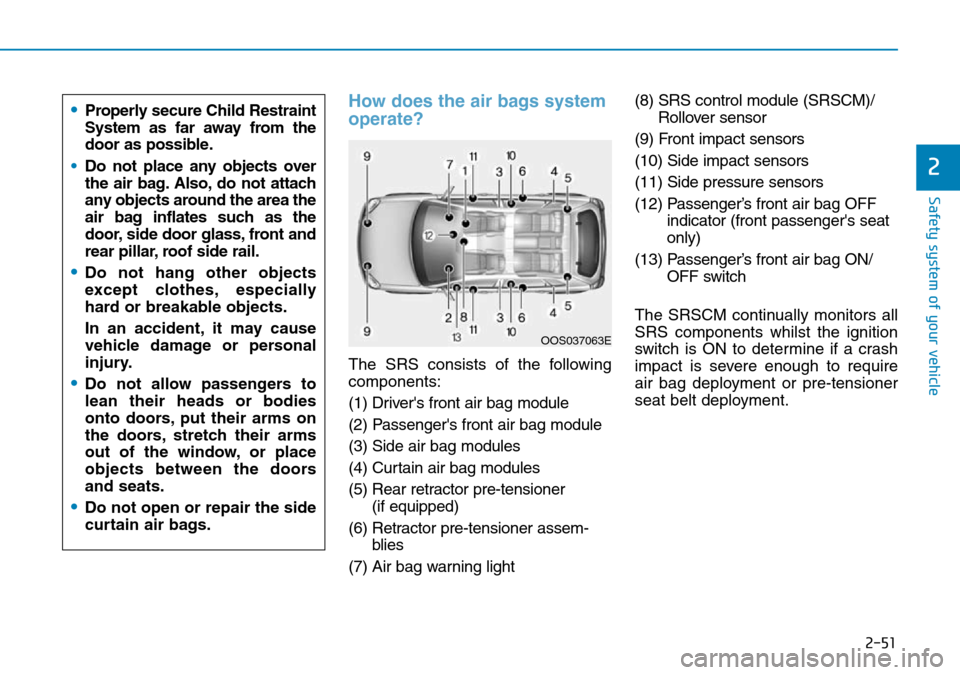
The SRS consists of the following
components:
(1) Driver's front air bag module
(2) Passenger's front air bag module
(3) Side air bag modules
(4) Curtain air bag modules
(5) Rear retractor pre-tensioner (if equipped)
(6) Retractor pre-tensioner assem- blies
(7) Air bag warning light (8) SRS control module (SRSCM)/
Rollover sensor
(9) Front impact sensors
(10) Side impact sensors
(11) Side pressure sensors
(12) Passenger’s front air bag OFF indicator (front passenger's seat
only)
(13) Passenger’s front air bag ON/ OFF switch
The SRSCM continually monitors all
SRS components whilst the ignition
switch is ON to determine if a crash
impact is severe enough to require
air bag deployment or pre-tensioner
seat belt deployment.
OOS037063E
•Properly secure Child Restraint
System as far away from the
door as possible.
• Do not place any objects over
the air bag. Also, do not attach
any objects around the area the
air bag inflates such as the
door, side door glass, front and
rear pillar, roof side rail.
•Do not hang other objects
except clothes, especially
hard or breakable objects.
In an accident, it may cause
vehicle damage or personal
injury.
•Do not allow passengers to
lean their heads or bodies
onto doors, put their arms on
the doors, stretch their arms
out of the window, or place
objects between the doors
and seats.
•Do not open or repair the side
curtain air bags.
Page 68 of 497
2-52
Safety system of your vehicle
SRS warning light
The SRS (Supplement Restraint
System) air bag warning light on the
instrument panel displays the air bag
symbol depicted in the illustration. The
system checks the air bag electrical
system for malfunctions. The light indi-
cates that there is a potential problem
with your air bag system, which could
include your side and/or curtain air
bags used for rollover protection (if
equipped with rollover sensor).During a moderate to severe frontal
collision, sensors will detect the vehi-
cle’s rapid deceleration. If the rate of
deceleration is high enough, the con-
trol unit will inflate the front air bags,
at the time and with the force needed.
The front air bags help protect the driv-
er and front passenger by responding
to frontal impacts in which seat belts
alone cannot provide adequate
restraint. When needed, the side air
bags help provide protection in the
event of a side impact or rollover by
supporting the side upper body area.
• Air bags are activated (able to inflate
if necessary) only when the ignition
switch is in the ON position.
• Air bags inflate in the event of certain frontal or side collisions to help pro-
tect the occupants from serious
physical injury.
• There is no single speed at which the air bags will inflate. Generally, air bags
are designed to inflate based upon
the severity of a collision and its direc-
tion. These two factors determine
whether the sensors produce an elec-
tronic deployment/inflation signal.
If your SRS malfunctions, the
air bag may not inflate properly
during an accident increasing
the risk of serious injury or
death.
If any of the following condi-
tions occur, your SRS is mal-
functioning:
•The light does not turn on for
approximately six seconds
when the ignition switch is in
the ON position.
•The light stays on after illumi-
nating for approximately six
seconds.
•The light comes on whilst the
vehicle is in motion.
•The light blinks when the
engine is running.
We recommend that a HYUNDAI
authorised repairer inspect the
SRS as soon as possible if any
of these conditions occur.
WARNING
Page 72 of 497
2-56
Safety system of your vehicle
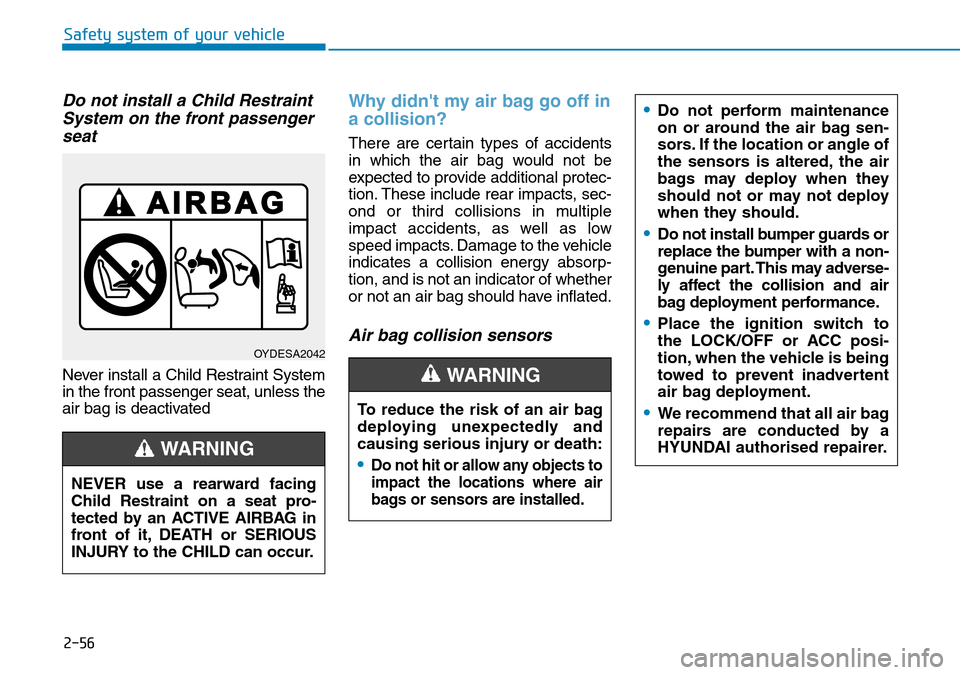
Do not install a Child RestraintSystem on the front passengerseat
Never install a Child Restraint System
in the front passenger seat, unless the
air bag is deactivated
Why didn't my air bag go off in
a collision?
There are certain types of accidents
in which the air bag would not be
expected to provide additional protec-
tion. These include rear impacts, sec-
ond or third collisions in multiple
impact accidents, as well as low
speed impacts. Damage to the vehicle
indicates a collision energy absorp-
tion, and is not an indicator of whether
or not an air bag should have inflated.
Air bag collision sensors
OYDESA2042
NEVER use a rearward facing
Child Restraint on a seat pro-
tected by an ACTIVE AIRBAG in
front of it, DEATH or SERIOUS
INJURY to the CHILD can occur.
WARNING
To reduce the risk of an air bag
deploying unexpectedly and
causing serious injury or death:
•Do not hit or allow any objects to
impact the locations where air
bags or sensors are installed.
WARNING
•Do not perform maintenance
on or around the air bag sen-
sors. If the location or angle of
the sensors is altered, the air
bags may deploy when they
should not or may not deploy
when they should.
•Do not install bumper guards or
replace the bumper with a non-
genuine part. This may adverse-
ly affect the collision and air
bag deployment performance.
•Place the ignition switch to
the LOCK/OFF or ACC posi-
tion, when the vehicle is being
towed to prevent inadvertent
air bag deployment.
•We recommend that all air bag
repairs are conducted by a
HYUNDAI authorised repairer.