maintenance Hyundai Kona 2018 - RHD (UK, Australia) Owner's Guide
[x] Cancel search | Manufacturer: HYUNDAI, Model Year: 2018, Model line: Kona, Model: Hyundai Kona 2018Pages: 497, PDF Size: 11.7 MB
Page 426 of 497
7-19
7
Maintenance
Information
If the vehicle is operated in extremely
dusty or sandy areas, replace the element
more often than the usual recommended
intervals.
• Do not drive with the air cleanerfilter removed. This will result in
excessive engine wear.
• When removing the air cleaner filter, be careful that dust or dirt
does not enter the air intake, or
damage may result.
• Use HYUNDAI genuine parts. Use of non-genuine parts could
damage the air flow sensor.
Filter inspection
If the vehicle is operated in the
severely air-polluted cities or on
dusty rough roads for a long period,
it should be inspected more fre-
quently and replaced earlier. When
you, the owner, replace the climate
control air filter, replace it performing
the following procedure, and be care-
ful to avoid damaging other compo-
nents.
Replace the filter according to the
Maintenance Schedule.
Filter replacement
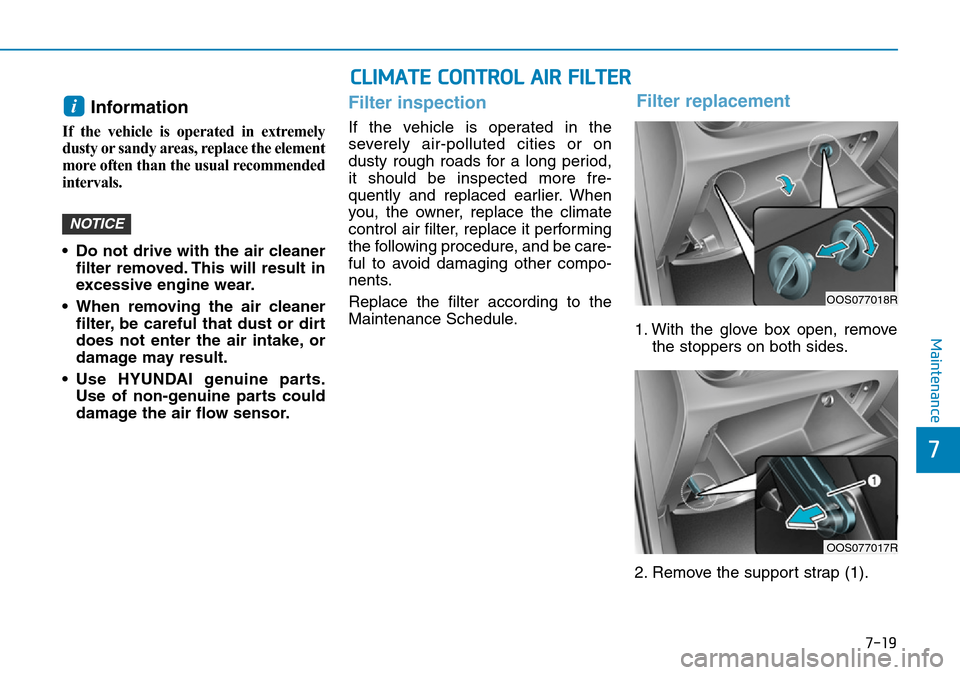
1. With the glove box open, remove the stoppers on both sides.
2. Remove the support strap (1).
NOTICE
i
CLIMATE CONTROL AIR FILTER
OOS077018R
OOS077017R
Page 427 of 497
7-20
Maintenance
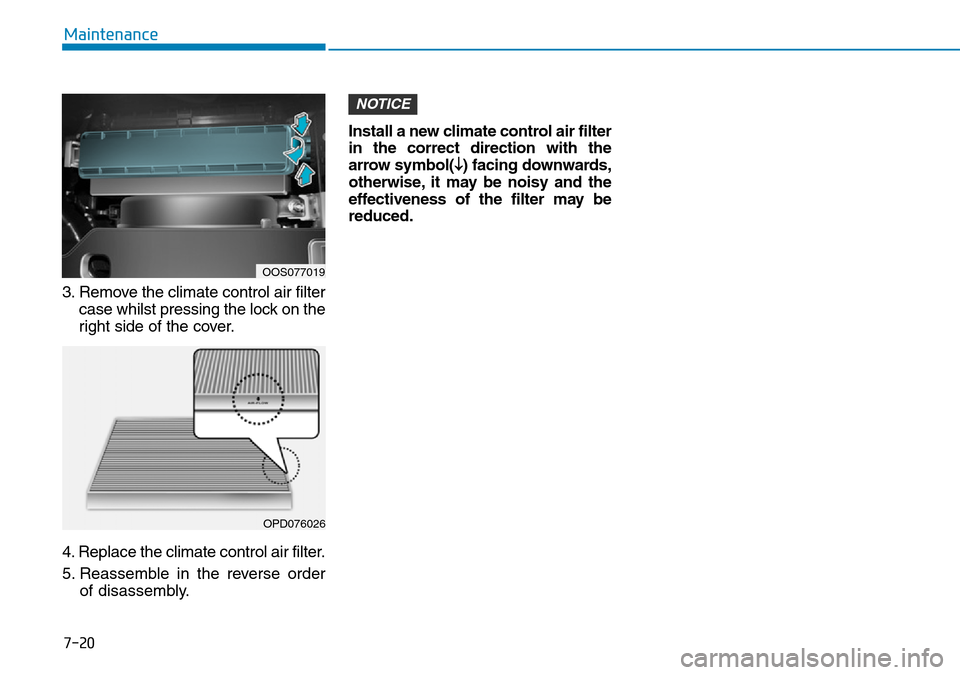
3. Remove the climate control air filter case whilst pressing the lock on the
right side of the cover.
4. Replace the climate control air filter.
5. Reassemble in the reverse order of disassembly. Install a new climate control air filter
in the correct direction with the
arrow symbol(
↓) facing downwards,
otherwise, it may be noisy and the
effectiveness of the filter may be
reduced.
NOTICE
OOS077019
OPD076026
Page 428 of 497
7-21
7
Maintenance
WIPER BLADES
Blade inspection
Contamination of either the wind-
screen or the wiper blades with for-
eign matter can reduce the effective-
ness of the windscreen wipers.
Common sources of contamination
are insects, tree sap, and hot wax
treatments used by some commer-
cial car washes. If the blades are not
wiping properly, clean both the win-
dow and the blades with a good
cleaner or mild detergent, and rinse
thoroughly with clean water.
To prevent damage to the wiper
blades, arms or other compo-
nents, do not:
• Use petrol, kerosene, paint thin-ner, or other solvents on or near
them.
• Attempt to move the wipers manually.
• Use non-specified wiper blades.
Information
Commercial hot waxes applied by auto-
matic car washes have been known to
make the windscreen difficult to clean.
Information
Wiper blades are consumable item.
Normal wear of the wipers may not be
covered by your vehicle warranty.
Blade replacement
When the wipers no longer clean
adequately, the blades may be worn
or cracked, and require replacement.
To prevent damage to the wiper arms
or other components, do not attempt
to move the wipers manually.
The use of a non-specified wiper
blade could result in wiper mal-
function and failure.
• In order to prevent damage to the bonnet and the wiper arms,
the wiper arms should only be
lifted when in the top wiping
position.
• Always return the wiper arms to the windscreen before driving.
Type A
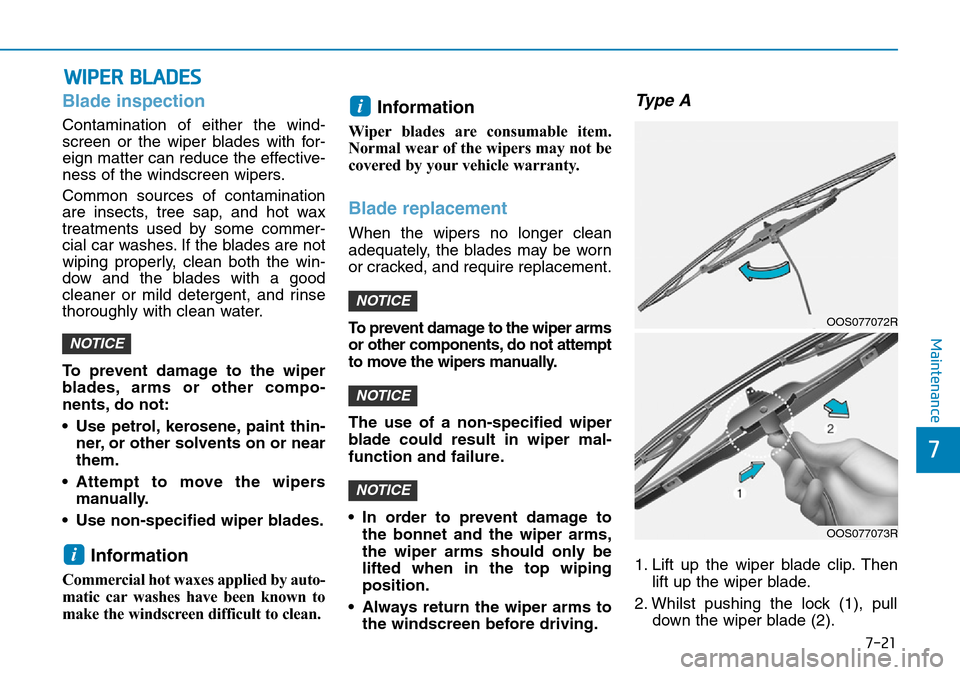
1. Lift up the wiper blade clip. Then lift up the wiper blade.
2. Whilst pushing the lock (1), pull down the wiper blade (2).
NOTICE
NOTICE
NOTICE
i
i
NOTICE
OOS077072R
OOS077073R
Page 429 of 497
7-22
Maintenance
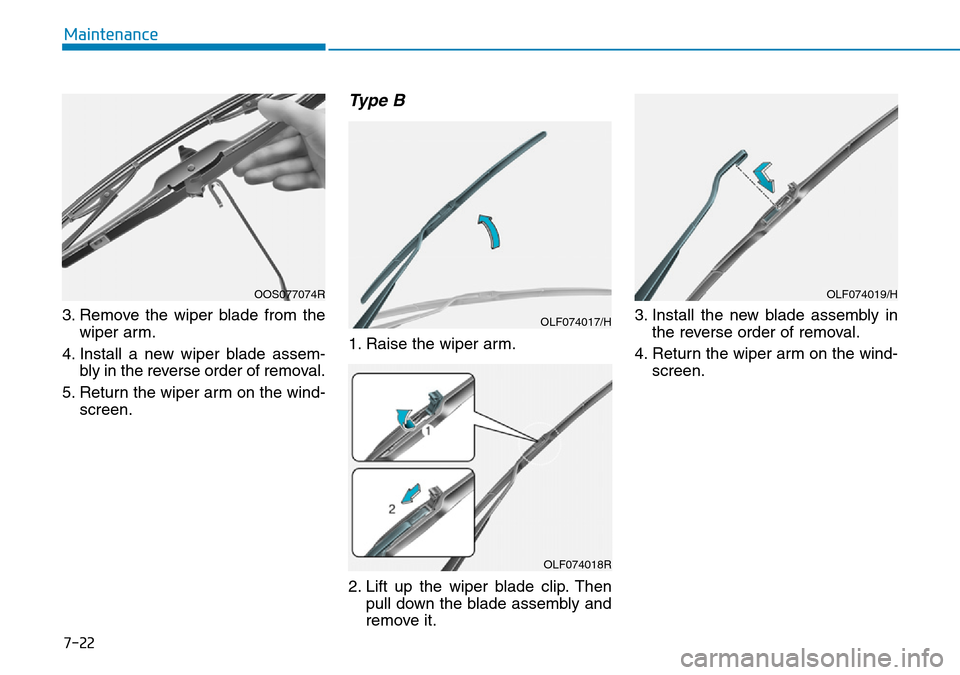
3. Remove the wiper blade from the wiper arm.
4. Install a new wiper blade assem- bly in the reverse order of removal.
5. Return the wiper arm on the wind- screen.
Type B
1. Raise the wiper arm.
2. Lift up the wiper blade clip. Thenpull down the blade assembly and
remove it. 3. Install the new blade assembly in
the reverse order of removal.
4. Return the wiper arm on the wind- screen.
OOS077074R
OLF074017/H
OLF074018R
OLF074019/H
Page 430 of 497
7-23
7
Maintenance
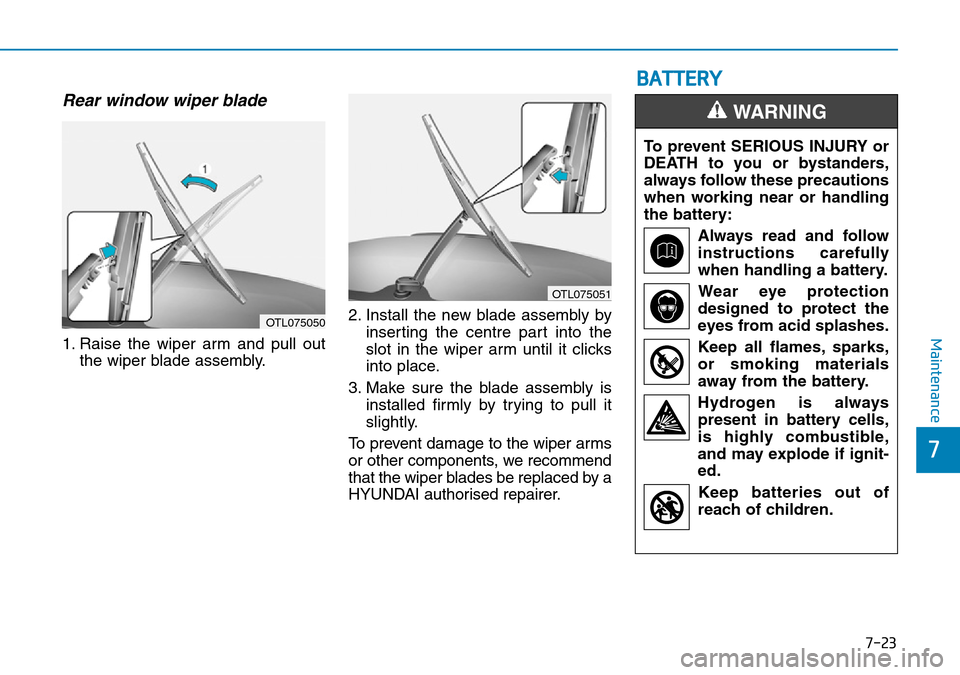
Rear window wiper blade
1. Raise the wiper arm and pull outthe wiper blade assembly. 2. Install the new blade assembly by
inserting the centre part into the
slot in the wiper arm until it clicks
into place.
3. Make sure the blade assembly is installed firmly by trying to pull it
slightly.
To prevent damage to the wiper arms
or other components, we recommend
that the wiper blades be replaced by a
HYUNDAI authorised repairer.
OTL075050
OTL075051
BATTERY
To prevent SERIOUS INJURY or
DEATH to you or bystanders,
always follow these precautions
when working near or handling
the battery: Always read and follow
instructions carefully
when handling a battery.Wear eye protection
designed to protect the
eyes from acid splashes.
Keep all flames, sparks,
or smoking materials
away from the battery.
Hydrogen is always present in battery cells,
is highly combustible,
and may explode if ignit-
ed.
Keep batteries out of
reach of children.
WARNING
Page 431 of 497
7-24
Maintenance• When you do not use the vehiclefor a long time in a low tempera-
ture area, disconnect the battery
and keep it indoors.
• Always charge the battery fully to prevent battery case damage
in low temperature areas.
If you connect unauthorised elec-
tronic devices to the battery, the
battery may be discharged. Never
use unauthorised devices.
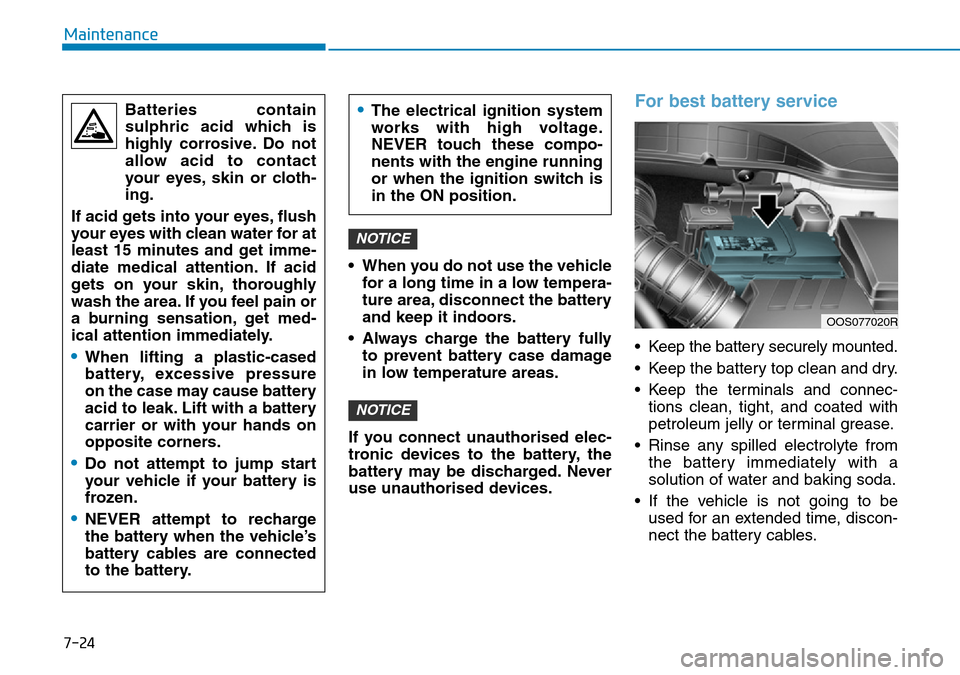
For best battery service
• Keep the battery securely mounted.
• Keep the battery top clean and dry.
• Keep the terminals and connec- tions clean, tight, and coated with
petroleum jelly or terminal grease.
• Rinse any spilled electrolyte from the battery immediately with a
solution of water and baking soda.
• If the vehicle is not going to be used for an extended time, discon-
nect the battery cables.
NOTICE
NOTICE
Batteries containsulphric acid which is
highly corrosive. Do not
allow acid to contact
your eyes, skin or cloth-
ing.
If acid gets into your eyes, flush
your eyes with clean water for at
least 15 minutes and get imme-
diate medical attention. If acid
gets on your skin, thoroughly
wash the area. If you feel pain or
a burning sensation, get med-
ical attention immediately.
•When lifting a plastic-cased
battery, excessive pressure
on the case may cause battery
acid to leak. Lift with a battery
carrier or with your hands on
opposite corners.
•Do not attempt to jump start
your vehicle if your battery is
frozen.
•NEVER attempt to recharge
the battery when the vehicle’s
battery cables are connected
to the battery.
•The electrical ignition system
works with high voltage.
NEVER touch these compo-
nents with the engine running
or when the ignition switch is
in the ON position.
OOS077020R
Page 432 of 497
7-25
7
Maintenance
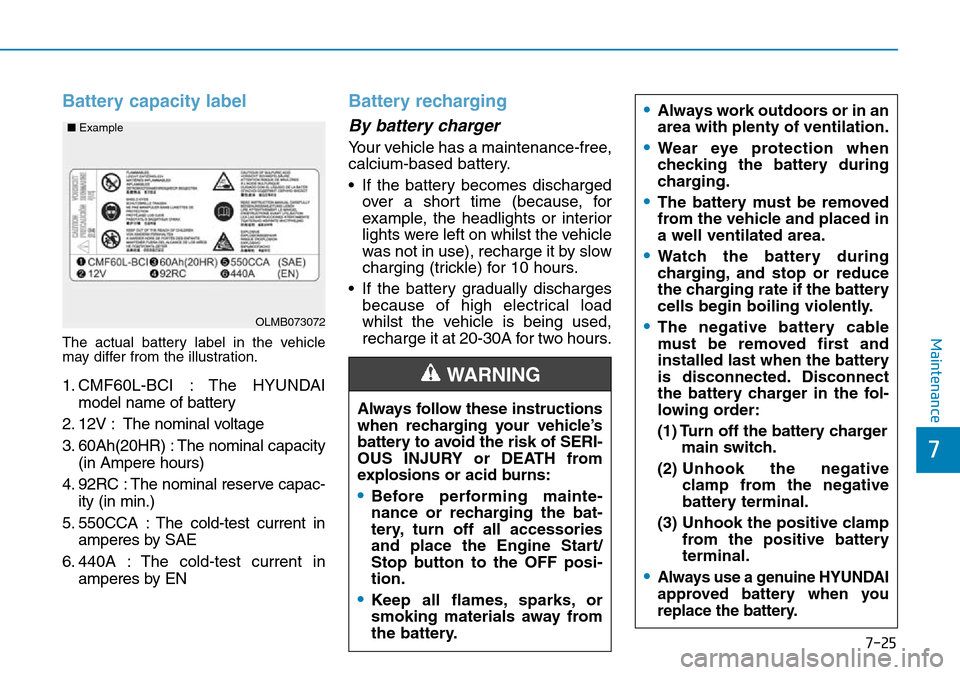
Battery capacity label
The actual battery label in the vehicle
may differ from the illustration.
1. CMF60L-BCI : The HYUNDAImodel name of battery
2. 12V : The nominal voltage
3. 60Ah(20HR) : The nominal capacity (in Ampere hours)
4. 92RC : The nominal reserve capac- ity (in min.)
5. 550CCA : The cold-test current in amperes by SAE
6. 440A : The cold-test current in amperes by EN
Battery recharging
By battery charger
Your vehicle has a maintenance-free,
calcium-based battery.
• If the battery becomes dischargedover a short time (because, for
example, the headlights or interior
lights were left on whilst the vehicle
was not in use), recharge it by slow
charging (trickle) for 10 hours.
• If the battery gradually discharges because of high electrical load
whilst the vehicle is being used,
recharge it at 20-30A for two hours.
OLMB073072
■
Example
Always follow these instructions
when recharging your vehicle’s
battery to avoid the risk of SERI-
OUS INJURY or DEATH from
explosions or acid burns:
•Before performing mainte-
nance or recharging the bat-
tery, turn off all accessories
and place the Engine Start/
Stop button to the OFF posi-
tion.
•Keep all flames, sparks, or
smoking materials away from
the battery.
WARNING
•Always work outdoors or in an
area with plenty of ventilation.
•Wear eye protection when
checking the battery during
charging.
•The battery must be removed
from the vehicle and placed in
a well ventilated area.
•Watch the battery during
charging, and stop or reduce
the charging rate if the battery
cells begin boiling violently.
•The negative battery cable
must be removed first and
installed last when the battery
is disconnected. Disconnect
the battery charger in the fol-
lowing order:
(1) Turn off the battery charger
main switch.
(2) Unhook the negative
clamp from the negative
battery terminal.
(3) Unhook the positive clamp from the positive battery
terminal.
•Always use a genuine HYUNDAI
approved battery when you
replace the battery.
Page 433 of 497
7-26
Maintenance
By jump starting
After a jump start from a good bat-
tery, drive the vehicle for 20-30 min-
utes before it is shutoff. The vehicle
may not restart if you shut it off
before the battery had a chance to
adequately recharge. See “Jump
Starting” in chapter 6 for more infor-
mation on jump starting procedures.
Information
An inappropriately disposedbattery can be harmful to
the environment and human
health.
Dispose of the battery according to
your local law(s) or regulations.
Reset items
The following items may need to be
reset after the battery has been dis-
charged or the battery has been dis-
connected.
• Auto up/down window
• Sunroof
• Trip computer
• Climate control system
• Driver position memory system
• Clock
• Audio system
i
AGM battery (if equipped)
•Absorbent Glass Matt (AGM)
batteries are maintenance-
free and we recommend that
the AGM battery be serviced
by a HYUNDAI authorised
repairer. For charging your
AGM battery, use only fully
automatic battery chargers
that are specially developed
for AGM batteries.
•When replacing the AGM bat-
tery, we recommend that you
use parts for replacement
from a HYUNDAI authorised
repairer.
•Do not open or remove the
cap on top of the battery. This
may cause leaks of internal
electrolyte that could result in
severe injury.
CAUTION
Page 434 of 497
7-27
7
Maintenance
TYRES AND WHEELS
Tyre care
For proper maintenance, safety, and
maximum fuel economy, you must
always maintain recommended tyre
inflation pressures and stay within the
load limits and weight distribution rec-
ommended for your vehicle.
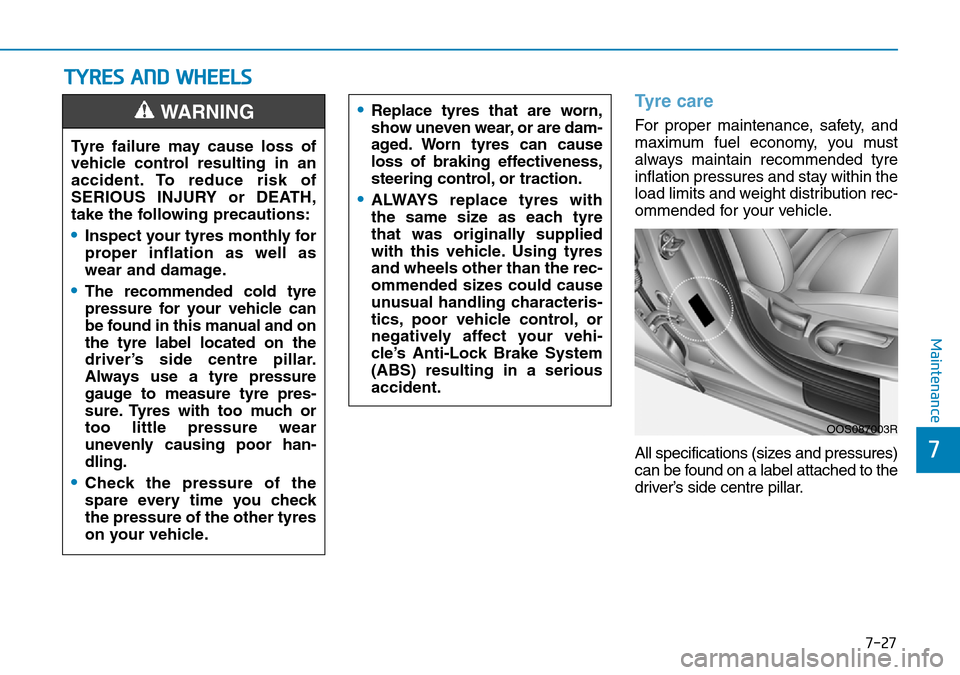
All specifications (sizes and pressures)
can be found on a label attached to the
driver’s side centre pillar.•Replace tyres that are worn,
show uneven wear, or are dam-
aged. Worn tyres can cause
loss of braking effectiveness,
steering control, or traction.
•ALWAYS replace tyres with
the same size as each tyre
that was originally supplied
with this vehicle. Using tyres
and wheels other than the rec-
ommended sizes could cause
unusual handling characteris-
tics, poor vehicle control, or
negatively affect your vehi-
cle’s Anti-Lock Brake System
(ABS) resulting in a serious
accident.
Tyre failure may cause loss of
vehicle control resulting in an
accident. To reduce risk of
SERIOUS INJURY or DEATH,
take the following precautions:
•Inspect your tyres monthly for
proper inflation as well as
wear and damage.
•The recommended cold tyre
pressure for your vehicle can
be found in this manual and on
the tyre label located on the
driver’s side centre pillar.
Always use a tyre pressure
gauge to measure tyre pres-
sure. Tyres with too much or
too little pressure wear
unevenly causing poor han-
dling.
•Check the pressure of the
spare every time you check
the pressure of the other tyres
on your vehicle.
WARNING
OOS087003R
Page 435 of 497
7-28
Maintenance
Recommended cold tyre infla-
tion pressures
All tyre pressures (including the
spare) should be checked when the
tyres are cold. “Cold tyres” means
the vehicle has not been driven for at
least three hours or has been driven
for less than 1 mile (1.6 km).
Warm tyres normally exceed recom-
mended cold tyre pressures by 28 to
41 kPa (4 to 6 psi). Do not release air
from warm tyres to adjust the pres-
sure or the tyres will be under-inflat-
ed. For recommended inflation pres-
sure, refer to “Tyre and Wheels” in
chapter 8.Recommended pressures must
be maintained for the best ride,
vehicle handling, and minimum
tyre wear.
Over-inflation or under-inflation
can reduce tyre life, adversely
affect vehicle handling, and
lead to sudden tyre failure that
could result in loss of vehicle
control resulting in an accident.
Severe under-inflation can lead
to severe heat build-up, causing
blowouts, tread separation and
other tyre failures that can
result in the loss of vehicle con-
trol resulting in an accident.
This risk is much higher on hot
days and when driving for long
periods at high speeds.
WARNING
•Under-inflation results in
excessive wear, poor handling
and reduced fuel economy.
Wheel deformation is also
possible. Keep your tyre pres-
sures at the proper levels. If a
tyre frequently needs refilling,
we recommend it be checked
by a HYUNDAI authorised
repairer.
•Over-inflation produces a
harsh ride, excessive wear at
the centre of the tyre tread,
and a greater possibility of
damage from road hazards.
CAUTION