maintenance Hyundai Kona 2018 - RHD (UK, Australia) User Guide
[x] Cancel search | Manufacturer: HYUNDAI, Model Year: 2018, Model line: Kona, Model: Hyundai Kona 2018Pages: 497, PDF Size: 11.7 MB
Page 251 of 497
5
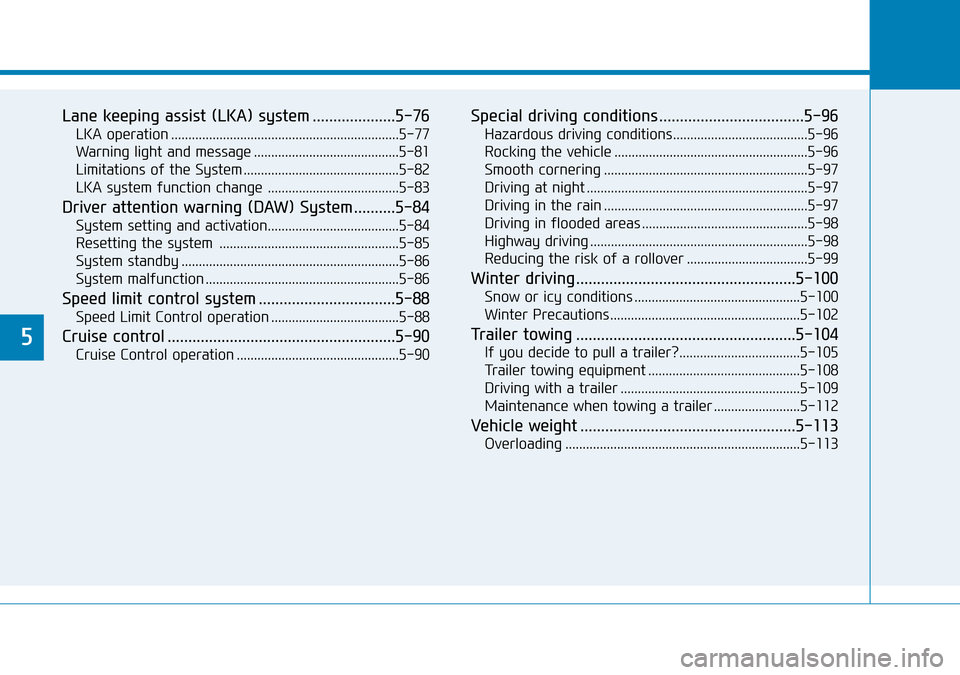
Lane keeping assist (LKA) system ....................5-76
LKA operation ..................................................................5-77
Warning light and message ..........................................5-81
Limitations of the System .............................................5-82
LKA system function change ......................................5-83
Driver attention warning (DAW) System ..........5-84
System setting and activation......................................5-84
Resetting the system ....................................................5-85
System standby ...............................................................5-86
System malfunction ........................................................5-86
Speed limit control system .................................5-88
Speed Limit Control operation .....................................5-88
Cruise control .......................................................5-90
Cruise Control operation ...............................................5-90
Special driving conditions ...................................5-96
Hazardous driving conditions.......................................5-96
Rocking the vehicle ........................................................5-96
Smooth cornering ...........................................................5-97
Driving at night ................................................................5-97
Driving in the rain ...........................................................5-97
Driving in flooded areas ................................................5-98
Highway driving ...............................................................5-98
Reducing the risk of a rollover ...................................5-99
Winter driving .....................................................5-100
Snow or icy conditions ................................................5-100
Winter Precautions .......................................................5-102
Trailer towing .....................................................5-104
If you decide to pull a trailer?...................................5-105
Trailer towing equipment ............................................5-108
Driving with a trailer ....................................................5-109
Maintenance when towing a trailer .........................5-112
Vehicle weight ....................................................5-113
Overloading ....................................................................5-11\
3
Page 351 of 497
5-102
Driving your vehicle
When using tyre chains:
• Wrong size chains or improperly installed chains can damage
your vehicle's brake lines, sus-
pension, body and wheels.
• Use SAE “S” class or wire chains.
• If you hear noise caused by chains contacting the body,
retighten the chain to prevent
contact with the vehicle body.
• To prevent body damage, retight- en the chains after driving 0.3~0.6
miles (0.5~1.0 km).
• Do not use tyre chains on vehi- cles equipped with aluminium
wheels. If unavoidable, use a
wire type chain.
• Use wire chains less than 12 mm (0.47 in) wide to prevent damage
to the chain’s connection.
Winter Precautions
Use high quality ethylene glycol
coolant
Your vehicle is delivered with high
quality ethylene glycol coolant in the
cooling system. It is the only type of
coolant that should be used because
it helps prevent corrosion in the cool-
ing system, lubricates the water
pump and prevents freezing. Be sure
to replace or replenish your coolant
in accordance with the maintenance
schedule. Before winter, have your
coolant tested to assure that its
freezing point is sufficient for the
temperatures anticipated during the
winter.
Check battery and cables
Winter temperatures affect battery
performance. Inspect the battery
and cables, as specified in chapter
7. The battery charging level can be
checked by a HYUNDAI authorised
repairer or in a service station. Change to "winter weight" oil if
necessary
In some regions during winter, it is
recommended to use the "winter
weight" oil with lower viscosity. For
further information, refer to the chap-
ter 8. When you are not sure about a
type of winter weight oil, consult a
HYUNDAI authorised repairer.
Check spark plugs and ignition
system
Inspect the spark plugs, as speci-
fied in chapter 7.
If necessary,
replace them. Also check all ignition
wirings and components for any
cracks, wear-out, and damage.
To prevent locks from freezing
To prevent the locks from being
frozen, spray approved de-icing fluid
or glycerin into key holes. When a
lock opening is already covered with
ice, spray approved de-icing fluid
over the ice to remove it. When an
internal part of a lock freezes, try to
thaw it with a heated key. Carefully
use the heated key to avoid an injury.
NOTICE
Page 361 of 497
5-112
Driving your vehicle
Ready to leave after parking ona hill
1. With the shift lever in P (Park, for
dual clutch transmission vehicle) or
neutral (for manual transmission
vehicle), apply your brakes and
hold the brake pedal down whilst
you:
• Start your engine;
• Shift into gear; and
• Release the parking brake.
2. Slowly remove your foot from the brake pedal.
3. Drive slowly until the trailer is clear of the chocks.
4. Stop and have someone pick up and store the chocks.
Maintenance when towing a
trailer
Your vehicle will need service more
often when you regularly pull a trail-
er. Important items to pay particular
attention to include engine oil, dual
clutch transmission fluid, axle lubri-
cant and cooling system fluid. Brake
condition is another important item to
frequently check. If you’re trailering,
it’s a good idea to review these items
before you start your trip. Don’t forget
to also maintain your trailer and tow-
bar. Follow the maintenance sched-
ule that accompanied your trailer and
check it periodically. Preferably, con-
duct the check at the start of each
day’s driving. Most importantly, all
towbar nuts and bolts should be
tight. To prevent vehicle damage:
• Due to higher load during trailer
usage, overheating might occur
on hot days or during uphill driv-
ing. If the coolant gauge indi-
cates over-heating, switch off
the air conditioner and stop the
vehicle in a safe area to cool
down the engine.
• Do not switch off the engine whilst the coolant gauge indi-
cates over-heating.
(Keep the engine idle to cool
down the engine)
• When towing check dual clutch fluid more frequently.
• If your vehicle is not equipped with an air conditioner, you
should install a condenser fan
to improve engine performance
when towing a trailer.
NOTICE
Page 408 of 497
7
Maintenance
7
Maintenance
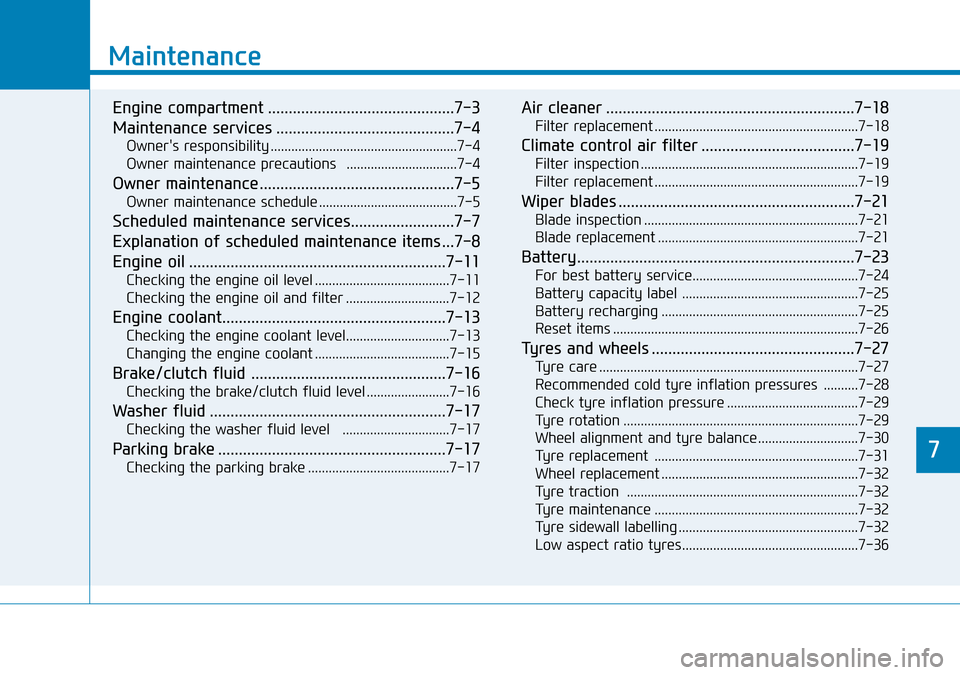
Engine compartment .............................................7-3
Maintenance services ...........................................7-4
Owner's responsibility ......................................................7-4
Owner maintenance precautions ................................7-4
Owner maintenance ...............................................7-5
Owner maintenance schedule ........................................7-5
Scheduled maintenance services.........................7-7
Explanation of scheduled maintenance items ...7-8
Engine oil ..............................................................7-11
Checking the engine oil level .......................................7-11
Checking the engine oil and filter ..............................7-12
Engine coolant......................................................7-13
Checking the engine coolant level..............................7-13
Changing the engine coolant .......................................7-15
Brake/clutch fluid ...............................................7-16
Checking the brake/clutch fluid level ........................7-16
Washer fluid .........................................................7-17
Checking the washer fluid level ...............................7-17
Parking brake .......................................................7-17
Checking the parking brake .........................................7-17
Air cleaner ............................................................7-18
Filter replacement ...........................................................7-18
Climate control air filter .....................................7-19
Filter inspection ...............................................................7-19
Filter replacement ...........................................................7-19
Wiper blades .........................................................7-21
Blade inspection ..............................................................7-21
Blade replacement ..........................................................7-21
Battery...................................................................7-23
For best battery service................................................7-24
Battery capacity label ...................................................7-25
Battery recharging .........................................................7-25
Reset items .......................................................................7\
-26
Tyres and wheels .................................................7-27
Tyre care ........................................................................\
...7-27
Recommended cold tyre inflation pressures ..........7-28
Check tyre inflation pressure ......................................7-29
Tyre rotation ....................................................................7-29\
Wheel alignment and tyre balance.............................7-30
Tyre replacement ...........................................................7-31
Wheel replacement .........................................................7-32
Tyre traction ...................................................................7-32
Tyre maintenance ...........................................................7-32
Tyre sidewall labelling ....................................................7-32
Low aspect ratio tyres...................................................7-36
7
Page 410 of 497
7-3
7
Maintenance
ENGINE COMPARTMENT
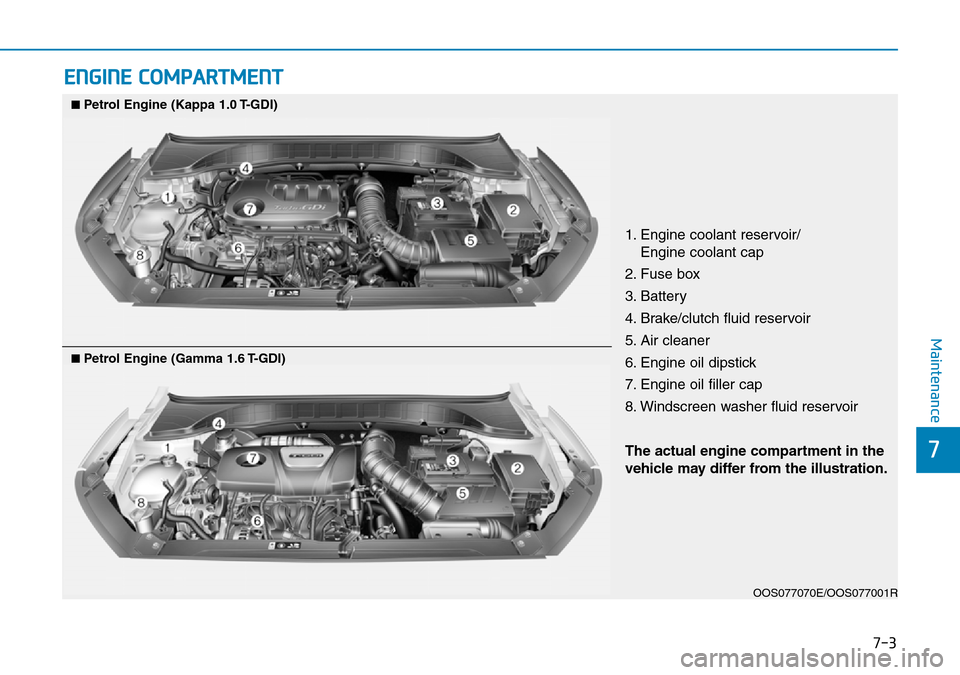
1. Engine coolant reservoir/Engine coolant cap
2. Fuse box
3. Battery
4. Brake/clutch fluid reservoir
5. Air cleaner
6. Engine oil dipstick
7. Engine oil filler cap
8. Windscreen washer fluid reservoir
The actual engine compartment in the
vehicle may differ from the illustration.
OOS077070E/OOS077001R
■Petrol Engine (Kappa 1.0 T-GDI)
■Petrol Engine (Gamma 1.6 T-GDI)
Page 411 of 497
7-4
Maintenance
MAINTENANCE SERVICES
You should exercise the utmost care
to prevent damage to your vehicle
and injury to yourself whenever per-
forming any maintenance or inspec-
tion procedures.
We recommend you have your vehi-
cle maintained and repaired by a
HYUNDAI authorised repairer. A
HYUNDAI authorised repairer meets
HYUNDAI’s high service quality
standards and receives technical
support from HYUNDAI in order to
provide you with a high level of serv-
ice satisfaction.
Owner’s responsibility
Maintenance service and record reten-
tion are the owner’s responsibility.
You should retain documents that
show proper maintenance has been
performed on your vehicle in accor-
dance with the scheduled mainte-
nance service charts shown on the
following pages. You need this infor-
mation to establish your compliance
with the servicing and maintenance
requirements of your vehicle war-
ranties.Detailed warranty information is pro-
vided in your Warranty Booklet.
Repairs and adjustments required as
a result of improper maintenance or
a lack of required maintenance are
not covered.
Owner maintenance precau-
tions
Inadequate, incomplete or insuffi-
cient servicing may result in opera-
tional problems with your vehicle that
could lead to vehicle damage, an
accident, or personal injury. This
chapter provides instructions only for
the maintenance items that are easy
to perform. Several procedures can
be done only by a HYUNDAI autho-
rised repairer with special tools.
Your vehicle should not be modified
in any way. Such modifications may
adversely affect the performance,
safety or durability of your vehicle
and may, in addition, violate condi-
tions of the limited warranties cover-
ing the vehicle.
.
Improper owner maintenance dur-
ing the warranty period may affect
warranty coverage. For details,
read the separate Warranty Booklet
provided with the vehicle. If you're
unsure about any servicing or
maintenance procedure, we rec-
ommend that the system be serv-
iced by a HYUNDAI authorised
repairer.
NOTICE
Page 412 of 497
7-5
7
Maintenance
OWNER MAINTENANCE
The following lists are vehicle checks
and inspections that should be per-
formed by the owner or a HYUNDAI
authorised repairer at the frequencies
indicated to help ensure safe, depend-
able operation of your vehicle.
Any adverse conditions should be
brought to the attention of your dealer
as soon as possible.
These Owner Maintenance vehicle
checks are generally not covered by
warranties and you may be charged
for labour, parts and lubricants used.
Owner maintenance schedule
When you stop for fuel:
• Check the engine oil level.
• Check the coolant level in theengine coolant reservoir.
• Check the windscreen washer fluid level.
• Check for low or under-inflated tyres.
Performing maintenance work
on a vehicle can be dangerous.
If you lack sufficient knowledge
and experience or the proper
tools and equipment to do the
work, we
recommend that the
system be serviced by a
HYUNDAI authorised repairer.
ALWAYS follow these precau-
tions for performing mainte-
nance work:
•Park your vehicle on level
ground, move the shift lever
into the P (Park, dual clutch
transmission vehicle) or neu-
tral (for manual transmission
vehicle) position, apply the
parking brake, and place the
ignition switch in the LOCK/
OFF position.
•Block the tyres (front and
back) to prevent the vehicle
from moving.
Remove loose clothing or jew-
ellery that can become entan-
gled in moving parts.
WARNING •If you must run the engine
during maintenance, do so
out doors or in an area with
plenty of ventilation.
•Keep flames, sparks, or smok-
ing materials away from the
battery and fuel-related parts.
Be careful when checking your
engine coolant level when the
engine is hot. This may result in
coolant being blown out of the
opening and cause serious
burns and other injuries.
WARNING
Page 413 of 497
7-6
Maintenance
Whilst operating your vehicle:
• Note any changes in the sound ofthe exhaust or any smell of exhaust
fumes in the vehicle.
• Check for vibrations in the steering wheel. Notice if there is any
increased steering effort or loose-
ness in the steering wheel, or
change in its straight-ahead position.
• Notice if your vehicle constantly turns slightly or “pulls” to one side when
travelling on smooth, level road.
• When stopping, listen and check for unusual sounds, pulling to one side,
increased brake pedal travel or
“hard-to-push” brake pedal.
• If any slipping or changes in the operation of your transmission
occurs, check the transmission fluid
level.
• Check the dual clutch transmission P (Park) function.
• Check the parking brake.
• Check for fluid leaks under your vehicle (water dripping from the air
conditioning system during or after
use is normal).
At least monthly:
• Check coolant level in the enginecoolant reservoir.
• Check the operation of all exterior lights, including the stoplights, turn
signals and hazard warning flashers.
• Check the inflation pressures of all tyres including the spare for tyres
that are worn, show uneven wear,
or are damaged.
• Check for loose wheel lug nuts.
At least twice a year: (i.e., every Spring and Autumn)
• Check radiator, heater and air condi-
tioning hoses for leaks or damage.
• Check windscreen washer spray and wiper operation. Clean wiper
blades with a clean cloth damp-
ened with washer fluid.
• Check headlamp alignment.
• Check muffler, exhaust pipes, shields and clamps.
• Check the seat belts for wear and function.
At least once a year:
• Clean body and door drain holes.
• Lubricate door hinges and bonnethinges.
• Lubricate door and bonnet locks and latches.
• Lubricate door rubber weather strips.
• Check the air conditioning system.
• Inspect and lubricate dual clutch transmission linkage and controls.
• Clean the battery and terminals.
• Check the brake fluid level.
Page 414 of 497
7-7
7
Maintenance
SCHEDULED MAINTENANCE SERVICES
Follow Normal Maintenance Schedule if the vehicle is usually operated where none of the following conditions apply.
If any of the following conditions apply, you must follow the Maintenance Under Severe Usage Conditions.
• Repeated driving short distance of less than 5 miles (8 km) in normal temperature or less than 10 miles (16 km) infreezing temperature
• Extensive engine idling or low speed driving for long distances
• Driving on rough, dusty, muddy, unpaved, graveled or salt-spread roads
• Driving in areas using salt or other corrosive materials or in very cold weather
• Driving in heavy traffic area
• Driving on uphill, downhill, or mountain road repeatedly
• Towing a trailer or using a camper, or roof rack
• Driving as a patrol car, taxi, other commercial use of vehicle towing
• Driving over 106 mile/h (170 km/h)
• Frequently driving in stop-and-go condition
If your vehicle is operated under the above conditions, you should inspect, replace or refill more frequently than Normal Maintenance Schedule which is provided in your Service Booklet.
Page 415 of 497
7-8
Maintenance
EXPLANATION OF SCHEDULED MAINTENANCE ITEMS
Engine oil and filter
The engine oil and filter should be
changed at the intervals specified in
the maintenance schedule. If the
vehicle is being driven in severe con-
ditions, more frequent oil and filter
changes are required.
Drive belts
Inspect all drive belts for evidence of
cuts, cracks, excessive wear or oil
saturation and replace if necessary.
Drive belts should be checked peri-
odically for proper tension and
adjusted as necessary.
Fuel lines, fuel hoses and con-
nections
Check the fuel lines, fuel hoses and
connections for leakage and dam-
age. We recommend that the fuel
lines, fuel hoses and connections be
replaced by a HYUNDAI authorised
repairer.
Fuel filter (for Petrol Engine)
HYUNDAI petrol vehicle is equipped
a lifetime fuel filter that integrated
with the fuel tank. Regular mainte-
nance or replacement is not needed
but depends on fuel quality. If there
are some important safety matters
like fuel flow restriction, surging, loss
of power, hard starting problem etc,
fuel filter inspection or replace is
needed. We recommend that the fuel
filter be Inspected or replaced by a
HYUNDAI authorised repairer.
Vapour hose and fuel filler cap
The vapour hose and fuel filler cap
should be inspected at those inter-
vals specified in the maintenance
schedule. Make sure that a new
vapour hose or fuel filler cap is cor-
rectly replaced.
Vacuum crankcase ventilation
hoses (if equipped)
Inspect the surface of hoses for evi-
dence of heat and/or mechanical
damage. Hard and brittle rubber,
cracking, tears, cuts, abrasions, and
excessive swelling indicate deterio-
ration. Particular attention should be
paid to examine those hose surfaces
nearest to high heat sources, such
as the exhaust manifold.
Inspect the hose routing to ensure
that the hoses do not come in con-
tact with any heat source, sharp
edges or moving component which
might cause heat damage or
mechanical wear. Inspect all hose
connections, such as clamps and
couplings, to make sure they are
secure, and that no leaks are pres-
ent. Hoses should be replaced
immediately if there is any evidence
of deterioration or damage.
When you are inspecting the belt,
place the ignition switch to the
LOCK/OFF or ACC position.
CAUTION