cooling Hyundai Kona 2018 User Guide
[x] Cancel search | Manufacturer: HYUNDAI, Model Year: 2018, Model line: Kona, Model: Hyundai Kona 2018Pages: 523, PDF Size: 33.6 MB
Page 421 of 523
7-9
7
Maintenance
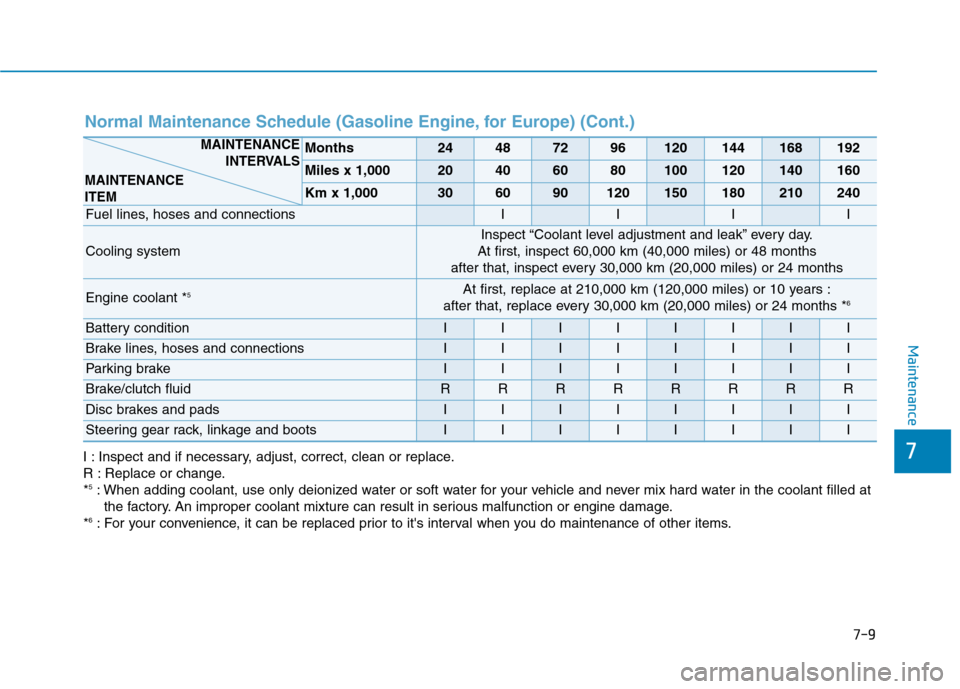
Normal Maintenance Schedule (Gasoline Engine, for Europe) (Cont.)
Months24487296120144168192
Miles x 1,00020406080100120140160
Km x 1,000306090120150180210240
Fuel lines, hoses and connectionsIIII
Cooling system
Inspect “Coolant level adjustment and leak” every day.
At first, inspect 60,000 km (40,000 miles) or 48 months
after that, inspect every 30,000 km (20,000 miles) or 24 months
Engine coolant * 5At first, replace at 210,000 km (120,000 miles) or 10 years :
after that, replace every 30,000 km (20,000 miles) or 24 months * 6
Battery conditionIIIIIIII
Brake lines, hoses and connectionsIIIIIIII
Parking brakeIIIIIIII
Brake/clutch fluidRRRRRRRR
Disc brakes and padsIIIIIIII
Steering gear rack, linkage and bootsIIIIIIII
MAINTENANCE
INTERVALS
MAINTENANCE ITEM
I : Inspect and if necessary, adjust, correct, clean or replace.
R : Replace or change.* 5
: When adding coolant, use only deionized water or soft water for your vehicle and never mix hard water in the coolant filled at
the factory. An improper coolant mixture can result in serious malfunction or engine damage.
* 6
: For your convenience, it can be replaced prior to it's interval when you do maintenance of other items.
Page 426 of 523
Maintenance
7-14
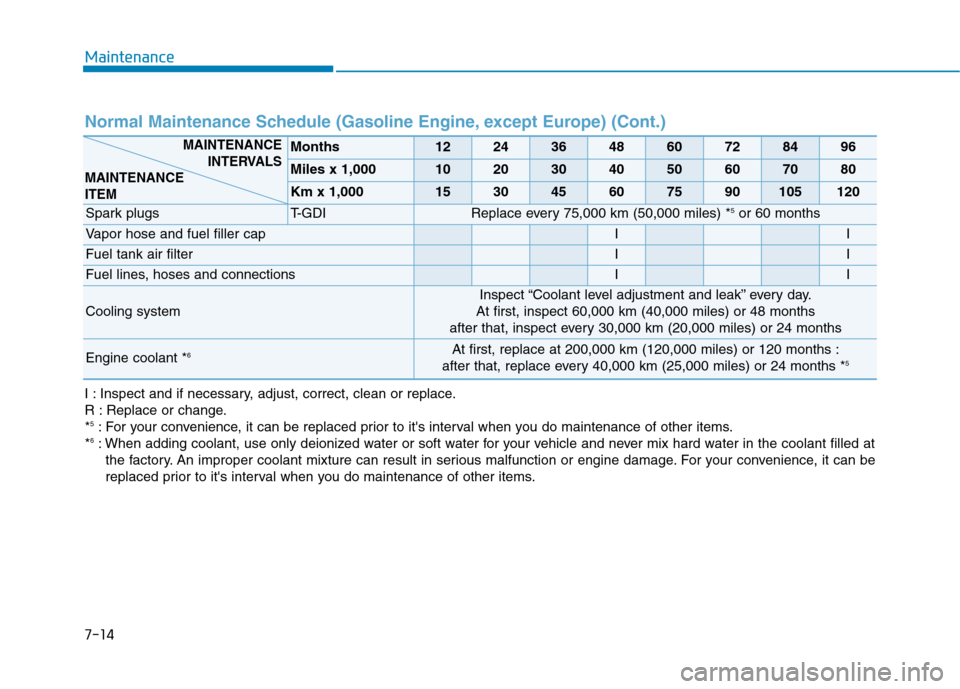
Months1224364860728496
Miles x 1,0001020304050607080
Km x 1,000153045607590105120
Spark plugsT-GDIReplace every 75,000 km (50,000 miles) *5
or 60 months
Vapor hose and fuel filler capII
Fuel tank air filterII
Fuel lines, hoses and connectionsII
Cooling system
Inspect “Coolant level adjustment and leak” every day.
At first, inspect 60,000 km (40,000 miles) or 48 months
after that, inspect every 30,000 km (20,000 miles) or 24 months
Engine coolant * 6At first, replace at 200,000 km (120,000 miles) or 120 months :
after that, replace every 40,000 km (25,000 miles) or 24 months * 5
Normal Maintenance Schedule (Gasoline Engine, except Europe) (Cont.)
MAINTENANCE
INTERVALS
MAINTENANCE ITEM
I : Inspect and if necessary, adjust, correct, clean or replace.
R : Replace or change.* 5
: For your convenience, it can be replaced prior to it's interval when you do maintenance of other items.
* 6
: When adding coolant, use only deionized water or soft water for your vehicle and never mix hard water in the coolant filled at
the factory. An improper coolant mixture can result in serious malfunction or engine damage. For your convenience, it can be
replaced prior to it's interval when you do maintenance of other items.
Page 432 of 523
7-20
Maintenance
Air cleaner filter
We recommend that the air cleaner
filter be replaced by an authorized
HYUNDAI dealer.
Spark plugs
(for Gasoline Engine)
Make sure to install new spark plugs
of the correct heat range.
Valve clearance
(for Gasoline Engine)
Inspect excessive valve noise and/or
engine vibration and adjust if neces-
sary. We recommend that the system
be serviced by an authorized HYUNDAI
dealer.
Cooling system
Check the cooling system parts,
such as radiator, coolant reservoir,
hoses and connections for leakage
and damage. Replace any damaged
parts.
Engine coolant
The coolant should be changed at
the intervals specified in the mainte-
nance schedule.
Manual transmission fluid (if equipped)
Inspect the manual transmission fluid according to the maintenance
schedule.
Dual clutch transmission fluid (if equipped)
Inspect the dual clutch transmission fluid according to the maintenance
schedule.
Brake hoses and lines
Visually check for proper installation,
chafing, cracks, deterioration and
any leakage. Replace any deteriorat-
ed or damaged parts immediately.
Brake/Clutch fluid (if equipped)
Check the brake/clutch fluid level in
the brake fluid reservoir. The level
should be between “MIN” and “MAX”
marks on the side of the reservoir.
Use only hydraulic brake fluid con-
forming to DOT 3 or DOT 4 specifi-cation.
Parking brake
Inspect the parking brake system
including the parking brake lever and
cables.
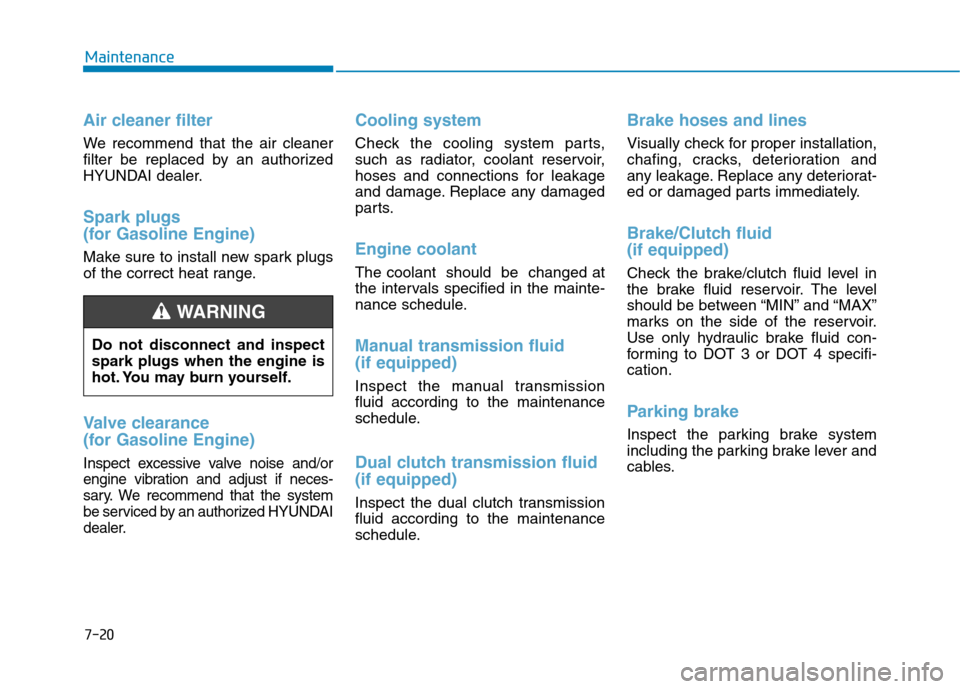
Do not disconnect and inspectspark plugs when the engine is
hot. You may burn yourself.
WARNING
Page 435 of 523
7-23
7
Maintenance
Checking the engine oil and filter
We recommend that the engine oil
and filter be replaced by an author-
ized HYUNDAI dealer.The high-pressure cooling system
has a reservoir filled with year-round
antifreeze coolant. The reservoir is
filled at the factory.
Check the antifreeze protection and
coolant concentration level at least
once a year, at the beginning of the
winter season, and before traveling
to a colder climate.
When the engine overheats from
low engine coolant, suddenly
adding engine coolant may cause
cracks in the engine. To prevent
damage, add engine coolant
slowly in small quantities.
Do not drive with no engine coolant. It may cause water pump
failure and engine seizure, etc.
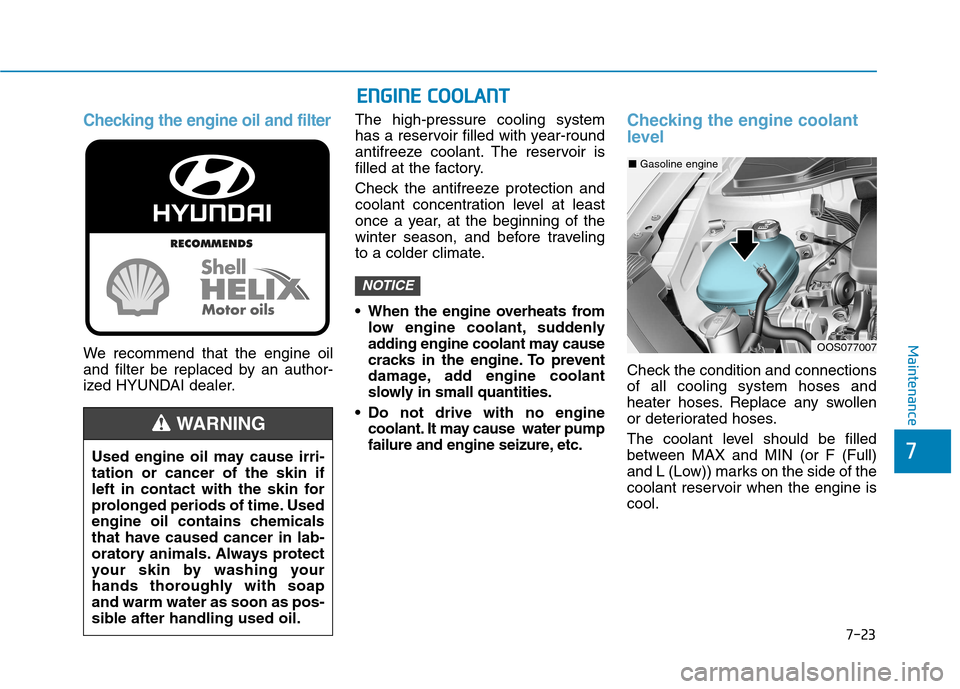
Checking the engine coolant
level
Check the condition and connections of all cooling system hoses and
heater hoses. Replace any swollen
or deteriorated hoses.
The coolant level should be filled
between MAX and MIN (or F (Full)
and L (Low)) marks on the side of the
coolant reservoir when the engine iscool.
NOTICE
Used engine oil may cause irri- tation or cancer of the skin if
left in contact with the skin for
prolonged periods of time. Used
engine oil contains chemicals
that have caused cancer in lab-
oratory animals. Always protect
your skin by washing your
hands thoroughly with soapand warm water as soon as pos-
sible after handling used oil.
WARNING
EENN GGIINN EE CC OO OOLLAA NN TT
OOS077007
■Gasoline engine
Page 436 of 523
7-24
Maintenance
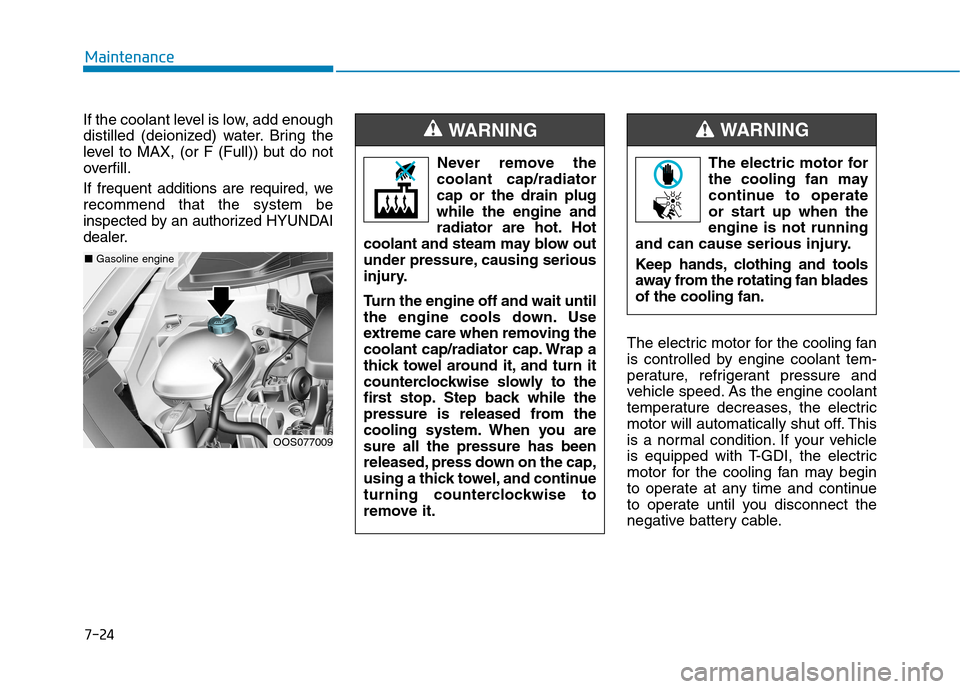
If the coolant level is low, add enough
distilled (deionized) water. Bring the
level to MAX, (or F (Full)) but do not
overfill.
If frequent additions are required, werecommend that the system be
inspected by an authorized HYUNDAI
dealer.
The electric motor for the cooling fan
is controlled by engine coolant tem-
perature, refrigerant pressure and
vehicle speed. As the engine coolant
temperature decreases, the electric
motor will automatically shut off. This
is a normal condition. If your vehicle
is equipped with T-GDI, the electric
motor for the cooling fan may begin
to operate at any time and continue
to operate until you disconnect the
negative battery cable.
OOS077009
■Gasoline engine The electric motor for
the cooling fan may
continue to operate
or start up when theengine is not running
and can cause serious injury.
Keep hands, clothing and tools
away from the rotating fan bladesof the cooling fan.
WARNING
Never remove the
coolant cap/radiator cap or the drain plugwhile the engine and
radiator are hot. Hot
coolant and steam may blow out
under pressure, causing serious
injury.
Turn the engine off and wait until
the engine cools down. Use
extreme care when removing the
coolant cap/radiator cap. Wrap a
thick towel around it, and turn it
counterclockwise slowly to the
first stop. Step back while the
pressure is released from the
cooling system. When you aresure all the pressure has been
released, press down on the cap,
using a thick towel, and continue
turning counterclockwise to
remove it.
WARNING
Page 468 of 523
7-56
Maintenance
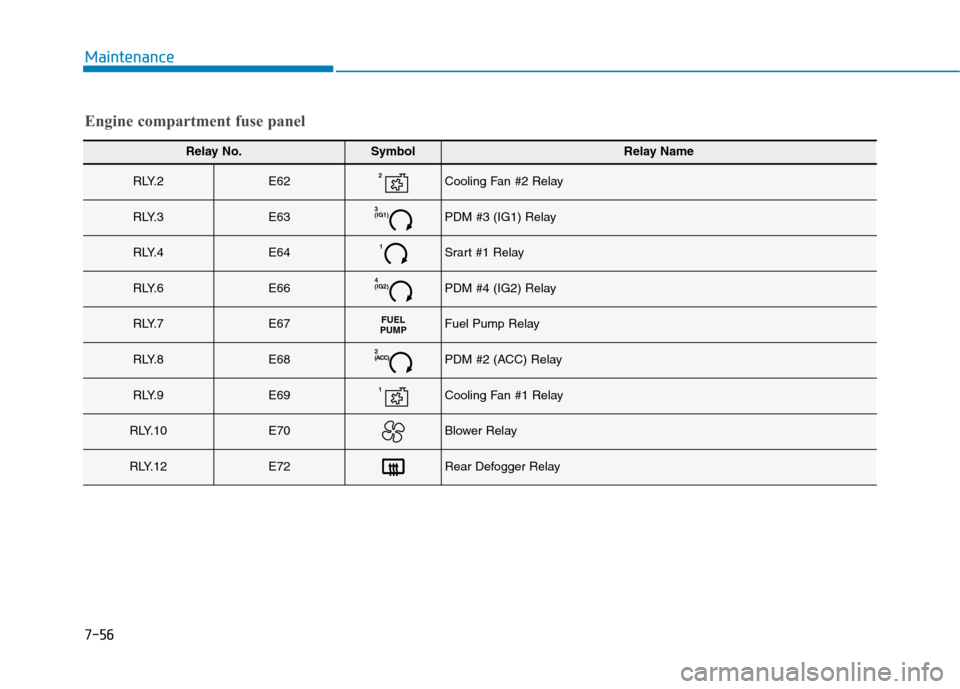
Engine compartment fuse panel
Relay No.SymbolRelay Name
R LY. 2E622Cooling Fan #2 Relay
R LY. 3E633 (IG1)PDM #3 (IG1) Relay
R LY. 4E641Srart #1 Relay
R LY. 6E664 (IG2)PDM #4 (IG2) Relay
R LY. 7E67FUEL
PUMPFuel Pump Relay
R LY. 8E682 (ACC)PDM #2 (ACC) Relay
R LY. 9E691Cooling Fan #1 Relay
RLY.10E70Blower Relay
RLY.12E72Rear Defogger Relay
Page 515 of 523
I-4Compact spare tire replacement ...................................7-41
Coolant..........................................................................7-23
Cooling fluid, see engine coolant .................................7-23
Crankcase emission control system..............................7-85
Cruise control system ...................................................5-90
Cup holder ..................................................................3-131
Curtain air bags.............................................................2-52
Dashboard illumination, see instrument panel illumination.................................................................3-38
Dashboard, see instrument cluster ................................3-37
Day/night rearview mirror ............................................3-19
Daytime running light (DRL) .......................................3-91
Declaration of conformity ............................................8-12
Defogging (Windshield) .............................................3-124
Defroster .....................................................................3-107 Rear window defroster ...........................................3-107
Defrosting (Windshield) .............................................3-124
Dimensions .....................................................................8-2
Display illumination, see instrument panel
illumination.................................................................3-38
Displays, see instrument cluster ...................................3-37
Distance to empty ........................................................3-41
Door locks.....................................................................3-11
Central door lock switch ..........................................3-13
Child-protector rear door lock .................................3-15
Auto door lock/unlock features................................3-15 Downhill Brake Control (DBC) ...................................5-38
Drinks holders, see cup holders..................................3-131
Drive mode integrated control system .........................5-53
Driver assist system ......................................................3-96
Rear view monitor....................................................3-99
Parking Distance Warning (Reverse) system.........3-100
Parking Distance Warning (Reverse/Forward) system ..................................................................3-104
Driver Attention Warning (DAW) system ....................5-84
Driver's air bag .............................................................2-48
Driving at night.............................................................5-97
Driving in flooded areas ...............................................5-98
Driving in the rain ........................................................5-97
Dual Clutch transmission (DCT)..................................5-19 DCT warning messages ...........................................5-21
Paddle shifter............................................................5-24
Good driving practices .............................................5-26
Electric chromic mirror (ECM) ....................................3-20
Electric power steering (EPS) ......................................3-17
Electronic stability control (ESC) ................................5-33
Emergency Stop Signal (ESS) ......................................5-37
Emergency towing ........................................................6-43
Emission control system ...............................................7-85 Crankcase emission control system .........................7-85
Evaporative emission control System ......................7-85
Exhaust emission control system .............................7-86
Index
D
E